Learning, Meaning and
Definition
Dr Rajesh Verma
Assistant Professor in Psychology
Govt. College Adampur, Hisar (Haryana)
Meaning
Gaining or acquisition of knowledge or skill
by practice, experience, observation or being
taught.
The gained
knowledge that led
to permanent change
in behaviour.
Definition
“Any relatively permanent change in behaviour or
behavioural potential produced by experience”. (NCERT,
XI).
Learning is a long-term change in mental
representations or associations as a result of experience
(Ormrod, 1995).
Permanent modification
in behaviour due to
experience or practice.
Introduction
The close analysis of definition and meaning of
learning it has been found that it
has three components i.e.
(i) Relatively permanent
change,
(ii) Modification of behaviour,
(iii) Practice, experience &
observation.
(i) Relatively Permanent Change – It means
when we acquire knowledge by virtue of experience,
observation or practice, the some part of it results in
modification in brain circuitry in order to make the
record of the
information.
Hence, it can be
said that learning
is function of
long term
memory.
(ii) Modification of Behaviour – It means that the
change that occurred in neural circuitry inside the brain
is expected to be expressed through corresponding
behavioural outcomes. The resulting behavioural
outcomes will differ from the behaviour that occurred
prior to the organic changes in the brain. The difference
between the pre-change
behavior and post-change
behaviour is known as
modification in behaviour.
The learning must be
distinguished from the
behavioural changes that
are neither permanent
nor learned (NCERT).
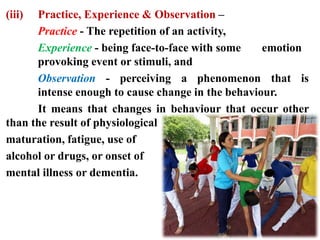
(iii) Practice, Experience & Observation –
Practice - The repetition of an activity,
Experience - being face-to-face with some emotion
provoking event or stimuli, and
Observation - perceiving a phenomenon that is
intense enough to cause change in the behaviour.
It means that changes in behaviour that occur other
than the result of physiological
maturation, fatigue, use of
alcohol or drugs, or onset of
mental illness or dementia.
Brief Discussion
Learning involves a sequence of psychological events
and differs from: -
(i) Maturation – Changes attributed to growth and
development due to genetic blue print.
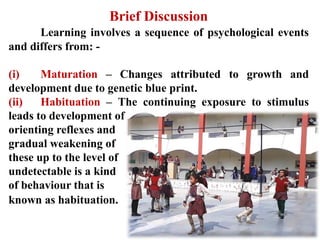
(ii) Habituation – The continuing exposure to stimulus
leads to development of
orienting reflexes and
gradual weakening of
these up to the level of
undetectable is a kind
of behaviour that is
known as habituation.
(iii) Performance – Performance is a person’s
observed behaviour or response or action.
Learning occurs in different ways. The simplest
kind of learning is called conditioning which is of two
types classical conditioning, and instrumental/operant
conditioning. Other types are observational learning,
cognitive learning, verbal learning, concept learning,
and skill learning.
References:
1. NCERT, XI Psychology Text book.
2. Ormrod, J. E. (2014). Human Learning (6th
Ed). New Jersey: Pearson.
Next Discussion
Factors Affecting Learning
Meet You Soon
With Next Video
vermasujit@yahoo.com
Thanks

learning definition and meaning

  • 1.
    Learning, Meaning and Definition DrRajesh Verma Assistant Professor in Psychology Govt. College Adampur, Hisar (Haryana)
  • 2.
    Meaning Gaining or acquisitionof knowledge or skill by practice, experience, observation or being taught. The gained knowledge that led to permanent change in behaviour.
  • 3.
    Definition “Any relatively permanentchange in behaviour or behavioural potential produced by experience”. (NCERT, XI). Learning is a long-term change in mental representations or associations as a result of experience (Ormrod, 1995). Permanent modification in behaviour due to experience or practice.
  • 4.
    Introduction The close analysisof definition and meaning of learning it has been found that it has three components i.e. (i) Relatively permanent change, (ii) Modification of behaviour, (iii) Practice, experience & observation.
  • 5.
    (i) Relatively PermanentChange – It means when we acquire knowledge by virtue of experience, observation or practice, the some part of it results in modification in brain circuitry in order to make the record of the information. Hence, it can be said that learning is function of long term memory.
  • 6.
    (ii) Modification ofBehaviour – It means that the change that occurred in neural circuitry inside the brain is expected to be expressed through corresponding behavioural outcomes. The resulting behavioural outcomes will differ from the behaviour that occurred prior to the organic changes in the brain. The difference between the pre-change behavior and post-change behaviour is known as modification in behaviour. The learning must be distinguished from the behavioural changes that are neither permanent nor learned (NCERT).
  • 7.
    (iii) Practice, Experience& Observation – Practice - The repetition of an activity, Experience - being face-to-face with some emotion provoking event or stimuli, and Observation - perceiving a phenomenon that is intense enough to cause change in the behaviour. It means that changes in behaviour that occur other than the result of physiological maturation, fatigue, use of alcohol or drugs, or onset of mental illness or dementia.
  • 8.
    Brief Discussion Learning involvesa sequence of psychological events and differs from: - (i) Maturation – Changes attributed to growth and development due to genetic blue print. (ii) Habituation – The continuing exposure to stimulus leads to development of orienting reflexes and gradual weakening of these up to the level of undetectable is a kind of behaviour that is known as habituation.
  • 9.
    (iii) Performance –Performance is a person’s observed behaviour or response or action. Learning occurs in different ways. The simplest kind of learning is called conditioning which is of two types classical conditioning, and instrumental/operant conditioning. Other types are observational learning, cognitive learning, verbal learning, concept learning, and skill learning.
  • 10.
    References: 1. NCERT, XIPsychology Text book. 2. Ormrod, J. E. (2014). Human Learning (6th Ed). New Jersey: Pearson.
  • 11.
  • 12.
    Meet You Soon WithNext Video vermasujit@yahoo.com Thanks