LEARNING ASSESSMENT AND EVALUATION
Akeem Akinfenwa
Chief Learning Officer
Purdue
Centre for Management Development, Shangisha, Lagos
April 30, 2014
Financial Literacy for All@
Learning Outline
 Learning Objectives
 Training Evaluation – What it is, Difference, Common Myths
 Reasons for Evaluation
 What Should Be Evaluated
 Key Questions To Ask in Evaluation
 Effective Evaluation
 Stages & Methods of Evaluation
 Exercise 1
 Exercise 2
 Conclusion
2
Financial Literacy Train the Trainers Workshop – April 30, 2014 @ CMD
Learning Objectives
 Why do we evaluate training programmes?
 Discuss the main stages of effective evaluation and
how the problems in the stages should be eliminated
 Prepare simple evaluation forms that can serve the
needs of your organization
3
Financial Literacy Train the Trainers Workshop – April 30, 2014 @ CMD
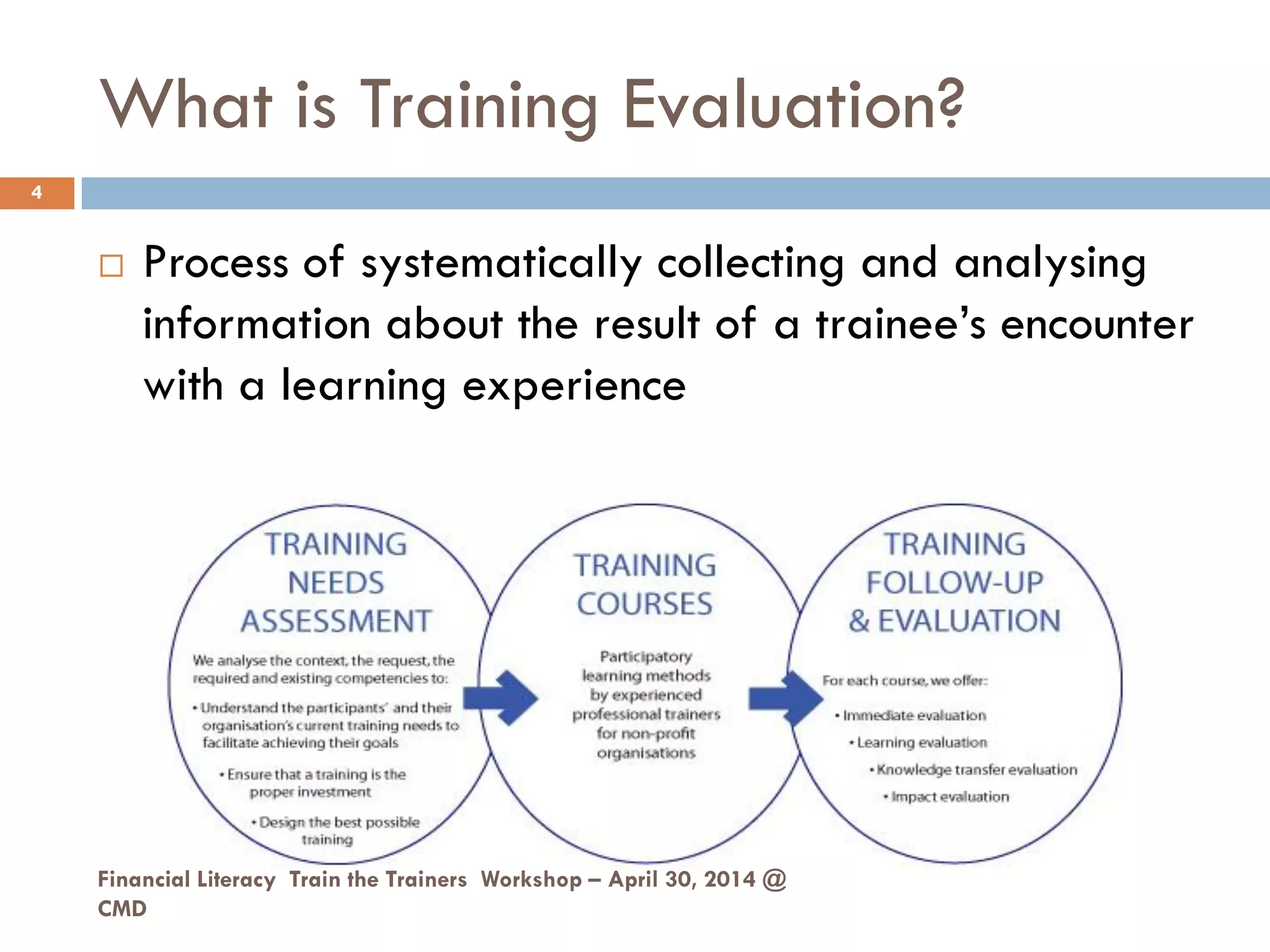
What is Training Evaluation?
 Process of systematically collecting and analysing
information about the result of a trainee’s encounter
with a learning experience
4
Financial Literacy Train the Trainers Workshop – April 30, 2014 @
CMD
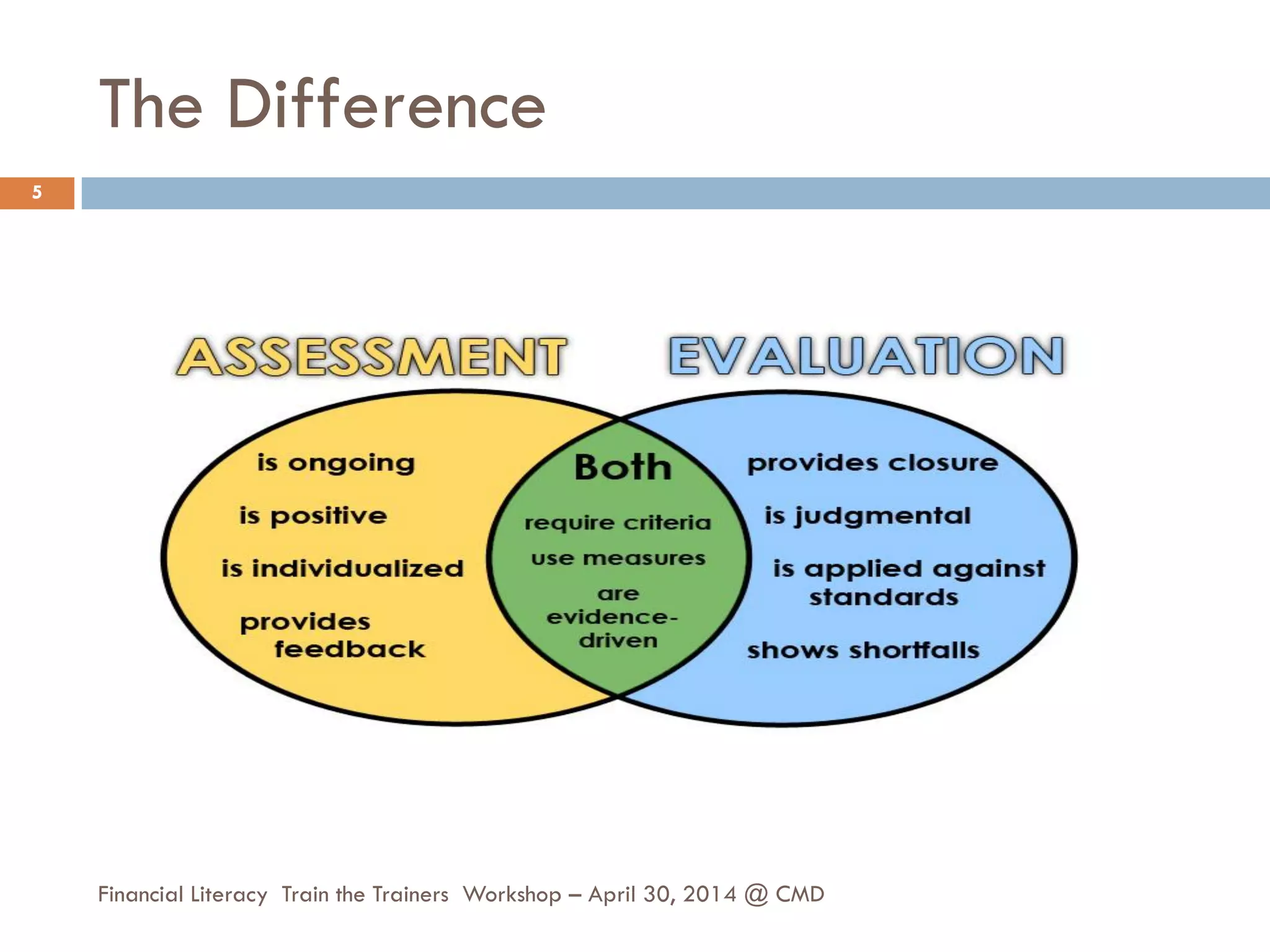
The Difference
5
Financial Literacy Train the Trainers Workshop – April 30, 2014 @ CMD
Common Myths about Evaluation
 Evaluation has to be large-scale
 Evaluation has to be sophisticated
 Evaluation must involve some outside agent or
organization
 Evaluation is a threat to the learner
 Evaluation is difficult
 Evaluation means a lot more work
 Evaluation is merely an academic exercise
6
Financial Literacy Train the Trainers Workshop – April 30, 2014 @ CMD
Reason for Evaluating Training
 To assess the degree of achievement of training objectives
 To assess the effectiveness of trainers
 To justify the expenses on training
 To improve contents/structures of similar future programme
 To decide if other persons may be exposed to similar
programmes in future
 To identify which trainee benefited the most/the least from
the programmes
 To reinforce important points for trainees
 To create advance expectations in the mind of trainees
(through pre-test)
 To aid learning
7
Financial Literacy Train the Trainers Workshop – April 30, 2014 @ CMD
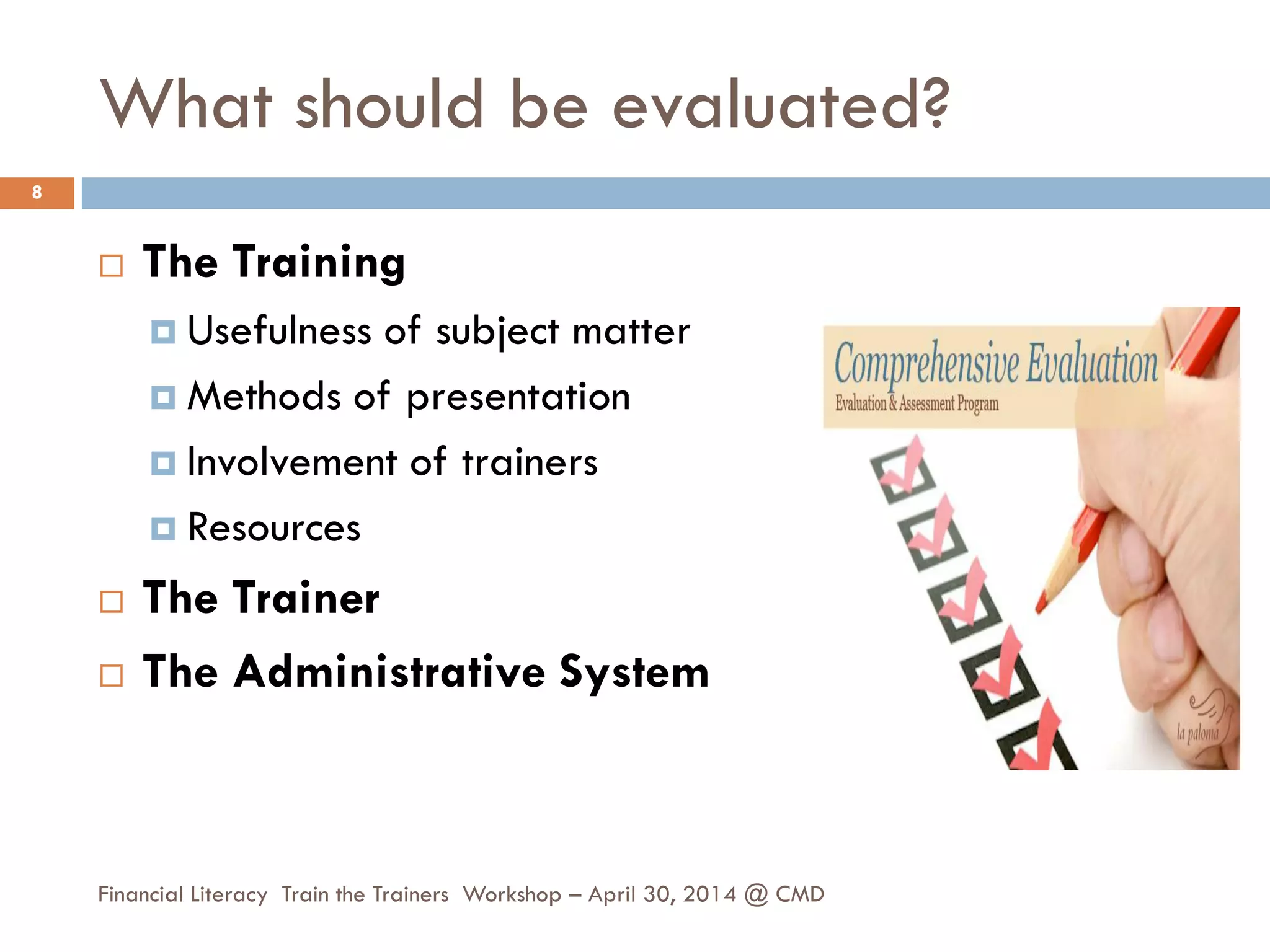
What should be evaluated?
 The Training
 Usefulness of subject matter
 Methods of presentation
 Involvement of trainers
 Resources
 The Trainer
 The Administrative System
8
Financial Literacy Train the Trainers Workshop – April 30, 2014 @ CMD
Questions
 Did the trainees achieve the objectives set for the
course?
 What did the trainees think of the course, the
organization, the training?
 What improvements can be made to the course
design?
 How efficient is the administration system?
9
Financial Literacy Train the Trainers Workshop – April 30, 2014 @ CMD
Effective Evaluation
 Link course objectives, teaching methods and evaluation
strategies
 The cost of evaluation should be reasonable to the cost
of the programme being evaluated
 The timing of every evaluation should be
administratively convenient for all person who will get
involved in the exercise
 Every method used should be;
 Reliable by consistently indicating a trainee's degree of
learning
 Valid by measuring the extent to which learning objectives
have been achieved
10
Financial Literacy Train the Trainers Workshop – April 30, 2014 @ CMD
Stages and Methods of Evaluation
Stages
1. Reaction or training level
2. Immediate outcome or learning level
3. Behaviour or intermediate outcome level
4. Functioning or ultimate outcome level
11
Financial Literacy Train the Trainers Workshop – April 30, 2014 @ CMD
1. Reaction or Training Level
Method
 Observing the interactions of trainees
 Trainees reaction to training – their opinion and
attitudes to
 The trainer
 The method and style of presentation
 Usefulness and interest in the subject matter
 Participation/involvement
12
Financial Literacy Train the Trainers Workshop – April 30, 2014 @ CMD
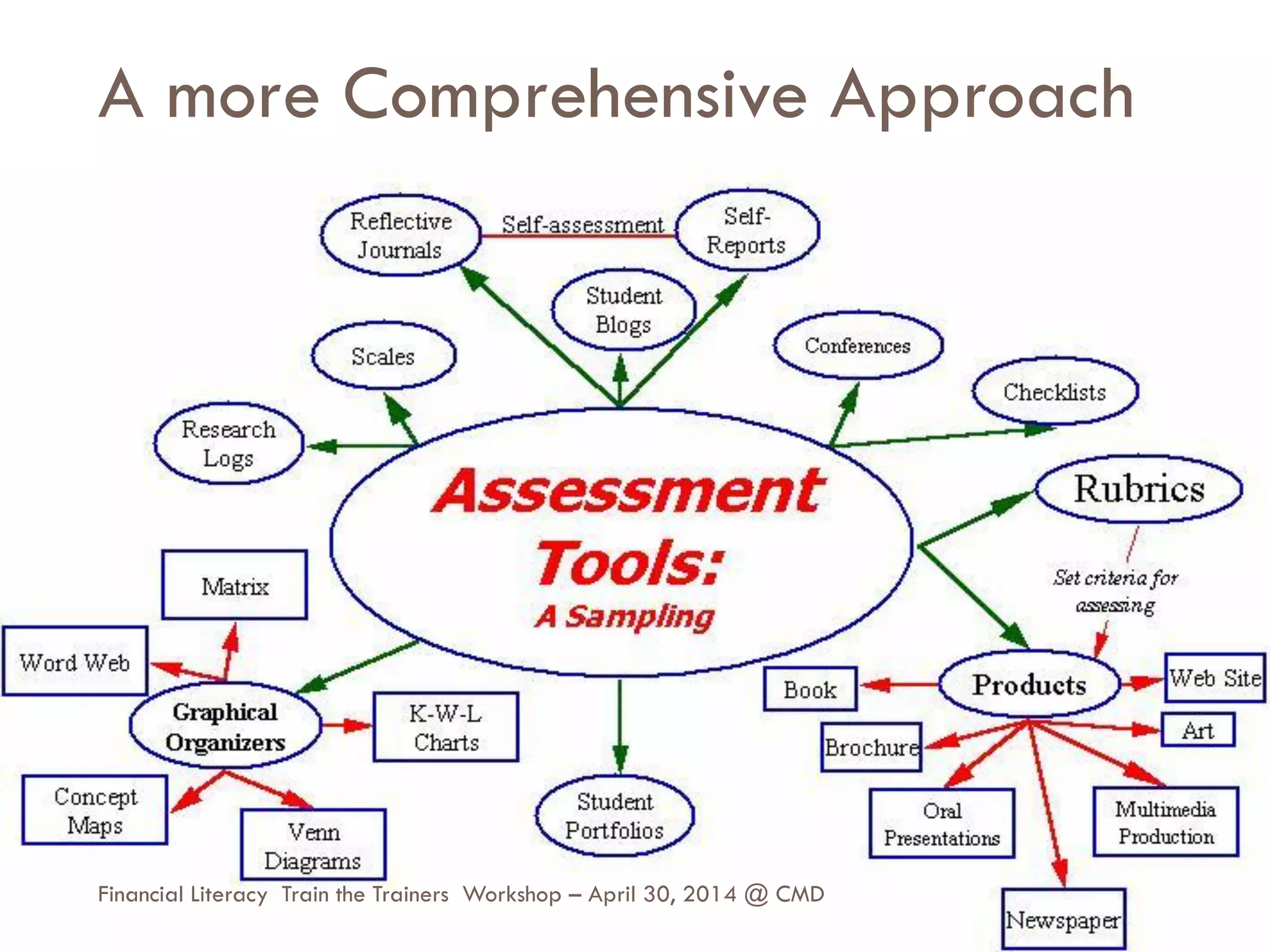
A more Comprehensive Approach
13
Financial Literacy Train the Trainers Workshop – April 30, 2014 @ CMD
…Reaction or training level
Benefit
 Indicate parts of programme trainees enjoyed
 Indicate parts of the programme, which require
improvement
 Enables trainers improve on course content /method
Problems
 sometimes unreliable
 Some trainees can influence others
 Some trainees develop prejudices, which influence their
assessments
14
Financial Literacy Train the Trainers Workshop – April 30, 2014 @ CMD
…Reaction or training level
Solutions/How to Overcome Problem
 Determine what you plan to find out
 Use comment forms
 Make forms anonymous
 Design forms so that stated reactions can be easily
tabulated and quantifies
15
Financial Literacy Train the Trainers Workshop – April 30, 2014 @ CMD
2. Immediate outcome or learning level
 Evaluation at the end of training to determine the
amount of learning acquired by trainees
Method
 Questionnaire or tests
 Course review form
 Supply missing items
 True or false
 Multiple choice
Benefit
 Helps trainee to identify areas of training needs
 Helps trainer determine effectiveness and efficiency
of method/style
16
Financial Literacy Train the Trainers Workshop – April 30, 2014 @ CMD
…Immediate outcome or learning level
Problem
 It does not indicate trainees ability to use or apply
knowledge in everyday life
Solutions/How to Overcome Problem
 Evaluate skills practically and by role play
 Engage! Engage!! and Engage!!!
 One minute check with your neighbour after every
critical learning point is delivered
17
Financial Literacy Train the Trainers Workshop – April 30, 2014 @ CMD
3. Behaviour or intermediate outcome level
Purpose: to find out something after training whether or not
a trainee’s knowledge, skills or behaviour has changed
Method:
 Appraisal of on-the-job performance on a before-and-after basis
 Appraisal or on the job performance by one ore more of the following;
 Trainees
 Trainee’s superior(s)
 Trainee’s subordinates
 Trainee’s peers or neutral persons familiar with job
 Observation
 Feedback forms
Comparison of trainee’s performance with that of control group (those who
did not receive training)
18
Financial Literacy Train the Trainers Workshop – April 30, 2014 @ CMD
… Behaviour or intermediate outcome level
Benefit
 To know if training had impacted on the trainee within the
established evaluation period
 Helps to justify (or otherwise) of training expenses
 Helps determine the expertise or otherwise of the training
company
Problem
 Determining an appropriate evaluation period
 Training Company Vs Trainee?
19
Financial Literacy Train the Trainers Workshop – April 30, 2014 @ CMD
… Behaviour or intermediate outcome level
Solutions/How to Overcome Problem
 Determine minimum standard of behaviour
 Determine trainee’s level of behaviour before training to
establish benchmark against standard
 Determine gap between expected and actual level of
behaviour
 Communicate findings to employee (trainee) and document in
appraisal file
 Monitor performance after training
20
Financial Literacy Train the Trainers Workshop – April 30, 2014 @ CMD
4. Functioning or ultimate outcome level
 To measure the effect of trainee’s job behaviour on
his/her productivity
Methods
 Check for cost reduction
 Review profitability attributable to trainee
 Increase in quality
 Reduction in the number of defects/rejects
 Reduction in the amount of complaints
 Productivity as a result of the multiplier effect on the team that
works directly with trainee
21
Financial Literacy Train the Trainers Workshop – April 30, 2014 @ CMD
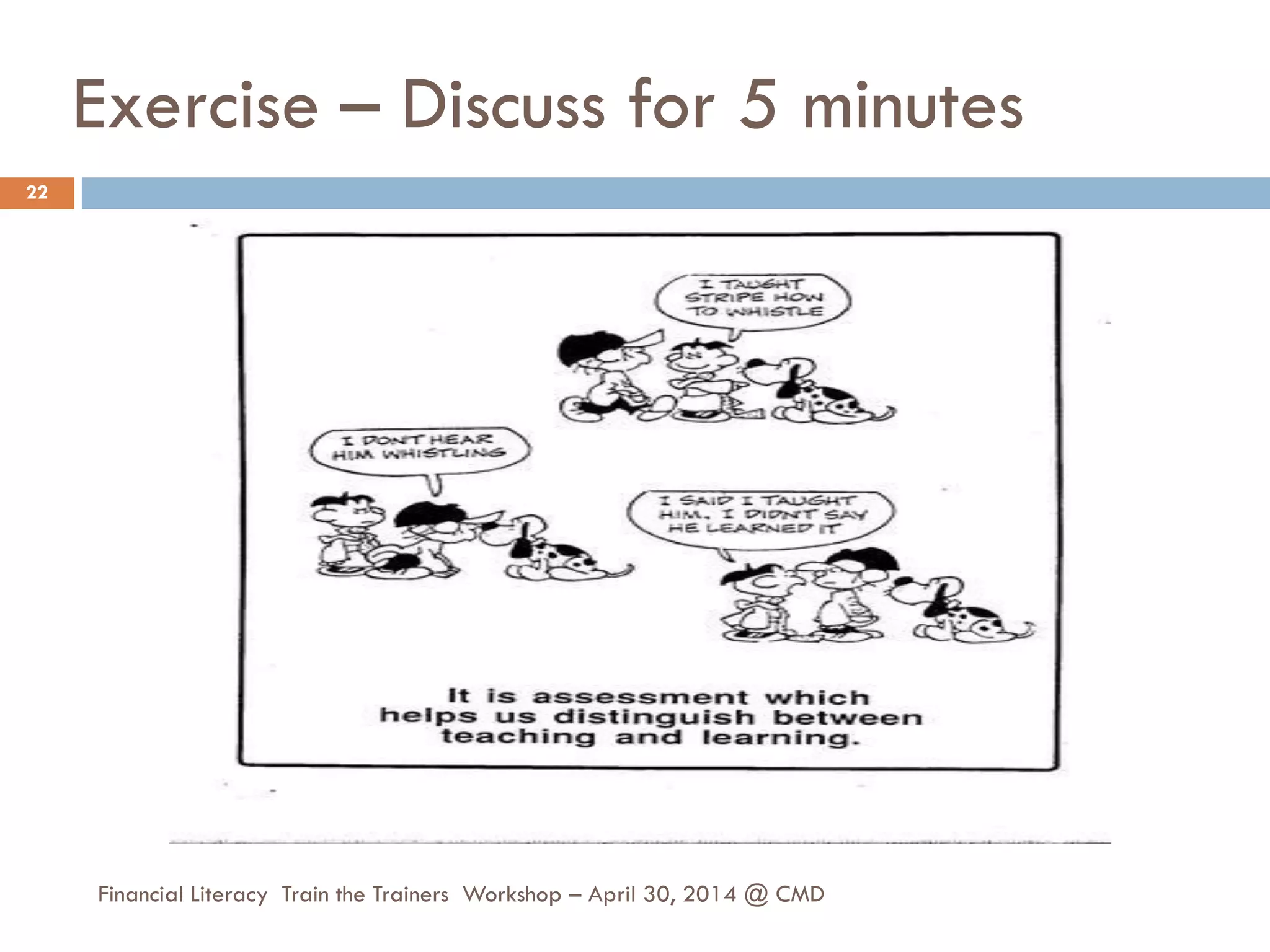
Exercise – Discuss for 5 minutes
22
Financial Literacy Train the Trainers Workshop – April 30, 2014 @ CMD
…Functioning or ultimate outcome level
Benefits
 Helps justify investment in training
 Helps in corporate and business strategic planning
 Helps training professionals in TNA
Problems
 There are often no comprehensive alignment at the onset between training
objectives, actual outcome and actions/remedial actions
 Trainers often lose what is learnt due to work environment and non
availability of opportunity to practice what is learnt
 Trainee did not approach training with the ultimate objective but rather tee-
off as a way to get away from the office, earn estacodes, etc
23
Financial Literacy Train the Trainers Workshop – April 30, 2014 @ CMD
…Functioning or ultimate outcome level
Solutions/How to Overcome Problem
 Linking TNA with Evaluation
 Ensure trainees have IPD plan
 Align IPD with Corporate goals
 Evaluate! Evaluate!! And Evaluate!!!
24
Financial Literacy Train the Trainers Workshop – April 30, 2014 @ CMD
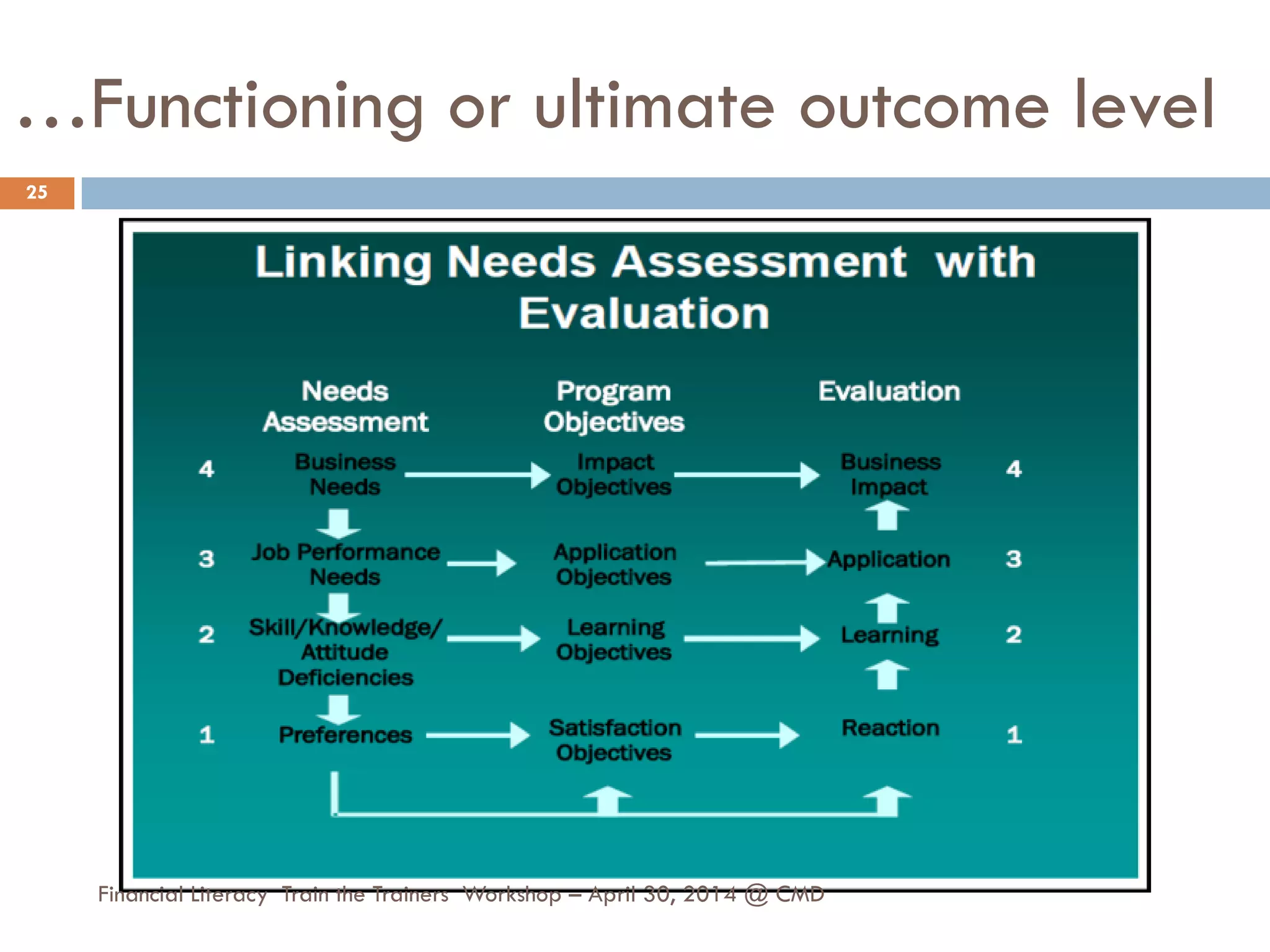
…Functioning or ultimate outcome level
25
Financial Literacy Train the Trainers Workshop – April 30, 2014 @ CMD
Exercise – 5 minutes – Break into groups
 You have just finished training a group of 219
students on character education in the 21st Century
for 3 hours
 Develop a one page post training evaluation form
to determine the effectiveness of your training. It
should encompass key aspects of the programme.
26
Financial Literacy Train the Trainers Workshop – April 30, 2014 @ CMD
Conclusion
A Practical Definition
What Gets Paid for Gets Measured and
What Gets Measured Gets Done
Anonymous
27
Financial Literacy Train the Trainers Workshop – April 30, 2014 @ CMD
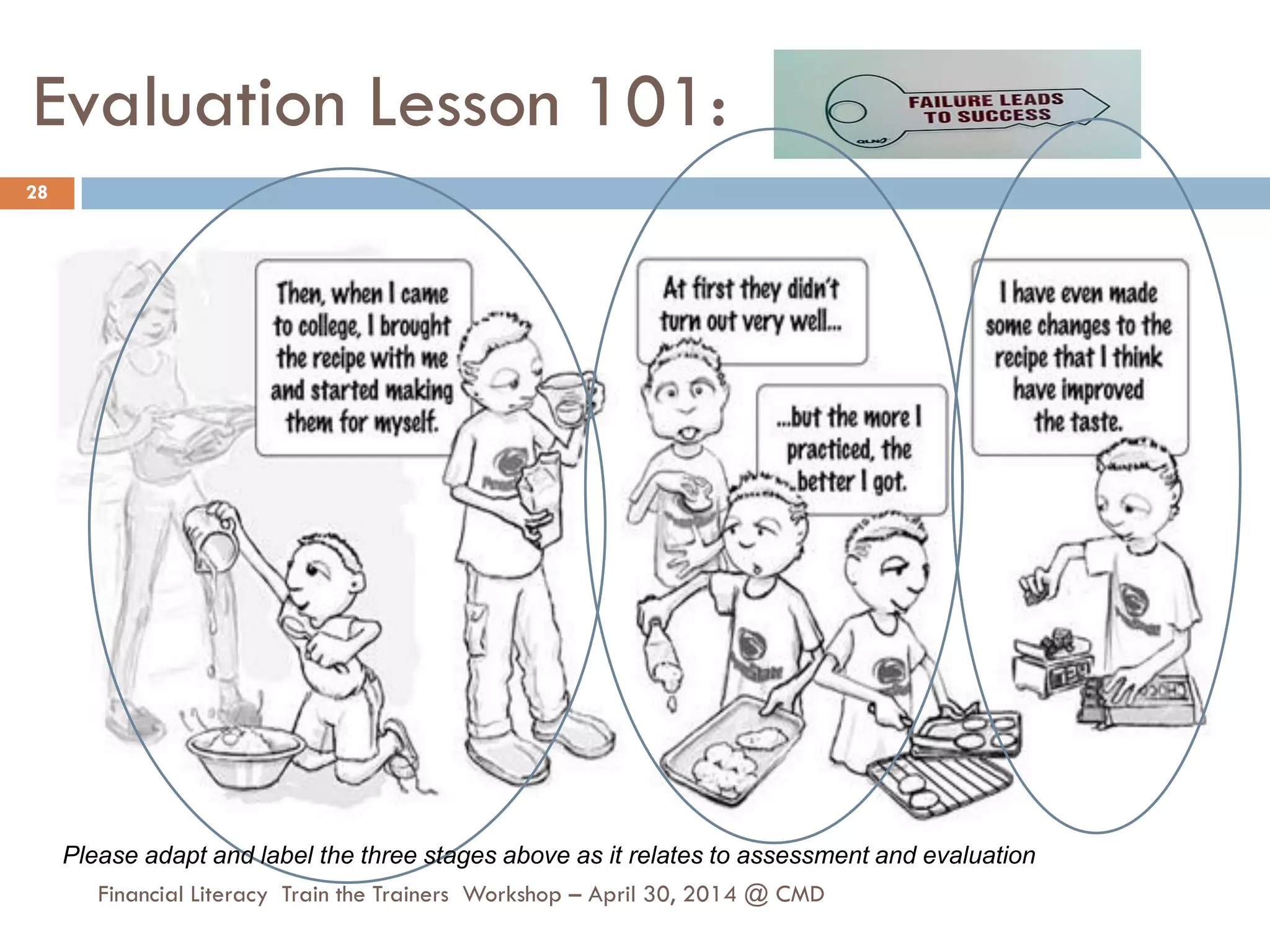
Evaluation Lesson 101:
Please adapt and label the three stages above as it relates to assessment and evaluation
28
Financial Literacy Train the Trainers Workshop – April 30, 2014 @ CMD
29
Financial Literacy Train the Trainers Workshop – April 30, 2014 @ CMD

Learning assessment and evaluation

  • 1.
    LEARNING ASSESSMENT ANDEVALUATION Akeem Akinfenwa Chief Learning Officer Purdue Centre for Management Development, Shangisha, Lagos April 30, 2014 Financial Literacy for All@
  • 2.
    Learning Outline  LearningObjectives  Training Evaluation – What it is, Difference, Common Myths  Reasons for Evaluation  What Should Be Evaluated  Key Questions To Ask in Evaluation  Effective Evaluation  Stages & Methods of Evaluation  Exercise 1  Exercise 2  Conclusion 2 Financial Literacy Train the Trainers Workshop – April 30, 2014 @ CMD
  • 3.
    Learning Objectives  Whydo we evaluate training programmes?  Discuss the main stages of effective evaluation and how the problems in the stages should be eliminated  Prepare simple evaluation forms that can serve the needs of your organization 3 Financial Literacy Train the Trainers Workshop – April 30, 2014 @ CMD
  • 4.
    What is TrainingEvaluation?  Process of systematically collecting and analysing information about the result of a trainee’s encounter with a learning experience 4 Financial Literacy Train the Trainers Workshop – April 30, 2014 @ CMD
  • 5.
    The Difference 5 Financial LiteracyTrain the Trainers Workshop – April 30, 2014 @ CMD
  • 6.
    Common Myths aboutEvaluation  Evaluation has to be large-scale  Evaluation has to be sophisticated  Evaluation must involve some outside agent or organization  Evaluation is a threat to the learner  Evaluation is difficult  Evaluation means a lot more work  Evaluation is merely an academic exercise 6 Financial Literacy Train the Trainers Workshop – April 30, 2014 @ CMD
  • 7.
    Reason for EvaluatingTraining  To assess the degree of achievement of training objectives  To assess the effectiveness of trainers  To justify the expenses on training  To improve contents/structures of similar future programme  To decide if other persons may be exposed to similar programmes in future  To identify which trainee benefited the most/the least from the programmes  To reinforce important points for trainees  To create advance expectations in the mind of trainees (through pre-test)  To aid learning 7 Financial Literacy Train the Trainers Workshop – April 30, 2014 @ CMD
  • 8.
    What should beevaluated?  The Training  Usefulness of subject matter  Methods of presentation  Involvement of trainers  Resources  The Trainer  The Administrative System 8 Financial Literacy Train the Trainers Workshop – April 30, 2014 @ CMD
  • 9.
    Questions  Did thetrainees achieve the objectives set for the course?  What did the trainees think of the course, the organization, the training?  What improvements can be made to the course design?  How efficient is the administration system? 9 Financial Literacy Train the Trainers Workshop – April 30, 2014 @ CMD
  • 10.
    Effective Evaluation  Linkcourse objectives, teaching methods and evaluation strategies  The cost of evaluation should be reasonable to the cost of the programme being evaluated  The timing of every evaluation should be administratively convenient for all person who will get involved in the exercise  Every method used should be;  Reliable by consistently indicating a trainee's degree of learning  Valid by measuring the extent to which learning objectives have been achieved 10 Financial Literacy Train the Trainers Workshop – April 30, 2014 @ CMD
  • 11.
    Stages and Methodsof Evaluation Stages 1. Reaction or training level 2. Immediate outcome or learning level 3. Behaviour or intermediate outcome level 4. Functioning or ultimate outcome level 11 Financial Literacy Train the Trainers Workshop – April 30, 2014 @ CMD
  • 12.
    1. Reaction orTraining Level Method  Observing the interactions of trainees  Trainees reaction to training – their opinion and attitudes to  The trainer  The method and style of presentation  Usefulness and interest in the subject matter  Participation/involvement 12 Financial Literacy Train the Trainers Workshop – April 30, 2014 @ CMD
  • 13.
    A more ComprehensiveApproach 13 Financial Literacy Train the Trainers Workshop – April 30, 2014 @ CMD
  • 14.
    …Reaction or traininglevel Benefit  Indicate parts of programme trainees enjoyed  Indicate parts of the programme, which require improvement  Enables trainers improve on course content /method Problems  sometimes unreliable  Some trainees can influence others  Some trainees develop prejudices, which influence their assessments 14 Financial Literacy Train the Trainers Workshop – April 30, 2014 @ CMD
  • 15.
    …Reaction or traininglevel Solutions/How to Overcome Problem  Determine what you plan to find out  Use comment forms  Make forms anonymous  Design forms so that stated reactions can be easily tabulated and quantifies 15 Financial Literacy Train the Trainers Workshop – April 30, 2014 @ CMD
  • 16.
    2. Immediate outcomeor learning level  Evaluation at the end of training to determine the amount of learning acquired by trainees Method  Questionnaire or tests  Course review form  Supply missing items  True or false  Multiple choice Benefit  Helps trainee to identify areas of training needs  Helps trainer determine effectiveness and efficiency of method/style 16 Financial Literacy Train the Trainers Workshop – April 30, 2014 @ CMD
  • 17.
    …Immediate outcome orlearning level Problem  It does not indicate trainees ability to use or apply knowledge in everyday life Solutions/How to Overcome Problem  Evaluate skills practically and by role play  Engage! Engage!! and Engage!!!  One minute check with your neighbour after every critical learning point is delivered 17 Financial Literacy Train the Trainers Workshop – April 30, 2014 @ CMD
  • 18.
    3. Behaviour orintermediate outcome level Purpose: to find out something after training whether or not a trainee’s knowledge, skills or behaviour has changed Method:  Appraisal of on-the-job performance on a before-and-after basis  Appraisal or on the job performance by one ore more of the following;  Trainees  Trainee’s superior(s)  Trainee’s subordinates  Trainee’s peers or neutral persons familiar with job  Observation  Feedback forms Comparison of trainee’s performance with that of control group (those who did not receive training) 18 Financial Literacy Train the Trainers Workshop – April 30, 2014 @ CMD
  • 19.
    … Behaviour orintermediate outcome level Benefit  To know if training had impacted on the trainee within the established evaluation period  Helps to justify (or otherwise) of training expenses  Helps determine the expertise or otherwise of the training company Problem  Determining an appropriate evaluation period  Training Company Vs Trainee? 19 Financial Literacy Train the Trainers Workshop – April 30, 2014 @ CMD
  • 20.
    … Behaviour orintermediate outcome level Solutions/How to Overcome Problem  Determine minimum standard of behaviour  Determine trainee’s level of behaviour before training to establish benchmark against standard  Determine gap between expected and actual level of behaviour  Communicate findings to employee (trainee) and document in appraisal file  Monitor performance after training 20 Financial Literacy Train the Trainers Workshop – April 30, 2014 @ CMD
  • 21.
    4. Functioning orultimate outcome level  To measure the effect of trainee’s job behaviour on his/her productivity Methods  Check for cost reduction  Review profitability attributable to trainee  Increase in quality  Reduction in the number of defects/rejects  Reduction in the amount of complaints  Productivity as a result of the multiplier effect on the team that works directly with trainee 21 Financial Literacy Train the Trainers Workshop – April 30, 2014 @ CMD
  • 22.
    Exercise – Discussfor 5 minutes 22 Financial Literacy Train the Trainers Workshop – April 30, 2014 @ CMD
  • 23.
    …Functioning or ultimateoutcome level Benefits  Helps justify investment in training  Helps in corporate and business strategic planning  Helps training professionals in TNA Problems  There are often no comprehensive alignment at the onset between training objectives, actual outcome and actions/remedial actions  Trainers often lose what is learnt due to work environment and non availability of opportunity to practice what is learnt  Trainee did not approach training with the ultimate objective but rather tee- off as a way to get away from the office, earn estacodes, etc 23 Financial Literacy Train the Trainers Workshop – April 30, 2014 @ CMD
  • 24.
    …Functioning or ultimateoutcome level Solutions/How to Overcome Problem  Linking TNA with Evaluation  Ensure trainees have IPD plan  Align IPD with Corporate goals  Evaluate! Evaluate!! And Evaluate!!! 24 Financial Literacy Train the Trainers Workshop – April 30, 2014 @ CMD
  • 25.
    …Functioning or ultimateoutcome level 25 Financial Literacy Train the Trainers Workshop – April 30, 2014 @ CMD
  • 26.
    Exercise – 5minutes – Break into groups  You have just finished training a group of 219 students on character education in the 21st Century for 3 hours  Develop a one page post training evaluation form to determine the effectiveness of your training. It should encompass key aspects of the programme. 26 Financial Literacy Train the Trainers Workshop – April 30, 2014 @ CMD
  • 27.
    Conclusion A Practical Definition WhatGets Paid for Gets Measured and What Gets Measured Gets Done Anonymous 27 Financial Literacy Train the Trainers Workshop – April 30, 2014 @ CMD
  • 28.
    Evaluation Lesson 101: Pleaseadapt and label the three stages above as it relates to assessment and evaluation 28 Financial Literacy Train the Trainers Workshop – April 30, 2014 @ CMD
  • 29.
    29 Financial Literacy Trainthe Trainers Workshop – April 30, 2014 @ CMD