







Learning Analytics in
Massive Open Online
Courses
PhD Defense 08.05.2017
Mohammad Khalil
Supervisor: Martin Ebner
Graz University of Technology
HELLO!
my name is Mohammad Khalil
2
Acknowledgements
I sincerely thank:
• My supervisor
• Committee
• Erasmus Mundus scholarship
• Master students (Stephan Moser, Ines
Legnar, Matthias Reischer, & Rainer
Reitbauer)
• Family, Friends, & Colleagues
3
1.
Introduction
Overview and Background
4
How Educational Technology Started
Sydney Pressey Multiple
Choice Machine (1924)
Plato V (1981)
Massive Open Online Courses
6
https://c2.staticflickr.com/2/1097/1296105722_057a1ab727_b.jpg
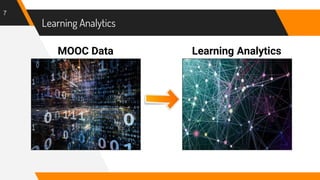
Learning Analytics
7
MOOC Data Learning Analytics
2.
Research Motivation
8
“• Relative novelty of MOOCs and learning
analytics
• What hidden patterns can learning
analytics unveil in MOOC educational
datasets?
9
Research Question
• How learning analytics can be developed
in MOOCs?
• What is the learning analytics potential in
bridging student interaction gaps in
MOOCs?
10
2.
Methodology
11
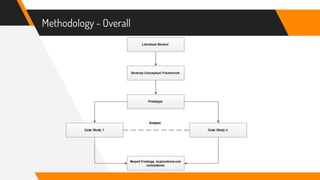
Methodology - Overall
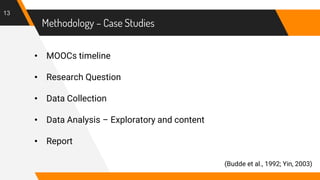
Methodology – Case Studies
13
• MOOCs timeline
• Research Question
• Data Collection
• Data Analysis – Exploratory and content
• Report
(Budde et al., 1992; Yin, 2003)
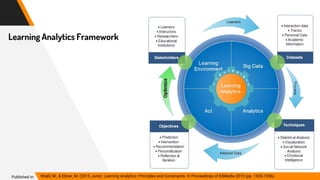
Khalil, M., & Ebner, M. (2015, June). Learning Analytics: Principles and Constraints. In Proceedings of EdMedia 2015 (pp. 1326-1336).Published in:
Learning Analytics Framework
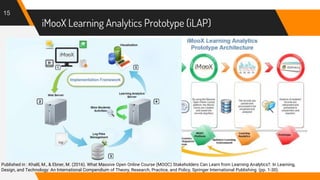
iMooX Learning Analytics Prototype (iLAP)
15
Published in : Khalil, M., & Ebner, M. (2016). What Massive Open Online Course (MOOC) Stakeholders Can Learn from Learning Analytics?. In Learning,
Design, and Technology: An International Compendium of Theory, Research, Practice, and Policy, Springer International Publishing. (pp. 1-30).
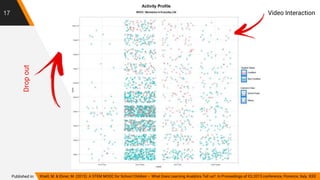
Students activities
16
17
Khalil, M. & Ebner, M. (2015). A STEM MOOC for School Children – What Does Learning Analytics Tell us?. In Proceedings of ICL2015 conference, Florence, Italy. IEEE
Video Interaction
Dropout
Published in:
RQ
- What student behavior exists in
MOOC Videos?
- What is the added value of
interactive videos in MOOCs?
18
19
Published in : Khalil, M., & Ebner, M. (2016). What Massive Open Online Course (MOOC) Stakeholders Can Learn from Learning Analytics?. In Learning,
Design, and Technology: An International Compendium of Theory, Research, Practice, and Policy, Springer International Publishing. (pp. 1-30).
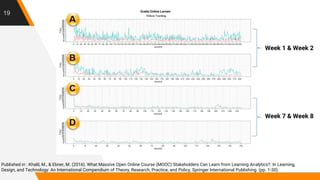
Week 1 & Week 2
Week 7 & Week 8
20
Wachtler, J., Khalil, M., Taraghi, B. & Ebner, M. (2016). On using learning analytics to track the activity of interactive MOOC videos. In Proceedings of the LAK 2016 Workshop on Smart Environments and
Analytics in Video-Based Learning (pp.8–17) Edinburgh, Scotland: CEURS-WS.
Published in:
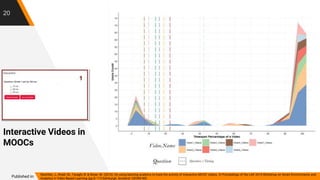
Interactive Videos in
MOOCs
RQ
- Is there a threshold in MOOCs where
learners drop the course or become
lurkers?
21
22
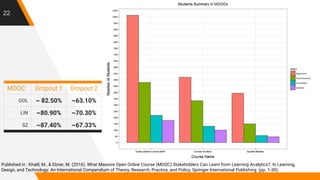
MOOC Dropout 1 Dropout 2
GOL ~ 82.50% ~63.10%
LIN ~80.90% ~70.30%
SZ ~87.40% ~67.33%
Published in : Khalil, M., & Ebner, M. (2016). What Massive Open Online Course (MOOC) Stakeholders Can Learn from Learning Analytics?. In Learning,
Design, and Technology: An International Compendium of Theory, Research, Practice, and Policy, Springer International Publishing. (pp. 1-30).
23
Lackner, E., Ebner, M. & Khalil, M. (2015). MOOCs as granular systems: design patterns to foster participant activity. eLearning Papers, 42, 28-37.Published in:
RQ
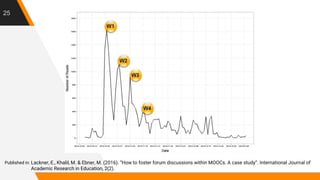
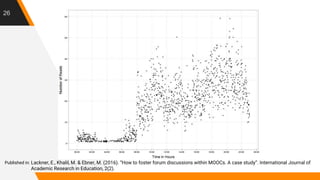
- How do students engage in MOOC discussion
forums?
24
25
Published in: Lackner, E., Khalil, M. & Ebner, M. (2016). “How to foster forum discussions within MOOCs. A case study”. International Journal of
Academic Research in Education, 2(2).
26
Published in: Lackner, E., Khalil, M. & Ebner, M. (2016). “How to foster forum discussions within MOOCs. A case study”. International Journal of
Academic Research in Education, 2(2).
RQ
- What participant types can be clustered in MOOCs
based on their MOOC engagement level?
27
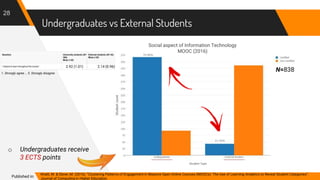
Undergraduates vs External Students
28
N=838
o Undergraduates receive
3 ECTS points
Khalil, M. & Ebner, M. (2016). “Clustering Patterns of Engagement in Massive Open Online Courses (MOOCs): The Use of Learning Analytics to Reveal Student Categories”.
Journal of Computing in Higher Education.
Published in:
2.92 (1.01) 2.14 (0.96)
1. Strongly agree … 5. Strongly disagree
Social aspect of Information Technology
MOOC (2016)
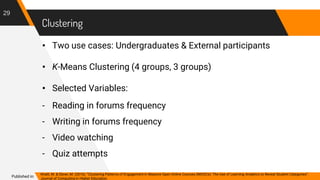
Clustering
29
Khalil, M. & Ebner, M. (2016). “Clustering Patterns of Engagement in Massive Open Online Courses (MOOCs): The Use of Learning Analytics to Reveal Student Categories”.
Journal of Computing in Higher Education.
Published in:
• Two use cases: Undergraduates & External participants
• K-Means Clustering (4 groups, 3 groups)
• Selected Variables:
- Reading in forums frequency
- Writing in forums frequency
- Video watching
- Quiz attempts
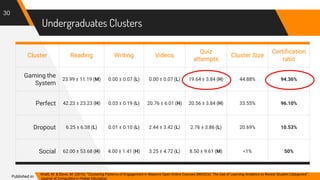
Undergraduates Clusters
30
Khalil, M. & Ebner, M. (2016). “Clustering Patterns of Engagement in Massive Open Online Courses (MOOCs): The Use of Learning Analytics to Reveal Student Categories”.
Journal of Computing in Higher Education.
Published in:
Cluster Reading Writing Videos
Quiz
attempts
Cluster Size
Certification
ratio
Gaming the
System
23.99 ± 11.19 (M) 0.00 ± 0.07 (L) 0.00 ± 0.07 (L) 19.64 ± 3.84 (H) 44.88% 94.36%
Perfect 42.23 ± 23.23 (H) 0.03 ± 0.19 (L) 20.76 ± 6.01 (H) 20.56 ± 3.84 (H) 33.55% 96.10%
Dropout 6.25 ± 6.38 (L) 0.01 ± 0.10 (L) 2.44 ± 3.42 (L) 2.76 ± 3.86 (L) 20.69% 10.53%
Social 62.00 ± 53.68 (H) 4.00 ± 1.41 (H) 3.25 ± 4.72 (L) 8.50 ± 9.61 (M) <1% 50%
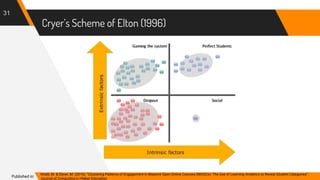
Cryer’s Scheme of Elton (1996)
31
Khalil, M. & Ebner, M. (2016). “Clustering Patterns of Engagement in Massive Open Online Courses (MOOCs): The Use of Learning Analytics to Reveal Student Categories”.
Journal of Computing in Higher Education.
Published in:
RQ
- How to motivate MOOC students and increase their
engagement?
32
33
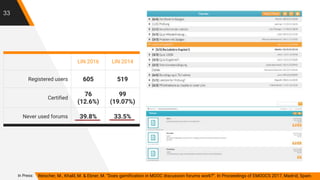
Reischer, M., Khalil, M. & Ebner, M. “Does gamification in MOOC discussion forums work?”. In Proceedings of EMOOCS 2017, Madrid, Spain.In Press:
LIN 2016 LIN 2014
Registered users 605 519
Certified
76
(12.6%)
99
(19.07%)
Never used forums 39.8% 33.5%
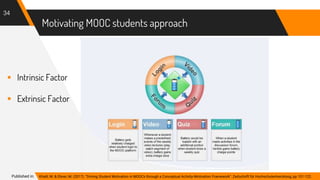
Motivating MOOC students approach
34
Published in: Khalil, M. & Ebner, M. (2017). “Driving Student Motivation in MOOCs through a Conceptual Activity-Motivation Framework”. Zeitschrift für Hochschulentwicklung, pp.101-122.
 Intrinsic Factor
 Extrinsic Factor
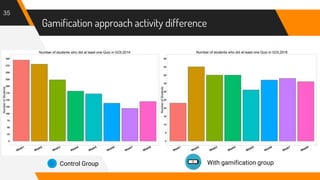
Gamification approach activity difference
35
Control Group With gamification group
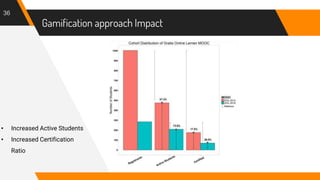
Gamification approach Impact
36
• Increased Active Students
• Increased Certification
Ratio
- What are the security constraints of learning analytics?
37
RQ
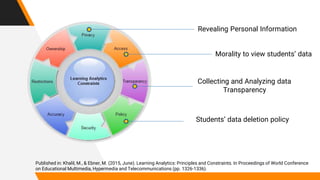
Revealing Personal Information
Morality to view students’ data
Collecting and Analyzing data
Transparency
Students’ data deletion policy
Published in: Khalil, M., & Ebner, M. (2015, June). Learning Analytics: Principles and Constraints. In Proceedings of World Conference
on Educational Multimedia, Hypermedia and Telecommunications (pp. 1326-1336).
39
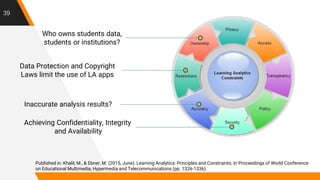
Achieving Confidentiality, Integrity
and Availability
Who owns students data,
students or institutions?
Data Protection and Copyright
Laws limit the use of LA apps
Inaccurate analysis results?
Published in: Khalil, M., & Ebner, M. (2015, June). Learning Analytics: Principles and Constraints. In Proceedings of World Conference
on Educational Multimedia, Hypermedia and Telecommunications (pp. 1326-1336).
40
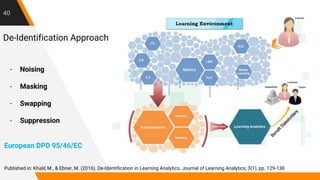
De-Identification Approach
Published in: Khalil, M., & Ebner, M. (2016). De-Identification in Learning Analytics. Journal of Learning Analytics, 3(1), pp. 129-138
- Noising
- Masking
- Swapping
- Suppression
European DPD 95/46/EC
Conclusions & Outcomes
41
42
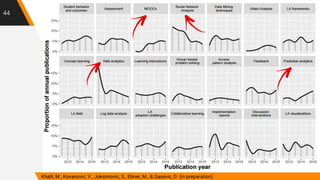
Future Research
• Learning Analytics
• MOOCs
43
44
Khalil, M., Kovanovic, V., Joksimovic, S., Ebner, M., & Gasevic, D. (in preparation).
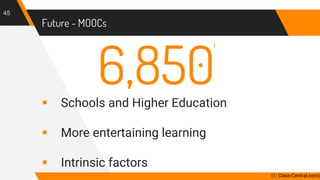
Future - MOOCs
 Schools and Higher Education
 More entertaining learning
 Intrinsic factors
45
6,850
1
(1: Class-Central.com)
46
THANK You!
Mohammad Khalil

Learning Analytics in Massive Open Online Courses - PhD Defense

  • 1.
    Learning Analytics in MassiveOpen Online Courses PhD Defense 08.05.2017 Mohammad Khalil Supervisor: Martin Ebner Graz University of Technology
  • 2.
    HELLO! my name isMohammad Khalil 2
  • 3.
    Acknowledgements I sincerely thank: •My supervisor • Committee • Erasmus Mundus scholarship • Master students (Stephan Moser, Ines Legnar, Matthias Reischer, & Rainer Reitbauer) • Family, Friends, & Colleagues 3
  • 4.
  • 5.
    How Educational TechnologyStarted Sydney Pressey Multiple Choice Machine (1924) Plato V (1981)
  • 6.
    Massive Open OnlineCourses 6 https://c2.staticflickr.com/2/1097/1296105722_057a1ab727_b.jpg
  • 7.
  • 8.
  • 9.
    “• Relative noveltyof MOOCs and learning analytics • What hidden patterns can learning analytics unveil in MOOC educational datasets? 9
  • 10.
    Research Question • Howlearning analytics can be developed in MOOCs? • What is the learning analytics potential in bridging student interaction gaps in MOOCs? 10
  • 11.
  • 12.
  • 13.
    Methodology – CaseStudies 13 • MOOCs timeline • Research Question • Data Collection • Data Analysis – Exploratory and content • Report (Budde et al., 1992; Yin, 2003)
  • 14.
    Khalil, M., &Ebner, M. (2015, June). Learning Analytics: Principles and Constraints. In Proceedings of EdMedia 2015 (pp. 1326-1336).Published in: Learning Analytics Framework
  • 15.
    iMooX Learning AnalyticsPrototype (iLAP) 15 Published in : Khalil, M., & Ebner, M. (2016). What Massive Open Online Course (MOOC) Stakeholders Can Learn from Learning Analytics?. In Learning, Design, and Technology: An International Compendium of Theory, Research, Practice, and Policy, Springer International Publishing. (pp. 1-30).
  • 16.
  • 17.
    17 Khalil, M. &Ebner, M. (2015). A STEM MOOC for School Children – What Does Learning Analytics Tell us?. In Proceedings of ICL2015 conference, Florence, Italy. IEEE Video Interaction Dropout Published in:
  • 18.
    RQ - What studentbehavior exists in MOOC Videos? - What is the added value of interactive videos in MOOCs? 18
  • 19.
    19 Published in :Khalil, M., & Ebner, M. (2016). What Massive Open Online Course (MOOC) Stakeholders Can Learn from Learning Analytics?. In Learning, Design, and Technology: An International Compendium of Theory, Research, Practice, and Policy, Springer International Publishing. (pp. 1-30). Week 1 & Week 2 Week 7 & Week 8
  • 20.
    20 Wachtler, J., Khalil,M., Taraghi, B. & Ebner, M. (2016). On using learning analytics to track the activity of interactive MOOC videos. In Proceedings of the LAK 2016 Workshop on Smart Environments and Analytics in Video-Based Learning (pp.8–17) Edinburgh, Scotland: CEURS-WS. Published in: Interactive Videos in MOOCs
  • 21.
    RQ - Is therea threshold in MOOCs where learners drop the course or become lurkers? 21
  • 22.
    22 MOOC Dropout 1Dropout 2 GOL ~ 82.50% ~63.10% LIN ~80.90% ~70.30% SZ ~87.40% ~67.33% Published in : Khalil, M., & Ebner, M. (2016). What Massive Open Online Course (MOOC) Stakeholders Can Learn from Learning Analytics?. In Learning, Design, and Technology: An International Compendium of Theory, Research, Practice, and Policy, Springer International Publishing. (pp. 1-30).
  • 23.
    23 Lackner, E., Ebner,M. & Khalil, M. (2015). MOOCs as granular systems: design patterns to foster participant activity. eLearning Papers, 42, 28-37.Published in:
  • 24.
    RQ - How dostudents engage in MOOC discussion forums? 24
  • 25.
    25 Published in: Lackner,E., Khalil, M. & Ebner, M. (2016). “How to foster forum discussions within MOOCs. A case study”. International Journal of Academic Research in Education, 2(2).
  • 26.
    26 Published in: Lackner,E., Khalil, M. & Ebner, M. (2016). “How to foster forum discussions within MOOCs. A case study”. International Journal of Academic Research in Education, 2(2).
  • 27.
    RQ - What participanttypes can be clustered in MOOCs based on their MOOC engagement level? 27
  • 28.
    Undergraduates vs ExternalStudents 28 N=838 o Undergraduates receive 3 ECTS points Khalil, M. & Ebner, M. (2016). “Clustering Patterns of Engagement in Massive Open Online Courses (MOOCs): The Use of Learning Analytics to Reveal Student Categories”. Journal of Computing in Higher Education. Published in: 2.92 (1.01) 2.14 (0.96) 1. Strongly agree … 5. Strongly disagree Social aspect of Information Technology MOOC (2016)
  • 29.
    Clustering 29 Khalil, M. &Ebner, M. (2016). “Clustering Patterns of Engagement in Massive Open Online Courses (MOOCs): The Use of Learning Analytics to Reveal Student Categories”. Journal of Computing in Higher Education. Published in: • Two use cases: Undergraduates & External participants • K-Means Clustering (4 groups, 3 groups) • Selected Variables: - Reading in forums frequency - Writing in forums frequency - Video watching - Quiz attempts
  • 30.
    Undergraduates Clusters 30 Khalil, M.& Ebner, M. (2016). “Clustering Patterns of Engagement in Massive Open Online Courses (MOOCs): The Use of Learning Analytics to Reveal Student Categories”. Journal of Computing in Higher Education. Published in: Cluster Reading Writing Videos Quiz attempts Cluster Size Certification ratio Gaming the System 23.99 ± 11.19 (M) 0.00 ± 0.07 (L) 0.00 ± 0.07 (L) 19.64 ± 3.84 (H) 44.88% 94.36% Perfect 42.23 ± 23.23 (H) 0.03 ± 0.19 (L) 20.76 ± 6.01 (H) 20.56 ± 3.84 (H) 33.55% 96.10% Dropout 6.25 ± 6.38 (L) 0.01 ± 0.10 (L) 2.44 ± 3.42 (L) 2.76 ± 3.86 (L) 20.69% 10.53% Social 62.00 ± 53.68 (H) 4.00 ± 1.41 (H) 3.25 ± 4.72 (L) 8.50 ± 9.61 (M) <1% 50%
  • 31.
    Cryer’s Scheme ofElton (1996) 31 Khalil, M. & Ebner, M. (2016). “Clustering Patterns of Engagement in Massive Open Online Courses (MOOCs): The Use of Learning Analytics to Reveal Student Categories”. Journal of Computing in Higher Education. Published in:
  • 32.
    RQ - How tomotivate MOOC students and increase their engagement? 32
  • 33.
    33 Reischer, M., Khalil,M. & Ebner, M. “Does gamification in MOOC discussion forums work?”. In Proceedings of EMOOCS 2017, Madrid, Spain.In Press: LIN 2016 LIN 2014 Registered users 605 519 Certified 76 (12.6%) 99 (19.07%) Never used forums 39.8% 33.5%
  • 34.
    Motivating MOOC studentsapproach 34 Published in: Khalil, M. & Ebner, M. (2017). “Driving Student Motivation in MOOCs through a Conceptual Activity-Motivation Framework”. Zeitschrift für Hochschulentwicklung, pp.101-122.  Intrinsic Factor  Extrinsic Factor
  • 35.
    Gamification approach activitydifference 35 Control Group With gamification group
  • 36.
    Gamification approach Impact 36 •Increased Active Students • Increased Certification Ratio
  • 37.
    - What arethe security constraints of learning analytics? 37 RQ
  • 38.
    Revealing Personal Information Moralityto view students’ data Collecting and Analyzing data Transparency Students’ data deletion policy Published in: Khalil, M., & Ebner, M. (2015, June). Learning Analytics: Principles and Constraints. In Proceedings of World Conference on Educational Multimedia, Hypermedia and Telecommunications (pp. 1326-1336).
  • 39.
    39 Achieving Confidentiality, Integrity andAvailability Who owns students data, students or institutions? Data Protection and Copyright Laws limit the use of LA apps Inaccurate analysis results? Published in: Khalil, M., & Ebner, M. (2015, June). Learning Analytics: Principles and Constraints. In Proceedings of World Conference on Educational Multimedia, Hypermedia and Telecommunications (pp. 1326-1336).
  • 40.
    40 De-Identification Approach Published in:Khalil, M., & Ebner, M. (2016). De-Identification in Learning Analytics. Journal of Learning Analytics, 3(1), pp. 129-138 - Noising - Masking - Swapping - Suppression European DPD 95/46/EC
  • 41.
  • 42.
  • 43.
    Future Research • LearningAnalytics • MOOCs 43
  • 44.
    44 Khalil, M., Kovanovic,V., Joksimovic, S., Ebner, M., & Gasevic, D. (in preparation).
  • 45.
    Future - MOOCs Schools and Higher Education  More entertaining learning  Intrinsic factors 45 6,850 1 (1: Class-Central.com)
  • 46.

Editor's Notes

  • #6 Sydney pressey is professor from Ohio..he tried to make a mcq machine without papers. Plato V is a televised teaching machine with many figures and visualizations.
  • #10 Relative novelty of MOOCs and learning analytics, and shortage of research in both