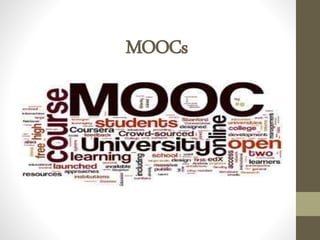
MOOCs
About
• MOOC is a Massive Open Online Class
• Started by Academia’s best and the brightest and now
filtering down to the trenches of Academia
• People must sign up, so they know how many are in.
• Courses are, in general, free
• Courses award no credit………yet.
• Teachers do not interact with students
Continue ……………..
About ……..
• Massive = the number of participants that can easily be
simultaneously engaged in the course.
• Open = related to several concepts: the software is open-
source, registration is open to anyone, the curriculum is
open, the sources of information are open, the
assessment processes are open, and the learners are
open to a range of different learning environments.
MOOCs……………………
• are open to anyone – no mandatory qualifications
• have no fees for study
• have enrolments at start >>> learners at end
• have learners who are not students of universities
• are fully online
• are very lightly tutored & supported
• do offer assessment (in various forms)
• have low study hours per week, on modules not degree
programs
Why MOOCs
• Reputation – early adopter of educational technology
• Exploration of a new pedagogical ‘space’ to inform practice
• Wish to reach as widely as we can with our courses
• Sharing experiences with peer universities
• Fun!
Modes in MOOCs
AnOnlinespacesforlearnerstoself-support+lighttouch
oversight
Benefits of MOOCs
Automated assessment– computer-marks
tests
Two types of MOOCs:
• cMOOC
• xMOOC
My field choice
My field of interest is
Philosophy and the Sciences
Learn about the historical and philosophical foundations of
contemporary science. Explore cutting-edge debates in the
philosophy of the physical sciences and philosophy of the
cognitive sciences.
The course is structured around two broad areas:
1. Philosophy and the Physical Sciences
2. Philosophy and the Cognitive Sciences
• https://www.coursera.org/course/philsci
References
Bell, F. (2011) Connectivism: Its Place in Theory-Informed Research and Innovation in
Technology-Enabled Learning. International Review of Research in Open and Distance
Learning. Volume 12, Number 3. Retrievable from web
http://www.irrodl.org/index.php/irrodl/article/view/902/1664 (accessed 20 May 2011).
Cormier D, Siemens G (2010) Through the open door: open courses as research, learning, and
engagement. EDUCAUSE Review; 2010; 45(4): 30-9.
de Waard, I., Kouropoulos, A., Gallagher, M. S., Keskin, N., Hogue, R., Rodriguez, O. C., Abajian,
S. (2011) mLearning and MOOCs in understanding Chaos, Emergence and Complexity in
Education: The search for equilibrium and a new educational order. (paper to be published at
IRRODL November 2011)
de Waard, I., Gallagher, M. S., Hogue, R., Kouropoulos, A., Rodriguez, O.C., Keskin, N., Abajian,
S. (2011). Exploring the MOOC format as a pedagogical approach for mLearning. Proceedings
of mLearn2011 (to be published October 2011).
Downs, S. (2006). Learning networks and connective knowledge. Instructional Technology
Forum: paper 92. Retrieved from web http://it.coe.uga.edu/itforum/paper92/paper92.html
(accessed 12 April 2011)

Mooc

  • 1.
  • 4.
    About • MOOC isa Massive Open Online Class • Started by Academia’s best and the brightest and now filtering down to the trenches of Academia • People must sign up, so they know how many are in. • Courses are, in general, free • Courses award no credit………yet. • Teachers do not interact with students Continue ……………..
  • 5.
    About …….. • Massive= the number of participants that can easily be simultaneously engaged in the course. • Open = related to several concepts: the software is open- source, registration is open to anyone, the curriculum is open, the sources of information are open, the assessment processes are open, and the learners are open to a range of different learning environments.
  • 6.
    MOOCs…………………… • are opento anyone – no mandatory qualifications • have no fees for study • have enrolments at start >>> learners at end • have learners who are not students of universities • are fully online • are very lightly tutored & supported • do offer assessment (in various forms) • have low study hours per week, on modules not degree programs
  • 7.
    Why MOOCs • Reputation– early adopter of educational technology • Exploration of a new pedagogical ‘space’ to inform practice • Wish to reach as widely as we can with our courses • Sharing experiences with peer universities • Fun!
  • 8.
  • 9.
  • 10.
  • 11.
  • 12.
    Two types ofMOOCs: • cMOOC • xMOOC
  • 13.
    My field choice Myfield of interest is Philosophy and the Sciences Learn about the historical and philosophical foundations of contemporary science. Explore cutting-edge debates in the philosophy of the physical sciences and philosophy of the cognitive sciences. The course is structured around two broad areas: 1. Philosophy and the Physical Sciences 2. Philosophy and the Cognitive Sciences • https://www.coursera.org/course/philsci
  • 14.
    References Bell, F. (2011)Connectivism: Its Place in Theory-Informed Research and Innovation in Technology-Enabled Learning. International Review of Research in Open and Distance Learning. Volume 12, Number 3. Retrievable from web http://www.irrodl.org/index.php/irrodl/article/view/902/1664 (accessed 20 May 2011). Cormier D, Siemens G (2010) Through the open door: open courses as research, learning, and engagement. EDUCAUSE Review; 2010; 45(4): 30-9. de Waard, I., Kouropoulos, A., Gallagher, M. S., Keskin, N., Hogue, R., Rodriguez, O. C., Abajian, S. (2011) mLearning and MOOCs in understanding Chaos, Emergence and Complexity in Education: The search for equilibrium and a new educational order. (paper to be published at IRRODL November 2011) de Waard, I., Gallagher, M. S., Hogue, R., Kouropoulos, A., Rodriguez, O.C., Keskin, N., Abajian, S. (2011). Exploring the MOOC format as a pedagogical approach for mLearning. Proceedings of mLearn2011 (to be published October 2011). Downs, S. (2006). Learning networks and connective knowledge. Instructional Technology Forum: paper 92. Retrieved from web http://it.coe.uga.edu/itforum/paper92/paper92.html (accessed 12 April 2011)