Seta A. Wicaksana
0811 19 53 43
wicaksana@humanikaconsulting.com
• Managing Director of Humanika Amanah
Indonesia – Humanika Consulting
• Managing Director of Humanika Bisnis Digital –
hipotest.com
• Ahli Senior di Komite Kebijakan Pengelolaan
Kinerja Organisasi dan SDM (KPKOS) Dewan
Pengawas BPJS Ketenagakerjaan
• Dosen Tetap Fakultas Psikologi Universitas
Pancasila
• Pembina Yayasan Humanika Edukasi Indonesia
• Penulis Buku “SOBAT” Elexmedia Gramedia 2016
• Organizational Development Expertise
• Pengembang Alat Tes minat bakat BRIGHT dan
Sistem Tes Psikologi berbasis aplikasi di
hipotest.com
• Sedang mengikuti tugas belajar Doktoral (S3) di
Fakultas Ilmu Ekonomi dan Bisnis Universitas
Pancasila Bidang MSDM
• Fakultas Psikologi S1 dan S2 Universitas Indonesia
• Mathematics: Cryptology sekolah ikatan dinas
Sandi Negara
Menu
• Introduction
• A Peek into the Future of
Workplace
• The ratio of Man-Machine Working
Hours 2018 vs. 2022
• Skills: The Currency of Future of
Work
• The Willingness to Learn
• Research in Learning Agility
• What is Learning Agility?
• Five Main Characteristics of
Learning Agility
• Three essential components of
learning agility
• Measure Learning Agility
• Learning Agility Matrix
• Approach to Assessment
• Impacts of Learning Agility
• The need of the hour: A continuous
professional development platform
to harness agility
• Summary
• References
In his 1970 book, Future Shock,
American Author Alvin Toffler wrote
that
“The illiterate of the
21st century will not be
those who cannot read
and write, but those
who cannot learn,
unlearn, and relearn”.
What he was explaining was the
learning agility definition. And he
was way ahead of his time.
Introduction
• In today’s kinetic business
environment: individuals, leaders, and
organizations can no longer rely on
strategies that have worked in the past,
or even those that are working today.
• VUCA: the Volatile, Uncertain,
Complex, and Ambiguous landscapes
in which today’s individuals, leaders,
and organizations must learn to adapt
and operate, has become trendy even
in corporate circles, as businesses
compete in an environment
characterized by constant, rapid, and
unpredictable evolution.
• VUCA is the new business reality, and
we all have to live with it. Learning is
central to functioning effectively in this
VUCA environment, and by its sheer
definition, has to be essentially agile
• The best performing enterprises have
individuals, leaders, and organizations
who thrive on change and can make
sense of uncertainty. These individuals
have ‘learning agility’.
Introduction
• People who have high levels of learning agility
seek out and learn from unfamiliar experiences
and then apply those lessons to succeed in the
next new situation. Learning agility helps them
know what to do when they don’t know what to
do.
• After conducting many thousands of senior
executive assessments across the globe, at Korn
Ferry we have found that learning agility is now
the single best predictor of executive success,
above intelligence and education. There are no
absolutes, but agile learners tend to get
promoted faster and achieve more.
• Yet, only about 15 per cent of people are really
strong agile learners.
• Why do some executives have initially successful
careers which then plateau or derail? They over-
rely on past solutions, have ‘blind spots’ to their
own faults, have underdeveloped competencies,
fail at relationships, can’t relinquish control and
simply quit learning. Worst of all, they are often
content with their company’s place in the
market.
A Peek into the Future of Workplace
The future of jobs is being shaped by:
• Technologies like AI, robotics (leading to
automation),
• Increased competition due to globalization
and
• A constant need to innovate
• The younger generations pushing against
traditional notions of work and demanding
careers that look different
This has given rise to:
• Gig workers who by several estimates will
constitute 50% of the global workforce in the
next 5 years
• Multiple generations at workforce with
widely differing personal and professional
objectives
A Peek into the Future of Workplace
• Work tasks are becoming novel and require
strong analytical and interpersonal skills.
• Jobs that require employees to do manual and
repetitive work are disappearing fast.
• Automation is taking care of work tasks that are
repetitive and do not need the use of high
cognitive abilities or human touch.
• As businesses transform to meet changing
customer demands and technology enables
automation of jobs that are simple and repetitive,
a lot of present jobs will go out of existence, and
many new jobs will come into existence.
• Additionally, most of the jobs will transform to
accommodate changing customer demands.
• To be able to keep up with the change,
organizations need to develop a future-ready
workforce that can be trained on futuristic skills.
A Peek into the Future of Workplace
The ratio of Man-Machine Working Hours
2018 vs. 2022
• Numerous jobs will become redundant and new roles requiring
new skills will emerge. Some studies estimate that about 58
million new job roles will require reskilling by 2022.
• But a broad clustering of the new roles reveals that they will be
around technology, organization development, and people and
culture.
• The new skills and roles support not only the technology
disruption but most drivers of Industry 4.0 that we saw earlier.
• You need people/social skills to manage a multi-gen diverse
workforce.
• You need focused and targeted L&D initiatives to drive the
adoption of new skills to innovate and create leadership muscle
to manage the increasing number of freelancers and gig workers.
• So now that we know why we need to reskill and what skills we
need to reskill on, we need to understand how quickly people
can pick up on training. Do they have the ability/willingness to
learn new skills and apply them to unfamiliar situations?
• The good news is, with rapid advancements in the science of
assessments, we can now measure this objectively using one of
the most effective L&D solutions, i.e., Learning Agility.
Skills: The Currency of Future of Work
• In a world of constant business and
technological disruption, the desire to know
more and learn new skills in order to survive
and improve as per the change has become
crucial.
• Achieving business results without learning new
strategies and models has become next to
impossible.
• Constant learning not only helps businesses but
individuals who are career-driven and aim for
higher roles of responsibilities.
• The willingness to learn has multifold benefits.
• Provides career growth and promotion
opportunities
• Enhances the readiness to face challenges and
uncertainty
• Assists in innovation and ideation
• Improves flexibility and adaptability
The Willingness to Learn
Research in Learning Agility
• Researcher Scott DeRue at the University of
Michigan established a model that identifies speed
and flexibility as the two most important factors
determining learning agility.
• Learning agility is about being able to digest a large
amount of information quickly (speed) and figure
out what is most important.
• DeRue also said you need to be able to change
frameworks (flexibility) that help you understand
how different things are related or connected. In
other words, flexibility is about being able to change
frameworks as necessary to explain what is going on.
• DeRue also made a distinction between learning
agility and learning ability. “Ability” means cognitive
ability or “smarts.” Ability is important to a point,
but then, smarter is not necessarily better.
• DeRue says there are both cognitive and behavioral
components to learning agility. The cognitive ones –
the “hard wiring,” if you will – are difficult, if not
impossible, to change. The behavioral ones are more
learnable, because if you do the things described by
the behavior, then you are demonstrating that part
of learning agility.
Research in Learning Agility
• Dr. Warner Burke from Columbia
University, confirmed what DeRue
described and found nine additional
dimensions of learning agility.
• His research also identified Flexibility
(open to new ideas and solutions),
Speed (acting quickly), Experimenting
(trying new behaviors), Performance
Risk-taking (taking on novel challenges),
Interpersonal Risk-taking (discussing
differences in opinions), Collaborating,
Information Gathering, Feedback
Seeking and Reflecting.
• Burke also developed a test to measure
learning agility, and his work led to a
valid and reliable tool with years of
research to support its results.
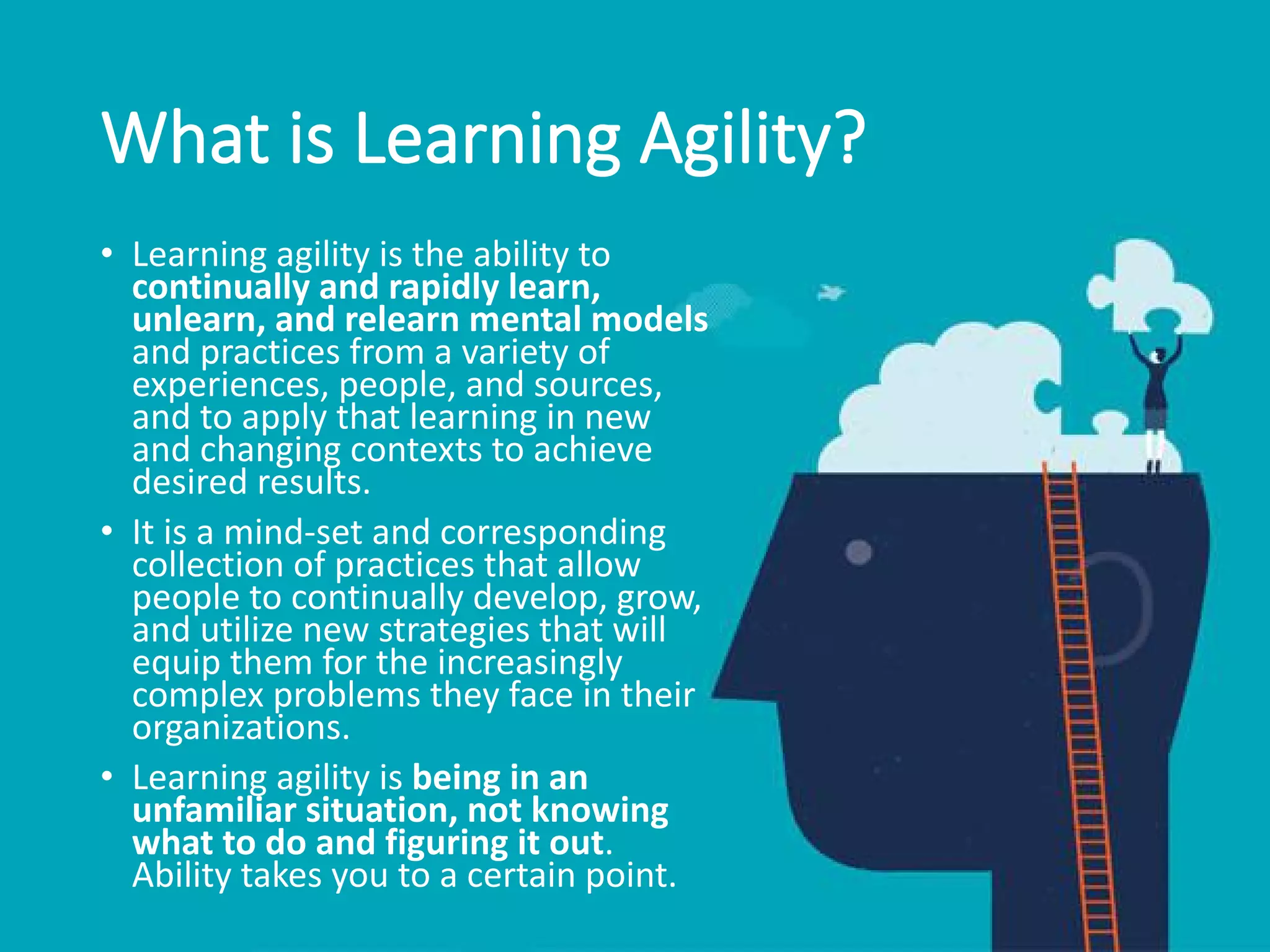
What is Learning Agility?
• Learning agility is the ability to
continually and rapidly learn,
unlearn, and relearn mental models
and practices from a variety of
experiences, people, and sources,
and to apply that learning in new
and changing contexts to achieve
desired results.
• It is a mind-set and corresponding
collection of practices that allow
people to continually develop, grow,
and utilize new strategies that will
equip them for the increasingly
complex problems they face in their
organizations.
• Learning agility is being in an
unfamiliar situation, not knowing
what to do and figuring it out.
Ability takes you to a certain point.
Five Main Characteristics of
Learning Agility
• Mental Agility — how
comfortable are they in dealing
with complexity?
• People Agility — are they skilled
communicators who can work
with diverse people?
• Change Agility — do they like to
experiment? Are they not afraid
to be at the forefront of change?
• Results Agility — can they
deliver results in first-time
situations?
• Self-Awareness — do they
recognise their own strengths
and weaknesses?
• Potential to Learn: The competencies that make you
successful in a specific role today might not be sufficient
tomorrow. A learning agile person has an open and receptive
mindset to constantly experience new things to reach new
goals.
• Motivation to Learn: Learners need to be engaged and
inspired by the learning process for learning to take hold
because changing ingrained behaviors and long-held habits is
hard work.
• Adaptability to Learn: If you remember, sometime back
Google and Procter & Gamble had organized an employee
swap — for about two months, their marketing and HR
employees worked at the other organization to see how they
managed operations differently. Once their tour was
completed, they brought those ideas back to their respective
companies. Instead of following a business-as-usual routine,
learning agile employees have an adaptability to learn
attitude, consistently working on improving their skills.
Three Essential Components Of
Learning Agility
• Mercer | Mettl has devised a
method for measuring a person’s
Learning Agility based on two
factors: ability and orientation.
• The ability to learn: are essential
cognitive competencies that
predisposes a person with the
ability to learn quickly by
identifying patterns, logical rules,
and trends in new data.
• The orientation to learn: are
essential behavioral competencies
that will predispose the
respondent to learn new things
quicker than others.
Measure Learning Agility
• Measuring Learning Ability
• An individual’s ability to learn is determined
by his/her fluid intelligence or the ability to
learn new things from scratch and then apply
that knowledge in different ways. Fluid
intelligence can be measured with the help of
abstract reasoning or spatial reasoning tests.
• Learning Ability = Fluid Intelligence = Ability to
discern patterns and linkages and the ability
to make fresh connections between different
concepts.
• Measuring Learning Orientation
• An individual’s orientation towards learning is
determined by his/her behavioral attributes,
such as open-mindedness, drive for mastery,
consciousness, and inquisitiveness.
• Learning Orientation = Open-Mindedness +
Inquisitiveness + Drive for Mastery +
Consciousness = Essential behavioral
competencies that will predispose the
respondent to learn new things faster than
others.
Measure Learning Agility
• Ren Jones, owner of Rennovate It, shares how learning ability and
intent/orientation are both needed to be learning agile.
• “Learning ability is not weighted more or less heavily than learning intent, but
rather, they are both necessary for a learner.
• For learning to occur, the learner must have varying degrees of intent and ability,
the necessary levels of each depend on each other.
• For instance, if an employee has a lower learning ability, they will need a higher
level of intent/orientation to help them comprehend the new information.
• If an employee has low intent, they will need a higher amount of ability to help
them catch on.
• The best employee would be one with a healthy balance of both ability and
intent.”
Measure Learning Agility
Learning Agility Matrix
Learning Agility Matrix is
a matrix that measures an
individual’s/organization’s
learning agility and
provides actionable
insights needed to
improve the
organization’s
performance and
productivity.
From: Mercer | Mettl’s
Average Learners
• Who Is an Average Learner?
An average learner is an individual
having average levels of both fluid
intelligence (ability) and behavioral
traits that support a Learning Agile
mindset (intent)
• When Do You Need an Average
Learner?
A job role, industry, or organisation
requires average learners if the job
mandates performing routine, non-
novel, and straightforward tasks. e.g.,
Data entry, KPO/BPO
Enthusiastic Learners
• Who Is an Enthusiastic Learner?
An enthusiastic learner is an individual
having an average level of fluid
intelligence (ability) and above-average
level of behavioral skills that supports a
Learning Agile mindset (intent)
• When Do You Need an Enthusiastic
Learner?
A job role, industry, or organization
demands enthusiastic learners if it
involves performing work that requires
creativity, people skills, passion, expertise
in their fields, and innovative thought
process. e.g., Journalism, Media &
Entertainment, Photography
Latent Learners
• Who Is a Latent Learner?
A latent learner is an individual having an
above-average level of fluid intelligence
(ability) and the average level of
behavioral traits that supports a Learning
Agile mindset (intent)
• When Do You Need a Latent Learner?
A job role, industry, or organization
demands latent learners if it involves
performing work that requires attention
to detail, focus, and perseverance,
performing complicated routine tasks
and strong cognitive abilities. e.g.,
Accounting, Banking
• Who Is a High Potential Learner?
A high potential is an individual having
both: very high level of fluid intelligence
(ability) and behavioral traits that
support a Learning Agile mindset (intent).
• When Do You Need a High Potential
Learner?
A job role, industry, or organization
demands high potential learners if it
involves performing work that requires
very strong interpersonal, cognitive,
analytical, problem-solving, logical
thinking, and decision-making skills. High
potentials are required when the nature
of work is very complicated, novel and
has high stakes attached to it. e.g., CXO
and leadership roles, stock market
trading, management consultant
High Potential Learners
• Find the gap using learning agility assessments
• Celebrate mistakes as learning opportunities
• Foster a culture that challenges the status quo
• Equip individuals, leaders and organizations with
the skills to deal with uncertainty
How Can Learning
Agility Be
Improved?
• Learning Agility is a meta-concept reflecting the
constellation of an individual’s cognitive ability and
behavioral predisposition.
• Outcomes of High Learning Agility includes the ability to
make a smooth transition between different roles as per the
role/company requirement, having a high potential for
career advancements and better job performance due to
the constant addition of new skills and knowledge.
Approach to Assessment
Impacts of Learning Agility
An organization with a learning agile workforce has:
• Improved employee productivity
• Future-ready workforce
• Increase in number of high potentials
• Higher overall organizational productivity and profitability
The Need Of The Hour: A Continuous
Professional Development Platform To Harness
Agility
• Traditional L&D processes don’t
harness learning agility. With
millennials taking over and workplace
environment evolving every other day,
what organizations need at this stage
is a comprehensive continuous
learning and dynamic performance
tracking mechanism which measures
both tangible as well as intangible
values an employee brings to the
team.
• On the other hand, if you want to contribute to your company’s agility, you have
to remember that your job is not only to train people but to put in place
programs and strategies which create a continuous learning environment.
The Need Of The Hour: A Continuous
Professional Development Platform To Harness
Agility
• The time has come to marry learning with
working. Both of them are not separate.
One of the hallmarks of a learning agile
organization is that they infuse learning into
daily work.
• In today’s times, the major difference
between successful people and those
whose careers falter is their ability to make
meaning from their experiences.
• That includes understanding the
entrenched patterns of behavior and
recognizing the fine nuances in different
situations.
• These are the cognitive traits you could
conveniently associate with someone who
is learning agile, and shows the willingness
and ability to learn throughout their careers,
if not their entire lives.
Summary
• Change was always the rule of law. What is different today is the pace of change, the immediacy, the extent of
impact and the number of horizontal and vertical factors they affect with every iteration.
• We are in the midst of an ongoing 4th industrial revolution. This is the new age of automation — an era of rapid
change where advances in technology are disrupting the very way we work and live.
• As this fourth industrial revolution continues to unfold, learning agility will be the difference between an
organization thriving or disappearing.
• For the threats are real. Rapidly changing technology has led to the emergence of a skill gap that is costing the US
economy over 1.3 Trillion Dollars annually in lost productivity. Ultimately, our ability to continuously learn and
adapt will determine the extent to which we thrive in today’s turbulent times. The extent to which we are able to
do this will have an impact not only on who we are today but also on who we can become tomorrow.
• We also need to adapt and renovate on the lines we think about strategy and implementation. The old school set
the goal – plan – execute the approved plan doesn’t work anymore. We need to adopt a ‘context-mindful’
framework that embraces situational awareness.
• As organizations are continuously changing, growing, shifting, restructuring, downsizing, bringing new leadership
onboard and acquiring new people and resources while frequently investing in new and advanced technologies, a
continuous learning & development platform that fosters lifelong learning culture could be the most decisive factor
in keeping employees learning agile and blending learning into daily work for enhanced business productivity on a
daily basis.
“To succeed in today’s complex
business world, individuals, leaders
and organizations must be
adaptable, resilient and open to
innovative thinking. And above all,
they need one essential quality —
‘Learning Agility’.”
- Steve Newhall - Korn Ferry’s
References:
• Hoff, D., 2018, What Is Learning Agility, Anyway?,
https://trainingindustry.com/blog/strategy-alignment-and-
planning/what-is-learning-agility-anyway/
• IEDP Editorial, 2014, Why ‘Learning Agility' Is Key to Leadership
Success, https://www.iedp.com/articles/why-learning-agility-is-
key-to-leadership-success/
• Jha, A., 2018, What is Learning Agility and
Why Organizations Should Make Their
Employees Learning Agile,
https://www.disprz.com/blog/what-is-
learningagility/#:~:text=To%20put%20it%20rather%20simply,by
%20acquiring%20the%20necessary%20capabilities.
• Knight, M., & Wong, N., 2017, The Organisational X-factor:
Learning Agility, https://focus.kornferry.com/leadership-and-
talent/the-organisational-x-factor-learning-agility/
• Singh, M., 2020, Learning Agility: How to Measure it?, Mercer |
Mettl, https://blog.mettl.com/how-to-measure-individual-and-
organizational-learning-agility/
• Zoe, E., 2019, What Is Learning Agility, And How Do You
Nurture It?,
https://www.efrontlearning.com/blog/2019/03/learning-agility-
what-is-how-nurture-it.html
Learning and Giving
for Better Indonesia
www.humanikaconsulting.com

Learning agility is key to success

  • 2.
    Seta A. Wicaksana 081119 53 43 wicaksana@humanikaconsulting.com • Managing Director of Humanika Amanah Indonesia – Humanika Consulting • Managing Director of Humanika Bisnis Digital – hipotest.com • Ahli Senior di Komite Kebijakan Pengelolaan Kinerja Organisasi dan SDM (KPKOS) Dewan Pengawas BPJS Ketenagakerjaan • Dosen Tetap Fakultas Psikologi Universitas Pancasila • Pembina Yayasan Humanika Edukasi Indonesia • Penulis Buku “SOBAT” Elexmedia Gramedia 2016 • Organizational Development Expertise • Pengembang Alat Tes minat bakat BRIGHT dan Sistem Tes Psikologi berbasis aplikasi di hipotest.com • Sedang mengikuti tugas belajar Doktoral (S3) di Fakultas Ilmu Ekonomi dan Bisnis Universitas Pancasila Bidang MSDM • Fakultas Psikologi S1 dan S2 Universitas Indonesia • Mathematics: Cryptology sekolah ikatan dinas Sandi Negara
  • 3.
    Menu • Introduction • APeek into the Future of Workplace • The ratio of Man-Machine Working Hours 2018 vs. 2022 • Skills: The Currency of Future of Work • The Willingness to Learn • Research in Learning Agility • What is Learning Agility? • Five Main Characteristics of Learning Agility • Three essential components of learning agility • Measure Learning Agility • Learning Agility Matrix • Approach to Assessment • Impacts of Learning Agility • The need of the hour: A continuous professional development platform to harness agility • Summary • References
  • 4.
    In his 1970book, Future Shock, American Author Alvin Toffler wrote that “The illiterate of the 21st century will not be those who cannot read and write, but those who cannot learn, unlearn, and relearn”. What he was explaining was the learning agility definition. And he was way ahead of his time.
  • 5.
    Introduction • In today’skinetic business environment: individuals, leaders, and organizations can no longer rely on strategies that have worked in the past, or even those that are working today. • VUCA: the Volatile, Uncertain, Complex, and Ambiguous landscapes in which today’s individuals, leaders, and organizations must learn to adapt and operate, has become trendy even in corporate circles, as businesses compete in an environment characterized by constant, rapid, and unpredictable evolution. • VUCA is the new business reality, and we all have to live with it. Learning is central to functioning effectively in this VUCA environment, and by its sheer definition, has to be essentially agile • The best performing enterprises have individuals, leaders, and organizations who thrive on change and can make sense of uncertainty. These individuals have ‘learning agility’.
  • 6.
    Introduction • People whohave high levels of learning agility seek out and learn from unfamiliar experiences and then apply those lessons to succeed in the next new situation. Learning agility helps them know what to do when they don’t know what to do. • After conducting many thousands of senior executive assessments across the globe, at Korn Ferry we have found that learning agility is now the single best predictor of executive success, above intelligence and education. There are no absolutes, but agile learners tend to get promoted faster and achieve more. • Yet, only about 15 per cent of people are really strong agile learners. • Why do some executives have initially successful careers which then plateau or derail? They over- rely on past solutions, have ‘blind spots’ to their own faults, have underdeveloped competencies, fail at relationships, can’t relinquish control and simply quit learning. Worst of all, they are often content with their company’s place in the market.
  • 7.
    A Peek intothe Future of Workplace
  • 8.
    The future ofjobs is being shaped by: • Technologies like AI, robotics (leading to automation), • Increased competition due to globalization and • A constant need to innovate • The younger generations pushing against traditional notions of work and demanding careers that look different This has given rise to: • Gig workers who by several estimates will constitute 50% of the global workforce in the next 5 years • Multiple generations at workforce with widely differing personal and professional objectives A Peek into the Future of Workplace
  • 9.
    • Work tasksare becoming novel and require strong analytical and interpersonal skills. • Jobs that require employees to do manual and repetitive work are disappearing fast. • Automation is taking care of work tasks that are repetitive and do not need the use of high cognitive abilities or human touch. • As businesses transform to meet changing customer demands and technology enables automation of jobs that are simple and repetitive, a lot of present jobs will go out of existence, and many new jobs will come into existence. • Additionally, most of the jobs will transform to accommodate changing customer demands. • To be able to keep up with the change, organizations need to develop a future-ready workforce that can be trained on futuristic skills. A Peek into the Future of Workplace
  • 10.
    The ratio ofMan-Machine Working Hours 2018 vs. 2022
  • 11.
    • Numerous jobswill become redundant and new roles requiring new skills will emerge. Some studies estimate that about 58 million new job roles will require reskilling by 2022. • But a broad clustering of the new roles reveals that they will be around technology, organization development, and people and culture. • The new skills and roles support not only the technology disruption but most drivers of Industry 4.0 that we saw earlier. • You need people/social skills to manage a multi-gen diverse workforce. • You need focused and targeted L&D initiatives to drive the adoption of new skills to innovate and create leadership muscle to manage the increasing number of freelancers and gig workers. • So now that we know why we need to reskill and what skills we need to reskill on, we need to understand how quickly people can pick up on training. Do they have the ability/willingness to learn new skills and apply them to unfamiliar situations? • The good news is, with rapid advancements in the science of assessments, we can now measure this objectively using one of the most effective L&D solutions, i.e., Learning Agility. Skills: The Currency of Future of Work
  • 12.
    • In aworld of constant business and technological disruption, the desire to know more and learn new skills in order to survive and improve as per the change has become crucial. • Achieving business results without learning new strategies and models has become next to impossible. • Constant learning not only helps businesses but individuals who are career-driven and aim for higher roles of responsibilities. • The willingness to learn has multifold benefits. • Provides career growth and promotion opportunities • Enhances the readiness to face challenges and uncertainty • Assists in innovation and ideation • Improves flexibility and adaptability The Willingness to Learn
  • 13.
    Research in LearningAgility • Researcher Scott DeRue at the University of Michigan established a model that identifies speed and flexibility as the two most important factors determining learning agility. • Learning agility is about being able to digest a large amount of information quickly (speed) and figure out what is most important. • DeRue also said you need to be able to change frameworks (flexibility) that help you understand how different things are related or connected. In other words, flexibility is about being able to change frameworks as necessary to explain what is going on. • DeRue also made a distinction between learning agility and learning ability. “Ability” means cognitive ability or “smarts.” Ability is important to a point, but then, smarter is not necessarily better. • DeRue says there are both cognitive and behavioral components to learning agility. The cognitive ones – the “hard wiring,” if you will – are difficult, if not impossible, to change. The behavioral ones are more learnable, because if you do the things described by the behavior, then you are demonstrating that part of learning agility.
  • 14.
    Research in LearningAgility • Dr. Warner Burke from Columbia University, confirmed what DeRue described and found nine additional dimensions of learning agility. • His research also identified Flexibility (open to new ideas and solutions), Speed (acting quickly), Experimenting (trying new behaviors), Performance Risk-taking (taking on novel challenges), Interpersonal Risk-taking (discussing differences in opinions), Collaborating, Information Gathering, Feedback Seeking and Reflecting. • Burke also developed a test to measure learning agility, and his work led to a valid and reliable tool with years of research to support its results.
  • 15.
    What is LearningAgility? • Learning agility is the ability to continually and rapidly learn, unlearn, and relearn mental models and practices from a variety of experiences, people, and sources, and to apply that learning in new and changing contexts to achieve desired results. • It is a mind-set and corresponding collection of practices that allow people to continually develop, grow, and utilize new strategies that will equip them for the increasingly complex problems they face in their organizations. • Learning agility is being in an unfamiliar situation, not knowing what to do and figuring it out. Ability takes you to a certain point.
  • 16.
    Five Main Characteristicsof Learning Agility • Mental Agility — how comfortable are they in dealing with complexity? • People Agility — are they skilled communicators who can work with diverse people? • Change Agility — do they like to experiment? Are they not afraid to be at the forefront of change? • Results Agility — can they deliver results in first-time situations? • Self-Awareness — do they recognise their own strengths and weaknesses?
  • 18.
    • Potential toLearn: The competencies that make you successful in a specific role today might not be sufficient tomorrow. A learning agile person has an open and receptive mindset to constantly experience new things to reach new goals. • Motivation to Learn: Learners need to be engaged and inspired by the learning process for learning to take hold because changing ingrained behaviors and long-held habits is hard work. • Adaptability to Learn: If you remember, sometime back Google and Procter & Gamble had organized an employee swap — for about two months, their marketing and HR employees worked at the other organization to see how they managed operations differently. Once their tour was completed, they brought those ideas back to their respective companies. Instead of following a business-as-usual routine, learning agile employees have an adaptability to learn attitude, consistently working on improving their skills. Three Essential Components Of Learning Agility
  • 19.
    • Mercer |Mettl has devised a method for measuring a person’s Learning Agility based on two factors: ability and orientation. • The ability to learn: are essential cognitive competencies that predisposes a person with the ability to learn quickly by identifying patterns, logical rules, and trends in new data. • The orientation to learn: are essential behavioral competencies that will predispose the respondent to learn new things quicker than others. Measure Learning Agility
  • 20.
    • Measuring LearningAbility • An individual’s ability to learn is determined by his/her fluid intelligence or the ability to learn new things from scratch and then apply that knowledge in different ways. Fluid intelligence can be measured with the help of abstract reasoning or spatial reasoning tests. • Learning Ability = Fluid Intelligence = Ability to discern patterns and linkages and the ability to make fresh connections between different concepts. • Measuring Learning Orientation • An individual’s orientation towards learning is determined by his/her behavioral attributes, such as open-mindedness, drive for mastery, consciousness, and inquisitiveness. • Learning Orientation = Open-Mindedness + Inquisitiveness + Drive for Mastery + Consciousness = Essential behavioral competencies that will predispose the respondent to learn new things faster than others. Measure Learning Agility
  • 21.
    • Ren Jones,owner of Rennovate It, shares how learning ability and intent/orientation are both needed to be learning agile. • “Learning ability is not weighted more or less heavily than learning intent, but rather, they are both necessary for a learner. • For learning to occur, the learner must have varying degrees of intent and ability, the necessary levels of each depend on each other. • For instance, if an employee has a lower learning ability, they will need a higher level of intent/orientation to help them comprehend the new information. • If an employee has low intent, they will need a higher amount of ability to help them catch on. • The best employee would be one with a healthy balance of both ability and intent.” Measure Learning Agility
  • 22.
    Learning Agility Matrix LearningAgility Matrix is a matrix that measures an individual’s/organization’s learning agility and provides actionable insights needed to improve the organization’s performance and productivity. From: Mercer | Mettl’s
  • 23.
    Average Learners • WhoIs an Average Learner? An average learner is an individual having average levels of both fluid intelligence (ability) and behavioral traits that support a Learning Agile mindset (intent) • When Do You Need an Average Learner? A job role, industry, or organisation requires average learners if the job mandates performing routine, non- novel, and straightforward tasks. e.g., Data entry, KPO/BPO
  • 24.
    Enthusiastic Learners • WhoIs an Enthusiastic Learner? An enthusiastic learner is an individual having an average level of fluid intelligence (ability) and above-average level of behavioral skills that supports a Learning Agile mindset (intent) • When Do You Need an Enthusiastic Learner? A job role, industry, or organization demands enthusiastic learners if it involves performing work that requires creativity, people skills, passion, expertise in their fields, and innovative thought process. e.g., Journalism, Media & Entertainment, Photography
  • 25.
    Latent Learners • WhoIs a Latent Learner? A latent learner is an individual having an above-average level of fluid intelligence (ability) and the average level of behavioral traits that supports a Learning Agile mindset (intent) • When Do You Need a Latent Learner? A job role, industry, or organization demands latent learners if it involves performing work that requires attention to detail, focus, and perseverance, performing complicated routine tasks and strong cognitive abilities. e.g., Accounting, Banking
  • 26.
    • Who Isa High Potential Learner? A high potential is an individual having both: very high level of fluid intelligence (ability) and behavioral traits that support a Learning Agile mindset (intent). • When Do You Need a High Potential Learner? A job role, industry, or organization demands high potential learners if it involves performing work that requires very strong interpersonal, cognitive, analytical, problem-solving, logical thinking, and decision-making skills. High potentials are required when the nature of work is very complicated, novel and has high stakes attached to it. e.g., CXO and leadership roles, stock market trading, management consultant High Potential Learners
  • 27.
    • Find thegap using learning agility assessments • Celebrate mistakes as learning opportunities • Foster a culture that challenges the status quo • Equip individuals, leaders and organizations with the skills to deal with uncertainty How Can Learning Agility Be Improved?
  • 28.
    • Learning Agilityis a meta-concept reflecting the constellation of an individual’s cognitive ability and behavioral predisposition. • Outcomes of High Learning Agility includes the ability to make a smooth transition between different roles as per the role/company requirement, having a high potential for career advancements and better job performance due to the constant addition of new skills and knowledge. Approach to Assessment
  • 29.
    Impacts of LearningAgility An organization with a learning agile workforce has: • Improved employee productivity • Future-ready workforce • Increase in number of high potentials • Higher overall organizational productivity and profitability
  • 31.
    The Need OfThe Hour: A Continuous Professional Development Platform To Harness Agility • Traditional L&D processes don’t harness learning agility. With millennials taking over and workplace environment evolving every other day, what organizations need at this stage is a comprehensive continuous learning and dynamic performance tracking mechanism which measures both tangible as well as intangible values an employee brings to the team. • On the other hand, if you want to contribute to your company’s agility, you have to remember that your job is not only to train people but to put in place programs and strategies which create a continuous learning environment.
  • 32.
    The Need OfThe Hour: A Continuous Professional Development Platform To Harness Agility • The time has come to marry learning with working. Both of them are not separate. One of the hallmarks of a learning agile organization is that they infuse learning into daily work. • In today’s times, the major difference between successful people and those whose careers falter is their ability to make meaning from their experiences. • That includes understanding the entrenched patterns of behavior and recognizing the fine nuances in different situations. • These are the cognitive traits you could conveniently associate with someone who is learning agile, and shows the willingness and ability to learn throughout their careers, if not their entire lives.
  • 33.
    Summary • Change wasalways the rule of law. What is different today is the pace of change, the immediacy, the extent of impact and the number of horizontal and vertical factors they affect with every iteration. • We are in the midst of an ongoing 4th industrial revolution. This is the new age of automation — an era of rapid change where advances in technology are disrupting the very way we work and live. • As this fourth industrial revolution continues to unfold, learning agility will be the difference between an organization thriving or disappearing. • For the threats are real. Rapidly changing technology has led to the emergence of a skill gap that is costing the US economy over 1.3 Trillion Dollars annually in lost productivity. Ultimately, our ability to continuously learn and adapt will determine the extent to which we thrive in today’s turbulent times. The extent to which we are able to do this will have an impact not only on who we are today but also on who we can become tomorrow. • We also need to adapt and renovate on the lines we think about strategy and implementation. The old school set the goal – plan – execute the approved plan doesn’t work anymore. We need to adopt a ‘context-mindful’ framework that embraces situational awareness. • As organizations are continuously changing, growing, shifting, restructuring, downsizing, bringing new leadership onboard and acquiring new people and resources while frequently investing in new and advanced technologies, a continuous learning & development platform that fosters lifelong learning culture could be the most decisive factor in keeping employees learning agile and blending learning into daily work for enhanced business productivity on a daily basis.
  • 34.
    “To succeed intoday’s complex business world, individuals, leaders and organizations must be adaptable, resilient and open to innovative thinking. And above all, they need one essential quality — ‘Learning Agility’.” - Steve Newhall - Korn Ferry’s
  • 35.
    References: • Hoff, D.,2018, What Is Learning Agility, Anyway?, https://trainingindustry.com/blog/strategy-alignment-and- planning/what-is-learning-agility-anyway/ • IEDP Editorial, 2014, Why ‘Learning Agility' Is Key to Leadership Success, https://www.iedp.com/articles/why-learning-agility-is- key-to-leadership-success/ • Jha, A., 2018, What is Learning Agility and Why Organizations Should Make Their Employees Learning Agile, https://www.disprz.com/blog/what-is- learningagility/#:~:text=To%20put%20it%20rather%20simply,by %20acquiring%20the%20necessary%20capabilities. • Knight, M., & Wong, N., 2017, The Organisational X-factor: Learning Agility, https://focus.kornferry.com/leadership-and- talent/the-organisational-x-factor-learning-agility/ • Singh, M., 2020, Learning Agility: How to Measure it?, Mercer | Mettl, https://blog.mettl.com/how-to-measure-individual-and- organizational-learning-agility/ • Zoe, E., 2019, What Is Learning Agility, And How Do You Nurture It?, https://www.efrontlearning.com/blog/2019/03/learning-agility- what-is-how-nurture-it.html
  • 36.
    Learning and Giving forBetter Indonesia www.humanikaconsulting.com