Embracing Agility
Khaarthigha Subramanian
Project Manager, Thoughtworks technologies Pvt. Ltd
Outline
What does Agility actually means?
Why agility is essential?
Reflect agility on our life - Let us think about “Being
Agile than doing Agile”
How we are able to connect this with our work and life
?
“Agility in Project Management”
Reflect agility at our Work
How do you define agility?
• Established businesses around the world and across a range of sectors are
striving to emulate the speed, dynamism, and customer centricity of digital
players.
• Agility is about flexibility and the ability of an organization to rapidly adapt and
steer itself in a new direction. “Consistently adaptable”
• The aim is to build stronger, more rounded professionals out of all our
people. Being agile is not just about changing the IT department or any other
function on its own.
• The key has been adhering to the “end-to-end principle” focused on solving
the client’s needs and united by a common definition of success.
• Being Agile also means how people deal with their knowledge complementing
with the knowledge of others.
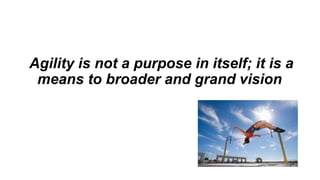
Agility is not a purpose in itself; it is a
means to broader and grand vision
Is Agility only about practices?
• Not practices but being practical 
• Is it about about coherence or collaboration? Its both 
• Is it only for speed ? No its about both speed and stability ,
sustainability
Key Aspects - Agility
Agility – Reflection with life
Key Aspects - Agility
What do you think/feel when you talk to a
5 yr old children?
Starting with “Why”
• Outcome based instead of “Output” based
• Empathize - Customer focused & outcome to the strategy and
vision
• ownership, empowerment, customer centricity
How do we request our peers to do
something?
Instruction on “To-Dos” -> Do we like it or hate it?
People orientation - “Increasing the
Meaning Quotient” of Work
• “Do this” “Why it is important to do this?” – Steering through context & Input
• Empowered teams and not just self-organized team -> What do you think can be
done?
• Handle knowledge rather than handling only people
Journey of our life in past 5-10
years?
• Agility: It rhymes with stability
• Both stable (resilient, reliable, and efficient) and dynamic (fast, nimble,
and adaptive).
• Balance the levers of Stability & Flexibility
Adaptive Leadership
Rapid adoption and adapt to the changes
"It is imperative to make adjustments quickly when things
are not working as planned.
One of the most important findings about successful
leaders of change is the simple fact that they tend to
be very timely in making decisions, solving
problems, removing roadblocks, and fighting the
tyranny of the urgent."
Handle Uncertainties
If it is uncertain, how am I prepared for it?
• Know the uncertainty that you are handling now and
• foresee the ambiguity you will face
• Don’t plan for it, rather outcome that you need despite those
How many learnt to drive without any
minor incidents or falling or hurting?
Capitalize on Mistakes
• Look back for mistakes to learn
• With experience and guidance, we discover that mistakes can, in
fact, often be turned around and transformed into a positive growth
experience.
• What do we do, then, when a mistake occurs? – handled in different way
provides a means to identify areas that need attention, improve skills,
deepen relationships
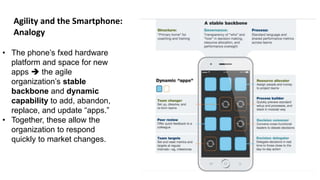
Agility and the Smartphone:
Analogy
• The phone’s fxed hardware
platform and space for new
apps  the agile
organization’s stable
backbone and dynamic
capability to add, abandon,
replace, and update “apps.”
• Together, these allow the
organization to respond
quickly to market changes.
• https://bestselfmedia.com/agility-training/
• http://arianebenefit.com/blog/2011/09/09/agility-8-habits/
• http://arianebenefit.com/
• https://www.td.org/Publications/Magazines/TD/TD-
Archive/2011/09/Training-for-Agility-Building-the-Skills-Employees-Need-
to-Zig-and-Zag
• https://hbr.org/2013/11/emotional-agility
• http://www.mckinsey.com/business-functions/organization/our-
insights/increasing-the-meaning-quotient-of-work
• https://www.raconteur.net/business/agility-takes-the-lead-in-project-
management

Agility for Project Managers

  • 1.
    Embracing Agility Khaarthigha Subramanian ProjectManager, Thoughtworks technologies Pvt. Ltd
  • 2.
    Outline What does Agilityactually means? Why agility is essential? Reflect agility on our life - Let us think about “Being Agile than doing Agile” How we are able to connect this with our work and life ? “Agility in Project Management” Reflect agility at our Work
  • 4.
    How do youdefine agility? • Established businesses around the world and across a range of sectors are striving to emulate the speed, dynamism, and customer centricity of digital players. • Agility is about flexibility and the ability of an organization to rapidly adapt and steer itself in a new direction. “Consistently adaptable” • The aim is to build stronger, more rounded professionals out of all our people. Being agile is not just about changing the IT department or any other function on its own. • The key has been adhering to the “end-to-end principle” focused on solving the client’s needs and united by a common definition of success. • Being Agile also means how people deal with their knowledge complementing with the knowledge of others.
  • 5.
    Agility is nota purpose in itself; it is a means to broader and grand vision
  • 6.
    Is Agility onlyabout practices? • Not practices but being practical  • Is it about about coherence or collaboration? Its both  • Is it only for speed ? No its about both speed and stability , sustainability
  • 7.
  • 8.
    Agility – Reflectionwith life Key Aspects - Agility
  • 9.
    What do youthink/feel when you talk to a 5 yr old children?
  • 10.
    Starting with “Why” •Outcome based instead of “Output” based • Empathize - Customer focused & outcome to the strategy and vision • ownership, empowerment, customer centricity
  • 11.
    How do werequest our peers to do something? Instruction on “To-Dos” -> Do we like it or hate it?
  • 12.
    People orientation -“Increasing the Meaning Quotient” of Work • “Do this” “Why it is important to do this?” – Steering through context & Input • Empowered teams and not just self-organized team -> What do you think can be done? • Handle knowledge rather than handling only people
  • 13.
    Journey of ourlife in past 5-10 years? • Agility: It rhymes with stability • Both stable (resilient, reliable, and efficient) and dynamic (fast, nimble, and adaptive). • Balance the levers of Stability & Flexibility
  • 14.
    Adaptive Leadership Rapid adoptionand adapt to the changes
  • 15.
    "It is imperativeto make adjustments quickly when things are not working as planned. One of the most important findings about successful leaders of change is the simple fact that they tend to be very timely in making decisions, solving problems, removing roadblocks, and fighting the tyranny of the urgent."
  • 16.
    Handle Uncertainties If itis uncertain, how am I prepared for it? • Know the uncertainty that you are handling now and • foresee the ambiguity you will face • Don’t plan for it, rather outcome that you need despite those
  • 17.
    How many learntto drive without any minor incidents or falling or hurting?
  • 18.
    Capitalize on Mistakes •Look back for mistakes to learn • With experience and guidance, we discover that mistakes can, in fact, often be turned around and transformed into a positive growth experience. • What do we do, then, when a mistake occurs? – handled in different way provides a means to identify areas that need attention, improve skills, deepen relationships
  • 20.
    Agility and theSmartphone: Analogy • The phone’s fxed hardware platform and space for new apps  the agile organization’s stable backbone and dynamic capability to add, abandon, replace, and update “apps.” • Together, these allow the organization to respond quickly to market changes.
  • 21.
    • https://bestselfmedia.com/agility-training/ • http://arianebenefit.com/blog/2011/09/09/agility-8-habits/ •http://arianebenefit.com/ • https://www.td.org/Publications/Magazines/TD/TD- Archive/2011/09/Training-for-Agility-Building-the-Skills-Employees-Need- to-Zig-and-Zag • https://hbr.org/2013/11/emotional-agility • http://www.mckinsey.com/business-functions/organization/our- insights/increasing-the-meaning-quotient-of-work • https://www.raconteur.net/business/agility-takes-the-lead-in-project- management

Editor's Notes

  • #3 (Being Agile) Lets forget “What” and “How” and let us focus on “why” ? Let us think about “Being Agile than doing Agile” Agility in our life, thoughts and actions. Are we Agile in our life? “We all have been Agile, in our life, Just a deep thought to be agile in our Professional space”
  • #7 Going Agile has been seen as a fix for many of these - but in fact that's a mistake. No one cares that your development teams are Agile. They can plan and estimate and retro their hearts out, and it doesn't matter. The only thing that matters is Agility - the ability of the organization as a whole to tightly connect strategic decisions to delivery to customers ("tightly" means rapidly and accurately).
  • #8 Going Agile has been seen as a fix for many of these - but in fact that's a mistake. No one cares that your development teams are Agile. They can plan and estimate and retro their hearts out, and it doesn't matter. The only thing that matters is Agility - the ability of the organization as a whole to tightly connect strategic decisions to delivery to customers ("tightly" means rapidly and accurately).
  • #9 Agile -> How many ppl wanted to do something but ended up doing something else as jobs? Wanted to study something Eg:medicine to Engg From organistion x to organisation y From Employee to entrepeneur How many changes that we would faced in life? (in last 5-10 years) Shifted House Shifted Location Taken up different responsibilities and roles ( Married, Became parent) Changes from Parent taking care of us to we taking care of parents
  • #10 Asking them to come up with the items that they think
  • #13 Recognize your patterns We’ve long been interested in work environments that inspire exceptional levels of energy, increase self-confidence, and boost individual productivity. By “meaning,” we and they imply a feeling that what’s happening really matters, that what’s being done has not been done before or that it will make a difference to others. “meaning maker” is a critical role for corporate strategist He observed that people fully employing their core capabilities to meet a goal or challenge created what he called “flow.” More important, he found that individuals who frequently experienced it were more productive and derived greater satisfaction from their work than those who didn’t. They set goals for themselves to increase their capabilities, thereby tapping into a seemingly limitless well of energy. And they expressed a willingness to repeat those activities in which they achieved flow even if they were not being paid to do so.
  • #14 Acting Quickly Swift decisions & focus back both stable (resilient, reliable, and efficient) and dynamic (fast, nimble, and adaptive).  balancing this tension between stability and flexibility is critical: organizational structure, which defines how resources are distributed; governance, which dictates how decisions are made; and processes, which determine how things get done, including the management of performance.
  • #15 How have been when we were responding to changes in our life ? Are we resisting it (or) Were we gng with the flow? Agile -> How many ppl wanted to do something but ended up doing something else as jobs? Wanted to study something Eg:medicine to Engg From organisation x to organisation y From Employee to entrepeneur How many changes that we would faced in life? (in last 5-10 years) Shifted House Shifted Location Taken up different responsibilities and roles ( Married, Became parent) Changes from Parent taking care of us to we taking care of parents
  • #16 Efficient responses. When individuals resist change, the efficiency with which they can adapt is reduced because a part of their attention and time is spent moving away from the direction of progress. When we do not resist and, in fact, are highly adaptable, we can progress toward our goals faster and with fewer diversions. Resistance creates organizational mental garbage that can build up and become a culture you don't want to combat.
  • #17 Uncertainties in Life: How many changes that we would faced in life? (in last 5-10 years) Shifted House Shifted Location Taken up different responsibilities and roles ( Married, Became parent) Changes from Parent taking care of us to we taking care of parents What next ? (in life) Mapping to Project Management:
  • #18 What do we do, then, when a mistake occurs? Are mistakes simply inevitable nuisances that must be accepted and endured? With experience and guidance, we discover that mistakes can, in fact, often be turned around and transformed into a positive growth experiences. When properly handled, mistakes provide a means to identify areas that need attention, improve our skills, deepen our relationships, and open new avenues that may have otherwise remained hidden.
  • #19 Discover how mistakes can be transformed into positive growth experiences. Learn how to use mistakes to identify ways to improve your skills, deepen your ability to collaborate, and reveal new opportunities for contributing to your career growth and your organization’s success. When properly handled, mistakes provide a means to identify areas that need attention, improve our skills, deepen our relationships, and open new avenues that may have otherwise remained hidden.