
Learners
and Learning
Section Four: Text as a context
              for Learning
Writers | Ian Moll, Jill Bradbury, Gisela Winkler,
Maggie Tshule, Merlyn van Voore, Lynne Slonimsky
Editor | John Gultig


The SAIDE Teacher Education Series
Learners and Learning
ISBN 978 0 620 46731 5
© 2010 SAIDE
               This work, a digital version of the SAIDE/Oxford publication of 2002, is
               released under the Creative Commons Attribution 3.0 licence.


1ST EDITION SERIES EDITOR: John Gultig
1ST EDITION AUDIOTAPE: George Lekorotsoana (producer) and John Gultig (concept and script)
DESIGN FOR DIGITAL VERSION: Michelle Randell
ILLUSTRATIONS: Andre Plant

SAIDE	
PO Box 31822	
Braamfontein 2017	
T: (011) 403 2813	
F: (011) 403 2814	
www.saide.org.za; www.oerafrica.org
The first edition was funded by the WK Kellogg foundation. This digital
version has been funded through the International Association of
Digital Publications.
section four


Text as a context
for learning


4.1	 Introduction . ......................................................................................   111
4.2	 How do we enter the world of reading? ....................................   112
4.3	 What makes reading a meaningful experience? ....................   122
4.4	 What kinds of reading support school learning? ...................   126
4.5	 Learning to read better ...................................................................   136
4.6	 Learning to study better .................................................................   139
4.7	 Texts, reading, and OBE . .................................................................   142
4.8	 Conclusion and key learning points ...........................................   145
Introduction                                                                                                          4.1
What will you learn in this section?
As you have discovered, everyday learning is very different from schooling. One of                                  11
the features that distinguishes the two is the centrality of language as an instrument
for school learning. Language allows learners to develop a more generalized and
                                                                                                        Week 11 begins.
systematic understanding of the world.
   We have discussed how teachers make deliberate and powerful interventions in
learning and how these interventions assist learners to bridge the gap between
what they know and what they still need to learn.
   Texts are often used by teachers to evoke and scaffold learning. Texts organize
and systematize knowledge and so play an important role in teaching learners to
think in school-like ways. Because of this, reading is one of the most important
language acts in school learning. We will see that at school a text is often the context
for learning, and the use of school textbooks requires learners to be active and inde-
pendent readers.
   This section will explore the relationship between learners, text, and the world.
We will find out how textbooks are written, how learners read, and how teachers can
assist learners to read critically.


More half-truths to think through
Read through the following assumptions about reading and learning. As before,
make notes about your agreements and disagreements with these half-truths.


                                              These half-truth statements are quite tricky. They seem simple at first, but the
                                                  more you think about them, the more complex the issues become!


	 Statement about learning	 What is true about 	                         What is inaccurate
		                           the statement?	                               or false about
			                                                                       the statement?

Reading is difficult and boring.
All readers will understand the meaning
of a text in exactly the same way.
There is only one way to read.
Textbooks should be read differently to
storybooks.
Children learn to love or hate reading
because of their parents’ attitudes to books.
Reading is only useful for school learning.
Learning through reading is just the same
as learning through talking and listening.
How do we enter the world of
4.2                                reading?
                                   Have you ever noticed that many languages use similar words for ‘reading’, ‘studying’,
                                   or ‘learning’? In Zulu, for example, the word ‘-funda’ can mean all three:
                                   •	 reading a book;
                                   •	 studying at school;
                                   •	 learning how to ride a bicycle.

                                   Even in English, where separate words exist, our mental links between reading and
                                   school learning (studying) are so close that the words can be exchanged. Students
                                   are often described as ‘reading History’ when they study at a university, or as ‘study-
                                   ing a book’ when they read through a book.
                                      Reading seems such an obvious and integrated part of school learning that we
                                   often forget to mention it. For example, in the previous section on school learning,
                                   only a very brief comment is made about the fact that school learning usually
                                   requires us to be literate. Yet there is no subject at school that does not involve
                                   reading, and there isn’t a child who can succeed at school without learning to read.
                                      So all teachers need to understand how the reading process works in order to
                                   make it a meaningful and rewarding activity for their learners. The purpose of this
                                   section is to help you to do that. We will:
                                   •	 explore how learners can successfully enter the world of reading;
                                   •	 look at the power of the written word in influencing the way we think.


                                   Differences between the written and spoken word
                                      Activity 31
                                      1	 Here are a few open-ended sentences about the spoken and the written
                                         word. Complete each sentence in any way you like.
                                      	 a	 The written word mostly ...
Spend about 30 minutes on this        	 b	 The spoken word only ...
activity. The extract comes from      	 c	 Without spoken words ...
M. Donaldson, Children’s Minds
                                      	 d	 The written word can ...
(London, Fontana, 1978), pp.
86–95.                                	 e	 The biggest difference between spoken and written words is …
                                      2	 Now read what Margaret Donaldson says about the differences between
                                         written and spoken language:

                                            ‘As literate adults, we have become so accustomed to the written
                                            word that we seldom stop to think how dramatically it differs from
                                            the spoken one. The spoken word (unless it is recorded) exists for a
                                            brief moment as one element in a tangle of shifting events, […] and
                                            then it fades. The written word endures. It is there on the page,
                                            distinct, lasting. We may return to it tomorrow. […] We can pick it up
                                            and slip it into a pocket or briefcase. Once a child has begun to learn
                                            to read, he can bring his book home from school and read to his
                                            mother the same words which he read to his teacher in the class-
                                            room earlier in the day.
                                                So a child’s first encounter with books provides him with much
                                            more favourable opportunities for becoming aware of language in
                                            its own right than his earlier encounters with the spoken word are
                                            likely to have done. Of course in some homes awareness of the
                                            spoken word is greatly encouraged. Some parents talk about words
text as a context for learning                                                                               113


          to their children, play word games with them and so on. But most
          talk only with words. […]
             For many children the earliest encounter with the written word is
          indirect, arising in the situation where a story is read aloud by an
          adult. This is already in a sense language freed from context; but the
          experience of hearing a story is not so likely to enhance awareness
          [of language] as the direct grappling with words on a page is. […]
             It turns out that those very features of the written word which
          encourage awareness of language may also encourage awareness
          of one’s own thinking and thus be relevant to the development of
          intellectual self-control. This has important consequences for the
          development of the kinds of thinking which are characteristic of
          logic, mathematics, and the sciences.’

   3	 Answer the following questions:
   	 a	What, according to Donaldson, is the most important difference
        between spoken and written language?
   	 b	What do you think it means to become ‘aware of language in its own
        right’?
   	 c	What is the significance of the distinction between spoken and written
        language for learning? (In addition to the last paragraph of
        Donaldson’s extract, it may also help you to look again at the discus-
        sion of discourse in Section Three on pages 83–91.)
   	 d	Donaldson makes the strong claim that reading has ‘important
        consequences for the development of kinds of thinking’. What do
        you think the relationship between reading and thinking is? Make
        some notes in your workbook. We will return to this question again at                  Reading, like
        the end of the section.                                                            learning, begins with
                                                                                             the mystery of the
                                                                                                 unknown.
What did we think?
Donaldson draws our attention to the fact that written words (as opposed to spoken
ones) are made permanent on paper or in books. As a result, books take on a life of
their own where experiences exist in and through language alone. Only by paying
attention to the language can we begin to unravel the meaning of the written
words.
   Think, for instance, of those who can’t read. For them the words on a page are
simply dead little black marks. As a literate person you might have experienced
similar feelings when looking at a sheet of music, or some scientific formula.
Musicians hear music when they read the notes on a music sheet. A formula creates
a whole world, a whole new concept, for the mathematician. But for us? These nota-
tions are just dead little black marks!
   However, for those who can ‘crack the code’, each little mark will help to reveal the
world within the book. In this sense, reading is a more active process than listening,
and it relies on an understanding of an abstract code. Readers must be able to inter-
pret letters and understand how these are formed into words and sentences.
   Reading, like learning, begins with the mystery of the unknown. At first there is a
huge gap between the world of the reader and the world of the book. At school
these two worlds exist together in the same place, but they do not necessarily meet.
Since written words are completely separated from our lives, we can look at them
and not be part of the experience they present.
   So how can we enter the world of reading?
114                                                                                 text as a context for learning


                        What happens when we read a book?
                           Activity 32
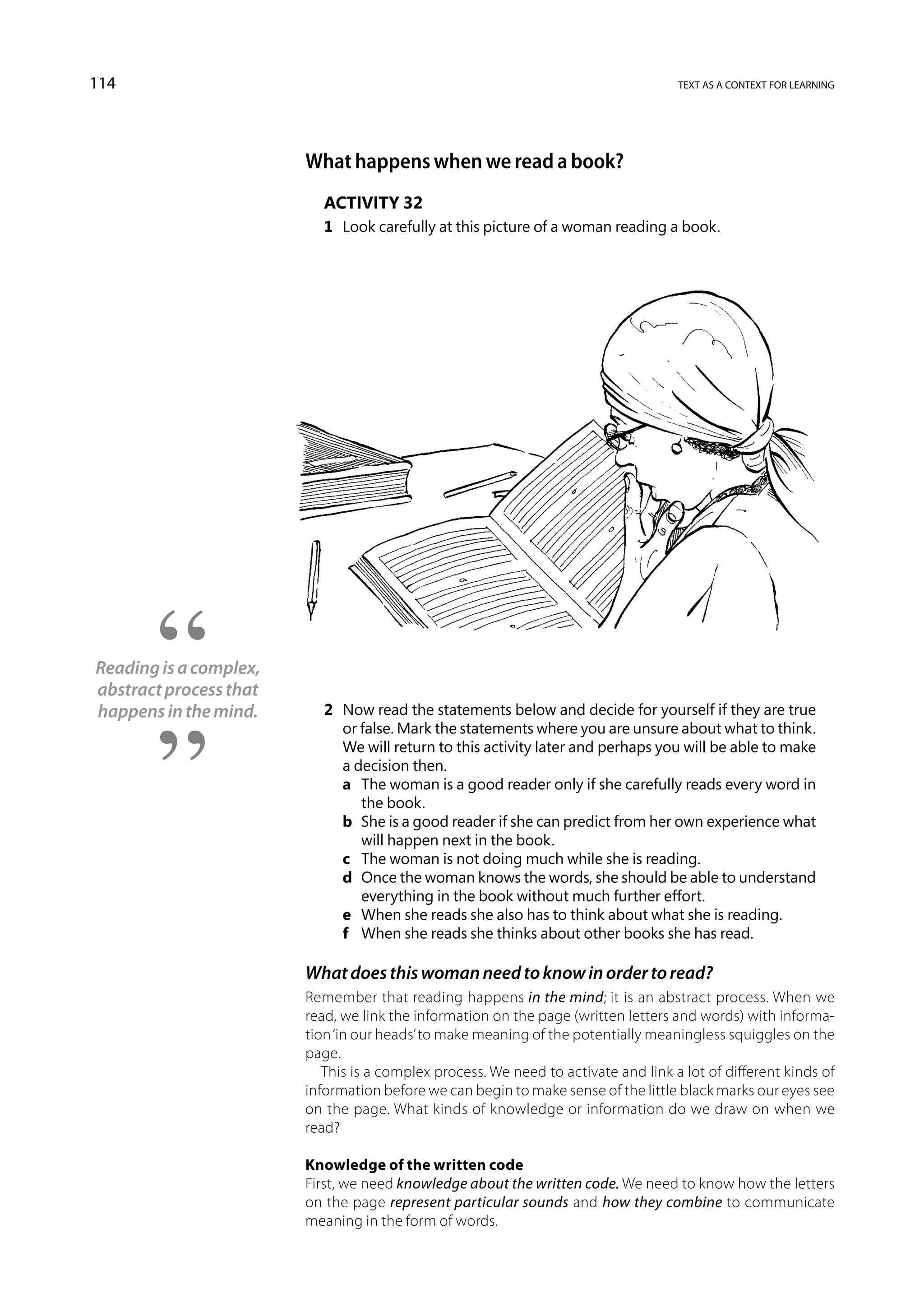
                           1	 Look carefully at this picture of a woman reading a book.


Reading is a complex,
abstract process that
happens in the mind.       2	 Now read the statements below and decide for yourself if they are true
                              or false. Mark the statements where you are unsure about what to think.
                              We will return to this activity later and perhaps you will be able to make
                              a decision then.
                           	 a	 The woman is a good reader only if she carefully reads every word in
                                 the book.
                           	 b	 She is a good reader if she can predict from her own experience what
                                 will happen next in the book.
                           	 c	 The woman is not doing much while she is reading.
                           	 d	 Once the woman knows the words, she should be able to understand
                                 everything in the book without much further effort.
                           	 e	 When she reads she also has to think about what she is reading.
                           	 f	 When she reads she thinks about other books she has read.

                        What does this woman need to know in order to read?
                        Remember that reading happens in the mind; it is an abstract process. When we
                        read, we link the information on the page (written letters and words) with informa-
                        tion ‘in our heads’ to make meaning of the potentially meaningless squiggles on the
                        page.
                           This is a complex process. We need to activate and link a lot of different kinds of
                        information before we can begin to make sense of the little black marks our eyes see
                        on the page. What kinds of knowledge or information do we draw on when we
                        read?

                        Knowledge of the written code
                        First, we need knowledge about the written code. We need to know how the letters
                        on the page represent particular sounds and how they combine to communicate
                        meaning in the form of words.
text as a context for learning                                                                         115


  For example, we need to recognize that ‘d’ sounds like ‘duh’, and that if it is
combined with ‘o’ and ‘g’ we have a word ‘dog’ that describes an animal many of us
keep at home. (We should also know that if we reverse these letters – ‘g’ + ‘o’ + ‘d’ – we
have a word that means something very different!)

Knowledge of the language
Second, we need knowledge of the language in which we read. Even if we can sound
out words correctly, they will remain meaningless if we do not know the language
of which they are a part.
   So, for instance, our example of ‘dog’ is only meaningful for those who can speak
English. Likewise, an isiZulu word like ‘funda’ is easy enough to sound out (although
we would probably pronounce it with an English accent), but if we don’t know
isiZulu, we won’t know what the word means even though we recognize all the
letters.
   In South Africa many students do a lot of their reading in English, which is their
second language. This obviously creates additional barriers and difficulties in the
reading process.
   Becoming familiar with the language in spoken form is also important for the
reading process as it enables us to develop an ‘ear’ for the language. This gives us a
basis from which to guess the sounds and meanings of new, unfamiliar words
encountered in text.
   However, knowing the language in which we read doesn’t only entail knowing
English or Zulu or Spanish. It also involves becoming familiar with the terms and
special discourse of the learning area in which we are reading. Many of us might be
very fluent in English but unable to understand a scientific text because it uses
specialist terminology and often uses common words differently from the way in
which they are used in everyday language. You are now in the process of learning
the language of learning as you read this module.

Knowledge of the rules of writing
Third, we need knowledge about the rules of writing. Even if we can sound out words
and know what they mean, we must relate the words to each other in a meaningful
way.
   We must be able to link the words we read into a larger network or structure. The
meaning of a text is not only about the parts but also, importantly, about the whole.
The way in which words are combined in sentences, paragraphs, and perhaps
sections with headings, develops a particular meaning.
   Throughout this text we have emphasized the importance of understanding how
different ideas link together to create a network of ideas or a concept. For example,
at the simplest level, a sentence like ‘The ball is in the net’ tells us, firstly, about the
relationship between the ‘ball’ and the ‘net’ (it is ‘in’ the net, not ‘on’ it or ‘next to’ it). But
secondly, if we are soccer fans, then the relationship between the ‘ball’ and the ‘net’
takes on new significance. It means that a goal has been scored.
   This is a simple way of moving into the next point. We also need to recognize the
kind of text (or genre) that we are reading – a textbook, a story, a newspaper article
etc. – in order to make meaning of a sentence or network of sentences. The sentence
‘The ball is in the net’ on the news or soccer pages of a newspaper means that a goal
has been scored.
   Equally though, we would read a textbook on soccer (or anything else) differently
from a story or newspaper article on soccer. Different kinds of texts need to be read,
and are read or interpreted, in different ways.
116                                                                                                text as a context for learning


                                    Knowledge of the world and how it works
                                    Fourth, we need knowledge of the world and how it works. In written text, experi-
                                    ences exist in and through language alone, and so we need to make links actively
                                    between the language of experience and what we actually see, hear, and feel in the
                                    world.
                                      For example, when we read about children waiting for a bus on a warm day, we
                                    will only ‘live’ the experience of that waiting if we can imagine the situation by
                                    drawing on our own experiences or what we already know. (As South Africans, we
                                    will probably imagine a hot, sweaty, possibly dusty wait. Canadians, on the other
                                    hand, may imagine a cold, snowy wait!)

                                    To summarize
                                    •	 Becoming a good reader means learning to ‘crack the code’.
                                    •	 In order to do this, we must know the alphabet and the language in which the text
                                       is written and recognize what kind of text it is. We should be able to tell if we are
                                       reading a story, a letter, or part of a textbook and what we can expect from each
                                       kind of writing. (What can you expect from a story that you cannot expect from a
                                       textbook?)
                                    •	 Finally, we need knowledge of the world so that we can bring our own experi-
                                       ences to the text and make it come alive. The richer our own life experiences are,
                                       the more colourful and vibrant the world of books can become.


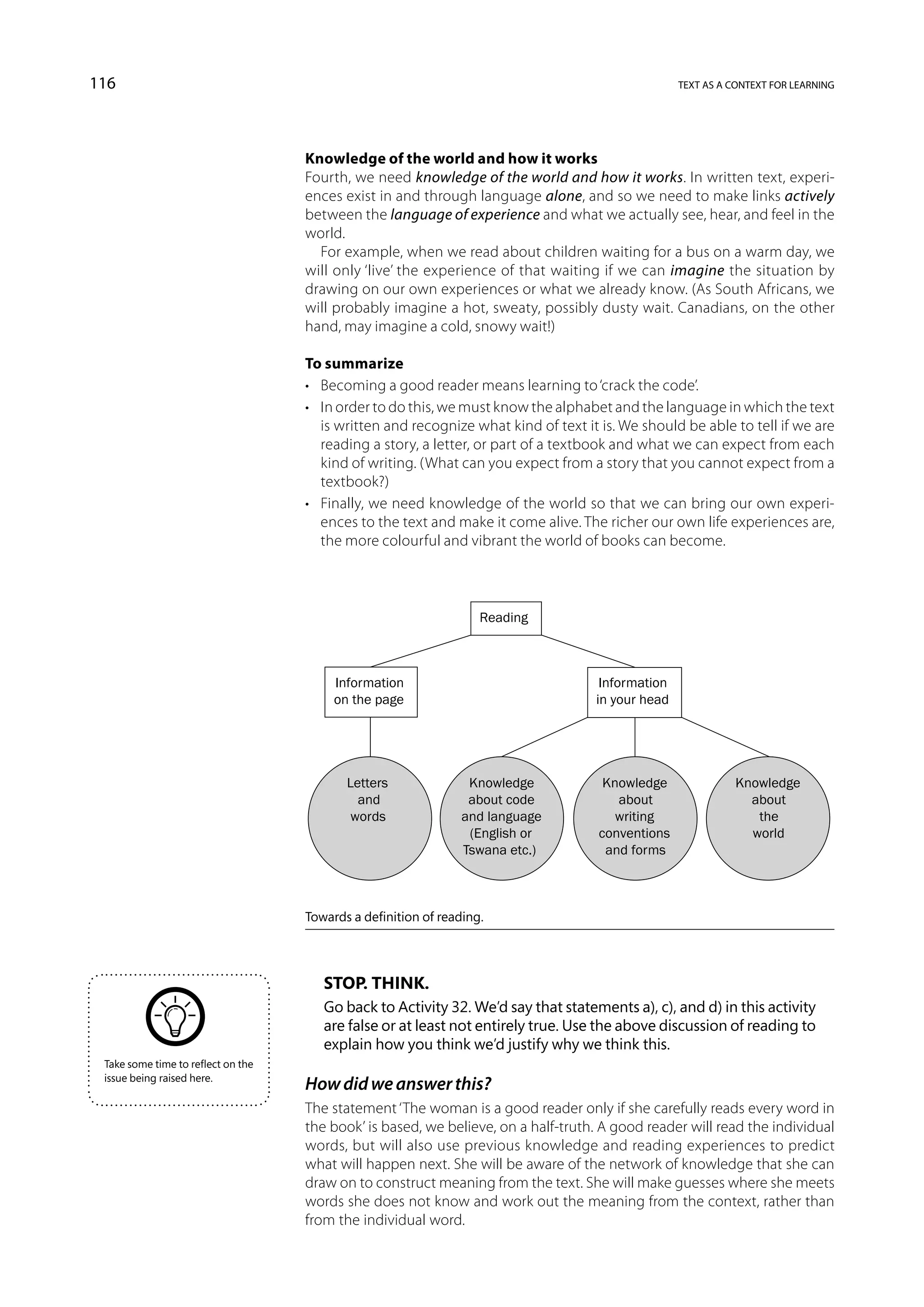
                                                                   Reading


                                         Information                                 Information
                                         on the page                                in your head


                                           Letters               Knowledge           Knowledge               Knowledge
                                             and                 about code            about                   about
                                            words               and language           writing                  the
                                                                 (English or        conventions                world
                                                                Tswana etc.)         and forms


                                    Towards a definition of reading.


                                       Stop. Think.
                                       Go back to Activity 32. We’d say that statements a), c), and d) in this activity
                                       are false or at least not entirely true. Use the above discussion of reading to
                                       explain how you think we’d justify why we think this.
 Take some time to reflect on the
 issue being raised here.
                                    How did we answer this?
                                    The statement ‘The woman is a good reader only if she carefully reads every word in
                                    the book’ is based, we believe, on a half-truth. A good reader will read the individual
                                    words, but will also use previous knowledge and reading experiences to predict
                                    what will happen next. She will be aware of the network of knowledge that she can
                                    draw on to construct meaning from the text. She will make guesses where she meets
                                    words she does not know and work out the meaning from the context, rather than
                                    from the individual word.
text as a context for learning                                                                                 117


   The statement ‘The woman is not doing much while she is reading’ is false. As we
found out earlier, reading is a complex activity of the mind that involves using many
different skills all at once. Although the woman is sitting quietly, her mind is very
active. She is relating the information on the page to her knowledge of the language,
and of the world, and of previous books she might have read in order to make
meaning of the text.
   Knowing the words is only a small part of reading so a statement like ‘Once the
woman knows the words, she should be able to understand everything in the book
at once’ is also false. If the words do not link up with a meaningful experience, the
woman can read the words off the page, but she might still not understand what the
book is about.
   Reading is an active process that can change from one sitting to the next. As the
interconnections and links we make between words (and also between the text and
our own lives and other texts that we have read) change, our understanding can
become more layered and complex each time we reread a book.

What do we do when we read?
In Section Two we discovered that knowledge is a network of interconnected infor-
mation and that the relationships between different facts are as important as the
facts themselves. We also realized that we can only bridge the gap between the
known and the unknown by using what we know to construct links for ourselves.              Reading is hard work
This process enables us to guess, question, and imagine the unknown.                      and can be exhausting,
   When we compare these insights to the discussion on reading above, we notice           especially if our experi-
many similarities:                                                                          ence of the world is
•	 First, reading is also about networking and making links between different kinds         very different to the
   of knowledge we already have. The relationships between headings, sentences,           world of the text we are
   or paragraphs are as important as the meaning of individual words.
                                                                                              reading about.
•	 Second, when we read we also have to construct the as yet unknown meaning of
   the text by using what we already know about books and the world. Reading
   presents us with a particular case of moving from the known to the unknown.


Why is reading so difficult?
Not all of us who read, however, enjoy the experience. Reading is hard work and can
be exhausting, especially if our experience of the world is very different to the world
of the text we are reading.
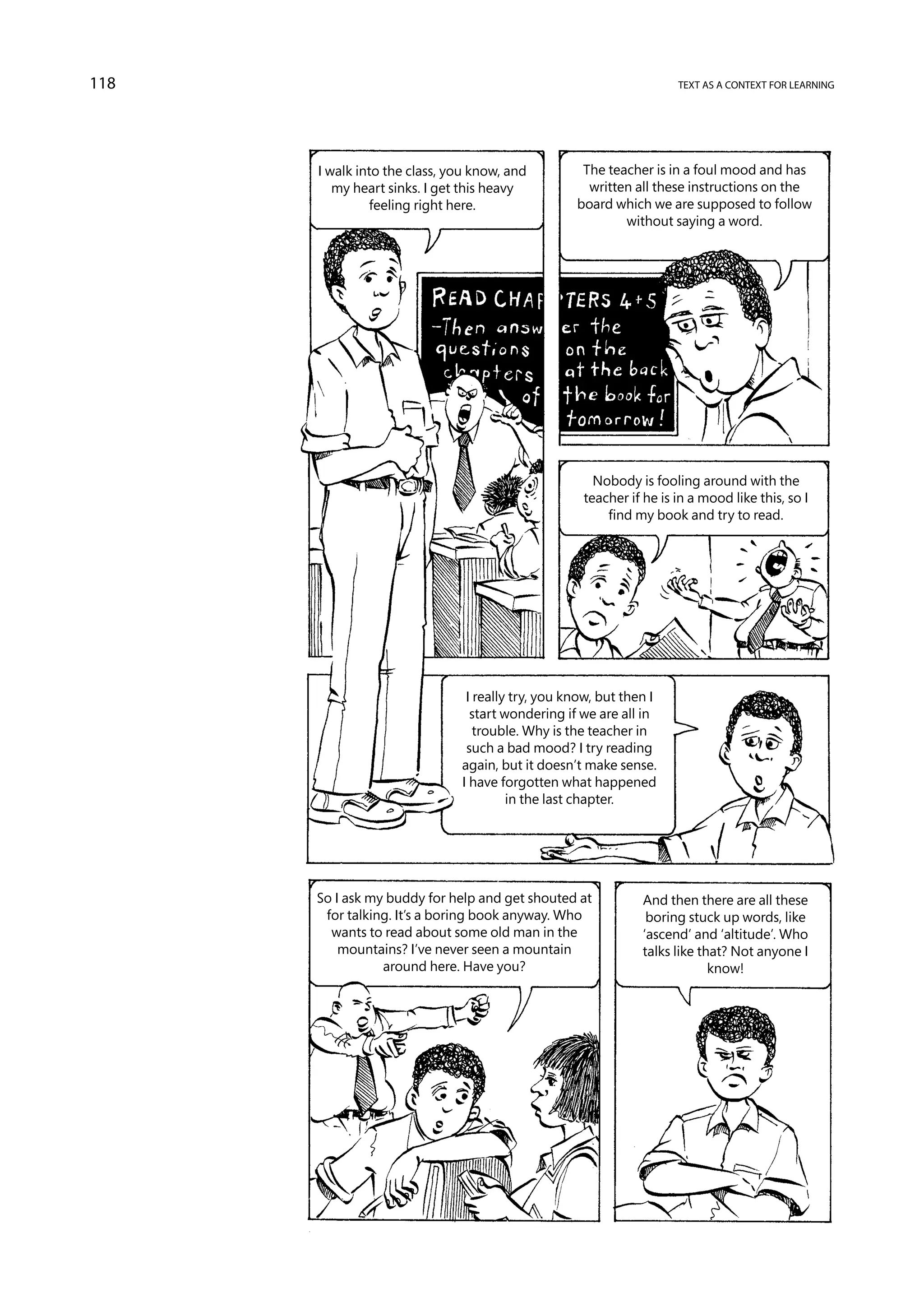
   Look at the following comment by a fifteen-year-old learner, Mike. He describes
what happened when he was supposed to read a book in class. As you read his story,
try to identify at least two reasons why Mike is not interacting with the book he is
supposed to be reading.
   We have represented his thoughts as a cartoon strip on the next two pages.
118                                                                 text as a context for learning


      I walk into the class, you know, and         The teacher is in a foul mood and has
         my heart sinks. I get this heavy           written all these instructions on the
               feeling right here.                board which we are supposed to follow
                                                          without saying a word.


                                                     Nobody is fooling around with the
                                                   teacher if he is in a mood like this, so I
                                                       find my book and try to read.


                               I really try, you know, but then I
                                start wondering if we are all in
                                 trouble. Why is the teacher in
                               such a bad mood? I try reading
                              again, but it doesn’t make sense.
                              I have forgotten what happened
                                       in the last chapter.


      So I ask my buddy for help and get shouted at           And then there are all these
       for talking. It’s a boring book anyway. Who             boring stuck up words, like
        wants to read about some old man in the               ‘ascend’ and ‘altitude’. Who
          mountains? I’ve never seen a mountain               talks like that? Not anyone I
                 around here. Have you?                                    know!
text as a context for learning                                                                                            119


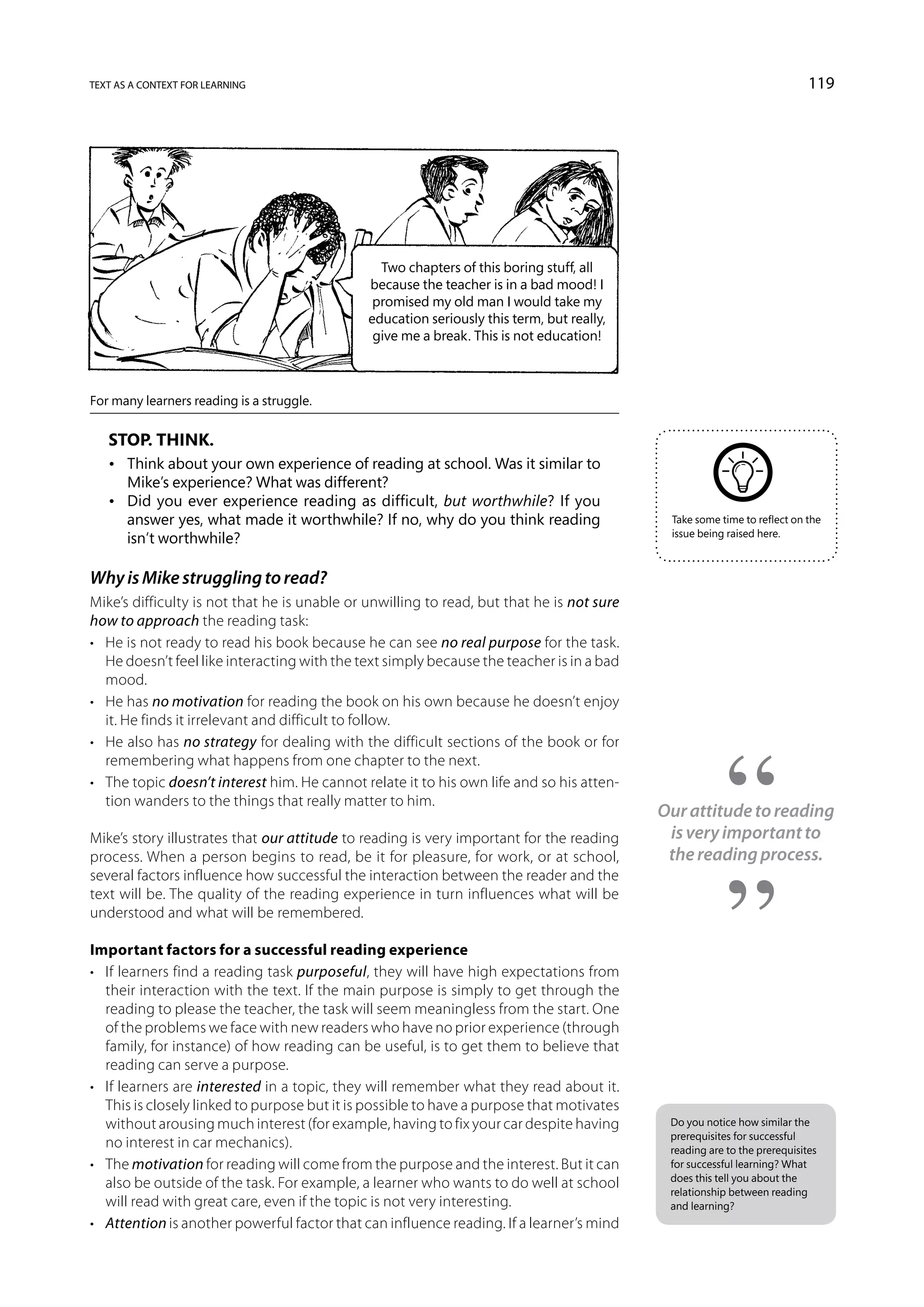
                                                Two chapters of this boring stuff, all
                                              because the teacher is in a bad mood! I
                                               promised my old man I would take my
                                              education seriously this term, but really,
                                               give me a break. This is not education!


For many learners reading is a struggle.


   Stop. Think.
   •	 Think about your own experience of reading at school. Was it similar to
      Mike’s experience? What was different?
   •	 Did you ever experience reading as difficult, but worthwhile? If you
      answer yes, what made it worthwhile? If no, why do you think reading                  Take some time to reflect on the
                                                                                            issue being raised here.
      isn’t worthwhile?

Why is Mike struggling to read?
Mike’s difficulty is not that he is unable or unwilling to read, but that he is not sure
how to approach the reading task:
•	 He is not ready to read his book because he can see no real purpose for the task.
   He doesn’t feel like interacting with the text simply because the teacher is in a bad
   mood.
•	 He has no motivation for reading the book on his own because he doesn’t enjoy
   it. He finds it irrelevant and difficult to follow.
•	 He also has no strategy for dealing with the difficult sections of the book or for
   remembering what happens from one chapter to the next.
•	 The topic doesn’t interest him. He cannot relate it to his own life and so his atten-
   tion wanders to the things that really matter to him.
                                                                                           Our attitude to reading
Mike’s story illustrates that our attitude to reading is very important for the reading     is very important to
process. When a person begins to read, be it for pleasure, for work, or at school,          the reading process.
several factors influence how successful the interaction between the reader and the
text will be. The quality of the reading experience in turn influences what will be
understood and what will be remembered.

Important factors for a successful reading experience
•	 If learners find a reading task purposeful, they will have high expectations from
   their interaction with the text. If the main purpose is simply to get through the
   reading to please the teacher, the task will seem meaningless from the start. One
   of the problems we face with new readers who have no prior experience (through
   family, for instance) of how reading can be useful, is to get them to believe that
   reading can serve a purpose.
•	 If learners are interested in a topic, they will remember what they read about it.
   This is closely linked to purpose but it is possible to have a purpose that motivates
   without arousing much interest (for example, having to fix your car despite having       Do you notice how similar the
                                                                                            prerequisites for successful
   no interest in car mechanics).                                                           reading are to the prerequisites
•	 The motivation for reading will come from the purpose and the interest. But it can       for successful learning? What
                                                                                            does this tell you about the
   also be outside of the task. For example, a learner who wants to do well at school
                                                                                            relationship between reading
   will read with great care, even if the topic is not very interesting.                    and learning?
•	 Attention is another powerful factor that can influence reading. If a learner’s mind
120                                                                                                     text as a context for learning


                                         is on other things, it will be difficult to make sense of the reading even if the topic
                                         is interesting and the learner knows why it is important to read it (he or she has a
                                         purpose).
                                      •	 A good reading strategy (like asking questions or predicting) can help learners to
                                         focus their interest and attention on the reading, even if it is difficult. This is an
                                         important way of overcoming distractions.
                                      •	 Making meaningful links between the text and our existing knowledge will influ-
                                         ence how successful the reading experience will be. (This is why we have tried to
                                         use familiar analogies in this text but, more importantly, why we have asked you
                                         to constantly relate ideas to your lives and practices as teachers.)

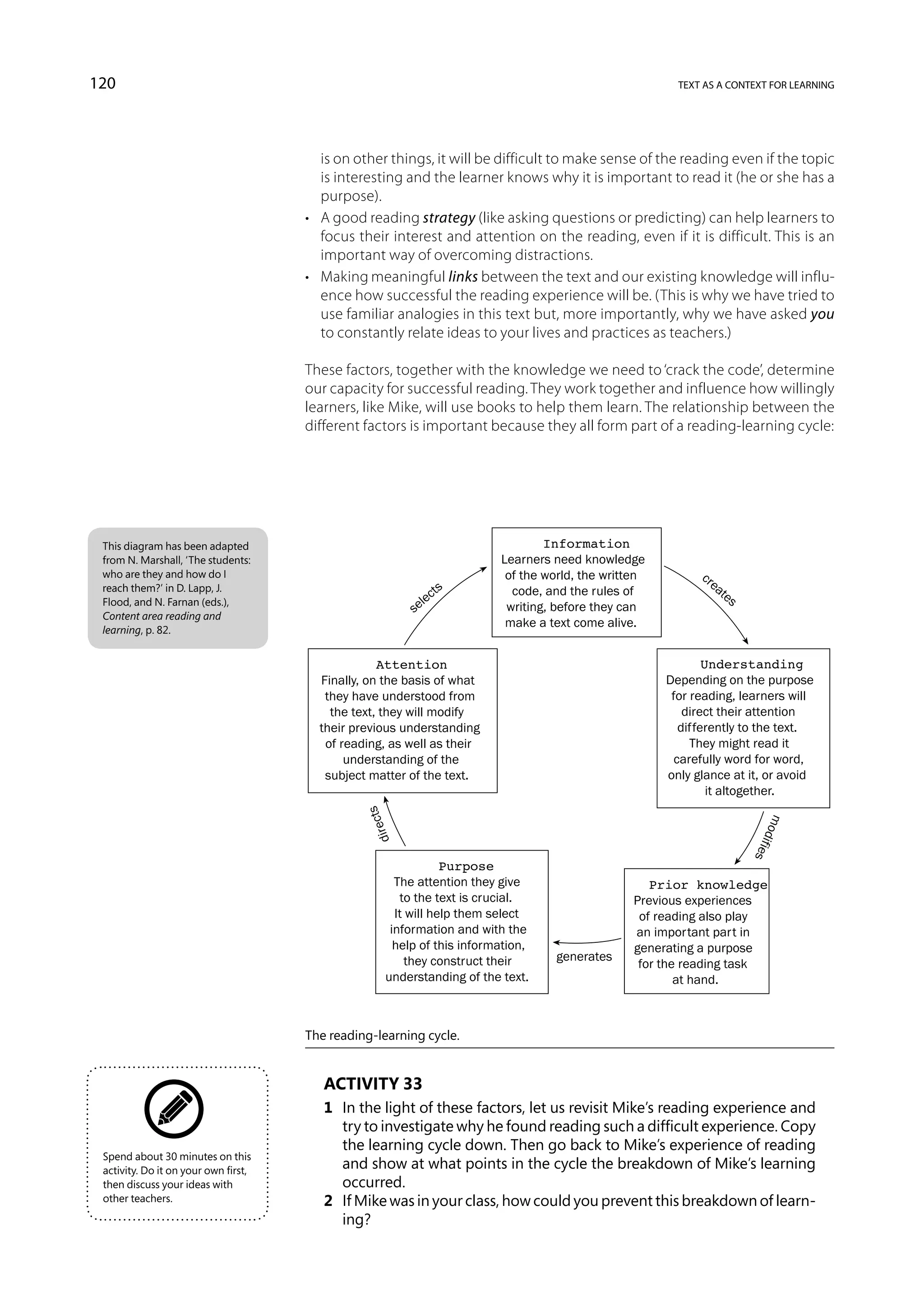
                                      These factors, together with the knowledge we need to ‘crack the code’, determine
                                      our capacity for successful reading. They work together and influence how willingly
                                      learners, like Mike, will use books to help them learn. The relationship between the
                                      different factors is important because they all form part of a reading-learning cycle:


 This diagram has been adapted                                                   Information
 from N. Marshall, ‘The students:                                        Learners need knowledge
 who are they and how do I                                                of the world, the written         cr
 reach them?’ in D. Lapp, J.                                       s                                             ea
                                                              ct           code, and the rules of                   tes
 Flood, and N. Farnan (eds.),
                                                          sele            writing, before they can
 Content area reading and
                                                                          make a text come alive.
 learning, p. 82.


                                                   Attention                                                  Understanding
                                        Finally, on the basis of what                                 Depending on the purpose
                                         they have understood from                                     for reading, learners will
                                          the text, they will modify                                      direct their attention
                                        their previous understanding                                     differently to the text.
                                         of reading, as well as their                                      They might read it
                                             understanding of the                                       carefully word for word,
                                         subject matter of the text.                                  only glance at it, or avoid
                                                                                                               it altogether.
                                                    cts


                                                                                                                          mo
                                                dire


                                                                                                                            difi
                                                                                                                          es


                                                                Purpose
                                                      The attention they give                      Prior knowledge
                                                       to the text is crucial.                  Previous experiences
                                                      It will help them select                   of reading also play
                                                     information and with the                   an important part in
                                                      help of this information,                 generating a purpose
                                                         they construct their     generates
                                                                                                 for the reading task
                                                    understanding of the text.                          at hand.


                                      The reading-learning cycle.


                                         Activity 33
                                         1	 In the light of these factors, let us revisit Mike’s reading experience and
                                            try to investigate why he found reading such a difficult experience. Copy
                                            the learning cycle down. Then go back to Mike’s experience of reading
 Spend about 30 minutes on this
 activity. Do it on your own first,         and show at what points in the cycle the breakdown of Mike’s learning
 then discuss your ideas with               occurred.
 other teachers.                         2	 If Mike was in your class, how could you prevent this breakdown of learn-
                                            ing?
text as a context for learning                                                             121


What did we think?
We discussed earlier that reading is an activity of the mind.
    By plotting Mike’s reading experience on the learning cycle we can see clearly
how involved the learner must be. The real breakdown in Mike’s learning occurred at
the point where he could not be bothered to read and so the gap between him and
the text couldn’t be bridged. He didn’t read, so he didn’t understand and didn’t learn
anything new.
    Although, technically speaking, Mike is literate and at school, he isn’t reading and
he isn’t learning. Reading has become a meaningless experience for him (as it is for
many other South African learners). As teachers, we need to recognize that reading
is inherently difficult (think about your own struggles with various texts – perhaps
even this module text).


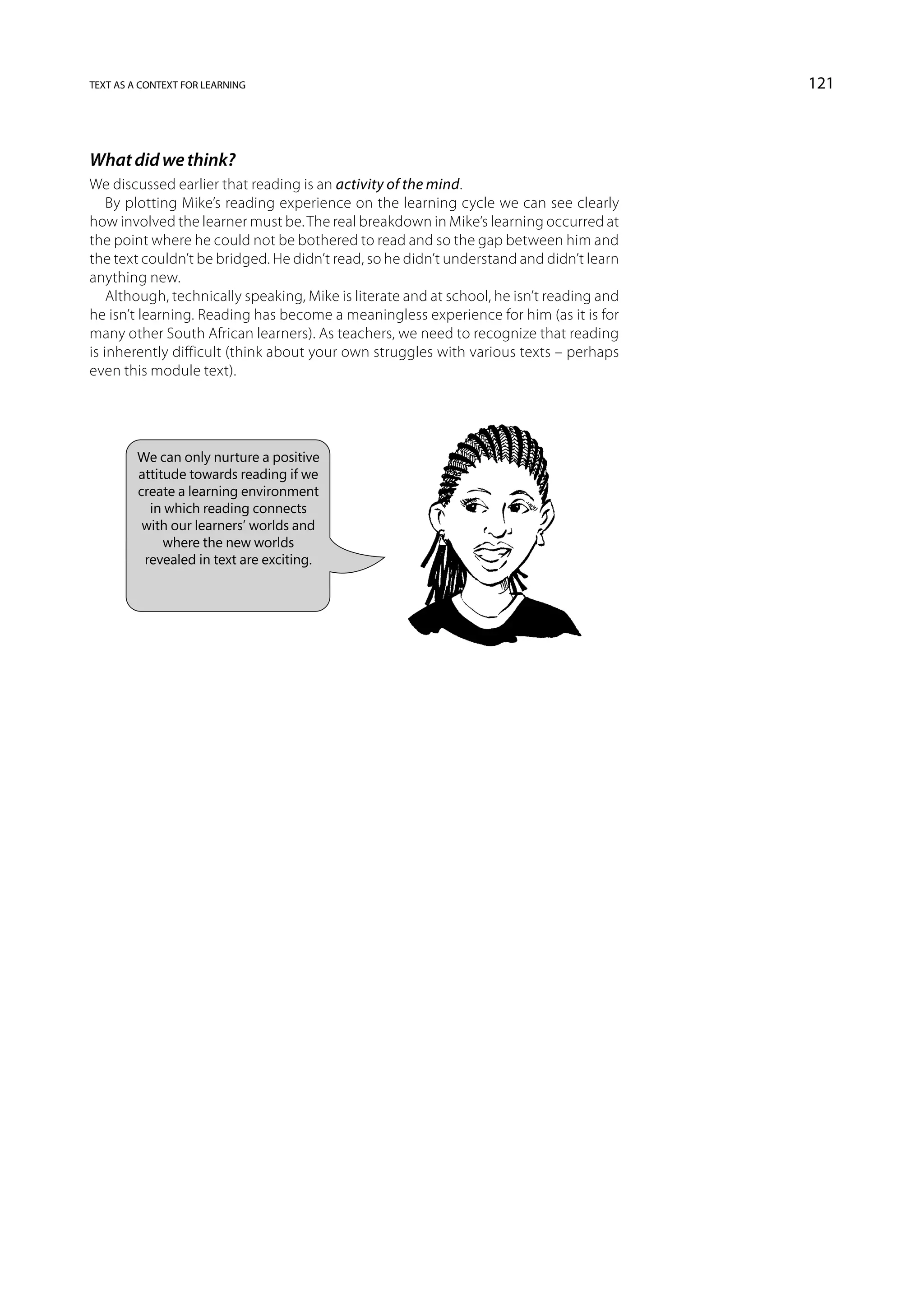
         We can only nurture a positive
         attitude towards reading if we
         create a learning environment
           in which reading connects
          with our learners’ worlds and
              where the new worlds
          revealed in text are exciting.
What makes reading a
4.3   meaningful experience?
      Not all learners approach a reading task with a positive attitude. Their interest, moti-
      vation, and skill will vary greatly, depending on their previous reading experiences.
      One factor, however, stands out as very important: The attitudes towards reading
      which learners bring to the classroom will have an important influence on how and
      what they will read in future.
        With support and guidance, most learners can experience how the books they
      read at school will open a new and exciting world of ideas and transport them far
      beyond the limited world of their everyday experience. In Activity 34 you will be
      working with the following poem that demonstrates this idea. It was written by a
      ten-year-old school boy in Cape Town.


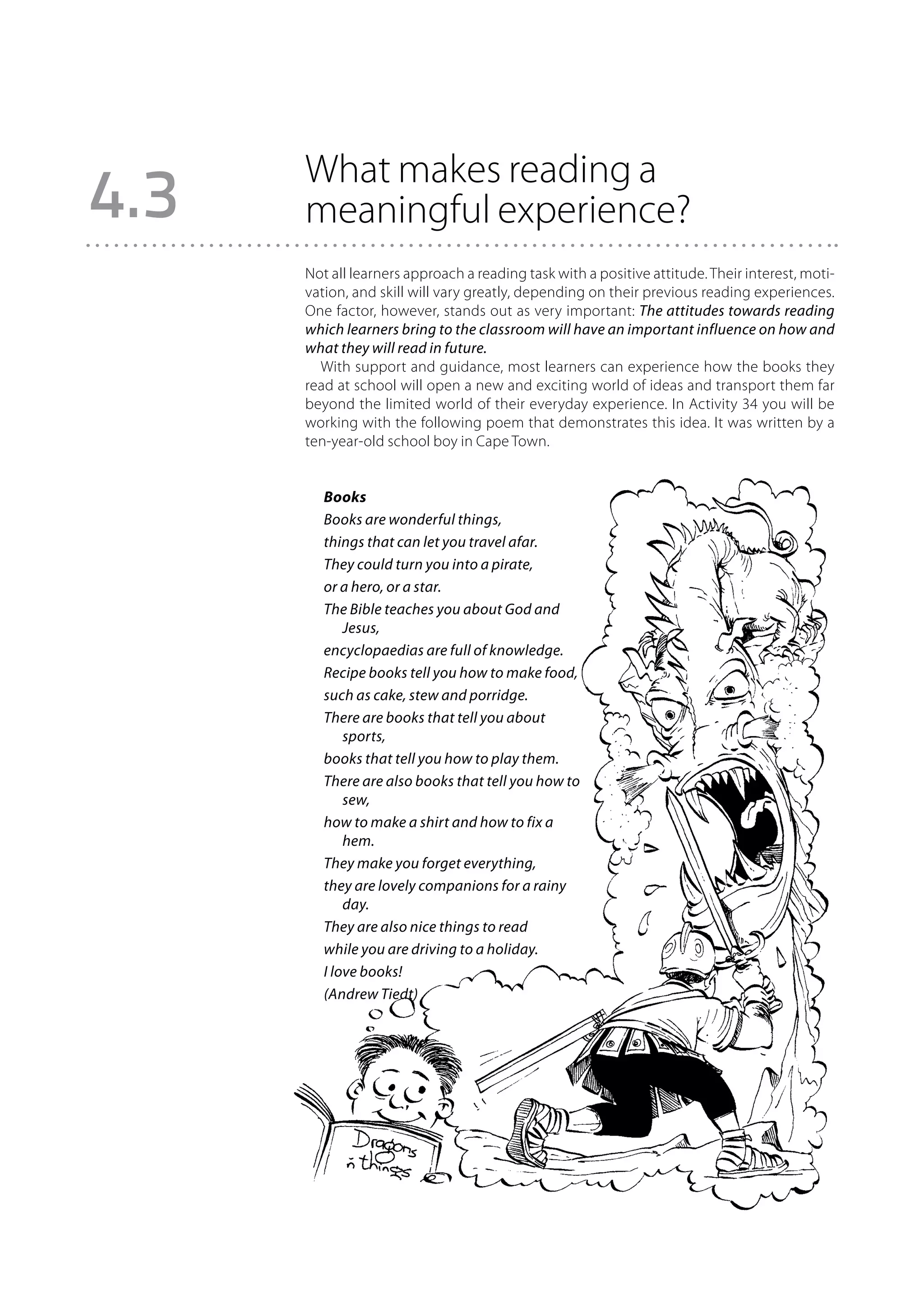
         Books
         Books are wonderful things,
         things that can let you travel afar.
         They could turn you into a pirate,
         or a hero, or a star.
         The Bible teaches you about God and
             Jesus,
         encyclopaedias are full of knowledge.
         Recipe books tell you how to make food,
         such as cake, stew and porridge.
         There are books that tell you about
             sports,
         books that tell you how to play them.
         There are also books that tell you how to
             sew,
         how to make a shirt and how to fix a
             hem.
         They make you forget everything,
         they are lovely companions for a rainy
             day.
         They are also nice things to read
         while you are driving to a holiday.
         I love books!
         (Andrew Tiedt)
text as a context for learning                                                                                           123


As teachers, we should never take reading for granted:
•	 When learners come to class with a negative attitude, we have to take their strug-
   gle with reading seriously and help them experience reading as a meaningful
   activity.
•	 When learners have had good reading experiences, it is our responsibility to make
   sure that the reading experiences we give them in class continue to strengthen
   their positive attitude towards the written word.

   Activity 34
   1	 In his poem on page 122, Andrew describes many things that books can
      do for people who read them. Reread the poem. Pick out examples that
      will allow you to comment on his attitude to reading.
   2	 Now answer these questions:                                                        Spend about 30 minutes on this
                                                                                         activity. First read the poem.
   	 a	 How does Andrew’s attitude to books compare with Mike’s?                         Then listen to its spoken form
   	 b	 How could we go about generating or encouraging this love of books              on your audiotape. You will find
         where it doesn’t exist?                                                         it at the beginning of Part 4 of
                                                                                         your tape. Listen to all of Part 4.
   	 c	 How can we use this love of reading to teach that which is as yet               In it you will hear Ian Moll
         unknown and beyond the learners’ interest?                                      explain why reading is
   	 d	 Are there any differences between the written and spoken forms of               important in school learning,
                                                                                         and Yvonne Reed give us some
         this poem?                                                                      ideas about how we can teach
                                                                                         people to read. Use these ideas
                                                                                         to inform your answers to
                                                                                         question 2. The poem is taken
The ‘magic’ of books                                                                     from the Molo Songololo
                                                                                         magazine (Issue 86, July–
                                                                                         August, 1994), p.16.
Unlike Mike, Andrew has clearly experienced a supportive learning environment
that helped him to enter the world of reading and learn from it. He has experienced
books as useful and exciting things. Andrew understands how they can assist him to
learn, and how they can simply bring joy.
   The poem also illustrates that the ‘magic’ of books is an important factor that
helps children to experience reading as a meaningful activity. For Andrew, books are
like friends that can turn him into a pirate, or keep him company on a rainy day or on
a long journey. In their book, On Learning to Read, Bettelheim and Zelan claim:

       ‘What is required for a child to be eager to learn to read is not knowledge
       about reading’s usefulness, but a fervent belief that being able to read
       will open to him a world of wonderful experiences, permit him to shed
       ignorance, understand the world, and become a master of his fate.’

   Activity 35
   1	 Turn to Reading 15 and read the extract by Bettelheim and Zelan called
      ‘The magic of reading’. Before you read the extract, carefully think about
      your own experience of learning to read.
   	 a	 What motivated you to learn to read?                                            Spend about an hour on this
   	 b	 Did you experience reading as a magical thing?                                   activity. Read the extract on
                                                                                         your own first, then meet with
   	 c	 Who supported you? Where did you struggle?                                       fellow learners and discuss
   	 d	 What was the attitude of your parents to reading?                                Bettelheim and Zelan’s ideas.
   2	 Read the extract by Bettelheim and Zelan and make notes about the
      factors that motivate children to read.
   3	 Now use Bettelheim and Zelan’s language or discourse to redescribe
      your experience in these more formal terms.
124                                                                text as a context for learning


      What did we think?
      We have all had unique experiences in learning to read. You may remember a favour-
      ite book, or have a fond memory of a special relationship with a parent or teacher
      that centred on books, or recall a less pleasant experience of anxiety or boredom in
      your first classroom.
         While we have all had unique experiences, we have also all had some common
      experiences of reading. As we suggested earlier, we only learn to read if reading
      seems purposeful and meaningful. Reading must give children the feeling that new
      worlds are opening before them. Only then can it be seen as the key to unlimited
      knowledge.
         Bettelheim and Zelan argue that a positive attitude to reading grows out of a
      child’s experience of how adults enjoy books. Children who have never shared the
      enjoyment of books with anyone will not believe that reading is important. In the
      end, it is the ‘wish to penetrate […] the important secrets adults possess’ that helps
      children to persist in the struggle of learning to read. Without this desire, as Mike’s
      experience so clearly shows, the act of reading seems meaningless from the start.
         This has important implications for teaching reading in South Africa. Many learn-
      ers come from homes which have no books, and where parents have been denied
      (by our history) the joy of literacy. So they enter schools with no model of reading as
      a joyful and meaningful activity. At school, they often encounter teachers who also
      don’t read and don’t see any point in reading. Many studies have pointed to the fact
      that teachers don’t read enough and don’t encourage reading in schools. So, both at
      home and at school, reading isn’t ‘modelled’.


                                                     In order to teach reading, teachers
                                                     need to start by actively extending
                                                      their own reading activities. They
                                                   should read more, read different kinds
                                                    of things, and then communicate this
                                                     personal world of active reading to
                                                  learners. This will encourage children to
                                                       see reading as something that is
                                                     pleasurable and useful beyond the
                                                                classroom walls.


      Bettelheim and Zelan argue that the kind of encouragement teachers and parents
      often use with learners, namely that reading will help you get ahead in life, is a very
      weak persuasive tool. They say that ‘usefulness’ isn’t something that motivates young
      learners. Instead, they suggest, we read (and children, in particular, read) because
      we are promised trips to magical lands. It is the fantasy that reading brings – the
      imaginative stories that books carry – that motivates us to read. This is what teachers
      need to communicate to learners, both in words and in actions.
         Bettelheim has often been criticized for being too ‘psychological’ and ‘magical’ in
      his description of reading. For example, although he talks about the importance of
      reading parents, he does not elaborate the extent to which reading and writing are
      social activities beyond the rather private space of the family. The political and
      economic dynamics of the society we live in can have a powerful influence on our
      attitude to reading, on our opportunities for reading, and on the uses that we can
      make of reading in our everyday life.
         What do you think?
text as a context for learning                                                                                                           125


   Activity 36
   1	 Read this newspaper report on the first ‘All Africa Conference on
      Children’s Reading’. Do you recognize any of Bettelheim and Zelan’s
      argument in this report?                                                                                Spend about 45 minutes on this
                                                                                                              activity.


Literacy lovers needed
FIRST ALL AFRICA CONFERENCE ON CHILDREN’S READING FINDS TEACHERS LACKING


   Elinor Sisulu                            knowledge. If educators, who are                     teaching are not made available to


   ‘K
                                            expected to promote reading, do not                  them. They never had any pre-serv-
                   ader Asmal was a         read themselves, how can they teach                  ice training in reading and its teach-
                   Boer. He died in the     children to love reading? This                       ing, and in-service training and
                   Anglo-Boer War that      concern was echoed throughout the                    workshops are not provided to
                   took place in            conference, which brought together                   enhance their competencies and
   Bloemfontein in 1968.’ Many teach-       teachers, teacher trainers, librarians,              self-esteem.’
   ers would guess that this horren-        researchers, writers, publishers,                        Teachers also need to know more
   dously inaccurate statement was the      literacy experts and policy makers                   about the literature of their coun-
   response of a primary school child.      from all over Africa and the world.                  tries, and courses in children’s liter-
   This level of ignorance would not            In his opening address to the                    ature should be included in the
   even surprise some. After all, how       conference, the first of its kind,                   curricula of teacher training colleg-
   many school children know that           Asmal said that millions of African                  es. Onukaogu suggested national
   Kader Asmal is our minister of           children have been denied the right                  awards for the best reading teach-
   education, and that the Anglo-Boer       to basic education, of which literacy                ers: ‘If we respect the reading teach-
   War was fought 100 years ago?            is the core. ‘The lack of access to                  ers, if we enhance their well-being,
   What should shock teachers is that       education robs these children of                     so will they respect and enhance the
   this response came from a second-        their chance to develop their natural                well-being of our children. If we
   year library science student!            abilities of reasoning, problem                      ignore our reading teachers, we do
      The Kader Asmal response was          solving and creative thinking, and                   so at our own peril.’
   quoted by Dr Lulu Makhubela in her       thus lift themselves out of poverty                      ‘Every teacher is a storyteller,’
   presentation to the All Africa           and ensure a better life for their own               declared one of the delegates. The
   Conference on Children’s Reading         c h i l d r e n . ’ Te a c h e r - t r a i n i n g   significance of storytelling and oral
   held in Pretoria on August 6 to 9. At    programmes need to be upgraded so                    traditions was a recurring theme of
   the conference, a leading Ugandan        that teachers can take full advantage                the conference. Mzingizi Manzezulu,
   publisher, James Tumusilme, told of      of the new curriculum and ‘trans-                    a subject adviser in the Western
   a school in Nigeria where a student,     form their classrooms into sites of                  Cape Department of Education,
   when asked who wrote Macbeth,            genuine intellectual exploration and                 demonstrated ways of using story-
   replied ‘I do not know, but it was not   creativity.’                                         telling to teach science. Australian
   me!’ The teacher and principal also          The importance of training teach-                writer Mem Fox argued that when
   did not know who wrote Macbeth           ers to teach children how to read                    learning to read children need teach-
   but agreed that it was not their         was a key concern. Professor                         ers who will tell stories and read
   student!                                 Onukaogu of the University of                        aloud often, teachers who are
      Naturally these anecdotes evoked      Ile-Ife in Nigeria bemoaned the fact                 passionate.
   much laughter among the confer-          that far too often teachers in Africa                    The conference showed that there
   ence delegates, but there was an         are ill-motivated and ill-equipped to                is no shortage of people committed
   underlying grave concern that many       teach reading. He argued that teach-                 to achieving literacy for all in Africa
   teachers and librarians do not read      ers in Africa are underpaid and                      and turning African children into
   enough to acquire basic general          neglected. ‘Adequate facilities for                  independent, life-long readers.


   2	 The article asks, ‘If educators, who are expected to promote reading, do
      not read themselves, how can they teach children to love reading?’ and
      claims that ‘[…] often teachers in Africa are ill-motivated and ill-equipped
      to teach reading.’ Discuss these views in terms of Bettelheim and Zelan’s
      ideas about reading.
What kinds of reading support
4.4                    school learning?
                       The All Africa Conference on Children’s Reading (Activity 36 on page 127) suggested
                       that millions of African children have been denied the right to a basic education of
            12         which literacy is the core.
                         Literacy, however, is only the beginning of school reading. As learners progress
Week 12 begins.        through school, the act of reading should become more familiar to them. They
                       should be able to enter the world of text with ease by the time they are in Grade 5 in
                       order to use text books, reference books, and other reading material to help them
                       succeed at school.
                         In South Africa, as in many parts of the world, this isn’t happening. Learners are
                       moving through school without ever becoming comfortable readers. If texts and
                       reading are at the core of school learning, then this fact will impact negatively on all
                       their learning. They will struggle to solve maths problems, they will struggle to read
                       Human and Social Studies textbooks, they will struggle to develop arguments in
                       problem-solving activities, and they will struggle to pass exams.


                       Why do teachers use textbooks?
                       As learners progress through school, learning and teaching become (and must
                       become) more and more textbook and reading based. There are four assumptions
                       that can explain why teachers increase the use of textbooks in the later years of
                       school:
                       •	 Textbooks help teachers to teach.
                       •	 Learners use textbooks to learn course content.
                       •	 Textbooks present the content of a course correctly and coherently.
Literacy is only the
                       •	 Textbooks introduce learners to the discourse of academic learning.
beginning of school
     reading.          You may immediately object to some of these assumptions, thinking, ‘But textbooks
                       are biased, or boring, or not related to life.’ In some senses you will be correct, but
                       this doesn’t mean that we should reject the principle that textbooks are important
                       in learning! Let’s consider the four assumptions in more detail.

                       Textbooks help teachers to teach but must be used creatively
                       We’d agree with the first assumption, namely that textbooks are a very important
                       resource for teachers. However, we’d also agree that textbooks are often used very
                       uncreatively. Sometimes teachers simply use them to keep learners busy.
                          Textbooks are a very useful resource for teachers. They contain most of the critical
                       content learners need to learn, and they are often well-structured and written acces-
                       sibly. However, while they are a resource for the teacher, they cannot and should not
                       be regarded as the teacher. Teachers need to use them creatively and soundly in
                       their teaching.

                       Textbooks carry course content but can be inaccessible
                       This brings us to the second assumption. If learners can establish meaningful links
                       to the textbook, they can use it to help them learn. Many learners in African and
                       other developing countries have to use textbooks that are written in their second or
                       third language. As a consequence, learners find it difficult to read and understand
                       these books. Identification with textbooks is often made even more difficult by the
                       so-called ‘euro-centrism’ of many textbooks. Instead of teaching the required
                       content by using African examples, textbooks may only use examples that are
text as a context for learning                                                                                        127


appropriate to the United States or Britain.
  When learners cannot easily make sense of the language and structure of their
textbooks, they rely on what they hear in, and remember from, class. Textbooks then
become increasingly irrelevant to the learning process and may even present barri-
ers, rather than bridges, for learning.

Textbooks should present the content of a course correctly and coher-
ently
The third assumption is particularly problematic. Every textbook presents a particu-
lar version of the information that is available about a subject. In the past, for
example, many South African history textbooks only presented a racist version of
the development of our country and the rest of Africa. Although textbooks are being
revised, the new books will also not be neutral and ‘true’. They can’t be.
   Books are written by people, and all people construct their own version of the
‘truth’; their own understanding of the world. That is perhaps why the new South
African curriculum identifies the ability of learners to collect, analyse, organize, and
critically evaluate information as a critical learning outcome. In the light of this
outcome, textbooks, no matter how biased they are, can be used to introduce learn-
ers to the discourse of schooling. In other words, good teachers can still use poor
and biased textbooks to develop in learners a critical attitude towards learning and
towards texts of all kinds.

Textbooks introduce learners to the discourse of academic learning
The increased use of textbooks not only means that learners have to read more texts
as they move from one grade to the next, but that they also have to learn to read
different kinds of texts. As we suggested earlier, different text genres require differ-
ent approaches to reading. (We read fictional stories differently to the way we read
non-fiction texts designed for learning.)
   Indeed, as learners progress through school, the activities of reading and learning
become increasingly integrated to the point where very little learning occurs
without reading. Even activities such as debating, group discussion, or conducting
experiments rely on learners’ reading abilities because all of these activities should
be preceded by preparation through reading and followed up by reading.
   Those learners who struggle with reading will increasingly also struggle in all
other areas of the curriculum.


Different kinds of school reading
What kinds of reading do learners need to be able to do in order to succeed at
school?

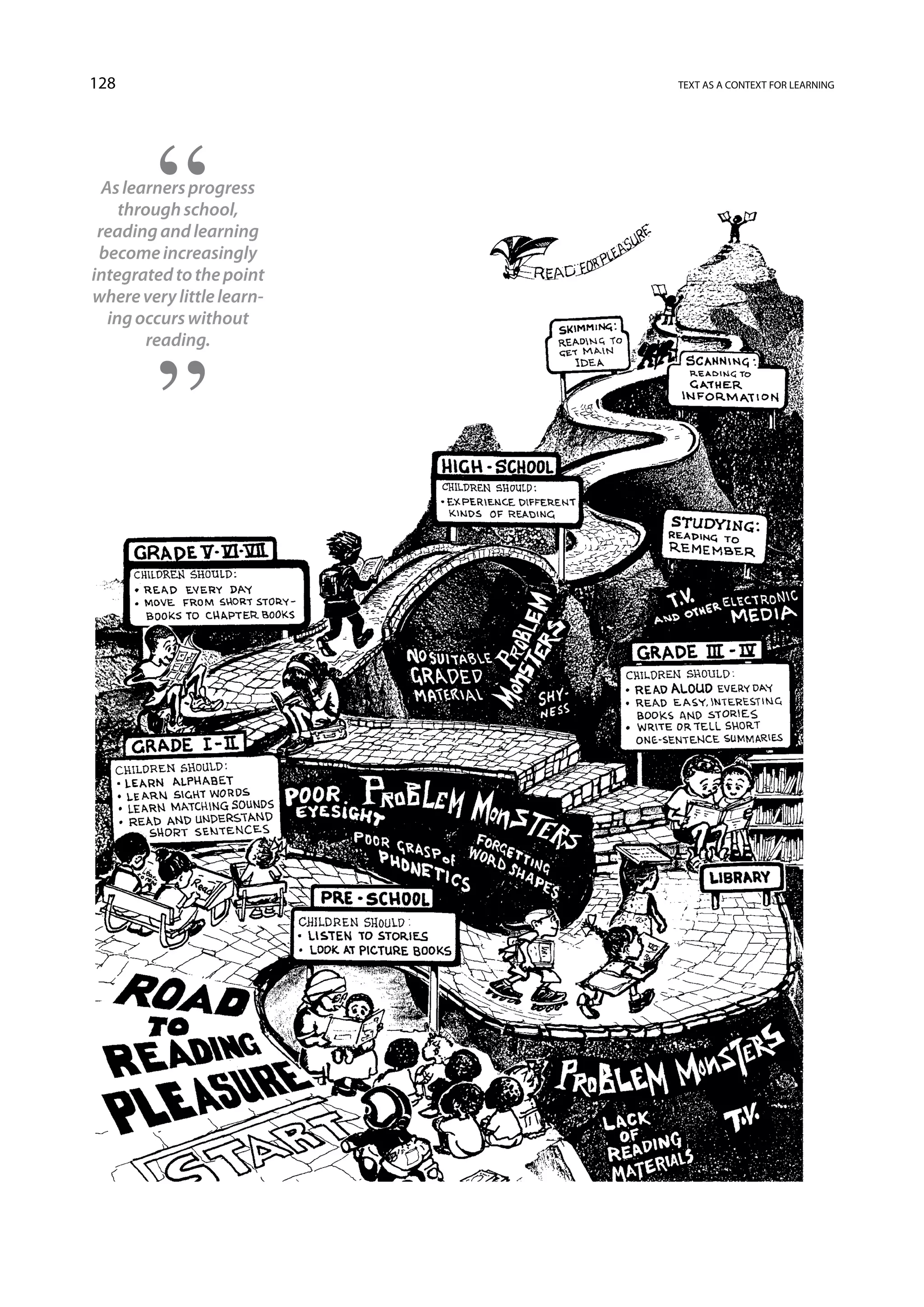
   Activity 37
   1	 Look carefully at the diagram of ‘the Road to Reading Pleasure’ on the
      next page. Then answer the questions on page 129. The diagram is from
      G. Winkler, All children can learn (Cape Town, Francolin Publishers,
      1999), p. 89.                                                                        Spend about 30 minutes on this
                                                                                           activity.
128                        text as a context for learning


  As learners progress
     through school,
 reading and learning
 become increasingly
integrated to the point
where very little learn-
   ing occurs without
         reading.
text as a context for learning                                                                129


   2	 Now answer the following questions:
   	 a	Which reading skills (other than basic literacy) are demanded by
        school learning across the curriculum?
   	 b	According to the diagram, how can teachers help learners to acquire
        these skills and become confident readers?

Schooling is an activity centred on texts
At school the ‘text’ becomes the main context for learning. (Do you remember what
the title of this section is?)
   In Section Three we examined how schooling takes learning beyond the contexts
of everyday life. We have also seen that books are important vehicles through which
learners are transported beyond the contexts of everyday life. Books open up new
worlds of knowledge and take people to places they cannot possibly go in reality.
   We have also learnt that reading and writing assist in the cognitive development
of learners who learn to become more disciplined and systematic in their thinking.
At school, children study written texts ranging from highly formal discourse (such as
a mathematics theorem) to texts that aim primarily to convey and evoke emotional
responses (for example, the poem by ten-year-old Andrew on page 122, or the poem
by R. D. Laing on page 39). Learners also talk about texts, whether these be books,
worksheets, learning tasks, or their own writing.
   The main point is this: almost all schooling can be characterized as activity centred
on texts.

School reading is circular and reflexive rather than linear
The ‘Road to Reading Pleasure’ (Activity 37 on pages 127–129) shows how reading
becomes an increasingly complex activity as learners move through school. As they
get older and more experienced, they no longer read books only for the sake of
following a story. Learning through reading entails an active process of deconstruct-
ing parts of a text and reconstructing a new whole for oneself from the text.
   This kind of reading is not a linear process: it doesn’t simply begin at the begin-
ning and end at the end of the text. Instead, advanced reading is a much more
circular and reflexive process. It involves starting at the beginning of a book
(although not always), but instead of simply reading through it, we usually:
•	 skim the text quickly first, concentrating on the headings, and the beginnings and
   ends of paragraphs in order to get a general idea of what is in the text;
•	 use this information to decide whether we want to read the text, and where we
   will begin.

At times, our reading process may be directed at finding specific information. We
might then only read a particular chapter, for instance. If we were reading for deep
understanding, we would read and reread with careful attention to detail to ensure
understanding. Sometimes we might also memorize the information we have read
and understood. At other times we may be reading for pleasure, in which case we
would begin at the beginning of a novel, for instance, and read quickly and without
attention to detail until we get to the exciting conclusion.
   School learners tend to spend more and more time reading as they progress, and
teachers are thus able to rely more and more on reading to provide the context
within which learning takes place. For example, we don’t have to take learners to a
river physically in order for them to understand about river pollution. We could,
instead, get learners to read interesting and informative case studies and theoretical
explanations of this phenomenon in textbooks in order to create a context for learn-
ing. The advantage of this kind of context is that it isn’t limited to your local river; we
can present learners with examples of a whole variety of different kinds of rivers and
of pollution from around the world.
130                                                                                   text as a context for learning


                        School reading is done actively and independently
                        For this to happen, however, learners have to develop into active and independent
                        readers who can make meaning from what they read.
                           Active readers use many different strategies to help them make meaning from a
                        text. For example, they ask themselves questions before they read, while they read,
                        and when they have finished reading. Active readers also monitor themselves as
                        they read, taking on the role of being their own internal teachers, asking themselves
                        ‘Do I really know what this is all about?’ As we said earlier, developing a clear under-
                        standing will often involve going back, rereading, and trying to link different parts of
                        the text to each other by using the bit that one has understood to try and under-
                        stand those bits that just don’t make sense.
                           The structure that the author has imposed on the text will help in this process. It
                        is particularly useful to pay attention to the ways in which the connections between
                        ideas are marked and to note whether an idea follows on from or extends an earlier
                        less complex idea or whether it is a new and perhaps contrasting position.
                           For instance, words like ‘first’, ‘second’ etc. indicate a sequence, while a word like
                        ‘however’ suggests that the text will either provide an alternative explanation or a
                        qualification to what has already been said.
                           We make sense of text; the meaning of a text doesn’t simply reveal itself to us! The
                        world of reading and the meaning of a text do not exist unless we make them happen
                        ourselves. Active engagement will enable learners to read independently and with
                        purpose and enjoyment. They won’t need a teacher or parent to force them to
                        read.


                        Developing active and independent readers
 Active, independent
                        But active and independent readers aren’t born, they are made. And teachers play a
 readers aren’t born,
                        very important role in making these readers!
   they are made.          The following exercise will illustrate one way in which Intermediate Phase teach-
                        ers can develop young, active, and independent readers. The short story is taken
                        from a Grade 6 text that was developed to encourage learners to be active readers.
                        An eleven-year-old boy, Peter Mkhalipi, originally wrote this story. We have chosen
                        to use it here in order to illustrate how teachers can encourage learners to use their
                        own writing for learning.
                           Read through the story. Think about the effect the questions in the text have on
                        your reading.

                        The giraffe and the rabbit
                              When Peter Mkhalipi was in Grade 6, he wrote a story about two friends. His
                              story teaches us that a friend sometimes makes a mistake, but when this
                              friend says he is sorry, it is time to forgive him.
                              What do you think will happen in Peter’s story?
                              Once upon a time a giraffe was grazing in the veld. Suddenly a rabbit
                              jumped out of the bush and greeted the giraffe. The rabbit and the giraffe
                              became friends and they went to have a drink of water.
                              Who will make the mistake? The rabbit or the giraffe?
                              Just as the giraffe was bending over to drink, the rabbit pushed it. The giraffe
                              lost its balance and fell into the water. It went down the river shouting for
                              help. The rabbit was laughing. Then he saw another giraffe and also pushed
                              it into the river. Down the river the two giraffes went.
                                  They were heading for a waterfall and the rabbit suddenly realized the
                              danger. He realized his joke had gone wrong and he had to save them.
                              How did he try to save them?
                              He got a rope and threw it to the giraffes. They tied it around themselves.
text as a context for learning                                                                                           131


       The rabbit then called the elephant and together they pulled and pulled
                                                                                           This story comes from G.
       until the giraffes were safely on shore.                                            Winkler, (Cape Town, Shuter 
           The rabbit said he was sorry. The giraffes forgave him and they were            Shooter)
       friends again.

What effect did these questions have on our reading?
The insertion of questions into a text is an example of a teaching method called
Directed Reading and Thinking Activity (DR-TA). The method consists of four steps.

Step 1: Guess
Insert questions that encourage the learners to guess what will happen in the story
(‘What do you think will happen?’).
   This will probably direct readers to actively notice, for instance, the title of the
story because it is often from the title that our initial expectations develop. We learn
from the title that this is a story about a relationship between animals. This creates a
sense of anticipation and expectation in the reader. A question like this may also
work to activate the learner’s network of knowledge about texts and about the
world. In this case, if we are familiar with fables (stories which use animals as the
main characters but which are really about human personalities and relationships)
we would expect the rabbit to play a trick. We would also expect the story to have a
moral or a lesson for us.

Step 2: Predict
Insert questions throughout the text to encourage learners to predict what will
happen in the next section of the story (‘Who will make the mistake?’‘How did he try
to save them?’).
   These questions are like bridges between the known part of the story (what has
happened so far) and the unknown (what will happen next). They encourage the
readers to use the information they have to imagine and predict what is still
unknown. In this sense prediction becomes a core element of the meaning-making
process involved in reading. Another effect of the questions is that they create a
purpose for reading. We want to read the next part of the story to see if our predic-
tion was correct or not.

Step 3: Read
Encourage readers to read the text. This procedure is made easier by all the directed
thinking we have done about the story so far. The questions function to break up the
text into manageable sections, so we only have to read a little bit before we can stop
and think about it again. This ensures that ideas are understood and integrated.

Step 4: Revise
Pose a question at the end of the reading process to help learners confirm, revise, or
elaborate their predictions. While learners are doing this they are constructing the
meaning of the text. If they ‘made a mistake’ and predicted something that did not         Do you notice any elements of
                                                                                           this strategy in the way in which
happen, we have created an opportunity for learning. Their mistakes make them
                                                                                           this Learning Guide has been
revise and elaborate their existing understanding of stories and what they can             written? Although it is aimed at
expect from them.                                                                          learners with a better level of
                                                                                           literacy, is an academic rather
DR-TA’s essential steps – activating and discussing what learners already know, and
                                                                                           than story text, and the writers
predicting, reading, and discussing what happened and what was learnt – can be             didn’t deliberately use this
approached in many ways. The method can also be used for many different kinds of           method, we do think that some
                                                                                           of the assumptions about
texts and in different learning areas. It can be used in small groups or with a whole
                                                                                           reading that underlie the DR-TA
class.                                                                                     method are evident. DR-TA was
    You will already have recognized the use of questions, predictions or guesses,         developed by Stauffer in 1969.
                                                                                           It has been around for a long
imagination, and interpreting mistakes as the central elements of learning, as
                                                                                           time and has survived many
discussed in Section Two. The power of the method, no matter how you use it, is that       changes in the educational
it closely follows the natural process of learning:                                        world because it is a flexible
                                                                                           method.
    The method begins with what learners know (equilibrium) and they make predic-
132                                                                                               text as a context for learning


                                    tions on the basis of that knowledge (focus on the familiar rather than the unfamil-
                                    iar – assimilation). Once learners read the text and find that they ‘made a mistake’ in
                                    their predictions, they experience a state of disequilibrium. They can no longer
                                    simply assimilate the information into their existing schemata and have to focus
                                    their attention on the unfamiliar aspects of the text. By doing that they extend their
                                    schemata to accommodate the unexpected information or turn of events. The
                                    process of accommodation means they re-establish a sense of equilibrium and have
                                    learnt something new.


                                                                                              The DR-TA method
                                                                                         illustrates very clearly how
                                                                                          an active reading process
                                                                                         can become an experience
                                                                                                  of learning.


                                    When you worked through Peter’s story about the giraffe and the rabbit, did you
                                    notice that ‘understanding’ did not occur as the end result of the ‘mechanics’ of
                                    reading? In other words, understanding is not something that happens only after
                                    learners have finished reading. Rather, reading for meaning or understanding
                                    formed part of the reading process itself from the very beginning of the story. This is
                                    why the DR-TA questions in the text can be such powerful supports for the reading
                                    process. By teaching learners to internalize the questioning process and to predict
                                    the development of the text as they read it, we can help them to learn through
                                    reading.

                                       Activity 38
                                       1	 You have already studied Reading 12 by Dillon in the context of Section
                                          Two. You will notice a section in the Dillon reading titled ‘Reading and
                                          studying’. Read this carefully.
 Do you remember the reading           2	 Answer these questions when you have finished reading:
 by Dillon? You may well have          	 a	 What different kinds of questions does Dillon suggest should be part
 struggled with it. We’d like you
                                             of reading for learning?
 to now reread it using the new
 knowledge you have learnt             	 b	 Describe these different kinds of questions as part of the DR-TA
 about reading actively. You will            method.
 need about an hour for this
 activity.


                                    Different levels of reading
                                    Reading, clearly, isn’t a matter of passively receiving ready-made understanding from
                                    books. All reading, right from the start, is a highly active process.
                                       The kinds of texts that learners encounter in their later school years require several
                                    levels of interpretation or meaning. We have identified four levels, all of which
                                    combine to make meaning possible:
                                    •	 literal comprehension;
                                    •	 interpretation;
                                    •	 critical reading;
                                    •	 creative reading.

                                    We will briefly explain what reading and thinking skills are required for each one.
text as a context for learning                                                               133


Literal comprehension
The learner has to be able to understand the meanings of words, recognize the main
idea, understand the sequence in which things are happening, and be able to recog-
nize the cause-effect relationships in the text.

Interpretation
This involves going beyond the actual information presented in the text. Learners
must be able to make generalizations, predict outcomes, and construct relation-
ships between different ideas in the text. At the simplest level, the skill of interpreta-
tion may lead us to make a statement like this, ‘The writer’s strong belief in predeter-
mined learning objectives and her faith in standardized tests, like IQ tests, suggest
that she would describe herself as a behaviourist’. In other words, we use existing
information to predict and generalize.

Critical reading
At this level the reader is expected to make judgements about the quality, value, or
accuracy of the ideas in the text. This includes looking for bias or exaggeration in the
way that the language is used. Critical reading may result in the following kind of
statement being made, ‘While the writer’s description of learning is interesting, her
suggestion that teachers are able to determine the outcomes of learning fly in the
face of most contemporary research’. In other words, we assess the quality of an
argument and come to a judgment about it.

Creative reading
This involves the reader using the text to generate new ideas or develop new insights
about a topic. At this level of reading we understand the ideas, we are able to use
them to predict and generalize, and we have opinions about their validity. In addi-
tion, we can also use the ideas as a basis for developing new ones. Creative reading
may lead us to make the following kind of argument, ‘Both Vygotsky and Piaget are
correct, but neither can tell us … (X). Our research shows that by factoring in the
effects of … (Y), we can … (Z).’ In other words, we use existing ideas to develop new
ideas about learning, or about anything else we are studying.

The full possibilities for meaning in reading can only be realized through working at
all of these different levels. We know that books are meaningless unless they are
read. The act of reading is the act of creating meaning. So the meaning of a book is
not in the book itself. It is the result of an interaction between the reader and the
text. Since meaning is dependent on the activity of the reader’s mind, the nature of
the reader’s activity will influence the nature of the meaning that is created.
   The following activity will allow you to explore this point.
134                                                                                                text as a context for learning


                                     Activity 39
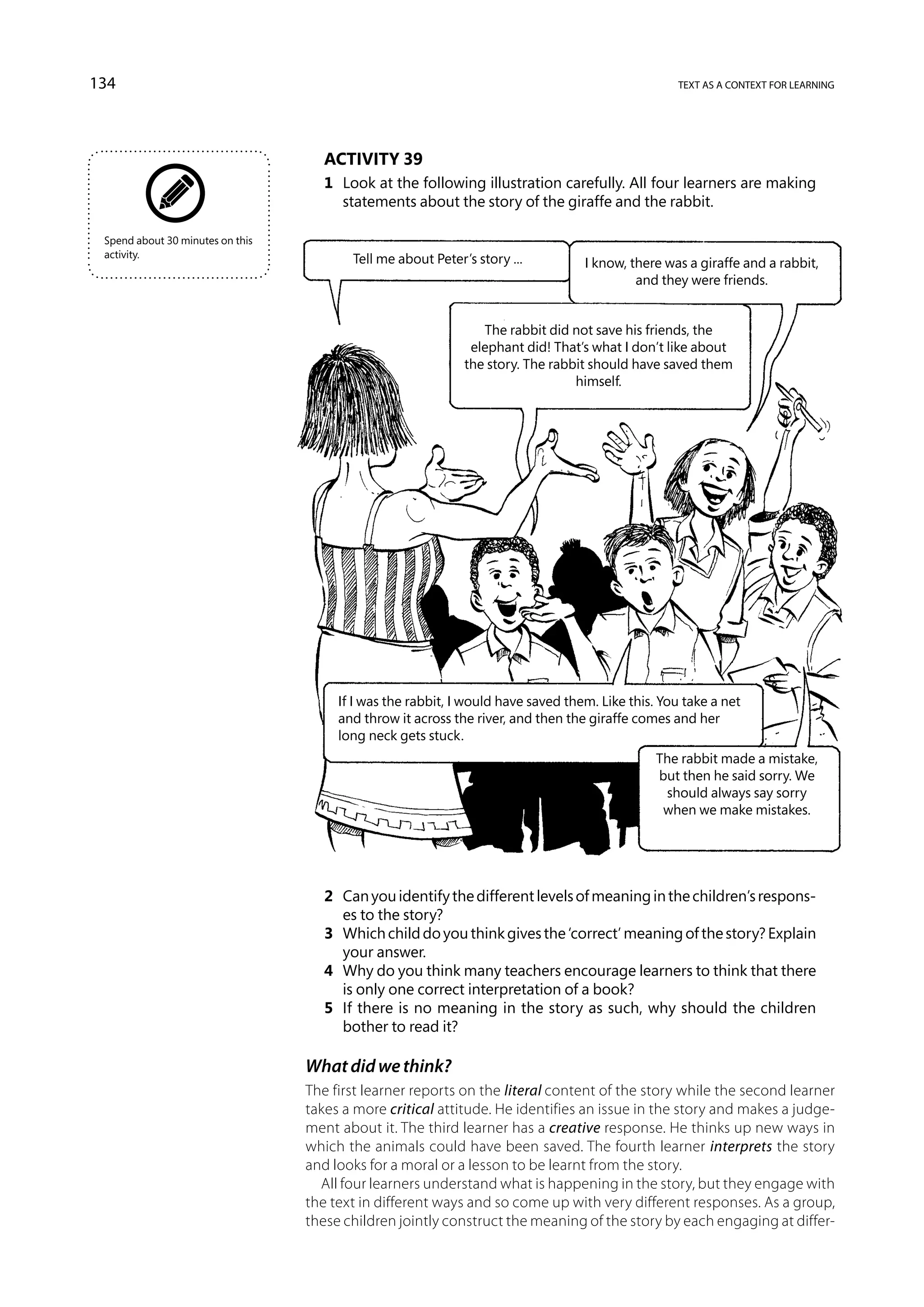
                                     1	 Look at the following illustration carefully. All four learners are making
                                        statements about the story of the giraffe and the rabbit.

 Spend about 30 minutes on this
 activity.                               Tell me about Peter’s story ...          I know, there was a giraffe and a rabbit,
                                                                                           and they were friends.


                                                                The rabbit did not save his friends, the
                                                              elephant did! That’s what I don’t like about
                                                             the story. The rabbit should have saved them
                                                                                himself.


                                       If I was the rabbit, I would have saved them. Like this. You take a net
                                       and throw it across the river, and then the giraffe comes and her
                                       long neck gets stuck.
                                                                                               The rabbit made a mistake,
                                                                                               but then he said sorry. We
                                                                                                should always say sorry
                                                                                                when we make mistakes.


                                     2	 Can you identify the different levels of meaning in the children’s respons-
                                        es to the story?
                                     3	 Which child do you think gives the ‘correct’ meaning of the story? Explain
                                        your answer.
                                     4	 Why do you think many teachers encourage learners to think that there
                                        is only one correct interpretation of a book?
                                     5	 If there is no meaning in the story as such, why should the children
                                        bother to read it?

                                  What did we think?
                                  The first learner reports on the literal content of the story while the second learner
                                  takes a more critical attitude. He identifies an issue in the story and makes a judge-
                                  ment about it. The third learner has a creative response. He thinks up new ways in
                                  which the animals could have been saved. The fourth learner interprets the story
                                  and looks for a moral or a lesson to be learnt from the story.
                                    All four learners understand what is happening in the story, but they engage with
                                  the text in different ways and so come up with very different responses. As a group,
                                  these children jointly construct the meaning of the story by each engaging at differ-
text as a context for learning                                                             135


ent levels. In order for the full meaning of the story to be developed, these levels are
all important: without the literal meaning of what happens in the story, the more
interpretative and critical responses would not be possible. And whereas a critical
response is more important in relation to textbooks than perhaps to a story like this
one, learners need to develop a critical approach not only to reading but also to all
aspects of life and learning.
   The levels of meaning that go beyond literal comprehension challenge many of
our preconceived ideas about books:
•	 They raise doubts about whether it is enough, or even necessary, to teach reading
   through comprehension exercises.
•	 Because they show us that so much of a book’s meaning lies in a learner’s head,
   they suggest that teachers should not emphasize memorizing what’s in a book.

The activity of the learner is now recognized as central. The outcomes that guide
South Africa’s new curriculum emphasize this active role for learners. For example,
the specific outcomes for the Languages, Literacy, and Communication learning
area encourage learners to:
•	 make and negotiate meaning and understanding;
•	 show critical awareness of language usage;
•	 respond to the aesthetic, affective, cultural, and social values in texts;
•	 access and use information from a variety of sources and situations;
•	 understand, know, and apply language structures and conventions in context;
•	 use language for learning;
•	 use appropriate communication strategies for specific purposes and situations.

Even though the National Curriculum Statements developed as part of the
Curriculum 2005 Review process describe the LLC outcomes in a slightly different
form and language, you will notice that they remain very similar to those above.


           These outcomes promote
           a critical approach to text
           and assert that reading is
            an interaction between
                 reader and text.
4.5   Learning to read better
      Earlier we looked at how textbooks are used for learning. We agreed that they are
      important sources of information and that learners need them to succeed at
      school.
         However, we also know that many teachers either don’t use textbooks in their
      teaching or they use them ineffectively, and many learners simply learn them off by
      heart. As the content and the demands of their courses become more complex,
      many learners feel stressed and anxious about reading books or using libraries to
      help them study. Even though learners may want to learn, the difficulty of textbook
      language makes reading tiring and, sometimes, almost impossible.
         We know that successful reading is about ‘cracking the code’. Let’s take a closer
      look at this code and find out how textbooks are written.


      How textbooks are structured
      In order to do this we will ‘study’ this Learning Guide and use examples from it to
      develop your understanding of the textbook code and the structure of text.
         The information in textbooks is usually organized and presented in carefully-
      designed patterns. Alvermann has identified five kinds of text structures or organ-
      izing patterns found in most textbooks, no matter what the subject content of the
      book might be. They are:
      •	 simple listings;
      •	 sequences;
      •	 comparisons;
      •	 cause-effect patterns;
      •	 problem solving.

      We will briefly explain each pattern before we work with them in greater depth.

      Simple listing
      This involves the presentation of information as a simple list of facts, often in order
      of importance. Sometimes lists are numbered or marked with bullet points. For
      example, what you are reading now is a simple listing. The purpose of a simple listing
      is to provide the reader with a short and clear overview of important information.

      Sequence
      A sequence describes events that happened in a particular order. The sequence can
      be presented as a story line, a time line, or a ‘before and after’ situation. The teaching
      purpose of a sequence is to draw the attention of the reader to the process or change
      involved in an event. For example, Mike’s description of his reading lesson on pages
      118–119 is a sequence with a story line.

      Compare and contrast
      This kind of text concentrates on differences and similarities between two or more
      things. Look at, for example, Donaldson’s discussion of the spoken and the written
      word on page 112. The purpose of writing and organizing a text in this way is to
      sharpen the reader’s understanding and definition of ideas.

      Cause and effect
      Cause-effect patterns look at events and their causes or consequences. The infor-
text as a context for learning                                                                                            137


mation can be organized in two ways. One way is to describe an event and then
identify the factors that caused it. Another possibility is to describe an event and
then trace the effect it had. The discussion of the learning potential of the DR-TA
method on pages 131–133, for example, uses this pattern. The teaching purpose
behind this kind of text is to help the reader see links between different events and
to find reasons for the way in which the links occur.

Problem-solution
This kind of text is similar to a cause-effect text, but concentrates specifically on
problem-solution relationships between different ideas. Such a text should always
clearly identify a problem that has to be solved. For example, our commentary after
Activity 32 (pages 114–116) is structured like this and sets out to solve the problem
‘Why are the above statements not true?’ This kind of text is often used to encourage
the reader to become a creative participant in finding a solution to a problem.
Exercises and activities in textbooks are commonly written as problem-solution           These ideas are from D. E.
                                                                                         Alvermann, Content Reading
text.                                                                                    and Literacy: Succeeding in
                                                                                         Today’s Diverse Classrooms
You can see from the above examples that this Learning Guide uses more than one          (Boston, Allyn  Bacon, 1998),
                                                                                         p. 208.
text structure. This is true of most textbooks in which you will find a combination of
patterns, depending on the content or purpose of the different chapters or sections
in the book.
   We now want you to work with these text structures in some detail. By paying
attention to the structure of a text, we can find clues to help us read and use text-
books meaningfully.
   Work through the following activity on text patterns. Although it requires you to
repeat a similar process each time, we encourage you to not skip any of the pattern
exercises as each one establishes a different kind of relationship between ideas in
the text. Once you have worked through the whole activity you will have deepened
your understanding about the way textbooks work. You will also have practised a
critical approach to reading text.

   Activity 40
   Sequence
   1	 Read our description of the DR-TA method again on pages 131–133 and
      then do the following:
   	 a	 Underline words in the text that signal that this passage is using a            This is a long activity. It will take
                                                                                         you at least 90 minutes to
         sequence structure.
                                                                                         complete. Take a break after the
   	 b	 the text is sequencing events, you should be able to pick out the
         As                                                                              first two exercises if you are
         following information:                                                          feeling tired.
   	 	 •  What is the first or initiating event?
                                                                                         Here are words that signal a
   	 	 •  What are the stages or steps?                                                  sequence or time order. Use
   	 	 •  How do they lead to one another?                                               them to guide you:
                                                                                         •  first, second, third;
   	 	 •  What is the final outcome?
                                                                                         •  next;
   	 c	 Draw a diagram of the sequence.                                                  •  initially;
                                                                                         •  finally;
                                                                                         •  before, after;
   Compare and contrast
                                                                                         •  when;
   2	 Read the discussion by Taylor and Vinjevold in Section Three (page 82)             •  now.
      and then do the following:
                                                                                         Here are words that signal a
   	 a	Underline words in the text that signal that this passage is using a
                                                                                         comparison or contrast. Use
        compare-and-contrast structure.                                                  them to guide you:
   	 b	 the text is comparing things, you should be able to pick out the
        If                                                                               •  on the other hand;
                                                                                         •  like, unlike;
        following information:
                                                                                         •  however;
   	 	 •  What things are being compared?                                                •  less than, least;
   	 	 •  How are they similar?                                                          •  more than, most;
                                                                                         •  other;
   	 	 •  How are they different?
                                                                                         •  differently, difference.
   	 c	Summarize the information of this section in a table like the one
        below.
138                                                                                         text as a context for learning


                               	                         reading readiness	                active reading
                               motivation
                               purpose
                               questions
                               attitude
                               interest
                               attention


                                   Cause and effect
                                   3	 Read our commentary on Activity 9 on pages 44–45.
                                   	 a	 Underline words in the text that signal its cause and effect structure.
                                   	 b	 What are the causes of mistakes?
                                   	 c	 What are the effects?
                                   	 d	 Summarize the information from the passage in the diagram below.
Here are words that signal
cause or effect. Use them to
guide you:
•  because;
•  since;
•  therefore;
•  if ... then;
•  as a result;
•  consequently;
•  nevertheless;
•  thus.


                               Why text structures are important
                               At the beginning of this section we quoted an extract by Donaldson that described
                               the nature of the written word. In the extract, she suggested that the written word
                               requires us to become ‘aware of language in its own right’ because ‘those very
                               features of the written word which encourage awareness of language may also
                               encourage awareness of one’s own thinking and be relevant to the development of
                               intellectual self-control’.
                                  Dillon proposed a similar strategy by suggesting the use of ‘questions about the
                               self’s process’ while engaged in reading and studying.
                                  Activity 40 required you to pay attention to signal words for particular text struc-
                               tures. In other words, following Donaldson’s argument, you had to pay attention to
                               a particular feature of the written word. The signal words, however, don’t only point
                               out (or signal) a certain kind of text. They also establish a relationship between the
                               ideas in the text. Consequently they affect the way in which we think.
                                  For example, by setting up learning as the effect of making a mistake, we are able
                               to think about mistakes as the cause rather than the absence of learning. The cause-
                               effect structure of the language has determined the structure of our thought.
                                  By understanding text structures we can begin to recognize the relationships
                               between parts of a text and become aware of our own thinking while we read.
                               This awareness is the essence of intellectual self-control and will help us to be
                               active and independent readers, able to use a text effectively in service of learning
                               and teaching.
Learning to study better                                                                                      4.6
Earlier we observed that many people use the words ‘reading’, ‘studying’, and ‘learn-
ing’ as if they all mean the same thing. We found out that although text-related
learning happens in both everyday life and at school, school learning in particular
                                                                                                           13
requires a lot of reading.
   Later we discovered some similarities between reading as a meaning-making
                                                                                            Week 13 begins.
process and learning. We also learnt why reading is such a powerful tool for learning.
Because it is so important to learning, we investigated different ways of reading and
showed how reading-for-learning can only happen when we become aware of the
nature of the written language and develop a critical attitude towards the text. As
the famous writer and educator, Paulo Freire, explains:

      ‘Studying is a difficult task that requires a systematic and critical atti-
      tude and intellectual discipline acquired only through practice.’                     This phrase is from Reading 14.
                                                                                            Paulo Freire was a Brazilian
                                                                                            educator who lived from 1921
                                                                                            to 1997. His ideas were very
                                                                                            influential in South Africa, first
                                                                                            in the radical Christian groups
                                                                                            and the black consciousness
               As teachers it is our                                                        movement and then in the
                                                                                            development of people’s
           responsibility to introduce
                                                                                            education in the late 1980s.
          learners to the practice and
         discipline of study. In order to
             do this well, we need to
          understand what the act of
        study really is and how it can be
                  encouraged.


In Activity 16 (Section Two, page 61) we thought about how learning is (and is not)
like banking. Paulo Freire used this metaphor to capture the old idea that learners
are passive recipients rather than active constructors of knowledge. In his book,
Pedagogy of the Oppressed, he made a distinction between banking education on
the one hand, and critical or dialogic education on the other. He urged that educa-
tors should stop thinking of teaching and learning as being like depositing money
in a bank, or depositing facts in the head of a learner, and rather think of it as an
active, critical process which can emancipate learners.
   In his article in the Reader, Freire takes this notion further in relation to the acts
(one might say activities and stress that they are active) of reading and studying.

   Activity 41
   1	 Turn to Reading 14 ‘The act of study’ from Freire’s book, The Politics of
      Education.
   2	 Compare ‘banking education’ to studying with a ‘critical vision’. (A hint:
      use what you learnt about the compare-and-contrast text structure to
      answer this question.)                                                                Spend about 90 minutes on this
                                                                                            activity. Read carefully. Use the
   3	 Would the DR-TA method of reading fit in with Freire’s ideas about                    ideas about reading and text
      study? If so, explain how. If not, explain why you don’t think so.                    structures you have learnt to
   4	 What does Freire say about the relationship between the learner and the               inform your reading. See
                                                                                            whether any of Freire’s ideas are
      world? In other words, what is the point of studying?                                 useful to your own ‘act’ of
                                                                                            study.
140                                                                 text as a context for learning


      Why do we study?
      Freire claims that the act of study is founded in a curious attitude towards the world.
      If learners are curious about the world, they will want to understand it and will use
      all kinds of resources to find out more about it.
          Reading and studying books are useful ways of finding out more information, but
      the information is not important on its own. It only becomes important if it is linked
      to real questions that emerge from our initial curiosity about the world. This is why
      he encourages us to take our own questions seriously, so that ‘we as good readers
      [can] concentrate on analysing the text, looking for a connection between the main
      idea and our own interest’.
          By using our own questions to guide us from the known to the unknown, we take
      on the role of the subject in the act of study. We are not studying in service of ‘educa-
      tion’ but are rather using education to develop our own thought. Studying is thus a
      way of making other people’s thoughts our own by ‘reinventing, re-creating, and
      rewriting’ them in the light of the real questions we ask about our world. Therefore
      the ‘one who studies should never stop being curious about other people and
      reality’.
          In other words, Freire believes that the relationship between the learner and the
      world gives purpose and meaning to the relationship between the learner and the
      text. Freire’s words are a great challenge to learners and teachers alike. He poses
      questions like:
      •	 How do we stay curious about the world when so much of our time as learners is
          spent feeling bored and frustrated in class?
      •	 How do we stay curious about the world when we spend years at school ‘absorb-
          ing’ other people’s ideas about the world rather than actively and creatively inter-
          acting with our own?

      But Freire doesn’t argue that we give up learning about other people’s ideas! Instead
      he says we cannot really study unless we actively make links between the texts we
      read and the context we live in.


                                                       The relationship between the
                                                       learner and the text not only
                                                      draws life from the relationship
                                                      of the learner to the world but
                                                            can also change this
                                                        relationship in quite radical
                                                                    ways.


      One way to keep the curiosity of learners alive is to allow them to spend time at
      school talking with others about the questions and ideas that truly interest them,
      and to make these questions the basis of a disciplined study that involves both the
      spoken and the written word. To study and learn actively, we need to talk about and
      debate the insights that we gain in reading in relation to our own contexts.
         In other words, we need to study the world and other people’s words, but we
      need to do so actively and dialogically. We mustn’t simply absorb these ideas uncrit-
      ically, as a bank ‘absorbs’ money!
         Freire allows us to understand how reading – the act of study – opens up new
      ways of understanding the world. It introduces the learner to the possibility of criti-
      cal, and even radical, change.
         This is why Freire argued that literacy, critical reading, and critical study are so
text as a context for learning                                                                                    141


important. Sometimes a text that may not initially appear to have much relevance
or interest for learners’ lives can offer significant new ways of describing, under-
standing, and explaining everyday events once it is understood.
   For example, look back at the discussion of ‘the University’ on Robben Island in
Section Three, pages 75–77. By reading books and talking about theoretical ideas
written many years ago by people from other countries, the prisoners of Robben
Island developed new political understandings and explanations of events within
their own experience; understandings which they would not otherwise have
gained.

   Activity 42
   1	 Turn to Reading 17 ‘Developing communities of reading and learning’
      by Brown and Campione. Carefully read the section entitled ‘Higher-
      order thinking skills in reading’.
   2	 What, according to the writers, is an ‘intelligent novice’? What skills does
      an intelligent novice need?                                                      Spend about 50 minutes on this
                                                                                       activity.
   3	 Do you think these authors would agree with Freire’s definition of the
      ‘act of study’? Give reasons for your answer.
   4	 Think of your own teaching. What more would you have to do to develop
      your learners as intelligent novices?
4.7                              Texts, reading, and OBE
                                 As we said earlier, the new South African curriculum suggests that learners should,
                                 by the end of their schooling, be able to:
                                 •	 make and negotiate meaning and understanding;
                                 •	 show a critical awareness of language usage;
                                 •	 respond to the aesthetic, affective, cultural, and social values in texts;
These are the seven language
outcomes listed in Department    •	 access and use information from a variety of sources and situations;
of Education, Report of the      •	 understand, know, and apply language structures and conventions in context;
Technical Committee to Assist
the Department of Education in   •	 use language for learning;
the Development of Standards
(Pretoria, 1997), pp. 28–41.
                                 •	 use appropriate communication strategies for specific purposes and situations.


                                 The role of reading in the new curriculum
                                 Reading and writing are not explicitly mentioned in these seven outcome state-
                                 ments. This omission has become a hotly-debated issue amongst teachers. Have
                                 OBE and Curriculum 2005 somehow forgotten about reading and writing?
                                    In the area of early literacy education, there has certainly been some hint of this.
                                 In 1998, the new outcomes-based curriculum was implemented in Grade 1 class-
                                 rooms. In preparing teachers for the change, many official guideline documents
                                 were issued. They fleshed out the specific outcomes – about making and negotiat-
                                 ing knowledge, about critical literacy, and about communication – into detailed
                                 guidelines for lesson planning.
                                    As a result many teachers moved towards more constructivist and integrated
                                 forms of teaching. However, very few of these guideline documents called for the
                                 deliberate teaching of reading. Reading and writing were relegated to two amongst
                                 a myriad of skills learners had to attain rather than as central processes in learning.
                                 The assumption was that if learners were presented with tasks involving reading
                                 and writing, they would construct the skills of reading and writing for themselves.
                                 Proponents of this view argued that their reading would be better than before,
                                 because they would learn it spontaneously in the course of interesting activities and
                                 not be turned off by boring reading instruction.
                                    The result was that some teachers started to believe that reading instruction
                                 would no longer be necessary, or even that it was ‘banned’ by the new curriculum.
                                 Here is an extreme example of this kind of thinking:
                                    A delegation of worried principals from a cluster of junior primary schools in
                                 western Soweto posed the following to their District Director as an agenda item for
                                 a meeting in October 1997: ‘the suspension of principals if we do not teach phonics/
                                 reading’. In the meeting they told their director that certain teachers, after attending
                                 a teachers’ union seminar on OBE, had informed them that phonics and reading
                                 programmes were part of the legacy of apartheid education, and that the new
                                 curriculum would no longer contain them. Obviously disturbed, the principals
                                 sought official reassurance on the matter from the department.
                                    Questions and debates about early reading in these terms have continued to
                                 trouble many teachers. In fact the confusion became so severe that by early 2000,
                                 the Department of Education found it necessary to intervene and assert (some
                                 might say reassert) its commitment to the fundamental importance of reading in
                                 the learning process.
                                    The new Director-General argued the following:

                                       ‘Reading, in its broadest sense, is key to the development and sustaina-
                                       bility of our fledgling democracy. The notion that the outcomes … do
text as a context for learning                                                                                         143


       not promote, expect, or ensure that learners will be able to read and
       write is a “myth”. The learning programme statement on literacy refers to
       a wider concept of literacy, including: language literacy, cultural literacy,      This quotation is from a paper
                                                                                          by Thami Mseleku, ‘Reading
       visual literacy; media literacy; numerical literacy; and computer literacy.’
                                                                                          and Tirisano – Government’s
                                                                                          Vision for Reading in the 21st
                                                                                          Century’ presented to the ERA
Why reading should be taught explicitly                                                   Working Conference on Reading
                                                                                          (28–29 February 2000).

Section Four has examined the central role of reading and writing in learning, in
schools, and throughout contemporary society. It examined how written texts
(books, journals, magazines, web sites etc.) provide the opportunity for learners to
develop an awareness of language and a concomitant awareness of their own think-
ing. We saw the importance of teaching good reading foundations in children’s
earliest encounters with the written word, and we examined the ongoing impor-
tance of literacy development throughout the educational process. Reading takes
us beyond our existing knowledge, and successful learners read more and more
texts of ever-increasing complexity as they progress through school.
   Our view is that reading and writing are fundamental to learning in educational
contexts. Not only must the teaching of reading be improved, but the practice of
reading and writing must appear explicitly as a critical learning outcome at all levels
as OBE matures.
   We would argue against the idea, found in much South African thinking and
writing about OBE, that children will construct the skills of reading and writing spon-
taneously. Our view is that good, explicit teaching of reading is essential to the
successful early acquisition of literacy. Here is a particular case of a young learner
which illustrates this point well:

       ‘In Grade 1, the teacher taught Ashok the alphabet. She made the
       students learn the sound of each letter for weeks. She made them write
       each letter.
           For the first two months, the chalkboard was covered with the alpha-
       bet. Children copied each letter several times. Ashok learnt all the letters.
       Teacher and children paid attention to the textbook which had a letter,
       word, and picture per page. Ashok learnt immediately the b of bird, the a
                                                                                          This is adapted from a paper by
       of apple, and the t of table. He failed to understand when the teacher             M. M. Clay, ‘How children learn
       added “ird” to b for bird. The teacher did not have time to notice or under-       to read: an international
       stand Ashok’s point of view.                                                       perspective’ presented to the
                                                                                          All Africa Conference on
           When Ashok went to Grade 2, he was asked to read a book. He said “b            Children’s Reading (Pretoria,
       of bird”, “a of apple”, “t of table”, reading letters off the page in this way.    August 1999).
       The teacher got annoyed with him and said, “Listen carefully to other
       children and read like them.” Ashok listened, but he couldn’t understand
       where he was making a mistake. He felt the others read just like him.
       Somehow he got through to Grade 3. Now he read by combining letters
       and vowel sounds. The teacher rarely asked him to read. Children sitting
       near him on the mat read the whole chapter. He didn’t feel bad about it.
       He memorized a whole poem and during a revision of lessons in the last
       weeks of Grade 3, he read the poem without opening at the right page.
       He was happy but the teacher was angry. The differences between his
       and his teacher’s points of view were becoming sharper.
           Grade 4 started. The first page of his new geography book, a new
       subject, said, “Our district is uneven and rocky … its construction is like a
       plateau.” Many children in the class had learnt to read fluently. They
       stood up and read, and then copied it into their notebooks. When Ashok
       tried to read slowly, the teacher would become impatient. The same situ-
       ation existed during science lessons. In a month the teacher got so fed up
       with Ashok that she stopped saying anything to him. Ashok felt that the
       teacher didn’t care any more. After the holidays, he didn’t go back to
       school.’
144                                                                                               text as a context for learning


                                       Stop. Think.
                                       Before you continue, think about this story. How does it illustrate the point
                                       that reading must be explicitly taught and isn’t spontaneously learnt?

 Take some time to reflect on the   How does the story end? Well, Ashok dropped out of school because he couldn’t
 issue being raised here.           learn how to read accurately for himself. In fact, as we saw, he constructed a ‘reading’
                                    practice of his own which remained trapped in his misunderstanding of what the
                                    task entailed. (Do you remember the discussions on misunderstanding and making
                                    mistakes in Sections One and Two?) He dropped out because the teacher failed to
                                    teach him new ways of reading. She failed to provide him with a pathway from the
                                    known to the unknown that would allow him to learn from, and overcome, his
                                    mistakes.
                                       Clay (the writer of this story) explains that the lesson to be learnt from Ashok’s
                                    story is that:

                                          ‘if children are confused [about reading], then expert teaching is needed
                                          to pull them out of it. … [the problem] will not sort itself out as the child
                                          gets older. On the contrary, the child will, willingly and with effort, build
                                          error upon error until there is a huge, seething ant-hill of error.’

                                    Many teachers, we believe, are wrong when they say that children construct their
                                    own knowledge of reading in the course of outcomes-based activity. They under-
                                    play the crucial role of reading instruction and, by doing this, limit the learners’
                                    reading abilities for life. Reading is critical to good learning and like all learning
                                    requires teaching and an active learning attitude by learners to be successful.
                                    Removing either makes good learning impossible.
Conclusion and key learning
points                                                                                                        4.8
Reassessing the half-truths
   Stop. Listen. Think.
   Relisten to Part 4 of your audiotape. Then go back to the half-truth state-
   ments at the beginning of this section on page 111 and decide if you still
   agree with your original responses:
   •	 Have any statements changed their meaning for you? In what way?
                                                                                              Take some time to reflect on the
   •	 Can you now see some truth in statements you initially thought were                     issue being raised here.
      incorrect?

Use what you have learnt in this section to develop your arguments both for and
against these different positions on reading. Use the half-truths as a checklist to
confirm what you now understand and what you are not yet certain about.


Key learning points
This section has investigated the relationship between learners, text, and the world.
  We have argued that the links between the reader and the text are critical for the
reading process, and that the knowledge the reader brings to the text is as impor-
tant as the information on the page. We also saw that at school, textbooks are often
the context for learning and that the use of school textbooks requires learners to be
active and independent readers. We then took a closer look at the way in which
textbooks are written, and explored how the structure of a text organizes and directs
the way we read it.
  We examined Freire’s critical view of reading as dependent on our curiosity about
the world and as a powerful force in changing our engagement with the world.
Building on his ideas, we suggested that schools need to develop ‘intelligent novices’
who are able to take on the questions of the world.
  Finally, we argued that teaching reading is an explicit and deliberate act. We
suggested that the dangerous half-truth emerging in South Africa – that reading
can be learnt spontaneously and therefore that teaching reading is outdated – could
doom millions of learners to be poor readers for life.

Here is our summary of this section’s key points:
•	 Reading is an activity of the mind requiring learners to ‘crack the code’ of the written
   text to generate meaning.
•	 Reading becomes meaningful when the reader can make links between his or her
   personal experience and the experience encoded in the text.
•	 Reading can be hard work and too many learners have a negative attitude towards
   it.
•	 Children are eager to learn to read when they believe that books are the key to a
   new world of experience.
•	 The attitude of adults towards reading influences the attitude of children towards
   books.
•	 Teachers need to read widely and actively themselves in order to establish a
   context of reading in the classroom.
•	 Learning through reading requires an active engagement at several different
   levels of meaning making.
146                                                                                                text as a context for learning


                                     •	 Different kinds of text require different approaches to reading, but all texts require
                                        active reading.
     The act of study                •	 Prediction and questioning are key reading skills.
       should not be                 •	 A critical approach to text is an essential skill for school learning.
     measured by the                 •	 All books follow certain text patterns that establish specific relationships between
                                        different parts of the text.
number of pages read
                                     •	 The structure of a text can influence the way we think about the ideas presented
   in one night or the
                                        in the text.
number of books read
                                     •	 Teachers need to introduce learners to the ‘discipline’ of study and encourage
in a semester. To study                 them in its practice.
    is not to consume                •	 The act of study is founded in a curious attitude towards the world.
  ideas, but to create               •	 Reading can produce further curiosity and a critical attitude to the familiar
  and recreate them.                    world.
                                     •	 The early skills of reading should be taught explicitly.


 This quotation comes from P.
 Freire, The Politics of Education
 (Masachusetts, Bergin  Garvey,
 1985).

Learners and Learning: Section Four: Text as a context for learning

  • 1.
    Learners and Learning Section Four:Text as a context for Learning Writers | Ian Moll, Jill Bradbury, Gisela Winkler, Maggie Tshule, Merlyn van Voore, Lynne Slonimsky Editor | John Gultig The SAIDE Teacher Education Series
  • 2.
    Learners and Learning ISBN978 0 620 46731 5 © 2010 SAIDE This work, a digital version of the SAIDE/Oxford publication of 2002, is released under the Creative Commons Attribution 3.0 licence. 1ST EDITION SERIES EDITOR: John Gultig 1ST EDITION AUDIOTAPE: George Lekorotsoana (producer) and John Gultig (concept and script) DESIGN FOR DIGITAL VERSION: Michelle Randell ILLUSTRATIONS: Andre Plant SAIDE PO Box 31822 Braamfontein 2017 T: (011) 403 2813 F: (011) 403 2814 www.saide.org.za; www.oerafrica.org The first edition was funded by the WK Kellogg foundation. This digital version has been funded through the International Association of Digital Publications.
  • 3.
    section four Text asa context for learning 4.1 Introduction . ......................................................................................   111 4.2 How do we enter the world of reading? ....................................   112 4.3 What makes reading a meaningful experience? ....................   122 4.4 What kinds of reading support school learning? ...................   126 4.5 Learning to read better ...................................................................   136 4.6 Learning to study better .................................................................   139 4.7 Texts, reading, and OBE . .................................................................   142 4.8 Conclusion and key learning points ...........................................   145
  • 5.
    Introduction 4.1 What will you learn in this section? As you have discovered, everyday learning is very different from schooling. One of 11 the features that distinguishes the two is the centrality of language as an instrument for school learning. Language allows learners to develop a more generalized and Week 11 begins. systematic understanding of the world. We have discussed how teachers make deliberate and powerful interventions in learning and how these interventions assist learners to bridge the gap between what they know and what they still need to learn. Texts are often used by teachers to evoke and scaffold learning. Texts organize and systematize knowledge and so play an important role in teaching learners to think in school-like ways. Because of this, reading is one of the most important language acts in school learning. We will see that at school a text is often the context for learning, and the use of school textbooks requires learners to be active and inde- pendent readers. This section will explore the relationship between learners, text, and the world. We will find out how textbooks are written, how learners read, and how teachers can assist learners to read critically. More half-truths to think through Read through the following assumptions about reading and learning. As before, make notes about your agreements and disagreements with these half-truths. These half-truth statements are quite tricky. They seem simple at first, but the more you think about them, the more complex the issues become! Statement about learning What is true about What is inaccurate the statement? or false about the statement? Reading is difficult and boring. All readers will understand the meaning of a text in exactly the same way. There is only one way to read. Textbooks should be read differently to storybooks. Children learn to love or hate reading because of their parents’ attitudes to books. Reading is only useful for school learning. Learning through reading is just the same as learning through talking and listening.
  • 6.
    How do weenter the world of 4.2 reading? Have you ever noticed that many languages use similar words for ‘reading’, ‘studying’, or ‘learning’? In Zulu, for example, the word ‘-funda’ can mean all three: • reading a book; • studying at school; • learning how to ride a bicycle. Even in English, where separate words exist, our mental links between reading and school learning (studying) are so close that the words can be exchanged. Students are often described as ‘reading History’ when they study at a university, or as ‘study- ing a book’ when they read through a book. Reading seems such an obvious and integrated part of school learning that we often forget to mention it. For example, in the previous section on school learning, only a very brief comment is made about the fact that school learning usually requires us to be literate. Yet there is no subject at school that does not involve reading, and there isn’t a child who can succeed at school without learning to read. So all teachers need to understand how the reading process works in order to make it a meaningful and rewarding activity for their learners. The purpose of this section is to help you to do that. We will: • explore how learners can successfully enter the world of reading; • look at the power of the written word in influencing the way we think. Differences between the written and spoken word Activity 31 1 Here are a few open-ended sentences about the spoken and the written word. Complete each sentence in any way you like. a The written word mostly ... Spend about 30 minutes on this b The spoken word only ... activity. The extract comes from c Without spoken words ... M. Donaldson, Children’s Minds d The written word can ... (London, Fontana, 1978), pp. 86–95. e The biggest difference between spoken and written words is … 2 Now read what Margaret Donaldson says about the differences between written and spoken language: ‘As literate adults, we have become so accustomed to the written word that we seldom stop to think how dramatically it differs from the spoken one. The spoken word (unless it is recorded) exists for a brief moment as one element in a tangle of shifting events, […] and then it fades. The written word endures. It is there on the page, distinct, lasting. We may return to it tomorrow. […] We can pick it up and slip it into a pocket or briefcase. Once a child has begun to learn to read, he can bring his book home from school and read to his mother the same words which he read to his teacher in the class- room earlier in the day. So a child’s first encounter with books provides him with much more favourable opportunities for becoming aware of language in its own right than his earlier encounters with the spoken word are likely to have done. Of course in some homes awareness of the spoken word is greatly encouraged. Some parents talk about words
  • 7.
    text as acontext for learning 113 to their children, play word games with them and so on. But most talk only with words. […] For many children the earliest encounter with the written word is indirect, arising in the situation where a story is read aloud by an adult. This is already in a sense language freed from context; but the experience of hearing a story is not so likely to enhance awareness [of language] as the direct grappling with words on a page is. […] It turns out that those very features of the written word which encourage awareness of language may also encourage awareness of one’s own thinking and thus be relevant to the development of intellectual self-control. This has important consequences for the development of the kinds of thinking which are characteristic of logic, mathematics, and the sciences.’ 3 Answer the following questions: a What, according to Donaldson, is the most important difference between spoken and written language? b What do you think it means to become ‘aware of language in its own right’? c What is the significance of the distinction between spoken and written language for learning? (In addition to the last paragraph of Donaldson’s extract, it may also help you to look again at the discus- sion of discourse in Section Three on pages 83–91.) d Donaldson makes the strong claim that reading has ‘important consequences for the development of kinds of thinking’. What do you think the relationship between reading and thinking is? Make some notes in your workbook. We will return to this question again at Reading, like the end of the section. learning, begins with the mystery of the unknown. What did we think? Donaldson draws our attention to the fact that written words (as opposed to spoken ones) are made permanent on paper or in books. As a result, books take on a life of their own where experiences exist in and through language alone. Only by paying attention to the language can we begin to unravel the meaning of the written words. Think, for instance, of those who can’t read. For them the words on a page are simply dead little black marks. As a literate person you might have experienced similar feelings when looking at a sheet of music, or some scientific formula. Musicians hear music when they read the notes on a music sheet. A formula creates a whole world, a whole new concept, for the mathematician. But for us? These nota- tions are just dead little black marks! However, for those who can ‘crack the code’, each little mark will help to reveal the world within the book. In this sense, reading is a more active process than listening, and it relies on an understanding of an abstract code. Readers must be able to inter- pret letters and understand how these are formed into words and sentences. Reading, like learning, begins with the mystery of the unknown. At first there is a huge gap between the world of the reader and the world of the book. At school these two worlds exist together in the same place, but they do not necessarily meet. Since written words are completely separated from our lives, we can look at them and not be part of the experience they present. So how can we enter the world of reading?
  • 8.
    114 text as a context for learning What happens when we read a book? Activity 32 1 Look carefully at this picture of a woman reading a book. Reading is a complex, abstract process that happens in the mind. 2 Now read the statements below and decide for yourself if they are true or false. Mark the statements where you are unsure about what to think. We will return to this activity later and perhaps you will be able to make a decision then. a The woman is a good reader only if she carefully reads every word in the book. b She is a good reader if she can predict from her own experience what will happen next in the book. c The woman is not doing much while she is reading. d Once the woman knows the words, she should be able to understand everything in the book without much further effort. e When she reads she also has to think about what she is reading. f When she reads she thinks about other books she has read. What does this woman need to know in order to read? Remember that reading happens in the mind; it is an abstract process. When we read, we link the information on the page (written letters and words) with informa- tion ‘in our heads’ to make meaning of the potentially meaningless squiggles on the page. This is a complex process. We need to activate and link a lot of different kinds of information before we can begin to make sense of the little black marks our eyes see on the page. What kinds of knowledge or information do we draw on when we read? Knowledge of the written code First, we need knowledge about the written code. We need to know how the letters on the page represent particular sounds and how they combine to communicate meaning in the form of words.
  • 9.
    text as acontext for learning 115 For example, we need to recognize that ‘d’ sounds like ‘duh’, and that if it is combined with ‘o’ and ‘g’ we have a word ‘dog’ that describes an animal many of us keep at home. (We should also know that if we reverse these letters – ‘g’ + ‘o’ + ‘d’ – we have a word that means something very different!) Knowledge of the language Second, we need knowledge of the language in which we read. Even if we can sound out words correctly, they will remain meaningless if we do not know the language of which they are a part. So, for instance, our example of ‘dog’ is only meaningful for those who can speak English. Likewise, an isiZulu word like ‘funda’ is easy enough to sound out (although we would probably pronounce it with an English accent), but if we don’t know isiZulu, we won’t know what the word means even though we recognize all the letters. In South Africa many students do a lot of their reading in English, which is their second language. This obviously creates additional barriers and difficulties in the reading process. Becoming familiar with the language in spoken form is also important for the reading process as it enables us to develop an ‘ear’ for the language. This gives us a basis from which to guess the sounds and meanings of new, unfamiliar words encountered in text. However, knowing the language in which we read doesn’t only entail knowing English or Zulu or Spanish. It also involves becoming familiar with the terms and special discourse of the learning area in which we are reading. Many of us might be very fluent in English but unable to understand a scientific text because it uses specialist terminology and often uses common words differently from the way in which they are used in everyday language. You are now in the process of learning the language of learning as you read this module. Knowledge of the rules of writing Third, we need knowledge about the rules of writing. Even if we can sound out words and know what they mean, we must relate the words to each other in a meaningful way. We must be able to link the words we read into a larger network or structure. The meaning of a text is not only about the parts but also, importantly, about the whole. The way in which words are combined in sentences, paragraphs, and perhaps sections with headings, develops a particular meaning. Throughout this text we have emphasized the importance of understanding how different ideas link together to create a network of ideas or a concept. For example, at the simplest level, a sentence like ‘The ball is in the net’ tells us, firstly, about the relationship between the ‘ball’ and the ‘net’ (it is ‘in’ the net, not ‘on’ it or ‘next to’ it). But secondly, if we are soccer fans, then the relationship between the ‘ball’ and the ‘net’ takes on new significance. It means that a goal has been scored. This is a simple way of moving into the next point. We also need to recognize the kind of text (or genre) that we are reading – a textbook, a story, a newspaper article etc. – in order to make meaning of a sentence or network of sentences. The sentence ‘The ball is in the net’ on the news or soccer pages of a newspaper means that a goal has been scored. Equally though, we would read a textbook on soccer (or anything else) differently from a story or newspaper article on soccer. Different kinds of texts need to be read, and are read or interpreted, in different ways.
  • 10.
    116 text as a context for learning Knowledge of the world and how it works Fourth, we need knowledge of the world and how it works. In written text, experi- ences exist in and through language alone, and so we need to make links actively between the language of experience and what we actually see, hear, and feel in the world. For example, when we read about children waiting for a bus on a warm day, we will only ‘live’ the experience of that waiting if we can imagine the situation by drawing on our own experiences or what we already know. (As South Africans, we will probably imagine a hot, sweaty, possibly dusty wait. Canadians, on the other hand, may imagine a cold, snowy wait!) To summarize • Becoming a good reader means learning to ‘crack the code’. • In order to do this, we must know the alphabet and the language in which the text is written and recognize what kind of text it is. We should be able to tell if we are reading a story, a letter, or part of a textbook and what we can expect from each kind of writing. (What can you expect from a story that you cannot expect from a textbook?) • Finally, we need knowledge of the world so that we can bring our own experi- ences to the text and make it come alive. The richer our own life experiences are, the more colourful and vibrant the world of books can become. Reading Information Information on the page in your head Letters Knowledge Knowledge Knowledge and about code about about words and language writing the (English or conventions world Tswana etc.) and forms Towards a definition of reading. Stop. Think. Go back to Activity 32. We’d say that statements a), c), and d) in this activity are false or at least not entirely true. Use the above discussion of reading to explain how you think we’d justify why we think this. Take some time to reflect on the issue being raised here. How did we answer this? The statement ‘The woman is a good reader only if she carefully reads every word in the book’ is based, we believe, on a half-truth. A good reader will read the individual words, but will also use previous knowledge and reading experiences to predict what will happen next. She will be aware of the network of knowledge that she can draw on to construct meaning from the text. She will make guesses where she meets words she does not know and work out the meaning from the context, rather than from the individual word.
  • 11.
    text as acontext for learning 117 The statement ‘The woman is not doing much while she is reading’ is false. As we found out earlier, reading is a complex activity of the mind that involves using many different skills all at once. Although the woman is sitting quietly, her mind is very active. She is relating the information on the page to her knowledge of the language, and of the world, and of previous books she might have read in order to make meaning of the text. Knowing the words is only a small part of reading so a statement like ‘Once the woman knows the words, she should be able to understand everything in the book at once’ is also false. If the words do not link up with a meaningful experience, the woman can read the words off the page, but she might still not understand what the book is about. Reading is an active process that can change from one sitting to the next. As the interconnections and links we make between words (and also between the text and our own lives and other texts that we have read) change, our understanding can become more layered and complex each time we reread a book. What do we do when we read? In Section Two we discovered that knowledge is a network of interconnected infor- mation and that the relationships between different facts are as important as the facts themselves. We also realized that we can only bridge the gap between the known and the unknown by using what we know to construct links for ourselves. Reading is hard work This process enables us to guess, question, and imagine the unknown. and can be exhausting, When we compare these insights to the discussion on reading above, we notice especially if our experi- many similarities: ence of the world is • First, reading is also about networking and making links between different kinds very different to the of knowledge we already have. The relationships between headings, sentences, world of the text we are or paragraphs are as important as the meaning of individual words. reading about. • Second, when we read we also have to construct the as yet unknown meaning of the text by using what we already know about books and the world. Reading presents us with a particular case of moving from the known to the unknown. Why is reading so difficult? Not all of us who read, however, enjoy the experience. Reading is hard work and can be exhausting, especially if our experience of the world is very different to the world of the text we are reading. Look at the following comment by a fifteen-year-old learner, Mike. He describes what happened when he was supposed to read a book in class. As you read his story, try to identify at least two reasons why Mike is not interacting with the book he is supposed to be reading. We have represented his thoughts as a cartoon strip on the next two pages.
  • 12.
    118 text as a context for learning I walk into the class, you know, and The teacher is in a foul mood and has my heart sinks. I get this heavy written all these instructions on the feeling right here. board which we are supposed to follow without saying a word. Nobody is fooling around with the teacher if he is in a mood like this, so I find my book and try to read. I really try, you know, but then I start wondering if we are all in trouble. Why is the teacher in such a bad mood? I try reading again, but it doesn’t make sense. I have forgotten what happened in the last chapter. So I ask my buddy for help and get shouted at And then there are all these for talking. It’s a boring book anyway. Who boring stuck up words, like wants to read about some old man in the ‘ascend’ and ‘altitude’. Who mountains? I’ve never seen a mountain talks like that? Not anyone I around here. Have you? know!
  • 13.
    text as acontext for learning 119 Two chapters of this boring stuff, all because the teacher is in a bad mood! I promised my old man I would take my education seriously this term, but really, give me a break. This is not education! For many learners reading is a struggle. Stop. Think. • Think about your own experience of reading at school. Was it similar to Mike’s experience? What was different? • Did you ever experience reading as difficult, but worthwhile? If you answer yes, what made it worthwhile? If no, why do you think reading Take some time to reflect on the issue being raised here. isn’t worthwhile? Why is Mike struggling to read? Mike’s difficulty is not that he is unable or unwilling to read, but that he is not sure how to approach the reading task: • He is not ready to read his book because he can see no real purpose for the task. He doesn’t feel like interacting with the text simply because the teacher is in a bad mood. • He has no motivation for reading the book on his own because he doesn’t enjoy it. He finds it irrelevant and difficult to follow. • He also has no strategy for dealing with the difficult sections of the book or for remembering what happens from one chapter to the next. • The topic doesn’t interest him. He cannot relate it to his own life and so his atten- tion wanders to the things that really matter to him. Our attitude to reading Mike’s story illustrates that our attitude to reading is very important for the reading is very important to process. When a person begins to read, be it for pleasure, for work, or at school, the reading process. several factors influence how successful the interaction between the reader and the text will be. The quality of the reading experience in turn influences what will be understood and what will be remembered. Important factors for a successful reading experience • If learners find a reading task purposeful, they will have high expectations from their interaction with the text. If the main purpose is simply to get through the reading to please the teacher, the task will seem meaningless from the start. One of the problems we face with new readers who have no prior experience (through family, for instance) of how reading can be useful, is to get them to believe that reading can serve a purpose. • If learners are interested in a topic, they will remember what they read about it. This is closely linked to purpose but it is possible to have a purpose that motivates without arousing much interest (for example, having to fix your car despite having Do you notice how similar the prerequisites for successful no interest in car mechanics). reading are to the prerequisites • The motivation for reading will come from the purpose and the interest. But it can for successful learning? What does this tell you about the also be outside of the task. For example, a learner who wants to do well at school relationship between reading will read with great care, even if the topic is not very interesting. and learning? • Attention is another powerful factor that can influence reading. If a learner’s mind
  • 14.
    120 text as a context for learning is on other things, it will be difficult to make sense of the reading even if the topic is interesting and the learner knows why it is important to read it (he or she has a purpose). • A good reading strategy (like asking questions or predicting) can help learners to focus their interest and attention on the reading, even if it is difficult. This is an important way of overcoming distractions. • Making meaningful links between the text and our existing knowledge will influ- ence how successful the reading experience will be. (This is why we have tried to use familiar analogies in this text but, more importantly, why we have asked you to constantly relate ideas to your lives and practices as teachers.) These factors, together with the knowledge we need to ‘crack the code’, determine our capacity for successful reading. They work together and influence how willingly learners, like Mike, will use books to help them learn. The relationship between the different factors is important because they all form part of a reading-learning cycle: This diagram has been adapted Information from N. Marshall, ‘The students: Learners need knowledge who are they and how do I of the world, the written cr reach them?’ in D. Lapp, J. s ea ct code, and the rules of tes Flood, and N. Farnan (eds.), sele writing, before they can Content area reading and make a text come alive. learning, p. 82. Attention Understanding Finally, on the basis of what Depending on the purpose they have understood from for reading, learners will the text, they will modify direct their attention their previous understanding differently to the text. of reading, as well as their They might read it understanding of the carefully word for word, subject matter of the text. only glance at it, or avoid it altogether. cts mo dire difi es Purpose The attention they give Prior knowledge to the text is crucial. Previous experiences It will help them select of reading also play information and with the an important part in help of this information, generating a purpose they construct their generates for the reading task understanding of the text. at hand. The reading-learning cycle. Activity 33 1 In the light of these factors, let us revisit Mike’s reading experience and try to investigate why he found reading such a difficult experience. Copy the learning cycle down. Then go back to Mike’s experience of reading Spend about 30 minutes on this activity. Do it on your own first, and show at what points in the cycle the breakdown of Mike’s learning then discuss your ideas with occurred. other teachers. 2 If Mike was in your class, how could you prevent this breakdown of learn- ing?
  • 15.
    text as acontext for learning 121 What did we think? We discussed earlier that reading is an activity of the mind. By plotting Mike’s reading experience on the learning cycle we can see clearly how involved the learner must be. The real breakdown in Mike’s learning occurred at the point where he could not be bothered to read and so the gap between him and the text couldn’t be bridged. He didn’t read, so he didn’t understand and didn’t learn anything new. Although, technically speaking, Mike is literate and at school, he isn’t reading and he isn’t learning. Reading has become a meaningless experience for him (as it is for many other South African learners). As teachers, we need to recognize that reading is inherently difficult (think about your own struggles with various texts – perhaps even this module text). We can only nurture a positive attitude towards reading if we create a learning environment in which reading connects with our learners’ worlds and where the new worlds revealed in text are exciting.
  • 16.
    What makes readinga 4.3 meaningful experience? Not all learners approach a reading task with a positive attitude. Their interest, moti- vation, and skill will vary greatly, depending on their previous reading experiences. One factor, however, stands out as very important: The attitudes towards reading which learners bring to the classroom will have an important influence on how and what they will read in future. With support and guidance, most learners can experience how the books they read at school will open a new and exciting world of ideas and transport them far beyond the limited world of their everyday experience. In Activity 34 you will be working with the following poem that demonstrates this idea. It was written by a ten-year-old school boy in Cape Town. Books Books are wonderful things, things that can let you travel afar. They could turn you into a pirate, or a hero, or a star. The Bible teaches you about God and Jesus, encyclopaedias are full of knowledge. Recipe books tell you how to make food, such as cake, stew and porridge. There are books that tell you about sports, books that tell you how to play them. There are also books that tell you how to sew, how to make a shirt and how to fix a hem. They make you forget everything, they are lovely companions for a rainy day. They are also nice things to read while you are driving to a holiday. I love books! (Andrew Tiedt)
  • 17.
    text as acontext for learning 123 As teachers, we should never take reading for granted: • When learners come to class with a negative attitude, we have to take their strug- gle with reading seriously and help them experience reading as a meaningful activity. • When learners have had good reading experiences, it is our responsibility to make sure that the reading experiences we give them in class continue to strengthen their positive attitude towards the written word. Activity 34 1 In his poem on page 122, Andrew describes many things that books can do for people who read them. Reread the poem. Pick out examples that will allow you to comment on his attitude to reading. 2 Now answer these questions: Spend about 30 minutes on this activity. First read the poem. a How does Andrew’s attitude to books compare with Mike’s? Then listen to its spoken form b How could we go about generating or encouraging this love of books on your audiotape. You will find where it doesn’t exist? it at the beginning of Part 4 of your tape. Listen to all of Part 4. c How can we use this love of reading to teach that which is as yet In it you will hear Ian Moll unknown and beyond the learners’ interest? explain why reading is d Are there any differences between the written and spoken forms of important in school learning, and Yvonne Reed give us some this poem? ideas about how we can teach people to read. Use these ideas to inform your answers to question 2. The poem is taken The ‘magic’ of books from the Molo Songololo magazine (Issue 86, July– August, 1994), p.16. Unlike Mike, Andrew has clearly experienced a supportive learning environment that helped him to enter the world of reading and learn from it. He has experienced books as useful and exciting things. Andrew understands how they can assist him to learn, and how they can simply bring joy. The poem also illustrates that the ‘magic’ of books is an important factor that helps children to experience reading as a meaningful activity. For Andrew, books are like friends that can turn him into a pirate, or keep him company on a rainy day or on a long journey. In their book, On Learning to Read, Bettelheim and Zelan claim: ‘What is required for a child to be eager to learn to read is not knowledge about reading’s usefulness, but a fervent belief that being able to read will open to him a world of wonderful experiences, permit him to shed ignorance, understand the world, and become a master of his fate.’ Activity 35 1 Turn to Reading 15 and read the extract by Bettelheim and Zelan called ‘The magic of reading’. Before you read the extract, carefully think about your own experience of learning to read. a What motivated you to learn to read? Spend about an hour on this b Did you experience reading as a magical thing? activity. Read the extract on your own first, then meet with c Who supported you? Where did you struggle? fellow learners and discuss d What was the attitude of your parents to reading? Bettelheim and Zelan’s ideas. 2 Read the extract by Bettelheim and Zelan and make notes about the factors that motivate children to read. 3 Now use Bettelheim and Zelan’s language or discourse to redescribe your experience in these more formal terms.
  • 18.
    124 text as a context for learning What did we think? We have all had unique experiences in learning to read. You may remember a favour- ite book, or have a fond memory of a special relationship with a parent or teacher that centred on books, or recall a less pleasant experience of anxiety or boredom in your first classroom. While we have all had unique experiences, we have also all had some common experiences of reading. As we suggested earlier, we only learn to read if reading seems purposeful and meaningful. Reading must give children the feeling that new worlds are opening before them. Only then can it be seen as the key to unlimited knowledge. Bettelheim and Zelan argue that a positive attitude to reading grows out of a child’s experience of how adults enjoy books. Children who have never shared the enjoyment of books with anyone will not believe that reading is important. In the end, it is the ‘wish to penetrate […] the important secrets adults possess’ that helps children to persist in the struggle of learning to read. Without this desire, as Mike’s experience so clearly shows, the act of reading seems meaningless from the start. This has important implications for teaching reading in South Africa. Many learn- ers come from homes which have no books, and where parents have been denied (by our history) the joy of literacy. So they enter schools with no model of reading as a joyful and meaningful activity. At school, they often encounter teachers who also don’t read and don’t see any point in reading. Many studies have pointed to the fact that teachers don’t read enough and don’t encourage reading in schools. So, both at home and at school, reading isn’t ‘modelled’. In order to teach reading, teachers need to start by actively extending their own reading activities. They should read more, read different kinds of things, and then communicate this personal world of active reading to learners. This will encourage children to see reading as something that is pleasurable and useful beyond the classroom walls. Bettelheim and Zelan argue that the kind of encouragement teachers and parents often use with learners, namely that reading will help you get ahead in life, is a very weak persuasive tool. They say that ‘usefulness’ isn’t something that motivates young learners. Instead, they suggest, we read (and children, in particular, read) because we are promised trips to magical lands. It is the fantasy that reading brings – the imaginative stories that books carry – that motivates us to read. This is what teachers need to communicate to learners, both in words and in actions. Bettelheim has often been criticized for being too ‘psychological’ and ‘magical’ in his description of reading. For example, although he talks about the importance of reading parents, he does not elaborate the extent to which reading and writing are social activities beyond the rather private space of the family. The political and economic dynamics of the society we live in can have a powerful influence on our attitude to reading, on our opportunities for reading, and on the uses that we can make of reading in our everyday life. What do you think?
  • 19.
    text as acontext for learning 125 Activity 36 1 Read this newspaper report on the first ‘All Africa Conference on Children’s Reading’. Do you recognize any of Bettelheim and Zelan’s argument in this report? Spend about 45 minutes on this activity. Literacy lovers needed FIRST ALL AFRICA CONFERENCE ON CHILDREN’S READING FINDS TEACHERS LACKING Elinor Sisulu knowledge. If educators, who are teaching are not made available to ‘K expected to promote reading, do not them. They never had any pre-serv- ader Asmal was a read themselves, how can they teach ice training in reading and its teach- Boer. He died in the children to love reading? This ing, and in-service training and Anglo-Boer War that concern was echoed throughout the workshops are not provided to took place in conference, which brought together enhance their competencies and Bloemfontein in 1968.’ Many teach- teachers, teacher trainers, librarians, self-esteem.’ ers would guess that this horren- researchers, writers, publishers, Teachers also need to know more dously inaccurate statement was the literacy experts and policy makers about the literature of their coun- response of a primary school child. from all over Africa and the world. tries, and courses in children’s liter- This level of ignorance would not In his opening address to the ature should be included in the even surprise some. After all, how conference, the first of its kind, curricula of teacher training colleg- many school children know that Asmal said that millions of African es. Onukaogu suggested national Kader Asmal is our minister of children have been denied the right awards for the best reading teach- education, and that the Anglo-Boer to basic education, of which literacy ers: ‘If we respect the reading teach- War was fought 100 years ago? is the core. ‘The lack of access to ers, if we enhance their well-being, What should shock teachers is that education robs these children of so will they respect and enhance the this response came from a second- their chance to develop their natural well-being of our children. If we year library science student! abilities of reasoning, problem ignore our reading teachers, we do The Kader Asmal response was solving and creative thinking, and so at our own peril.’ quoted by Dr Lulu Makhubela in her thus lift themselves out of poverty ‘Every teacher is a storyteller,’ presentation to the All Africa and ensure a better life for their own declared one of the delegates. The Conference on Children’s Reading c h i l d r e n . ’ Te a c h e r - t r a i n i n g significance of storytelling and oral held in Pretoria on August 6 to 9. At programmes need to be upgraded so traditions was a recurring theme of the conference, a leading Ugandan that teachers can take full advantage the conference. Mzingizi Manzezulu, publisher, James Tumusilme, told of of the new curriculum and ‘trans- a subject adviser in the Western a school in Nigeria where a student, form their classrooms into sites of Cape Department of Education, when asked who wrote Macbeth, genuine intellectual exploration and demonstrated ways of using story- replied ‘I do not know, but it was not creativity.’ telling to teach science. Australian me!’ The teacher and principal also The importance of training teach- writer Mem Fox argued that when did not know who wrote Macbeth ers to teach children how to read learning to read children need teach- but agreed that it was not their was a key concern. Professor ers who will tell stories and read student! Onukaogu of the University of aloud often, teachers who are Naturally these anecdotes evoked Ile-Ife in Nigeria bemoaned the fact passionate. much laughter among the confer- that far too often teachers in Africa The conference showed that there ence delegates, but there was an are ill-motivated and ill-equipped to is no shortage of people committed underlying grave concern that many teach reading. He argued that teach- to achieving literacy for all in Africa teachers and librarians do not read ers in Africa are underpaid and and turning African children into enough to acquire basic general neglected. ‘Adequate facilities for independent, life-long readers. 2 The article asks, ‘If educators, who are expected to promote reading, do not read themselves, how can they teach children to love reading?’ and claims that ‘[…] often teachers in Africa are ill-motivated and ill-equipped to teach reading.’ Discuss these views in terms of Bettelheim and Zelan’s ideas about reading.
  • 20.
    What kinds ofreading support 4.4 school learning? The All Africa Conference on Children’s Reading (Activity 36 on page 127) suggested that millions of African children have been denied the right to a basic education of 12 which literacy is the core. Literacy, however, is only the beginning of school reading. As learners progress Week 12 begins. through school, the act of reading should become more familiar to them. They should be able to enter the world of text with ease by the time they are in Grade 5 in order to use text books, reference books, and other reading material to help them succeed at school. In South Africa, as in many parts of the world, this isn’t happening. Learners are moving through school without ever becoming comfortable readers. If texts and reading are at the core of school learning, then this fact will impact negatively on all their learning. They will struggle to solve maths problems, they will struggle to read Human and Social Studies textbooks, they will struggle to develop arguments in problem-solving activities, and they will struggle to pass exams. Why do teachers use textbooks? As learners progress through school, learning and teaching become (and must become) more and more textbook and reading based. There are four assumptions that can explain why teachers increase the use of textbooks in the later years of school: • Textbooks help teachers to teach. • Learners use textbooks to learn course content. • Textbooks present the content of a course correctly and coherently. Literacy is only the • Textbooks introduce learners to the discourse of academic learning. beginning of school reading. You may immediately object to some of these assumptions, thinking, ‘But textbooks are biased, or boring, or not related to life.’ In some senses you will be correct, but this doesn’t mean that we should reject the principle that textbooks are important in learning! Let’s consider the four assumptions in more detail. Textbooks help teachers to teach but must be used creatively We’d agree with the first assumption, namely that textbooks are a very important resource for teachers. However, we’d also agree that textbooks are often used very uncreatively. Sometimes teachers simply use them to keep learners busy. Textbooks are a very useful resource for teachers. They contain most of the critical content learners need to learn, and they are often well-structured and written acces- sibly. However, while they are a resource for the teacher, they cannot and should not be regarded as the teacher. Teachers need to use them creatively and soundly in their teaching. Textbooks carry course content but can be inaccessible This brings us to the second assumption. If learners can establish meaningful links to the textbook, they can use it to help them learn. Many learners in African and other developing countries have to use textbooks that are written in their second or third language. As a consequence, learners find it difficult to read and understand these books. Identification with textbooks is often made even more difficult by the so-called ‘euro-centrism’ of many textbooks. Instead of teaching the required content by using African examples, textbooks may only use examples that are
  • 21.
    text as acontext for learning 127 appropriate to the United States or Britain. When learners cannot easily make sense of the language and structure of their textbooks, they rely on what they hear in, and remember from, class. Textbooks then become increasingly irrelevant to the learning process and may even present barri- ers, rather than bridges, for learning. Textbooks should present the content of a course correctly and coher- ently The third assumption is particularly problematic. Every textbook presents a particu- lar version of the information that is available about a subject. In the past, for example, many South African history textbooks only presented a racist version of the development of our country and the rest of Africa. Although textbooks are being revised, the new books will also not be neutral and ‘true’. They can’t be. Books are written by people, and all people construct their own version of the ‘truth’; their own understanding of the world. That is perhaps why the new South African curriculum identifies the ability of learners to collect, analyse, organize, and critically evaluate information as a critical learning outcome. In the light of this outcome, textbooks, no matter how biased they are, can be used to introduce learn- ers to the discourse of schooling. In other words, good teachers can still use poor and biased textbooks to develop in learners a critical attitude towards learning and towards texts of all kinds. Textbooks introduce learners to the discourse of academic learning The increased use of textbooks not only means that learners have to read more texts as they move from one grade to the next, but that they also have to learn to read different kinds of texts. As we suggested earlier, different text genres require differ- ent approaches to reading. (We read fictional stories differently to the way we read non-fiction texts designed for learning.) Indeed, as learners progress through school, the activities of reading and learning become increasingly integrated to the point where very little learning occurs without reading. Even activities such as debating, group discussion, or conducting experiments rely on learners’ reading abilities because all of these activities should be preceded by preparation through reading and followed up by reading. Those learners who struggle with reading will increasingly also struggle in all other areas of the curriculum. Different kinds of school reading What kinds of reading do learners need to be able to do in order to succeed at school? Activity 37 1 Look carefully at the diagram of ‘the Road to Reading Pleasure’ on the next page. Then answer the questions on page 129. The diagram is from G. Winkler, All children can learn (Cape Town, Francolin Publishers, 1999), p. 89. Spend about 30 minutes on this activity.
  • 22.
    128 text as a context for learning As learners progress through school, reading and learning become increasingly integrated to the point where very little learn- ing occurs without reading.
  • 23.
    text as acontext for learning 129 2 Now answer the following questions: a Which reading skills (other than basic literacy) are demanded by school learning across the curriculum? b According to the diagram, how can teachers help learners to acquire these skills and become confident readers? Schooling is an activity centred on texts At school the ‘text’ becomes the main context for learning. (Do you remember what the title of this section is?) In Section Three we examined how schooling takes learning beyond the contexts of everyday life. We have also seen that books are important vehicles through which learners are transported beyond the contexts of everyday life. Books open up new worlds of knowledge and take people to places they cannot possibly go in reality. We have also learnt that reading and writing assist in the cognitive development of learners who learn to become more disciplined and systematic in their thinking. At school, children study written texts ranging from highly formal discourse (such as a mathematics theorem) to texts that aim primarily to convey and evoke emotional responses (for example, the poem by ten-year-old Andrew on page 122, or the poem by R. D. Laing on page 39). Learners also talk about texts, whether these be books, worksheets, learning tasks, or their own writing. The main point is this: almost all schooling can be characterized as activity centred on texts. School reading is circular and reflexive rather than linear The ‘Road to Reading Pleasure’ (Activity 37 on pages 127–129) shows how reading becomes an increasingly complex activity as learners move through school. As they get older and more experienced, they no longer read books only for the sake of following a story. Learning through reading entails an active process of deconstruct- ing parts of a text and reconstructing a new whole for oneself from the text. This kind of reading is not a linear process: it doesn’t simply begin at the begin- ning and end at the end of the text. Instead, advanced reading is a much more circular and reflexive process. It involves starting at the beginning of a book (although not always), but instead of simply reading through it, we usually: • skim the text quickly first, concentrating on the headings, and the beginnings and ends of paragraphs in order to get a general idea of what is in the text; • use this information to decide whether we want to read the text, and where we will begin. At times, our reading process may be directed at finding specific information. We might then only read a particular chapter, for instance. If we were reading for deep understanding, we would read and reread with careful attention to detail to ensure understanding. Sometimes we might also memorize the information we have read and understood. At other times we may be reading for pleasure, in which case we would begin at the beginning of a novel, for instance, and read quickly and without attention to detail until we get to the exciting conclusion. School learners tend to spend more and more time reading as they progress, and teachers are thus able to rely more and more on reading to provide the context within which learning takes place. For example, we don’t have to take learners to a river physically in order for them to understand about river pollution. We could, instead, get learners to read interesting and informative case studies and theoretical explanations of this phenomenon in textbooks in order to create a context for learn- ing. The advantage of this kind of context is that it isn’t limited to your local river; we can present learners with examples of a whole variety of different kinds of rivers and of pollution from around the world.
  • 24.
    130 text as a context for learning School reading is done actively and independently For this to happen, however, learners have to develop into active and independent readers who can make meaning from what they read. Active readers use many different strategies to help them make meaning from a text. For example, they ask themselves questions before they read, while they read, and when they have finished reading. Active readers also monitor themselves as they read, taking on the role of being their own internal teachers, asking themselves ‘Do I really know what this is all about?’ As we said earlier, developing a clear under- standing will often involve going back, rereading, and trying to link different parts of the text to each other by using the bit that one has understood to try and under- stand those bits that just don’t make sense. The structure that the author has imposed on the text will help in this process. It is particularly useful to pay attention to the ways in which the connections between ideas are marked and to note whether an idea follows on from or extends an earlier less complex idea or whether it is a new and perhaps contrasting position. For instance, words like ‘first’, ‘second’ etc. indicate a sequence, while a word like ‘however’ suggests that the text will either provide an alternative explanation or a qualification to what has already been said. We make sense of text; the meaning of a text doesn’t simply reveal itself to us! The world of reading and the meaning of a text do not exist unless we make them happen ourselves. Active engagement will enable learners to read independently and with purpose and enjoyment. They won’t need a teacher or parent to force them to read. Developing active and independent readers Active, independent But active and independent readers aren’t born, they are made. And teachers play a readers aren’t born, very important role in making these readers! they are made. The following exercise will illustrate one way in which Intermediate Phase teach- ers can develop young, active, and independent readers. The short story is taken from a Grade 6 text that was developed to encourage learners to be active readers. An eleven-year-old boy, Peter Mkhalipi, originally wrote this story. We have chosen to use it here in order to illustrate how teachers can encourage learners to use their own writing for learning. Read through the story. Think about the effect the questions in the text have on your reading. The giraffe and the rabbit When Peter Mkhalipi was in Grade 6, he wrote a story about two friends. His story teaches us that a friend sometimes makes a mistake, but when this friend says he is sorry, it is time to forgive him. What do you think will happen in Peter’s story? Once upon a time a giraffe was grazing in the veld. Suddenly a rabbit jumped out of the bush and greeted the giraffe. The rabbit and the giraffe became friends and they went to have a drink of water. Who will make the mistake? The rabbit or the giraffe? Just as the giraffe was bending over to drink, the rabbit pushed it. The giraffe lost its balance and fell into the water. It went down the river shouting for help. The rabbit was laughing. Then he saw another giraffe and also pushed it into the river. Down the river the two giraffes went. They were heading for a waterfall and the rabbit suddenly realized the danger. He realized his joke had gone wrong and he had to save them. How did he try to save them? He got a rope and threw it to the giraffes. They tied it around themselves.
  • 25.
    text as acontext for learning 131 The rabbit then called the elephant and together they pulled and pulled This story comes from G. until the giraffes were safely on shore. Winkler, (Cape Town, Shuter The rabbit said he was sorry. The giraffes forgave him and they were Shooter) friends again. What effect did these questions have on our reading? The insertion of questions into a text is an example of a teaching method called Directed Reading and Thinking Activity (DR-TA). The method consists of four steps. Step 1: Guess Insert questions that encourage the learners to guess what will happen in the story (‘What do you think will happen?’). This will probably direct readers to actively notice, for instance, the title of the story because it is often from the title that our initial expectations develop. We learn from the title that this is a story about a relationship between animals. This creates a sense of anticipation and expectation in the reader. A question like this may also work to activate the learner’s network of knowledge about texts and about the world. In this case, if we are familiar with fables (stories which use animals as the main characters but which are really about human personalities and relationships) we would expect the rabbit to play a trick. We would also expect the story to have a moral or a lesson for us. Step 2: Predict Insert questions throughout the text to encourage learners to predict what will happen in the next section of the story (‘Who will make the mistake?’‘How did he try to save them?’). These questions are like bridges between the known part of the story (what has happened so far) and the unknown (what will happen next). They encourage the readers to use the information they have to imagine and predict what is still unknown. In this sense prediction becomes a core element of the meaning-making process involved in reading. Another effect of the questions is that they create a purpose for reading. We want to read the next part of the story to see if our predic- tion was correct or not. Step 3: Read Encourage readers to read the text. This procedure is made easier by all the directed thinking we have done about the story so far. The questions function to break up the text into manageable sections, so we only have to read a little bit before we can stop and think about it again. This ensures that ideas are understood and integrated. Step 4: Revise Pose a question at the end of the reading process to help learners confirm, revise, or elaborate their predictions. While learners are doing this they are constructing the meaning of the text. If they ‘made a mistake’ and predicted something that did not Do you notice any elements of this strategy in the way in which happen, we have created an opportunity for learning. Their mistakes make them this Learning Guide has been revise and elaborate their existing understanding of stories and what they can written? Although it is aimed at expect from them. learners with a better level of literacy, is an academic rather DR-TA’s essential steps – activating and discussing what learners already know, and than story text, and the writers predicting, reading, and discussing what happened and what was learnt – can be didn’t deliberately use this approached in many ways. The method can also be used for many different kinds of method, we do think that some of the assumptions about texts and in different learning areas. It can be used in small groups or with a whole reading that underlie the DR-TA class. method are evident. DR-TA was You will already have recognized the use of questions, predictions or guesses, developed by Stauffer in 1969. It has been around for a long imagination, and interpreting mistakes as the central elements of learning, as time and has survived many discussed in Section Two. The power of the method, no matter how you use it, is that changes in the educational it closely follows the natural process of learning: world because it is a flexible method. The method begins with what learners know (equilibrium) and they make predic-
  • 26.
    132 text as a context for learning tions on the basis of that knowledge (focus on the familiar rather than the unfamil- iar – assimilation). Once learners read the text and find that they ‘made a mistake’ in their predictions, they experience a state of disequilibrium. They can no longer simply assimilate the information into their existing schemata and have to focus their attention on the unfamiliar aspects of the text. By doing that they extend their schemata to accommodate the unexpected information or turn of events. The process of accommodation means they re-establish a sense of equilibrium and have learnt something new. The DR-TA method illustrates very clearly how an active reading process can become an experience of learning. When you worked through Peter’s story about the giraffe and the rabbit, did you notice that ‘understanding’ did not occur as the end result of the ‘mechanics’ of reading? In other words, understanding is not something that happens only after learners have finished reading. Rather, reading for meaning or understanding formed part of the reading process itself from the very beginning of the story. This is why the DR-TA questions in the text can be such powerful supports for the reading process. By teaching learners to internalize the questioning process and to predict the development of the text as they read it, we can help them to learn through reading. Activity 38 1 You have already studied Reading 12 by Dillon in the context of Section Two. You will notice a section in the Dillon reading titled ‘Reading and studying’. Read this carefully. Do you remember the reading 2 Answer these questions when you have finished reading: by Dillon? You may well have a What different kinds of questions does Dillon suggest should be part struggled with it. We’d like you of reading for learning? to now reread it using the new knowledge you have learnt b Describe these different kinds of questions as part of the DR-TA about reading actively. You will method. need about an hour for this activity. Different levels of reading Reading, clearly, isn’t a matter of passively receiving ready-made understanding from books. All reading, right from the start, is a highly active process. The kinds of texts that learners encounter in their later school years require several levels of interpretation or meaning. We have identified four levels, all of which combine to make meaning possible: • literal comprehension; • interpretation; • critical reading; • creative reading. We will briefly explain what reading and thinking skills are required for each one.
  • 27.
    text as acontext for learning 133 Literal comprehension The learner has to be able to understand the meanings of words, recognize the main idea, understand the sequence in which things are happening, and be able to recog- nize the cause-effect relationships in the text. Interpretation This involves going beyond the actual information presented in the text. Learners must be able to make generalizations, predict outcomes, and construct relation- ships between different ideas in the text. At the simplest level, the skill of interpreta- tion may lead us to make a statement like this, ‘The writer’s strong belief in predeter- mined learning objectives and her faith in standardized tests, like IQ tests, suggest that she would describe herself as a behaviourist’. In other words, we use existing information to predict and generalize. Critical reading At this level the reader is expected to make judgements about the quality, value, or accuracy of the ideas in the text. This includes looking for bias or exaggeration in the way that the language is used. Critical reading may result in the following kind of statement being made, ‘While the writer’s description of learning is interesting, her suggestion that teachers are able to determine the outcomes of learning fly in the face of most contemporary research’. In other words, we assess the quality of an argument and come to a judgment about it. Creative reading This involves the reader using the text to generate new ideas or develop new insights about a topic. At this level of reading we understand the ideas, we are able to use them to predict and generalize, and we have opinions about their validity. In addi- tion, we can also use the ideas as a basis for developing new ones. Creative reading may lead us to make the following kind of argument, ‘Both Vygotsky and Piaget are correct, but neither can tell us … (X). Our research shows that by factoring in the effects of … (Y), we can … (Z).’ In other words, we use existing ideas to develop new ideas about learning, or about anything else we are studying. The full possibilities for meaning in reading can only be realized through working at all of these different levels. We know that books are meaningless unless they are read. The act of reading is the act of creating meaning. So the meaning of a book is not in the book itself. It is the result of an interaction between the reader and the text. Since meaning is dependent on the activity of the reader’s mind, the nature of the reader’s activity will influence the nature of the meaning that is created. The following activity will allow you to explore this point.
  • 28.
    134 text as a context for learning Activity 39 1 Look at the following illustration carefully. All four learners are making statements about the story of the giraffe and the rabbit. Spend about 30 minutes on this activity. Tell me about Peter’s story ... I know, there was a giraffe and a rabbit, and they were friends. The rabbit did not save his friends, the elephant did! That’s what I don’t like about the story. The rabbit should have saved them himself. If I was the rabbit, I would have saved them. Like this. You take a net and throw it across the river, and then the giraffe comes and her long neck gets stuck. The rabbit made a mistake, but then he said sorry. We should always say sorry when we make mistakes. 2 Can you identify the different levels of meaning in the children’s respons- es to the story? 3 Which child do you think gives the ‘correct’ meaning of the story? Explain your answer. 4 Why do you think many teachers encourage learners to think that there is only one correct interpretation of a book? 5 If there is no meaning in the story as such, why should the children bother to read it? What did we think? The first learner reports on the literal content of the story while the second learner takes a more critical attitude. He identifies an issue in the story and makes a judge- ment about it. The third learner has a creative response. He thinks up new ways in which the animals could have been saved. The fourth learner interprets the story and looks for a moral or a lesson to be learnt from the story. All four learners understand what is happening in the story, but they engage with the text in different ways and so come up with very different responses. As a group, these children jointly construct the meaning of the story by each engaging at differ-
  • 29.
    text as acontext for learning 135 ent levels. In order for the full meaning of the story to be developed, these levels are all important: without the literal meaning of what happens in the story, the more interpretative and critical responses would not be possible. And whereas a critical response is more important in relation to textbooks than perhaps to a story like this one, learners need to develop a critical approach not only to reading but also to all aspects of life and learning. The levels of meaning that go beyond literal comprehension challenge many of our preconceived ideas about books: • They raise doubts about whether it is enough, or even necessary, to teach reading through comprehension exercises. • Because they show us that so much of a book’s meaning lies in a learner’s head, they suggest that teachers should not emphasize memorizing what’s in a book. The activity of the learner is now recognized as central. The outcomes that guide South Africa’s new curriculum emphasize this active role for learners. For example, the specific outcomes for the Languages, Literacy, and Communication learning area encourage learners to: • make and negotiate meaning and understanding; • show critical awareness of language usage; • respond to the aesthetic, affective, cultural, and social values in texts; • access and use information from a variety of sources and situations; • understand, know, and apply language structures and conventions in context; • use language for learning; • use appropriate communication strategies for specific purposes and situations. Even though the National Curriculum Statements developed as part of the Curriculum 2005 Review process describe the LLC outcomes in a slightly different form and language, you will notice that they remain very similar to those above. These outcomes promote a critical approach to text and assert that reading is an interaction between reader and text.
  • 30.
    4.5 Learning to read better Earlier we looked at how textbooks are used for learning. We agreed that they are important sources of information and that learners need them to succeed at school. However, we also know that many teachers either don’t use textbooks in their teaching or they use them ineffectively, and many learners simply learn them off by heart. As the content and the demands of their courses become more complex, many learners feel stressed and anxious about reading books or using libraries to help them study. Even though learners may want to learn, the difficulty of textbook language makes reading tiring and, sometimes, almost impossible. We know that successful reading is about ‘cracking the code’. Let’s take a closer look at this code and find out how textbooks are written. How textbooks are structured In order to do this we will ‘study’ this Learning Guide and use examples from it to develop your understanding of the textbook code and the structure of text. The information in textbooks is usually organized and presented in carefully- designed patterns. Alvermann has identified five kinds of text structures or organ- izing patterns found in most textbooks, no matter what the subject content of the book might be. They are: • simple listings; • sequences; • comparisons; • cause-effect patterns; • problem solving. We will briefly explain each pattern before we work with them in greater depth. Simple listing This involves the presentation of information as a simple list of facts, often in order of importance. Sometimes lists are numbered or marked with bullet points. For example, what you are reading now is a simple listing. The purpose of a simple listing is to provide the reader with a short and clear overview of important information. Sequence A sequence describes events that happened in a particular order. The sequence can be presented as a story line, a time line, or a ‘before and after’ situation. The teaching purpose of a sequence is to draw the attention of the reader to the process or change involved in an event. For example, Mike’s description of his reading lesson on pages 118–119 is a sequence with a story line. Compare and contrast This kind of text concentrates on differences and similarities between two or more things. Look at, for example, Donaldson’s discussion of the spoken and the written word on page 112. The purpose of writing and organizing a text in this way is to sharpen the reader’s understanding and definition of ideas. Cause and effect Cause-effect patterns look at events and their causes or consequences. The infor-
  • 31.
    text as acontext for learning 137 mation can be organized in two ways. One way is to describe an event and then identify the factors that caused it. Another possibility is to describe an event and then trace the effect it had. The discussion of the learning potential of the DR-TA method on pages 131–133, for example, uses this pattern. The teaching purpose behind this kind of text is to help the reader see links between different events and to find reasons for the way in which the links occur. Problem-solution This kind of text is similar to a cause-effect text, but concentrates specifically on problem-solution relationships between different ideas. Such a text should always clearly identify a problem that has to be solved. For example, our commentary after Activity 32 (pages 114–116) is structured like this and sets out to solve the problem ‘Why are the above statements not true?’ This kind of text is often used to encourage the reader to become a creative participant in finding a solution to a problem. Exercises and activities in textbooks are commonly written as problem-solution These ideas are from D. E. Alvermann, Content Reading text. and Literacy: Succeeding in Today’s Diverse Classrooms You can see from the above examples that this Learning Guide uses more than one (Boston, Allyn Bacon, 1998), p. 208. text structure. This is true of most textbooks in which you will find a combination of patterns, depending on the content or purpose of the different chapters or sections in the book. We now want you to work with these text structures in some detail. By paying attention to the structure of a text, we can find clues to help us read and use text- books meaningfully. Work through the following activity on text patterns. Although it requires you to repeat a similar process each time, we encourage you to not skip any of the pattern exercises as each one establishes a different kind of relationship between ideas in the text. Once you have worked through the whole activity you will have deepened your understanding about the way textbooks work. You will also have practised a critical approach to reading text. Activity 40 Sequence 1 Read our description of the DR-TA method again on pages 131–133 and then do the following: a Underline words in the text that signal that this passage is using a This is a long activity. It will take you at least 90 minutes to sequence structure. complete. Take a break after the b the text is sequencing events, you should be able to pick out the As first two exercises if you are following information: feeling tired. •  What is the first or initiating event? Here are words that signal a •  What are the stages or steps? sequence or time order. Use •  How do they lead to one another? them to guide you: •  first, second, third; •  What is the final outcome? •  next; c Draw a diagram of the sequence. •  initially; •  finally; •  before, after; Compare and contrast •  when; 2 Read the discussion by Taylor and Vinjevold in Section Three (page 82) •  now. and then do the following: Here are words that signal a a Underline words in the text that signal that this passage is using a comparison or contrast. Use compare-and-contrast structure. them to guide you: b the text is comparing things, you should be able to pick out the If •  on the other hand; •  like, unlike; following information: •  however; •  What things are being compared? •  less than, least; •  How are they similar? •  more than, most; •  other; •  How are they different? •  differently, difference. c Summarize the information of this section in a table like the one below.
  • 32.
    138 text as a context for learning reading readiness active reading motivation purpose questions attitude interest attention Cause and effect 3 Read our commentary on Activity 9 on pages 44–45. a Underline words in the text that signal its cause and effect structure. b What are the causes of mistakes? c What are the effects? d Summarize the information from the passage in the diagram below. Here are words that signal cause or effect. Use them to guide you: •  because; •  since; •  therefore; •  if ... then; •  as a result; •  consequently; •  nevertheless; •  thus. Why text structures are important At the beginning of this section we quoted an extract by Donaldson that described the nature of the written word. In the extract, she suggested that the written word requires us to become ‘aware of language in its own right’ because ‘those very features of the written word which encourage awareness of language may also encourage awareness of one’s own thinking and be relevant to the development of intellectual self-control’. Dillon proposed a similar strategy by suggesting the use of ‘questions about the self’s process’ while engaged in reading and studying. Activity 40 required you to pay attention to signal words for particular text struc- tures. In other words, following Donaldson’s argument, you had to pay attention to a particular feature of the written word. The signal words, however, don’t only point out (or signal) a certain kind of text. They also establish a relationship between the ideas in the text. Consequently they affect the way in which we think. For example, by setting up learning as the effect of making a mistake, we are able to think about mistakes as the cause rather than the absence of learning. The cause- effect structure of the language has determined the structure of our thought. By understanding text structures we can begin to recognize the relationships between parts of a text and become aware of our own thinking while we read. This awareness is the essence of intellectual self-control and will help us to be active and independent readers, able to use a text effectively in service of learning and teaching.
  • 33.
    Learning to studybetter 4.6 Earlier we observed that many people use the words ‘reading’, ‘studying’, and ‘learn- ing’ as if they all mean the same thing. We found out that although text-related learning happens in both everyday life and at school, school learning in particular 13 requires a lot of reading. Later we discovered some similarities between reading as a meaning-making Week 13 begins. process and learning. We also learnt why reading is such a powerful tool for learning. Because it is so important to learning, we investigated different ways of reading and showed how reading-for-learning can only happen when we become aware of the nature of the written language and develop a critical attitude towards the text. As the famous writer and educator, Paulo Freire, explains: ‘Studying is a difficult task that requires a systematic and critical atti- tude and intellectual discipline acquired only through practice.’ This phrase is from Reading 14. Paulo Freire was a Brazilian educator who lived from 1921 to 1997. His ideas were very influential in South Africa, first in the radical Christian groups and the black consciousness As teachers it is our movement and then in the development of people’s responsibility to introduce education in the late 1980s. learners to the practice and discipline of study. In order to do this well, we need to understand what the act of study really is and how it can be encouraged. In Activity 16 (Section Two, page 61) we thought about how learning is (and is not) like banking. Paulo Freire used this metaphor to capture the old idea that learners are passive recipients rather than active constructors of knowledge. In his book, Pedagogy of the Oppressed, he made a distinction between banking education on the one hand, and critical or dialogic education on the other. He urged that educa- tors should stop thinking of teaching and learning as being like depositing money in a bank, or depositing facts in the head of a learner, and rather think of it as an active, critical process which can emancipate learners. In his article in the Reader, Freire takes this notion further in relation to the acts (one might say activities and stress that they are active) of reading and studying. Activity 41 1 Turn to Reading 14 ‘The act of study’ from Freire’s book, The Politics of Education. 2 Compare ‘banking education’ to studying with a ‘critical vision’. (A hint: use what you learnt about the compare-and-contrast text structure to answer this question.) Spend about 90 minutes on this activity. Read carefully. Use the 3 Would the DR-TA method of reading fit in with Freire’s ideas about ideas about reading and text study? If so, explain how. If not, explain why you don’t think so. structures you have learnt to 4 What does Freire say about the relationship between the learner and the inform your reading. See whether any of Freire’s ideas are world? In other words, what is the point of studying? useful to your own ‘act’ of study.
  • 34.
    140 text as a context for learning Why do we study? Freire claims that the act of study is founded in a curious attitude towards the world. If learners are curious about the world, they will want to understand it and will use all kinds of resources to find out more about it. Reading and studying books are useful ways of finding out more information, but the information is not important on its own. It only becomes important if it is linked to real questions that emerge from our initial curiosity about the world. This is why he encourages us to take our own questions seriously, so that ‘we as good readers [can] concentrate on analysing the text, looking for a connection between the main idea and our own interest’. By using our own questions to guide us from the known to the unknown, we take on the role of the subject in the act of study. We are not studying in service of ‘educa- tion’ but are rather using education to develop our own thought. Studying is thus a way of making other people’s thoughts our own by ‘reinventing, re-creating, and rewriting’ them in the light of the real questions we ask about our world. Therefore the ‘one who studies should never stop being curious about other people and reality’. In other words, Freire believes that the relationship between the learner and the world gives purpose and meaning to the relationship between the learner and the text. Freire’s words are a great challenge to learners and teachers alike. He poses questions like: • How do we stay curious about the world when so much of our time as learners is spent feeling bored and frustrated in class? • How do we stay curious about the world when we spend years at school ‘absorb- ing’ other people’s ideas about the world rather than actively and creatively inter- acting with our own? But Freire doesn’t argue that we give up learning about other people’s ideas! Instead he says we cannot really study unless we actively make links between the texts we read and the context we live in. The relationship between the learner and the text not only draws life from the relationship of the learner to the world but can also change this relationship in quite radical ways. One way to keep the curiosity of learners alive is to allow them to spend time at school talking with others about the questions and ideas that truly interest them, and to make these questions the basis of a disciplined study that involves both the spoken and the written word. To study and learn actively, we need to talk about and debate the insights that we gain in reading in relation to our own contexts. In other words, we need to study the world and other people’s words, but we need to do so actively and dialogically. We mustn’t simply absorb these ideas uncrit- ically, as a bank ‘absorbs’ money! Freire allows us to understand how reading – the act of study – opens up new ways of understanding the world. It introduces the learner to the possibility of criti- cal, and even radical, change. This is why Freire argued that literacy, critical reading, and critical study are so
  • 35.
    text as acontext for learning 141 important. Sometimes a text that may not initially appear to have much relevance or interest for learners’ lives can offer significant new ways of describing, under- standing, and explaining everyday events once it is understood. For example, look back at the discussion of ‘the University’ on Robben Island in Section Three, pages 75–77. By reading books and talking about theoretical ideas written many years ago by people from other countries, the prisoners of Robben Island developed new political understandings and explanations of events within their own experience; understandings which they would not otherwise have gained. Activity 42 1 Turn to Reading 17 ‘Developing communities of reading and learning’ by Brown and Campione. Carefully read the section entitled ‘Higher- order thinking skills in reading’. 2 What, according to the writers, is an ‘intelligent novice’? What skills does an intelligent novice need? Spend about 50 minutes on this activity. 3 Do you think these authors would agree with Freire’s definition of the ‘act of study’? Give reasons for your answer. 4 Think of your own teaching. What more would you have to do to develop your learners as intelligent novices?
  • 36.
    4.7 Texts, reading, and OBE As we said earlier, the new South African curriculum suggests that learners should, by the end of their schooling, be able to: • make and negotiate meaning and understanding; • show a critical awareness of language usage; • respond to the aesthetic, affective, cultural, and social values in texts; These are the seven language outcomes listed in Department • access and use information from a variety of sources and situations; of Education, Report of the • understand, know, and apply language structures and conventions in context; Technical Committee to Assist the Department of Education in • use language for learning; the Development of Standards (Pretoria, 1997), pp. 28–41. • use appropriate communication strategies for specific purposes and situations. The role of reading in the new curriculum Reading and writing are not explicitly mentioned in these seven outcome state- ments. This omission has become a hotly-debated issue amongst teachers. Have OBE and Curriculum 2005 somehow forgotten about reading and writing? In the area of early literacy education, there has certainly been some hint of this. In 1998, the new outcomes-based curriculum was implemented in Grade 1 class- rooms. In preparing teachers for the change, many official guideline documents were issued. They fleshed out the specific outcomes – about making and negotiat- ing knowledge, about critical literacy, and about communication – into detailed guidelines for lesson planning. As a result many teachers moved towards more constructivist and integrated forms of teaching. However, very few of these guideline documents called for the deliberate teaching of reading. Reading and writing were relegated to two amongst a myriad of skills learners had to attain rather than as central processes in learning. The assumption was that if learners were presented with tasks involving reading and writing, they would construct the skills of reading and writing for themselves. Proponents of this view argued that their reading would be better than before, because they would learn it spontaneously in the course of interesting activities and not be turned off by boring reading instruction. The result was that some teachers started to believe that reading instruction would no longer be necessary, or even that it was ‘banned’ by the new curriculum. Here is an extreme example of this kind of thinking: A delegation of worried principals from a cluster of junior primary schools in western Soweto posed the following to their District Director as an agenda item for a meeting in October 1997: ‘the suspension of principals if we do not teach phonics/ reading’. In the meeting they told their director that certain teachers, after attending a teachers’ union seminar on OBE, had informed them that phonics and reading programmes were part of the legacy of apartheid education, and that the new curriculum would no longer contain them. Obviously disturbed, the principals sought official reassurance on the matter from the department. Questions and debates about early reading in these terms have continued to trouble many teachers. In fact the confusion became so severe that by early 2000, the Department of Education found it necessary to intervene and assert (some might say reassert) its commitment to the fundamental importance of reading in the learning process. The new Director-General argued the following: ‘Reading, in its broadest sense, is key to the development and sustaina- bility of our fledgling democracy. The notion that the outcomes … do
  • 37.
    text as acontext for learning 143 not promote, expect, or ensure that learners will be able to read and write is a “myth”. The learning programme statement on literacy refers to a wider concept of literacy, including: language literacy, cultural literacy, This quotation is from a paper by Thami Mseleku, ‘Reading visual literacy; media literacy; numerical literacy; and computer literacy.’ and Tirisano – Government’s Vision for Reading in the 21st Century’ presented to the ERA Why reading should be taught explicitly Working Conference on Reading (28–29 February 2000). Section Four has examined the central role of reading and writing in learning, in schools, and throughout contemporary society. It examined how written texts (books, journals, magazines, web sites etc.) provide the opportunity for learners to develop an awareness of language and a concomitant awareness of their own think- ing. We saw the importance of teaching good reading foundations in children’s earliest encounters with the written word, and we examined the ongoing impor- tance of literacy development throughout the educational process. Reading takes us beyond our existing knowledge, and successful learners read more and more texts of ever-increasing complexity as they progress through school. Our view is that reading and writing are fundamental to learning in educational contexts. Not only must the teaching of reading be improved, but the practice of reading and writing must appear explicitly as a critical learning outcome at all levels as OBE matures. We would argue against the idea, found in much South African thinking and writing about OBE, that children will construct the skills of reading and writing spon- taneously. Our view is that good, explicit teaching of reading is essential to the successful early acquisition of literacy. Here is a particular case of a young learner which illustrates this point well: ‘In Grade 1, the teacher taught Ashok the alphabet. She made the students learn the sound of each letter for weeks. She made them write each letter. For the first two months, the chalkboard was covered with the alpha- bet. Children copied each letter several times. Ashok learnt all the letters. Teacher and children paid attention to the textbook which had a letter, word, and picture per page. Ashok learnt immediately the b of bird, the a This is adapted from a paper by of apple, and the t of table. He failed to understand when the teacher M. M. Clay, ‘How children learn added “ird” to b for bird. The teacher did not have time to notice or under- to read: an international stand Ashok’s point of view. perspective’ presented to the All Africa Conference on When Ashok went to Grade 2, he was asked to read a book. He said “b Children’s Reading (Pretoria, of bird”, “a of apple”, “t of table”, reading letters off the page in this way. August 1999). The teacher got annoyed with him and said, “Listen carefully to other children and read like them.” Ashok listened, but he couldn’t understand where he was making a mistake. He felt the others read just like him. Somehow he got through to Grade 3. Now he read by combining letters and vowel sounds. The teacher rarely asked him to read. Children sitting near him on the mat read the whole chapter. He didn’t feel bad about it. He memorized a whole poem and during a revision of lessons in the last weeks of Grade 3, he read the poem without opening at the right page. He was happy but the teacher was angry. The differences between his and his teacher’s points of view were becoming sharper. Grade 4 started. The first page of his new geography book, a new subject, said, “Our district is uneven and rocky … its construction is like a plateau.” Many children in the class had learnt to read fluently. They stood up and read, and then copied it into their notebooks. When Ashok tried to read slowly, the teacher would become impatient. The same situ- ation existed during science lessons. In a month the teacher got so fed up with Ashok that she stopped saying anything to him. Ashok felt that the teacher didn’t care any more. After the holidays, he didn’t go back to school.’
  • 38.
    144 text as a context for learning Stop. Think. Before you continue, think about this story. How does it illustrate the point that reading must be explicitly taught and isn’t spontaneously learnt? Take some time to reflect on the How does the story end? Well, Ashok dropped out of school because he couldn’t issue being raised here. learn how to read accurately for himself. In fact, as we saw, he constructed a ‘reading’ practice of his own which remained trapped in his misunderstanding of what the task entailed. (Do you remember the discussions on misunderstanding and making mistakes in Sections One and Two?) He dropped out because the teacher failed to teach him new ways of reading. She failed to provide him with a pathway from the known to the unknown that would allow him to learn from, and overcome, his mistakes. Clay (the writer of this story) explains that the lesson to be learnt from Ashok’s story is that: ‘if children are confused [about reading], then expert teaching is needed to pull them out of it. … [the problem] will not sort itself out as the child gets older. On the contrary, the child will, willingly and with effort, build error upon error until there is a huge, seething ant-hill of error.’ Many teachers, we believe, are wrong when they say that children construct their own knowledge of reading in the course of outcomes-based activity. They under- play the crucial role of reading instruction and, by doing this, limit the learners’ reading abilities for life. Reading is critical to good learning and like all learning requires teaching and an active learning attitude by learners to be successful. Removing either makes good learning impossible.
  • 39.
    Conclusion and keylearning points 4.8 Reassessing the half-truths Stop. Listen. Think. Relisten to Part 4 of your audiotape. Then go back to the half-truth state- ments at the beginning of this section on page 111 and decide if you still agree with your original responses: • Have any statements changed their meaning for you? In what way? Take some time to reflect on the • Can you now see some truth in statements you initially thought were issue being raised here. incorrect? Use what you have learnt in this section to develop your arguments both for and against these different positions on reading. Use the half-truths as a checklist to confirm what you now understand and what you are not yet certain about. Key learning points This section has investigated the relationship between learners, text, and the world. We have argued that the links between the reader and the text are critical for the reading process, and that the knowledge the reader brings to the text is as impor- tant as the information on the page. We also saw that at school, textbooks are often the context for learning and that the use of school textbooks requires learners to be active and independent readers. We then took a closer look at the way in which textbooks are written, and explored how the structure of a text organizes and directs the way we read it. We examined Freire’s critical view of reading as dependent on our curiosity about the world and as a powerful force in changing our engagement with the world. Building on his ideas, we suggested that schools need to develop ‘intelligent novices’ who are able to take on the questions of the world. Finally, we argued that teaching reading is an explicit and deliberate act. We suggested that the dangerous half-truth emerging in South Africa – that reading can be learnt spontaneously and therefore that teaching reading is outdated – could doom millions of learners to be poor readers for life. Here is our summary of this section’s key points: • Reading is an activity of the mind requiring learners to ‘crack the code’ of the written text to generate meaning. • Reading becomes meaningful when the reader can make links between his or her personal experience and the experience encoded in the text. • Reading can be hard work and too many learners have a negative attitude towards it. • Children are eager to learn to read when they believe that books are the key to a new world of experience. • The attitude of adults towards reading influences the attitude of children towards books. • Teachers need to read widely and actively themselves in order to establish a context of reading in the classroom. • Learning through reading requires an active engagement at several different levels of meaning making.
  • 40.
    146 text as a context for learning • Different kinds of text require different approaches to reading, but all texts require active reading. The act of study • Prediction and questioning are key reading skills. should not be • A critical approach to text is an essential skill for school learning. measured by the • All books follow certain text patterns that establish specific relationships between different parts of the text. number of pages read • The structure of a text can influence the way we think about the ideas presented in one night or the in the text. number of books read • Teachers need to introduce learners to the ‘discipline’ of study and encourage in a semester. To study them in its practice. is not to consume • The act of study is founded in a curious attitude towards the world. ideas, but to create • Reading can produce further curiosity and a critical attitude to the familiar and recreate them. world. • The early skills of reading should be taught explicitly. This quotation comes from P. Freire, The Politics of Education (Masachusetts, Bergin Garvey, 1985).