











What makes a fire burn
is space between the logs,
a breathing space.
Too much of a good thing,
too many logs packed in too tight
can douse the flames
almost as surely
as a pail of water would.
So building fires
requires attention
to the spaces in between,
as much as the wood.
When we are able to build
open spaces
in the same way
we have learned
to pile on the logs,
then we can come to see how
it is fuel, and absence of the fuel
together, that makes fire possible.
We only need to lay a log
lightly from time to time.
A fire
grows
simply because the space is there,with
openings
in which the flame
that knows just how it wants to burn
can find its way.
--Judy Brown
Fire
"Catching
Fire"
Using Inquiry to
Ignite Learning in
a Writing
Classroom
Juanita Ramirez-
Robertson
Denton ISD,
Texas Woman's University
Marla Robertson
Texas Woman's University
Jennifer Smith
Texas Woman's University
Polly Vaughan
Lewisville ISD,
University of North Texas
Writing is Learning
Writing is learning quote
Donald Murray:
"meaning is not thought up and then written down.
The act of writing is an act of thought" (1985, p. 3).
"use writing as a way of learning, a way of
discovering and exploring, of finding what you may
have to say and finding ways in which you may say
it" (p. 6).
Think of your classroom/work
Everyone write:
What are my wonderings?
What are my questions?
What am I struggling with?
Why am I here?
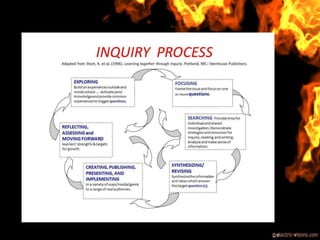
Inquiry
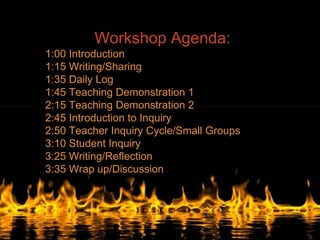
Workshop Agenda:
1:00 Introduction
1:15 Writing/Sharing
1:35 Daily Log
1:45 Teaching Demonstration 1
2:15 Teaching Demonstration 2
2:45 Introduction to Inquiry
2:50 Teacher Inquiry Cycle/Small Groups
3:10 Student Inquiry
3:25 Writing/Reflection
3:35 Wrap up/Discussion
Read Aloud - Journal Writing
Getting
Started
Writer's Notebook -Ralph Fletcher
Author's
Chair
Daily Log
Dog Daily
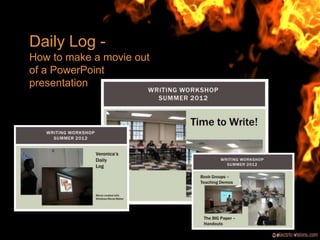
Daily Log -
How to make a movie out
of a PowerPoint
presentation
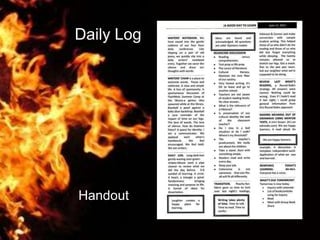
Daily Log
Handout
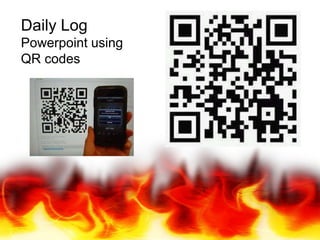
Daily Log
Powerpoint using
QR codes
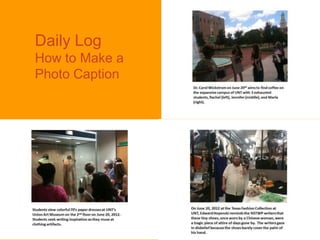
Daily Log
How to Make a
Photo Caption
Teaching
Demonstration
1
Generating Topics
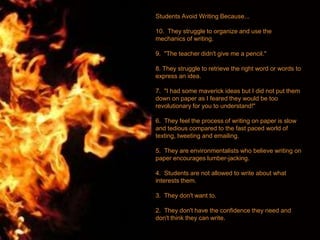
Students Avoid Writing Because...
10. They struggle to organize and use the
mechanics of writing.
9. "The teacher didn't give me a pencil."
8. They struggle to retrieve the right word or words to
express an idea.
7. "I had some maverick ideas but I did not put them
down on paper as I feared they would be too
revolutionary for you to understand!"
6. They feel the process of writing on paper is slow
and tedious compared to the fast paced world of
texting, tweeting and emailing.
5. They are environmentalists who believe writing on
paper encourages lumber-jacking.
4. Students are not allowed to write about what
interests them.
3. They don't want to.
2. They don't have the confidence they need and
don't think they can write.
1. "I don't have
anything to
write about."
Help them light the fire!
In the classroom generating writing ideas and topics can be
one of the most daunting tasks that young writers face.
The teacher’s role is to provide students with strategies for
generating and selecting their own topics and ideas, not
to feed or give the students topics.
The
Bucket
List
Write,
write,
write!
Strategies for
Generating Topics
Brainstorming
Free Writing
Looping
Clustering
Listing
Cross Pollination
Teaching
Demonstration
2
Using Mentor Texts
• —Books or other texts that
students can refer to when
learning a new writing skill.
• —Mentor texts are for every
age and ability level – even the
teachers!
• —We use mentors in every
aspect of our lives, why not
use them in writing also?
What are mentor texts?
Choosing mentor texts
You need to enjoy the text, be
drawn to it in some way.
—Does the book provide
examples that you want to
teach?
—Choose a variety of genres:
poetry, fiction, nonfiction,
memoirs
Introducing mentor texts
• —FIRST, through read-alouds.
• —Allow students to enjoy the story, listen to
the words, appreciate the writing.
• —THEN, revisit and use as a learning tool.
Using Mentor Texts to Add Detail to
Writing
Dorfman, L. R. & Cappelli, R. (2007). Mentor Texts. Portland, OR: Stenhouse Publishers
Choose a book that is familiar to students.
—Reread the first couple of pages, leaving out the details.
—When students notice, ask them what they want to know
that was not just read.
—Reread the pages, including the details.
Purpose
—When we leave details
out of our writing, it
leaves the reader asking
many questions. We
want the questions to be
answered in our writing,
so we add details.
Help them light the fire!
What do I write about?
—Brainstorm a list of SMALL moments
Start with
one sentence
—Choose one moment
and write about it in one
sentence.
—The best hot chocolate
I ever tasted was in
Venice, Italy.
—Look at my sentence.
The best hot chocolate I ever tasted
was in Venice, Italy.
—What questions do you
have?
Add details
—Use the questions to
help you add details to
your writing.
—By answering the
questions, the writing
will be clearer and
more interesting.
Let's Try It!
• —Volunteers?
• —Your turn:
◦Turn to a neighbor.
◦Read your sentence and record the questions
your partner asks.
◦Listen to your partner’s sentence and ask
questions.
◦Answer the questions in your writing.
Independent Writing
—Trade your writing with a different neighbor.
—As you read the writing, mark if there are any areas that
you have additional questions.
—Trade writing back and revise.
—
The goal is for
students to begin
to ask and answer
their own
questions in
writing.
Introduction to Inquiry
Without purpose,
significant learning is
difficult if not
impossible to achieve.
(Wilhelm, p. 8)
Help them light the fire!
By recasting a curricular topic in terms
of a guiding question, we set the
stage for a model of teaching known
as "inquiry"
(Wilhelm, p. 8 - See Jacobs, 1989; Smith & Wilhelm, 2006; Travers, 1998;
Wiggins & McTighe, 2003)
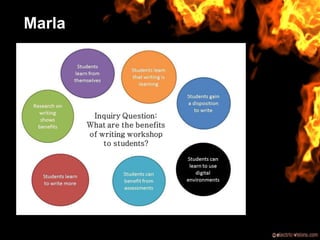
Marla
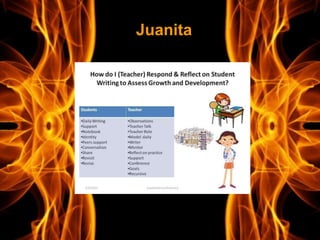
Juanita
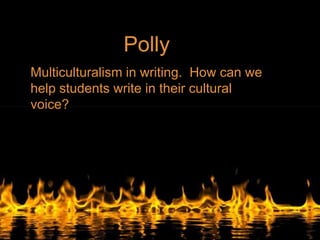
Polly
Multiculturalism in writing. How can we
help students write in their cultural
voice?
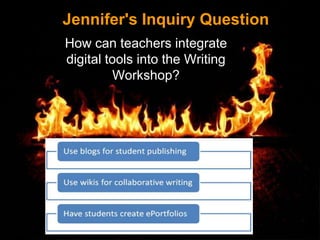
Jennifer's Inquiry Question
How can teachers integrate
digital tools into the Writing
Workshop?
Dog Daily
Coming Back To Inquiry
Teacher Inquiry
Implementing the Inquiry Cycle
in your teaching practice
Early Elementary - Marla
Upper Elementary - Jennifer
Middle School
High School
Students with Services
- Polly
Content Area/ELL - Juanita
Your Teacher Inquiry
Student Inquiry
Implementing the Inquiry Cycle
in your classroom
Help them light the fire!
Writing is a process of
"learning to write and writing
to learn"
-Zinsser, 1988, p. 16
Journal Writing/Reflection
We only need to lay a log
lightly from time to time.
A fire
grows
simply because the space is there,with
openings
in which the flame
that knows just how it wants to burn
can find its way.
--Judy Brown
Wrap-up/Discussion
Ah ha Moments
Catching Fire Workshop References
Allington, R. L. (2001). What Really Matters for Struggling Readers: Designing Research-based Programs. New York,
NY: Addison-Wesley.
Allington, R. L., & Cunningham, P. M. (2006). Schools That Work: Where All Children Read and Write. New York, NY:
Allyn & Bacon, Inc.
Brindley, R., & Schneider, J. J. (2002). Writing Instruction or Destruction? Lessons to be Learned from Fourth Grade
Teachers’ Perspectives. Journal of Teacher Education, 53, 328-341.
Cambourne, B. (1988). The Whole Story: Natural Learning and the Acquisition of Literacy in the Classroom. Auckland,
New Zealand: Ashton Scholastic.
Capello, M. (2006). Under Construction: Voice and Identity Development in Writing Workshop. Language Arts, 83(6),
482-491.
Corden, R. (2007). Developing Reading-writing Connections: The Impact of Explicit Instruction of Literary Devices on
the Quality of Children’s Narrative Writing. Journal of Research in Childhood Education, 21(3), 269-89.
Elbow, P. (2000). Everyone can write: Essays Towards a Hopeful Theory of Writing and Teaching Writing. New York:
Oxford University Press.
Graves, D. H. (2002). Testing is Not Teaching: What Should Count in Education. Portsmouth, NH: Heinemann.
Murray, D. M. (1985). A Writer Teaches Writing. Dallas, TX: Houghton Mifflin.
National Commission on Writing for America’s Families, Schools, and Colleges. (2003). The Neglected “R”: The Need
for a Writing Revolution. New York: College Board.
Catching Fire Workshop References
National Writing Project, & Nagin, C. (2006). Because Writing Matters: Improving Student Writing in our Schools. San
Francisco, CA: Jossey-Bass.
Ray, K. W. (2006). Study Driven: A Framework for Planning Units of Study in the Writing Workshop. Portsmouth, NH:
Heinemann.
Shelton, N. R., & Fu, D. (2004). Creating Space for Teaching Writing and for Test Preparation. Language Arts, 82(2),
120-128.
Short, K., Harste, J., & Burke, C. (1996). Creating Classrooms for Authors and Inquirers. 2nd ed. Portsmouth, NH:
Heinemann.
Smith, F. (1988). Joining the Literacy Club. Portsmouth, NH: Heinemman.
Vygotsky, L. (1978). Mind in Society: The Development of Higher Psychological Processes, trans. M. Cole, V. John-
Steiner, S. Scribner, and E. Souberman. Cambridge, MA: Harvard University Press.
Wenger, E. (1998). Communities of Practice: Learning, Meaning, and Identity. New York: Cambridge University Press.
Whyte, A., Lazarte, A., Thompson, I., Ellis, N., Muse, A., & Talbot, R. (2007). The National Writing Project, Teachers’
Writing Lives, and Student Achievement in Writing. Action in Teacher Education, 29(2), 5-16.
Wilhelm, J. (2007). Engaging Readers and Writers with Inquiry: Promoting Deep Understandings in Language Arts and
the Content Areas with Guiding Questions. New York: Scholastic.
Zinsser, W. K. (1988). Writing to Learn. New York, NY: Harper & Row.
Catch Fire!
Juanita
Ramirez-Robertson
jrobertson@twu.edu
Marla Robertson
mrobertson6@twu.edu
Jennifer Smith
jsmith30@twu.edu
Polly Vaughan
vaughanp@lisd.net

Catching fire presentation

  • 1.
    What makes afire burn is space between the logs, a breathing space. Too much of a good thing, too many logs packed in too tight can douse the flames almost as surely as a pail of water would. So building fires requires attention to the spaces in between, as much as the wood. When we are able to build open spaces in the same way we have learned to pile on the logs, then we can come to see how it is fuel, and absence of the fuel together, that makes fire possible. We only need to lay a log lightly from time to time. A fire grows simply because the space is there,with openings in which the flame that knows just how it wants to burn can find its way. --Judy Brown Fire
  • 2.
    "Catching Fire" Using Inquiry to IgniteLearning in a Writing Classroom
  • 3.
    Juanita Ramirez- Robertson Denton ISD, TexasWoman's University Marla Robertson Texas Woman's University Jennifer Smith Texas Woman's University Polly Vaughan Lewisville ISD, University of North Texas
  • 4.
    Writing is Learning Writingis learning quote Donald Murray: "meaning is not thought up and then written down. The act of writing is an act of thought" (1985, p. 3). "use writing as a way of learning, a way of discovering and exploring, of finding what you may have to say and finding ways in which you may say it" (p. 6).
  • 5.
    Think of yourclassroom/work Everyone write: What are my wonderings? What are my questions? What am I struggling with? Why am I here? Inquiry
  • 6.
    Workshop Agenda: 1:00 Introduction 1:15Writing/Sharing 1:35 Daily Log 1:45 Teaching Demonstration 1 2:15 Teaching Demonstration 2 2:45 Introduction to Inquiry 2:50 Teacher Inquiry Cycle/Small Groups 3:10 Student Inquiry 3:25 Writing/Reflection 3:35 Wrap up/Discussion
  • 7.
    Read Aloud -Journal Writing Getting Started Writer's Notebook -Ralph Fletcher
  • 8.
  • 9.
  • 10.
    Dog Daily Daily Log- How to make a movie out of a PowerPoint presentation
  • 11.
  • 12.
  • 13.
    Daily Log How toMake a Photo Caption
  • 14.
  • 15.
  • 16.
    Students Avoid WritingBecause... 10. They struggle to organize and use the mechanics of writing. 9. "The teacher didn't give me a pencil." 8. They struggle to retrieve the right word or words to express an idea. 7. "I had some maverick ideas but I did not put them down on paper as I feared they would be too revolutionary for you to understand!" 6. They feel the process of writing on paper is slow and tedious compared to the fast paced world of texting, tweeting and emailing. 5. They are environmentalists who believe writing on paper encourages lumber-jacking. 4. Students are not allowed to write about what interests them. 3. They don't want to. 2. They don't have the confidence they need and don't think they can write.
  • 17.
    1. "I don'thave anything to write about."
  • 18.
    Help them lightthe fire! In the classroom generating writing ideas and topics can be one of the most daunting tasks that young writers face. The teacher’s role is to provide students with strategies for generating and selecting their own topics and ideas, not to feed or give the students topics.
  • 19.
  • 20.
  • 21.
    Strategies for Generating Topics Brainstorming FreeWriting Looping Clustering Listing Cross Pollination
  • 22.
  • 23.
  • 24.
    • —Books orother texts that students can refer to when learning a new writing skill. • —Mentor texts are for every age and ability level – even the teachers! • —We use mentors in every aspect of our lives, why not use them in writing also? What are mentor texts?
  • 25.
    Choosing mentor texts Youneed to enjoy the text, be drawn to it in some way. —Does the book provide examples that you want to teach? —Choose a variety of genres: poetry, fiction, nonfiction, memoirs
  • 26.
    Introducing mentor texts •—FIRST, through read-alouds. • —Allow students to enjoy the story, listen to the words, appreciate the writing. • —THEN, revisit and use as a learning tool.
  • 27.
    Using Mentor Textsto Add Detail to Writing Dorfman, L. R. & Cappelli, R. (2007). Mentor Texts. Portland, OR: Stenhouse Publishers Choose a book that is familiar to students. —Reread the first couple of pages, leaving out the details. —When students notice, ask them what they want to know that was not just read. —Reread the pages, including the details.
  • 28.
    Purpose —When we leavedetails out of our writing, it leaves the reader asking many questions. We want the questions to be answered in our writing, so we add details.
  • 29.
    Help them lightthe fire! What do I write about? —Brainstorm a list of SMALL moments
  • 30.
    Start with one sentence —Chooseone moment and write about it in one sentence. —The best hot chocolate I ever tasted was in Venice, Italy.
  • 31.
    —Look at mysentence. The best hot chocolate I ever tasted was in Venice, Italy. —What questions do you have?
  • 32.
    Add details —Use thequestions to help you add details to your writing. —By answering the questions, the writing will be clearer and more interesting.
  • 33.
    Let's Try It! •—Volunteers? • —Your turn: ◦Turn to a neighbor. ◦Read your sentence and record the questions your partner asks. ◦Listen to your partner’s sentence and ask questions. ◦Answer the questions in your writing.
  • 34.
    Independent Writing —Trade yourwriting with a different neighbor. —As you read the writing, mark if there are any areas that you have additional questions. —Trade writing back and revise. —
  • 35.
    The goal isfor students to begin to ask and answer their own questions in writing.
  • 36.
  • 37.
    Without purpose, significant learningis difficult if not impossible to achieve. (Wilhelm, p. 8)
  • 38.
    Help them lightthe fire! By recasting a curricular topic in terms of a guiding question, we set the stage for a model of teaching known as "inquiry" (Wilhelm, p. 8 - See Jacobs, 1989; Smith & Wilhelm, 2006; Travers, 1998; Wiggins & McTighe, 2003)
  • 39.
  • 40.
  • 41.
    Polly Multiculturalism in writing.How can we help students write in their cultural voice?
  • 42.
    Jennifer's Inquiry Question Howcan teachers integrate digital tools into the Writing Workshop?
  • 43.
  • 44.
    Teacher Inquiry Implementing theInquiry Cycle in your teaching practice
  • 45.
    Early Elementary -Marla Upper Elementary - Jennifer Middle School High School Students with Services - Polly Content Area/ELL - Juanita Your Teacher Inquiry
  • 46.
    Student Inquiry Implementing theInquiry Cycle in your classroom
  • 51.
    Help them lightthe fire! Writing is a process of "learning to write and writing to learn" -Zinsser, 1988, p. 16
  • 52.
    Journal Writing/Reflection We onlyneed to lay a log lightly from time to time. A fire grows simply because the space is there,with openings in which the flame that knows just how it wants to burn can find its way. --Judy Brown
  • 53.
  • 54.
    Catching Fire WorkshopReferences Allington, R. L. (2001). What Really Matters for Struggling Readers: Designing Research-based Programs. New York, NY: Addison-Wesley. Allington, R. L., & Cunningham, P. M. (2006). Schools That Work: Where All Children Read and Write. New York, NY: Allyn & Bacon, Inc. Brindley, R., & Schneider, J. J. (2002). Writing Instruction or Destruction? Lessons to be Learned from Fourth Grade Teachers’ Perspectives. Journal of Teacher Education, 53, 328-341. Cambourne, B. (1988). The Whole Story: Natural Learning and the Acquisition of Literacy in the Classroom. Auckland, New Zealand: Ashton Scholastic. Capello, M. (2006). Under Construction: Voice and Identity Development in Writing Workshop. Language Arts, 83(6), 482-491. Corden, R. (2007). Developing Reading-writing Connections: The Impact of Explicit Instruction of Literary Devices on the Quality of Children’s Narrative Writing. Journal of Research in Childhood Education, 21(3), 269-89. Elbow, P. (2000). Everyone can write: Essays Towards a Hopeful Theory of Writing and Teaching Writing. New York: Oxford University Press. Graves, D. H. (2002). Testing is Not Teaching: What Should Count in Education. Portsmouth, NH: Heinemann. Murray, D. M. (1985). A Writer Teaches Writing. Dallas, TX: Houghton Mifflin. National Commission on Writing for America’s Families, Schools, and Colleges. (2003). The Neglected “R”: The Need for a Writing Revolution. New York: College Board.
  • 55.
    Catching Fire WorkshopReferences National Writing Project, & Nagin, C. (2006). Because Writing Matters: Improving Student Writing in our Schools. San Francisco, CA: Jossey-Bass. Ray, K. W. (2006). Study Driven: A Framework for Planning Units of Study in the Writing Workshop. Portsmouth, NH: Heinemann. Shelton, N. R., & Fu, D. (2004). Creating Space for Teaching Writing and for Test Preparation. Language Arts, 82(2), 120-128. Short, K., Harste, J., & Burke, C. (1996). Creating Classrooms for Authors and Inquirers. 2nd ed. Portsmouth, NH: Heinemann. Smith, F. (1988). Joining the Literacy Club. Portsmouth, NH: Heinemman. Vygotsky, L. (1978). Mind in Society: The Development of Higher Psychological Processes, trans. M. Cole, V. John- Steiner, S. Scribner, and E. Souberman. Cambridge, MA: Harvard University Press. Wenger, E. (1998). Communities of Practice: Learning, Meaning, and Identity. New York: Cambridge University Press. Whyte, A., Lazarte, A., Thompson, I., Ellis, N., Muse, A., & Talbot, R. (2007). The National Writing Project, Teachers’ Writing Lives, and Student Achievement in Writing. Action in Teacher Education, 29(2), 5-16. Wilhelm, J. (2007). Engaging Readers and Writers with Inquiry: Promoting Deep Understandings in Language Arts and the Content Areas with Guiding Questions. New York: Scholastic. Zinsser, W. K. (1988). Writing to Learn. New York, NY: Harper & Row.
  • 56.