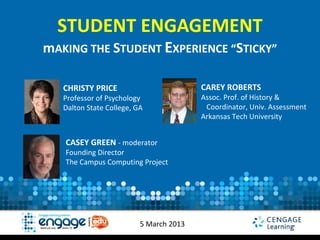
STUDENT ENGAGEMENT
mAKING THE STUDENT EXPERIENCE “STICKY”

   CHRISTY PRICE                         CAREY ROBERTS
   Professor of Psychology               Assoc. Prof. of History &
   Dalton State College, GA               Coordinator, Univ. Assessment
                                         Arkansas Tech University


   CASEY GREEN - moderator
   Founding Director
   The Campus Computing Project


                          5 March 2013
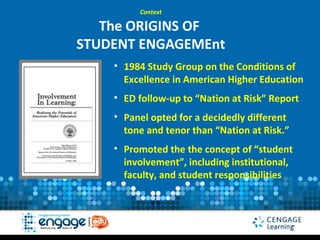
Context

   The ORIGINS OF
STUDENT ENGAGEMEnt
    • 1984 Study Group on the Conditions of
      Excellence in American Higher Education
    • ED follow-up to “Nation at Risk” Report
    • Panel opted for a decidedly different
      tone and tenor than “Nation at Risk.”
    • Promoted the the concept of “student
      involvement”, including institutional,
      faculty, and student responsibilities
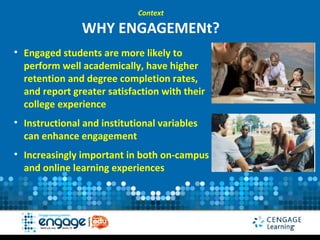
Context

               WHY ENGAGEMENt?
• Engaged students are more likely to
  perform well academically, have higher
  retention and degree completion rates,
  and report greater satisfaction with their
  college experience
• Instructional and institutional variables
  can enhance engagement
• Increasingly important in both on-campus
  and online learning experiences
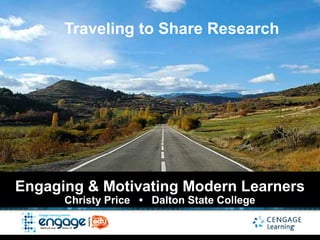
Traveling to Share Research


Engaging & Motivating Modern Learners
      Christy Price • Dalton State College
The Student Perspective on Professors
Some comments are clearly negative…

            “She acted like she
               knew more
            than the students.”
            Rejection of Hierarchy &
  No Value of Information for Information’s Sake
The Student Perspective on Professors
Some comments are difficult to classify…

    “I failed a quiz because I didn’t
        realize he was teaching.
    I thought he was just talking.”

Attentions Issues resulting from Multimedia Culture
The Student Perspective on Professors
Some comments are difficult to classify…

   “If I only had one hour to live
I would spend it with my Professor…
        Because he can make
               an hour
     seem like a LIFETIME!”
IS THERE


Will What We Do
Make a Difference?
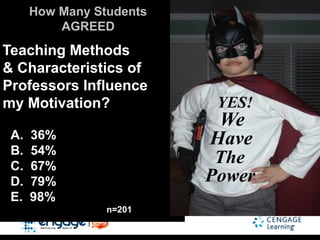
How Many Students
          AGREED
Teaching Methods
& Characteristics of
Professors Influence
my Motivation?             YES!
                           We
 A.   36%                 Have
 B.   54%
 C.   67%
                           The
 D.   79%                 Power
 E.   98%
                 n=201
GIRL SCOUTS
       Because Next Time,
You’ll Just Buy the Darn Cookies!
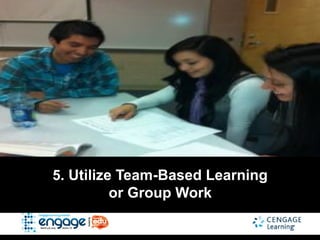
5. Utilize Team-Based Learning
          or Group Work
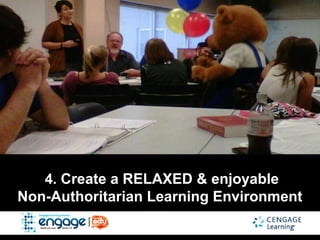
4. Create a RELAXED & enjoyable
Non-Authoritarian Learning Environment
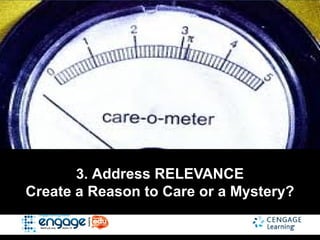
3. Address RELEVANCE
Create a Reason to Care or a Mystery?
2. Embed MULTIMEDIA & other VISUALS
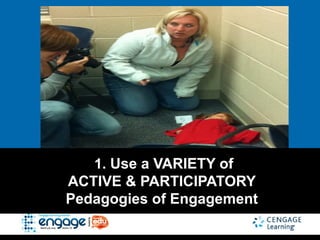
1. Use a VARIETY of
ACTIVE & PARTICIPATORY
Pedagogies of Engagement
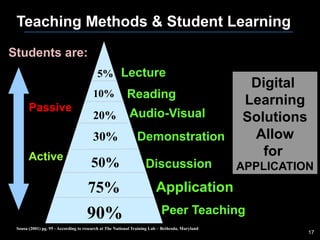
Teaching Methods & Student Learning
Students are:
                                          5% Lecture
                                                                                                  Digital
                                        10%              Reading
       Passive
                                                                                                 Learning
                                        20%               Audio-Visual                           Solutions
                                        30%                   Demonstration                       Allow
       Active                                                                                       for
                                       50%                         Discussion                    APPLICATION
                                     75%                                Application
                                     90%                                   Peer Teaching
 Sousa (2001) pg. 95 - According to research at The National Training Lab – Bethesda, Maryland
                                                                                                             17
Overcoming the Big
Problems
 Carey M. Roberts
Professor of History
Arkansas Tech University
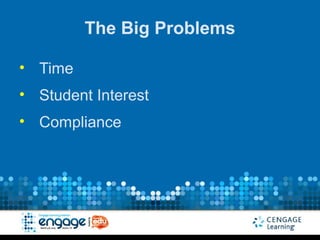
The Big Problems

• Time
• Student Interest
• Compliance
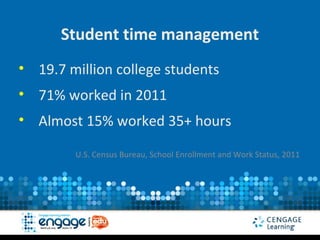
Student time management
• 19.7 million college students
• 71% worked in 2011
• Almost 15% worked 35+ hours

        U.S. Census Bureau, School Enrollment and Work Status, 2011
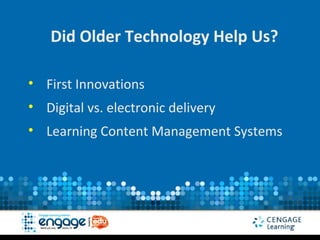
Did Older Technology Help Us?

• First Innovations
• Digital vs. electronic delivery
• Learning Content Management Systems
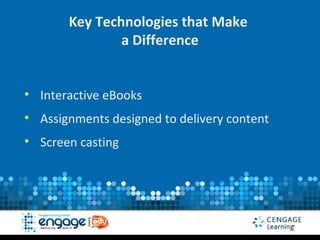
Key Technologies that Make
               a Difference


• Interactive eBooks
• Assignments designed to delivery content
• Screen casting
What Technology Best
          Helps Faculty?

• Engages Students
• Saves Time
• Linked to Student Outcomes
• Robust Reporting
Too Much Information

• Less Is Best
• Student Time Management
• Focus on Key Learning Goals
Let’s Discuss!!
Contact Information
CHRISTY PRICE              CAREY ROBERTS              CASEY GREEN
Dalton State College, GA   Arkansas Tech University   Campus Computing Project
cprice@daltonstate.edu     croberts@atu.edu           cgreen@campuscomputing.net

Engage 2013, SXSWedu, Christy Price, Casey Green, Carey Roberts -- Making the Student Experience "Sticky"

  • 2.
    STUDENT ENGAGEMENT mAKING THESTUDENT EXPERIENCE “STICKY” CHRISTY PRICE CAREY ROBERTS Professor of Psychology Assoc. Prof. of History & Dalton State College, GA Coordinator, Univ. Assessment Arkansas Tech University CASEY GREEN - moderator Founding Director The Campus Computing Project 5 March 2013
  • 3.
    Context The ORIGINS OF STUDENT ENGAGEMEnt • 1984 Study Group on the Conditions of Excellence in American Higher Education • ED follow-up to “Nation at Risk” Report • Panel opted for a decidedly different tone and tenor than “Nation at Risk.” • Promoted the the concept of “student involvement”, including institutional, faculty, and student responsibilities
  • 4.
    Context WHY ENGAGEMENt? • Engaged students are more likely to perform well academically, have higher retention and degree completion rates, and report greater satisfaction with their college experience • Instructional and institutional variables can enhance engagement • Increasingly important in both on-campus and online learning experiences
  • 5.
    Traveling to ShareResearch Engaging & Motivating Modern Learners Christy Price • Dalton State College
  • 6.
    The Student Perspectiveon Professors Some comments are clearly negative… “She acted like she knew more than the students.” Rejection of Hierarchy & No Value of Information for Information’s Sake
  • 7.
    The Student Perspectiveon Professors Some comments are difficult to classify… “I failed a quiz because I didn’t realize he was teaching. I thought he was just talking.” Attentions Issues resulting from Multimedia Culture
  • 8.
    The Student Perspectiveon Professors Some comments are difficult to classify… “If I only had one hour to live I would spend it with my Professor… Because he can make an hour seem like a LIFETIME!”
  • 9.
    IS THERE Will WhatWe Do Make a Difference?
  • 10.
    How Many Students AGREED Teaching Methods & Characteristics of Professors Influence my Motivation? YES! We A. 36% Have B. 54% C. 67% The D. 79% Power E. 98% n=201
  • 11.
    GIRL SCOUTS Because Next Time, You’ll Just Buy the Darn Cookies!
  • 12.
    5. Utilize Team-BasedLearning or Group Work
  • 13.
    4. Create aRELAXED & enjoyable Non-Authoritarian Learning Environment
  • 14.
    3. Address RELEVANCE Createa Reason to Care or a Mystery?
  • 15.
    2. Embed MULTIMEDIA& other VISUALS
  • 16.
    1. Use aVARIETY of ACTIVE & PARTICIPATORY Pedagogies of Engagement
  • 17.
    Teaching Methods &Student Learning Students are: 5% Lecture Digital 10% Reading Passive Learning 20% Audio-Visual Solutions 30% Demonstration Allow Active for 50% Discussion APPLICATION 75% Application 90% Peer Teaching Sousa (2001) pg. 95 - According to research at The National Training Lab – Bethesda, Maryland 17
  • 18.
    Overcoming the Big Problems Carey M. Roberts Professor of History Arkansas Tech University
  • 19.
    The Big Problems •Time • Student Interest • Compliance
  • 20.
    Student time management •19.7 million college students • 71% worked in 2011 • Almost 15% worked 35+ hours U.S. Census Bureau, School Enrollment and Work Status, 2011
  • 21.
    Did Older TechnologyHelp Us? • First Innovations • Digital vs. electronic delivery • Learning Content Management Systems
  • 22.
    Key Technologies thatMake a Difference • Interactive eBooks • Assignments designed to delivery content • Screen casting
  • 23.
    What Technology Best Helps Faculty? • Engages Students • Saves Time • Linked to Student Outcomes • Robust Reporting
  • 24.
    Too Much Information •Less Is Best • Student Time Management • Focus on Key Learning Goals
  • 25.
  • 26.
    Contact Information CHRISTY PRICE CAREY ROBERTS CASEY GREEN Dalton State College, GA Arkansas Tech University Campus Computing Project cprice@daltonstate.edu croberts@atu.edu cgreen@campuscomputing.net