- 1 -Confidential not to be used without consent
March 2013
Resistance to Change –
Addressing the Underlying Attitudes
Cate Collins & Ketan Varia
W: www.kinetik.uk.com | E: bebetter@kinetik.uk.com | T: 0203 397 0686 Version 1.2 Edited 8th May 2014
Kinetik Solutions Ltd. Registered in England & Wales, No 6067771. Registered Office: 16 Wychwood Close, Edgware, Middlesex, HA8 6TE. VAT GB 839 9186 67
- 2 -Confidential not to be used without consent
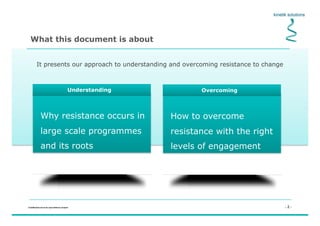
It presents our approach to understanding and overcoming resistance to change
What this document is about
Why resistance occurs in
large scale programmes
and its roots
Understanding
How to overcome
resistance with the right
levels of engagement
Overcoming
- 3 -Confidential not to be used without consent
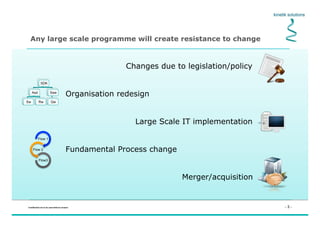
Any large scale programme will create resistance to change
Merger/acquisition
Changes due to legislation/policy
Organisation redesign
SDK
Asd
Sw Rw
Swe
Qw
Large Scale IT implementation
Fundamental Process change
Flow 1
Flow 2
Flow3
- 4 -Confidential not to be used without consent
If there is no personal benefit
all you get is resistance
- 5 -Confidential not to be used without consent
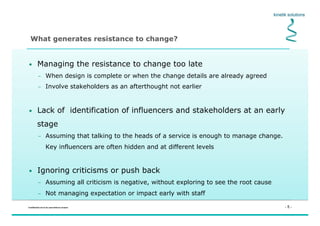
•  Managing the resistance to change too late
–  When design is complete or when the change details are already agreed
–  Involve stakeholders as an afterthought not earlier
•  Lack of identification of influencers and stakeholders at an early
stage
–  Assuming that talking to the heads of a service is enough to manage change.
Key influencers are often hidden and at different levels
•  Ignoring criticisms or push back
–  Assuming all criticism is negative, without exploring to see the root cause
–  Not managing expectation or impact early with staff
What generates resistance to change?
- 6 -Confidential not to be used without consent
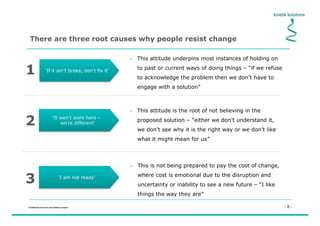
‘If it ain’t broke, don’t fix it’
‘I am not ready’
–  This attitude underpins most instances of holding on
to past or current ways of doing things – “if we refuse
to acknowledge the problem then we don’t have to
engage with a solution”
–  This is not being prepared to pay the cost of change,
where cost is emotional due to the disruption and
uncertainty or inability to see a new future – “I like
things the way they are”
‘It won’t work here –
we’re different’
–  This attitude is the root of not believing in the
proposed solution – “either we don’t understand it,
we don’t see why it is the right way or we don’t like
what it might mean for us”
There are three root causes why people resist change
1
2
3
- 7 -Confidential not to be used without consent
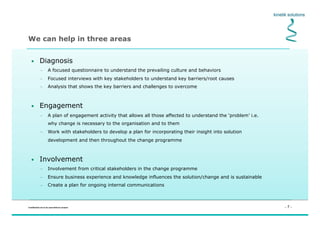
We can help in three areas
•  Diagnosis
–  A focused questionnaire to understand the prevailing culture and behaviors
–  Focused interviews with key stakeholders to understand key barriers/root causes
–  Analysis that shows the key barriers and challenges to overcome
•  Engagement
–  A plan of engagement activity that allows all those affected to understand the ‘problem’ i.e.
why change is necessary to the organisation and to them
–  Work with stakeholders to develop a plan for incorporating their insight into solution
development and then throughout the change programme
•  Involvement
–  Involvement from critical stakeholders in the change programme
–  Ensure business experience and knowledge influences the solution/change and is sustainable
–  Create a plan for ongoing internal communications
- 8 -Confidential not to be used without consent
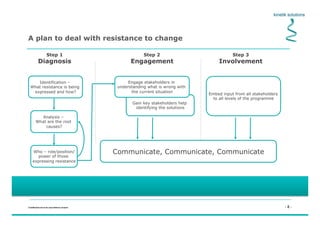
A plan to deal with resistance to change
Step 1
Diagnosis
Step 2
Engagement
Step 3
Involvement
Who – role/position/
power of those
expressing resistance
Analysis –
What are the root
causes?
Gain key stakeholders help
identifying the solutions
Communicate, Communicate, Communicate
Embed input from all stakeholders
to all levels of the programme
Identification –
What resistance is being
expressed and how?
Engage stakeholders in
understanding what is wrong with
the current situation
- 9 -Confidential not to be used without consent
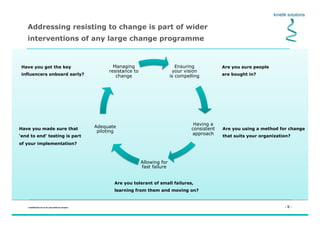
Addressing resisting to change is part of wider
interventions of any large change programme
Ensuring
your vision
is compelling
Having a
consistent
approach
Allowing for
fast failure
Adequate
piloting
Managing
resistance to
change
Have you got the key
influencers onboard early?
Are you sure people
are bought in?
Are you using a method for change
that suits your organization?
Are you tolerant of small failures,
learning from them and moving on?
Have you made sure that
‘end to end’ testing is part
of your implementation?
Kinetik Solutions Ltd
16 Wychwood Close
Edgware • Middlesex • HA8 6TE
Registered in England & Wales, No. 6067771
VAT GB 839 9186 67
www.kinetik.uk.com
bebetter@kinetik.uk.com
020 3397 0686
about kinetik solutions
Consultancy profile
•  Established in 2007, kinetik solutions delivers complex change for large
organisations in the public and private sectors
•  Our team consists of highly experienced consultants each with over 10 years
change management experience in blue-chip organisations or a ‘Big 4’
management consultancy
•  We continually invest in learning to offer the latest thinking in transformational
change to our clients. We run regular public events on Lean learning for our
NHS clients and are members of:
-  Lean Enterprise Group
-  Deming Alliance
-  Operational Excellence Group
-  Enterprise Thinking Group
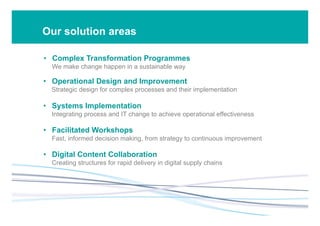
Our solution areas
•  Complex Transformation Programmes
We make change happen in a sustainable way
•  Operational Design and Improvement
Strategic design for complex processes and their implementation
•  Systems Implementation
Integrating process and IT change to achieve operational effectiveness
•  Facilitated Workshops
Fast, informed decision making, from strategy to continuous improvement
•  Digital Content Collaboration
Creating structures for rapid delivery in digital supply chains
We work with a range of clients in a variety of sectors
Kinetik Solutions Ltd
Registered in England & Wales, No 6067771
Registered Office 16 • Wychwood Close
Edgware • Middlesex • HA8 6TE
VAT GB 839 9186 67
www.kinetik.uk.com
bebetter@kinetik.uk.com
020 3397 0686
kinetik solutions
agility to sustain change

Resistance to change

  • 1.
    - 1 -Confidentialnot to be used without consent March 2013 Resistance to Change – Addressing the Underlying Attitudes Cate Collins & Ketan Varia W: www.kinetik.uk.com | E: bebetter@kinetik.uk.com | T: 0203 397 0686 Version 1.2 Edited 8th May 2014 Kinetik Solutions Ltd. Registered in England & Wales, No 6067771. Registered Office: 16 Wychwood Close, Edgware, Middlesex, HA8 6TE. VAT GB 839 9186 67
  • 2.
    - 2 -Confidentialnot to be used without consent It presents our approach to understanding and overcoming resistance to change What this document is about Why resistance occurs in large scale programmes and its roots Understanding How to overcome resistance with the right levels of engagement Overcoming
  • 3.
    - 3 -Confidentialnot to be used without consent Any large scale programme will create resistance to change Merger/acquisition Changes due to legislation/policy Organisation redesign SDK Asd Sw Rw Swe Qw Large Scale IT implementation Fundamental Process change Flow 1 Flow 2 Flow3
  • 4.
    - 4 -Confidentialnot to be used without consent If there is no personal benefit all you get is resistance
  • 5.
    - 5 -Confidentialnot to be used without consent •  Managing the resistance to change too late –  When design is complete or when the change details are already agreed –  Involve stakeholders as an afterthought not earlier •  Lack of identification of influencers and stakeholders at an early stage –  Assuming that talking to the heads of a service is enough to manage change. Key influencers are often hidden and at different levels •  Ignoring criticisms or push back –  Assuming all criticism is negative, without exploring to see the root cause –  Not managing expectation or impact early with staff What generates resistance to change?
  • 6.
    - 6 -Confidentialnot to be used without consent ‘If it ain’t broke, don’t fix it’ ‘I am not ready’ –  This attitude underpins most instances of holding on to past or current ways of doing things – “if we refuse to acknowledge the problem then we don’t have to engage with a solution” –  This is not being prepared to pay the cost of change, where cost is emotional due to the disruption and uncertainty or inability to see a new future – “I like things the way they are” ‘It won’t work here – we’re different’ –  This attitude is the root of not believing in the proposed solution – “either we don’t understand it, we don’t see why it is the right way or we don’t like what it might mean for us” There are three root causes why people resist change 1 2 3
  • 7.
    - 7 -Confidentialnot to be used without consent We can help in three areas •  Diagnosis –  A focused questionnaire to understand the prevailing culture and behaviors –  Focused interviews with key stakeholders to understand key barriers/root causes –  Analysis that shows the key barriers and challenges to overcome •  Engagement –  A plan of engagement activity that allows all those affected to understand the ‘problem’ i.e. why change is necessary to the organisation and to them –  Work with stakeholders to develop a plan for incorporating their insight into solution development and then throughout the change programme •  Involvement –  Involvement from critical stakeholders in the change programme –  Ensure business experience and knowledge influences the solution/change and is sustainable –  Create a plan for ongoing internal communications
  • 8.
    - 8 -Confidentialnot to be used without consent A plan to deal with resistance to change Step 1 Diagnosis Step 2 Engagement Step 3 Involvement Who – role/position/ power of those expressing resistance Analysis – What are the root causes? Gain key stakeholders help identifying the solutions Communicate, Communicate, Communicate Embed input from all stakeholders to all levels of the programme Identification – What resistance is being expressed and how? Engage stakeholders in understanding what is wrong with the current situation
  • 9.
    - 9 -Confidentialnot to be used without consent Addressing resisting to change is part of wider interventions of any large change programme Ensuring your vision is compelling Having a consistent approach Allowing for fast failure Adequate piloting Managing resistance to change Have you got the key influencers onboard early? Are you sure people are bought in? Are you using a method for change that suits your organization? Are you tolerant of small failures, learning from them and moving on? Have you made sure that ‘end to end’ testing is part of your implementation?
  • 10.
    Kinetik Solutions Ltd 16Wychwood Close Edgware • Middlesex • HA8 6TE Registered in England & Wales, No. 6067771 VAT GB 839 9186 67 www.kinetik.uk.com bebetter@kinetik.uk.com 020 3397 0686 about kinetik solutions
  • 11.
    Consultancy profile •  Establishedin 2007, kinetik solutions delivers complex change for large organisations in the public and private sectors •  Our team consists of highly experienced consultants each with over 10 years change management experience in blue-chip organisations or a ‘Big 4’ management consultancy •  We continually invest in learning to offer the latest thinking in transformational change to our clients. We run regular public events on Lean learning for our NHS clients and are members of: -  Lean Enterprise Group -  Deming Alliance -  Operational Excellence Group -  Enterprise Thinking Group
  • 12.
    Our solution areas • Complex Transformation Programmes We make change happen in a sustainable way •  Operational Design and Improvement Strategic design for complex processes and their implementation •  Systems Implementation Integrating process and IT change to achieve operational effectiveness •  Facilitated Workshops Fast, informed decision making, from strategy to continuous improvement •  Digital Content Collaboration Creating structures for rapid delivery in digital supply chains
  • 13.
    We work witha range of clients in a variety of sectors
  • 14.
    Kinetik Solutions Ltd Registeredin England & Wales, No 6067771 Registered Office 16 • Wychwood Close Edgware • Middlesex • HA8 6TE VAT GB 839 9186 67 www.kinetik.uk.com bebetter@kinetik.uk.com 020 3397 0686 kinetik solutions agility to sustain change