1
Lean: Understanding a Customer
Requirements Matrix
Series on Quality Systems Management Tools
Dr. Sharon L. Burton, DBA
Goal
The goal of this lesson is for users to understand
the usage of a Customer Requirements Matrix
as a quality and business process improvement
tool.
Learning Objectives
At the end of this lesson users should be able to
 Articulate the usage of a Customer Requirements
Matrix
 Explain how to develop a Customer
Requirements Matrix
 Demonstrate the development of a Customer
Requirements Matrix
What is a Customer Requirements Matrix?
Customer Requirements Matrix is a tool for:
• Addressing requirements tracking
• Speaking to scope creep
• Providing what features a product or service
should have and why
What is the Value of the Customer
Requirements Matrix?
Customer Requirements Matrix Helps Users:
• Understand the business domains
• Reveal outputs
• Understand the quality characteristics
• Describe the business domains
• Comprehend what to measure
• Know the targets
• Understand the importance to customers of what to measure
• Learn the customer’s view of the gaps
• Establish the ranking order of the processes being measured
Creation Time to Allot for the Customer
Requirements Matrix
From Start to Finish Allow 5 hours
• Data Collection: 1-3 hours
• Diagramming the Customer Requirements Matrix: 1
hour
• Walk through of Customer Requirements Matrix with
Stakeholders: 1 hour
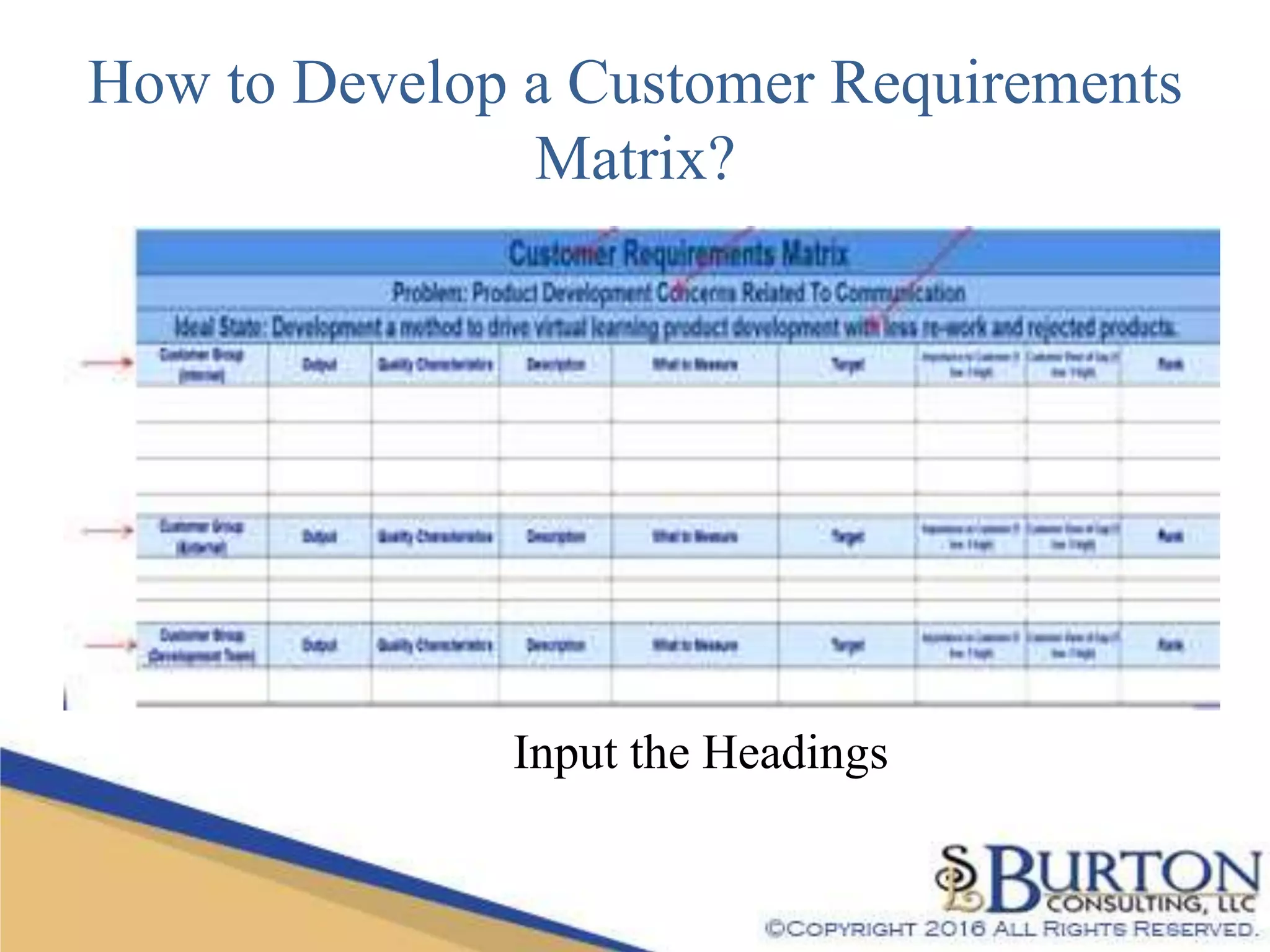
How to Develop a Customer Requirements
Matrix?
Input the Headings
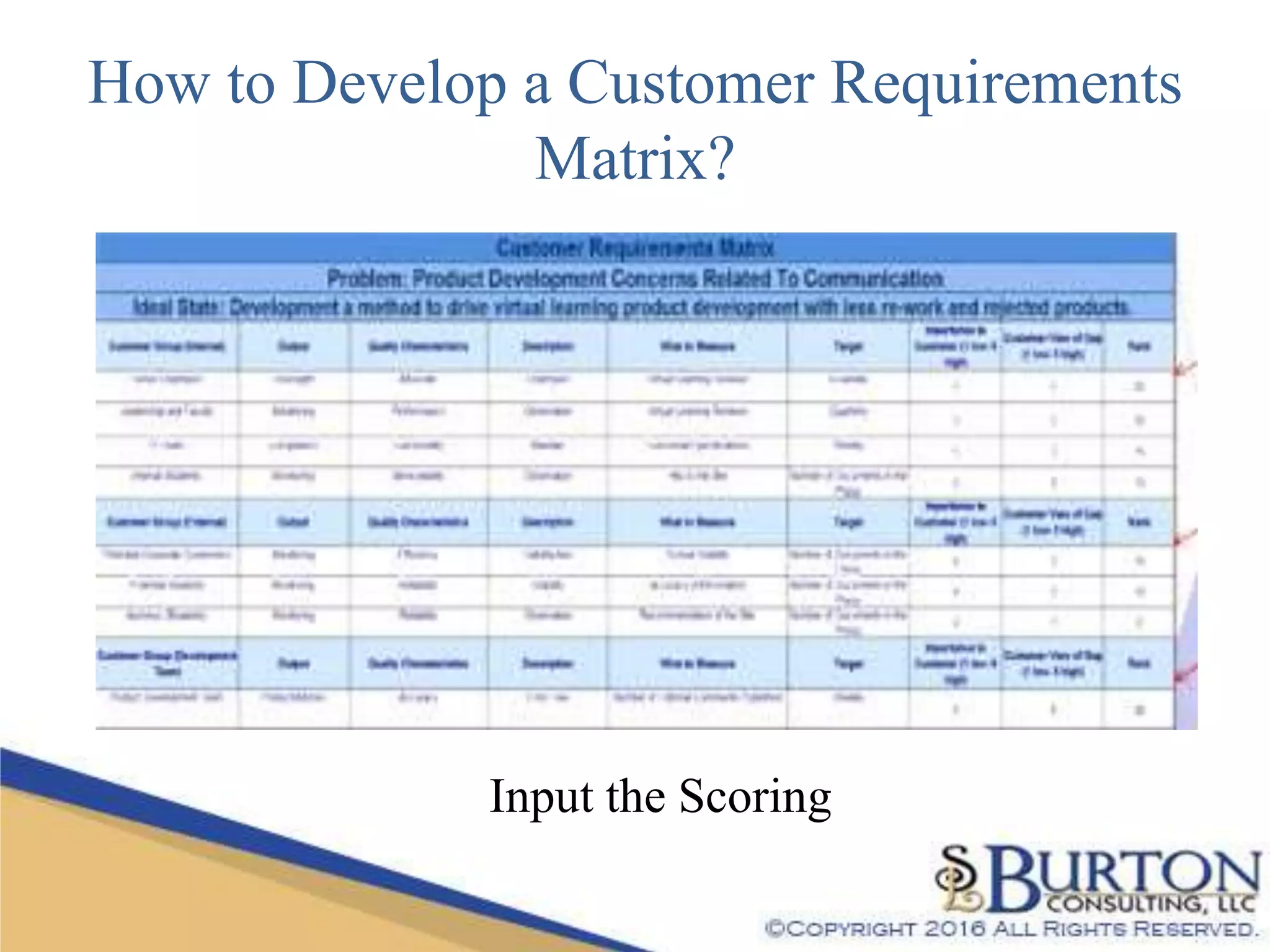
How to Develop a Customer Requirements
Matrix?
Input the Scoring
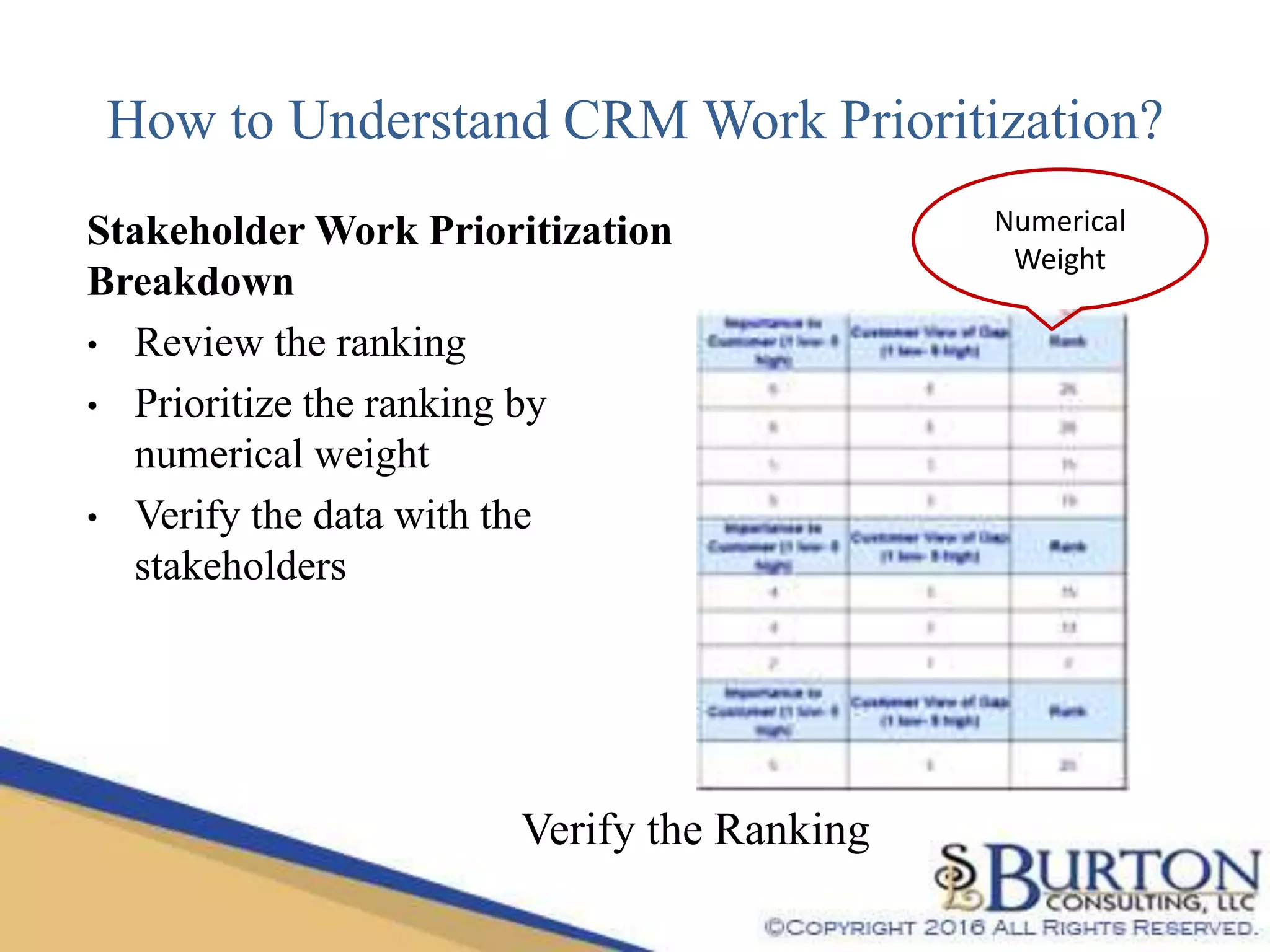
How to Understand CRM Work Prioritization?
Verify the Ranking
Stakeholder Work Prioritization
Breakdown
• Review the ranking
• Prioritize the ranking by
numerical weight
• Verify the data with the
stakeholders
Numerical
Weight
Bibliography
Campos, J., & Ballend, HJ-c. (2012). The voice of the customer for project
development, 4th edition; Your illustrated guide to obtaining prioritizing and
using customer requirements and creating winning. West Linn, OR:
Rapidinnovation Press.
Chaudhuri, A., & Bhattachuryya, M. (2009). A combined QFD and integer
programming framework to determine attribute levels for conjoint study.
International Journal of Production Research, 47(23), 6633-6649. doi:
10.1080.00207540802350757
Gin-Shuh, L., Tsung-Yu, C., & Shu-Fen, K. (2006). Applying fuzzy quality function
deployment to identify service management requirements for an ocean freight
forwarder. Total Quality Management & Business Excellence, 17(5), 539-554.
doi: 10.1080/14783360600587994
Liang, G. (2010). Applying Applying fuzzy quality function deployment to identify
service management requirements for customer quality needs. Quality &
Quantity, 44(1), 47-57. doi: 10.1007/s11135-008-9178-7
Raynor, D. (2014). Why use a requirements diagram? Part 1. Retrieved from
http://www.batimes.com/articles/why-use-a-requirements-matrix-part-1.html

LEAN: Understanding a Customer Requirements Matrix 2016

  • 1.
    1 Lean: Understanding aCustomer Requirements Matrix Series on Quality Systems Management Tools Dr. Sharon L. Burton, DBA
  • 2.
    Goal The goal ofthis lesson is for users to understand the usage of a Customer Requirements Matrix as a quality and business process improvement tool.
  • 3.
    Learning Objectives At theend of this lesson users should be able to  Articulate the usage of a Customer Requirements Matrix  Explain how to develop a Customer Requirements Matrix  Demonstrate the development of a Customer Requirements Matrix
  • 4.
    What is aCustomer Requirements Matrix? Customer Requirements Matrix is a tool for: • Addressing requirements tracking • Speaking to scope creep • Providing what features a product or service should have and why
  • 5.
    What is theValue of the Customer Requirements Matrix? Customer Requirements Matrix Helps Users: • Understand the business domains • Reveal outputs • Understand the quality characteristics • Describe the business domains • Comprehend what to measure • Know the targets • Understand the importance to customers of what to measure • Learn the customer’s view of the gaps • Establish the ranking order of the processes being measured
  • 6.
    Creation Time toAllot for the Customer Requirements Matrix From Start to Finish Allow 5 hours • Data Collection: 1-3 hours • Diagramming the Customer Requirements Matrix: 1 hour • Walk through of Customer Requirements Matrix with Stakeholders: 1 hour
  • 7.
    How to Developa Customer Requirements Matrix? Input the Headings
  • 8.
    How to Developa Customer Requirements Matrix? Input the Scoring
  • 9.
    How to UnderstandCRM Work Prioritization? Verify the Ranking Stakeholder Work Prioritization Breakdown • Review the ranking • Prioritize the ranking by numerical weight • Verify the data with the stakeholders Numerical Weight
  • 10.
    Bibliography Campos, J., &Ballend, HJ-c. (2012). The voice of the customer for project development, 4th edition; Your illustrated guide to obtaining prioritizing and using customer requirements and creating winning. West Linn, OR: Rapidinnovation Press. Chaudhuri, A., & Bhattachuryya, M. (2009). A combined QFD and integer programming framework to determine attribute levels for conjoint study. International Journal of Production Research, 47(23), 6633-6649. doi: 10.1080.00207540802350757 Gin-Shuh, L., Tsung-Yu, C., & Shu-Fen, K. (2006). Applying fuzzy quality function deployment to identify service management requirements for an ocean freight forwarder. Total Quality Management & Business Excellence, 17(5), 539-554. doi: 10.1080/14783360600587994 Liang, G. (2010). Applying Applying fuzzy quality function deployment to identify service management requirements for customer quality needs. Quality & Quantity, 44(1), 47-57. doi: 10.1007/s11135-008-9178-7 Raynor, D. (2014). Why use a requirements diagram? Part 1. Retrieved from http://www.batimes.com/articles/why-use-a-requirements-matrix-part-1.html