Process Matrix
1
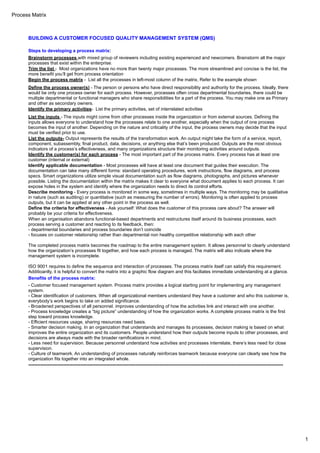
BUILDING A CUSTOMER FOCUSED QUALITY MANAGEMENT SYSTEM (QMS)
Steps to developing a process matrix:
Brainstorm processes with mixed group of reviewers including existing experienced and newcomers. Brainstorm all the major
processes that exist within the enterprise.
Trim the list - Most organizations have no more than twenty major processes. The more streamlined and concise is the list, the
more benefit you’ll get from process orientation
Begin the process matrix - List all the processes in left-most column of the matrix, Refer to the example shown
Define the process owner(s) - The person or persons who have direct responsibility and authority for the process. Ideally, there
would be only one process owner for each process. However, processes often cross departmental boundaries, there could be
multiple departmental or functional managers who share responsibilities for a part of the process. You may make one as Primary
and other as secondary owners.
Identify the primary activities- List the primary activities, set of interrelated activities
List the inputs - The inputs might come from other processes inside the organization or from external sources. Defining the
inputs allows everyone to understand how the processes relate to one another, especially when the output of one process
becomes the input of another. Depending on the nature and criticality of the input, the process owners may decide that the input
must be verified prior to use.
List the outputs- Output represents the results of the transformation work. An output might take the form of a service, report,
component, subassembly, final product, data, decisions, or anything else that’s been produced. Outputs are the most obvious
indicators of a process’s effectiveness, and many organizations structure their monitoring activities around outputs.
Identify the customer(s) for each process - The most important part of the process matrix. Every process has at least one
customer (internal or external)
Identify applicable documentation - Most processes will have at least one document that guides their execution. The
documentation can take many different forms: standard operating procedures, work instructions, flow diagrams, and process
specs. Smart organizations utilize simple visual documentation such as flow diagrams, photographs, and pictures whenever
possible. Listing the documentation within the matrix makes it clear to everyone what document applies to each process. It can
expose holes in the system and identify where the organization needs to direct its control efforts.
Describe monitoring - Every process is monitored in some way, sometimes in multiple ways. The monitoring may be qualitative
in nature (such as auditing) or quantitative (such as measuring the number of errors). Monitoring is often applied to process
outputs, but it can be applied at any other point in the process as well.
Define the criteria for effectiveness - Ask yourself: What does the customer of this process care about? The answer will
probably be your criteria for effectiveness.
When an organisation abandons functional-based departments and restructures itself around its business processes, each
process serving a customer and reacting to its feedback, then:
- departmental boundaries and process boundaries don’t coincide
- focuses on customer relationship rather than departmental non healthy competitive relationship with each other
The completed process matrix becomes the roadmap to the entire management system. It allows personnel to clearly understand
how the organization’s processes fit together, and how each process is managed. The matrix will also indicate where the
management system is incomplete.
ISO 9001 requires to define the sequence and interaction of processes. The process matrix itself can satisfy this requirement.
Additioanlly, it is helpful to convert the matrix into a graphic flow diagram and this faciliates immediate understanding at a glance.
Benefits of the process matrix:
- Customer focused management system. Process matrix provides a logical starting point for implementing any management
system.
- Clear identification of customers. When all organizational members understand they have a customer and who this customer is,
everybody’s work begins to take on added significance.
- Broadened perspectives of all personnel. improves understanding of how the activities link and interact with one another.
- Process knowledge creates a “big picture” understanding of how the organization works. A complete process matrix is the first
step toward process knowledge.
- Efficient resources usage, sharing resources need basis.
- Smarter decision making. In an organization that understands and manages its processes, decision making is based on what
improves the entire organization and its customers. People understand how their outputs become inputs to other processes, and
decisions are always made with the broader ramifications in mind.
- Less need for supervision. Because personnel understand how activities and processes interrelate, there’s less need for close
supervision.
- Culture of teamwork. An understanding of processes naturally reinforces teamwork because everyone can clearly see how the
organization fits together into an integrated whole.
-----------------------------------------------------------------------------------------------------------------------------------------------------------------------
Process Matrix
2
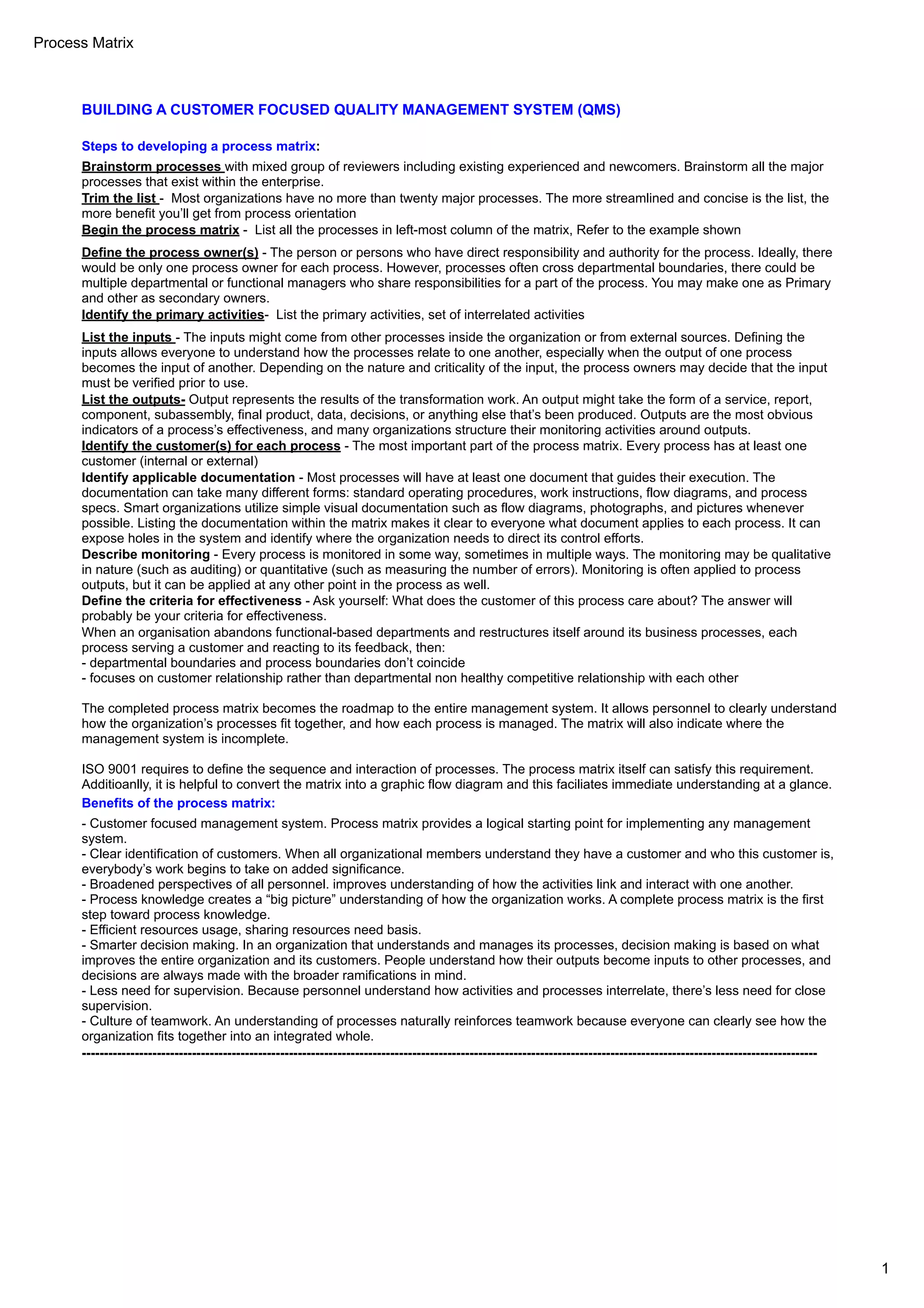
Below is the example of Process Matrix
Process Process
Owner(s)
Activities Inputs Outputs Method of
process
monitoring
Criteria for
effectiveness
1. Business
Planning
General
Manager
Risk Analysis Environmental
risks
Business plan Internal audit Achievement of
business plan
Strategic planning Market research Key measures Business review
meetings
Improvement of
key measures
Customer
feedback
Communication
plan for both
Net income
Organizational
vision
Past experience
2. Market
research &
marketing
Director of
Sales
Explore new
product
opportunities
Market research Pricing Internal audit Revenue growth
Set pricing Innovation (R&D
inputs)
Design inputs Business review
meetings
Net income
Develop
marketing
Competitive data Marketing media
Publish sales
literature
Industry
benchmarking
Develop and use
tools for capturing
customer
feedback
Provide advice for
reacting to
feedback
3. Design &
Development
R&D
Manager
Understand
market needs
Design inputs Engineering
drawings
Internal audit % of revenue
from products
less than 1 year
old
Plan design
activities
Creativity Product
specifications
Business review
meetings
Net income
Review design
progress
Past designs
Verify & validate
designs
Communicate
design info
Maintain design
documents
4. Order
fulfillment
Director of
Sales
Providing product
info
Sales literature Customer orders Internal audit % on-time
delivery
Quoting Pricing schedules Clearly defined
requirements
Weekly staff
meeting
Revenue growth
Booking &
reviewing orders
Customer needs Net income
Communicating
requirements
5. Inbound
process
Logistics
Mgr
Select suppliers P.O. requisitions Purchased
products
Internal audit Average unit cost
by commodity
Communicate
requirements
Supplier
references
Damage-free
handling &
storage
Weekly staff
meeting
% on-time
delivery
Place orders Organizational
needs
Business review
meetings
Net income
Evaluate supplier
performance
Verifying
incoming product
Ensuring labeling
Warehousing
Material handling
6. Product
realization
Production
Mgr
Scheduling
production
Customer orders Final product Internal audit % on-time
delivery
Performing OJT Delivery dates Inspection data Line checks Average unit cost
by product line
Process Matrix
3
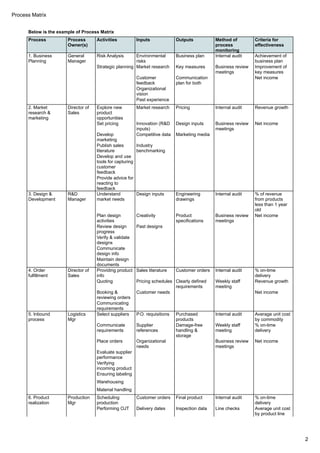
[NOTE: there may
be multiple
realization
processes,
depending on the
diversity of activities
involved]
Production
Mgr
Producing
product/service
Raw materials Certificates of
Analysis
Product
inspections
Net income
Verifying product Supplies Business review
meetings
Calibrating all
measuring
equipment
electricity,
downtime
Weekly
production
roundup
Providing
feedback
Human resources
Tools &
equipment
Product
specifications
Engineering
drawings
7. Control of
nonconforming
product
Production
Mgr
Identifying
nonconforming
products
Inspection criteria Dispositions Internal audit Complete
adherence to
procedure
Determining
Dispositions
Procedure for
control of
nonconforming
products
Corrective actions Number of Major/
minor NCs
Taking corrective
actions
Cost of Quality
8. Outbound
process
Logistics
Mgr
Packaging Final product Delivered product Internal audit % on-time
delivery
Labeling Delivery dates Damage-free
handling &
storage
Business review
meetings
Net income
Warehousing Packaging
materials
% Recalled /
Returned
Material handling Labels
Scheduling
pickups
Trucking services
Shipping
9. Customer
satisfaction
Director of
Sales
Develop tools for
gauging
perceptions
Field report forms Customer
feedback
Internal audit Revenue growth
Capturing
feedback
Field report
schedules
Trends Business review
meetings
Net income
Analyzing results Prioritized
opportunities
Taking action
10. Business
review
General
Manager
Reviewing
implementation of
business plan
Business plan Preventive
actions
Internal audit Achievement of
business plan
Monitoring
progress on key
measures
Performance data Business plan
revisions
Improvement of
key measures
Analyzing all
other required
inputs
Key measures Strategic
decisions
Net income
Capacity planning
Analysis of
skillset
Process Matrix
4
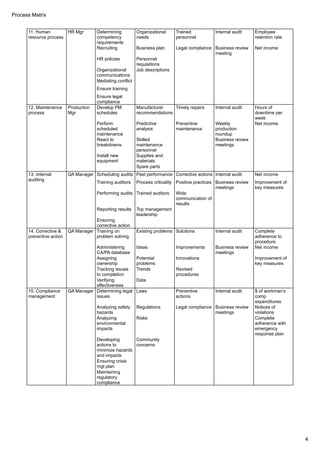
11. Human
resource process
HR Mgr Determining
competency
requirements
Organizational
needs
Trained
personnel
Internal audit Employee
retention rate
Recruiting Business plan Legal compliance Business review
meeting
Net income
HR policies Personnel
requisitions
Organizational
communications
Job descriptions
Mediating conflict
Ensure training
Ensure legal
compliance
12. Maintenance
process
Production
Mgr
Develop PM
schedules
Manufacturer
recommendations
Timely repairs Internal audit Hours of
downtime per
week
Perform
scheduled
maintenance
Predictive
analysis
Preventive
maintenance
Weekly
production
roundup
Net income
React to
breakdowns
Skilled
maintenance
personnel
Business review
meetings
Install new
equipment
Supplies and
materials
Spare parts
13. Internal
auditing
QA Manager Scheduling audits Past performance Corrective actions Internal audit Net income
Training auditors Process criticality Positive practices Business review
meetings
Improvement of
key measures
Performing audits Trained auditors Wide
communication of
results
Reporting results Top management
leadership
Ensuring
corrective action
14. Corrective &
preventive action
QA Manager Training on
problem solving
Existing problems Solutions Internal audit Complete
adherence to
procedure
Administering
CA/PA database
Ideas Improvements Business review
meetings
Net income
Assigning
ownership
Potential
problems
Innovations Improvement of
key measures
Tracking issues
to completion
Trends Revised
procedures
Verifying
effectiveness
Data
15. Compliance
management
QA Manager Determining legal
issues
Laws Preventive
actions
Internal audit $ of workman’s
comp
expenditures
Analyzing safety
hazards
Regulations Legal compliance Business review
meetings
Notices of
violations
Analyzing
environmental
impacts
Risks Complete
adherence with
emergency
response plan
Developing
actions to
minimize hazards
and impacts
Community
concerns
Ensuring crisis
mgt plan
Maintaining
regulatory
compliance
Process Matrix
5
16. Document &
record control
QA Manager Ensuring
availability of
documents
Process needs Procedures Internal audit Complete
adherence with
procedure
Facilitating
revision of
documents
Competency of
personnel
Policies
Disposal of
obsolete docs
Computer media Timely revisions
Maintenance of
records
Degree of product
complexity
Retrievable
records
Legal
requirements
Available
instructions
Reference : Becoming a Customer-focused Organization – by Craig Cochran (Author)

Process Matrix.pdf

  • 1.
    Process Matrix 1 BUILDING ACUSTOMER FOCUSED QUALITY MANAGEMENT SYSTEM (QMS) Steps to developing a process matrix: Brainstorm processes with mixed group of reviewers including existing experienced and newcomers. Brainstorm all the major processes that exist within the enterprise. Trim the list - Most organizations have no more than twenty major processes. The more streamlined and concise is the list, the more benefit you’ll get from process orientation Begin the process matrix - List all the processes in left-most column of the matrix, Refer to the example shown Define the process owner(s) - The person or persons who have direct responsibility and authority for the process. Ideally, there would be only one process owner for each process. However, processes often cross departmental boundaries, there could be multiple departmental or functional managers who share responsibilities for a part of the process. You may make one as Primary and other as secondary owners. Identify the primary activities- List the primary activities, set of interrelated activities List the inputs - The inputs might come from other processes inside the organization or from external sources. Defining the inputs allows everyone to understand how the processes relate to one another, especially when the output of one process becomes the input of another. Depending on the nature and criticality of the input, the process owners may decide that the input must be verified prior to use. List the outputs- Output represents the results of the transformation work. An output might take the form of a service, report, component, subassembly, final product, data, decisions, or anything else that’s been produced. Outputs are the most obvious indicators of a process’s effectiveness, and many organizations structure their monitoring activities around outputs. Identify the customer(s) for each process - The most important part of the process matrix. Every process has at least one customer (internal or external) Identify applicable documentation - Most processes will have at least one document that guides their execution. The documentation can take many different forms: standard operating procedures, work instructions, flow diagrams, and process specs. Smart organizations utilize simple visual documentation such as flow diagrams, photographs, and pictures whenever possible. Listing the documentation within the matrix makes it clear to everyone what document applies to each process. It can expose holes in the system and identify where the organization needs to direct its control efforts. Describe monitoring - Every process is monitored in some way, sometimes in multiple ways. The monitoring may be qualitative in nature (such as auditing) or quantitative (such as measuring the number of errors). Monitoring is often applied to process outputs, but it can be applied at any other point in the process as well. Define the criteria for effectiveness - Ask yourself: What does the customer of this process care about? The answer will probably be your criteria for effectiveness. When an organisation abandons functional-based departments and restructures itself around its business processes, each process serving a customer and reacting to its feedback, then: - departmental boundaries and process boundaries don’t coincide - focuses on customer relationship rather than departmental non healthy competitive relationship with each other The completed process matrix becomes the roadmap to the entire management system. It allows personnel to clearly understand how the organization’s processes fit together, and how each process is managed. The matrix will also indicate where the management system is incomplete. ISO 9001 requires to define the sequence and interaction of processes. The process matrix itself can satisfy this requirement. Additioanlly, it is helpful to convert the matrix into a graphic flow diagram and this faciliates immediate understanding at a glance. Benefits of the process matrix: - Customer focused management system. Process matrix provides a logical starting point for implementing any management system. - Clear identification of customers. When all organizational members understand they have a customer and who this customer is, everybody’s work begins to take on added significance. - Broadened perspectives of all personnel. improves understanding of how the activities link and interact with one another. - Process knowledge creates a “big picture” understanding of how the organization works. A complete process matrix is the first step toward process knowledge. - Efficient resources usage, sharing resources need basis. - Smarter decision making. In an organization that understands and manages its processes, decision making is based on what improves the entire organization and its customers. People understand how their outputs become inputs to other processes, and decisions are always made with the broader ramifications in mind. - Less need for supervision. Because personnel understand how activities and processes interrelate, there’s less need for close supervision. - Culture of teamwork. An understanding of processes naturally reinforces teamwork because everyone can clearly see how the organization fits together into an integrated whole. -----------------------------------------------------------------------------------------------------------------------------------------------------------------------
  • 2.
    Process Matrix 2 Below isthe example of Process Matrix Process Process Owner(s) Activities Inputs Outputs Method of process monitoring Criteria for effectiveness 1. Business Planning General Manager Risk Analysis Environmental risks Business plan Internal audit Achievement of business plan Strategic planning Market research Key measures Business review meetings Improvement of key measures Customer feedback Communication plan for both Net income Organizational vision Past experience 2. Market research & marketing Director of Sales Explore new product opportunities Market research Pricing Internal audit Revenue growth Set pricing Innovation (R&D inputs) Design inputs Business review meetings Net income Develop marketing Competitive data Marketing media Publish sales literature Industry benchmarking Develop and use tools for capturing customer feedback Provide advice for reacting to feedback 3. Design & Development R&D Manager Understand market needs Design inputs Engineering drawings Internal audit % of revenue from products less than 1 year old Plan design activities Creativity Product specifications Business review meetings Net income Review design progress Past designs Verify & validate designs Communicate design info Maintain design documents 4. Order fulfillment Director of Sales Providing product info Sales literature Customer orders Internal audit % on-time delivery Quoting Pricing schedules Clearly defined requirements Weekly staff meeting Revenue growth Booking & reviewing orders Customer needs Net income Communicating requirements 5. Inbound process Logistics Mgr Select suppliers P.O. requisitions Purchased products Internal audit Average unit cost by commodity Communicate requirements Supplier references Damage-free handling & storage Weekly staff meeting % on-time delivery Place orders Organizational needs Business review meetings Net income Evaluate supplier performance Verifying incoming product Ensuring labeling Warehousing Material handling 6. Product realization Production Mgr Scheduling production Customer orders Final product Internal audit % on-time delivery Performing OJT Delivery dates Inspection data Line checks Average unit cost by product line
  • 3.
    Process Matrix 3 [NOTE: theremay be multiple realization processes, depending on the diversity of activities involved] Production Mgr Producing product/service Raw materials Certificates of Analysis Product inspections Net income Verifying product Supplies Business review meetings Calibrating all measuring equipment electricity, downtime Weekly production roundup Providing feedback Human resources Tools & equipment Product specifications Engineering drawings 7. Control of nonconforming product Production Mgr Identifying nonconforming products Inspection criteria Dispositions Internal audit Complete adherence to procedure Determining Dispositions Procedure for control of nonconforming products Corrective actions Number of Major/ minor NCs Taking corrective actions Cost of Quality 8. Outbound process Logistics Mgr Packaging Final product Delivered product Internal audit % on-time delivery Labeling Delivery dates Damage-free handling & storage Business review meetings Net income Warehousing Packaging materials % Recalled / Returned Material handling Labels Scheduling pickups Trucking services Shipping 9. Customer satisfaction Director of Sales Develop tools for gauging perceptions Field report forms Customer feedback Internal audit Revenue growth Capturing feedback Field report schedules Trends Business review meetings Net income Analyzing results Prioritized opportunities Taking action 10. Business review General Manager Reviewing implementation of business plan Business plan Preventive actions Internal audit Achievement of business plan Monitoring progress on key measures Performance data Business plan revisions Improvement of key measures Analyzing all other required inputs Key measures Strategic decisions Net income Capacity planning Analysis of skillset
  • 4.
    Process Matrix 4 11. Human resourceprocess HR Mgr Determining competency requirements Organizational needs Trained personnel Internal audit Employee retention rate Recruiting Business plan Legal compliance Business review meeting Net income HR policies Personnel requisitions Organizational communications Job descriptions Mediating conflict Ensure training Ensure legal compliance 12. Maintenance process Production Mgr Develop PM schedules Manufacturer recommendations Timely repairs Internal audit Hours of downtime per week Perform scheduled maintenance Predictive analysis Preventive maintenance Weekly production roundup Net income React to breakdowns Skilled maintenance personnel Business review meetings Install new equipment Supplies and materials Spare parts 13. Internal auditing QA Manager Scheduling audits Past performance Corrective actions Internal audit Net income Training auditors Process criticality Positive practices Business review meetings Improvement of key measures Performing audits Trained auditors Wide communication of results Reporting results Top management leadership Ensuring corrective action 14. Corrective & preventive action QA Manager Training on problem solving Existing problems Solutions Internal audit Complete adherence to procedure Administering CA/PA database Ideas Improvements Business review meetings Net income Assigning ownership Potential problems Innovations Improvement of key measures Tracking issues to completion Trends Revised procedures Verifying effectiveness Data 15. Compliance management QA Manager Determining legal issues Laws Preventive actions Internal audit $ of workman’s comp expenditures Analyzing safety hazards Regulations Legal compliance Business review meetings Notices of violations Analyzing environmental impacts Risks Complete adherence with emergency response plan Developing actions to minimize hazards and impacts Community concerns Ensuring crisis mgt plan Maintaining regulatory compliance
  • 5.
    Process Matrix 5 16. Document& record control QA Manager Ensuring availability of documents Process needs Procedures Internal audit Complete adherence with procedure Facilitating revision of documents Competency of personnel Policies Disposal of obsolete docs Computer media Timely revisions Maintenance of records Degree of product complexity Retrievable records Legal requirements Available instructions Reference : Becoming a Customer-focused Organization – by Craig Cochran (Author)