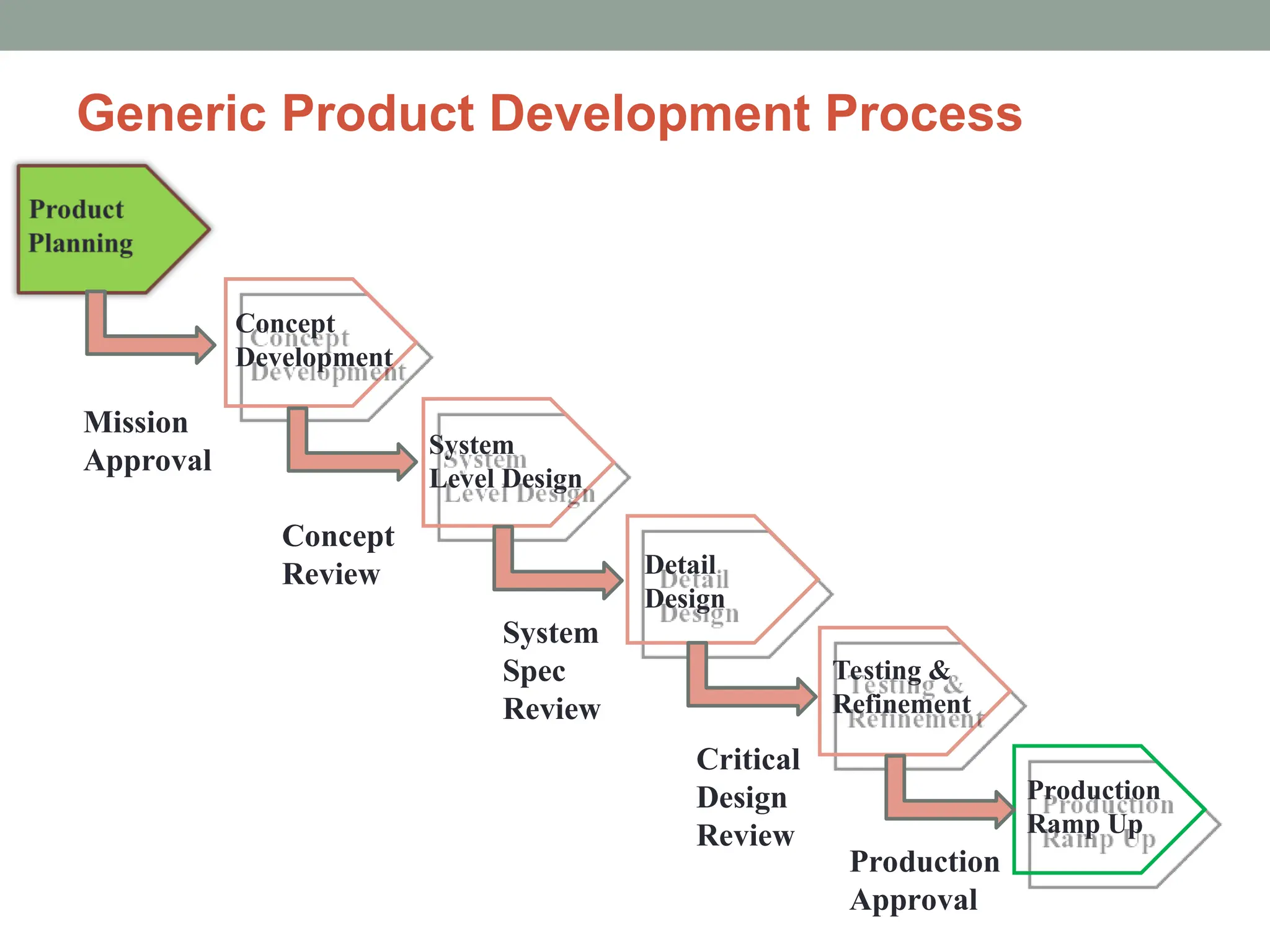
Generic Product DevelopmentProcess
Concept
Development
System
Level Design
Detail
Design
Testing &
Refinement
Production
Ramp Up
Mission
Approval
Concept
Review
System
Spec
Review
Critical
Design
Review
Production
Approval
3.
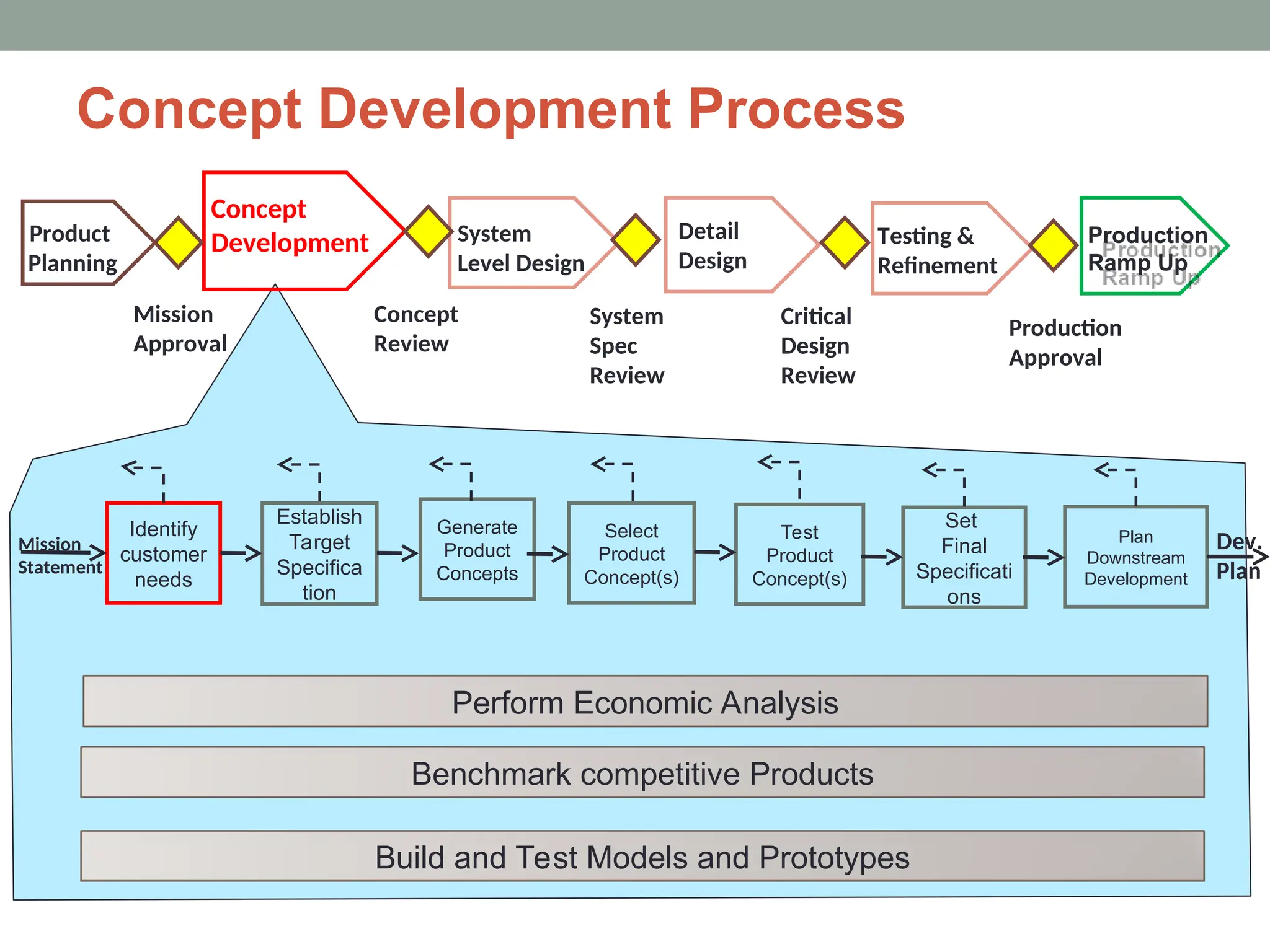
Concept Development Process
Product
Planning
Concept
DevelopmentSystem
Level Design
Detail
Design
Testing &
Refinement
Mission
Approval
Concept
Review
System
Spec
Review
Critical
Design
Review
Production
Approval
Identify
customer
needs
Establish
Target
Specifica
tion
Plan
Downstream
Development
Generate
Product
Concepts
Select
Product
Concept(s)
Test
Product
Concept(s)
Set
Final
Specificati
ons
Mission
Statement
Perform Economic Analysis
Benchmark competitive Products
Build and Test Models and Prototypes
Production
Ramp Up
Dev.
Plan
4.
• Satisfying needsis just as important in revolutionary
products as in incremental products.
• Even if exact needs do not become known, information
like usage criteria, usage time, usage environment of the
product can be very helpful
5.
• Ensure thatthe product is focused on customer needs
• Identify latent or hidden as well as explicit needs
• Provide a fact base for justifying the product specifications
• Create an archival record of the needs activity of the
development process.
• Ensure that no critical customer need is missed.
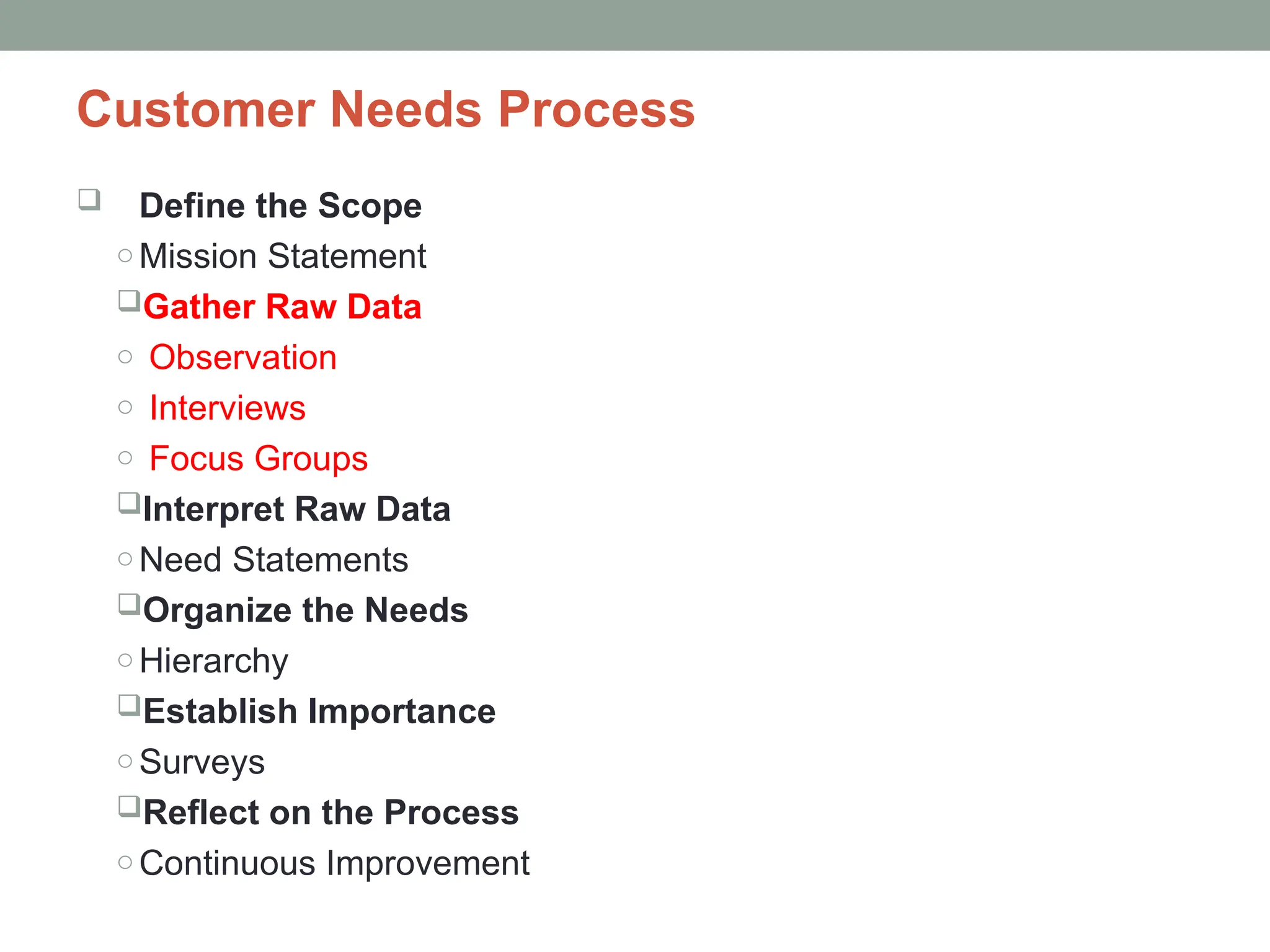
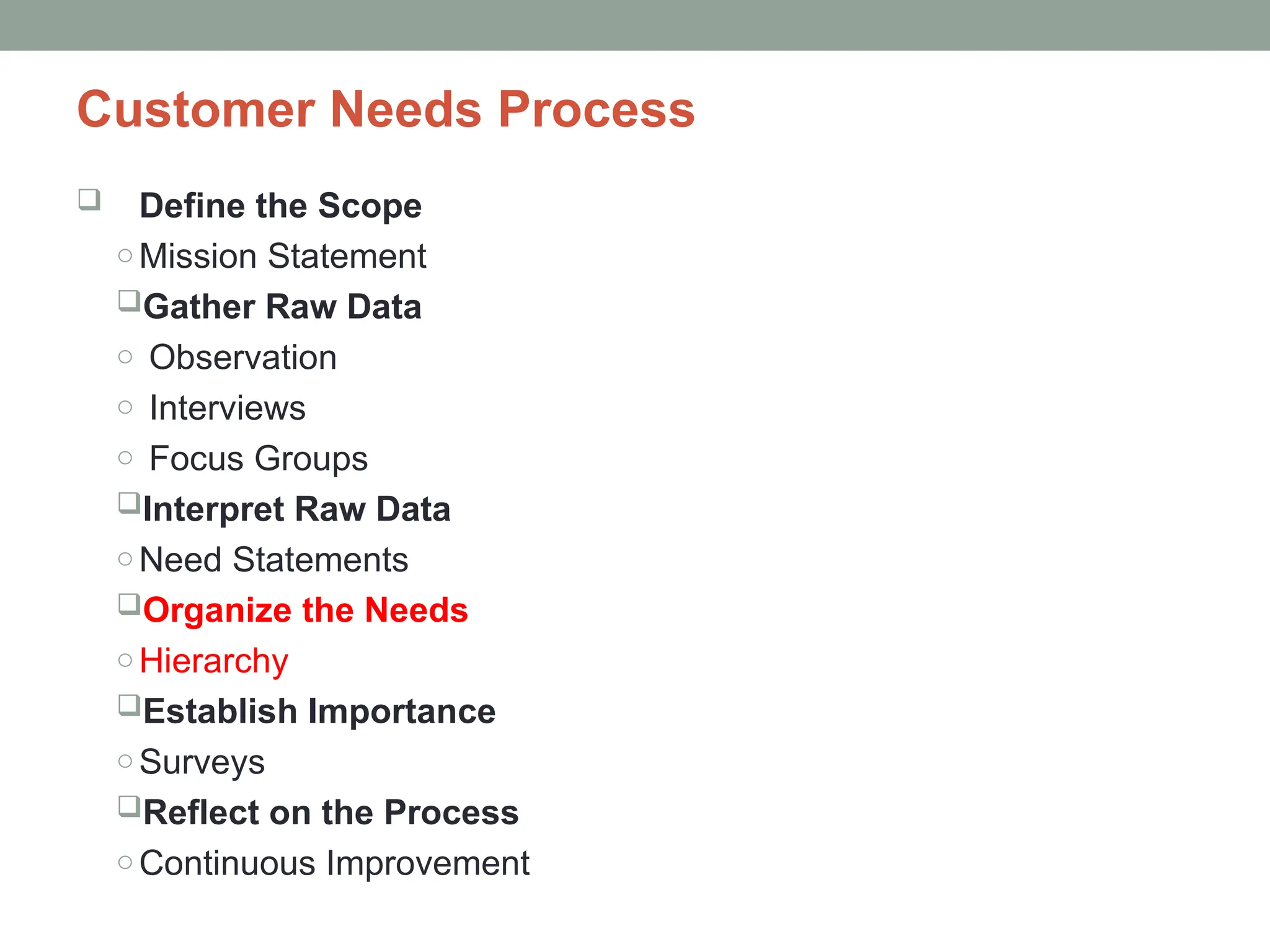
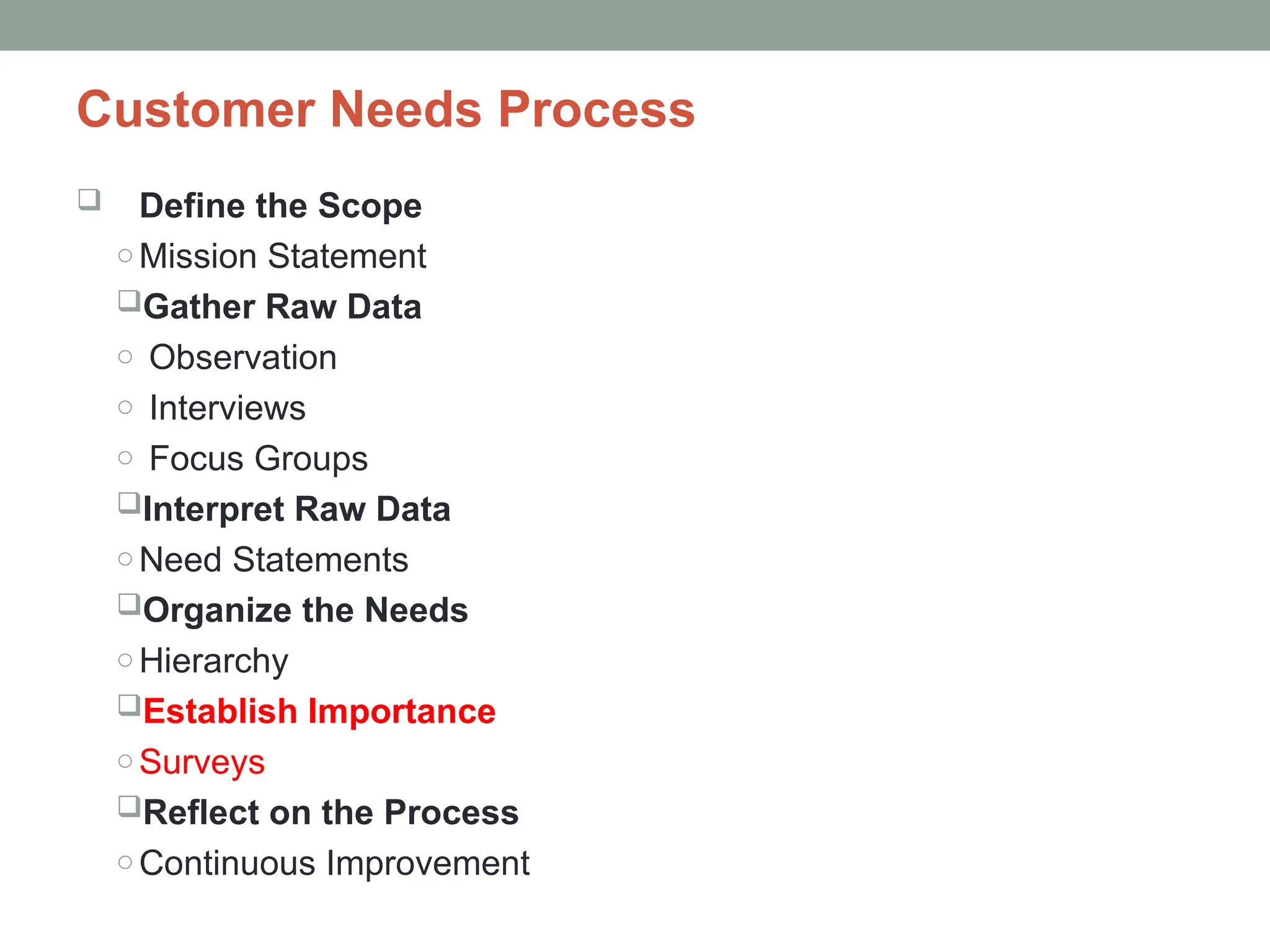
Customer Needs Process
6.
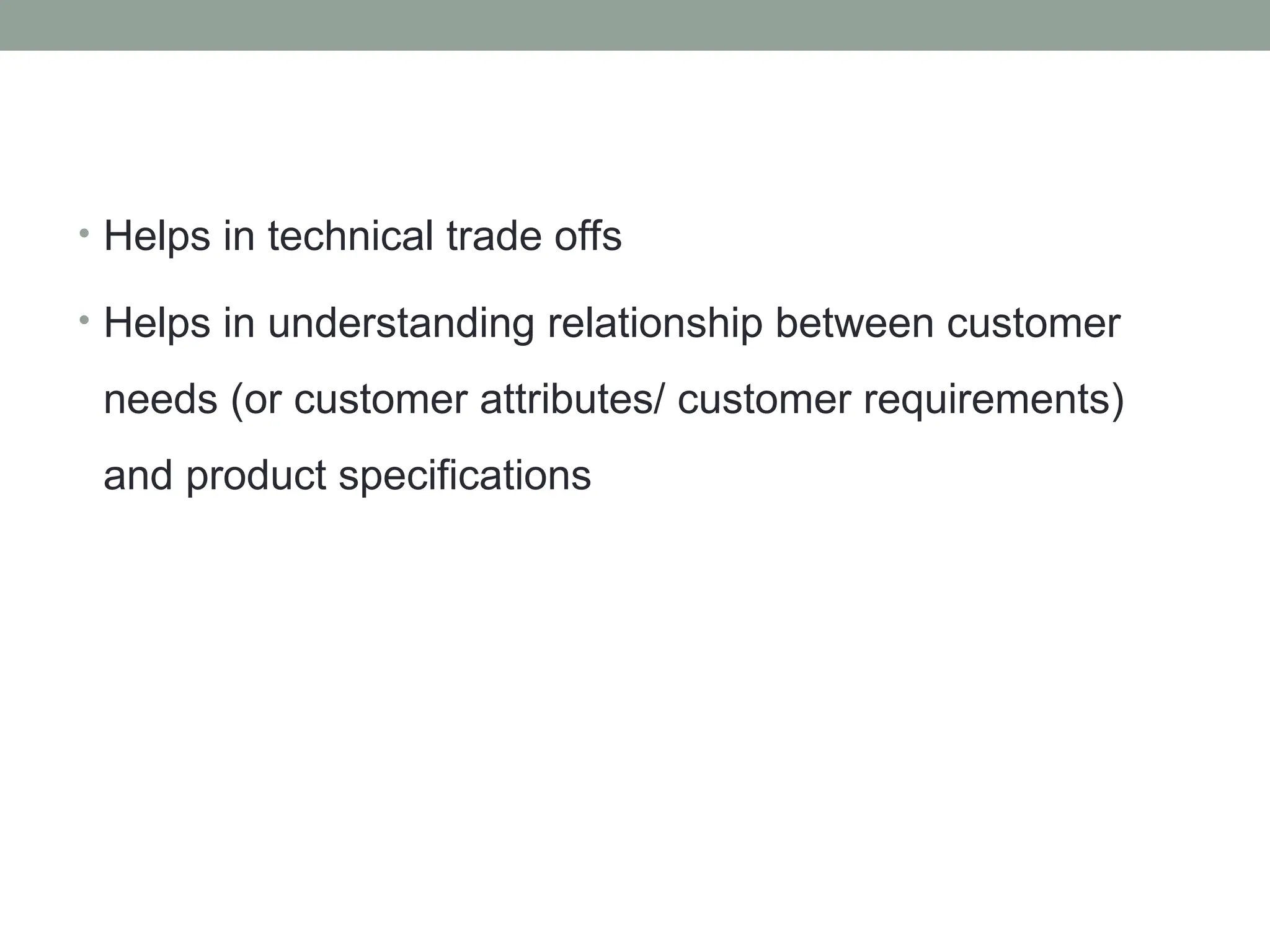
• Helps intechnical trade offs
• Helps in understanding relationship between customer
needs (or customer attributes/ customer requirements)
and product specifications
7.
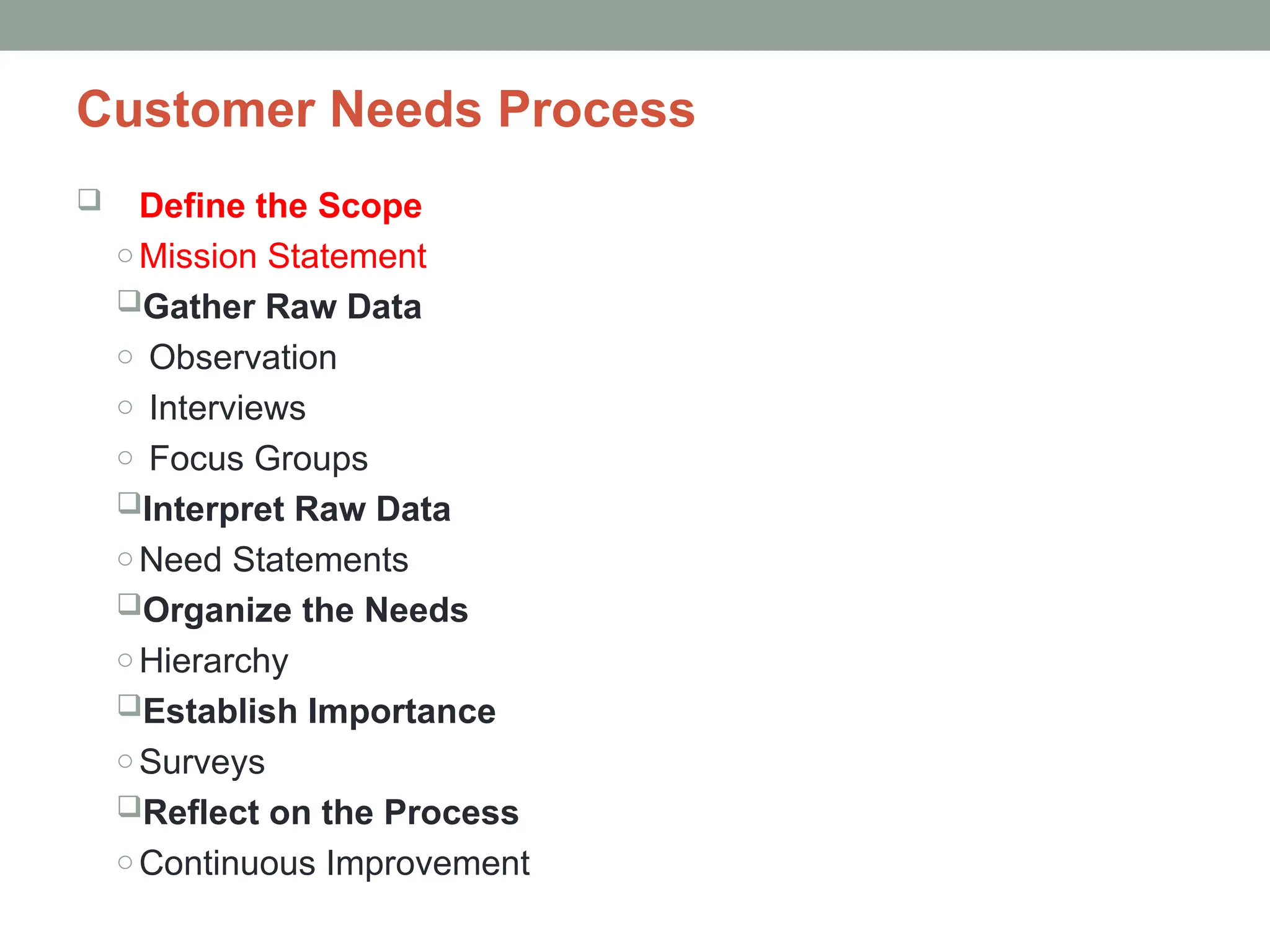
Define theScope
o Mission Statement
Gather Raw Data
o Observation
o Interviews
o Focus Groups
Interpret Raw Data
o Need Statements
Organize the Needs
o Hierarchy
Establish Importance
o Surveys
Reflect on the Process
o Continuous Improvement
Customer Needs Process
8.
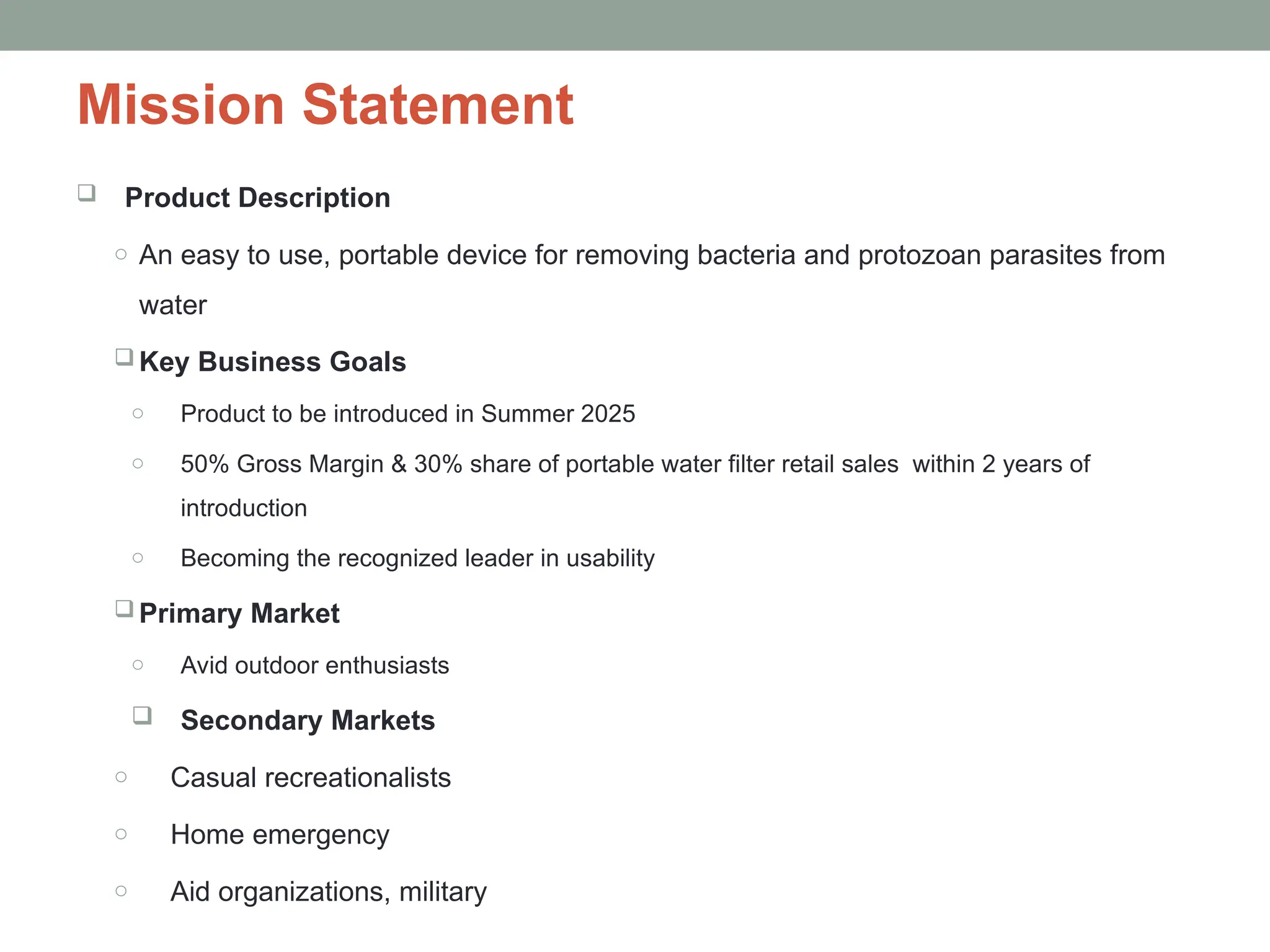
Mission Statement
ProductDescription
o An easy to use, portable device for removing bacteria and protozoan parasites from
water
Key Business Goals
o Product to be introduced in Summer 2025
o 50% Gross Margin & 30% share of portable water filter retail sales within 2 years of
introduction
o Becoming the recognized leader in usability
Primary Market
o Avid outdoor enthusiasts
Secondary Markets
o Casual recreationalists
o Home emergency
o Aid organizations, military
9.
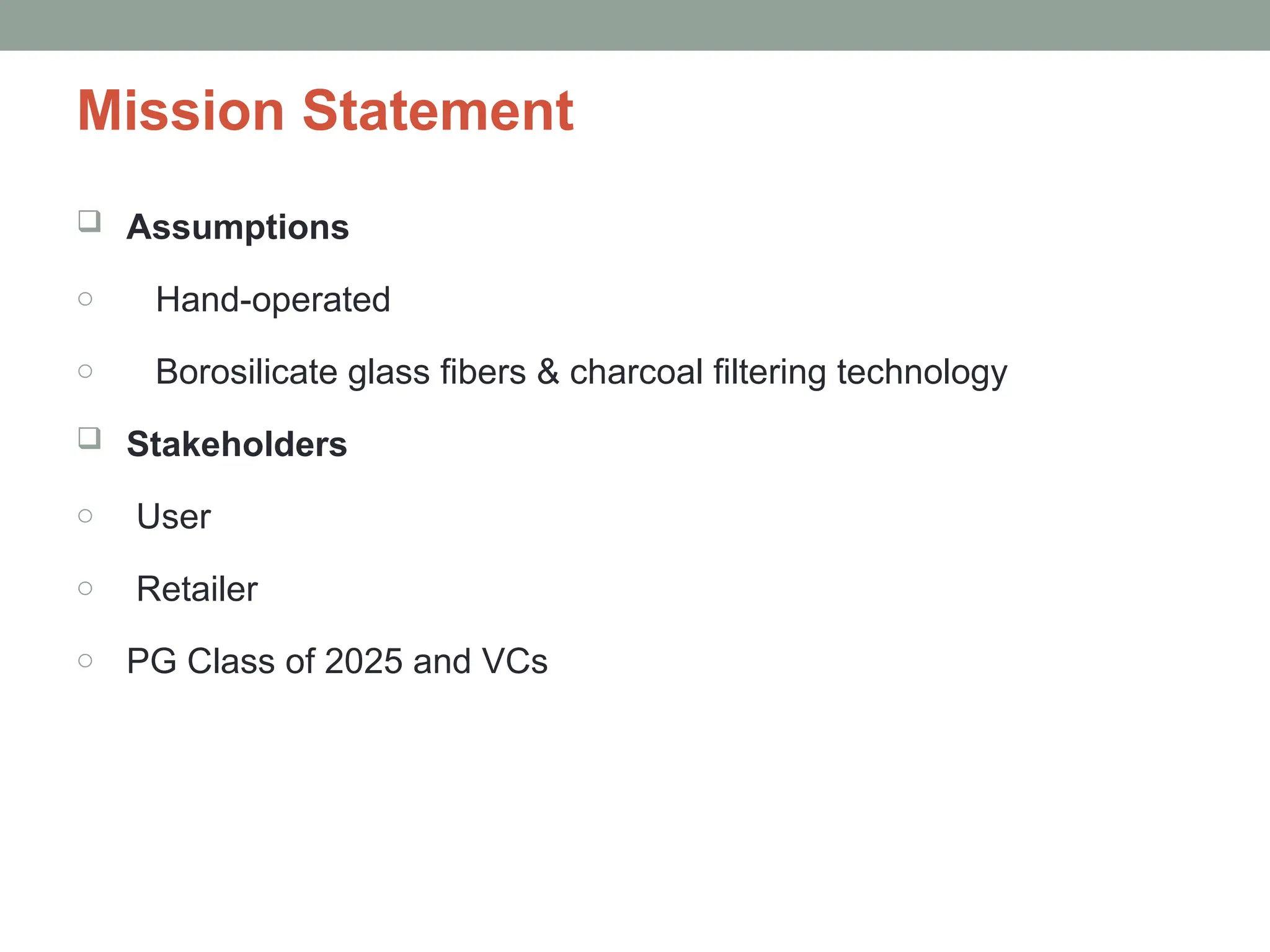
Mission Statement
Assumptions
oHand-operated
o Borosilicate glass fibers & charcoal filtering technology
Stakeholders
o User
o Retailer
o PG Class of 2025 and VCs
10.
Define theScope
o Mission Statement
Gather Raw Data
o Observation
o Interviews
o Focus Groups
Interpret Raw Data
o Need Statements
Organize the Needs
o Hierarchy
Establish Importance
o Surveys
Reflect on the Process
o Continuous Improvement
Customer Needs Process
11.
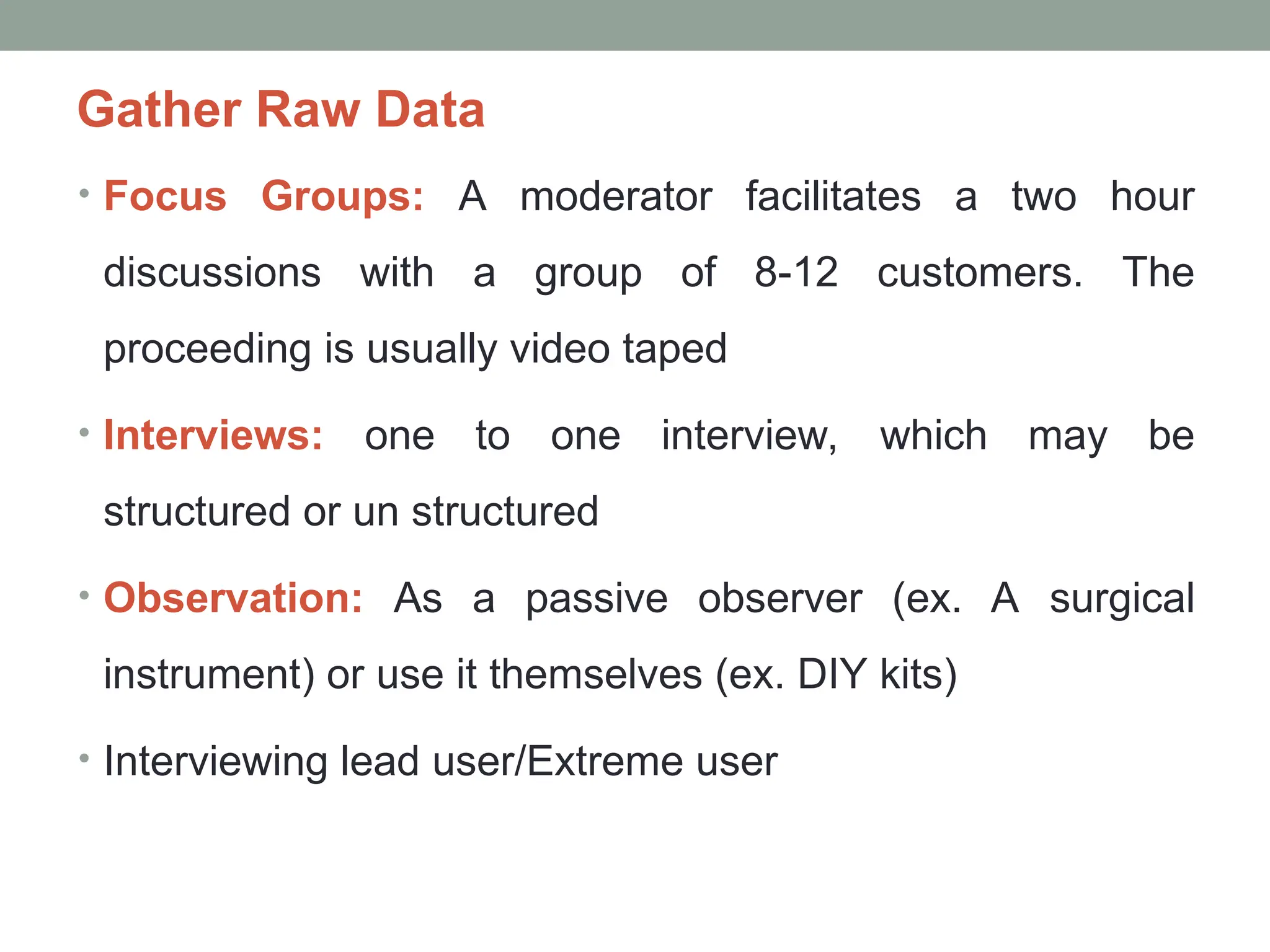
Gather Raw Data
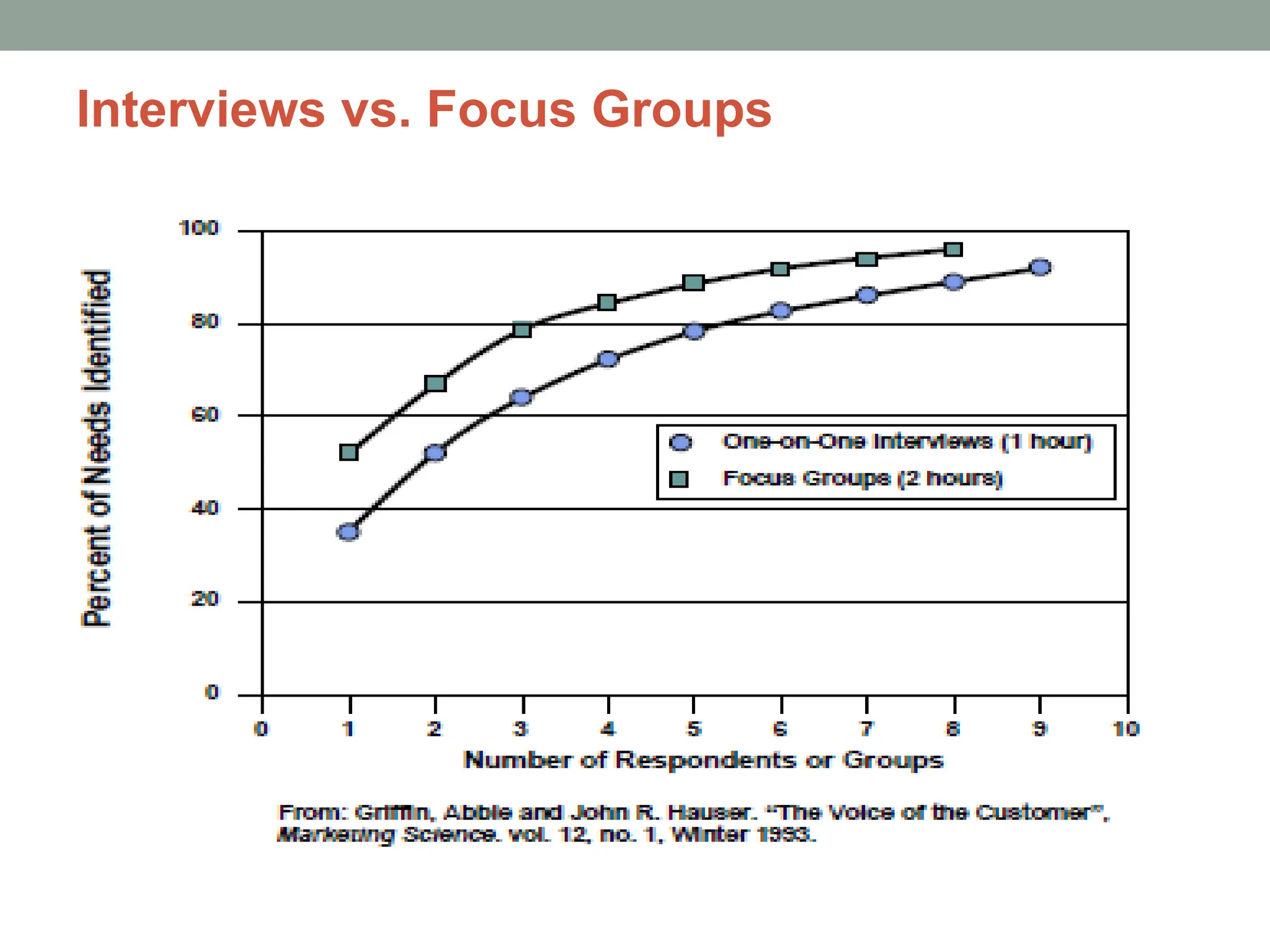
•Focus Groups: A moderator facilitates a two hour
discussions with a group of 8-12 customers. The
proceeding is usually video taped
• Interviews: one to one interview, which may be
structured or un structured
• Observation: As a passive observer (ex. A surgical
instrument) or use it themselves (ex. DIY kits)
• Interviewing lead user/Extreme user
12.
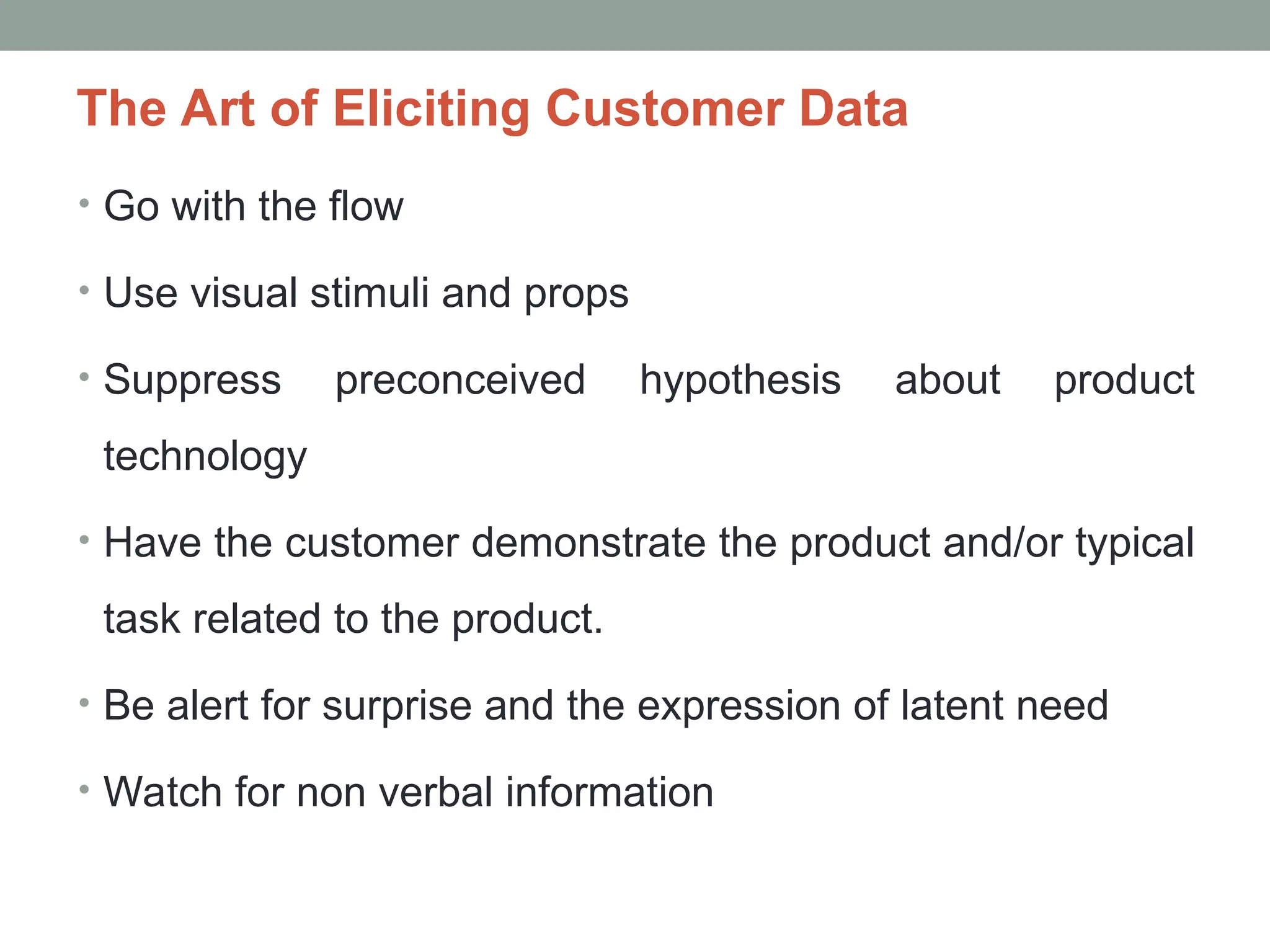
The Art ofEliciting Customer Data
• Go with the flow
• Use visual stimuli and props
• Suppress preconceived hypothesis about product
technology
• Have the customer demonstrate the product and/or typical
task related to the product.
• Be alert for surprise and the expression of latent need
• Watch for non verbal information
13.
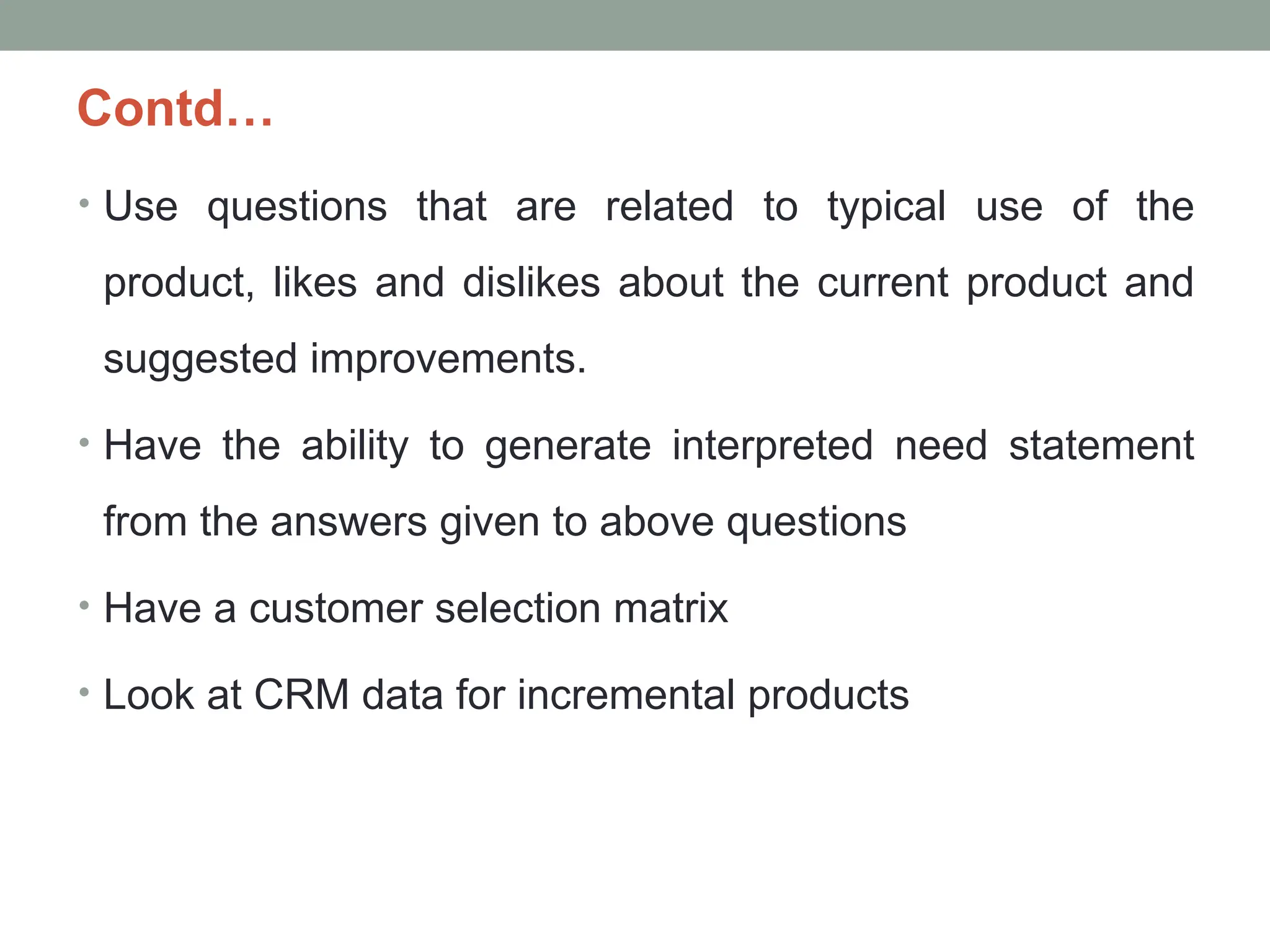
Contd…
• Use questionsthat are related to typical use of the
product, likes and dislikes about the current product and
suggested improvements.
• Have the ability to generate interpreted need statement
from the answers given to above questions
• Have a customer selection matrix
• Look at CRM data for incremental products
Define theScope
o Mission Statement
Gather Raw Data
o Observation
o Interviews
o Focus Groups
Interpret Raw Data
o Need Statements
Organize the Needs
o Hierarchy
Establish Importance
o Surveys
Reflect on the Process
o Continuous Improvement
Customer Needs Process
18.
Five Guidelines forWriting Needs
Statements:
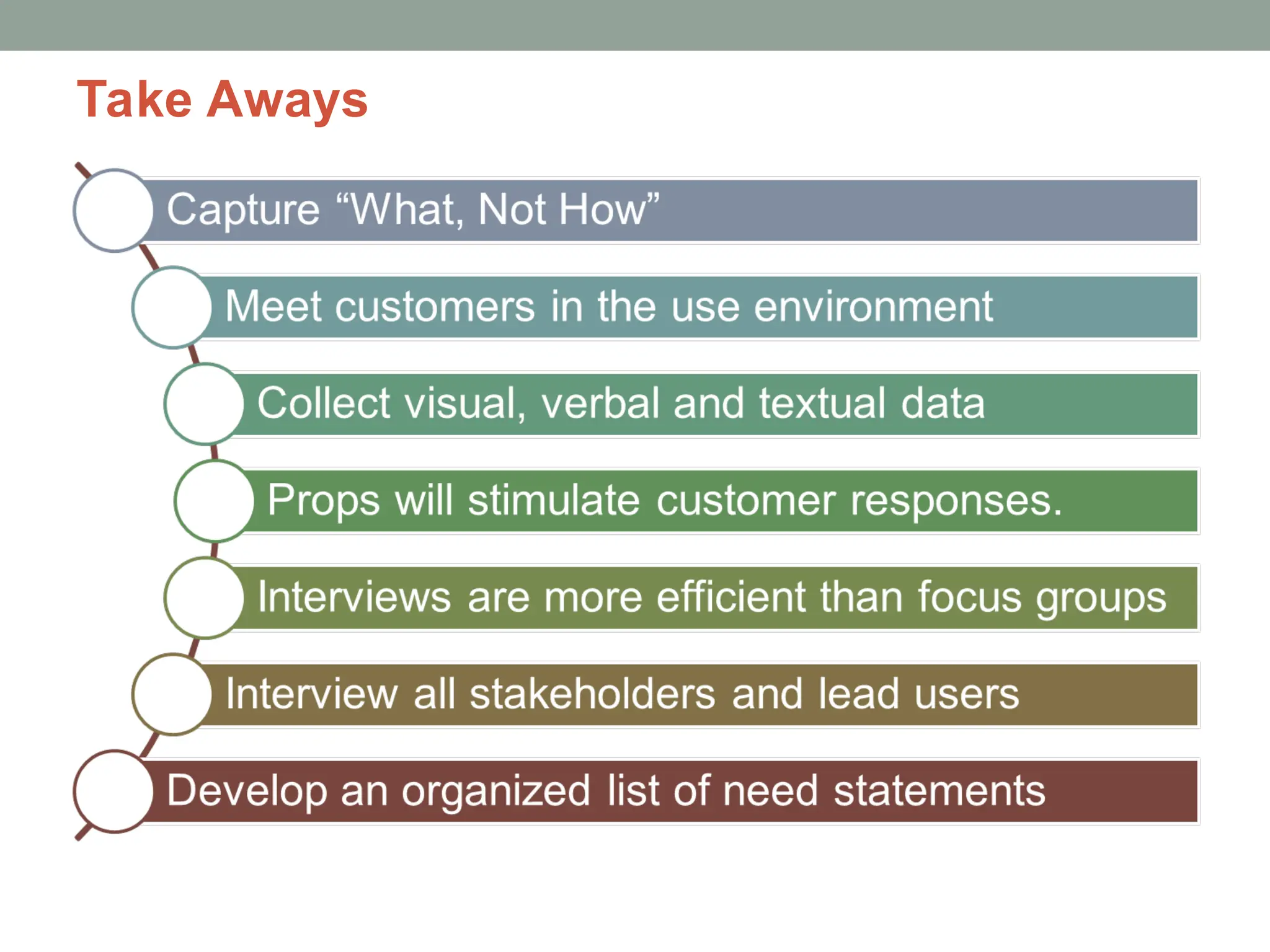
• Express the need in terms of what the product
has to do, not in terms of how it might do it
• Express the need as specifically as the raw data
• Use positive not negative phrasing
• Express the need as an attribute of the product
• Avoid the words must and should
19.
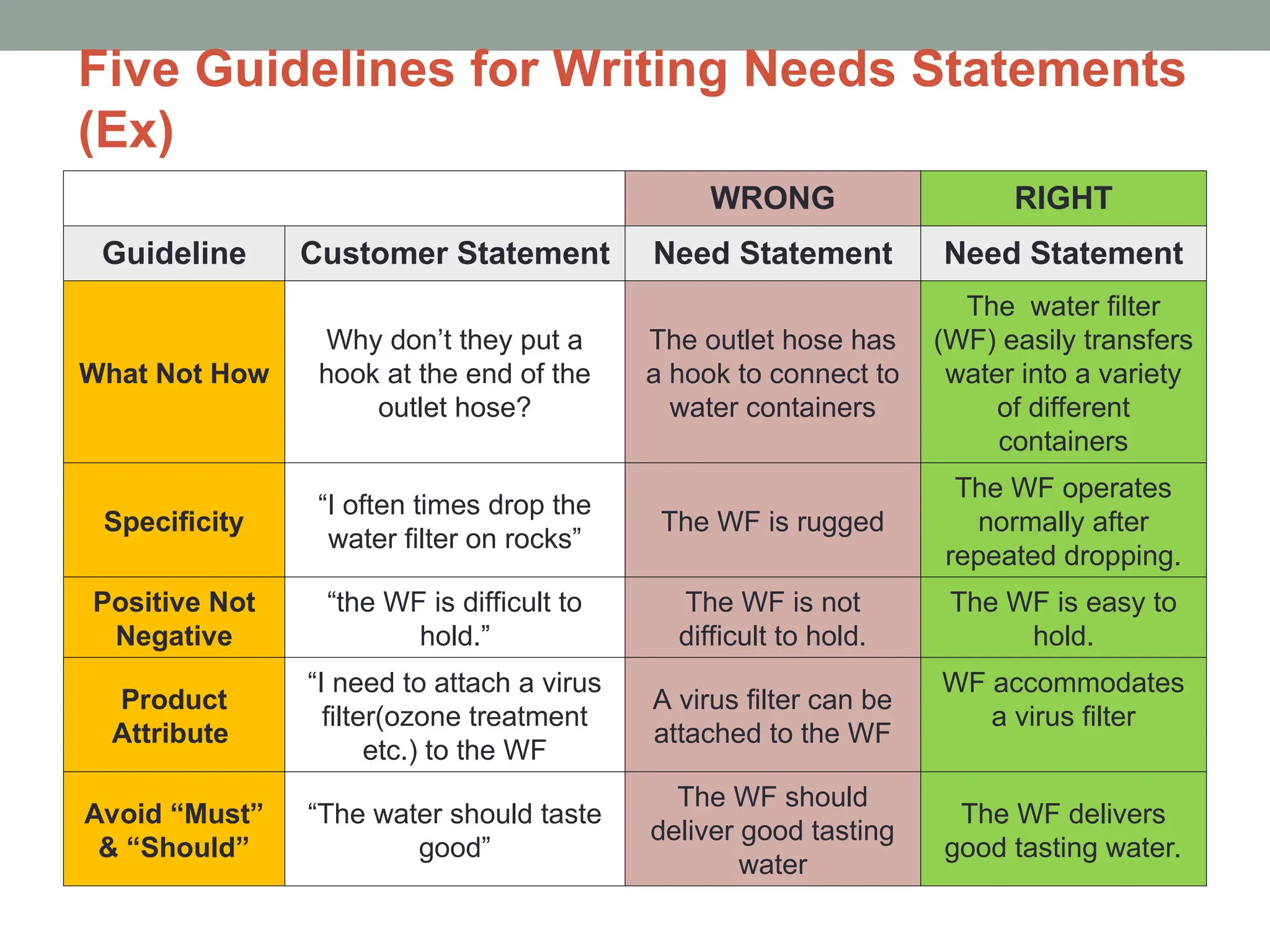
Five Guidelines forWriting Needs Statements
(Ex)
WRONG RIGHT
Guideline Customer Statement Need Statement Need Statement
What Not How
Why don’t they put a
hook at the end of the
outlet hose?
The outlet hose has
a hook to connect to
water containers
The water filter
(WF) easily transfers
water into a variety
of different
containers
Specificity
“I often times drop the
water filter on rocks”
The WF is rugged
The WF operates
normally after
repeated dropping.
Positive Not
Negative
“the WF is difficult to
hold.”
The WF is not
difficult to hold.
The WF is easy to
hold.
Product
Attribute
“I need to attach a virus
filter(ozone treatment
etc.) to the WF
A virus filter can be
attached to the WF
WF accommodates
a virus filter
Avoid “Must”
& “Should”
“The water should taste
good”
The WF should
deliver good tasting
water
The WF delivers
good tasting water.
20.
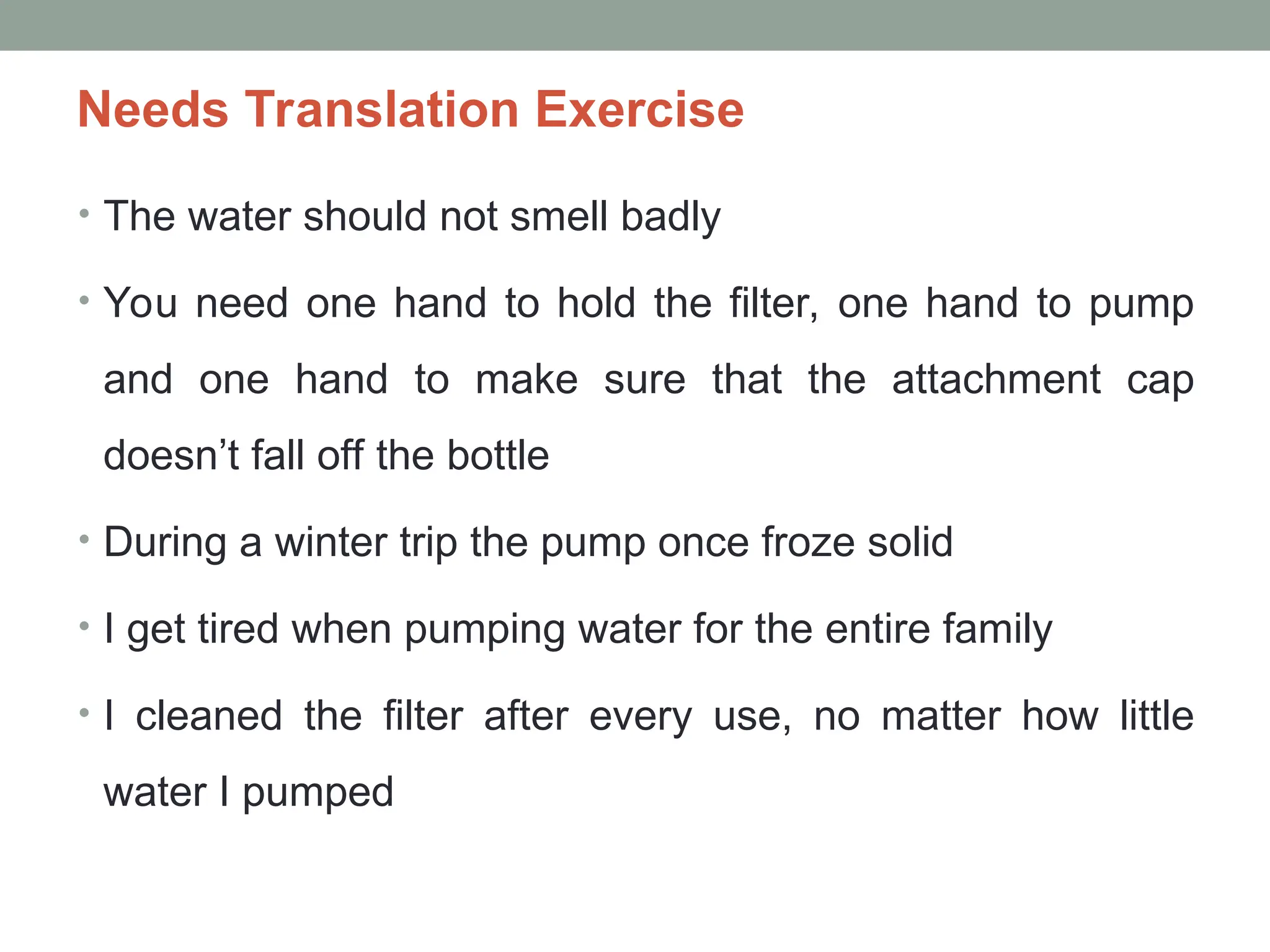
Needs Translation Exercise
•The water should not smell badly
• You need one hand to hold the filter, one hand to pump
and one hand to make sure that the attachment cap
doesn’t fall off the bottle
• During a winter trip the pump once froze solid
• I get tired when pumping water for the entire family
• I cleaned the filter after every use, no matter how little
water I pumped
21.
Define theScope
o Mission Statement
Gather Raw Data
o Observation
o Interviews
o Focus Groups
Interpret Raw Data
o Need Statements
Organize the Needs
o Hierarchy
Establish Importance
o Surveys
Reflect on the Process
o Continuous Improvement
Customer Needs Process
22.
Organizing the Needsinto a Hierarchy
• Print or write each need statement on a separate card or self-
stick note
• Eliminate redundant statement
• Group the cards according to similarity of the needs they
express. Should be done as customer thinks about the product
not the way development team thinks about it
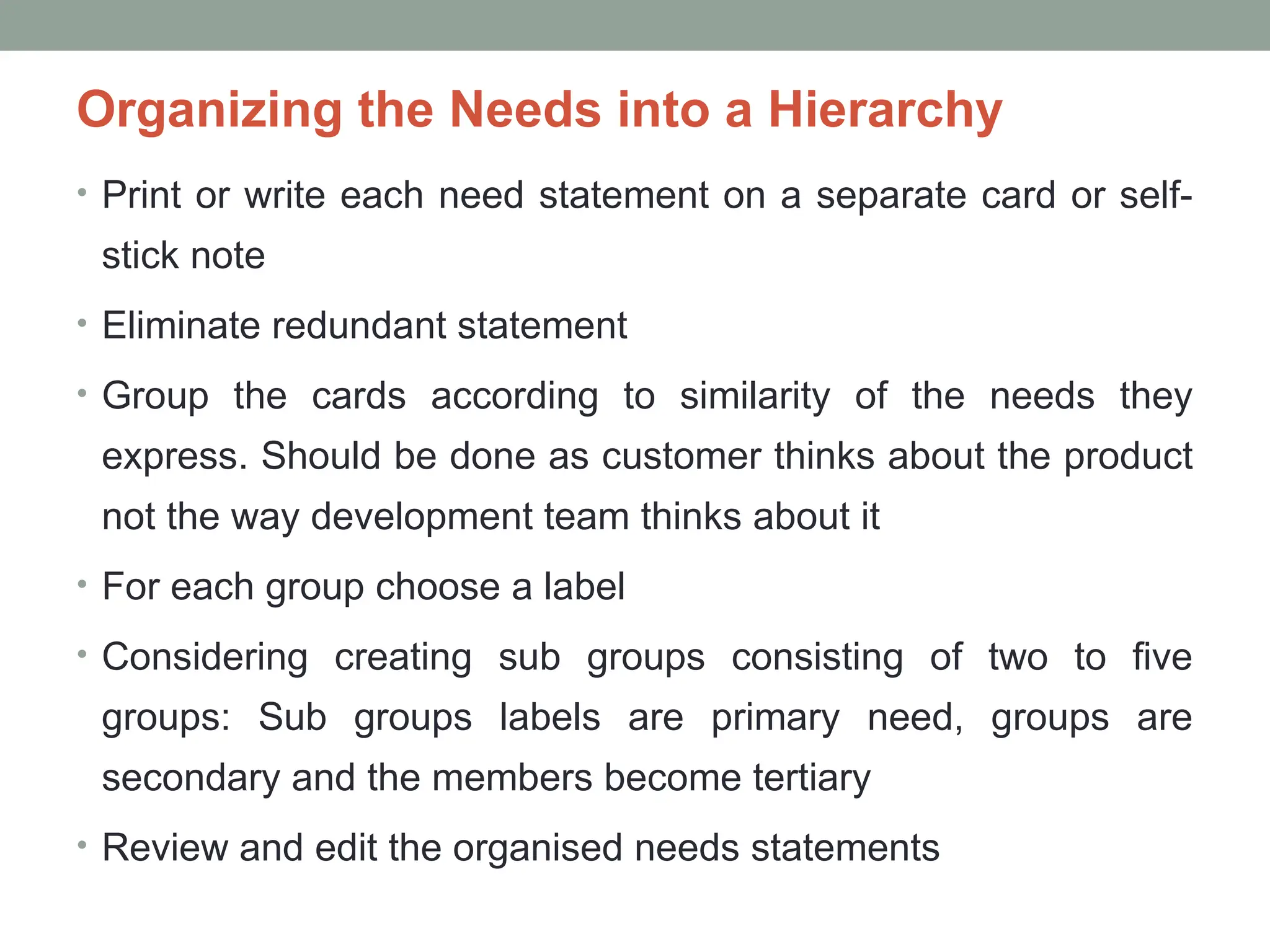
• For each group choose a label
• Considering creating sub groups consisting of two to five
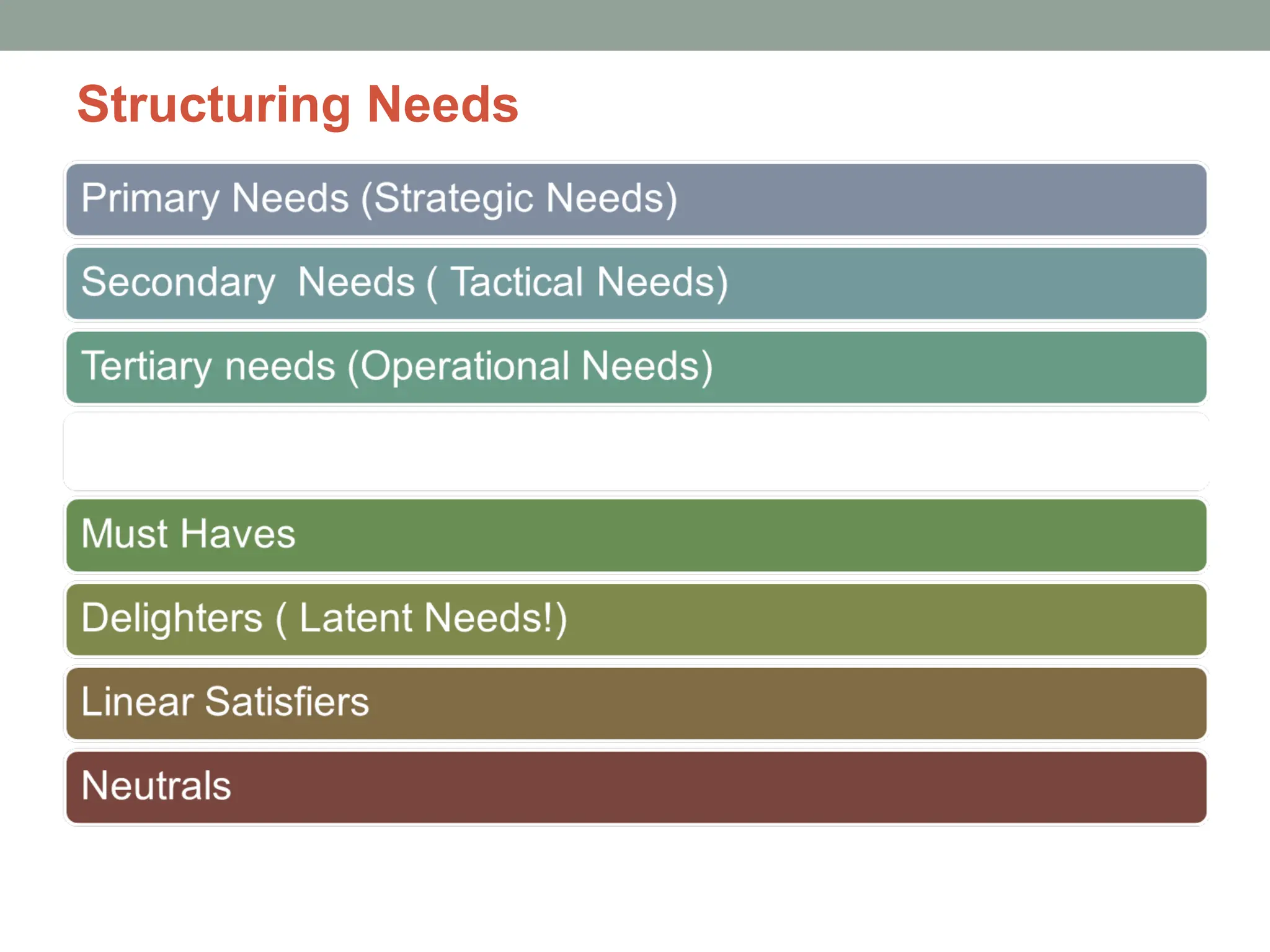
groups: Sub groups labels are primary need, groups are
secondary and the members become tertiary
• Review and edit the organised needs statements
Structuring Needs
A tendencythat:
• Customers sort needs more evenly
• Customer ordering reflects actual use
• Group ordering reflects engineering view
• Professional teams only slightly outperform students
26.
Define theScope
o Mission Statement
Gather Raw Data
o Observation
o Interviews
o Focus Groups
Interpret Raw Data
o Need Statements
Organize the Needs
o Hierarchy
Establish Importance
o Surveys
Reflect on the Process
o Continuous Improvement
Customer Needs Process
27.
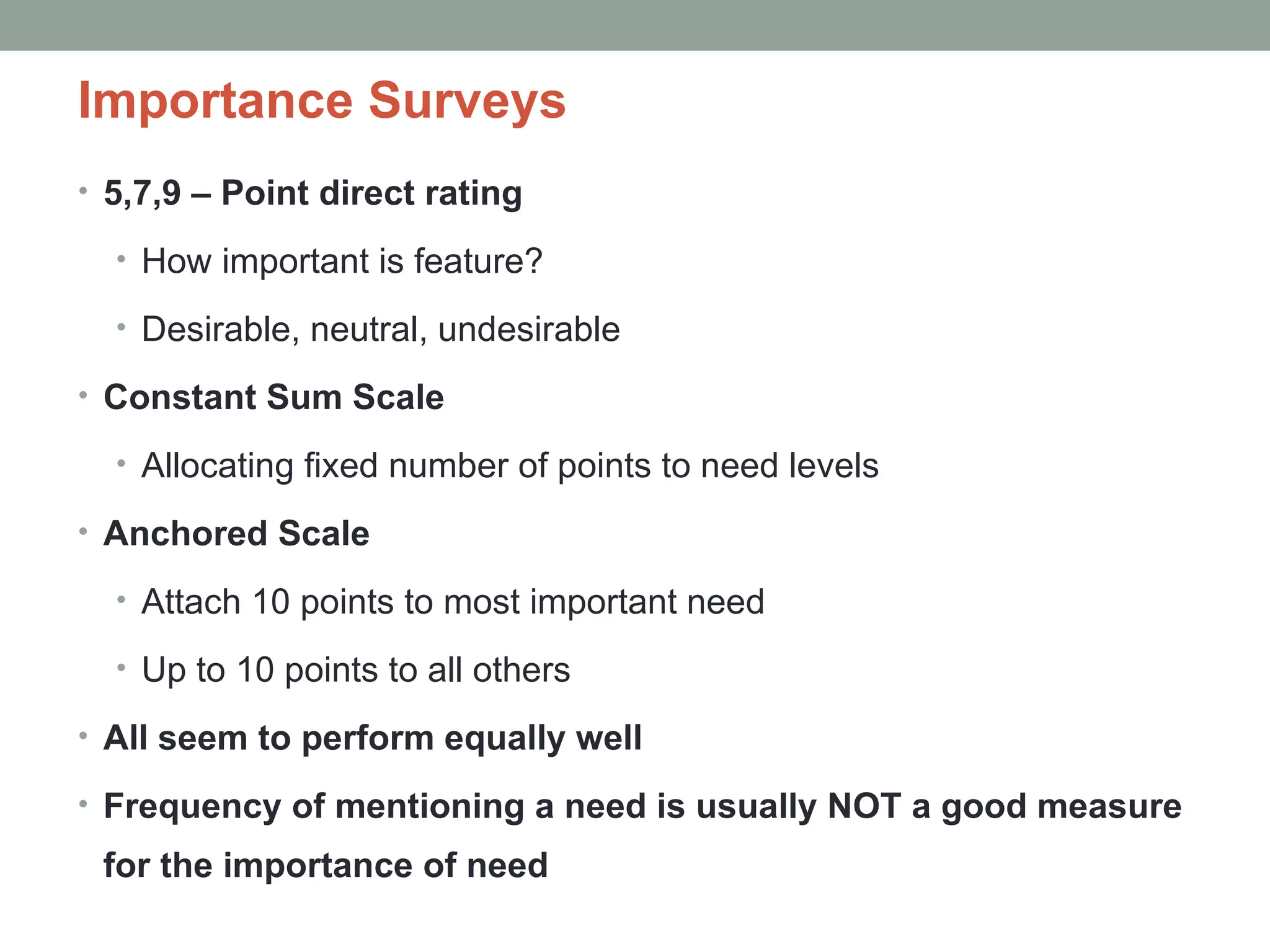
Importance Surveys
• 5,7,9– Point direct rating
• How important is feature?
• Desirable, neutral, undesirable
• Constant Sum Scale
• Allocating fixed number of points to need levels
• Anchored Scale
• Attach 10 points to most important need
• Up to 10 points to all others
• All seem to perform equally well
• Frequency of mentioning a need is usually NOT a good measure
for the importance of need
28.
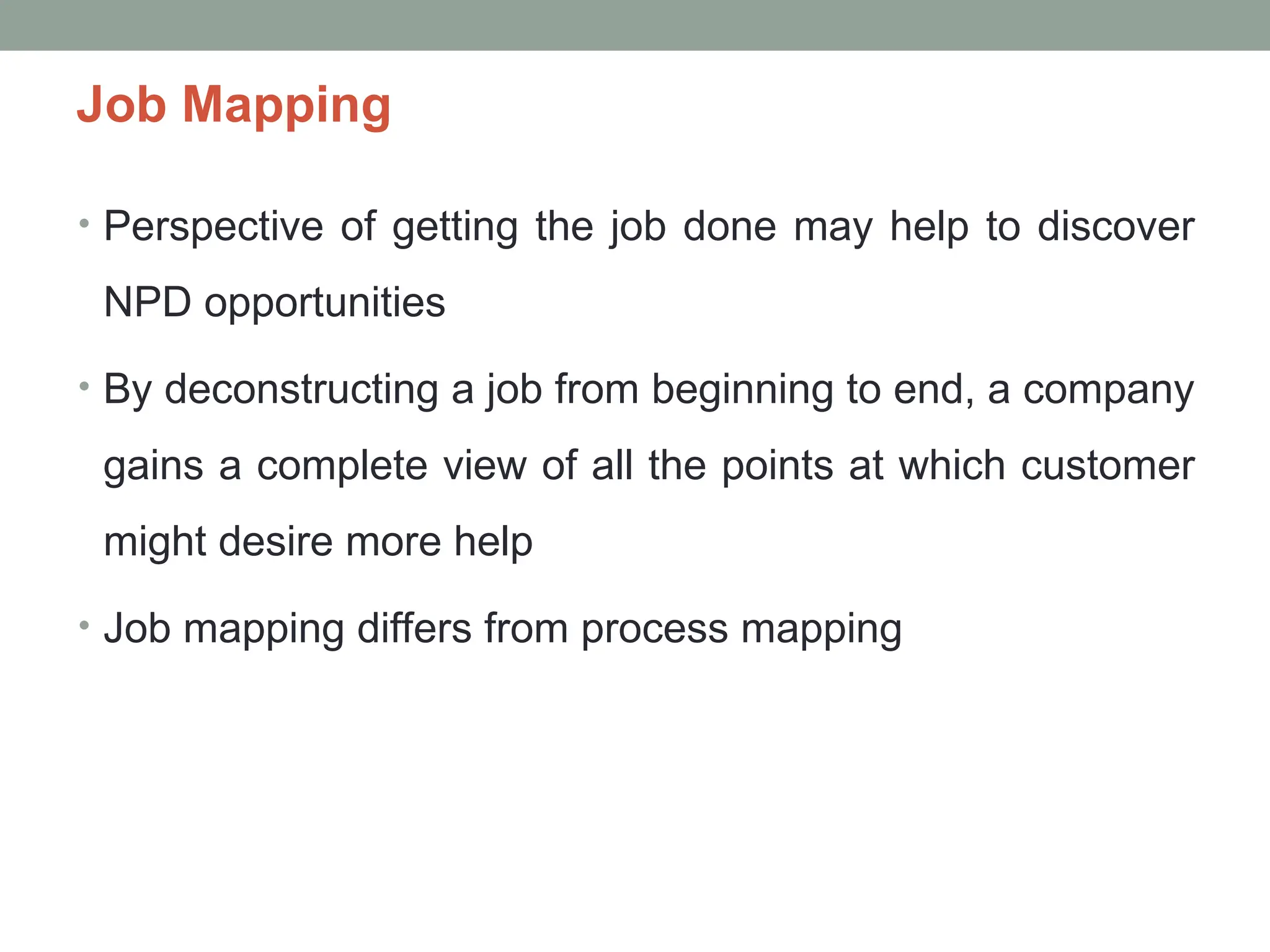
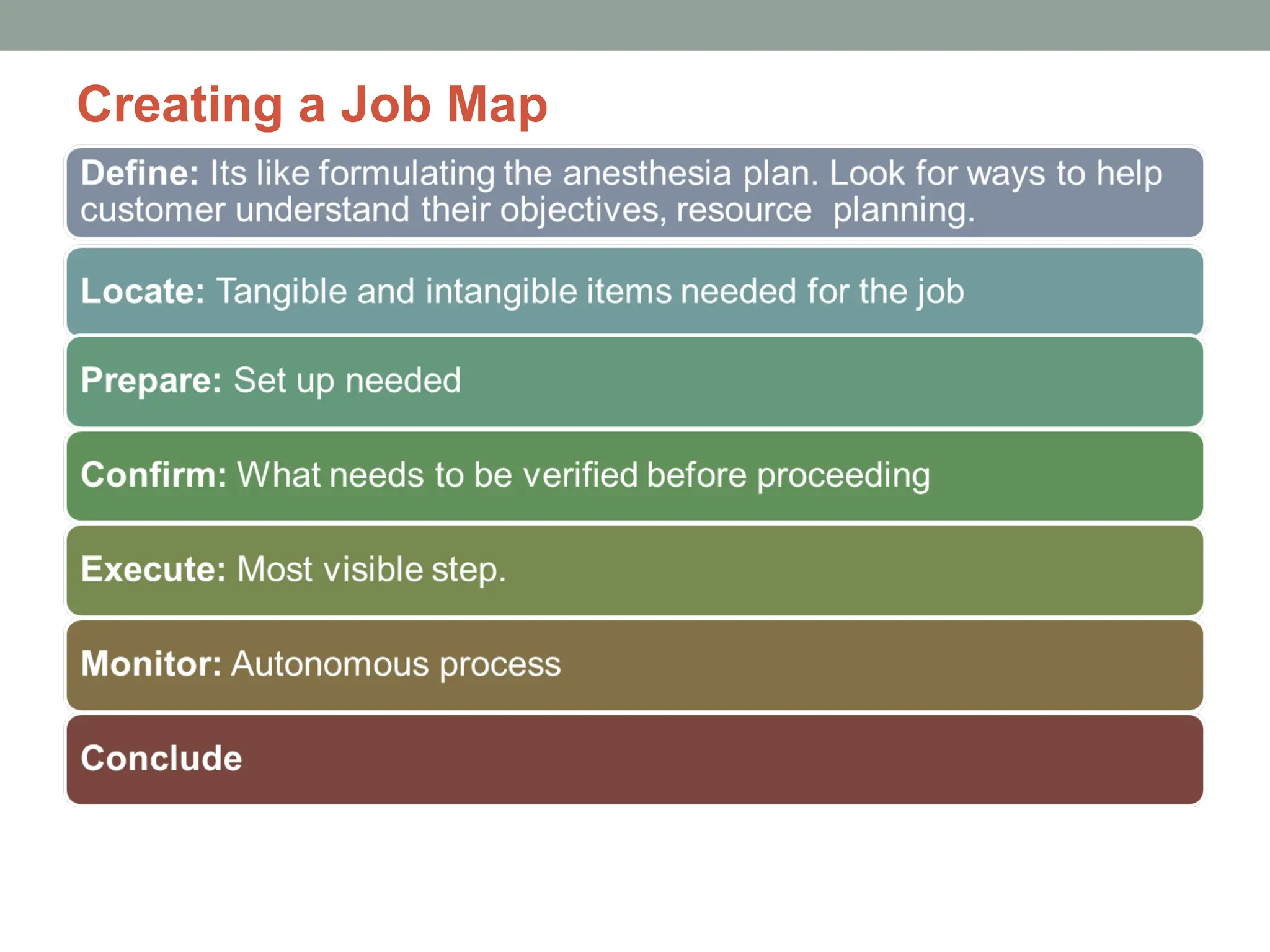
Job Mapping
• Perspectiveof getting the job done may help to discover
NPD opportunities
• By deconstructing a job from beginning to end, a company
gains a complete view of all the points at which customer
might desire more help
• Job mapping differs from process mapping
29.
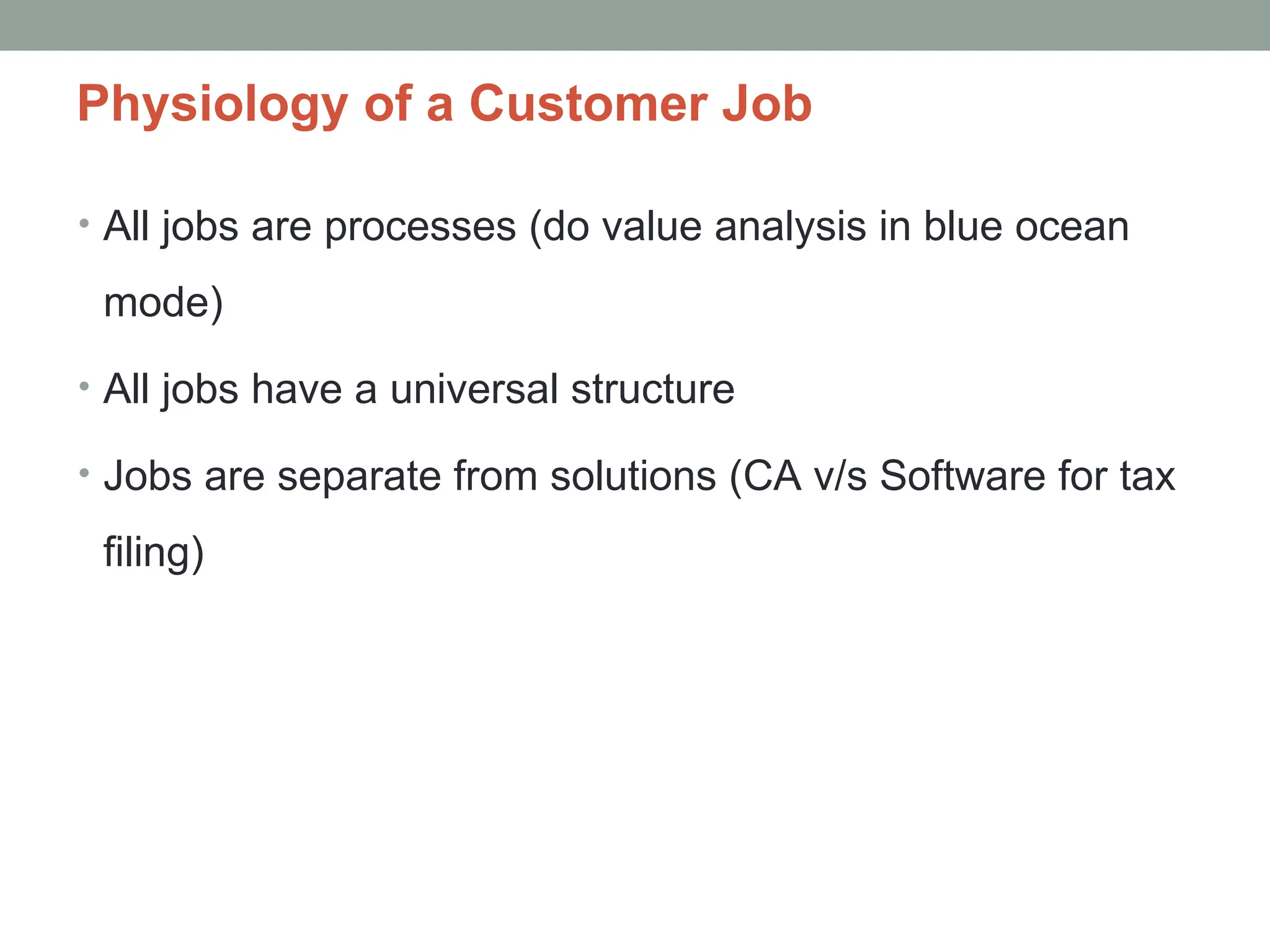
Physiology of aCustomer Job
• All jobs are processes (do value analysis in blue ocean
mode)
• All jobs have a universal structure
• Jobs are separate from solutions (CA v/s Software for tax
filing)