Lean Startup
“The Lean Startup method is about how to
drive a startup-how to steer, when to turn,
and when to persevere-and grow a
business with maximum acceleration.”
What Is The Lean Startup
Methodology?
A method for developing businesses and products first proposed in
2008 by Eric Ries that can shorten the product development
cycle by adopting a combination of business-hypothesis-driven
experimentation, iterative product releases, and
validated learning in order to meet early needs of customers
and reduce market risk by avoiding spending money where the
outcome is uncertain.
3 Myths About The Lean
Startup
Myth 1:
Lean means cheap. Lean Startup try to spend as little money as
possible.
Truth:
The Lean Startup method is not about cost, it is about speed.
3 Myths About The Lean
Startup
Myth 2:
It won’t work for my business. It’s only for tech / web
companies.
Truth:
Any company, regardless of industry, can use the Lean Startup
methodology to reduce uncertainty about what your customers
really want.
3 Myths About The Lean
Startup
Myth 3:
It only works for small, bootstrapped companies.
Truth:
The Lean Startup method is used in Fortune 500 companies
and in capital-intensive large scale projects.
5 Principles of The Lean Startup
 Entrepreneurs are everywhere
 Entrepreneurship is management
 Validated Learning
 Build – Measure – Learn
 Innovation Accounting
The Lean Startup Principles
 Entrepreneurs are everywhere (even in well-established
firms).
 Entrepreneurship is management (but different from
managing traditional firms).
 Validated learning (about customers).
 Build-Measure-Learn (feedback loop).
 Innovation accounting (using actionable metrics –
mostly about customer behaviors).
 Eric Ries, The Lean Startup: How Today's Entrepreneurs Use Continuous
Innovation to Create Radically Successful Businesses, 2011.
5 Principles of The Lean Startup
Principle #1
Entrepreneurs are everywhere
You don’t have to work for or launch a startup venture to be an
entrepreneur. You don’t have to work in a garage to be in a startup.
Anyone who works for a company that creates new products and
services under conditions of extreme uncertainty is an entrepreneur.
Entrepreneurship is the context in which you operate.
5 Principles of The Lean Startup
Principle #2
Entrepreneurship is management
Launching a new product or service is inherently risky full of
uncertainty. Managing that risk and uncertainty is the job of the
entrepreneur.
5 Principles of The Lean Startup
Principle #3
Validated Learning
Startups exist to learn how to build a sustainable business. Learning is the unit of
progress. Learning can only be done by experimentation. Validated
learning is the process of testing every element element
the vision, to determine whether the vision is sustainable.
5 Principles of The Lean Startup
Principle #4
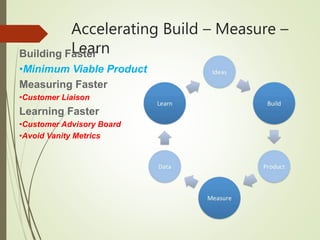
Build – Measure – Learn
The fundamental activity of a startup is to turn ideas into
products or services, measure how customers respond, and
then learn whether to pivot or persevere. All successful
startup processes should be geared towards accelerating this
feedback loop.
5 Principles of The Lean Startup
Principle #5
Innovation Accounting
Focused on defining, measuring, and communicating progress so that
assumptions can be validated, and the product or service moves closer
towards sustainability. Differs from traditional accounting which is
focused on measuring established products for sustainable products.
Accelerating Build – Measure –
LearnBuilding Faster
•Minimum Viable Product
Measuring Faster
•Customer Liaison
Learning Faster
•Customer Advisory Board
•Avoid Vanity Metrics
MVP
In product development, the Minimum Viable Product (MVP) is a strategy used for fast
and quantitative market testing of a product or product features. It is an iterative process
of idea generation, prototyping, presentation, data collection, analysis and learning.
An MVP Example
Why is Dropbox more popular than other programs with
similar functionality?
Well, let’s take a step back and think about the sync problem
and what the ideal solution for it would do:
 There would be a folder.
 You’d put your stuff in it.
 It would sync.
What Is Pivot?
 Pivot: A change to business model component based on customer feedbacks. A pivot
is not a failure.
 Pivot is a structured course correction designed to test a new fundamental
hypothesis about the product, strategy, engine of growth, etc.

Lean startup

  • 1.
    Lean Startup “The LeanStartup method is about how to drive a startup-how to steer, when to turn, and when to persevere-and grow a business with maximum acceleration.”
  • 2.
    What Is TheLean Startup Methodology? A method for developing businesses and products first proposed in 2008 by Eric Ries that can shorten the product development cycle by adopting a combination of business-hypothesis-driven experimentation, iterative product releases, and validated learning in order to meet early needs of customers and reduce market risk by avoiding spending money where the outcome is uncertain.
  • 3.
    3 Myths AboutThe Lean Startup Myth 1: Lean means cheap. Lean Startup try to spend as little money as possible. Truth: The Lean Startup method is not about cost, it is about speed.
  • 4.
    3 Myths AboutThe Lean Startup Myth 2: It won’t work for my business. It’s only for tech / web companies. Truth: Any company, regardless of industry, can use the Lean Startup methodology to reduce uncertainty about what your customers really want.
  • 5.
    3 Myths AboutThe Lean Startup Myth 3: It only works for small, bootstrapped companies. Truth: The Lean Startup method is used in Fortune 500 companies and in capital-intensive large scale projects.
  • 6.
    5 Principles ofThe Lean Startup  Entrepreneurs are everywhere  Entrepreneurship is management  Validated Learning  Build – Measure – Learn  Innovation Accounting
  • 7.
    The Lean StartupPrinciples  Entrepreneurs are everywhere (even in well-established firms).  Entrepreneurship is management (but different from managing traditional firms).  Validated learning (about customers).  Build-Measure-Learn (feedback loop).  Innovation accounting (using actionable metrics – mostly about customer behaviors).  Eric Ries, The Lean Startup: How Today's Entrepreneurs Use Continuous Innovation to Create Radically Successful Businesses, 2011.
  • 8.
    5 Principles ofThe Lean Startup Principle #1 Entrepreneurs are everywhere You don’t have to work for or launch a startup venture to be an entrepreneur. You don’t have to work in a garage to be in a startup. Anyone who works for a company that creates new products and services under conditions of extreme uncertainty is an entrepreneur. Entrepreneurship is the context in which you operate.
  • 9.
    5 Principles ofThe Lean Startup Principle #2 Entrepreneurship is management Launching a new product or service is inherently risky full of uncertainty. Managing that risk and uncertainty is the job of the entrepreneur.
  • 10.
    5 Principles ofThe Lean Startup Principle #3 Validated Learning Startups exist to learn how to build a sustainable business. Learning is the unit of progress. Learning can only be done by experimentation. Validated learning is the process of testing every element element the vision, to determine whether the vision is sustainable.
  • 11.
    5 Principles ofThe Lean Startup Principle #4 Build – Measure – Learn The fundamental activity of a startup is to turn ideas into products or services, measure how customers respond, and then learn whether to pivot or persevere. All successful startup processes should be geared towards accelerating this feedback loop.
  • 12.
    5 Principles ofThe Lean Startup Principle #5 Innovation Accounting Focused on defining, measuring, and communicating progress so that assumptions can be validated, and the product or service moves closer towards sustainability. Differs from traditional accounting which is focused on measuring established products for sustainable products.
  • 13.
    Accelerating Build –Measure – LearnBuilding Faster •Minimum Viable Product Measuring Faster •Customer Liaison Learning Faster •Customer Advisory Board •Avoid Vanity Metrics
  • 14.
    MVP In product development,the Minimum Viable Product (MVP) is a strategy used for fast and quantitative market testing of a product or product features. It is an iterative process of idea generation, prototyping, presentation, data collection, analysis and learning.
  • 15.
    An MVP Example Whyis Dropbox more popular than other programs with similar functionality? Well, let’s take a step back and think about the sync problem and what the ideal solution for it would do:  There would be a folder.  You’d put your stuff in it.  It would sync.
  • 16.
    What Is Pivot? Pivot: A change to business model component based on customer feedbacks. A pivot is not a failure.  Pivot is a structured course correction designed to test a new fundamental hypothesis about the product, strategy, engine of growth, etc.