The Lean Startup
Resumen del libro de Eric Ries
Roots
When to use
● Problem known / solution known
  Waterfall

● Problem known / solution unknown
  Agile

● Problem unknown / solution unknown
  Lean
Pillars of the lean startup

1.   Entrepreneurs are everywhere
2.   Entrepreneurship is management
3.   Validated learning
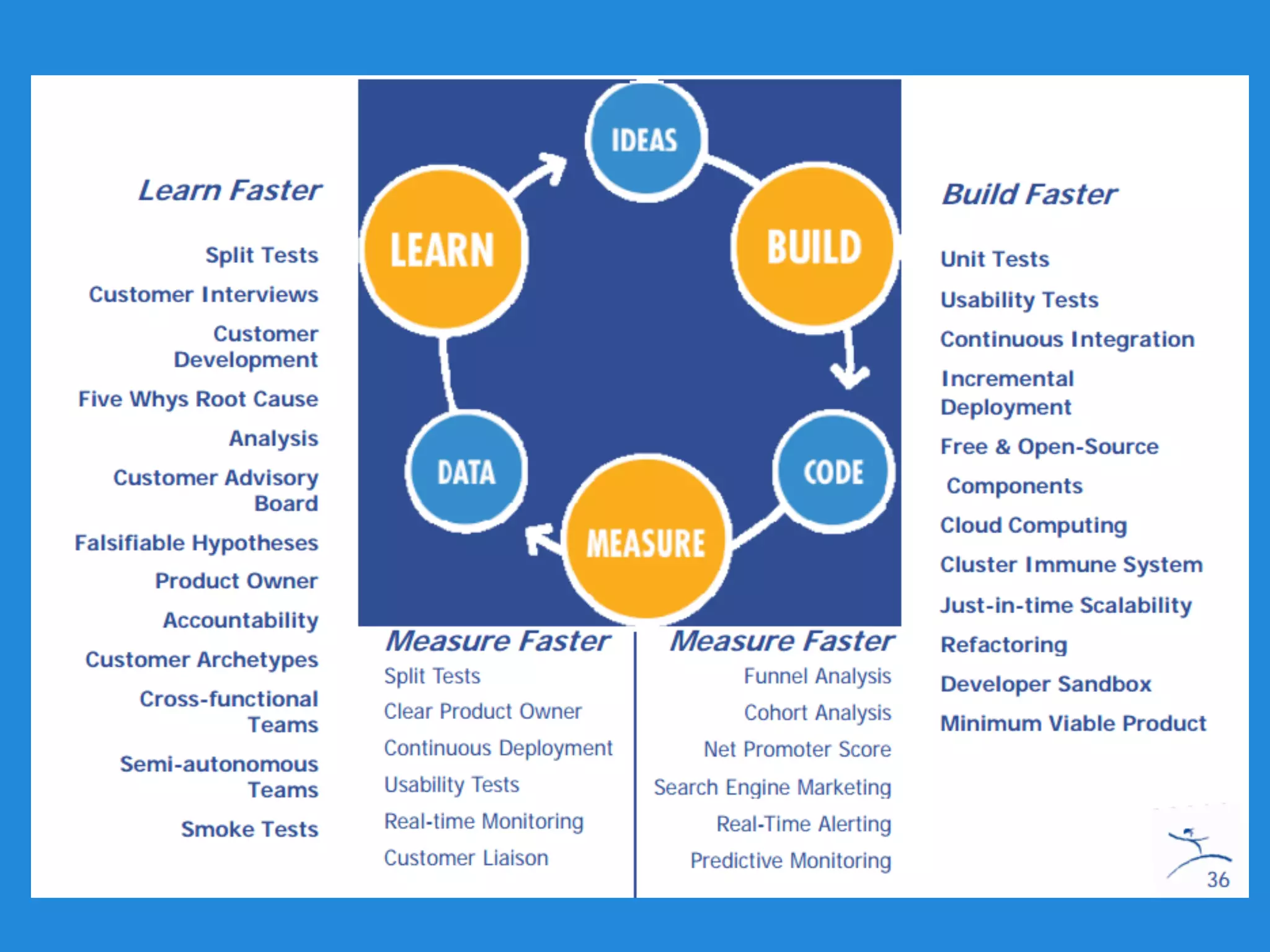
4.   Build-measure-learn loop
5.   Innovation accounting
Part 1: Vision
Define
A startup is a company designed to grow
fast. Being newly founded does not in itself
make a company a startup. Nor is it necessary
for a startup to work on technology, or take
venture funding, or have some sort of "exit."
The only essential thing is growth. Everything
else we associate with startups follows from
growth.

                                  Paul Graham
Define
A startup is a human institution designed to
create a new product or service under
conditions of extreme uncertainty.

Entrepreneurship is management.
Learn
If the fundamental goal of entrepreneurship is
to engage in organization building under
conditions of extreme uncertainty, its most vital
function is learning.

Unfortunately, “learning” is the oldest excuse in
the book for a failure of execution.
Learn
Adopt the view that your job is to find a
synthesis between your vision and what
customers would accept; it isn’t to capitulate to
what customers think they want or to tell
customers what they ought to want.
Learn
The point is not to find the average customer
but to find early adopters: the customers who
feel the need for the product most acutely.
Learn
It is often easier to raise money or acquire
other resources when you have zero revenue,
zero customers, and zero traction than when
you have a small amount.

This phenomenon creates a brutal incentive:
postpone getting any data until you are certain
of success.
Learn
Can we build a sustainable business around
this set of products and services?
Experiment
Think big, start small. Build a minimum viable
product to test your hypothesis relying on the
scientific method.
Experiment
Break down the grand vision into its component
parts. The two most important assumptions
entrepreneurs make are the value hypothesis
and the growth hypothesis.
Experiment
Planning is a tool that only works in the
presence of a long and stable operating history.
Part 2: Steer
Leap
Your goal is to validate your value and growth
hypothesis.
Leap
Genchi Gembutsu: "go and see for yourself"

You cannot be sure you really understand any
part of any business problem unless you go
and see for yourself firsthand.

"If you don't go, you don't know"
Leap
Lean UX recognizes that the customer
archetype is a hypothesis, not a fact.

The customer profile should be considered
provisional until the strategy has shown via
validated learning that we can serve this type of
customer in a sustainable way.
Leap
Avoid the dangers of the two extremes: just do
it vs analysis paralysis.
Test
The fastest way to get through the Build-
Measure-Learn feedback loop with the
minimum amount of effort is via a MVP.

The goal of the MVP is to begin the process of
learning, not end it.
Test
Before new products can be sold successfully
to the mass market, they have to be sold to
early adopters. These people are a special
breed of customer. They accept—in fact
prefer—an 80 percent solution; you don’t need
a perfect solution to capture their interest.
Test
The lesson of the MVP is that any additional
work beyond what was required to start
learning is waste, no matter how important it
might have seemed at the time.
Test
Examples of MVPs

●   Video
●   Landing page
●   Concierge
●   Wizard of Oz.
Test
If we do not know who the customer is, we do
not know what quality is.
Measure
Innovation accounting enables startups to
prove objectively that they are learning how to
grow a sustainable business.
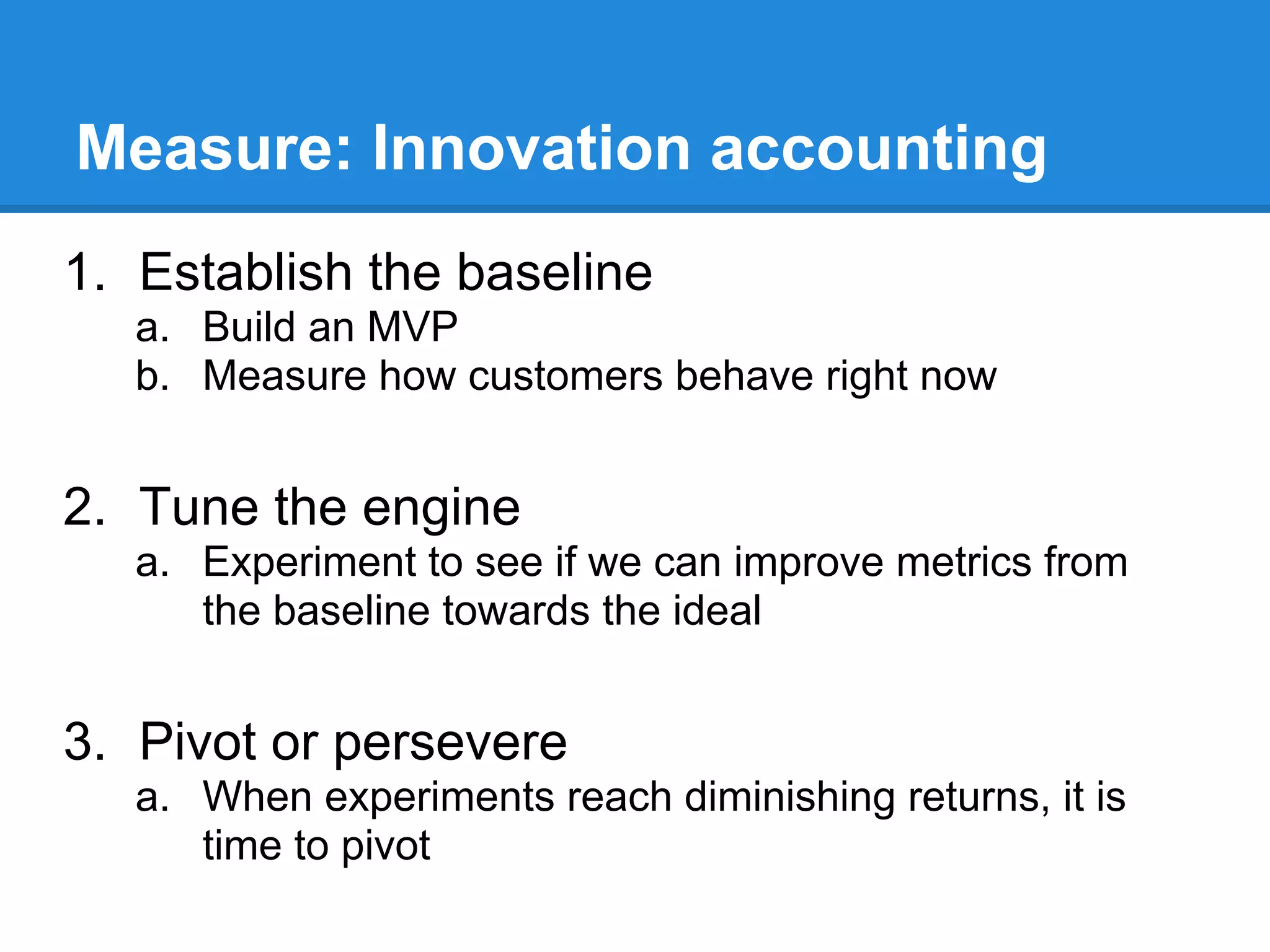
Measure: Innovation accounting
1. Establish the baseline
   a. Build an MVP
   b. Measure how customers behave right now


2. Tune the engine
   a. Experiment to see if we can improve metrics from
      the baseline towards the ideal


3. Pivot or persevere
   a. When experiments reach diminishing returns, it is
      time to pivot
Measure
Metrics must be:
● Actionable
● Accessible
● Auditable
Measure
This is the pattern: poor quantitative results
force us to declare failure and create the
motivation, context, and space for more
qualitative research.
Measure: Using kanban
Stories could be cataloged as being in one of
four states of development: in the product
backlog, actively being built, done (feature
complete from a technical point of view), or in
the process of being validated.

Validated was defined as “knowing whether the
story was a good idea to have been done in the
first place.”
Pivot
Pivot is to change direction while keeping a
foot on sure ground.

A pivot is better understood as a new strategic
hypothesis that will require a new MVP to test.

A startup's runway is the number of pivots it
can still make.
Pivot
The more money, time, and creative energy
that has been sunk into an idea, the harder it is
to pivot.

Remember, if we're building something that
nobody wants, it doesn't much matter if we're
doing it on time and on budget.
Pivot: Kinds
●   Zoom in
●   Zoom out
●   Customer segment
●   Customer need
●   Bussiness architecture
●   Value capture
●   Engine of growth
●   Channel
●   Technology
Part 3: Accelerate
Batch
Working in small batches ensures that a startup
can minimize the expenditure of time, money,
and effort that ultimately turns out to have been
wasted.
Batch
By reducing batch size, we can get through
the Build-Measure-Learn feedback loop
more quickly than our competitors can.

The ability to learn faster from customers is the
essential competitive advantage that startups
must possess.
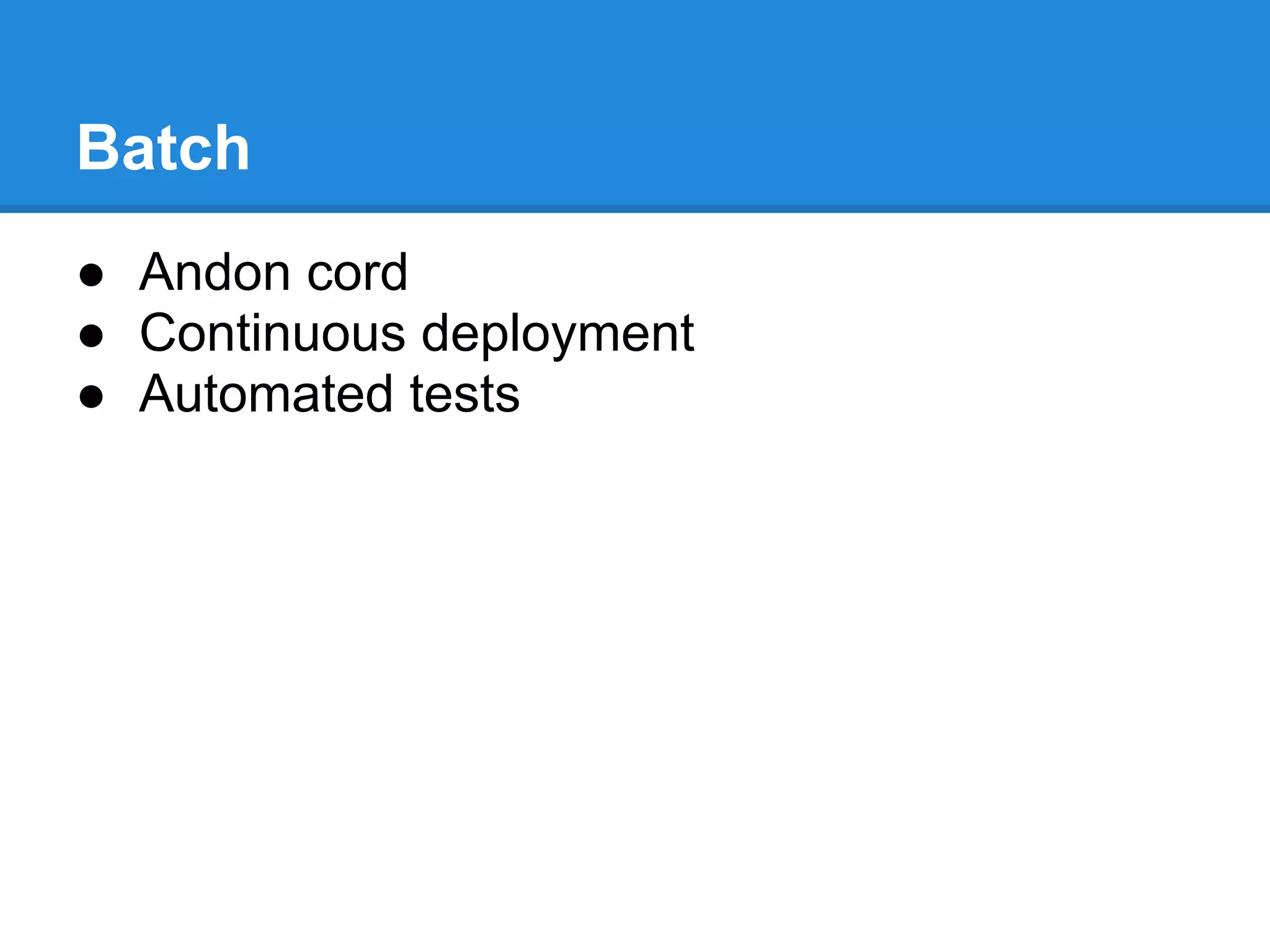
Batch
● Andon cord
● Continuous deployment
● Automated tests
Batch
Large-batch death spiral: the larger the batch,
the higher the pressure to deliver a high-quality
version of the product.

In light of how long the product has been in
development, why not fix one more bug or add
one more feature? Who really wants to be the
manager who risked the success of this huge
release by failing to address a potentially
critical flaw?
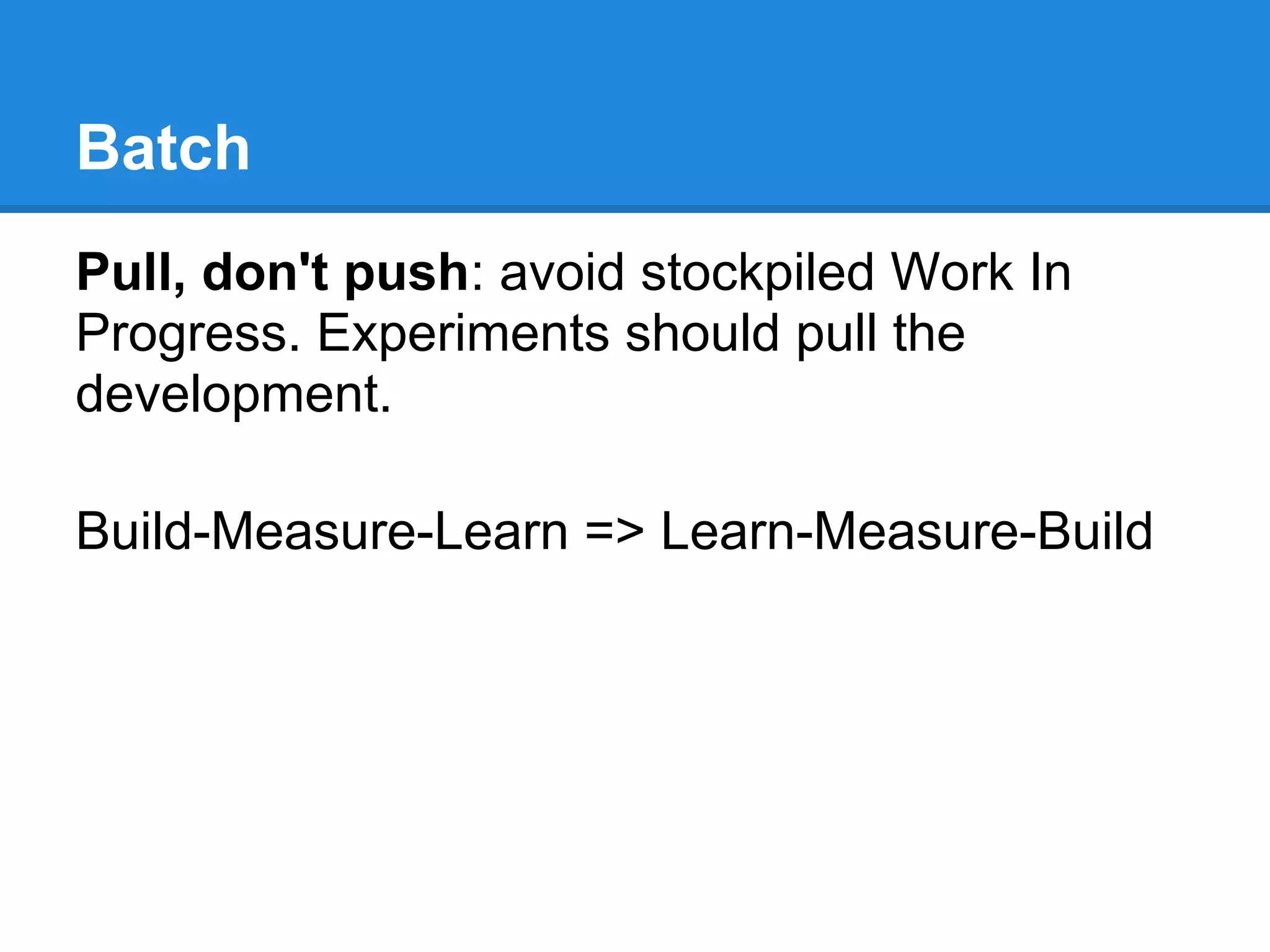
Batch
Pull, don't push: avoid stockpiled Work In
Progress. Experiments should pull the
development.

Build-Measure-Learn => Learn-Measure-Build
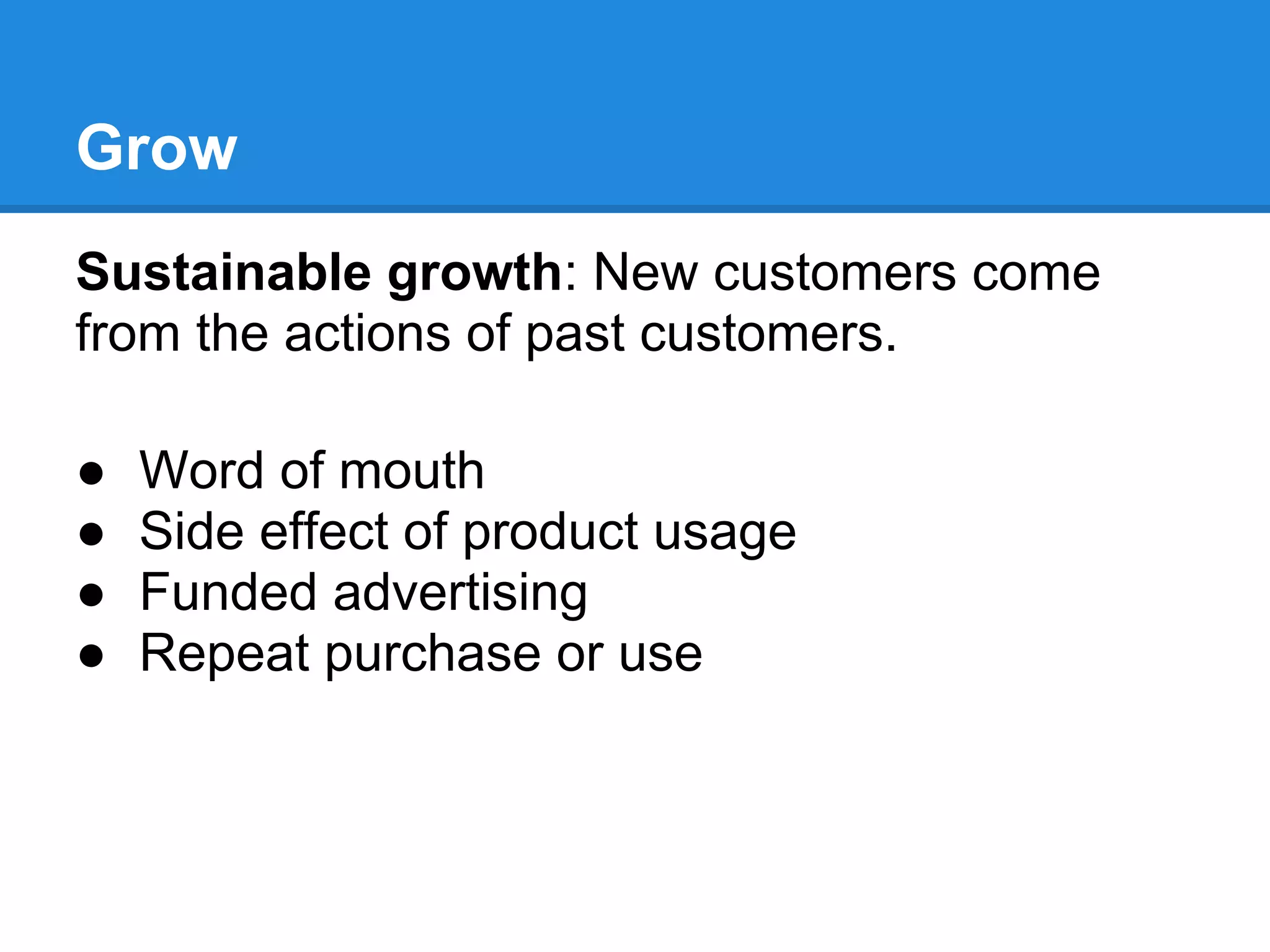
Grow
Sustainable growth: New customers come
from the actions of past customers.

●   Word of mouth
●   Side effect of product usage
●   Funded advertising
●   Repeat purchase or use
Grow: Engines of growth
Sticky

● Relies on high customer retention rate.
● Key is for new customer acquisition exceed
  churn rate.
Grow: Engines of growth
Viral

Many viral product do not charge customers
directly but rely on indirect sources of revenue
such as advertising.

Customers are not intentionally acting as
evangelists, growth happens automatically as a
side effect of customers using the product.
Grow: Engines of growth
Paid

● Marginal profit, the margin between LTV
  (customer lifetime value) and CPA (cost per
  acquisition)
● Relies on paid advertising
Adapt
Build a company that can adapt and change as
fast as possible.
Adapt: The five whys
The core idea of Five Whys is to tie
investments directly to the prevention of the
most problematic symptoms.

Adopt these simple rules:
1- Be tolerant of all mistakes the first time
2- Never allow the same mistake to be made
twice
Innovate
As the company grows, keep innovating. Build
small teams of entrepreneurs within the
company to have a diverse portfolio and keep
innovating.

Create a sandbox for innovation that will
contain the impact of the new innovation but
not constrain the methods of the startup team.
Innovate
Startup teams require three structural
attributes:
● scarce but secure resources,
● independent authority to develop their
   business,
● and a personal stake in the outcome.
Innovate
The innovation team should be cross-functional
and have a clear team leader.

It should be empowered to build, market, and
deploy products or features in the sandbox
without prior approval.

It should be required to report on the success
or failure of those efforts by using standard
actionable metrics and innovation accounting.
Innovate
Entrepreneur Is a Job Title
Epilogue
For all of our vaunted efficiency in the making
of things, our economy is still incredibly
wasteful.
This waste comes not from the inefficient
organization of work but rather from working on
the wrong things - and on an industrial scale.
As Peter Drucker said, “There is surely nothing
quite so useless as doing with great efficiency
what should not be done at all.”
Epilogue
By focusing on functional efficiency, we lose
sight of the real goal of innovation: to learn that
which is currently unknown.
Extractos de "What User-Centered Design is Good For"
de Dan Saffer
User-centered design
No matter how many users you talk to, no
matter how much data you collect, at the end of
the day, a human has to decide.

No amount of data analysis can make up for a
lack of talent.
User-centered design
Users and their data should be there to inform
designers, not to substitute for them.

Great ideas can't be tested. Only mediocre
ideas can be tested.
Preguntas?

Lean Startup

  • 1.
    The Lean Startup Resumendel libro de Eric Ries
  • 2.
  • 3.
    When to use ●Problem known / solution known Waterfall ● Problem known / solution unknown Agile ● Problem unknown / solution unknown Lean
  • 4.
    Pillars of thelean startup 1. Entrepreneurs are everywhere 2. Entrepreneurship is management 3. Validated learning 4. Build-measure-learn loop 5. Innovation accounting
  • 5.
  • 6.
    Define A startup isa company designed to grow fast. Being newly founded does not in itself make a company a startup. Nor is it necessary for a startup to work on technology, or take venture funding, or have some sort of "exit." The only essential thing is growth. Everything else we associate with startups follows from growth. Paul Graham
  • 7.
    Define A startup isa human institution designed to create a new product or service under conditions of extreme uncertainty. Entrepreneurship is management.
  • 8.
    Learn If the fundamentalgoal of entrepreneurship is to engage in organization building under conditions of extreme uncertainty, its most vital function is learning. Unfortunately, “learning” is the oldest excuse in the book for a failure of execution.
  • 9.
    Learn Adopt the viewthat your job is to find a synthesis between your vision and what customers would accept; it isn’t to capitulate to what customers think they want or to tell customers what they ought to want.
  • 10.
    Learn The point isnot to find the average customer but to find early adopters: the customers who feel the need for the product most acutely.
  • 11.
    Learn It is ofteneasier to raise money or acquire other resources when you have zero revenue, zero customers, and zero traction than when you have a small amount. This phenomenon creates a brutal incentive: postpone getting any data until you are certain of success.
  • 12.
    Learn Can we builda sustainable business around this set of products and services?
  • 13.
    Experiment Think big, startsmall. Build a minimum viable product to test your hypothesis relying on the scientific method.
  • 14.
    Experiment Break down thegrand vision into its component parts. The two most important assumptions entrepreneurs make are the value hypothesis and the growth hypothesis.
  • 15.
    Experiment Planning is atool that only works in the presence of a long and stable operating history.
  • 16.
  • 17.
    Leap Your goal isto validate your value and growth hypothesis.
  • 18.
    Leap Genchi Gembutsu: "goand see for yourself" You cannot be sure you really understand any part of any business problem unless you go and see for yourself firsthand. "If you don't go, you don't know"
  • 19.
    Leap Lean UX recognizesthat the customer archetype is a hypothesis, not a fact. The customer profile should be considered provisional until the strategy has shown via validated learning that we can serve this type of customer in a sustainable way.
  • 20.
    Leap Avoid the dangersof the two extremes: just do it vs analysis paralysis.
  • 21.
    Test The fastest wayto get through the Build- Measure-Learn feedback loop with the minimum amount of effort is via a MVP. The goal of the MVP is to begin the process of learning, not end it.
  • 22.
    Test Before new productscan be sold successfully to the mass market, they have to be sold to early adopters. These people are a special breed of customer. They accept—in fact prefer—an 80 percent solution; you don’t need a perfect solution to capture their interest.
  • 23.
    Test The lesson ofthe MVP is that any additional work beyond what was required to start learning is waste, no matter how important it might have seemed at the time.
  • 24.
    Test Examples of MVPs ● Video ● Landing page ● Concierge ● Wizard of Oz.
  • 25.
    Test If we donot know who the customer is, we do not know what quality is.
  • 26.
    Measure Innovation accounting enablesstartups to prove objectively that they are learning how to grow a sustainable business.
  • 27.
    Measure: Innovation accounting 1.Establish the baseline a. Build an MVP b. Measure how customers behave right now 2. Tune the engine a. Experiment to see if we can improve metrics from the baseline towards the ideal 3. Pivot or persevere a. When experiments reach diminishing returns, it is time to pivot
  • 28.
    Measure Metrics must be: ●Actionable ● Accessible ● Auditable
  • 29.
    Measure This is thepattern: poor quantitative results force us to declare failure and create the motivation, context, and space for more qualitative research.
  • 30.
    Measure: Using kanban Storiescould be cataloged as being in one of four states of development: in the product backlog, actively being built, done (feature complete from a technical point of view), or in the process of being validated. Validated was defined as “knowing whether the story was a good idea to have been done in the first place.”
  • 31.
    Pivot Pivot is tochange direction while keeping a foot on sure ground. A pivot is better understood as a new strategic hypothesis that will require a new MVP to test. A startup's runway is the number of pivots it can still make.
  • 32.
    Pivot The more money,time, and creative energy that has been sunk into an idea, the harder it is to pivot. Remember, if we're building something that nobody wants, it doesn't much matter if we're doing it on time and on budget.
  • 33.
    Pivot: Kinds ● Zoom in ● Zoom out ● Customer segment ● Customer need ● Bussiness architecture ● Value capture ● Engine of growth ● Channel ● Technology
  • 34.
  • 35.
    Batch Working in smallbatches ensures that a startup can minimize the expenditure of time, money, and effort that ultimately turns out to have been wasted.
  • 36.
    Batch By reducing batchsize, we can get through the Build-Measure-Learn feedback loop more quickly than our competitors can. The ability to learn faster from customers is the essential competitive advantage that startups must possess.
  • 38.
    Batch ● Andon cord ●Continuous deployment ● Automated tests
  • 39.
    Batch Large-batch death spiral:the larger the batch, the higher the pressure to deliver a high-quality version of the product. In light of how long the product has been in development, why not fix one more bug or add one more feature? Who really wants to be the manager who risked the success of this huge release by failing to address a potentially critical flaw?
  • 40.
    Batch Pull, don't push:avoid stockpiled Work In Progress. Experiments should pull the development. Build-Measure-Learn => Learn-Measure-Build
  • 41.
    Grow Sustainable growth: Newcustomers come from the actions of past customers. ● Word of mouth ● Side effect of product usage ● Funded advertising ● Repeat purchase or use
  • 42.
    Grow: Engines ofgrowth Sticky ● Relies on high customer retention rate. ● Key is for new customer acquisition exceed churn rate.
  • 43.
    Grow: Engines ofgrowth Viral Many viral product do not charge customers directly but rely on indirect sources of revenue such as advertising. Customers are not intentionally acting as evangelists, growth happens automatically as a side effect of customers using the product.
  • 44.
    Grow: Engines ofgrowth Paid ● Marginal profit, the margin between LTV (customer lifetime value) and CPA (cost per acquisition) ● Relies on paid advertising
  • 45.
    Adapt Build a companythat can adapt and change as fast as possible.
  • 46.
    Adapt: The fivewhys The core idea of Five Whys is to tie investments directly to the prevention of the most problematic symptoms. Adopt these simple rules: 1- Be tolerant of all mistakes the first time 2- Never allow the same mistake to be made twice
  • 47.
    Innovate As the companygrows, keep innovating. Build small teams of entrepreneurs within the company to have a diverse portfolio and keep innovating. Create a sandbox for innovation that will contain the impact of the new innovation but not constrain the methods of the startup team.
  • 48.
    Innovate Startup teams requirethree structural attributes: ● scarce but secure resources, ● independent authority to develop their business, ● and a personal stake in the outcome.
  • 49.
    Innovate The innovation teamshould be cross-functional and have a clear team leader. It should be empowered to build, market, and deploy products or features in the sandbox without prior approval. It should be required to report on the success or failure of those efforts by using standard actionable metrics and innovation accounting.
  • 50.
  • 51.
    Epilogue For all ofour vaunted efficiency in the making of things, our economy is still incredibly wasteful. This waste comes not from the inefficient organization of work but rather from working on the wrong things - and on an industrial scale. As Peter Drucker said, “There is surely nothing quite so useless as doing with great efficiency what should not be done at all.”
  • 52.
    Epilogue By focusing onfunctional efficiency, we lose sight of the real goal of innovation: to learn that which is currently unknown.
  • 53.
    Extractos de "WhatUser-Centered Design is Good For" de Dan Saffer
  • 54.
    User-centered design No matterhow many users you talk to, no matter how much data you collect, at the end of the day, a human has to decide. No amount of data analysis can make up for a lack of talent.
  • 55.
    User-centered design Users andtheir data should be there to inform designers, not to substitute for them. Great ideas can't be tested. Only mediocre ideas can be tested.
  • 56.