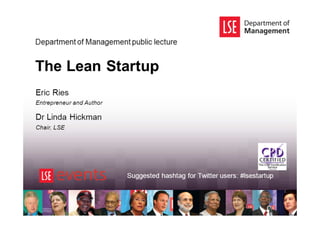
The Lean Startup
Eric Ries
Entrepreneur and Author
Dr Linda Hickman
Chair, LSE
Department of Management public lecture
Suggested hashtag for Twitter users: #lsestartup
Eric Ries (@ericries)
http://StartupLessonsLearned.com
The Lean Startup
#leanstartup
Lean Startup Principles
Entrepreneurs are everywhere
Entrepreneurship is management
Validated Learning
Build – Measure - Learn
Innovation Accounting
Lean Startup Principles
Entrepreneurs are everywhere
What is a startup?
• A startup is a human institution designed to
deliver a new product or service under
conditions of extreme uncertainty.
• Nothing to do with size of company, sector of the
economy, or industry
What is a startup?
STARTUP
=
EXPERIMENT
STOP
WASTING
PEOPLE’S
TIME
Most Startups Fail
Most Startups Fail
Most Startups Fail
Lean Startup Principles
Entrepreneurs are everywhere
Entrepreneurship is management
Who to Blame
• Father of scientific
management
• Study work to find the best
way
• Management by exception
• Standardize work into tasks
• Compensate workers based
on performance
“In the past, the man was
first. In the future, the
system will be first.”
(1911)
Frederick Winslow Taylor
(1856 – 1915)
Entrepreneurship is management
• Our goal is to create an institution, not just a
product
• Traditional management practices fail
- “general management” as taught to MBAs
• Need practices and principles geared to the
startup context of extreme uncertainty
• Not just for “two guys in a garage”
The Pivot
I’
The Pivot
• What do successful startups have in common?
- They started out as digital cash for PDAs, but evolved into online
payments for eBay.
- They started building BASIC interpreters, but evolved
into the world's largest operating systems monopoly.
- They were shocked to discover their online games
company was actually a photo-sharing site.
• Pivot: change directions but stay grounded in what
we’ve learned.
Speed Wins
If we can reduce the time between pivots
We can increase our odds of success
Before we run out of money
Lean Startup Principles
Entrepreneurs are everywhere
Entrepreneurship is management
Validated Learning
Achieving Failure
• If we’re building something nobody wants, what
does it matter if we accomplish it:
On time?
On budget?
With high quality?
With beautiful design?
• Achieving Failure = successfully executing a bad
plan
The Lean Revolution
W. Edwards
Deming
(1900 – 1993)
Taiichi Ohno - 大
野 耐
(1912 – 1990)
“The customer is the most important part of the production line.” -Deming
STOP
WASTING
PEOPLE’S
TIME
Lean Startup Principles
Entrepreneurs are everywhere
Entrepreneurship is management
Validated Learning
Build – Measure - Learn
Minimize TOTAL time through the loop
There’s much more…
Learn Faster
Split Tests
Customer Development
Five Whys
Customer Advisory Board
Falsifiable Hypotheses
Product Owner
Accountability
Customer Archetypes
Cross-functional Teams
Semi-autonomous Teams
Smoke Tests
Measure Faster
Split Tests
Continuous Deployment
Usability Tests
Real-time Monitoring & Alerting
Customer Liaison
Build Faster
Unit Tests
Usability Tests
Continuous Integration
Incremental Deployment
Free & Open-Source
Cloud Computing
Cluster Immune System
Just-in-time Scalability
Refactoring
Developer Sandbox
Minimum Viable Product
Measure Faster
Funnel Analysis
Cohort Analysis
Net Promoter Score
Search Engine Marketing
Predictive Monitoring
Lean Startup Principles
Entrepreneurs are everywhere
Entrepreneurship is management
Validated Learning
Build – Measure - Learn
Innovation Accounting
The Toyota Way
http://bit.ly/thetoyotaway
The Startup Way
PeoplePeople
CultureCulture
ProcessProcess
AccountabilityAccountability
Innovation Accounting
The Three Learning Milestones
1. Establish the baseline
- Build a Minimum Viable Product (MVP)
- Measure how customers behave right now
2. Tune the engine
- Experiment to see if we can improve metrics from the
baseline towards the ideal
3. Pivot or persevere
- When experiments reach diminishing returns, it’s time to
pivot.
STOP
WASTING
PEOPLE’S
TIME
Questions
How do we know when to pivot?
Vision or Strategy or Product?
What should we measure?
How do products grow?
Are we creating value?
What’s in the MVP?
Can we go faster?
http://bit.ly/LeanStartupUK
Thanks!
• Buy the book @
http://theleanstartup.com/book
• Blog: http://StartupLessonsLearned.com
• Get in touch (#leanstartup)
- http://twitter.com/ericries
- eric@theleanstartup.com
• Additional resources
- http://theleanstartup.com
- Lean Startup Wiki:
http://leanstartup.pbworks.com
Myth #1
Myth
Lean means cheap. Lean startups try to
spend as little money as possible.
Truth
The Lean Startup method is not about cost,
it is about speed.
Myth #2
Myth
The Lean Startup is only for
Web 2.0/internet/consumer software companies.
Truth
The Lean Startup applies to all companies that
face uncertainty about what customers will want.
Myth #3
Myth
Lean Startups are small bootstrapped startups.
Truth
Lean Startups are ambitious and are able
to deploy large amounts of capital.
Myth #4
Myth
Lean Startups replace vision with data
or customer feedback.
Truth
Lean Startups are driven by a compelling vision,
and are rigorous about testing each element of
this vision
Lean Startup Principles
Entrepreneurs are everywhere
Entrepreneurship is management
Validated Learning
Build – Measure - Learn
Innovation Accounting
Minimum Viable Product
• Visionary customers can “fill in the gaps” on
missing features, if the product solves a real
problem
• Allows us to achieve a big vision in small
increments without going in circles
• Requires a commitment to iteration
• MVP is only for BIG VISION products;
unnecessary for minimal products.
Continuous Deployment
Learn Faster
Customer Development
Five Whys
Measure Faster
Split Testing
Actionable Metrics
Net Promoter Score
SEM
Build Faster
Continuous Deployment
Small Batches
Minimum Viable Product
Refactoring
Continuous Deployment Principles
Have every problem once
Stop the line when anything fails
Fast response over prevention
Continuous Deployment
• Deploy new software quickly
- At IMVU time from check-in to production = 20 minutes
• Tell a good change from a bad change (quickly)
• Revert a bad change quickly
- And “shut down the line”
• Work in small batches
- At IMVU, a large batch = 3 days worth of work
• Break large projects down into small batches
Cluster Immune System
What it looks like to ship one piece of code to production:
• Run tests locally (SimpleTest, Selenium)
- Everyone has a complete sandbox
• Continuous Integration Server (BuildBot)
- All tests must pass or “shut down the line”
- Automatic feedback if the team is going too fast
• Incremental deploy
- Monitor cluster and business metrics in real-time
- Reject changes that move metrics out-of-bounds
• Alerting & Predictive monitoring (Nagios)
- Monitor all metrics that stakeholders care about
- If any metric goes out-of-bounds, wake somebody up
- Use historical trends to predict acceptable bounds
• When customers see a failure
- Fix the problem for customers
- Improve your defenses at each level
Minimum Viable Product
Learn Faster
Customer Development
Five Whys
Measure Faster
Split Testing
Actionable Metrics
Net Promoter Score
SEM
Build Faster
Continuous Deployment
Small Batches
Minimum Viable Product
Refactoring
Why do we build products?
• Delight customers
• Get lots of them signed up
• Make a lot of money
• Realize a big vision; change the world
• Learn to predict the future
Possible Approaches
• “Maximize chances of success”
- build a great product with enough features that increase the
odds that customers will want it
- Problem: no feedback until the end, might be too late to adjust
• “Release early, release often”
- Get as much feedback as possible, as soon as possible
- Problem: run around in circles, chasing what customers think
they want
Minimum Viable Product
• The minimum set of features needed to learn from
earlyvangelists – visionary early adopters
- Avoid building products that nobody wants
- Maximize the learning per dollar spent
• Probably much more minimum than you think!
Minimum Viable Product
• Visionary customers can “fill in the gaps” on
missing features, if the product solves a real
problem
• Allows us to achieve a big vision in small
increments without going in circles
• Requires a commitment to iteration
• MVP is only for BIG VISION products;
unnecessary for minimal products.
Techniques
• Smoke testing with landing pages, AdWords
• SEM on five dollars a day
• In-product split testing
• Paper prototypes
• Customer discovery/validation
• Removing features (“cut and paste”)
Fears
• False negative: “customers would have liked the
full product, but the MVP sucks, so we
abandoned the vision”
• Visionary complex: “but customers don’t know
what they want!”
• Too busy to learn: “it would be faster to just build
it right, all this measuring distracts from
delighting customers”
Five Whys
Learn Faster
Five Whys Root
Cause Analysis
Measure Faster
Rapid Split Tests
Code Faster
Continuous Deployment
Five Whys Root Cause Analysis
• A technique for continuous improvement of
company process.
• Ask “why” five times when something
unexpected happens.
• Make proportional investments in prevention at
all five levels of the hierarchy.
• Behind every supposed technical problem is
usually a human problem. Fix the cause, not just
the symptom.
Rapid Split Tests
Learn Faster
Five Whys Root
Cause Analysis
Measure Faster
Rapid Split Tests
Code Faster
Continuous Deployment
Split-testing all the time
• A/B testing is key to validating your hypotheses
• Has to be simple enough for everyone to use
and understand it
• Make creating a split-test no more than one line
of code:
if( setup_experiment(...) == "control" ) {
// do it the old way
} else {
// do it the new way
}
The AAA’s of Metrics
• Actionable
• Accessible
• Auditable
Measure the Macro
• Always look at cohort-based metrics over time
• Split-test the small, measure the large
Control Group (A) Experiment (B)
# Registered 1025 1099
Downloads 755 (73%) 733 (67%)
Active days 0-1 600 (58%) 650 (59%)
Active days 1-3 500 (48%) 545 (49%)
Active days 3-10 300 (29%) 330 (30%)
Active days 10-30 250 (24%) 290 (26%)
Total Revenue $3210.50 $3450.10
RPU $3.13 $3.14
Lean Startup Principles
Entrepreneurs are everywhere
Entrepreneurship is management
Validated Learning
Innovation Accounting
Minimum Viable Product
• The minimum set of features needed to learn from
earlyvangelists – visionary early adopters
- Avoid building products that nobody wants
- Maximize the learning per dollar spent
• Probably much more minimum than you think!
Minimum Viable Product
• Visionary customers can “fill in the gaps” on
missing features, if the product solves a real
problem
• Allows us to achieve a big vision in small
increments without going in circles
• Requires a commitment to iteration
• MVP is only for BIG VISION products;
unnecessary for minimal products.
Split-testing all the time
• A/B testing is key to validating your hypotheses
• Has to be simple enough for everyone to use
and understand it
• Make creating a split-test no more than one line
of code:
if( setup_experiment(...) == "control" ) {
// do it the old way
} else {
// do it the new way
}
The AAA’s of Metrics
• Actionable
• Accessible
• Auditable
Measure the Macro
• Always look at cohort-based metrics over time
• Split-test the small, measure the large
Control Group (A) Experiment (B)
# Registered 1025 1099
Downloads 755 (73%) 733 (67%)
Active days 0-1 600 (58%) 650 (59%)
Active days 1-3 500 (48%) 545 (49%)
Active days 3-10 300 (29%) 330 (30%)
Active days 10-30 250 (24%) 290 (26%)
Total Revenue $3210.50 $3450.10
RPU $3.13 $3.14
I’
The Lean Startup
Eric Ries
Entrepreneur and Author
Dr Linda Hickman
Chair, LSE
Department of Management public lecture
Suggested hashtag for Twitter users: #lsestartup

Lean startup

  • 1.
    The Lean Startup EricRies Entrepreneur and Author Dr Linda Hickman Chair, LSE Department of Management public lecture Suggested hashtag for Twitter users: #lsestartup
  • 2.
  • 3.
    Lean Startup Principles Entrepreneursare everywhere Entrepreneurship is management Validated Learning Build – Measure - Learn Innovation Accounting
  • 4.
  • 5.
    What is astartup? • A startup is a human institution designed to deliver a new product or service under conditions of extreme uncertainty. • Nothing to do with size of company, sector of the economy, or industry
  • 6.
    What is astartup? STARTUP = EXPERIMENT
  • 7.
  • 8.
  • 9.
  • 10.
  • 11.
    Lean Startup Principles Entrepreneursare everywhere Entrepreneurship is management
  • 12.
    Who to Blame •Father of scientific management • Study work to find the best way • Management by exception • Standardize work into tasks • Compensate workers based on performance “In the past, the man was first. In the future, the system will be first.” (1911) Frederick Winslow Taylor (1856 – 1915)
  • 13.
    Entrepreneurship is management •Our goal is to create an institution, not just a product • Traditional management practices fail - “general management” as taught to MBAs • Need practices and principles geared to the startup context of extreme uncertainty • Not just for “two guys in a garage”
  • 14.
  • 15.
  • 16.
    The Pivot • Whatdo successful startups have in common? - They started out as digital cash for PDAs, but evolved into online payments for eBay. - They started building BASIC interpreters, but evolved into the world's largest operating systems monopoly. - They were shocked to discover their online games company was actually a photo-sharing site. • Pivot: change directions but stay grounded in what we’ve learned.
  • 17.
    Speed Wins If wecan reduce the time between pivots We can increase our odds of success Before we run out of money
  • 18.
    Lean Startup Principles Entrepreneursare everywhere Entrepreneurship is management Validated Learning
  • 19.
    Achieving Failure • Ifwe’re building something nobody wants, what does it matter if we accomplish it: On time? On budget? With high quality? With beautiful design? • Achieving Failure = successfully executing a bad plan
  • 20.
    The Lean Revolution W.Edwards Deming (1900 – 1993) Taiichi Ohno - 大 野 耐 (1912 – 1990) “The customer is the most important part of the production line.” -Deming
  • 21.
  • 22.
    Lean Startup Principles Entrepreneursare everywhere Entrepreneurship is management Validated Learning Build – Measure - Learn
  • 23.
    Minimize TOTAL timethrough the loop
  • 24.
    There’s much more… LearnFaster Split Tests Customer Development Five Whys Customer Advisory Board Falsifiable Hypotheses Product Owner Accountability Customer Archetypes Cross-functional Teams Semi-autonomous Teams Smoke Tests Measure Faster Split Tests Continuous Deployment Usability Tests Real-time Monitoring & Alerting Customer Liaison Build Faster Unit Tests Usability Tests Continuous Integration Incremental Deployment Free & Open-Source Cloud Computing Cluster Immune System Just-in-time Scalability Refactoring Developer Sandbox Minimum Viable Product Measure Faster Funnel Analysis Cohort Analysis Net Promoter Score Search Engine Marketing Predictive Monitoring
  • 25.
    Lean Startup Principles Entrepreneursare everywhere Entrepreneurship is management Validated Learning Build – Measure - Learn Innovation Accounting
  • 26.
  • 27.
  • 28.
    Innovation Accounting The ThreeLearning Milestones 1. Establish the baseline - Build a Minimum Viable Product (MVP) - Measure how customers behave right now 2. Tune the engine - Experiment to see if we can improve metrics from the baseline towards the ideal 3. Pivot or persevere - When experiments reach diminishing returns, it’s time to pivot.
  • 29.
  • 30.
    Questions How do weknow when to pivot? Vision or Strategy or Product? What should we measure? How do products grow? Are we creating value? What’s in the MVP? Can we go faster?
  • 31.
  • 32.
    Thanks! • Buy thebook @ http://theleanstartup.com/book • Blog: http://StartupLessonsLearned.com • Get in touch (#leanstartup) - http://twitter.com/ericries - eric@theleanstartup.com • Additional resources - http://theleanstartup.com - Lean Startup Wiki: http://leanstartup.pbworks.com
  • 34.
    Myth #1 Myth Lean meanscheap. Lean startups try to spend as little money as possible. Truth The Lean Startup method is not about cost, it is about speed.
  • 35.
    Myth #2 Myth The LeanStartup is only for Web 2.0/internet/consumer software companies. Truth The Lean Startup applies to all companies that face uncertainty about what customers will want.
  • 36.
    Myth #3 Myth Lean Startupsare small bootstrapped startups. Truth Lean Startups are ambitious and are able to deploy large amounts of capital.
  • 37.
    Myth #4 Myth Lean Startupsreplace vision with data or customer feedback. Truth Lean Startups are driven by a compelling vision, and are rigorous about testing each element of this vision
  • 38.
    Lean Startup Principles Entrepreneursare everywhere Entrepreneurship is management Validated Learning Build – Measure - Learn Innovation Accounting
  • 39.
    Minimum Viable Product •Visionary customers can “fill in the gaps” on missing features, if the product solves a real problem • Allows us to achieve a big vision in small increments without going in circles • Requires a commitment to iteration • MVP is only for BIG VISION products; unnecessary for minimal products.
  • 40.
    Continuous Deployment Learn Faster CustomerDevelopment Five Whys Measure Faster Split Testing Actionable Metrics Net Promoter Score SEM Build Faster Continuous Deployment Small Batches Minimum Viable Product Refactoring
  • 41.
    Continuous Deployment Principles Haveevery problem once Stop the line when anything fails Fast response over prevention
  • 42.
    Continuous Deployment • Deploynew software quickly - At IMVU time from check-in to production = 20 minutes • Tell a good change from a bad change (quickly) • Revert a bad change quickly - And “shut down the line” • Work in small batches - At IMVU, a large batch = 3 days worth of work • Break large projects down into small batches
  • 43.
    Cluster Immune System Whatit looks like to ship one piece of code to production: • Run tests locally (SimpleTest, Selenium) - Everyone has a complete sandbox • Continuous Integration Server (BuildBot) - All tests must pass or “shut down the line” - Automatic feedback if the team is going too fast • Incremental deploy - Monitor cluster and business metrics in real-time - Reject changes that move metrics out-of-bounds • Alerting & Predictive monitoring (Nagios) - Monitor all metrics that stakeholders care about - If any metric goes out-of-bounds, wake somebody up - Use historical trends to predict acceptable bounds • When customers see a failure - Fix the problem for customers - Improve your defenses at each level
  • 44.
    Minimum Viable Product LearnFaster Customer Development Five Whys Measure Faster Split Testing Actionable Metrics Net Promoter Score SEM Build Faster Continuous Deployment Small Batches Minimum Viable Product Refactoring
  • 45.
    Why do webuild products? • Delight customers • Get lots of them signed up • Make a lot of money • Realize a big vision; change the world • Learn to predict the future
  • 46.
    Possible Approaches • “Maximizechances of success” - build a great product with enough features that increase the odds that customers will want it - Problem: no feedback until the end, might be too late to adjust • “Release early, release often” - Get as much feedback as possible, as soon as possible - Problem: run around in circles, chasing what customers think they want
  • 47.
    Minimum Viable Product •The minimum set of features needed to learn from earlyvangelists – visionary early adopters - Avoid building products that nobody wants - Maximize the learning per dollar spent • Probably much more minimum than you think!
  • 48.
    Minimum Viable Product •Visionary customers can “fill in the gaps” on missing features, if the product solves a real problem • Allows us to achieve a big vision in small increments without going in circles • Requires a commitment to iteration • MVP is only for BIG VISION products; unnecessary for minimal products.
  • 49.
    Techniques • Smoke testingwith landing pages, AdWords • SEM on five dollars a day • In-product split testing • Paper prototypes • Customer discovery/validation • Removing features (“cut and paste”)
  • 50.
    Fears • False negative:“customers would have liked the full product, but the MVP sucks, so we abandoned the vision” • Visionary complex: “but customers don’t know what they want!” • Too busy to learn: “it would be faster to just build it right, all this measuring distracts from delighting customers”
  • 51.
    Five Whys Learn Faster FiveWhys Root Cause Analysis Measure Faster Rapid Split Tests Code Faster Continuous Deployment
  • 52.
    Five Whys RootCause Analysis • A technique for continuous improvement of company process. • Ask “why” five times when something unexpected happens. • Make proportional investments in prevention at all five levels of the hierarchy. • Behind every supposed technical problem is usually a human problem. Fix the cause, not just the symptom.
  • 53.
    Rapid Split Tests LearnFaster Five Whys Root Cause Analysis Measure Faster Rapid Split Tests Code Faster Continuous Deployment
  • 54.
    Split-testing all thetime • A/B testing is key to validating your hypotheses • Has to be simple enough for everyone to use and understand it • Make creating a split-test no more than one line of code: if( setup_experiment(...) == "control" ) { // do it the old way } else { // do it the new way }
  • 55.
    The AAA’s ofMetrics • Actionable • Accessible • Auditable
  • 56.
    Measure the Macro •Always look at cohort-based metrics over time • Split-test the small, measure the large Control Group (A) Experiment (B) # Registered 1025 1099 Downloads 755 (73%) 733 (67%) Active days 0-1 600 (58%) 650 (59%) Active days 1-3 500 (48%) 545 (49%) Active days 3-10 300 (29%) 330 (30%) Active days 10-30 250 (24%) 290 (26%) Total Revenue $3210.50 $3450.10 RPU $3.13 $3.14
  • 57.
    Lean Startup Principles Entrepreneursare everywhere Entrepreneurship is management Validated Learning Innovation Accounting
  • 58.
    Minimum Viable Product •The minimum set of features needed to learn from earlyvangelists – visionary early adopters - Avoid building products that nobody wants - Maximize the learning per dollar spent • Probably much more minimum than you think!
  • 59.
    Minimum Viable Product •Visionary customers can “fill in the gaps” on missing features, if the product solves a real problem • Allows us to achieve a big vision in small increments without going in circles • Requires a commitment to iteration • MVP is only for BIG VISION products; unnecessary for minimal products.
  • 60.
    Split-testing all thetime • A/B testing is key to validating your hypotheses • Has to be simple enough for everyone to use and understand it • Make creating a split-test no more than one line of code: if( setup_experiment(...) == "control" ) { // do it the old way } else { // do it the new way }
  • 61.
    The AAA’s ofMetrics • Actionable • Accessible • Auditable
  • 62.
    Measure the Macro •Always look at cohort-based metrics over time • Split-test the small, measure the large Control Group (A) Experiment (B) # Registered 1025 1099 Downloads 755 (73%) 733 (67%) Active days 0-1 600 (58%) 650 (59%) Active days 1-3 500 (48%) 545 (49%) Active days 3-10 300 (29%) 330 (30%) Active days 10-30 250 (24%) 290 (26%) Total Revenue $3210.50 $3450.10 RPU $3.13 $3.14
  • 63.
  • 64.
    The Lean Startup EricRies Entrepreneur and Author Dr Linda Hickman Chair, LSE Department of Management public lecture Suggested hashtag for Twitter users: #lsestartup