
»   5/12 – What to Expect
»   5/19 – First Pitches
»   5/26 – Experiment Day
»   6/2 – Customers, Users, Payers
»   6/9 –Value Propositions
»   6/16 – Distribution Channels
»   6/23 – Customer Relationships
»   6/30 – Revenue Models
»   7/7 – Partners
»   7/14 – Key Resources & Costs
»   7/21 – Lessons Learned Presentations
-   09:05am - 404 Video
-   09:10am - Review assignments / homework
-   09:30am - Presentations
-   10:00am - Design first experiment
-   10:30am - Get out of the building!
-   03:30pm - Review data
-   03:45pm – Share-Out – What did you learn
-   04:00pm - Design second experiment
-   04:20pm – Homework + Coaching
Video
»   1: There are no facts inside the building, so get outside.
»   2: Pair customer development with agile development
»   3: Failure is an integral part of the search
»   4: Make continuous iterations and pivots
»   5: No business plan survives first contact with customers so use a business
    model canvas
»   6: Design experiments to test and validate your hypotheses
»   7: Agree on market type. In changes everything
»   8: Startup metrics differ from those in existing companies
»   9: Fast decision-making, cycle time, speed and tempo
»   10: It’s all about passion
»   11: Startup job titles are very different from large companies
»   12: Preserve all cash until needed. Then spend.
»   13: Communicate and share learning
»   14: Customer development success begins with buy-in
»   Problem / Solution Fit
»   Earlyvangelists
»   MVPs
»   Business Model Hypotheses
»   Product features & benefits
»   Multi-sided
»   “Free”
»   Freemium
»   Open Source
»   Insurance
»   Bait & Hook
»   Open
»   Outside-In
»   Inside-Out
»   Epicenters
»   “What If?” questions
»   Ideation process
»   Team diversity
»   Brainstorming
» What is a startup? First principles
» Make no little plans – defining the scalable
  startup
» A startup is not a smaller version of a large
  company
» 3-5 minutes
  ˃Market Size
  ˃Type of business: IP, Licensing, startup,
   unknown
  ˃Proposed experiments to test customer
   segment, value proposition, channel and
   revenue model of the hypotheses.
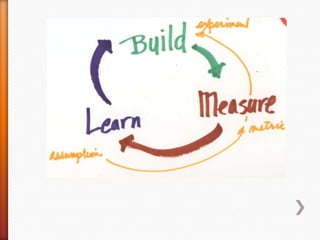
All new business ideas begin as educated guesses
- We often begin with assumptions
- Design experiments to capture customer behavior data
- Make good decisions based this data

Move through the loop quickly
- Test riskiest assumptions via hypotheses
- Do it again based on what you learned
What is the biggest assumption that if false, will cause my
product to fail?

            “If this is not true, we’re out of business”

Rank assumptions in order of greatest risk, develop
experiments to validate/in each assumption.

What’s the difference between assumptions and hypotheses?
- Hypotheses are numeric
• Tests your riskiest assumption…
• Based on a numeric hypothesis…
• Measures real behavior (or as close to it as possible)
• Can be built and executed quickly!
Build the least amount required to get the behavioral data you
need to validate/invalidate your hypothesis.

               Rapid Experiments with Customers

      Ask yourself: Is this the minimum amount I can do to
       validate/invalidate my most important hypothesis?
Based on your Business Model Canvas…

» Write down you top 5 riskiest assumptions, related
  to your customer and value proposition.
» Prioritize these assumptions, riskiest at the top (are
  you sure..? Focus on customer problem assumptions)
» Select the top assumption!
» Write down at least three numeric hypotheses based
  on behavior
» Select the hypothesis most likely to provide real
  validation
» Create a list of 3 potential experiments based on this
  hypothesis
» Choose first experiment to execute
» Return no later than 3:15pm
» What was your hypothesis?
» What was the experiment you designed to test the
  hypothesis?
» What was the result (pass/fail)
» What did you learn?
» What was surprising?
» What will you do next?
» Document / review / re-prioritize 5 riskiest
  assumptions
» Choose riskiest assumption
» Write 3 measurable, behavioral hypotheses
» Which one will provide best validation?
» Brainstorm 3 experiments
» Choose an experiment that will validate/invalidate
  your hypothesis fastest.
» Team presentation for next class: (5 minutes)
   ˃ Talk to as many customers as you can
   ˃ What were your value proposition hypotheses?
   ˃ What do customers think about your value proposition hypotheses?
   ˃ Post updates in the Google group (lessons learned, canvas changes)

» Read: Business Model Generation p146-150,
  161-168 and 200-211
» Read: The Startup Owners Manual p85-97

Lean Launchpad - Week 3 - Experiment Day

  • 2.
    » 5/12 – What to Expect » 5/19 – First Pitches » 5/26 – Experiment Day » 6/2 – Customers, Users, Payers » 6/9 –Value Propositions » 6/16 – Distribution Channels » 6/23 – Customer Relationships » 6/30 – Revenue Models » 7/7 – Partners » 7/14 – Key Resources & Costs » 7/21 – Lessons Learned Presentations
  • 3.
    - 09:05am - 404 Video - 09:10am - Review assignments / homework - 09:30am - Presentations - 10:00am - Design first experiment - 10:30am - Get out of the building! - 03:30pm - Review data - 03:45pm – Share-Out – What did you learn - 04:00pm - Design second experiment - 04:20pm – Homework + Coaching
  • 4.
  • 7.
    » 1: There are no facts inside the building, so get outside. » 2: Pair customer development with agile development » 3: Failure is an integral part of the search » 4: Make continuous iterations and pivots » 5: No business plan survives first contact with customers so use a business model canvas » 6: Design experiments to test and validate your hypotheses » 7: Agree on market type. In changes everything » 8: Startup metrics differ from those in existing companies » 9: Fast decision-making, cycle time, speed and tempo » 10: It’s all about passion » 11: Startup job titles are very different from large companies » 12: Preserve all cash until needed. Then spend. » 13: Communicate and share learning » 14: Customer development success begins with buy-in
  • 8.
    » Problem / Solution Fit » Earlyvangelists » MVPs » Business Model Hypotheses » Product features & benefits
  • 10.
    » Multi-sided » “Free” » Freemium » Open Source » Insurance » Bait & Hook » Open » Outside-In » Inside-Out
  • 11.
    » Epicenters » “What If?” questions » Ideation process » Team diversity » Brainstorming
  • 12.
    » What isa startup? First principles » Make no little plans – defining the scalable startup » A startup is not a smaller version of a large company
  • 13.
    » 3-5 minutes ˃Market Size ˃Type of business: IP, Licensing, startup, unknown ˃Proposed experiments to test customer segment, value proposition, channel and revenue model of the hypotheses.
  • 21.
    All new businessideas begin as educated guesses - We often begin with assumptions - Design experiments to capture customer behavior data - Make good decisions based this data Move through the loop quickly - Test riskiest assumptions via hypotheses - Do it again based on what you learned
  • 23.
    What is thebiggest assumption that if false, will cause my product to fail? “If this is not true, we’re out of business” Rank assumptions in order of greatest risk, develop experiments to validate/in each assumption. What’s the difference between assumptions and hypotheses? - Hypotheses are numeric
  • 24.
    • Tests yourriskiest assumption… • Based on a numeric hypothesis… • Measures real behavior (or as close to it as possible) • Can be built and executed quickly!
  • 25.
    Build the leastamount required to get the behavioral data you need to validate/invalidate your hypothesis. Rapid Experiments with Customers Ask yourself: Is this the minimum amount I can do to validate/invalidate my most important hypothesis?
  • 26.
    Based on yourBusiness Model Canvas… » Write down you top 5 riskiest assumptions, related to your customer and value proposition.
  • 27.
    » Prioritize theseassumptions, riskiest at the top (are you sure..? Focus on customer problem assumptions)
  • 28.
    » Select thetop assumption!
  • 29.
    » Write downat least three numeric hypotheses based on behavior
  • 30.
    » Select thehypothesis most likely to provide real validation
  • 31.
    » Create alist of 3 potential experiments based on this hypothesis
  • 32.
    » Choose firstexperiment to execute
  • 33.
    » Return nolater than 3:15pm
  • 34.
    » What wasyour hypothesis? » What was the experiment you designed to test the hypothesis? » What was the result (pass/fail) » What did you learn? » What was surprising? » What will you do next?
  • 35.
    » Document /review / re-prioritize 5 riskiest assumptions » Choose riskiest assumption » Write 3 measurable, behavioral hypotheses » Which one will provide best validation? » Brainstorm 3 experiments » Choose an experiment that will validate/invalidate your hypothesis fastest.
  • 36.
    » Team presentationfor next class: (5 minutes) ˃ Talk to as many customers as you can ˃ What were your value proposition hypotheses? ˃ What do customers think about your value proposition hypotheses? ˃ Post updates in the Google group (lessons learned, canvas changes) » Read: Business Model Generation p146-150, 161-168 and 200-211 » Read: The Startup Owners Manual p85-97

Editor's Notes

  • #5 5 minutes
  • #23 You’ll be testing many hypothesis, but the “exchange of currency”
  • #24 You’ll be testing many hypothesis, but the “exchange of currency”
  • #26 Engineering prioritization – its ok
  • #27 3 minutes