Lessons Learned
Lean LaunchPad (LLP)
Accelerator Program
@iainverigin
August 2014
I’m in Kenya with
UBC Sauder
Social Entrepreneurship
@UBC_SSE
established 2006
Kibera, Mathare, and Mathare
Who Are You?
• iHub Startups
• UBC SSE Kids
• Local Entrepreneurs
• Local University Students
• Mentors
• iHub Staff
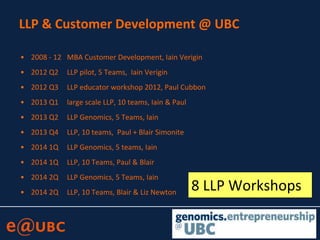
LLP & Customer Development @ UBC
• 2008 - 12 MBA Customer Development, Iain Verigin
• 2012 Q2 LLP pilot, 5 Teams, Iain Verigin
• 2012 Q3 LLP educator workshop 2012, Paul Cubbon
• 2013 Q1 large scale LLP, 10 teams, Iain & Paul
• 2013 Q2 LLP Genomics, 5 Teams, Iain
• 2013 Q4 LLP, 10 teams, Paul + Blair Simonite
• 2014 1Q LLP Genomics, 5 teams, Iain
• 2014 1Q LLP, 10 Teams, Paul & Blair
• 2014 2Q LLP Genomics, 5 Teams, Iain
• 2014 2Q LLP, 10 Teams, Blair & Liz Newton
8 LLP Workshops
What is
LLP all
About?
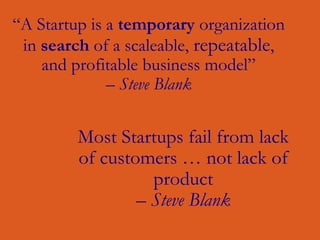
“A Startup is a temporary organization
in search of a scaleable, repeatable,
and profitable business model”
– Steve Blank
Most Startups fail from lack
of customers … not lack of
product
– Steve Blank
LLP is a rigorous search
for customers and
business models
(it requires the Primary
Investigator(s) to be
directly involved )http://vimeo.com/79755368
To Create a Customer
Drucker says …
“There is only one valid definition
of business purpose: …”
Page 20 “The Essential Drucker”
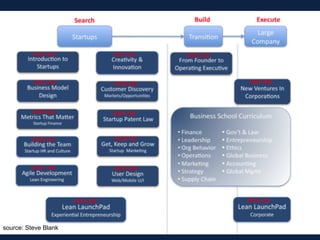
How Does LLP Fit With
Traditional Business School
Curriculum?
It is “Complementary”
which means “It’s totally different”
source: Steve Blank
More Detail
wrt/
Lean LaunchPad
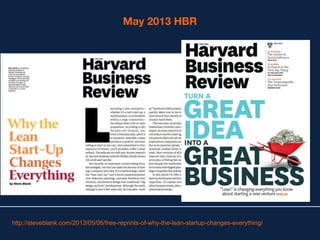
May 2013 HBR
http://steveblank.com/2013/05/06/free-reprints-of-why-the-lean-startup-changes-everything/
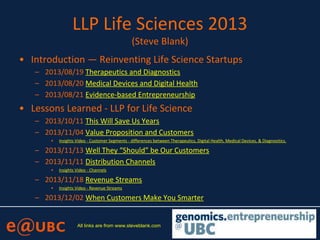
LLP Life Sciences 2013
(Steve Blank)
• Introduction — Reinventing Life Science Startups
– 2013/08/19 Therapeutics and Diagnostics
– 2013/08/20 Medical Devices and Digital Health
– 2013/08/21 Evidence-based Entrepreneurship
• Lessons Learned - LLP for Life Science
– 2013/10/11 This Will Save Us Years
– 2013/11/04 Value Proposition and Customers
• Insights Video - Customer Segments - differences between Therapeutics, Digital Health, Medical Devices, & Diagnositics.
– 2013/11/13 Well They “Should” be Our Customers
– 2013/11/11 Distribution Channels
• Insights Video - Channels
– 2013/11/18 Revenue Streams
• Insights Video - Revenue Streams
– 2013/12/02 When Customers Make You Smarter
All links are from www.steveblank.com
What Does
Search Look Like?
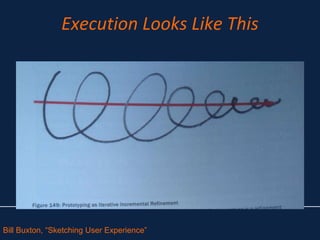
Execution Looks Like This
Bill Buxton, “Sketching User Experience”
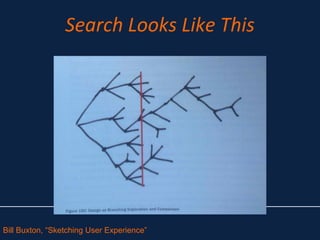
Search Looks Like This
Bill Buxton, “Sketching User Experience”
What Are We
“Really” Gonna
Do?
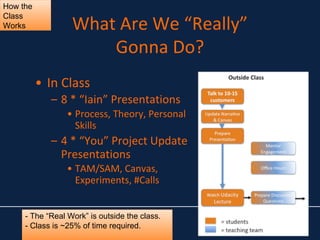
What Are We “Really”
Gonna Do?
• In Class
– 8 * “Iain” Presentations
• Process, Theory, Personal
Skills
– 4 * “You” Project Update
Presentations
• TAM/SAM, Canvas,
Experiments, #Calls
How the
Class
Works
- The “Real Work” is outside the class.
- Class is ~25% of time required.
What is Under
the Hood?
Theory &
Models
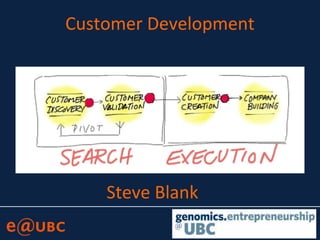
Customer Development
Steve Blank
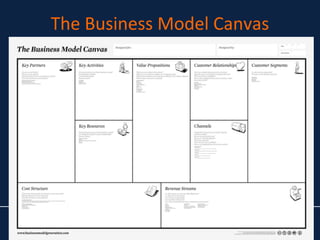
The Business Model Canvas
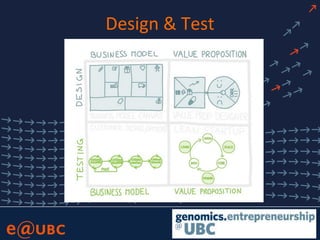
Design & Test
Customer
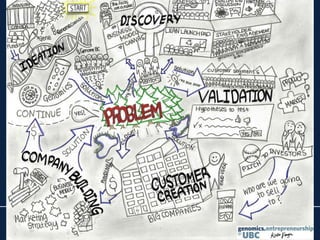
Discovery
Customer
Validation
Customer
Creation
Scale
Company
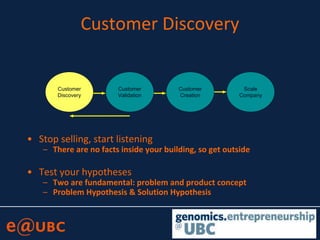
Customer Discovery
• Stop selling, start listening
– There are no facts inside your building, so get outside
• Test your hypotheses
– Two are fundamental: problem and product concept
– Problem Hypothesis & Solution Hypothesis
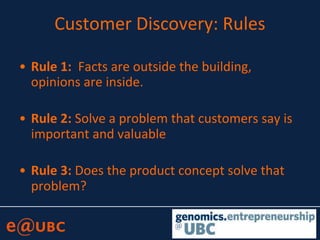
Customer Discovery: Rules
• Rule 1: Facts are outside the building,
opinions are inside.
• Rule 2: Solve a problem that customers say is
important and valuable
• Rule 3: Does the product concept solve that
problem?
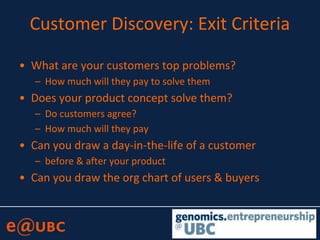
Customer Discovery: Exit Criteria
• What are your customers top problems?
– How much will they pay to solve them
• Does your product concept solve them?
– Do customers agree?
– How much will they pay
• Can you draw a day-in-the-life of a customer
– before & after your product
• Can you draw the org chart of users & buyers
Your
Work?
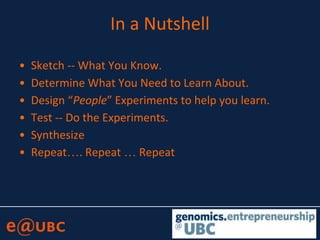
In a Nutshell
• Sketch -- What You Know.
• Determine What You Need to Learn About.
• Design “People” Experiments to help you learn.
• Test -- Do the Experiments.
• Synthesize
• Repeat…. Repeat … Repeat
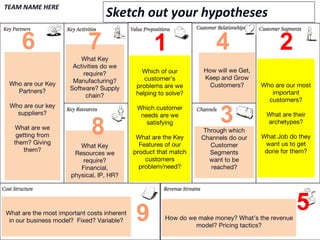
TEAM NAME HERE
Who are our most
important
customers?
What are their
archetypes?
What Job do they
want us to get
done for them?
What Key
Activities do we
require?
Manufacturing?
Software? Supply
chain?
Which of our
customer’s
problems are we
helping to solve?
Which customer
needs are we
satisfying
What are the Key
Features of our
product that match
customers
problem/need?
Who are our Key
Partners?
Who are our key
suppliers?
What are we
getting from
them? Giving
them?
What are the most important costs inherent
in our business model? Fixed? Variable? How do we make money? What’s the revenue
model? Pricing tactics?
Through which
Channels do our
Customer
Segments
want to be
reached?
What Key
Resources we
require?
Financial,
physical, IP, HR?
Sketch out your hypotheses
1
3
4 2
How will we Get,
Keep and Grow
Customers?
5
6 7
8
9
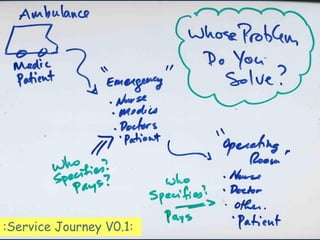
:Service Journey V0.1:
test
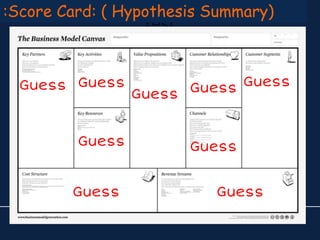
:Score Card: ( Hypothesis Summary)
Guess Guess
Guess Guess Guess
GuessGuess
Guess Guess
Test & Synthesize – Outside Class
• Interview & Experiment on
Customers & Prospects (10-15 / wk)
• Blog Your Progress
• Develop a Storyline (Narrative)
• Synthesize Your Results
• Revise Canvas & Plan – Repeat Steps
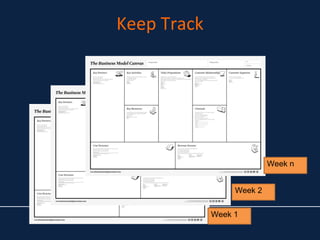
Keep Track
Week n
Week 1
Week 2
Program
Details?
What’s In It For You?
What you get
• Guidance to tried and tested resources
• Trained, experience instructors (coaches)
• An industry mentor
• Administrative support in the program
• Opportunity to move towards being investor ready
• Access to other e@ubc resources and support
What you commit to give (or……consequences….!)
• Your time and commitment as a team to the process for 2 months
• To read and prepare as directed
• To get out of the building and undertake primary customer research
• Commitment to blog progress regularly
• A willingness to be open-minded!
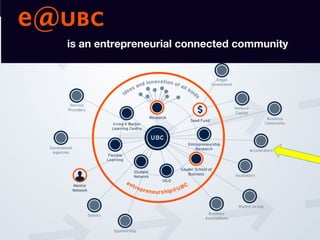
is an entrepreneurial connected community
Examples
&
Past
Participants
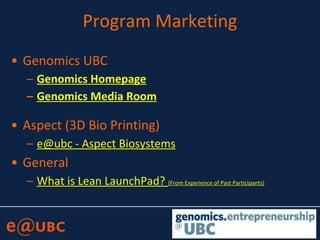
Program Marketing
• Genomics UBC
– Genomics Homepage
– Genomics Media Room
• Aspect (3D Bio Printing)
– e@ubc - Aspect Biosystems
• General
– What is Lean LaunchPad? (From Experience of Past Participants)
Lessons Learned
&
Future Work
Lessons Learned
Teams that finish are much
better prepared for the
startup journey
Lessons Learned
It’s way harder
complicated,
& different
than you thought
Lessons Learned
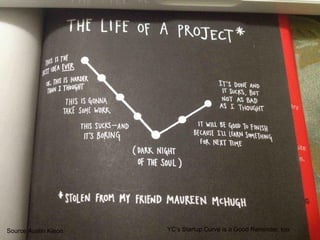
Source Austin Kleon
Lessons Learned
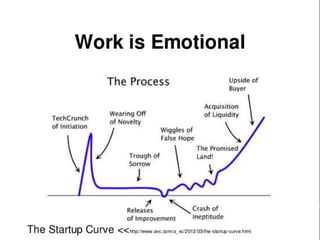
Source Austin Kleon YC’s Startup Curve is a Good Reminder, too
Lessons Learned
A third of the teams do
NOT finish.
( Let them die. )
Lessons Learned - Synthesis
• We need Pre-LLP training
– Most teams are not prepared for rigour and discipline of LLP
(never mind becoming a company)
• We need Post-LLP followup
– startups take years not months.
• Startup Skills are different than Big Company
– Most teams do not have personal skills required to perform
Customer Discovery
– Most mentors can’t help here (they are big company)
Solutions Being Tested
• Pre LLP
– Office Hours Bi-Weekly ( industry Mentors )
– e101 available for all UBC students
– “Startup Weekend” at UBC Fall and Winter
Term
• Post LLP
– “Informal Board” led by Team ( e@UBC )
– Government Funding.
– Office Hours Bi-Weekly
Solutions - Post LLP
-- Informal Board & Mentoring
• Brad Feld’s Startup Boards is a great resource
• Focus on non-financial mentors in early days
• The team needs to take charge and select it’s
own mentors and informal board.
Solutions - Personal Skills Required
• Communicate
• Listen
• Help ( How to be of Service)
• Don’t Be an Asshole!
• Be Remarkable!
-- I have a full presentation on this <smile>
Dating Skills for Engineers
The
End

Lean LaunchPad e@UBC Lessons Learned presented at iHub Nairobi 2014.08.12

  • 1.
    Lessons Learned Lean LaunchPad(LLP) Accelerator Program @iainverigin August 2014
  • 2.
    I’m in Kenyawith UBC Sauder Social Entrepreneurship @UBC_SSE established 2006 Kibera, Mathare, and Mathare
  • 3.
    Who Are You? •iHub Startups • UBC SSE Kids • Local Entrepreneurs • Local University Students • Mentors • iHub Staff
  • 4.
    LLP & CustomerDevelopment @ UBC • 2008 - 12 MBA Customer Development, Iain Verigin • 2012 Q2 LLP pilot, 5 Teams, Iain Verigin • 2012 Q3 LLP educator workshop 2012, Paul Cubbon • 2013 Q1 large scale LLP, 10 teams, Iain & Paul • 2013 Q2 LLP Genomics, 5 Teams, Iain • 2013 Q4 LLP, 10 teams, Paul + Blair Simonite • 2014 1Q LLP Genomics, 5 teams, Iain • 2014 1Q LLP, 10 Teams, Paul & Blair • 2014 2Q LLP Genomics, 5 Teams, Iain • 2014 2Q LLP, 10 Teams, Blair & Liz Newton 8 LLP Workshops
  • 6.
  • 7.
    “A Startup isa temporary organization in search of a scaleable, repeatable, and profitable business model” – Steve Blank Most Startups fail from lack of customers … not lack of product – Steve Blank
  • 8.
    LLP is arigorous search for customers and business models (it requires the Primary Investigator(s) to be directly involved )http://vimeo.com/79755368
  • 9.
    To Create aCustomer Drucker says … “There is only one valid definition of business purpose: …” Page 20 “The Essential Drucker”
  • 10.
    How Does LLPFit With Traditional Business School Curriculum? It is “Complementary” which means “It’s totally different”
  • 11.
  • 12.
  • 13.
  • 14.
    LLP Life Sciences2013 (Steve Blank) • Introduction — Reinventing Life Science Startups – 2013/08/19 Therapeutics and Diagnostics – 2013/08/20 Medical Devices and Digital Health – 2013/08/21 Evidence-based Entrepreneurship • Lessons Learned - LLP for Life Science – 2013/10/11 This Will Save Us Years – 2013/11/04 Value Proposition and Customers • Insights Video - Customer Segments - differences between Therapeutics, Digital Health, Medical Devices, & Diagnositics. – 2013/11/13 Well They “Should” be Our Customers – 2013/11/11 Distribution Channels • Insights Video - Channels – 2013/11/18 Revenue Streams • Insights Video - Revenue Streams – 2013/12/02 When Customers Make You Smarter All links are from www.steveblank.com
  • 15.
  • 16.
    Execution Looks LikeThis Bill Buxton, “Sketching User Experience”
  • 17.
    Search Looks LikeThis Bill Buxton, “Sketching User Experience”
  • 18.
  • 19.
    What Are We“Really” Gonna Do? • In Class – 8 * “Iain” Presentations • Process, Theory, Personal Skills – 4 * “You” Project Update Presentations • TAM/SAM, Canvas, Experiments, #Calls How the Class Works - The “Real Work” is outside the class. - Class is ~25% of time required.
  • 20.
  • 21.
  • 22.
  • 23.
  • 24.
  • 25.
    Customer Discovery Customer Validation Customer Creation Scale Company Customer Discovery • Stopselling, start listening – There are no facts inside your building, so get outside • Test your hypotheses – Two are fundamental: problem and product concept – Problem Hypothesis & Solution Hypothesis
  • 26.
    Customer Discovery: Rules •Rule 1: Facts are outside the building, opinions are inside. • Rule 2: Solve a problem that customers say is important and valuable • Rule 3: Does the product concept solve that problem?
  • 27.
    Customer Discovery: ExitCriteria • What are your customers top problems? – How much will they pay to solve them • Does your product concept solve them? – Do customers agree? – How much will they pay • Can you draw a day-in-the-life of a customer – before & after your product • Can you draw the org chart of users & buyers
  • 28.
  • 29.
    In a Nutshell •Sketch -- What You Know. • Determine What You Need to Learn About. • Design “People” Experiments to help you learn. • Test -- Do the Experiments. • Synthesize • Repeat…. Repeat … Repeat
  • 30.
    TEAM NAME HERE Whoare our most important customers? What are their archetypes? What Job do they want us to get done for them? What Key Activities do we require? Manufacturing? Software? Supply chain? Which of our customer’s problems are we helping to solve? Which customer needs are we satisfying What are the Key Features of our product that match customers problem/need? Who are our Key Partners? Who are our key suppliers? What are we getting from them? Giving them? What are the most important costs inherent in our business model? Fixed? Variable? How do we make money? What’s the revenue model? Pricing tactics? Through which Channels do our Customer Segments want to be reached? What Key Resources we require? Financial, physical, IP, HR? Sketch out your hypotheses 1 3 4 2 How will we Get, Keep and Grow Customers? 5 6 7 8 9
  • 31.
  • 32.
    test :Score Card: (Hypothesis Summary) Guess Guess Guess Guess Guess GuessGuess Guess Guess
  • 33.
    Test & Synthesize– Outside Class • Interview & Experiment on Customers & Prospects (10-15 / wk) • Blog Your Progress • Develop a Storyline (Narrative) • Synthesize Your Results • Revise Canvas & Plan – Repeat Steps
  • 34.
  • 35.
  • 36.
    What’s In ItFor You? What you get • Guidance to tried and tested resources • Trained, experience instructors (coaches) • An industry mentor • Administrative support in the program • Opportunity to move towards being investor ready • Access to other e@ubc resources and support What you commit to give (or……consequences….!) • Your time and commitment as a team to the process for 2 months • To read and prepare as directed • To get out of the building and undertake primary customer research • Commitment to blog progress regularly • A willingness to be open-minded!
  • 37.
    is an entrepreneurialconnected community
  • 38.
  • 39.
    Program Marketing • GenomicsUBC – Genomics Homepage – Genomics Media Room • Aspect (3D Bio Printing) – e@ubc - Aspect Biosystems • General – What is Lean LaunchPad? (From Experience of Past Participants)
  • 40.
  • 41.
    Lessons Learned Teams thatfinish are much better prepared for the startup journey
  • 42.
    Lessons Learned It’s wayharder complicated, & different than you thought
  • 43.
  • 44.
    Lessons Learned Source AustinKleon YC’s Startup Curve is a Good Reminder, too
  • 46.
    Lessons Learned A thirdof the teams do NOT finish. ( Let them die. )
  • 47.
    Lessons Learned -Synthesis • We need Pre-LLP training – Most teams are not prepared for rigour and discipline of LLP (never mind becoming a company) • We need Post-LLP followup – startups take years not months. • Startup Skills are different than Big Company – Most teams do not have personal skills required to perform Customer Discovery – Most mentors can’t help here (they are big company)
  • 48.
    Solutions Being Tested •Pre LLP – Office Hours Bi-Weekly ( industry Mentors ) – e101 available for all UBC students – “Startup Weekend” at UBC Fall and Winter Term • Post LLP – “Informal Board” led by Team ( e@UBC ) – Government Funding. – Office Hours Bi-Weekly
  • 49.
    Solutions - PostLLP -- Informal Board & Mentoring • Brad Feld’s Startup Boards is a great resource • Focus on non-financial mentors in early days • The team needs to take charge and select it’s own mentors and informal board.
  • 50.
    Solutions - PersonalSkills Required • Communicate • Listen • Help ( How to be of Service) • Don’t Be an Asshole! • Be Remarkable! -- I have a full presentation on this <smile> Dating Skills for Engineers
  • 51.