University of California at Berkeley - Haas School of Business
                                   MBA/EWMBA 295F


                   The Customer Development Process in High Tech:
                 Sales, Marketing & Business Development in a Startup

Instructor: Steve Blank                                     Time: 6-8pm Room C210
Prerequisite(s): Passion, Creativity and Resilience
Class Format: Seminar & Research Project                    Units of Credit: 2


Purpose of the Course

Why Teach This Class?
Business schools teach aspiring executives a variety of courses around the execution of
known business models, (accounting, organizational behavior, managerial skills,
marketing, operations, etc.)
       In contrast, startups search for a business model. (Or more accurately,
startups are a temporary organization designed to search for a scalable and repeatable
business model.) There are few courses which teach aspiring entrepreneurs the skills
(business models, customer and agile development, design thinking, etc.) to optimize
this search.
       Many entrepreneurship courses focus on teaching students “how to write a
business plan.” Others emphasize how to build a product. If you’ve read any of my
previous posts, you know I believe that: 1) a product is just a part of a startup, but
understanding customers, channel, pricing, etc. are what make it a business, 2)
business plans are fine for large companies where there is an existing market, existing
product and existing customers. In a startup none of these are known.
       Therefore we developed a class to teach how to think about all the parts of
building a business, not just the product.
What’s Different About the Class?
This class will introduce management tools for entrepreneurs. We’ll build the class
around the business model / customer development / solution stack.
       The class will cover Business Model Design as well the four steps of Customer
Development; Customer Discovery - understanding customer problems and needs,
Customer Validation -developing a sales model that can be replicated, Customer
Creation - creating and driving end user demand, and Company Building - transitioning
the organization from learning and discovery to a well oiled machine engineered for
execution.

Page 1 of 7                      Spring 2011   revision 3                   Blank
The key points of this class are:
1. Get out of the building. Very few technology startups fail for lack of technology. They
almost always fail for lack of customers. Yet surprisingly few companies take the basic
step of attempting to learn about their customers (or potential customers) until it is too
late - it's just so easy to focus on product and technology instead. True, there are the
rare products that have literally no market risk; they are all about technology risk (i.e. life
sciences and a "cure for cancer"). For everyone else you need to get some facts to
inform and qualify our hypotheses ("fancy word for guesses") about what kind of product
customers will ultimately buy.
2. Theory of market types. Market Types explain why different startups face wildly
different challenges and time horizons. There are three fundamental situations that
change what your company needs to do: creating a new market, bringing a new product
to an existing market, and resegmenting an existing market. If you're entering an
existing market, competition comes from the incumbent players. When creating a new
market, it may take years before you get traction with early customers.
3. Finding a market for the product as specified. Customer Development tries is to find
the minimum feature set required to get early customers.
4. Phases of product & company growth. Customer Development posits that startups go
through four stages of growth; Customer Discovery (when you're just trying to figure out
if there are any customers who might want your product), Customer Validation (when
you make your first revenue by selling your early product), Customer Creation (akin to a
traditional startup launch,) and Company Building (where you gear up to Cross the
Chasm and realign management.
5. Learning and iterating vs. linear execution. In the early stage of a startup companies
are focused on figuring out which way is up. In a traditional startup, they would probably
launch their product and company, failing or succeeding spectacularly. Only after a
major, public, and expensive failure would they iterate.
6. Premature Execution: An insight of Customer Development is that startups need time
spent in a mindset of learning and iterating, before they try to launch. During that time,
they can collect facts and change direction in private, without dramatic and public
embarrassment for their founders and investors.
       This course will challenge your perception of the traditional sales, marketing and
business development roles, leave you with a new way to view and organize these
roles, and help you increase the odds of a successful venture.


Page 2 of 7                       Spring 2011   revision 3                        Blank
Requirements

      The main requirements for this class are passion, energy and resourcefulness.
The course also assumes that students have either; experience in bringing a new
product to market, taken a basic Entrepreneurship course, or have written a business
plan.

Method of Instruction:

The course will combine lectures, readings, case materials and regular class
involvement by entrepreneurs and business professionals. Well-prepared and
intellectually engaged students are essential for the class to succeed.
        The readings for this course are principally from the course text: Four Steps to
the Epiphany, articles, book chapters and cases that will be published in an on-line
Reader. They are organized as required readings and cases for class discussion along
with suggested supplemental readings that will deepen your understanding of the class.

Method of Evaluation:

(1) Four Application Exercises assigned throughout the semester, students will work
individually and independent to analyze Business Model Design, Customer Discovery,
Customer Validation and Customer Creation choices companies have made. Students
will analyze a company’s business model and then look at their customer and market
hypothesis, channel and sales strategy, and demand creation activities. These
exercises will cover understanding early customer needs and matching them with
product features, how to research product distribution channels, creating a sales
roadmap for early customers, and demand creation and chasm-crossing sales plan to
transition to mainstream customers. The companies used in these exercises can be
known from direct experience or from independent research efforts.

(2) A team-written independent research paper (teams of 4) of approximately 10 pages
in length. This paper puts together all the lessons of customer development by doing
primary research outside the building interviewing founders of a company you selected.
The paper analyzes and compares the founders world-view with the lessons learned
from the class during the course of the semester.

Basis for Final Grade:
Students will be graded on the independent research project (50% of final grade),
completion and quality of effort related to the Application Exercises (25% of final grade),

Page 3 of 7                     Spring 2011   revision 3                       Blank
and class attendance and participation (25% of final grade).

Instructor
Steve Blank is a retired serial entrepreneur and private investor. Since 1978 Steve has
been a founder of or participant in eight Silicon Valley startups including Zilog and
MIPS, two semiconductor startups; Ardent, a supercomputer company; Convergent
Technologies a workstation company; SuperMac, an Apple peripheral supplier; Rocket
Science, a video game company, and E.piphany; an enterprise software company.
These startups resulted in five IPO's, and three very deep craters. Steve's operational
roles have spanned CEO to VP of Marketing.

Steve has been lecturing at the Haas School at U.C. Berkeley in the entrepreneurship
program since 2002, Columbia Business School since 2005, and Stanford’s School of
Engineering since 2006. He is a Trustee at U.C. Santa Cruz. Currently, Steve serves
on the boards of Audubon California and the California League of Conservation Voters.
He was appointed to the California Coastal Commission by Governor Schwarzenegger
in February 2007.

Office hours: By appointment
Email: sblank@kandsranch.com
Twitter: sgblank
Blog: www.steveblank.com


Page 4 of 7                    Spring 2011   revision 3                     Blank
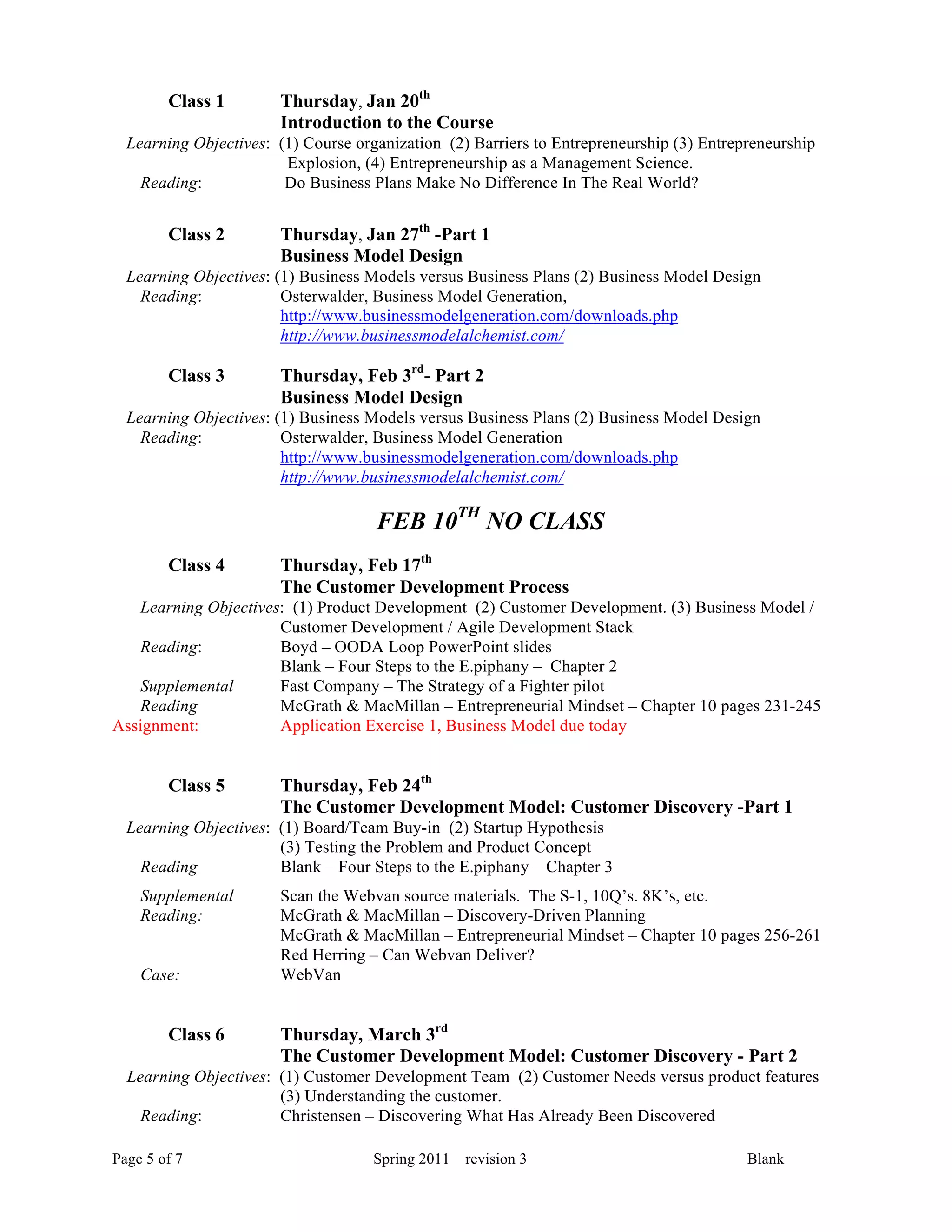
Class 1        Thursday, Jan 20th
                       Introduction to the Course
  Learning Objectives: (1) Course organization (2) Barriers to Entrepreneurship (3) Entrepreneurship
                        Explosion, (4) Entrepreneurship as a Management Science.
    Reading:            Do Business Plans Make No Difference In The Real World?


        Class 2        Thursday, Jan 27th -Part 1
                       Business Model Design
  Learning Objectives: (1) Business Models versus Business Plans (2) Business Model Design
    Reading:            Osterwalder, Business Model Generation,
                        http://www.businessmodelgeneration.com/downloads.php
                        http://www.businessmodelalchemist.com/

        Class 3        Thursday, Feb 3rd- Part 2
                       Business Model Design
  Learning Objectives: (1) Business Models versus Business Plans (2) Business Model Design
    Reading:            Osterwalder, Business Model Generation
                        http://www.businessmodelgeneration.com/downloads.php
                        http://www.businessmodelalchemist.com/

                                     FEB 10TH NO CLASS
        Class 4        Thursday, Feb 17th
                       The Customer Development Process
   Learning Objectives: (1) Product Development (2) Customer Development. (3) Business Model /
                      Customer Development / Agile Development Stack
   Reading:           Boyd – OODA Loop PowerPoint slides
                      Blank – Four Steps to the E.piphany – Chapter 2
   Supplemental       Fast Company – The Strategy of a Fighter pilot
   Reading            McGrath & MacMillan – Entrepreneurial Mindset – Chapter 10 pages 231-245
Assignment:           Application Exercise 1, Business Model due today


        Class 5        Thursday, Feb 24th
                       The Customer Development Model: Customer Discovery -Part 1
  Learning Objectives: (1) Board/Team Buy-in (2) Startup Hypothesis
                       (3) Testing the Problem and Product Concept
    Reading            Blank – Four Steps to the E.piphany – Chapter 3
    Supplemental       Scan the Webvan source materials. The S-1, 10Q’s. 8K’s, etc.
    Reading:           McGrath & MacMillan – Discovery-Driven Planning
                       McGrath & MacMillan – Entrepreneurial Mindset – Chapter 10 pages 256-261
                       Red Herring – Can Webvan Deliver?
    Case:              WebVan


        Class 6        Thursday, March 3rd
                       The Customer Development Model: Customer Discovery - Part 2
  Learning Objectives: (1) Customer Development Team (2) Customer Needs versus product features
                       (3) Understanding the customer.
    Reading:           Christensen – Discovering What Has Already Been Discovered

Page 5 of 7                          Spring 2011   revision 3                             Blank
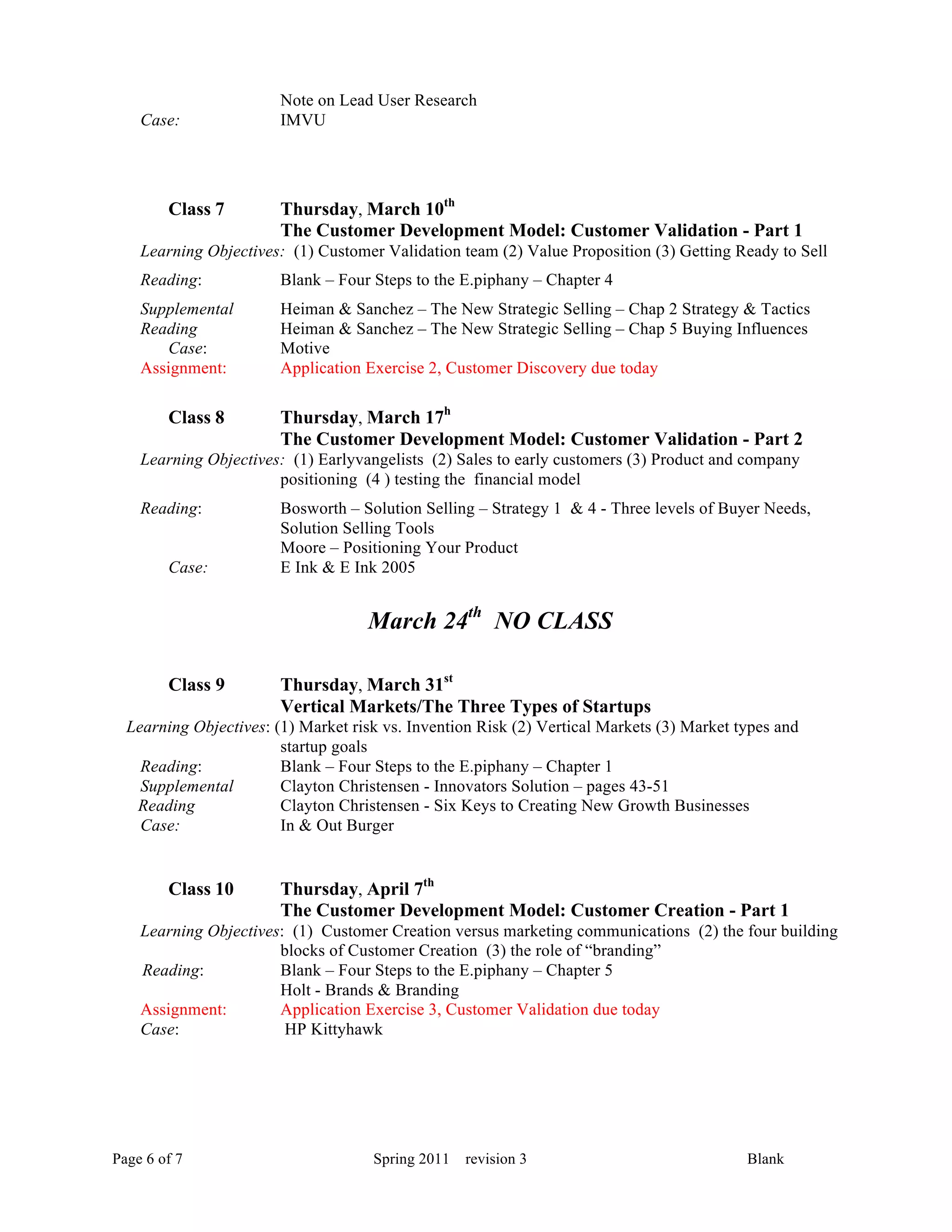
Note on Lead User Research
    Case:               IMVU


        Class 7         Thursday, March 10th
                        The Customer Development Model: Customer Validation - Part 1
    Learning Objectives: (1) Customer Validation team (2) Value Proposition (3) Getting Ready to Sell
    Reading:            Blank – Four Steps to the E.piphany – Chapter 4
    Supplemental        Heiman & Sanchez – The New Strategic Selling – Chap 2 Strategy & Tactics
    Reading             Heiman & Sanchez – The New Strategic Selling – Chap 5 Buying Influences
       Case:            Motive
    Assignment:         Application Exercise 2, Customer Discovery due today

        Class 8         Thursday, March 17h
                        The Customer Development Model: Customer Validation - Part 2
    Learning Objectives: (1) Earlyvangelists (2) Sales to early customers (3) Product and company
                       positioning (4 ) testing the financial model
    Reading:            Bosworth – Solution Selling – Strategy 1 & 4 - Three levels of Buyer Needs,
                        Solution Selling Tools
                        Moore – Positioning Your Product
        Case:           E Ink & E Ink 2005


                                    March 24th NO CLASS

        Class 9         Thursday, March 31st
                        Vertical Markets/The Three Types of Startups
  Learning Objectives: (1) Market risk vs. Invention Risk (2) Vertical Markets (3) Market types and
                        startup goals
    Reading:            Blank – Four Steps to the E.piphany – Chapter 1
    Supplemental        Clayton Christensen - Innovators Solution – pages 43-51
   Reading              Clayton Christensen - Six Keys to Creating New Growth Businesses
    Case:               In & Out Burger


        Class 10        Thursday, April 7th
                        The Customer Development Model: Customer Creation - Part 1
    Learning Objectives: (1) Customer Creation versus marketing communications (2) the four building
                       blocks of Customer Creation (3) the role of “branding”
    Reading:           Blank – Four Steps to the E.piphany – Chapter 5
                       Holt - Brands & Branding
    Assignment:        Application Exercise 3, Customer Validation due today
    Case:               HP Kittyhawk


Page 6 of 7                          Spring 2011   revision 3                              Blank
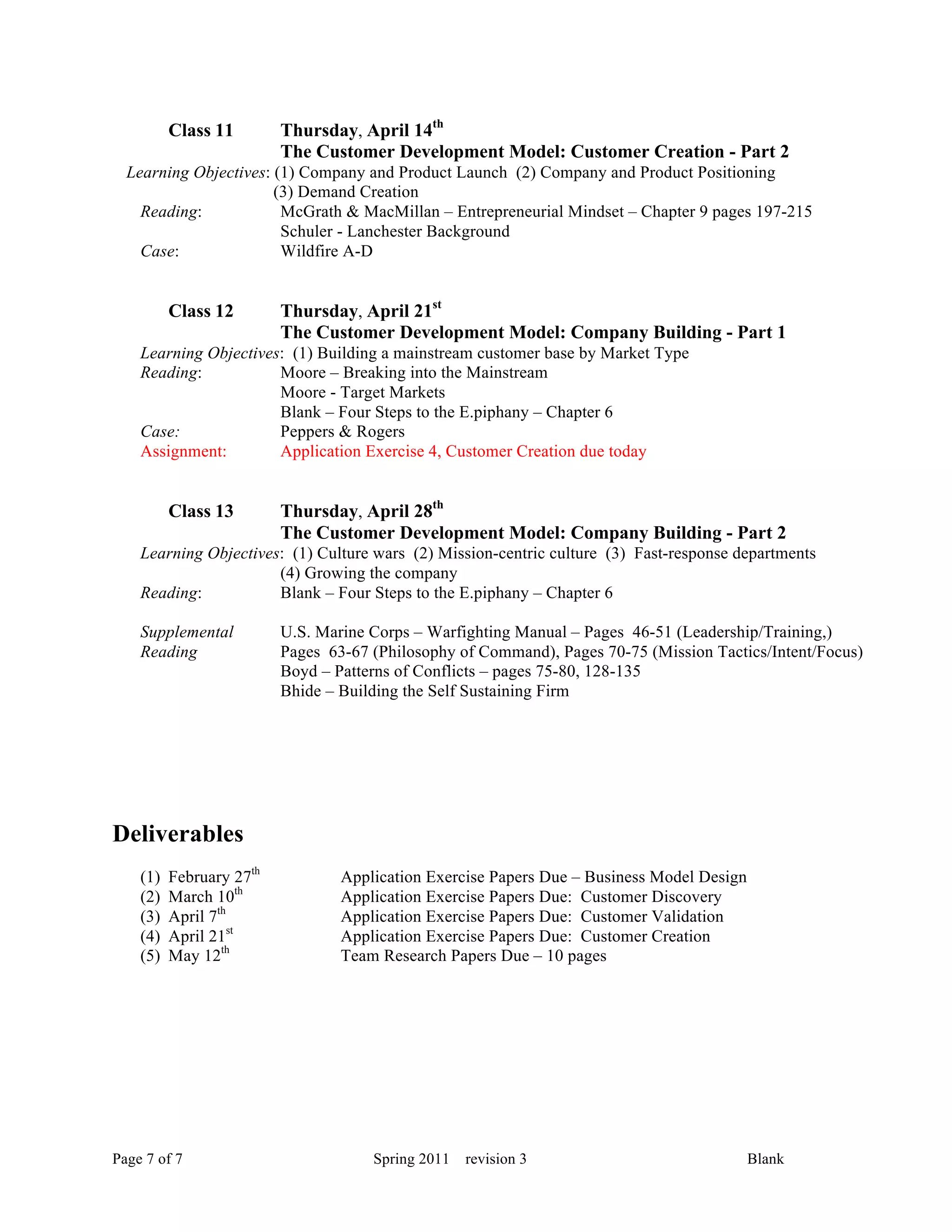
Class 11        Thursday, April 14th
                          The Customer Development Model: Customer Creation - Part 2
  Learning Objectives: (1) Company and Product Launch (2) Company and Product Positioning
                       (3) Demand Creation
    Reading:            McGrath & MacMillan – Entrepreneurial Mindset – Chapter 9 pages 197-215
                        Schuler - Lanchester Background
    Case:               Wildfire A-D


          Class 12        Thursday, April 21st
                          The Customer Development Model: Company Building - Part 1
    Learning Objectives: (1) Building a mainstream customer base by Market Type
    Reading:           Moore – Breaking into the Mainstream
                       Moore - Target Markets
                       Blank – Four Steps to the E.piphany – Chapter 6
    Case:              Peppers & Rogers
    Assignment:        Application Exercise 4, Customer Creation due today


          Class 13        Thursday, April 28th
                          The Customer Development Model: Company Building - Part 2
    Learning Objectives: (1) Culture wars (2) Mission-centric culture (3) Fast-response departments
                       (4) Growing the company
    Reading:           Blank – Four Steps to the E.piphany – Chapter 6

    Supplemental          U.S. Marine Corps – Warfighting Manual – Pages 46-51 (Leadership/Training,)
    Reading               Pages 63-67 (Philosophy of Command), Pages 70-75 (Mission Tactics/Intent/Focus)
                          Boyd – Patterns of Conflicts – pages 75-80, 128-135
                          Bhide – Building the Self Sustaining Firm


Deliverables
    (1)   February 27th           Application Exercise Papers Due – Business Model Design
    (2)   March 10th              Application Exercise Papers Due: Customer Discovery
    (3)   April 7th               Application Exercise Papers Due: Customer Validation
    (4)   April 21st              Application Exercise Papers Due: Customer Creation
    (5)   May 12th                Team Research Papers Due – 10 pages


Page 7 of 7                           Spring 2011   revision 3                              Blank

Spring 2011 mba 295 f syllalbus rev 3

  • 1.
    University of Californiaat Berkeley - Haas School of Business MBA/EWMBA 295F The Customer Development Process in High Tech: Sales, Marketing & Business Development in a Startup Instructor: Steve Blank Time: 6-8pm Room C210 Prerequisite(s): Passion, Creativity and Resilience Class Format: Seminar & Research Project Units of Credit: 2 Purpose of the Course Why Teach This Class? Business schools teach aspiring executives a variety of courses around the execution of known business models, (accounting, organizational behavior, managerial skills, marketing, operations, etc.) In contrast, startups search for a business model. (Or more accurately, startups are a temporary organization designed to search for a scalable and repeatable business model.) There are few courses which teach aspiring entrepreneurs the skills (business models, customer and agile development, design thinking, etc.) to optimize this search. Many entrepreneurship courses focus on teaching students “how to write a business plan.” Others emphasize how to build a product. If you’ve read any of my previous posts, you know I believe that: 1) a product is just a part of a startup, but understanding customers, channel, pricing, etc. are what make it a business, 2) business plans are fine for large companies where there is an existing market, existing product and existing customers. In a startup none of these are known. Therefore we developed a class to teach how to think about all the parts of building a business, not just the product. What’s Different About the Class? This class will introduce management tools for entrepreneurs. We’ll build the class around the business model / customer development / solution stack. The class will cover Business Model Design as well the four steps of Customer Development; Customer Discovery - understanding customer problems and needs, Customer Validation -developing a sales model that can be replicated, Customer Creation - creating and driving end user demand, and Company Building - transitioning the organization from learning and discovery to a well oiled machine engineered for execution. Page 1 of 7 Spring 2011 revision 3 Blank
  • 2.
    The key pointsof this class are: 1. Get out of the building. Very few technology startups fail for lack of technology. They almost always fail for lack of customers. Yet surprisingly few companies take the basic step of attempting to learn about their customers (or potential customers) until it is too late - it's just so easy to focus on product and technology instead. True, there are the rare products that have literally no market risk; they are all about technology risk (i.e. life sciences and a "cure for cancer"). For everyone else you need to get some facts to inform and qualify our hypotheses ("fancy word for guesses") about what kind of product customers will ultimately buy. 2. Theory of market types. Market Types explain why different startups face wildly different challenges and time horizons. There are three fundamental situations that change what your company needs to do: creating a new market, bringing a new product to an existing market, and resegmenting an existing market. If you're entering an existing market, competition comes from the incumbent players. When creating a new market, it may take years before you get traction with early customers. 3. Finding a market for the product as specified. Customer Development tries is to find the minimum feature set required to get early customers. 4. Phases of product & company growth. Customer Development posits that startups go through four stages of growth; Customer Discovery (when you're just trying to figure out if there are any customers who might want your product), Customer Validation (when you make your first revenue by selling your early product), Customer Creation (akin to a traditional startup launch,) and Company Building (where you gear up to Cross the Chasm and realign management. 5. Learning and iterating vs. linear execution. In the early stage of a startup companies are focused on figuring out which way is up. In a traditional startup, they would probably launch their product and company, failing or succeeding spectacularly. Only after a major, public, and expensive failure would they iterate. 6. Premature Execution: An insight of Customer Development is that startups need time spent in a mindset of learning and iterating, before they try to launch. During that time, they can collect facts and change direction in private, without dramatic and public embarrassment for their founders and investors. This course will challenge your perception of the traditional sales, marketing and business development roles, leave you with a new way to view and organize these roles, and help you increase the odds of a successful venture. Page 2 of 7 Spring 2011 revision 3 Blank
  • 3.
    Requirements The main requirements for this class are passion, energy and resourcefulness. The course also assumes that students have either; experience in bringing a new product to market, taken a basic Entrepreneurship course, or have written a business plan. Method of Instruction: The course will combine lectures, readings, case materials and regular class involvement by entrepreneurs and business professionals. Well-prepared and intellectually engaged students are essential for the class to succeed. The readings for this course are principally from the course text: Four Steps to the Epiphany, articles, book chapters and cases that will be published in an on-line Reader. They are organized as required readings and cases for class discussion along with suggested supplemental readings that will deepen your understanding of the class. Method of Evaluation: (1) Four Application Exercises assigned throughout the semester, students will work individually and independent to analyze Business Model Design, Customer Discovery, Customer Validation and Customer Creation choices companies have made. Students will analyze a company’s business model and then look at their customer and market hypothesis, channel and sales strategy, and demand creation activities. These exercises will cover understanding early customer needs and matching them with product features, how to research product distribution channels, creating a sales roadmap for early customers, and demand creation and chasm-crossing sales plan to transition to mainstream customers. The companies used in these exercises can be known from direct experience or from independent research efforts. (2) A team-written independent research paper (teams of 4) of approximately 10 pages in length. This paper puts together all the lessons of customer development by doing primary research outside the building interviewing founders of a company you selected. The paper analyzes and compares the founders world-view with the lessons learned from the class during the course of the semester. Basis for Final Grade: Students will be graded on the independent research project (50% of final grade), completion and quality of effort related to the Application Exercises (25% of final grade), Page 3 of 7 Spring 2011 revision 3 Blank
  • 4.
    and class attendanceand participation (25% of final grade). Instructor Steve Blank is a retired serial entrepreneur and private investor. Since 1978 Steve has been a founder of or participant in eight Silicon Valley startups including Zilog and MIPS, two semiconductor startups; Ardent, a supercomputer company; Convergent Technologies a workstation company; SuperMac, an Apple peripheral supplier; Rocket Science, a video game company, and E.piphany; an enterprise software company. These startups resulted in five IPO's, and three very deep craters. Steve's operational roles have spanned CEO to VP of Marketing. Steve has been lecturing at the Haas School at U.C. Berkeley in the entrepreneurship program since 2002, Columbia Business School since 2005, and Stanford’s School of Engineering since 2006. He is a Trustee at U.C. Santa Cruz. Currently, Steve serves on the boards of Audubon California and the California League of Conservation Voters. He was appointed to the California Coastal Commission by Governor Schwarzenegger in February 2007. Office hours: By appointment Email: sblank@kandsranch.com Twitter: sgblank Blog: www.steveblank.com Page 4 of 7 Spring 2011 revision 3 Blank
  • 5.
    Class 1 Thursday, Jan 20th Introduction to the Course Learning Objectives: (1) Course organization (2) Barriers to Entrepreneurship (3) Entrepreneurship Explosion, (4) Entrepreneurship as a Management Science. Reading: Do Business Plans Make No Difference In The Real World? Class 2 Thursday, Jan 27th -Part 1 Business Model Design Learning Objectives: (1) Business Models versus Business Plans (2) Business Model Design Reading: Osterwalder, Business Model Generation, http://www.businessmodelgeneration.com/downloads.php http://www.businessmodelalchemist.com/ Class 3 Thursday, Feb 3rd- Part 2 Business Model Design Learning Objectives: (1) Business Models versus Business Plans (2) Business Model Design Reading: Osterwalder, Business Model Generation http://www.businessmodelgeneration.com/downloads.php http://www.businessmodelalchemist.com/ FEB 10TH NO CLASS Class 4 Thursday, Feb 17th The Customer Development Process Learning Objectives: (1) Product Development (2) Customer Development. (3) Business Model / Customer Development / Agile Development Stack Reading: Boyd – OODA Loop PowerPoint slides Blank – Four Steps to the E.piphany – Chapter 2 Supplemental Fast Company – The Strategy of a Fighter pilot Reading McGrath & MacMillan – Entrepreneurial Mindset – Chapter 10 pages 231-245 Assignment: Application Exercise 1, Business Model due today Class 5 Thursday, Feb 24th The Customer Development Model: Customer Discovery -Part 1 Learning Objectives: (1) Board/Team Buy-in (2) Startup Hypothesis (3) Testing the Problem and Product Concept Reading Blank – Four Steps to the E.piphany – Chapter 3 Supplemental Scan the Webvan source materials. The S-1, 10Q’s. 8K’s, etc. Reading: McGrath & MacMillan – Discovery-Driven Planning McGrath & MacMillan – Entrepreneurial Mindset – Chapter 10 pages 256-261 Red Herring – Can Webvan Deliver? Case: WebVan Class 6 Thursday, March 3rd The Customer Development Model: Customer Discovery - Part 2 Learning Objectives: (1) Customer Development Team (2) Customer Needs versus product features (3) Understanding the customer. Reading: Christensen – Discovering What Has Already Been Discovered Page 5 of 7 Spring 2011 revision 3 Blank
  • 6.
    Note on LeadUser Research Case: IMVU Class 7 Thursday, March 10th The Customer Development Model: Customer Validation - Part 1 Learning Objectives: (1) Customer Validation team (2) Value Proposition (3) Getting Ready to Sell Reading: Blank – Four Steps to the E.piphany – Chapter 4 Supplemental Heiman & Sanchez – The New Strategic Selling – Chap 2 Strategy & Tactics Reading Heiman & Sanchez – The New Strategic Selling – Chap 5 Buying Influences Case: Motive Assignment: Application Exercise 2, Customer Discovery due today Class 8 Thursday, March 17h The Customer Development Model: Customer Validation - Part 2 Learning Objectives: (1) Earlyvangelists (2) Sales to early customers (3) Product and company positioning (4 ) testing the financial model Reading: Bosworth – Solution Selling – Strategy 1 & 4 - Three levels of Buyer Needs, Solution Selling Tools Moore – Positioning Your Product Case: E Ink & E Ink 2005 March 24th NO CLASS Class 9 Thursday, March 31st Vertical Markets/The Three Types of Startups Learning Objectives: (1) Market risk vs. Invention Risk (2) Vertical Markets (3) Market types and startup goals Reading: Blank – Four Steps to the E.piphany – Chapter 1 Supplemental Clayton Christensen - Innovators Solution – pages 43-51 Reading Clayton Christensen - Six Keys to Creating New Growth Businesses Case: In & Out Burger Class 10 Thursday, April 7th The Customer Development Model: Customer Creation - Part 1 Learning Objectives: (1) Customer Creation versus marketing communications (2) the four building blocks of Customer Creation (3) the role of “branding” Reading: Blank – Four Steps to the E.piphany – Chapter 5 Holt - Brands & Branding Assignment: Application Exercise 3, Customer Validation due today Case: HP Kittyhawk Page 6 of 7 Spring 2011 revision 3 Blank
  • 7.
    Class 11 Thursday, April 14th The Customer Development Model: Customer Creation - Part 2 Learning Objectives: (1) Company and Product Launch (2) Company and Product Positioning (3) Demand Creation Reading: McGrath & MacMillan – Entrepreneurial Mindset – Chapter 9 pages 197-215 Schuler - Lanchester Background Case: Wildfire A-D Class 12 Thursday, April 21st The Customer Development Model: Company Building - Part 1 Learning Objectives: (1) Building a mainstream customer base by Market Type Reading: Moore – Breaking into the Mainstream Moore - Target Markets Blank – Four Steps to the E.piphany – Chapter 6 Case: Peppers & Rogers Assignment: Application Exercise 4, Customer Creation due today Class 13 Thursday, April 28th The Customer Development Model: Company Building - Part 2 Learning Objectives: (1) Culture wars (2) Mission-centric culture (3) Fast-response departments (4) Growing the company Reading: Blank – Four Steps to the E.piphany – Chapter 6 Supplemental U.S. Marine Corps – Warfighting Manual – Pages 46-51 (Leadership/Training,) Reading Pages 63-67 (Philosophy of Command), Pages 70-75 (Mission Tactics/Intent/Focus) Boyd – Patterns of Conflicts – pages 75-80, 128-135 Bhide – Building the Self Sustaining Firm Deliverables (1) February 27th Application Exercise Papers Due – Business Model Design (2) March 10th Application Exercise Papers Due: Customer Discovery (3) April 7th Application Exercise Papers Due: Customer Validation (4) April 21st Application Exercise Papers Due: Customer Creation (5) May 12th Team Research Papers Due – 10 pages Page 7 of 7 Spring 2011 revision 3 Blank