
BA 395 – independent researchTori BybelDom DiBettaKevin McnavageKyle yorkeDr. jenniferedmondsLean & Green Operations in Local NEPA Businesses
Project Introduction 				Dr. Jennifer EdmondsWhat does it mean to be LEAN? 		Kevin McNavageWhat does it mean to be GREEN?Dom DiBettaWhat does this mean for Restaurants?Tori BybelThe Restaurant Industry - Scope of Project 	Kyle YorkeNext Steps					 	Dr. Jennifer EdmondsYour questions are welcome at any time…
LeanKevin McNavage
Defining LeanA systematic approach to identifying and eliminating waste (non-value-added activities) through continuous improvement by flowing the product at the pull of the customer in pursuit of perfection
Lean = Eliminating WasteNon-Value Added (downtime)Defects
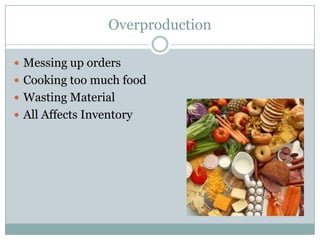
Overproduction
Waiting
Not utilizing employees (People Waste)
Transportation
Excess Processing
Motion Waste
Space*Typically 95% of  lead time is non-value added*
Definition of Value AddedValue added-  Any activity that increases the market form or function of a product or service. (Things customers are willing to pay for)Non-Value-Added- Any activity that does not increase the market form or function & is unnecessary ( These should be eliminated, simplified, reduced, or integrated)
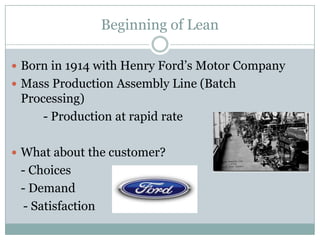
Beginning of LeanBorn in 1914 with Henry Ford’s Motor CompanyMass Production Assembly Line (Batch Processing)		- Production at rapid rateWhat about the customer?	- Choices	- Demand    - Satisfaction
Toyota Production System(TPS)Inability to compete	- Lack of money & spaceImperative: become innovativeAfter WWII	- Ford 10x more productive than Toyota
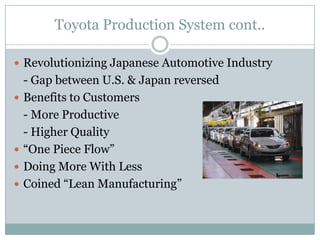
Toyota Production System cont..Revolutionizing Japanese Automotive Industry	- Gap between U.S. & Japan reversedBenefits to Customers	- More Productive	- Higher Quality“One Piece Flow”Doing More With LessCoined “Lean Manufacturing”
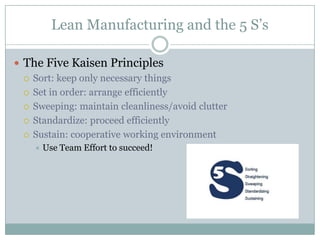
Lean Manufacturing and the 5 S’sThe Five Kaisen PrinciplesSort: keep only necessary thingsSet in order: arrange efficientlySweeping: maintain cleanliness/avoid clutterStandardize: proceed efficientlySustain: cooperative working environmentUse Team Effort to succeed!
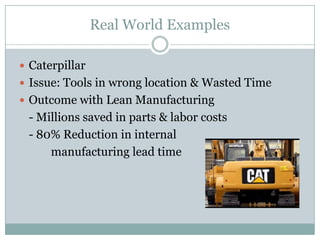
Real World ExamplesCaterpillarIssue: Tools in wrong location & Wasted TimeOutcome with Lean Manufacturing	- Millions saved in parts & labor costs	- 80% Reduction in internal           manufacturing lead time
Real World ExamplesMcDonald’sIssue: Overproduction and Motion WasteOutcome with Lean ManufacturingOne Piece Flow > BatchSystematic production lineMillions saved due to efficiency
Keys to Sustaining LeanInternalize into daily routinesNever ending processProvide discipline/motivation/incentivesVisible management commitmentOpen CommunicationStandardize as not to slip back
GreenDom DiBetta
What it means to “Go Green”Changing global climates created awareness for mother earth.Understanding what practices effect the environmentMake changes to benefit the environment and yourselfEvaluate the outcomes and continue to grow
Green Practices for BusinessesDo it and do it rightLocal, State, and Federal Laws and RegulationsEnvironmental, Health, and SafetyWalk the walk, Talk the talkProve what you say you have doneand will do
Understanding The ImpactUnderstanding how the business affects the environment and relates to the relationships with suppliers and consumersWhat you buy, sell, and how your performTracking Operations (day to day)Utilities usage, waste management, raw materials, packaging, purchasing, emissions, inventory management
Room for ImprovementBe practical and profitableBenefit the business and environment
Vision StatementIdea to ImplementEverything you would like to see becomea realityFoundation for customers, stakeholders, community,and all employees to show your willingness to investin the environmentGet FeedbackWhich employees and team members are on board
Vision StatementEXAMPLE: The Company intends to respect the environment in the design, production, and distribution of its products and services, committing to be in full compliance with all laws and regulations and go above and beyond whenever possible, procedure compliance for all employees, community members, and all others to access through documented action plan.
Make a PlanCommit to an action plan
Areas to address
Gather support
Employee participation is crucialPromote participation, going above and beyond, and unbridled acts to the company’s visionCreating incentives, rewards, and recognition plans for those who step up and take on more than what’s expected of them
Where To FocusAdministrative Waste
Paper utilization
Using fewer products and raw materialsHuge financial gains can be found hereGreen printingPrinting supplies and printersRecycled paperReduce, Reuse, Recycle Culture
 Recycling stations
Wasted materials are wasted money
Increase efficiency for all materials, get innovativeWhere To FocusPurchasingCommit to environmentally preferable productsBuy items made from recycled materialsSeek reconditioned, usually at a much lower costWork with suppliers to meet both of your goalsUnderstanding of the purchasing policy will ensure successRent Instead of Buying EquipmentCopiers, computers, ovens, etcEnsures a recycling or reusing processes is in place
Where To FocusEnergy AuditsFree or inexpensiveYield huge financial savingsUsing energy service companies that make upgrades at little or no cost to your companyAlternatives to toxic productsCleaners, toners, glue, batteriesSeek out better options to reduce toxic emissions and waste accumulation
Where To FocusLower Energy Needs and Consumption
Turn off lights in unused areas, equipment that is not in use especially during after hours and weekendsUtilize motion sensors and timersReflectors for fluorescent fixtures, compact fluorescent bulbs instead of incandescentEquipment and appliancesEnergy star and updated machinery to better allocate labor usage and energy consumption and space optimization
Where To FocusHeating and Cooling
Efficient Insulation of building
Windows and DoorsSealing and RetainingUpdated and efficient heating and cooling units
Thermal camera to evaluate energy lossesWhere To FocusWater utilization
Frequent water audits to evaluate water leaks and have them repaired quickly
Timed irrigation
Create awareness among team members to use effectively
Low flow aerators
Seek out low flow appliances
Reuse waterRain water for irrigation
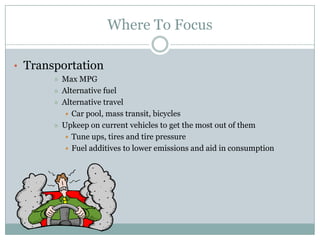
Where To FocusTransportation
Max MPG
Alternative fuel
Alternative travelCar pool, mass transit, bicyclesUpkeep on current vehicles to get the most out of themTune ups, tires and tire pressureFuel additives to lower emissions and aid in consumption
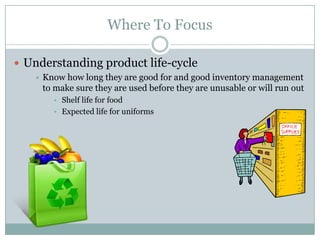
Where To FocusUnderstanding product life-cycleKnow how long they are good for and good inventory management to make sure they are used before they are unusable or will run outShelf life for foodExpected life for uniforms

LEAN & GREEN Restaurants (F10-1)

  • 1.
    BA 395 –independent researchTori BybelDom DiBettaKevin McnavageKyle yorkeDr. jenniferedmondsLean & Green Operations in Local NEPA Businesses
  • 2.
    Project Introduction Dr.Jennifer EdmondsWhat does it mean to be LEAN? Kevin McNavageWhat does it mean to be GREEN?Dom DiBettaWhat does this mean for Restaurants?Tori BybelThe Restaurant Industry - Scope of Project Kyle YorkeNext Steps Dr. Jennifer EdmondsYour questions are welcome at any time…
  • 3.
  • 4.
    Defining LeanA systematicapproach to identifying and eliminating waste (non-value-added activities) through continuous improvement by flowing the product at the pull of the customer in pursuit of perfection
  • 5.
    Lean = EliminatingWasteNon-Value Added (downtime)Defects
  • 6.
  • 7.
  • 8.
  • 9.
  • 10.
  • 11.
  • 12.
    Space*Typically 95% of lead time is non-value added*
  • 13.
    Definition of ValueAddedValue added- Any activity that increases the market form or function of a product or service. (Things customers are willing to pay for)Non-Value-Added- Any activity that does not increase the market form or function & is unnecessary ( These should be eliminated, simplified, reduced, or integrated)
  • 14.
    Beginning of LeanBornin 1914 with Henry Ford’s Motor CompanyMass Production Assembly Line (Batch Processing) - Production at rapid rateWhat about the customer? - Choices - Demand - Satisfaction
  • 15.
    Toyota Production System(TPS)Inabilityto compete - Lack of money & spaceImperative: become innovativeAfter WWII - Ford 10x more productive than Toyota
  • 16.
    Toyota Production Systemcont..Revolutionizing Japanese Automotive Industry - Gap between U.S. & Japan reversedBenefits to Customers - More Productive - Higher Quality“One Piece Flow”Doing More With LessCoined “Lean Manufacturing”
  • 17.
    Lean Manufacturing andthe 5 S’sThe Five Kaisen PrinciplesSort: keep only necessary thingsSet in order: arrange efficientlySweeping: maintain cleanliness/avoid clutterStandardize: proceed efficientlySustain: cooperative working environmentUse Team Effort to succeed!
  • 18.
    Real World ExamplesCaterpillarIssue:Tools in wrong location & Wasted TimeOutcome with Lean Manufacturing - Millions saved in parts & labor costs - 80% Reduction in internal manufacturing lead time
  • 19.
    Real World ExamplesMcDonald’sIssue:Overproduction and Motion WasteOutcome with Lean ManufacturingOne Piece Flow > BatchSystematic production lineMillions saved due to efficiency
  • 20.
    Keys to SustainingLeanInternalize into daily routinesNever ending processProvide discipline/motivation/incentivesVisible management commitmentOpen CommunicationStandardize as not to slip back
  • 21.
  • 22.
    What it meansto “Go Green”Changing global climates created awareness for mother earth.Understanding what practices effect the environmentMake changes to benefit the environment and yourselfEvaluate the outcomes and continue to grow
  • 23.
    Green Practices forBusinessesDo it and do it rightLocal, State, and Federal Laws and RegulationsEnvironmental, Health, and SafetyWalk the walk, Talk the talkProve what you say you have doneand will do
  • 24.
    Understanding The ImpactUnderstandinghow the business affects the environment and relates to the relationships with suppliers and consumersWhat you buy, sell, and how your performTracking Operations (day to day)Utilities usage, waste management, raw materials, packaging, purchasing, emissions, inventory management
  • 25.
    Room for ImprovementBepractical and profitableBenefit the business and environment
  • 26.
    Vision StatementIdea toImplementEverything you would like to see becomea realityFoundation for customers, stakeholders, community,and all employees to show your willingness to investin the environmentGet FeedbackWhich employees and team members are on board
  • 27.
    Vision StatementEXAMPLE: TheCompany intends to respect the environment in the design, production, and distribution of its products and services, committing to be in full compliance with all laws and regulations and go above and beyond whenever possible, procedure compliance for all employees, community members, and all others to access through documented action plan.
  • 28.
    Make a PlanCommitto an action plan
  • 29.
  • 30.
  • 31.
    Employee participation iscrucialPromote participation, going above and beyond, and unbridled acts to the company’s visionCreating incentives, rewards, and recognition plans for those who step up and take on more than what’s expected of them
  • 32.
  • 33.
  • 34.
    Using fewer productsand raw materialsHuge financial gains can be found hereGreen printingPrinting supplies and printersRecycled paperReduce, Reuse, Recycle Culture
  • 35.
  • 36.
  • 37.
    Increase efficiency forall materials, get innovativeWhere To FocusPurchasingCommit to environmentally preferable productsBuy items made from recycled materialsSeek reconditioned, usually at a much lower costWork with suppliers to meet both of your goalsUnderstanding of the purchasing policy will ensure successRent Instead of Buying EquipmentCopiers, computers, ovens, etcEnsures a recycling or reusing processes is in place
  • 38.
    Where To FocusEnergyAuditsFree or inexpensiveYield huge financial savingsUsing energy service companies that make upgrades at little or no cost to your companyAlternatives to toxic productsCleaners, toners, glue, batteriesSeek out better options to reduce toxic emissions and waste accumulation
  • 39.
    Where To FocusLowerEnergy Needs and Consumption
  • 40.
    Turn off lightsin unused areas, equipment that is not in use especially during after hours and weekendsUtilize motion sensors and timersReflectors for fluorescent fixtures, compact fluorescent bulbs instead of incandescentEquipment and appliancesEnergy star and updated machinery to better allocate labor usage and energy consumption and space optimization
  • 41.
  • 42.
  • 43.
    Windows and DoorsSealingand RetainingUpdated and efficient heating and cooling units
  • 44.
    Thermal camera toevaluate energy lossesWhere To FocusWater utilization
  • 45.
    Frequent water auditsto evaluate water leaks and have them repaired quickly
  • 46.
  • 47.
    Create awareness amongteam members to use effectively
  • 48.
  • 49.
    Seek out lowflow appliances
  • 50.
    Reuse waterRain waterfor irrigation
  • 51.
  • 52.
  • 53.
  • 54.
    Alternative travelCar pool,mass transit, bicyclesUpkeep on current vehicles to get the most out of themTune ups, tires and tire pressureFuel additives to lower emissions and aid in consumption
  • 55.
    Where To FocusUnderstandingproduct life-cycleKnow how long they are good for and good inventory management to make sure they are used before they are unusable or will run outShelf life for foodExpected life for uniforms