Sustainability, innovation and diversification –
      finding a competitive advantage
 Nathan Pearce-Boltec – Parsons Brinckerhoff – Climate Change & Resource Efficiency
           David Chuter – Futuris – Executive, Strategy & Communications
                                  30th August 2011
Agenda

•   Introductions
•   Climate change & resource efficiency
•   Project background
•   Data analysis
•   Areas of focus
•   Key findings
•   Benefits delivered
•   Why does all this matter?
•   Finding competitive advantage
•   Final thoughts
Introductions

•   Parsons Brinckerhoff                     •   Futuris Automotive
    – global consulting firm                     – Australia’s largest automotive
        • assists public and private               supplier
          clients                                    • design & manufacture of
        • plan, develop, design,                       seating and interiors
          construct, operate and                     • cleantech manufacturing
          maintain critical infrastructure             solutions
    – integrated energy, water &                 – 1,350 employees
      waste infrastructure solutions                 • 500+ in Victoria
Climate Change & Resource Efficiency

• Energy
   – Efficiency studies & audits
   – Alternative energy supply options      • Integrated energy,
        • Renewables, waste to energy,
          cogeneration/trigeneration          water & waste
• Water                                       infrastructure solutions
   –   Efficiency studies & audits             – Green infrastructure
   –   GHG emissions estimation
   –   Wastewater treatment/re-use
   –   Trade-waste studies

• Climate change strategy
   – Carbon price impacts to business

• Geotechnical
   – Impacts of sea level rise on coastal
     areas
Project background
Project background

• Energy efficiency study and level 3 energy audit
   – Level 3 (AS/NZS 3598:2000): a ‘firm’ assessment of energy use

   – Capital cost and savings estimates within 10% accuracy
     (Level 2 within 20%)

   – Scope: to assess beyond the ‘low-hanging fruit’
Data analysis

• Energy breakdown


• Compressed air demand analysis


• Data logging
Areas of focus

• Efficiency study covered production & administration
   – Total energy use
   – Heating, Ventilation & Air Conditioning (HVAC)
   – Production processes & plant
       •   Compressed air
       •   Chilled water
       •   Conveyer systems
       •   Welding bays
   – Utilities
       • Hot water units
       • Natural gas supply
   – Lighting
Key findings

•   HVAC operating on weekends
•   Space heater control upgrade
•   Administration lighting operating on
    weekends
•   Conveyer system operates during lunch time


                                  •   Easy to implement
                                  •   Simple solutions that are often over
                                      looked
                                  •   Minimal disruption to process
Benefits delivered

– Identified energy saving opportunities for further
  32% reduction in annual energy consumption
    – at least 25 tangible, feasible initiatives
    – fully costed with capital expense, payback and ROI
– Some surprises…
  • heating, ventilation and air-conditioning (HVAC) and
    lighting were identified as major areas of energy use
    – despite significant recent initiatives
– Significant hands on experience gained by Futuris
  team
  • enable similar programs at other sites and suppliers
– Understanding of the clear need for relevant targets
  • measure and track energy consumption, eg GJ/tonne
    – requiring smart meter installations
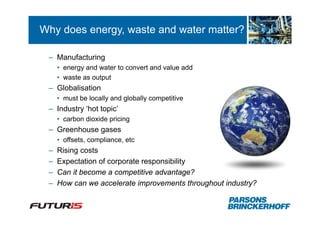
Why does energy, waste and water matter?

 – Manufacturing
     • energy and water to convert and value add
     • waste as output
 – Globalisation
     • must be locally and globally competitive
 – Industry ‘hot topic’
     • carbon dioxide pricing
 – Greenhouse gases
     • offsets, compliance, etc
 –   Rising costs
 –   Expectation of corporate responsibility
 –   Can it become a competitive advantage?
 –   How can we accelerate improvements throughout industry?
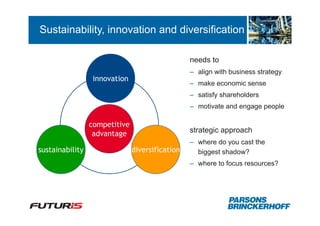
Sustainability, innovation and diversification

                                                 needs to
                                                 – align with business strategy
                  innovation
                                                 – make economic sense
                                                 – satisfy shareholders
                                                 – motivate and engage people

                 competitive
                  advantage                      strategic approach
                                                 – where do you cast the
sustainability                 diversification     biggest shadow?
                                                 – where to focus resources?
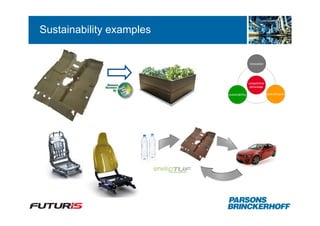
Sustainability examples

                                           innovation


                                           competitive
                                            advantage

                          sustainability                 diversification
Sustainability– some considerations

– Strategy for sustainability
  • start somewhere!
  • be honest about your intentions
  • be selective to get quick wins
  • involve the people who care
  • investigate support sources
– Be creative - innovation can lead to opportunity
                                                                  innovation
– Needs to provide a value proposition
  • cost benefit to customer & to the business
                                                                  competitive
– Waste, water and energy affect productivity                      advantage

                                                 sustainability                 diversification
– Find your competitive advantage!
A final thought…


“impact on society if you
  You can never have an


  have not changed
  yourself…
              ”
  Nelson Mandela

2. Parsons Brinckerhoff

  • 1.
    Sustainability, innovation anddiversification – finding a competitive advantage Nathan Pearce-Boltec – Parsons Brinckerhoff – Climate Change & Resource Efficiency David Chuter – Futuris – Executive, Strategy & Communications 30th August 2011
  • 2.
    Agenda • Introductions • Climate change & resource efficiency • Project background • Data analysis • Areas of focus • Key findings • Benefits delivered • Why does all this matter? • Finding competitive advantage • Final thoughts
  • 3.
    Introductions • Parsons Brinckerhoff • Futuris Automotive – global consulting firm – Australia’s largest automotive • assists public and private supplier clients • design & manufacture of • plan, develop, design, seating and interiors construct, operate and • cleantech manufacturing maintain critical infrastructure solutions – integrated energy, water & – 1,350 employees waste infrastructure solutions • 500+ in Victoria
  • 4.
    Climate Change &Resource Efficiency • Energy – Efficiency studies & audits – Alternative energy supply options • Integrated energy, • Renewables, waste to energy, cogeneration/trigeneration water & waste • Water infrastructure solutions – Efficiency studies & audits – Green infrastructure – GHG emissions estimation – Wastewater treatment/re-use – Trade-waste studies • Climate change strategy – Carbon price impacts to business • Geotechnical – Impacts of sea level rise on coastal areas
  • 5.
  • 6.
    Project background • Energyefficiency study and level 3 energy audit – Level 3 (AS/NZS 3598:2000): a ‘firm’ assessment of energy use – Capital cost and savings estimates within 10% accuracy (Level 2 within 20%) – Scope: to assess beyond the ‘low-hanging fruit’
  • 7.
    Data analysis • Energybreakdown • Compressed air demand analysis • Data logging
  • 8.
    Areas of focus •Efficiency study covered production & administration – Total energy use – Heating, Ventilation & Air Conditioning (HVAC) – Production processes & plant • Compressed air • Chilled water • Conveyer systems • Welding bays – Utilities • Hot water units • Natural gas supply – Lighting
  • 9.
    Key findings • HVAC operating on weekends • Space heater control upgrade • Administration lighting operating on weekends • Conveyer system operates during lunch time • Easy to implement • Simple solutions that are often over looked • Minimal disruption to process
  • 10.
    Benefits delivered – Identifiedenergy saving opportunities for further 32% reduction in annual energy consumption – at least 25 tangible, feasible initiatives – fully costed with capital expense, payback and ROI – Some surprises… • heating, ventilation and air-conditioning (HVAC) and lighting were identified as major areas of energy use – despite significant recent initiatives – Significant hands on experience gained by Futuris team • enable similar programs at other sites and suppliers – Understanding of the clear need for relevant targets • measure and track energy consumption, eg GJ/tonne – requiring smart meter installations
  • 11.
    Why does energy,waste and water matter? – Manufacturing • energy and water to convert and value add • waste as output – Globalisation • must be locally and globally competitive – Industry ‘hot topic’ • carbon dioxide pricing – Greenhouse gases • offsets, compliance, etc – Rising costs – Expectation of corporate responsibility – Can it become a competitive advantage? – How can we accelerate improvements throughout industry?
  • 12.
    Sustainability, innovation anddiversification needs to – align with business strategy innovation – make economic sense – satisfy shareholders – motivate and engage people competitive advantage strategic approach – where do you cast the sustainability diversification biggest shadow? – where to focus resources?
  • 13.
    Sustainability examples innovation competitive advantage sustainability diversification
  • 14.
    Sustainability– some considerations –Strategy for sustainability • start somewhere! • be honest about your intentions • be selective to get quick wins • involve the people who care • investigate support sources – Be creative - innovation can lead to opportunity innovation – Needs to provide a value proposition • cost benefit to customer & to the business competitive – Waste, water and energy affect productivity advantage sustainability diversification – Find your competitive advantage!
  • 15.
    A final thought… “impacton society if you You can never have an have not changed yourself… ” Nelson Mandela