Sphere of Influence
Harnessing the Power of
Business to Promote
Sustainable Ecology and
Commerce
Beth Anne Clark
Sustainable Visions Consulting
copyright ©2014
All Rights Reserved
Why the Green Wave?
Increasing Awareness and Expectations
Consumer pressure started it,
Return on Investment has made it grow.
“Business As Usual”
Unintended Consequences
Externalization
Planned Obsolescence
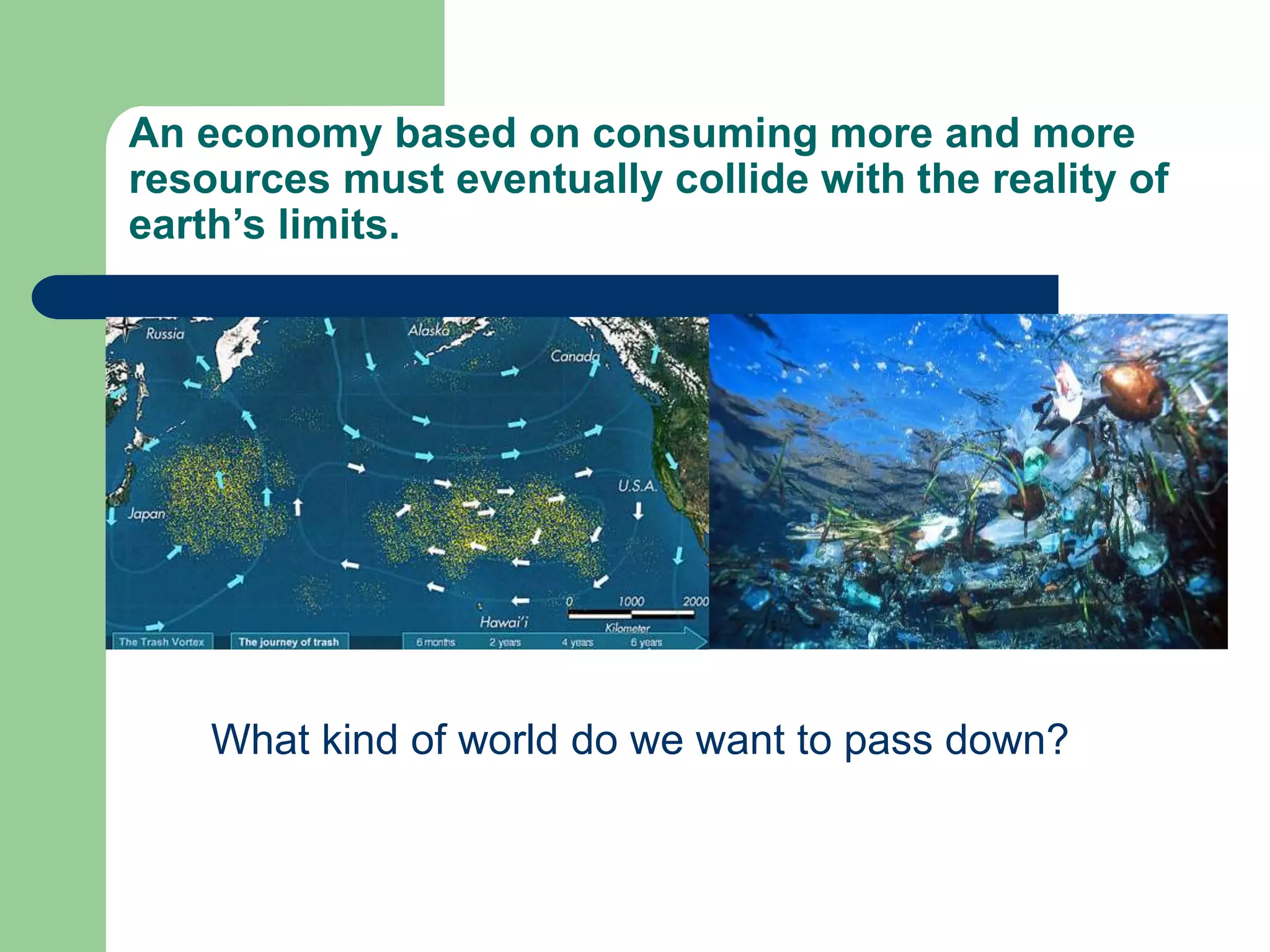
An economy based on consuming more and more
resources must eventually collide with the reality of
earth’s limits.
What kind of world do we want to pass down?
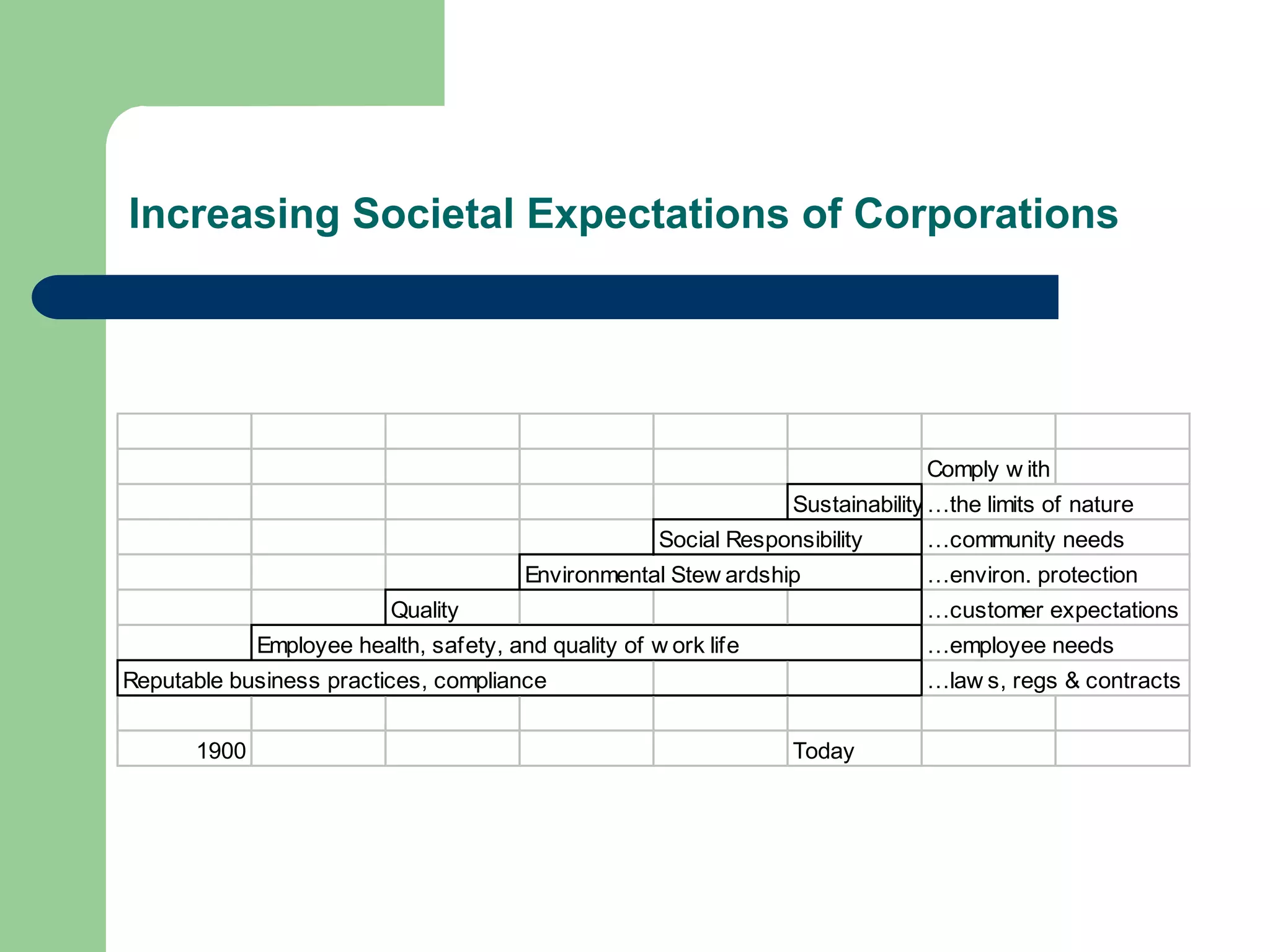
Increasing Societal Expectations of Corporations
Comply w ith
Sustainability…the limits of nature
Social Responsibility …community needs
Environmental Stew ardship …environ. protection
Quality …customer expectations
Employee health, safety, and quality of w ork life …employee needs
Reputable business practices, compliance …law s, regs & contracts
1900 Today
Consumer Awareness
Quality of Life & Health
Poor Air quality
Pervasive use of chemicals / toxins
Threats from Global Warming
Water shortages
Energy crisis
Higher food commodity prices
Competition for resources from developing nations
Multiple Stakeholders Driving
Business Change
 Customers
 Investors – Shareholders & Pension Funds
 Regulators
 Employees
 Suppliers
 Communities
 NGO’s
What is Sustainability?
Meeting our needs without compromising future
generations ability to meet their needs.
Recognizes holistic “triple bottom line” measures of success as
interdependent.
 Economic – return on investment
 Environmental – nature provides a host of services upon which we depend
 Social- meeting needs of all
Optimizing all 3
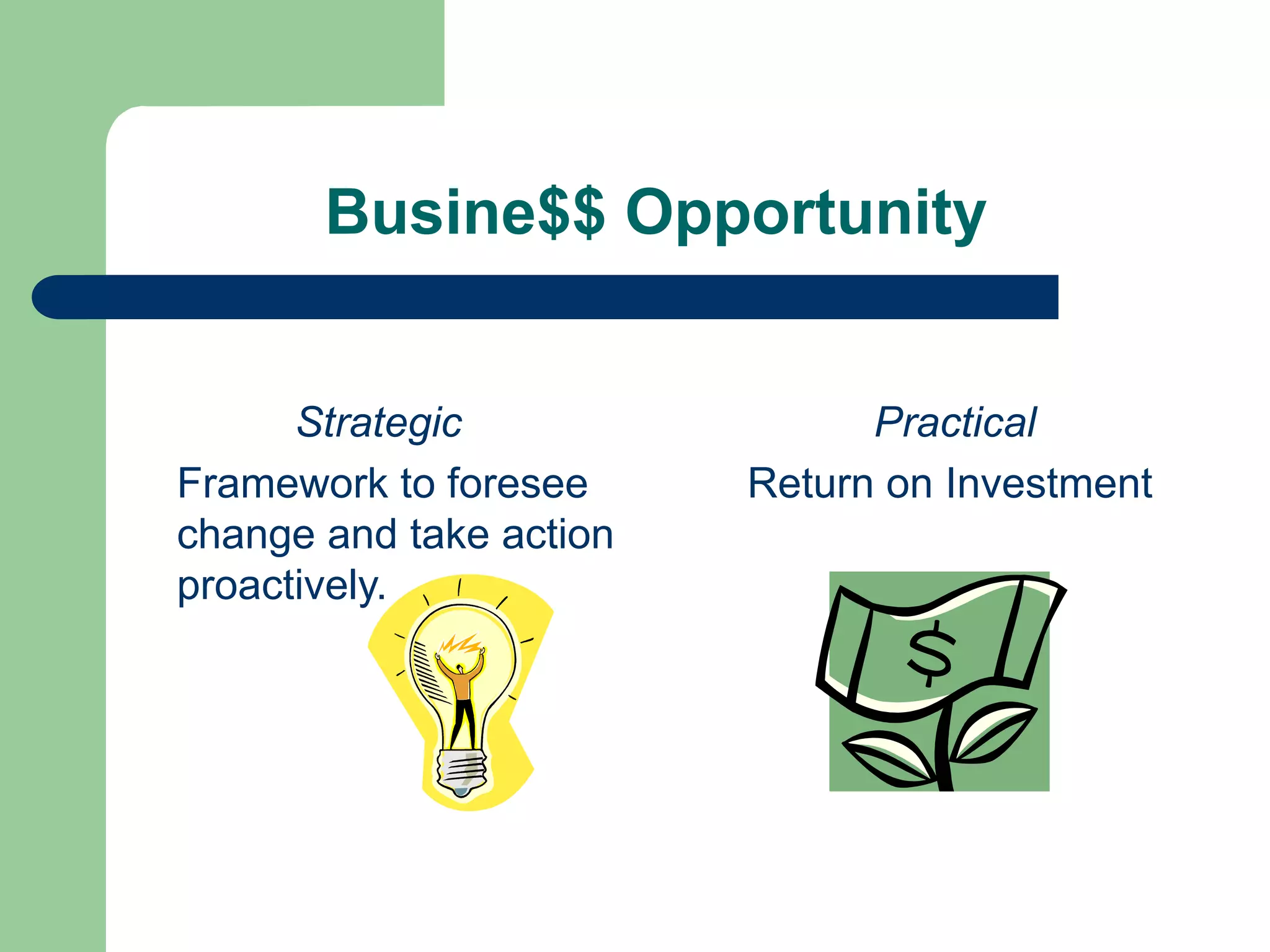
Busine$$ Opportunity
Strategic
Framework to foresee
change and take action
proactively.
Practical
Return on Investment
Strategic Value
 Innovation in process
and design (Video link)
 Competitive advantage
 Discover new markets
 Enhance Image
 Reduce risk
 Increased productivity
 Attract best talent
Risk Management
 Time and Productivity Costs
of management
 Lose customers
 Bad press
 Shut out of markets
 Regulations
 Losing insurance coverage
 Legal liability
What Does a Sustainable Business
Look Like?
 No one size fits all solution
 Embedded into the culture of
the organization
 Looking at business through
environmental “lens”
 1000’s of individual
practices
Components
Materials
Energy
Product Design
Process Efficiency
Waste
Community Affairs
Corporate Governance
Influence & Leadership
Materials
 Eliminate toxins
 Realize radically greater productivity of natural
resources
Product Lifecyles
-Cradle to Cradle closed loop system
 Use materials that come from local, green, socially
responsible sources
Certifications / Organic
Energy Use & Production
 Conduct Energy Consumption Analysis
HVAC, Lighting, Technology, Appliances
Transportation - Biodesiel, Hybrids, Electric
 Shift to renewables
Solar, Wind, Geothermal, Bio, Tidal
Often synergistic benefits
Example: Natural lighting
– Reduces energy costs for lighting and air conditioning
– Reduces CO2 emissions at the power plant
– Increases sales in retail facilities
– Reduces absenteeism
– Increases employee productivity and satisfaction
– Increases test scores for school children
– Produces better sleep for nursing home residents
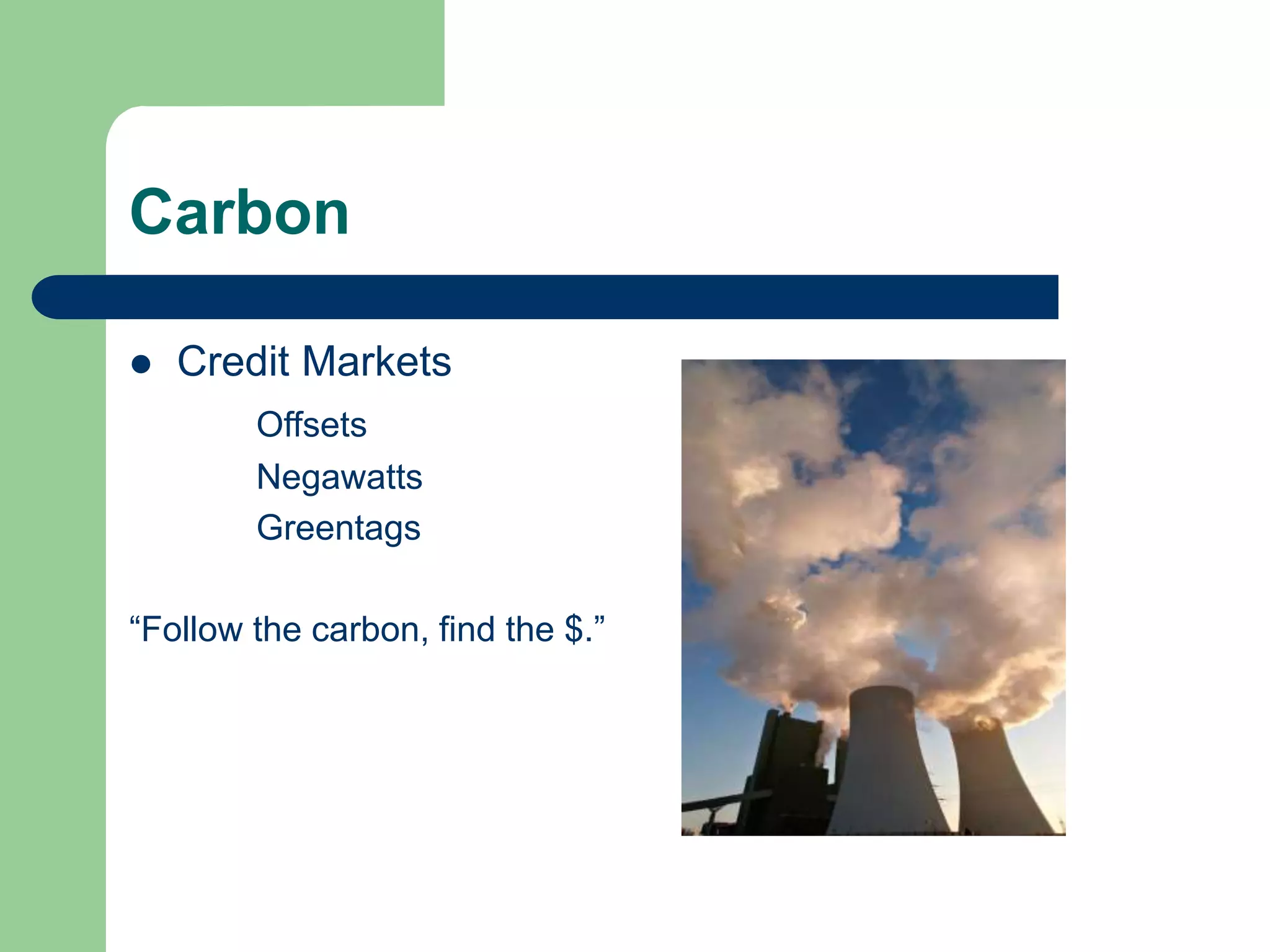
Carbon
 Credit Markets
Offsets
Negawatts
Greentags
“Follow the carbon, find the $.”
Product Design
 Design for Environment (DfE)
Reduces energy, materials consumption, use of
hazardous materials and waste throughout life of
its products
 Life Cycle Assessments (LCA)
 Life Cycle Costing (LCC)
Where is the biggest impact?
 Manufacture
 Use
 Disposal
Zero Waste, 100% Product
Waste is anything that does
not provide value to the
customer
 Extended Producer Responsibility
(EPR)
 LEAN Techniques
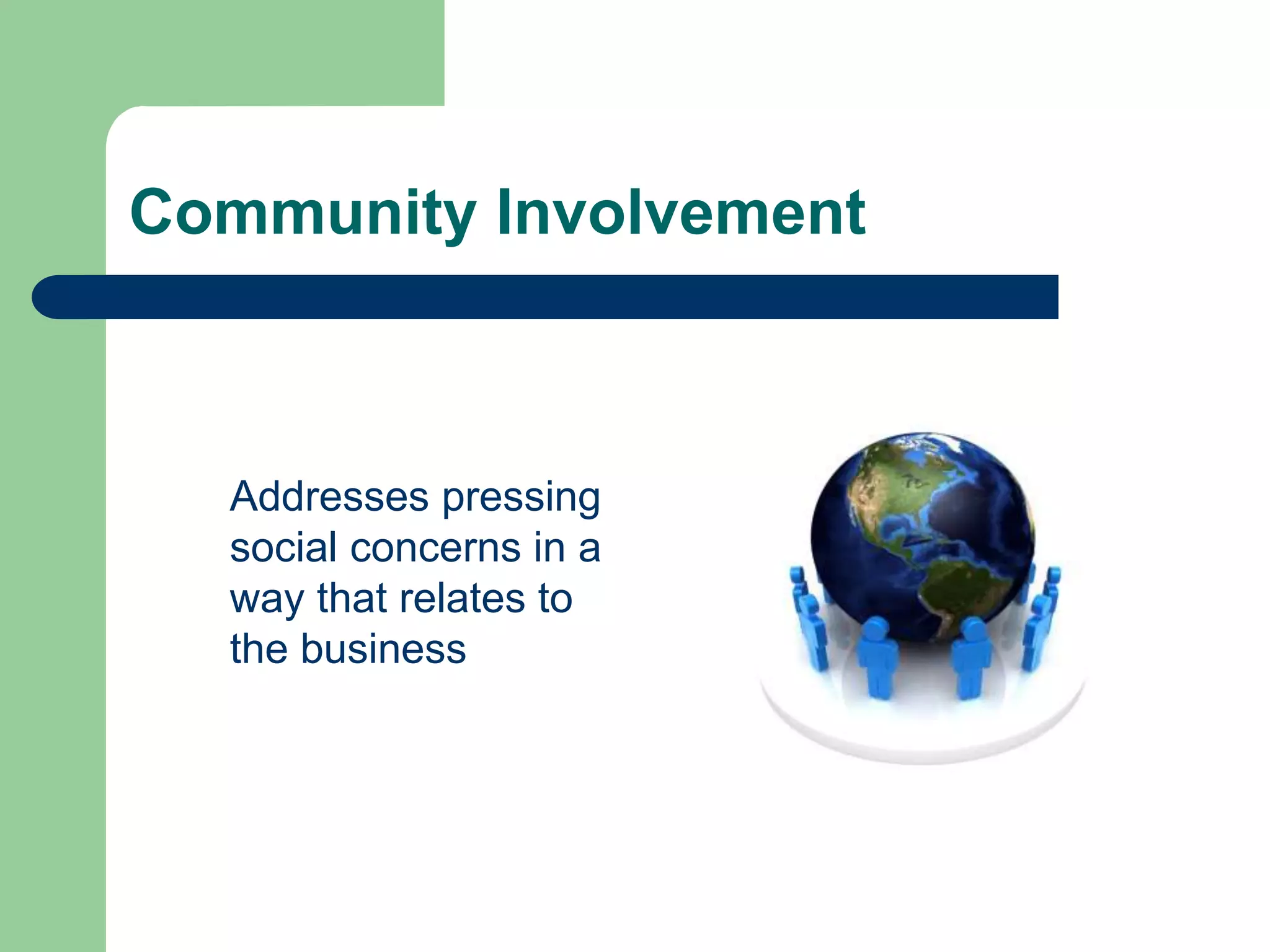
Community Involvement
Addresses pressing
social concerns in a
way that relates to
the business
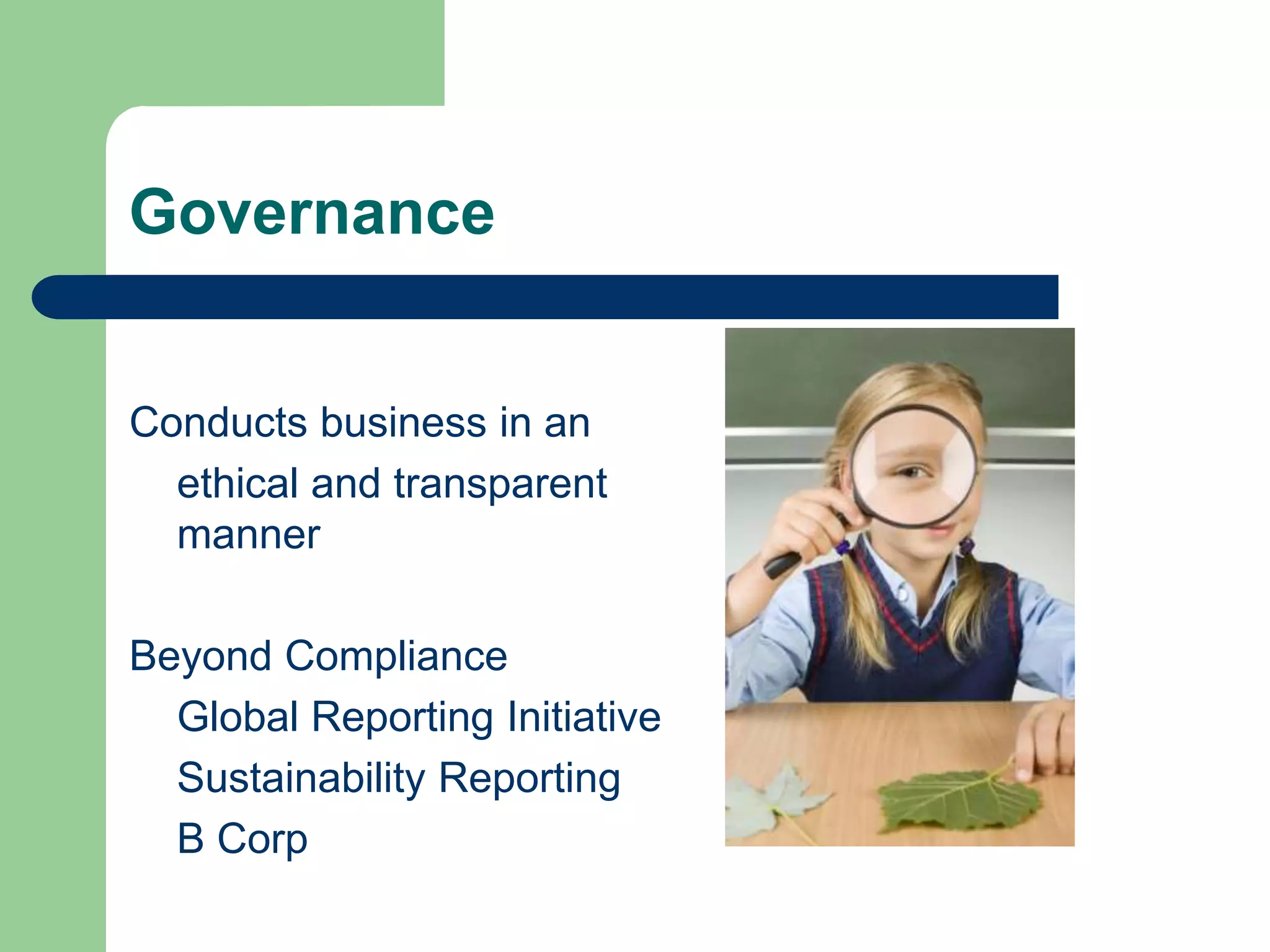
Governance
Conducts business in an
ethical and transparent
manner
Beyond Compliance
Global Reporting Initiative
Sustainability Reporting
B Corp
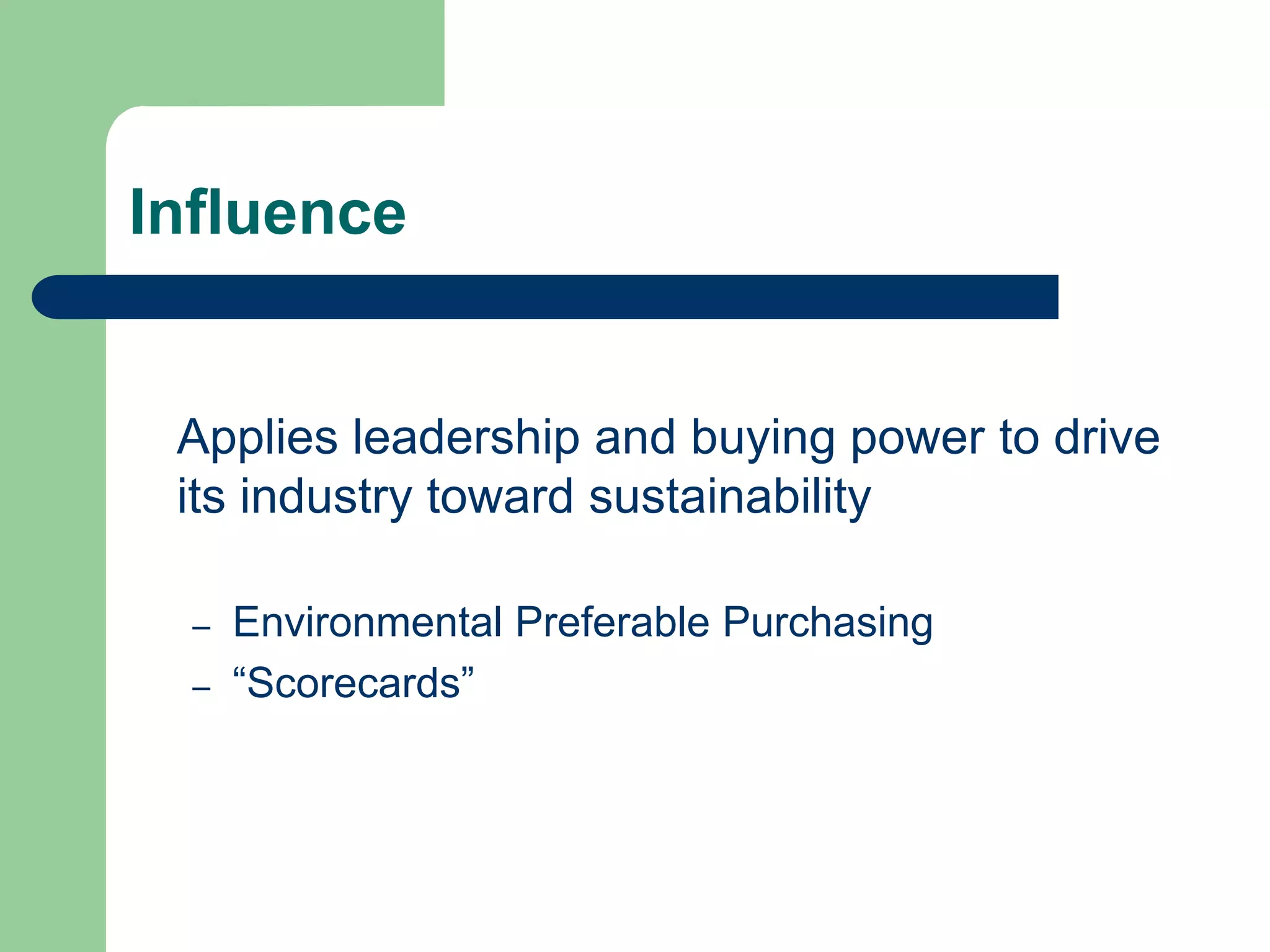
Influence
Applies leadership and buying power to drive
its industry toward sustainability
– Environmental Preferable Purchasing
– “Scorecards”
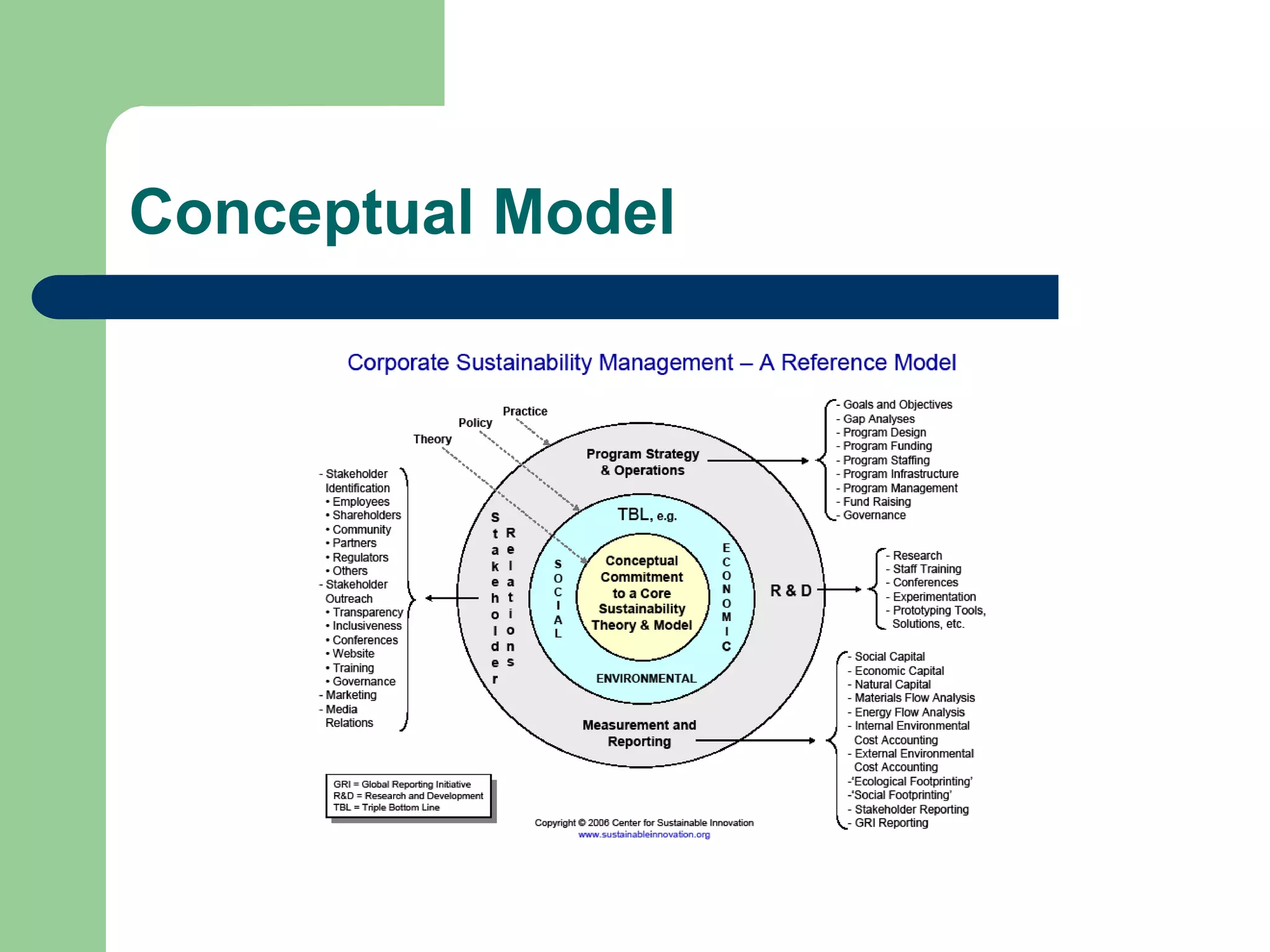
Conceptual Model
Bottom Line Impact
 Reduced Energy expense
 Reduced raw material expense
 Reduced disposal costs
 Improved productivity and loyalty
 Improved sales
 Favorable insurance rates
 Favorable credit rating and
interest rates
 More loyal customers
Sustainability is coming…
 It is a leadership issue,
not a technology issue
 Those who wait risk
losing market share
 How might this affect
your business model?
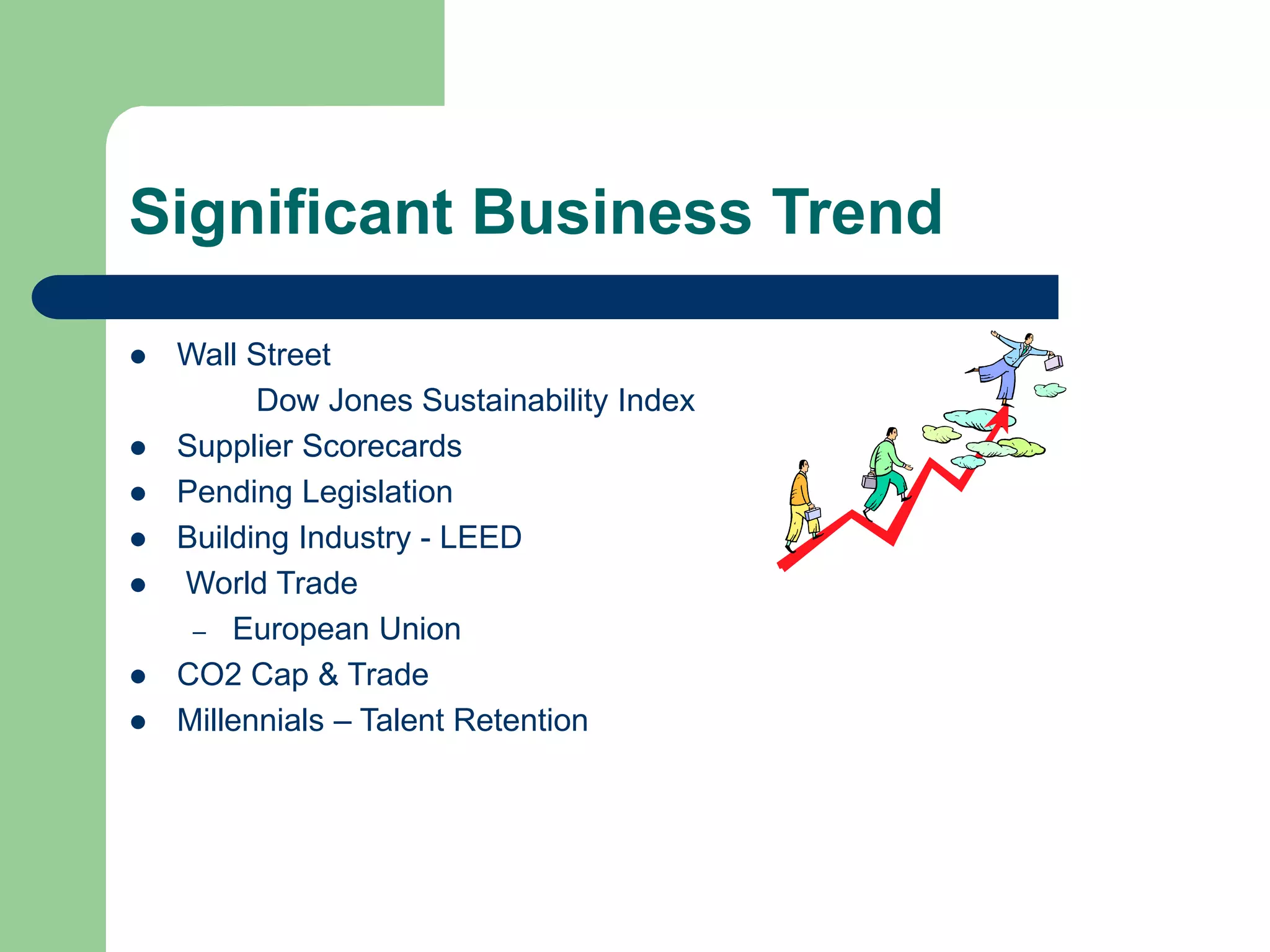
Significant Business Trend
 Wall Street
Dow Jones Sustainability Index
 Supplier Scorecards
 Pending Legislation
 Building Industry - LEED
 World Trade
– European Union
 CO2 Cap & Trade
 Millennials – Talent Retention
How Integrate into Business Strategy?
Systematic approach
– Vision
– Assessment
– Coaching & Training
– Determine Project Priorities
– Implementation
– Measurement
– Evaluate
– Refine
Be EcoConscious
Look through an
environmental lens to
integrate environmental
concerns into business
decisions….
Actions
 Develop a sustainability mission statement and
communicate it with employees. Commit to
evaluating environmental impact in every decision.
 Assemble cross functional team to assess programs
 Conduct an energy audit & materials flow analysis
 Create an assessment tool for suppliers - EPP
 Educate employees and survey for ideas
 Challenge long standing industry assumptions
Quick Hits
For the Office
 Set printer default double sided
 Convert to electronic vs. paper
 Buy recycled, post-consumer
 Buy Energy Star appliances
 Eliminate disposables
 Recycle paper, ink cartridges, toner
(& use eco solvents), bottles,
cardboard, batteries
 Promote alternative transportation
by employees / carpools
 Reduce air travel
 Use green cleaning supplies
 Use power strips to turn off multiple
items when not in use
 Cluster off site appointments
 Use a programmable thermostat
 Sign up for NC Greenpower and
other use offset programs
 Inflate tires, clean fuel filters, don’t
idle, drive slower
 Unplug chargers when not in use
 Xeriscape
 Ship “all-together”, shred cardboard
for packaging materials
 Upgrade lighting to LCD’s
 Turn off lights, fans when not in use
 Aereate / Install low flow devices
 Plant trees, Buy local, Donate
 Educate all employees,
stakeholders, ask for ideas. Make it
fun.
 Tell your story
 Influence! Vote / Write / Buy Green
“We chose to go to the moon not because it is
easy, but because it is hard.”
John Kennedy, September 1962
In the last century we used technology and
innovation to achieve a tremendous increase in
human productivity. Now we need to apply that same
“can do” spirit to resource productivity and energy
independence.
Questions
Beth Anne Clark
Sustainable Visions Consulting
beth.clark@sustainvisions.com
www.sustainvisions.com
704-575-4482

Sphere of Influence 2014

  • 1.
    Sphere of Influence Harnessingthe Power of Business to Promote Sustainable Ecology and Commerce Beth Anne Clark Sustainable Visions Consulting copyright ©2014 All Rights Reserved
  • 2.
    Why the GreenWave? Increasing Awareness and Expectations Consumer pressure started it, Return on Investment has made it grow. “Business As Usual” Unintended Consequences Externalization Planned Obsolescence
  • 3.
    An economy basedon consuming more and more resources must eventually collide with the reality of earth’s limits. What kind of world do we want to pass down?
  • 4.
    Increasing Societal Expectationsof Corporations Comply w ith Sustainability…the limits of nature Social Responsibility …community needs Environmental Stew ardship …environ. protection Quality …customer expectations Employee health, safety, and quality of w ork life …employee needs Reputable business practices, compliance …law s, regs & contracts 1900 Today
  • 5.
    Consumer Awareness Quality ofLife & Health Poor Air quality Pervasive use of chemicals / toxins Threats from Global Warming Water shortages Energy crisis Higher food commodity prices Competition for resources from developing nations
  • 6.
    Multiple Stakeholders Driving BusinessChange  Customers  Investors – Shareholders & Pension Funds  Regulators  Employees  Suppliers  Communities  NGO’s
  • 7.
    What is Sustainability? Meetingour needs without compromising future generations ability to meet their needs. Recognizes holistic “triple bottom line” measures of success as interdependent.  Economic – return on investment  Environmental – nature provides a host of services upon which we depend  Social- meeting needs of all Optimizing all 3
  • 8.
    Busine$$ Opportunity Strategic Framework toforesee change and take action proactively. Practical Return on Investment
  • 9.
    Strategic Value  Innovationin process and design (Video link)  Competitive advantage  Discover new markets  Enhance Image  Reduce risk  Increased productivity  Attract best talent
  • 10.
    Risk Management  Timeand Productivity Costs of management  Lose customers  Bad press  Shut out of markets  Regulations  Losing insurance coverage  Legal liability
  • 11.
    What Does aSustainable Business Look Like?  No one size fits all solution  Embedded into the culture of the organization  Looking at business through environmental “lens”  1000’s of individual practices
  • 12.
    Components Materials Energy Product Design Process Efficiency Waste CommunityAffairs Corporate Governance Influence & Leadership
  • 13.
    Materials  Eliminate toxins Realize radically greater productivity of natural resources Product Lifecyles -Cradle to Cradle closed loop system  Use materials that come from local, green, socially responsible sources Certifications / Organic
  • 14.
    Energy Use &Production  Conduct Energy Consumption Analysis HVAC, Lighting, Technology, Appliances Transportation - Biodesiel, Hybrids, Electric  Shift to renewables Solar, Wind, Geothermal, Bio, Tidal
  • 15.
    Often synergistic benefits Example:Natural lighting – Reduces energy costs for lighting and air conditioning – Reduces CO2 emissions at the power plant – Increases sales in retail facilities – Reduces absenteeism – Increases employee productivity and satisfaction – Increases test scores for school children – Produces better sleep for nursing home residents
  • 16.
  • 17.
    Product Design  Designfor Environment (DfE) Reduces energy, materials consumption, use of hazardous materials and waste throughout life of its products  Life Cycle Assessments (LCA)  Life Cycle Costing (LCC)
  • 18.
    Where is thebiggest impact?  Manufacture  Use  Disposal
  • 19.
    Zero Waste, 100%Product Waste is anything that does not provide value to the customer  Extended Producer Responsibility (EPR)  LEAN Techniques
  • 20.
    Community Involvement Addresses pressing socialconcerns in a way that relates to the business
  • 21.
    Governance Conducts business inan ethical and transparent manner Beyond Compliance Global Reporting Initiative Sustainability Reporting B Corp
  • 22.
    Influence Applies leadership andbuying power to drive its industry toward sustainability – Environmental Preferable Purchasing – “Scorecards”
  • 23.
  • 24.
    Bottom Line Impact Reduced Energy expense  Reduced raw material expense  Reduced disposal costs  Improved productivity and loyalty  Improved sales  Favorable insurance rates  Favorable credit rating and interest rates  More loyal customers
  • 25.
    Sustainability is coming… It is a leadership issue, not a technology issue  Those who wait risk losing market share  How might this affect your business model?
  • 26.
    Significant Business Trend Wall Street Dow Jones Sustainability Index  Supplier Scorecards  Pending Legislation  Building Industry - LEED  World Trade – European Union  CO2 Cap & Trade  Millennials – Talent Retention
  • 27.
    How Integrate intoBusiness Strategy? Systematic approach – Vision – Assessment – Coaching & Training – Determine Project Priorities – Implementation – Measurement – Evaluate – Refine
  • 28.
    Be EcoConscious Look throughan environmental lens to integrate environmental concerns into business decisions….
  • 29.
    Actions  Develop asustainability mission statement and communicate it with employees. Commit to evaluating environmental impact in every decision.  Assemble cross functional team to assess programs  Conduct an energy audit & materials flow analysis  Create an assessment tool for suppliers - EPP  Educate employees and survey for ideas  Challenge long standing industry assumptions
  • 30.
    Quick Hits For theOffice  Set printer default double sided  Convert to electronic vs. paper  Buy recycled, post-consumer  Buy Energy Star appliances  Eliminate disposables  Recycle paper, ink cartridges, toner (& use eco solvents), bottles, cardboard, batteries  Promote alternative transportation by employees / carpools  Reduce air travel  Use green cleaning supplies  Use power strips to turn off multiple items when not in use  Cluster off site appointments  Use a programmable thermostat  Sign up for NC Greenpower and other use offset programs  Inflate tires, clean fuel filters, don’t idle, drive slower  Unplug chargers when not in use  Xeriscape  Ship “all-together”, shred cardboard for packaging materials  Upgrade lighting to LCD’s  Turn off lights, fans when not in use  Aereate / Install low flow devices  Plant trees, Buy local, Donate  Educate all employees, stakeholders, ask for ideas. Make it fun.  Tell your story  Influence! Vote / Write / Buy Green
  • 31.
    “We chose togo to the moon not because it is easy, but because it is hard.” John Kennedy, September 1962 In the last century we used technology and innovation to achieve a tremendous increase in human productivity. Now we need to apply that same “can do” spirit to resource productivity and energy independence.
  • 32.
    Questions Beth Anne Clark SustainableVisions Consulting beth.clark@sustainvisions.com www.sustainvisions.com 704-575-4482

Editor's Notes

  • #2 Beth Clark - TY for coming taking time to learn more about “Greening Your Business”. Reasons being here as indiv as each in this room:, some beg new bus (how affect bus model), others know what they can do integrate their existing but for everyone, I think quote by great baseball philosopher Yogi Berra very applicable, he said, “You have to be very careful if you don’t know where you are going, because you might not get there”. Collective Sense out there, yea, want to do something, but where begin? Thing is, Can’t escape the bombardment of news, ads, info about green. (Every magazine from Newsweek to Vanity Fair has green issue, heard “1st green radio station News, Tv, every website offers - Facts / statistics about Do / Don’t Do: often conflicting – take light bulbs – compact flourescents (CFL’s)vs. incandescent, disposal problems contain mercury, and switch fleet to hybrids, new better technology around corner? , and need to use recycled content paper, pre consumer or post consumer? Will it jam my copier? Not supposed to make copies anyway, go strictly electronic – fat chance of that! what if my computer crashes? even the little things paper / plastic bags, for the love of Pete if only I can I remember to bring them?? Argh! Enough to make you throw up your hands and give up. Yet KNOW we bumping up against the limits of nature, KNOW better way to design our products, services, and communities, but where do I start? What is realistic, is it going to be expensive? Understandably, Process bec a sust. bus diff every each company, common parameters & strategy. Not a “workshop” all go back specific plan, but better understanding what all the buzz is about, reasons why worthwhile endeavor, what looks like, as well as how. I’ve been beating this drum for a very long time. Began 20 yrs. ago Waste and recycling, Catawba Lands Conservancy, (about 8 yrs ago – following links on iternet, disc sust quite by accident – hit me like ….this is it – this is the answer to env. crisis) widespread integration of environm considerations core bus strategy will create a world in which we and all living systems will thrive, AND increase profits for business. The ulitmate win-win, knew it would happen.) finding like minded people…….Austrialia…Calif…finally Chlt…(Green&Greater),ED Carolinas EcoCrescent – Sust. Bus. Leadership Forum, consultant – systematically integrate sust into daily business 1.Reason here see oppty for new business that utilizes green concept (solar, eco friendly janatorial, etc) OR 2.Know need to address green w/in business model to gain competitive edge /or remain competitive What kind of business are you in / starting? Why here? What is your interest in this topic? What potential benefits perceive? Why titled Sphere of Influence? Solution is YOU! Each of us make dec every day affect env. Personally don’t want hear dire …can’t do anything about dying coral reefs, but I’m here to tell you that you can (at least indirectly), don’t have bec env “activist” or sacrifice std of living…as bus / indiv - ”vote” with your dollars in prod svcs purch My goal thru adoption widespread sust bus eventually we as cons. won’t need to pay attention. It will bec “Bus as Usual” Meanwhile Here to focus on solutions: Doesn’t matter type business / role w/in co./ background – each of us, every day, plays a part in unfolding industry Of course, little bit what got us to this point….
  • #3 Paul Hawken calls env. movement greates of 21st century, (given 8 yrs into, not much of a stretch) Why now? Convergence of 2 factors 1. Many scientists say :”tipping pt” of env. crisis – I’m no chicken little, but evidence multi-faceted (touch on this minute) 2. Awareness precipitated Al Gore’s Inconvenient Truth docum (July 2006)Global Warming began “tipping point” of public consc., energy crisis accelerated Organizations working for change on many fronts – 8 events our region since March – Regional ( city/cnty event), public Sierra Club Clean and Green, Sust. Bus. Leadership forum, faith community, weekend financial indust, textile indust – repeated across nation (Southeast behind West coast, Michigan / wisconson…Florida) My work has focused on Business community specifically Business is dominant institution of our age ^ ability and ,as you will see, financial motivation to transform Business as Usual, which is a waste making system –(For every truck of product there are 32 truckloads of waste.) Been said, Past doing best can given level of awareness so…must raise awareness. Before talk about what sust is, explore how got crisis Bus. As Usual old industrial system comprised of 3 aspects contrib env degredation Uninted conseq – natural by-=product system of use. chem sold to homeowners to make lawns green runoff into streams, “uninhabitable for incidental human contact” Loss of animal habitats clearing land for dev 2. “Externalization” = Nature provides host of svcs upon which we depend. Economic value of natural resources (air / water purification) est $35 trillion per year. All econ of world valued at 18 trillion. Svcs not included in cost/ benefit analysis of company, but when comprimised cost us as taxpayers & citizens. .. (ex. Poor air quality – asthma – emergency room – health insurance / absenteeism effluents (water discharge), water treatment – infrastructure, superfund sites, health effect (Love Canal 70’s) During Indust revolution nature has been converted to raw materials and resources which considered limitless. Nature has no “rights”, considered “property”, owned .^ few empowered to make dec that affect needs of many. 3.More sinister , concept– Planned Obsolescence – The Story of Stuff – discusses how we designed systems so that key to profitability functional and perceived obsolescence functional –needing to replace - break, but w/in “acceptable” time frame / computer upgrades make past applications obsolete (Quickbooks) perceived – fashion $500 bill advert / yr. Each per avg 4 hrs TV / day, kids can ident 1000 company logos, about 20 plants and animals Convergence led to increased awareness and expectations of corp DISCLAIMER – LOTS OF STATS, ASK ME FOR REFERENCE – CAN’T VERIFY CORRECTNESS! If don’t like a stat, Take sources with a grain of salt?
  • #4 Feb. 5, 2008 continent of trash / plastic photographed. One is over 300 mill tons, twice size of TX. Impossible to extract. No ownership. Ingested, animals decompose, then kills again. 70% sinks Releases poison. Ends up in our food. Not the kind of “abundance” we want. Recent trip to Chicago – vibrant, exciting, wealthy, everybody good looking Thought amount of resources it took to sustain that lifestyle for one night –( quote stats from Story of Stuff) -Multiply in cities across the globe……just can’t continue No surprise bumping up against the limits of nature. I want to make it clear that don’t believe we have to radically change our standard of living to restore the vitality of nature. We can work smarter, as you will see.
  • #5 Portrial Industrial Evolution (obv timeline not to scale) Loose progression over time of corporate responsibility. Charged with more than just provide products Early last century 1. Prompted 1906 Upton Sinclair’s book The Jungle revealed truths about meat industry Comply with laws / regulations, (discourage monopolies, false product claims - elixirs,) – 2.”Organized labor” came on scene to combat unfair labor practices respond to ee needs 3.Rachel Carson’s book Silent Spring 1962, increasingcust expectations safety & service 1st Earth Day 1970 – promote awareness 4. Env stewardship bec focus for corps prompted by events such as 1984 Union Carbide chem release in Bhopal & Exxon Valdez in 89 – regulation 5. Community needs – CSR – corp social responsibility movement– international labor practices (Nike) / transparancy thru internet, Enron 6. Brings us to “Sustainability” recognizes limits of nature as well as econ concerns– Far beyond making profit , obeying laws, paying taxes, creating jobs– Multiple stakeholders - who want corps exceed all laws, set higher ethical standard, help build better society for all Last century we used technology and innovation to achieve incr human productivity, need to turn same spirit into resource productivity Who are the stakeholders driving change now?
  • #6 Talk about Awareness piece. What motivates people step out of their lives, contact a company, and say enough is enough? Consumer pressure is what drove this movement. (co’s forced to respond) Motivated Health concerns Looking around, surface looks great. Conditioned selves to gloss over what we see / experience as negative Now increased transparancy (internet) overwhelmed with information revealing lies below surface. Heard for years now, All biological systems (biomes) are in decline in area, viability, and productivity. (forests, tundra, …. Fact is, We are losing 50-55,000 species per year. Extinction natural part of an evolving planet.(99.9999 all species have bec extinct) Humans are infant species. (If cal yr – we arrived last 15 seconds) At top of food chain of species we are most vulnerable. Argueably we are hastening conditions make planet uninhabitable. Directly, beginning to feel deteriorating cond impact Qual of Life & concerned for our health. Rates of Cancer rising – (Cancer alley in Louisiana) Air – Meck Cnty receives F (American Lung Assoc. State of the Air report 2008), Not long ago added new air code “purple” – {Cliffside Coal plant threat from ozone and particles including heavy metals, mercury – autism?} 151 new coal fired power plants in dev in US – Toxins – (bisphenal A) BPA – endocrine disruptor – ingestion mimics hormones in the body – hard plastic - baby bottles, sippy cups, make up, lining of all metal cans, CD’s- 1000’s products – detected in urine 93% people older than 6 – NEVER microwave plastics! Could this contrib. to documented onset early puberty girls? We think “govt” protects us. Yet in 1996 Congress Passed Safe Food Act, despite EPS spending $80 mill, as of June 2007 no chemicals had been screened. (Milwaukee Sentinal expose / Bill Moyers June 08) Canada banned in baby bottles, Calif. Banned in ch care products. This case, industry’s respons to demonstrate the safety of their products That’s just one chem we know we ingest, let alone apply purposefully as bugspray or have incedentary contact through pesticides, fertilizers, detergents, etc. {Toxic Release Inventory – Story of Stuff)} In the US, industry admits to releasing over 4 billion lbs. of toxic chemicals a year(2005 EPA’s) Michael Braungart quote “If you are looking for weapons of mass destruction, here they are.” Global Warming – I’ve never identified one way or another, to me, plenty reasons to err side of conservatism. Know concept 212 degrees?(boiling pt,rubber band, balloon breaking) , “feedback loops” accelerate trands melting of permafrost, – melting of glaciers, sea level rise CO2 levels now at 350 ppm, on way to 450 ppm (no matter what actions we take) Will have to adapt at some level. Water – lowest common denomenator. Desalination requires a lot of Energy Energy Crisis - China & India – China taken over from US as biggest polluter, and growing. Whole books written – The End of Oil is good. Also Thomas Friedman The World Flat Resources / Food - 2 recent Nobel Peace prize winners have gone to environmentalists – Al Gore & Wangari Mathuii Scarcity leads to violence Dev Nations – Rising standards of living in Malaysia…..??? People using more resources Population remained under 1 bill up until about 1800 130 yrs to add next bill (1930), 30 yrs. to get to 3 bill (1960) Now we are at ~ 6 bill in 1999. Just reported last week, will reach 7 bill in 2012, just 13 yrs.{– pop doubled my lifetime ( about 50 yrs) – Stat 11th Hour movie} Our wealth of resources, also allowed luxury to focus on “bigger more holistic” issues. Didn’t have to spend all day collecting roots, or dung to fuel fire for tonights meal. Enough of us made voices heard, now cacaphony. (just nick of time..back to subsistance focus) Same time internet allowed greater flow infor, transparancy
  • #7 Business pressured various ways by stakeholders to adopt sust practices: 1. Customers are most powerful force. Whether it’s outcry over Wal-Mart’s lack of benefits and living wages, boycott of Exxon gas stations (me still) , or movement to buy local….Cust are voting with dollars/purchases. 2. Investors want profits, qtly earnings reports driving very sh term business focus – gotten to point where want 3 mos ret on inv. cap expenditures (Conundrum) Shareholders – want profits, but also are you and me (oil company ad, who owns? You!) Pension Funds – increasingly putting fiduciary pressure investments make, size of funds wield considerable power– EX State of California retirement $, religious organizations Even tho cust incre demanding “beyond compliance” 3. Regulators (Govt) –affect :recent news air permits being held up for Cliffside coal plant , mercury 4. Attracting best talent motivates co’s - EE’s want to feel good about what do - Sust. progressive co’s attracting most qual people 5. Suppliers are bringing innovative products to market. Being driven, and being innovative. 6. Community – unwritten “liscence to operate” – WalMart rejected community, voted out 7. NGO’s (non-governmental org) spotlighting actions. Once held in contempt by corps, now acting as “advisors”, co’s willing to listen and learn CERES holds roundtable discussions in safe atmosphere Adam Werbach, formerly w/ Sierra Club, now consultant, WalMart, Saachi & Saachi S
  • #8 What is Sust? Meeting our needs w/o comprimising fut gen abil to meet their needs !!!Several yrs now quiet revolution w/ front runners (bleeding edge)– discovered bus. int. and env. int hand in hand – sustainability bridges gap betwn econ vitality & healthy people and planet Comes from holistic, integrated process which produces synergies previously unattainable from a non-integrated process. How? Add env. to normal bus. filters Put in perspective ….(MBDC retroactive design assignment) Goal: Become not just “less bad” but restorative. Buildings that give out more energy than consume. InterfaceCarpet manuf that has used it’s influence to change entire industry ^ negate resources used Challenges: 1. Bus. Community long standing “wall” hear “environmentalism” think tree huggers / cost $$ 2. Confusing concept, broad, interwoven, multi-faceted – huge learning curve - goal today lay out logical way Key is understanding, Not either / or trade off, but maximization of all three – First environ. movement to recog economy – ROI – hard #’s necessary, mectrics, measurement – this is language of business Environ. Social – optimizing all 3 aspects
  • #9 All this leads to what has been called an Industrial Evolution. Early adaptors seeing real value both as strategic framework and bringing dramatic bottom line benefits. Let’s explore both strategic and practical aspects of this movement.
  • #10 Explore How does looking at bus. thru env. lens present oppty? Like walking into room thru diff door, whole new view what is possible! (1.)Thinking in sustainable framework brings about tremedous Innovation – by challenge long standing assumptions (Video Link) a) Aveda refillable lipstick - YouTube 3 international design awards plus hit with consumers b) C&A Carpet – Cust. Concerned C&D waste (51% in Meck cnty) and carpet in landfull (may last up to 20,000 yrs.) challenged long term assumption that must separate vinyl backing from nylon nap. Discovered combined materials performed better and cost less to manuf. Now eager to recycle. c) Also, Interface designed carpet emulates floor of forest. (2.)Comp Adv –(six sigma folks” VOC” Voice of Customer) – taking it to next level…cutting edge is “business as service” –business model – shift in perspective that can transform a business - don’t want carpet, want design, ambience, warmth, noise abatement – designe carpet “ lease program” co retains ownership (design for end of life)– promotes LT cust relationship (3). 3 billion people in non industrialized nations – underserved market - ice cream to India p. 48 BG Consumer economy – 1 bill, Emerging markets = 2 bill, Survival econ = 3 bill – how can serve these people? (4). Enhanced Image – a)Customers are paying attention, want to feel good about purchases & b) Goodwill from NGO’s if know you are trying do right thing (5.) Reduced RISK to ee’s and community and related expenses (more later) - Huge (6. )Once again –EE’s lifeforce of org - Talent - EE’s want to be assoc. with cause– attract best talent
  • #11 Look at strategic aspect of risk more closely, what are Practical = economic bens Reducing risk? Sust hit Manufacturing sector first – Look at cost of bus as usual: haz materials, E intensive, depletes nat res., tons of waste, global, scrutinized NGO’s and regulators, global brand to protect…. 1.Cost of management of toxic chemicals - training, spill response, special equip and cleaning (time), permits, disposal fees, commun (internal & ouutreach to comm), health related / goggles, gloves, protective suits, masks, showers, soaps, nurse, scrubbers, filters, warning labels, fines, legal fees 2. Lose Cust – Electrolux became int in sust when major cust refused to buy refridgeration units bec used ozone depleting Clouroflourcarbons CFC’s (freon). 3. Press – “Court of public perception” .Nike’s Asia suppliers worker abuse – public outcry 4. Markets – Sony playstations banned in Netherlands, cadmium in cables. Corporate image, buy kid toxic toy? 5. Regs – electronic waste big issue – US considering “take back” legislation similar to EU where manuf respons prod at end of useful life – more later…. 6. Ins – Swiss Re – largest pty and life inse reinsurer in the US considers climate change next big litigation risk following asbestos and tobacco. Pty damage from weather events &disease outbreaks. Targeting E companies and large emitters of GHG, threatening w/d coverage against claims for sr. execs that fail to adopt cli chg polocies. 7. Legal Liab – Bisphoral A, not yet, but poss?
  • #13 These are common target areas sust bus : We’ll explore how sust principals impacts each of these aspects in detail Materials – talk about radical resource efficiency Energy - perhaps biggest bang for your buck right now Look more closely at Product Design and innovation and process efficiency Elim waste Discussion comm affairs and corp gov Finally – look at influence and leadership
  • #14 Toxins –Rohner / DesignTex – handout. 2. Paul Hawkens and Amory Lovins – Book Natural Capital - 4-10x productivity Linear Lifecycle (vs. circular or Cradle to Cradle)- Extraction,Production, Distribution, Consumption, Disposal – {The Story of Stuff }– binder clip (read) 2. Certifications give structure / framework/ recognition – but can be $$ to qualify LEED for example – eventually all will happen w/o commissioning Product Specific : Forest Stewardship Council, Marine Stewardship council Energy Star label - appliances, Green Seal - household cleaning prods 3rd party verification USDA Organic, Rainforest Alliance, Certified Humane Raised and Handled, Fair Trade Need refinement…….
  • #15 Buildings use 48% of Energy in U.S. Most E impact is in ( 30 yr)useful life of structure, yet most builders are focused on reducing construction costs. Often owners not those who pay E bills over time, so no motivation for high efficiency HVAC, lighting, insulation, Energy Star appliances Energy Analysis - Lighting (Ex) Compact Flourescent (CFL) vs. incandescent – 75% less E – 95 apartments retirement home saved $900 electric bill Jan 07 vs Jan 05. Cost about 8x but last much longer, 8000 hours. Prob – harsher, won’t work in dimmer & mercury (4mg. Vs. 500 mg thermometer). Upcoming = LED’s (GE example), Induction lighting…!!! In the US, copiers, computers, faxes represent 3rd largest E use in commercial bldgs.Impact is multiplied since a/c impacted Motors – 99% E in lifecycle use, vs. 1% cost of unit, installation, maintenance Great potential in Renewables: Solar hot water heaters prisons red nat gas bill by 20% - breakeven &Million solar roofs project – tax credits? Wind – Germany regulated util to buy excess wind E, now farmers gen. elect. ( regulation helped promote) turbines next to highways Geothermal – use heat from earth’s core Bio – non food best, switchgrass Tidal – turbines under water Often strategies have synergystic benefits – look closer at Daylighting
  • #16 Consider both Hard and soft $ benefits Wal-Mart sales All documented studies
  • #17 Would be remiss if didn’t touch on Additional aspect of Energy economy - Pending GHG legislation driving big bus trend. Calif – developers, VMT (vehicle miles travelled) Funding at risk for projects Facilities begin estab baseline – new admin some kind of carbon trading system will be enacted Cap & Trade = 151 new coal fire plants planned in US One year’s co2 emmisions of just 2 would wipe out entire benefit every household replaced 1 60 watt w/ CFL Kansas not building their coal plant (show article) Key in this carbon econ is to quantify & benchmark: NC Greenpower = non profit org funnels vol contrib toward renewable E - $4 / mo = 100 kw E Negawatts = measuring reduced E demand (thru efficiency / conservation) Greentags = “renewable energy credit” (REC;s)producers of “green” power can sell RECs as well as the power itself, increasing their profits, while other interests can buy or trade RECs for reasons ranging from improving corporate image to satisfying regulatory compliance. When RECs are traded, the entity purchasing the RECs gains the right to claim environmental benefits. Renewable Energy Certificates are also commonly referred to as Green Tags, Renewable Energy Credits, Tradable Renewable Certificates (TRCs), and environmental attributes. white tags =
  • #18 Product design is one way to affect many components : redu energy, materials, so forth “Design for Env” –Prius designed for env. Considers:Recycled content, toxicity, harvesting, Demassify – same result less material Shipping – design for transport, wt & size Toxics – water based vs. petro E req in manuf process, use waste heat/ H2o reuse/ Waste By prods use as inputs Uniformity for recycle and reassembly Designed for Disassembly Life Cycle Assessment – process of examining the impacts of a product over its entire lifetime. Where do the raw matrerials come from How are they transported how is it manufa, how does it reach the cust Eval Life Cycle costing – true cost over long-term – longevity of product, safety costs, disposal cost List of Aveda ques – ex. Of DfE
  • #19 Looking at where might start in your own business – Where biggest Impact? Electrolux examined Washing machine biggest impact is use – many yrs of loads, 40 gall + hot h20. So developed now common front load use fraction of h20, red E use, easier on clothes so last longer , early into Asian market, increasing % of sales w/ higher profit margins than trad lines
  • #20 One study of “material throughput” in US manuf discovered only 6% of culmulative inputs throughout entire extraction, manuf, transpotation process ended up in actual product. Remaining 94% was waste. (P. 71 BG (Packaging) Quote Ray Anderson – every truckload product = 32 trucks of waste. Waste making system. Waste is anything does not provide val to the cust. Waste comes in many forms: Most commonly think of Materials (scrap & by-products), Energy, Emissions (chemicals, dust, ozone), haz substances, noise, (what about) defects, off-quality, over runs, inventory? Consider everything waste, Not only Pay to buy, pay to treat or pay to dispose - $ down drain (chemicals), up smokestack, in the dumpster Most “Wastes” have intrinsic value, if can find markets for by-products. ^ Conservation = buried treasure -Newspapers become insulation or mixed with seed and sprayed on landscape to germanate groundcover. -Ground up wooden pallets are dyed to become landscaping (red) or used for boiler fuel to create energy Converting cost sector to profit sector Way beyond – reduce, reuse, recycle, compost Trend: fundamental shift in product responsibility Extended producer respon (EPR), shift from traditional linear model where manufacturers not only respon for production and performance, but also disposal EU – far ahead of US – WEEE, European “Waste Electrical and Electronic Equipment Directives”– anything with a cord, even the packaging’ US begun to address carpeting and e-waste. National Electronic Product Stewardship Initiative – take back. Xerox – Already leased copiers, so many tended to come back ^ created disassembly plant, reuse parts where possible. Saved $2 bill since 1990 and diverted equiv. of 2 mill printers and copiers from the landfill. Impacted prod design to increase durability and compatibility with next generation models ( process called up-cycling) To quote Yogi Bera “Hard to make predictions, especially about the future”, but if you are product manufacturer, must ask self, is it only matter of time before most products are required to be taken back?? 2. Another movement toward LEAN business practices – focused on operational effectiveness and efficiency. Examines connections among processes to eliminate delay, defects, and variation. Value stream mapping every activity. ( 7 Deadly Wastes - Inventory, Over-processing, over production, motion and transportation, waiting, defects)
  • #21 Next component of sustainable business is one who considers the social as well as envir impacts of business activity. How does bus affect land use,/ infrastructure,/ local economy? Are there Volunteer / Philanthropy opportunities available that relate to your business? Stoneyfield Farms – organic yogurt, invested in school lunch program NC Bio - Research Center Kannapolis perfect example of good corp citizen – Murdock site facility in econ depressed area revitalized land vacated by Pillotex facility partner with local govt on dev infrastructure building green structures Argueably - Speedway (Bruton Smith) – cut trees violation of ordinance, then threatening to pull out when reprimanded – bad corp cit. unfortunately he was rewarded by beh. with great tax incentives to stay (70 mill $)
  • #22 Sust business act Beyond compliance – adhere not letter of the law, but spirit of intent. Transparancy Many companies voluntarily participate in the Global Reporting Initiative – GRI Index – organized around parameters of env & social activities Sustainability Report – document similar to an annual report highlighting efforts
  • #23 Last component is Influence. Apply leadership and buying power to drive progress. This aspect will be respons. for real applied change. Unlike consumers who can be misled by “greenwashing”, corps are 1) Making the companies they hire accountable: Enacting Env. Pref. Purch standards add energy effic to bid specifications, and recycled content for purch (for ex) 2) Another tool supplier “scorecards” to rate specific and overall envir comittment Wal-Mart numerous scorecards (over 60,000 suppliers worldwide)– Packaging scorecard – “Pushing lower amount of packaging they use by 5% by 2013, use more renewable materials, and reduce energy use.” This benefits Wal-Mart directly, Filter down effects of reduced packaging = more items per truck, ^ reduced shipping expense per item, etc…bottom line results. (Ripple Effect – other ways to influence Banks make loans for buildings and businesses & development, impact on traffic, quality of life Architects direct impact minimal, but design communities and buildings which affect VMT (veh miles travelled, energy used in bldgs. ) (Interface says it is has met goal now regenerative, due to it’s influence on others in indus)
  • #24 Here’s a conceptual model of what we’ve discussed thus far. At core of bus. Sust strat is commitment to ingrate env and social with econ measure of success. Diff components to consider – We’ve talked about Stakeholders, Measurement & Reporting, Strategy to implement, R&D –goes along with the design for envirnment element. Nice picture Circular element brings to mind concentric rings, getting more detailed & nuanced as bec ingrained in corp culture
  • #25 By applying various components, results in tremendous bottom line impact. ROI - measure Consider recent headlines :GM (hummer is dead) vs. Toyota (1st hybrid to surpass 1 mill cars)
  • #26 {Fastest growing movement of the 21st century} – explosion of awareness Leadership is changing - If the People will lead, the leaders will follow Convergence of Econ & Oil crisis force us to re-eval - work / shop cycle, rush around Feeling of loss – desensitized – lost the feeling of the beauty of the world, so far removed 73% of US Co.s plan to issue some sort of sust. report – 2002 Pricewaters study 39 States have joined the Climate Registry 18 GHG bills b4 congress (Lieberman-Warner) Dow Jones Sustainability Indes, & CCX – Chicago Carbon Exchange
  • #27 Several Real drivers that will continue to influence companies Nationally – Building industry and all that encompasses Wall St. – lending practices Pending Legislation – Carbon trading, take back initiatives Global – Discussed some European efforts, also Canada’s Env. Choice EcoLogo program,Germany Blue Angel Ecologo criteria. Growth of Eco-Industrial parks. Some here in US, bigger in Europe & China - bus collaborate across sectors in small localized area. Cap & Trade - huge driver as we have discussed Green Collar Jobs –In 2007 green industries generated more than $300 bill and employed more than 1.5 million people”. Bruce Doyle, Univ. of Michigan Ex. Toledo’s auto glass industry transition to center for solar photovoltaics technology and manufacturing Youth – Just try not to recycle if you have an elem school student in your home! Env. orgs and cirriculums fastest growing student groups in colleges across US (MIT’s Energy Club- Vending Misers)
  • #28 How?Where to begin? As business strategy, really integrate into fabric of organization Strategic vision should come from very top tier of organ. Assess, where currently. Any outliers in data? – benchmark and identify opportunities Educate and involve all personnel – bec part of process Where most environ. impact? Biggest initial cost savings? Focus areas initially, add Document progress to show ROI, put numbers to hard and soft dollar results Evaluate results to make adjustments and broadcast successes Finally, refine as necessary, go further, dig deeper Dow Chemical held contest for project with greatest ROI – avg 300%
  • #29 Hope I’ve convinced you by now. If still have reservations, consider Don’t have to implement all components, – or at once, just be aware! Every person makes multiple decisions every day. As entrepreneurs, going green may provide additional funding such as Grants, technical assistance, tax credits For Ex. Growth in green Venture Capital funding (2/2008 Business Week) $2.6 bill influx to cleantech 1st 3 qtrs 07. Is the 4th largest VC sector.
  • #30 Why? Yes, that is my daughter. Can I look her in the eye and say I’ve done all I could? The Solution is YOU! Every day, each of us makes an impact with every informed decision you make. Use decision points as leverage points Is there a better way? Ask yourself…… What is the whole impact of this decision over time? (Aveda list) What is my Sphere of Influence? Can I look my kid in the eye?
  • #31 Key is leadership – Challenge what you “know” (Long standing assumptions) – “Will not pay for estimates” Perhaps they will wait until Tuesday when you are in the area if you explain it is part of an overall effort to keep costs down and reduce emissions. Use as an oppty to educate your customers.
  • #32 Specific, general to all orgs, all sizes Paper 30% recycled content or more – post cons (copier, TP, towels, NC Greenpower offsets & Renewable Energy Credits (REC) – “greentags” Xeriscape – uses native, low h2o varitey plants, drip irr, mulch, organ soil improvements Trees sequester13 lbs. of Co2 per year plus cools ambient temp by 10” red a/c demand by 10-50% Keeping tires inflated properly can improve gas mileage by 3% or more. Every gallon of gas saved keeps 20 lbs. of CO2 out of atmosphere. Vote / write / Ask – Politicians make policy makers, Judges decide precidents on cases, ask companies what they are doing, tell others your opinion Editorials chance to be published Ask companies what they are doing about issues of concern If the people lead, the leaders will follow. Airlines slowing down to save fuel
  • #33 Paul Hawken counters sentiment this is most critical / scary time Most exciting time to be alive. Chance to reimagine / redesign everything! Need to work symphonically, not in isolation. time for a great new American enterprise--time for this nation to take a clearly leading role in space achievement, which in many ways may hold the key to our future on Earth. I believe we possess all the resources and talents necessary. But the facts of the matter are that we have never made the national decisions or marshalled the national resources required for such leadership. We have never specified long-range goals on an urgent time schedule, or managed our resources and our time so as to insure their fulfillment.
  • #34 We all win! One of those “smart cars” seen those on the road?