Creating a Model to
                                    Understand Product
                                      (and Software)
    info@netobjectives.com
    www.netobjectives.com
                                       Development
                                                          Going Beyond Toyota


                                                                    Alan Shalloway


1                            Copyright © 2008 Net Objectives. All Rights Reserved.   30 September 2009
Net Objectives: Who We Are
    Mission     Assisting companies to maximize the return of their investment in
                software development. The goal is for companies to increase their
                ability to respond to changing business needs while improving the
                efficiencies of their development teams.

    Services    Assessments and consulting to help create the proper structure for
                the organization. Training and coaching in Lean, Agile, Scrum,
                Patterns, Test-Driven Development to manifest the plan.
    Expertise   Enterprise Technology Delivery
                Lean Software Development
                Agile Methods (Scrum, XP, Kanban)
                Product Management
                Agile Analysis
                Design Patterns
                Test-Driven Development / Quality Assurance

2                             Copyright © 2008 Net Objectives. All Rights Reserved.   30 September 2009
Resources
     Resources: www.netobjectives.com/resources
        –   Webinars/Training Videos (PowerPoint with audio)
        –   Articles and whitepapers
        –   Pre/post course support Supporting materials
        –   Quizzes
        –   Recommended reading paths
       Blogs and podcasts: blogs.netobjectives.com
       Annotated Bibliography
       After-Course Support (students only)
       Additional Training
       Two User Groups
        – http://tech.groups.yahoo.com/group/leanagile
        – http://tech.groups.yahoo.com/group/leanprogramming


            Join our e-mail list to receive regular updates and information
                  about our resources and training of interest to you

3              Copyright © 2008 Net Objectives. All Rights Reserved.          30 September 2009
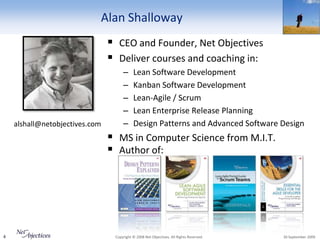
Alan Shalloway
                                 CEO and Founder, Net Objectives
                                 Deliver courses and coaching in:
                                     –     Lean Software Development
                                     –     Kanban Software Development
                                     –     Lean-Agile / Scrum
                                     –     Lean Enterprise Release Planning
    alshall@netobjectives.com        –     Design Patterns and Advanced Software Design
                                 MS in Computer Science from M.I.T.
                                 Author of:


4                                Copyright © 2008 Net Objectives. All Rights Reserved.   30 September 2009
Agenda

       What is Lean?
       Product Development Is Not Manufacturing
       Re-defining Lean
       Lean-Thinking in Software Development


5                       Copyright © 2008 Net Objectives. All Rights Reserved.   30 September 2009
What Is Lean?


6               30 September 2009
Lean-Thinking

     Originates from The Machine That Changed the World:
        The Story of Lean Production, Womack and Jones, 1991
       Commonly thought of as “How Toyota Does It”
       Toyota
        – Started with Deming
        – Added “Just In Time” and Autonomation
        – Created a culture of continuous improvement by
            Management that leads, not directs
            Very effective methods for learning, sharing and communicating


7                              Copyright © 2008 Net Objectives. All Rights Reserved.   30 September 2009
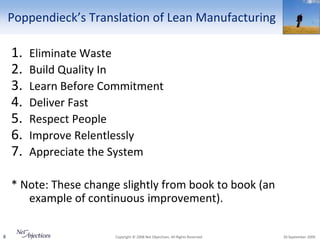
Poppendieck’s Translation of Lean Manufacturing

    1.   Eliminate Waste
    2.   Build Quality In
    3.   Learn Before Commitment
    4.   Deliver Fast
    5.   Respect People
    6.   Improve Relentlessly
    7.   Appreciate the System

    * Note: These change slightly from book to book (an
       example of continuous improvement).

8                       Copyright © 2008 Net Objectives. All Rights Reserved.   30 September 2009
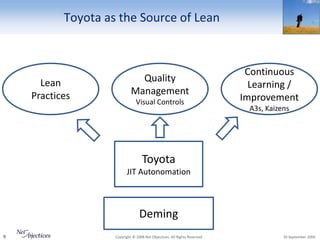
Toyota as the Source of Lean


                                                                             Continuous
      Lean                     Quality
                                                                              Learning /
    Practices                Management
                                Visual Controls                             Improvement
                                                                             A3s, Kaizens


                                    Toyota
                          JIT Autonomation


                                  Deming
9                   Copyright © 2008 Net Objectives. All Rights Reserved.              30 September 2009
Product
     Development
        Is Not
     Manufacturing
     Insights May Be Different


10                           30 September 2009
Software Development as Product Development

      Software is more of a discovery process
      Parallels the work of designing a product prior to
       manufacturing
        – A useful definition of Product Development is that it is the
          collective activities, or system, that a company uses to
          convert its technology and ideas into a stream of products
          that meet the needs of customers and the strategic goals of
          the company


                                Product Development for the Lean Enterprise, by Michael Kennedy. Oaklea Press. 2003

11                      _1dd   Copyright © 2008 Net Objectives. All Rights Reserved.                    30 September 2009
What Is Software Development Like?

      It is not like building construction
        – Where you know what you need to do
        – Little discovery is taking place
      Instead…
      It is like product development
        – Where you don’t know what to do
        – Where much of your time is in discovery
            Discover what the customer wants
            Discover how to build it
            Build it


12                     _1dd   Copyright © 2008 Net Objectives. All Rights Reserved.   30 September 2009
Principles Apply Everywhere

      Practices depend upon context
      May misinterpret the principles due to such different
         contexts
        Here are two examples …


13                       Copyright © 2008 Net Objectives. All Rights Reserved.   30 September 2009
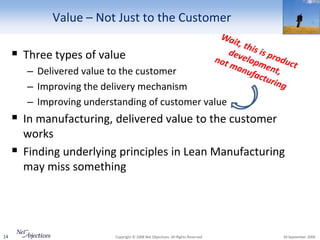
Value – Not Just to the Customer

      Three types of value
         – Delivered value to the customer
         – Improving the delivery mechanism
         – Improving understanding of customer value
      In manufacturing, delivered value to the customer
         works
        Finding underlying principles in Lean Manufacturing
         may miss something


14                         Copyright © 2008 Net Objectives. All Rights Reserved.   30 September 2009
Set Based Concurrent Engineering

        SBCE is a risk mitigation practice
        Alternatives exist in the software world
        What we need is risk mitigation, not necessarily SBCE
        Biggest risk in product development is market risk, not
         technical risk
        Not saying SBCE wouldn’t be useful (but other methods
         may be as or more useful)


15                         Copyright © 2008 Net Objectives. All Rights Reserved.   30 September 2009
Re-Defining Lean


16                 30 September 2009
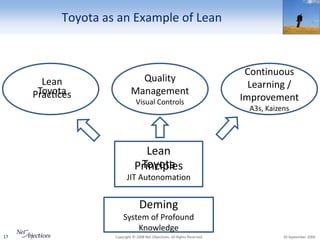
Toyota as an Example of Lean


                                                                             Continuous
       Lean                    Quality
                                                                              Learning /
      Toyota
     Practices               Management
                                Visual Controls                             Improvement
                                                                             A3s, Kaizens


                                  Lean
                                Toyota
                               Principles
                          JIT Autonomation


                                  Deming
                        System of Profound
                            Knowledge
17                  Copyright © 2008 Net Objectives. All Rights Reserved.              30 September 2009
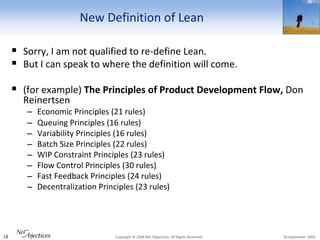
New Definition of Lean

      Sorry, I am not qualified to re-define Lean.
      But I can speak to where the definition will come.

      (for example) The Principles of Product Development Flow, Don
       Reinertsen
        –   Economic Principles (21 rules)
        –   Queuing Principles (16 rules)
        –   Variability Principles (16 rules)
        –   Batch Size Principles (22 rules)
        –   WIP Constraint Principles (23 rules)
        –   Flow Control Principles (30 rules)
        –   Fast Feedback Principles (24 rules)
        –   Decentralization Principles (23 rules)


18                                Copyright © 2008 Net Objectives. All Rights Reserved.   30 September 2009
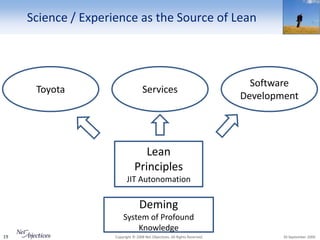
Science / Experience as the Source of Lean


                                                                               Software
      Toyota                         Services
                                                                             Development


                              Lean
                         Lean-Thinking
                           Principles
                              Flow
                           JIT Autonomation

                                   Deming
                         System of Profound
                             Knowledge
19                   Copyright © 2008 Net Objectives. All Rights Reserved.           30 September 2009
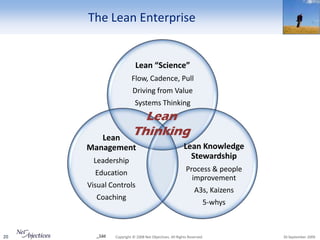
The Lean Enterprise


                          Lean “Science”
                       Flow, Cadence, Pull
                        Driving from Value
                         Systems Thinking
                          Lean
        Lean
                        Thinking
     Management                                        Lean Knowledge
      Leadership
                                                         Stewardship
       Education                                        Process & people
                                                          improvement
     Visual Controls
                                                             A3s, Kaizens
       Coaching
                                                                  5-whys


20     _1dd   Copyright © 2008 Net Objectives. All Rights Reserved.         30 September 2009
Components of Lean-Thinking

      The Foundation of Lean-Thinking
       – Deming
           Systems
           People
           Look to the whole


21                          Copyright © 2008 Net Objectives. All Rights Reserved.   30 September 2009
The Science of Lean Thinking

      Flow, pull and cadence
      Just In Time
        – Improving speed of delivery is more important than
          improving productivity
        – Transforms our view to Flow
      Utilization Theory
        – Queues / Batch Sizes / WIP / Little’s Law / Thrashing
        – Telephone Switching Systems (100 yrs ago)
        – Internet Flow
      Improving flow improves quality and lowers cost

22                          Copyright © 2008 Net Objectives. All Rights Reserved.   30 September 2009
Systems Thinking Opens Up New Possibilities

      At the Miami Lean/Kanban Conference (May 2009)
         experience reports demonstrated that CPI was
         achieved faster than one would have expected from
         start up agile teams.
        Why?
          – Focus on process not people (less fear)
          – Gave ability to test theories (true PDSA)
          – Most importantly, enabled people to think in concrete terms
            and infer principles from what was happening


23                           Copyright © 2008 Net Objectives. All Rights Reserved.   30 September 2009
Transparency Creates Management Opportunities

      Management is not a dysfunctional role to be
         protected from
        Management is a key component of any enterprise
         endeavor
        Management is not servant leadership
        Management is as committed as the teams


24                       Copyright © 2008 Net Objectives. All Rights Reserved.   30 September 2009
Lean Management

      What is management?
      Perhaps, should ask – what should management be?
       – Based on general business
       – Based on enabling Lean-Science to manifest itself
      Lean-Thinking provides the basis for Lean-Management
      How does management and culture relate?


25                         Copyright © 2008 Net Objectives. All Rights Reserved.   30 September 2009
Creating a Lean Culture

         “Should a company target its culture in its efforts to transform its production
     processes and all the positions – high and low – associated with it? It is tempting
     to answer: Yes! But that would be a mistake.
         Culture is no more likely a target than the air we breathe. It is not something
     to target for change. Culture is an idea arising from experience. That is, our idea
     of the culture of a place or organization is a result of what we experience there.
     In this way, a company’s culture is a result of its management system. The
     premise of this book is that culture is critical, and to change it, you have to
     change your management system.
         So, focus on your management system, on targets you can see, such as
     leaders’ behavior, specific expectations, tools, and routine practices. Lean
     production systems make this easier, because they emphasize explicitly defined
     processes and use visual controls.”

                                                  David Mann. Creating a Lean Culture: Tools to Sustain Lean Conversions


26                           _1dd   Copyright © 2008 Net Objectives. All Rights Reserved.                         30 September 2009
Lean Knowledge Stewardship

        Continuous process improvement
        Improved skills
        Knowledge sharing
        A3s
        Kaizens
        AARs
        5-whys
        Value-Stream Mapping


27                       Copyright © 2008 Net Objectives. All Rights Reserved.   30 September 2009
A Personal Story


28                 30 September 2009
Ups and Downs

      Lean-thinking leads to
        – Lean-management leads to
            Lean knowledge stewardship
      Organizations can evolve at all levels


29                           Copyright © 2008 Net Objectives. All Rights Reserved.   30 September 2009
Lean Thinking
     Throughout the
        Enterprise
     Extending Agility Beyond the
         Development Team


30                            30 September 2009
Enterprise Agility Requires

      Business Agility
        – set direction
      Product Portfolio Management
        – apply resources
      Team Agility
        – do the work
      Proper Management
        – tie Teams Together
      Technical Skills
        – keep software quality high


31                          Copyright © 2008 Net Objectives. All Rights Reserved.   30 September 2009
In Depth
      Business Agility
         –   Shorter planning cycle
         –   Continuous re-planning
         –   Focused on maximizing ROI of consumed products
         –   Product Development value streams create business operational value
             streams
      Product Portfolio Management
         – Manage via MMFs and value delivered
         – Enable well-defined teams
      Team Agility
         – Build and deliver incrementally based on business needs
         – Continuously improve process
         – Use visual controls to create transparency
      Proper Management
         – Improve organizational structure to reduce impediments to flow
         – Coach teams to ensure process being improved
      Technical Skills
         – Take advantage of best engineering and testing practices
         – Continuously improve technical skills and approach
32                                Copyright © 2008 Net Objectives. All Rights Reserved.   30 September 2009
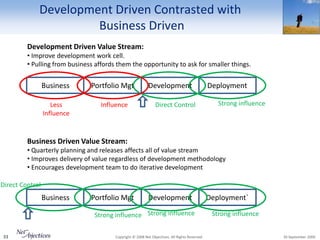
Development Driven Contrasted with
                      Business Driven
         Development Driven Value Stream:
         • Improve development work cell.
         • Pulling from business affords them the opportunity to ask for smaller things.


                 Business      Portfolio Mgt               Development                          Deployment

                    Less           Influence                    Direct Control                     Strong influence
                 Influence


         Business Driven Value Stream:
         • Quarterly planning and releases affects all of value stream
         • Improves delivery of value regardless of development methodology
         • Encourages development team to do iterative development

Direct Control
                 Business      Portfolio Mgt               Development                          Deployment`

                                Strong influence Strong influence                                Strong influence


33                                      Copyright © 2008 Net Objectives. All Rights Reserved.                         30 September 2009
Business Agility + Team Agility = Enterprise Agility

      Proper management needed to facilitate this
      Technical agility needed to sustain it


34                      Copyright © 2008 Net Objectives. All Rights Reserved.   30 September 2009
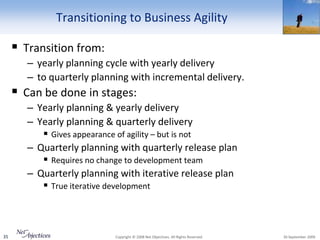
Transitioning to Business Agility

      Transition from:
        – yearly planning cycle with yearly delivery
        – to quarterly planning with incremental delivery.
      Can be done in stages:
        – Yearly planning & yearly delivery
        – Yearly planning & quarterly delivery
            Gives appearance of agility – but is not
        – Quarterly planning with quarterly release plan
            Requires no change to development team
        – Quarterly planning with iterative release plan
            True iterative development


35                          Copyright © 2008 Net Objectives. All Rights Reserved.   30 September 2009
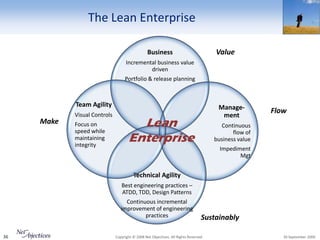
The Lean Enterprise

                                                 Business                             Value
                                    Incremental business value
                                             driven
                                   Portfolio & release planning


            Team Agility                                                               Manage-         Flow
            Visual Controls                                                             ment
     Make   Focus on
            speed while
                                       Lean                                             Continuous
                                                                                             flow of
            maintaining
            integrity
                                     Enterprise                                       business value
                                                                                        Impediment
                                                                                               Mgt


                                        Technical Agility
                                 Best engineering practices –
                                 ATDD, TDD, Design Patterns
                                   Continuous incremental
                                 improvement of engineering
                                          practices                              Sustainably

36                            Copyright © 2008 Net Objectives. All Rights Reserved.                       30 September 2009
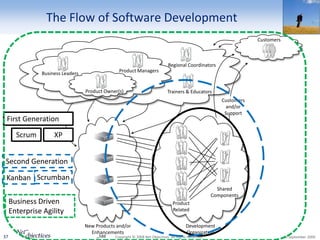
The Flow of Software Development
                                                                                                                     Customers


                                                                             Regional Coordinators
                                                Product Managers
               Business Leaders


                                  Product Owner(s)                           Trainers & Educators
                                                                                                         Customers
                                                                                                           and/or
                                                                                                          Support
 First Generation

       Scrum        XP


 Second Generation

 Kanban Scrumban
                                                                                                        Shared
                                                                                                      Components
     Business Driven                                                            Product
     Enterprise Agility                                                         Related


                                  New Products and/or                                   Development
                                    Enhancements                                        Organization
37                                    _1dd    Copyright © 2008 Net Objectives. All Rights Reserved.                              30 September 2009
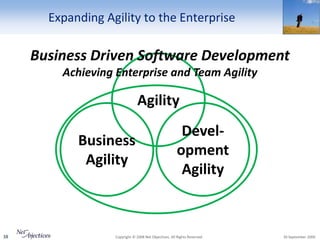
Expanding Agility to the Enterprise

     Business Driven Software Development
         Achieving Enterprise and Team Agility

                                Agility
                                                         Devel-
            Business
                                                        opment
             Agility
                                                         Agility


38                 Copyright © 2008 Net Objectives. All Rights Reserved.   30 September 2009
Question and
       Answer


39              30 September 2009
info@netobjectives.com
                                                              Thank You!
     www.netobjectives.com

                                             … and following is more to help you
                                                    plan your next steps


40                            Copyright © 2008 Net Objectives. All Rights Reserved.   30 September 2009
Resources
      Resources: www.netobjectives.com/resources
         –   Webinars/Training Videos (PowerPoint with audio)
         –   Articles and whitepapers
         –   Pre/post course support Supporting materials
         –   Quizzes
         –   Recommended reading paths
        Blogs and podcasts: blogs.netobjectives.com
        Annotated Bibliography
        After-Course Support (students only)
        Additional Training
        Two User Groups
         – http://tech.groups.yahoo.com/group/leanagile
         – http://tech.groups.yahoo.com/group/leanprogramming


             Join our e-mail list to receive regular updates and information
                   about our resources and training of interest to you

41              Copyright © 2008 Net Objectives. All Rights Reserved.          30 September 2009
Bibliography
      Science of Lean-Thinking
        – Managing the Design Factory, Don Reinertsen
        – Principles of Product Development Flow: Second Generation
          Lean Product Development, Donald Reinertsen
        – Lean Thinking: Banish Waste and Create Wealth in Your
          Corporation, Revised and Updated, James Womack, Daniel Jones
      Lean Management
        – Leader’s Handbook: Making Things Happen, Getting Things
          Done, Peter Scholtes
        – Creating a Lean Culture: Tools to Sustain Lean Conversions,
          David Mann
      Lean Learning
        – Managing to Learn, John Shook
42                          Copyright © 2008 Net Objectives. All Rights Reserved.   30 September 2009
New Online Course
      Everywhere (Internet)
        – Lean Software Development – TBD starting this summer


       For more information, see www.netobjectives.com/courses

43                                  Copyright © 2008 Net Objectives. All Rights Reserved.   30 September 2009
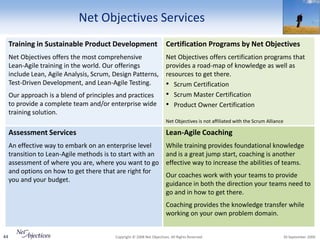
Net Objectives Services
     Training in Sustainable Product Development                        Certification Programs by Net Objectives
     Net Objectives offers the most comprehensive                       Net Objectives offers certification programs that
     Lean-Agile training in the world. Our offerings                    provides a road-map of knowledge as well as
     include Lean, Agile Analysis, Scrum, Design Patterns,              resources to get there.
     Test-Driven Development, and Lean-Agile Testing.                   • Scrum Certification
     Our approach is a blend of principles and practices                • Scrum Master Certification
     to provide a complete team and/or enterprise wide                  • Product Owner Certification
     training solution.
                                                                        Net Objectives is not affiliated with the Scrum Alliance

     Assessment Services                                                Lean-Agile Coaching
     An effective way to embark on an enterprise level                  While training provides foundational knowledge
     transition to Lean-Agile methods is to start with an               and is a great jump start, coaching is another
     assessment of where you are, where you want to go                  effective way to increase the abilities of teams.
     and options on how to get there that are right for
                                                                        Our coaches work with your teams to provide
     you and your budget.
                                                                        guidance in both the direction your teams need to
                                                                        go and in how to get there.
                                                                        Coaching provides the knowledge transfer while
                                                                        working on your own problem domain.


44                                        Copyright © 2008 Net Objectives. All Rights Reserved.                                    30 September 2009
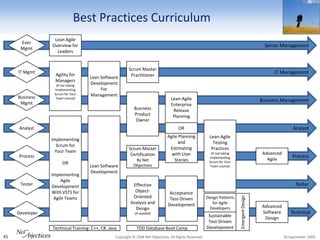
Best Practices Curriculum
                  Lean Agile
      Exec
                 Overview for                                                                                                                  Senior Management
      Mgmt
                   Leaders


                                                         Scrum Master
     IT Mgmt
                  Agility for                                                                                                                      IT Management
                                    Lean Software         Practitioner
                  Managers
                   (if not taking
                                    Development
                  Implementing           For
                  Scrum for Your    Management
     Business      Team course)                                                   Lean-Agile                                                  Business Management
      Mgmt                                                                        Enterprise
                                                            Business               Release
                                                            Product                Planning
                                                             Owner
      Analyst                                                                          OR                                                                     Analyst
                                                                                Agile Planning            Lean-Agile
                 Implementing
                                                                                      and                   Testing
                   Scrum for
                                                         Scrum Master            Estimating                Practices
                  Your Team                                                                                (if not taking                     Advanced
     Process                                              Certification           with User                                                                  Process
                                                                                                          Implementing
                                                            By Net                  Stories               Scrum for Your
                                                                                                                                                Agile
                       OR                                  Objectives
                                    Lean Software                                                          Team course)
                                    Development
                 Implementing
                      Agile
      Tester     Development                               Effective                                                                                           Tester
                 With VSTS for                              Object-              Acceptance
                                                           Oriented


                                                                                                                            Emergent Design
                  Agile Teams                                                    Test-Driven             Design Patterns
                                                          Analysis and          Development                 for Agile
                                                            Design                                         Developers                         Advanced
     Developer                                              (if needed)                                                                       Software      Technical
                                                                                                          Sustainable                          Design
                                                                                                          Test-Driven
                 Technical Training: C++, C#, Java           TDD Database Boot Camp                      Development
45                                               Copyright © 2008 Net Objectives. All Rights Reserved.                                                   30 September 2009
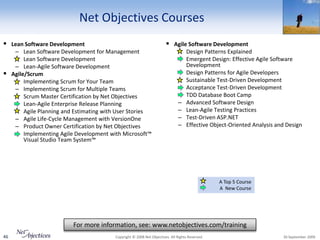
Net Objectives Courses
 Lean Software Development                                           Agile Software Development
   – Lean Software Development for Management                               – Design Patterns Explained
   – Lean Software Development                                              – Emergent Design: Effective Agile Software
   – Lean-Agile Software Development                                          Development
 Agile/Scrum                                                               – Design Patterns for Agile Developers
   – Implementing Scrum for Your Team                                       – Sustainable Test-Driven Development
   – Implementing Scrum for Multiple Teams                                  – Acceptance Test-Driven Development
   – Scrum Master Certification by Net Objectives                           – TDD Database Boot Camp
   – Lean-Agile Enterprise Release Planning                                 – Advanced Software Design
   – Agile Planning and Estimating with User Stories                        – Lean-Agile Testing Practices
   – Agile Life-Cycle Management with VersionOne                            – Test-Driven ASP.NET
   – Product Owner Certification by Net Objectives                          – Effective Object-Oriented Analysis and Design
   – Implementing Agile Development with Microsoft™
       Visual Studio Team System™


                                                                                               A Top 5 Course
                                                                                               A New Course


                        For more information, see: www.netobjectives.com/training
46                                     Copyright © 2008 Net Objectives. All Rights Reserved.                       30 September 2009

Lean Software Development Alan Shalloway

  • 1.
    Creating a Modelto Understand Product (and Software) info@netobjectives.com www.netobjectives.com Development Going Beyond Toyota Alan Shalloway 1 Copyright © 2008 Net Objectives. All Rights Reserved. 30 September 2009
  • 2.
    Net Objectives: WhoWe Are Mission Assisting companies to maximize the return of their investment in software development. The goal is for companies to increase their ability to respond to changing business needs while improving the efficiencies of their development teams. Services Assessments and consulting to help create the proper structure for the organization. Training and coaching in Lean, Agile, Scrum, Patterns, Test-Driven Development to manifest the plan. Expertise Enterprise Technology Delivery Lean Software Development Agile Methods (Scrum, XP, Kanban) Product Management Agile Analysis Design Patterns Test-Driven Development / Quality Assurance 2 Copyright © 2008 Net Objectives. All Rights Reserved. 30 September 2009
  • 3.
    Resources  Resources: www.netobjectives.com/resources – Webinars/Training Videos (PowerPoint with audio) – Articles and whitepapers – Pre/post course support Supporting materials – Quizzes – Recommended reading paths  Blogs and podcasts: blogs.netobjectives.com  Annotated Bibliography  After-Course Support (students only)  Additional Training  Two User Groups – http://tech.groups.yahoo.com/group/leanagile – http://tech.groups.yahoo.com/group/leanprogramming Join our e-mail list to receive regular updates and information about our resources and training of interest to you 3 Copyright © 2008 Net Objectives. All Rights Reserved. 30 September 2009
  • 4.
    Alan Shalloway  CEO and Founder, Net Objectives  Deliver courses and coaching in: – Lean Software Development – Kanban Software Development – Lean-Agile / Scrum – Lean Enterprise Release Planning alshall@netobjectives.com – Design Patterns and Advanced Software Design  MS in Computer Science from M.I.T.  Author of: 4 Copyright © 2008 Net Objectives. All Rights Reserved. 30 September 2009
  • 5.
    Agenda  What is Lean?  Product Development Is Not Manufacturing  Re-defining Lean  Lean-Thinking in Software Development 5 Copyright © 2008 Net Objectives. All Rights Reserved. 30 September 2009
  • 6.
    What Is Lean? 6 30 September 2009
  • 7.
    Lean-Thinking  Originates from The Machine That Changed the World: The Story of Lean Production, Womack and Jones, 1991  Commonly thought of as “How Toyota Does It”  Toyota – Started with Deming – Added “Just In Time” and Autonomation – Created a culture of continuous improvement by  Management that leads, not directs  Very effective methods for learning, sharing and communicating 7 Copyright © 2008 Net Objectives. All Rights Reserved. 30 September 2009
  • 8.
    Poppendieck’s Translation ofLean Manufacturing 1. Eliminate Waste 2. Build Quality In 3. Learn Before Commitment 4. Deliver Fast 5. Respect People 6. Improve Relentlessly 7. Appreciate the System * Note: These change slightly from book to book (an example of continuous improvement). 8 Copyright © 2008 Net Objectives. All Rights Reserved. 30 September 2009
  • 9.
    Toyota as theSource of Lean Continuous Lean Quality Learning / Practices Management Visual Controls Improvement A3s, Kaizens Toyota JIT Autonomation Deming 9 Copyright © 2008 Net Objectives. All Rights Reserved. 30 September 2009
  • 10.
    Product Development Is Not Manufacturing Insights May Be Different 10 30 September 2009
  • 11.
    Software Development asProduct Development  Software is more of a discovery process  Parallels the work of designing a product prior to manufacturing – A useful definition of Product Development is that it is the collective activities, or system, that a company uses to convert its technology and ideas into a stream of products that meet the needs of customers and the strategic goals of the company Product Development for the Lean Enterprise, by Michael Kennedy. Oaklea Press. 2003 11 _1dd Copyright © 2008 Net Objectives. All Rights Reserved. 30 September 2009
  • 12.
    What Is SoftwareDevelopment Like?  It is not like building construction – Where you know what you need to do – Little discovery is taking place  Instead…  It is like product development – Where you don’t know what to do – Where much of your time is in discovery  Discover what the customer wants  Discover how to build it  Build it 12 _1dd Copyright © 2008 Net Objectives. All Rights Reserved. 30 September 2009
  • 13.
    Principles Apply Everywhere  Practices depend upon context  May misinterpret the principles due to such different contexts  Here are two examples … 13 Copyright © 2008 Net Objectives. All Rights Reserved. 30 September 2009
  • 14.
    Value – NotJust to the Customer  Three types of value – Delivered value to the customer – Improving the delivery mechanism – Improving understanding of customer value  In manufacturing, delivered value to the customer works  Finding underlying principles in Lean Manufacturing may miss something 14 Copyright © 2008 Net Objectives. All Rights Reserved. 30 September 2009
  • 15.
    Set Based ConcurrentEngineering  SBCE is a risk mitigation practice  Alternatives exist in the software world  What we need is risk mitigation, not necessarily SBCE  Biggest risk in product development is market risk, not technical risk  Not saying SBCE wouldn’t be useful (but other methods may be as or more useful) 15 Copyright © 2008 Net Objectives. All Rights Reserved. 30 September 2009
  • 16.
    Re-Defining Lean 16 30 September 2009
  • 17.
    Toyota as anExample of Lean Continuous Lean Quality Learning / Toyota Practices Management Visual Controls Improvement A3s, Kaizens Lean Toyota Principles JIT Autonomation Deming System of Profound Knowledge 17 Copyright © 2008 Net Objectives. All Rights Reserved. 30 September 2009
  • 18.
    New Definition ofLean  Sorry, I am not qualified to re-define Lean.  But I can speak to where the definition will come.  (for example) The Principles of Product Development Flow, Don Reinertsen – Economic Principles (21 rules) – Queuing Principles (16 rules) – Variability Principles (16 rules) – Batch Size Principles (22 rules) – WIP Constraint Principles (23 rules) – Flow Control Principles (30 rules) – Fast Feedback Principles (24 rules) – Decentralization Principles (23 rules) 18 Copyright © 2008 Net Objectives. All Rights Reserved. 30 September 2009
  • 19.
    Science / Experienceas the Source of Lean Software Toyota Services Development Lean Lean-Thinking Principles Flow JIT Autonomation Deming System of Profound Knowledge 19 Copyright © 2008 Net Objectives. All Rights Reserved. 30 September 2009
  • 20.
    The Lean Enterprise Lean “Science” Flow, Cadence, Pull Driving from Value Systems Thinking Lean Lean Thinking Management Lean Knowledge Leadership Stewardship Education Process & people improvement Visual Controls A3s, Kaizens Coaching 5-whys 20 _1dd Copyright © 2008 Net Objectives. All Rights Reserved. 30 September 2009
  • 21.
    Components of Lean-Thinking  The Foundation of Lean-Thinking – Deming  Systems  People  Look to the whole 21 Copyright © 2008 Net Objectives. All Rights Reserved. 30 September 2009
  • 22.
    The Science ofLean Thinking  Flow, pull and cadence  Just In Time – Improving speed of delivery is more important than improving productivity – Transforms our view to Flow  Utilization Theory – Queues / Batch Sizes / WIP / Little’s Law / Thrashing – Telephone Switching Systems (100 yrs ago) – Internet Flow  Improving flow improves quality and lowers cost 22 Copyright © 2008 Net Objectives. All Rights Reserved. 30 September 2009
  • 23.
    Systems Thinking OpensUp New Possibilities  At the Miami Lean/Kanban Conference (May 2009) experience reports demonstrated that CPI was achieved faster than one would have expected from start up agile teams.  Why? – Focus on process not people (less fear) – Gave ability to test theories (true PDSA) – Most importantly, enabled people to think in concrete terms and infer principles from what was happening 23 Copyright © 2008 Net Objectives. All Rights Reserved. 30 September 2009
  • 24.
    Transparency Creates ManagementOpportunities  Management is not a dysfunctional role to be protected from  Management is a key component of any enterprise endeavor  Management is not servant leadership  Management is as committed as the teams 24 Copyright © 2008 Net Objectives. All Rights Reserved. 30 September 2009
  • 25.
    Lean Management  What is management?  Perhaps, should ask – what should management be? – Based on general business – Based on enabling Lean-Science to manifest itself  Lean-Thinking provides the basis for Lean-Management  How does management and culture relate? 25 Copyright © 2008 Net Objectives. All Rights Reserved. 30 September 2009
  • 26.
    Creating a LeanCulture “Should a company target its culture in its efforts to transform its production processes and all the positions – high and low – associated with it? It is tempting to answer: Yes! But that would be a mistake. Culture is no more likely a target than the air we breathe. It is not something to target for change. Culture is an idea arising from experience. That is, our idea of the culture of a place or organization is a result of what we experience there. In this way, a company’s culture is a result of its management system. The premise of this book is that culture is critical, and to change it, you have to change your management system. So, focus on your management system, on targets you can see, such as leaders’ behavior, specific expectations, tools, and routine practices. Lean production systems make this easier, because they emphasize explicitly defined processes and use visual controls.” David Mann. Creating a Lean Culture: Tools to Sustain Lean Conversions 26 _1dd Copyright © 2008 Net Objectives. All Rights Reserved. 30 September 2009
  • 27.
    Lean Knowledge Stewardship  Continuous process improvement  Improved skills  Knowledge sharing  A3s  Kaizens  AARs  5-whys  Value-Stream Mapping 27 Copyright © 2008 Net Objectives. All Rights Reserved. 30 September 2009
  • 28.
    A Personal Story 28 30 September 2009
  • 29.
    Ups and Downs  Lean-thinking leads to – Lean-management leads to  Lean knowledge stewardship  Organizations can evolve at all levels 29 Copyright © 2008 Net Objectives. All Rights Reserved. 30 September 2009
  • 30.
    Lean Thinking Throughout the Enterprise Extending Agility Beyond the Development Team 30 30 September 2009
  • 31.
    Enterprise Agility Requires  Business Agility – set direction  Product Portfolio Management – apply resources  Team Agility – do the work  Proper Management – tie Teams Together  Technical Skills – keep software quality high 31 Copyright © 2008 Net Objectives. All Rights Reserved. 30 September 2009
  • 32.
    In Depth  Business Agility – Shorter planning cycle – Continuous re-planning – Focused on maximizing ROI of consumed products – Product Development value streams create business operational value streams  Product Portfolio Management – Manage via MMFs and value delivered – Enable well-defined teams  Team Agility – Build and deliver incrementally based on business needs – Continuously improve process – Use visual controls to create transparency  Proper Management – Improve organizational structure to reduce impediments to flow – Coach teams to ensure process being improved  Technical Skills – Take advantage of best engineering and testing practices – Continuously improve technical skills and approach 32 Copyright © 2008 Net Objectives. All Rights Reserved. 30 September 2009
  • 33.
    Development Driven Contrastedwith Business Driven Development Driven Value Stream: • Improve development work cell. • Pulling from business affords them the opportunity to ask for smaller things. Business Portfolio Mgt Development Deployment Less Influence Direct Control Strong influence Influence Business Driven Value Stream: • Quarterly planning and releases affects all of value stream • Improves delivery of value regardless of development methodology • Encourages development team to do iterative development Direct Control Business Portfolio Mgt Development Deployment` Strong influence Strong influence Strong influence 33 Copyright © 2008 Net Objectives. All Rights Reserved. 30 September 2009
  • 34.
    Business Agility +Team Agility = Enterprise Agility  Proper management needed to facilitate this  Technical agility needed to sustain it 34 Copyright © 2008 Net Objectives. All Rights Reserved. 30 September 2009
  • 35.
    Transitioning to BusinessAgility  Transition from: – yearly planning cycle with yearly delivery – to quarterly planning with incremental delivery.  Can be done in stages: – Yearly planning & yearly delivery – Yearly planning & quarterly delivery  Gives appearance of agility – but is not – Quarterly planning with quarterly release plan  Requires no change to development team – Quarterly planning with iterative release plan  True iterative development 35 Copyright © 2008 Net Objectives. All Rights Reserved. 30 September 2009
  • 36.
    The Lean Enterprise Business Value Incremental business value driven Portfolio & release planning Team Agility Manage- Flow Visual Controls ment Make Focus on speed while Lean Continuous flow of maintaining integrity Enterprise business value Impediment Mgt Technical Agility Best engineering practices – ATDD, TDD, Design Patterns Continuous incremental improvement of engineering practices Sustainably 36 Copyright © 2008 Net Objectives. All Rights Reserved. 30 September 2009
  • 37.
    The Flow ofSoftware Development Customers Regional Coordinators Product Managers Business Leaders Product Owner(s) Trainers & Educators Customers and/or Support First Generation Scrum XP Second Generation Kanban Scrumban Shared Components Business Driven Product Enterprise Agility Related New Products and/or Development Enhancements Organization 37 _1dd Copyright © 2008 Net Objectives. All Rights Reserved. 30 September 2009
  • 38.
    Expanding Agility tothe Enterprise Business Driven Software Development Achieving Enterprise and Team Agility Agility Devel- Business opment Agility Agility 38 Copyright © 2008 Net Objectives. All Rights Reserved. 30 September 2009
  • 39.
    Question and Answer 39 30 September 2009
  • 40.
    info@netobjectives.com Thank You! www.netobjectives.com … and following is more to help you plan your next steps 40 Copyright © 2008 Net Objectives. All Rights Reserved. 30 September 2009
  • 41.
    Resources  Resources: www.netobjectives.com/resources – Webinars/Training Videos (PowerPoint with audio) – Articles and whitepapers – Pre/post course support Supporting materials – Quizzes – Recommended reading paths  Blogs and podcasts: blogs.netobjectives.com  Annotated Bibliography  After-Course Support (students only)  Additional Training  Two User Groups – http://tech.groups.yahoo.com/group/leanagile – http://tech.groups.yahoo.com/group/leanprogramming Join our e-mail list to receive regular updates and information about our resources and training of interest to you 41 Copyright © 2008 Net Objectives. All Rights Reserved. 30 September 2009
  • 42.
    Bibliography  Science of Lean-Thinking – Managing the Design Factory, Don Reinertsen – Principles of Product Development Flow: Second Generation Lean Product Development, Donald Reinertsen – Lean Thinking: Banish Waste and Create Wealth in Your Corporation, Revised and Updated, James Womack, Daniel Jones  Lean Management – Leader’s Handbook: Making Things Happen, Getting Things Done, Peter Scholtes – Creating a Lean Culture: Tools to Sustain Lean Conversions, David Mann  Lean Learning – Managing to Learn, John Shook 42 Copyright © 2008 Net Objectives. All Rights Reserved. 30 September 2009
  • 43.
    New Online Course  Everywhere (Internet) – Lean Software Development – TBD starting this summer For more information, see www.netobjectives.com/courses 43 Copyright © 2008 Net Objectives. All Rights Reserved. 30 September 2009
  • 44.
    Net Objectives Services Training in Sustainable Product Development Certification Programs by Net Objectives Net Objectives offers the most comprehensive Net Objectives offers certification programs that Lean-Agile training in the world. Our offerings provides a road-map of knowledge as well as include Lean, Agile Analysis, Scrum, Design Patterns, resources to get there. Test-Driven Development, and Lean-Agile Testing. • Scrum Certification Our approach is a blend of principles and practices • Scrum Master Certification to provide a complete team and/or enterprise wide • Product Owner Certification training solution. Net Objectives is not affiliated with the Scrum Alliance Assessment Services Lean-Agile Coaching An effective way to embark on an enterprise level While training provides foundational knowledge transition to Lean-Agile methods is to start with an and is a great jump start, coaching is another assessment of where you are, where you want to go effective way to increase the abilities of teams. and options on how to get there that are right for Our coaches work with your teams to provide you and your budget. guidance in both the direction your teams need to go and in how to get there. Coaching provides the knowledge transfer while working on your own problem domain. 44 Copyright © 2008 Net Objectives. All Rights Reserved. 30 September 2009
  • 45.
    Best Practices Curriculum Lean Agile Exec Overview for Senior Management Mgmt Leaders Scrum Master IT Mgmt Agility for IT Management Lean Software Practitioner Managers (if not taking Development Implementing For Scrum for Your Management Business Team course) Lean-Agile Business Management Mgmt Enterprise Business Release Product Planning Owner Analyst OR Analyst Agile Planning Lean-Agile Implementing and Testing Scrum for Scrum Master Estimating Practices Your Team (if not taking Advanced Process Certification with User Process Implementing By Net Stories Scrum for Your Agile OR Objectives Lean Software Team course) Development Implementing Agile Tester Development Effective Tester With VSTS for Object- Acceptance Oriented Emergent Design Agile Teams Test-Driven Design Patterns Analysis and Development for Agile Design Developers Advanced Developer (if needed) Software Technical Sustainable Design Test-Driven Technical Training: C++, C#, Java TDD Database Boot Camp Development 45 Copyright © 2008 Net Objectives. All Rights Reserved. 30 September 2009
  • 46.
    Net Objectives Courses Lean Software Development  Agile Software Development – Lean Software Development for Management – Design Patterns Explained – Lean Software Development – Emergent Design: Effective Agile Software – Lean-Agile Software Development Development  Agile/Scrum – Design Patterns for Agile Developers – Implementing Scrum for Your Team – Sustainable Test-Driven Development – Implementing Scrum for Multiple Teams – Acceptance Test-Driven Development – Scrum Master Certification by Net Objectives – TDD Database Boot Camp – Lean-Agile Enterprise Release Planning – Advanced Software Design – Agile Planning and Estimating with User Stories – Lean-Agile Testing Practices – Agile Life-Cycle Management with VersionOne – Test-Driven ASP.NET – Product Owner Certification by Net Objectives – Effective Object-Oriented Analysis and Design – Implementing Agile Development with Microsoft™ Visual Studio Team System™ A Top 5 Course A New Course For more information, see: www.netobjectives.com/training 46 Copyright © 2008 Net Objectives. All Rights Reserved. 30 September 2009