IBM Software                         Agility@Scale™
Rational


Applying agile and lean principles
to the governance of software and
systems development
2   Agility@Scale


Applying lean thinking to the governance                          It’s possible to loosen the reins on
of software development                                           development teams without losing control.
As more and more project teams adopt agile software
development methods, issues arise with traditional approaches     The good news is that you’re likely following some of these
to IT governance. Such approaches—which include Control           practices already. The bad news is that it’ll likely take your
Objectives for Information and Related Technology (COBIT)         organization several years to adopt every practice, and there’s
and the Project Management Institute (PMI) Organizational         no set order in which to implement them. However, the
Project Management Maturity Model (OPM-3)—are often too           practices are synergistic and can be adopted incrementally.
heavy in practice for development shops seeking to be more        Each added practice helps strengthen your ability to effectively
agile or lean.                                                    implement subsequent practices.

Effective governance for lean development isn’t about
                                                                  Defining governance
command and control. Instead, the focus is on enabling the
                                                                  IT and systems engineering governance establishes chains of
right behaviors and practices through collaborative and
                                                                  responsibility, authority and communication in support of the
supportive techniques. It is far more effective to motivate
                                                                  overall enterprise’s goals and strategy. It also establishes
people to do the right thing than it is to force them to do so.
                                                                  measurements, policies, standards and control mechanisms to
                                                                  enable people to carry out their roles and responsibilities
A lean approach to development governance weaves the
                                                                  effectively.1 You do this by balancing risk versus return on
philosophies of lean and agile software development into
                                                                  investment (ROI), setting in place effective processes and
traditional IT governance to form a lightweight, collaboration-
                                                                  practices, defining the direction and goals for the department,
based framework that reflects the realities of modern IT
                                                                  and defining the roles that people play with and within the
organizations.
                                                                  department.
This paper begins with an overview of the principles of
                                                                  Governance and management are two different things:
effective IT governance, discussing how they pertain to the
                                                                  Governance looks at an organization from the outside, treating
more specific subset of development governance. It follows
                                                                  it as a system that needs to have the appropriate structure and
with an overview of the principles of lean software
                                                                  processes in place to provide a stream of value. Management,
development. The heart of the paper is a description of
                                                                  on the other hand, is inside the organization and ensures that
eighteen practices that define a lean approach to governing
                                                                  the structure and processes are implemented effectively.
software development projects within your IT organization.
These practices show how to embed governance into tools,
                                                                  Development governance is an important subset of IT and
processes and development guidance to make it as easy as
                                                                  system engineering governance, the scope of which covers the
possible for people to keep their software and systems delivery
                                                                  steering of software and system development projects. Based
projects on track. They bring the lean thinking that has
                                                                  on considerable experience with agile development teams, IBM
revolutionized supply chain management into the governance
                                                                  believes organizations that have adopted COBIT or OPM-3
of software and systems development.
                                                                  (or similar traditional frameworks) can benefit by loosening the
                                                                  reins on their approach to governing development projects—
                                                                  without sacrificing essential controls and audit trails.

                                                                  To help you improve your governance framework, IBM has
                                                                  developed a palette of practices that support lean development.
IBM Software 3


Although many of these practices also apply to IT and systems          organization performing in such a way that business goals are
engineering governance in general, the focus of this paper is on       met. In many ways the maxims “You ship the organization” and
governing agile and lean development projects.                         “You get what you measure” are primary motivators for
                                                                       organizations to build an effective development governance
Principles of effective IT governance                                  program.
In The IBM Rational Edge2, Murray Cantor and John D.
Sanders describe seven principles to guide IT governance               Deployment
efforts. Because development governance is a subset of IT              The governance solution must be implemented incrementally.
governance, these principles are directly applicable to a              You cannot implement all of the practices described in this
discussion of lean development governance. They address                paper at once. You must first pick and choose the ones that
process, artifact lifecycle, risk, suitability, behavior, deployment   address your immediate pains before adopting others.
and automation.
                                                                       Automation
Process                                                                Technology makes the governance solution empowering and
Governance is a process that is applied to the processes that          unobtrusive. The more you embed, or automate, your
need to be governed. Policies and standards are applied to             development governance practices through automation and
development processes; decision rights are enforced within the         culture, the more likely they are to be followed.
processes; and the processes are measured and controlled.
                                                                       Principles of lean software development
Artifact lifecycle                                                     In Implementing Lean Software Development 3, Mary and
The lifecycles of artifacts produced by the governed processes         Tom Poppendieck show how the seven principles of lean
guide the governance solution. Part of governing software              manufacturing can be applied to optimize the whole IT value
development is understanding the artifacts (such as executable         stream. These principles offer practical, measurable ways to
tests and working software) produced by project teams, and             transform software delivery processes.
then monitoring how these artifacts evolve throughout the
develop¬ment effort.                                                   Eliminate waste
                                                                       Lean thinking advocates regard any activity that does not
Risk                                                                   directly add value to the finished product as waste. The three
Measures and controls must be adjusted according to the level          biggest sources of waste in software development are the
of risk. When risk is low you can focus on measuring the               addition of extra features, churn and crossing organizational
activities of the team. When risk is high you need to focus on         boundaries. Crossing organizational boundaries can increase
helping the team mitigate the risk(s) it faces.                        costs by 25 percent or more by creating buffers that slow
                                                                       response time and interfere with communication. It is critical
Suitability                                                            that development teams be allowed to organize and operate in
The needs of the organization determine how the level and              a manner that reflects the work they’re trying to accomplish—
style of governance are tailored. For example, development             rather than the functional roles of team members.
teams building life critical software need a tighter governance
approach than teams building an informational Web site.                Build in quality
                                                                       The Poppendiecks make a simple observation: if you routinely
Behavior                                                               find problems with your verification process, then your process
The governance solution drives the organizational behavior.            must be defective. When you regularly find that your
From a development governance point of view, the challenge is          developers are doing things that you don’t want them to
to create an environment that results in the development
4   Agility@Scale


do—or are not doing what they should be doing—then your            Optimize the whole
approach to governance must be at fault. It’s important not to     If you want to govern your development efforts effectively, you
make governance yet another set of activities layered on top of    must look at the bigger picture. You need to understand the
your software process. Instead the strategy should be to embed     high-level business processes that individual projects support—
governance into your processes, making it as easy as possible      processes that often cross multiple systems. You need to
for developers to do the right thing.                              manage programs of interrelated systems so you can deliver a
                                                                   complete product to your stakeholders. Measurements should
Create knowledge                                                   address how well you’re delivering business value, because that
Planning is useful, but learning is essential. You want to         is the raison d’être of your IT department.
promote strategies, such as iterative development, that help
teams discover what stakeholders really want and act on that       Categories of development governance
knowledge. It’s also important to have a body of reusable          Traditional governance often uses command-and-control
standards and guidelines that people can easily modify to meet     strategies. These strategies focus on managing and directing
specific project needs. In addition, consistent and timely         development project teams explicitly, using gateways and
feedback is important, both within the team and at the             triggers that attempt to enforce rules and catch violations.
program level, through continuous monitoring of simple and         Although valid and effective in some situations, this approach
relevant metrics.                                                  can be like herding cats for many organizations. Much work is
                                                                   put into establishing the governance framework and managing
Defer commitment                                                   the governance effort, but very little is achieved in practice.
It’s not necessary to start software development by defining a
complete specification. You can support the business effectively   In contrast, lean governance focuses on collaborative strategies
through flexible architectures that are change tolerant and by     that strive to enable and motivate team members implicitly.
scheduling irreversible decisions to the last possible moment.     For example, the traditional approach to coding guidelines
Frequently, deferring commitment requires the ability to           would be to create them and then enforce their usage through
closely couple end-to-end business scenarios to capabilities       formal inspections and post hoc correction of errant code. The
developed in multiple applications by multiple projects.           lean approach would be to write the guidelines collaboratively
                                                                   with your programmers, explain why it’s important for
Deliver quickly
                                                                   everyone to adopt the guidelines, and then provide tooling and
It is possible to deliver high-quality systems quickly. By
                                                                   support to make it as easy as possible for developers to
limiting the work of a team to its capacity, you can establish a
                                                                   continuously code within those guidelines.
reliable and repeatable flow of work. An effective governance
strategy doesn’t demand teams do more than they are capable
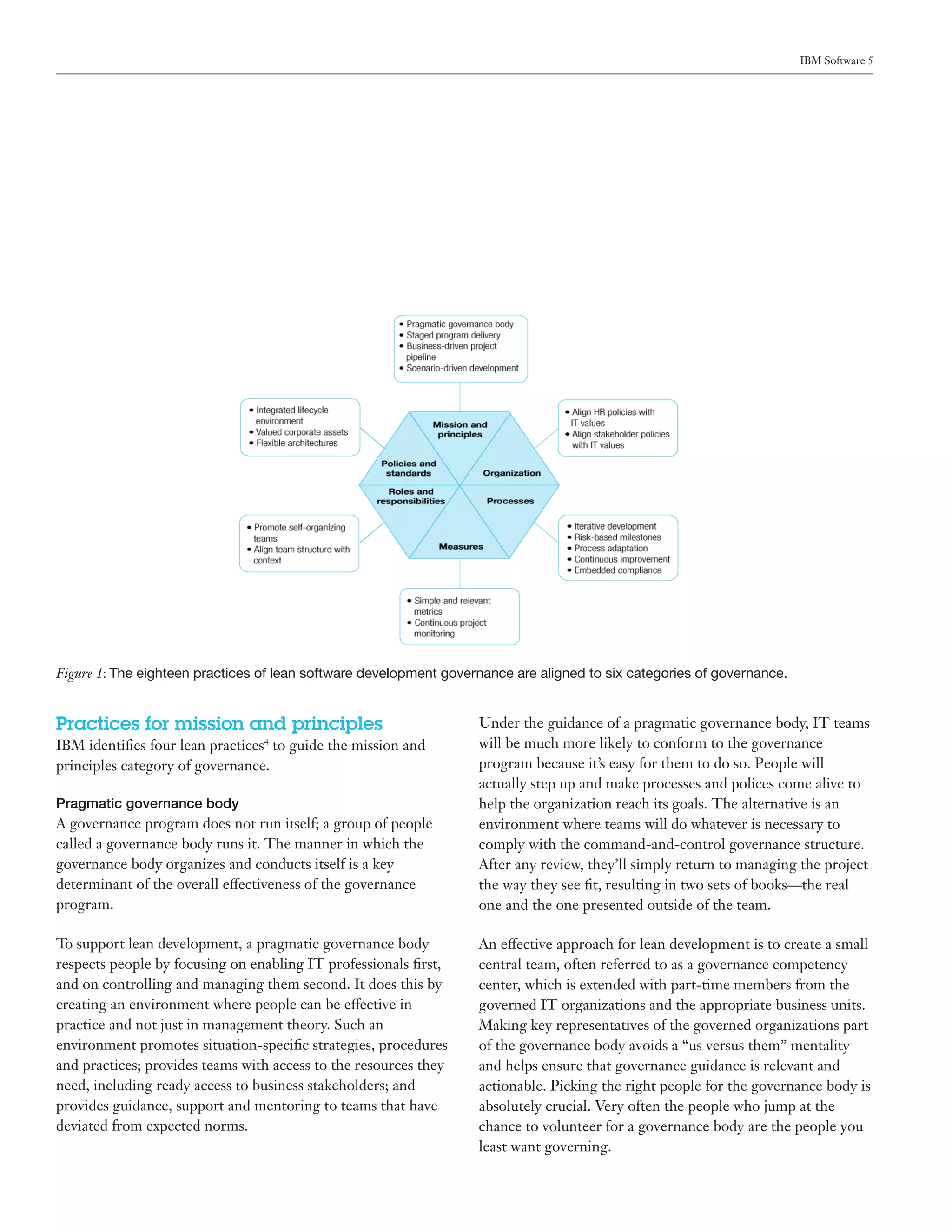
                                                                   Figure 1 categorizes and illustrates the relationships of the
of, but instead asks them to self-organize and determine what
                                                                   practices for lean governance. It shows how they align to the
they can accomplish. At an organizational level, it’s important
                                                                   six major categories of IT governance: mission and principles,
to enable programs to deliver business value at a pace defined
                                                                   organization, processes, measures, roles and responsibilities,
by the fastest-moving projects, rather than at the speed of the
                                                                   and policies and standards.
slowest project.

Respect people
The Poppendiecks also observe that sustainable advantage is
gained from engaged, thinking people. The implication is that
you need a human resources strategy that focuses on enabling
IT teams—not on controlling them.
IBM Software 5


Figure 1: The eighteen practices of lean software development governance are aligned to six categories of governance.


Practices for mission and principles                               Under the guidance of a pragmatic governance body, IT teams
IBM identifies four lean practices to guide the mission and
                                 4                                 will be much more likely to conform to the governance
principles category of governance.                                 program because it’s easy for them to do so. People will
                                                                   actually step up and make processes and polices come alive to
Pragmatic governance body                                          help the organization reach its goals. The alternative is an
A governance program does not run itself; a group of people        environment where teams will do whatever is necessary to
called a governance body runs it. The manner in which the          comply with the command-and-control governance structure.
governance body organizes and conducts itself is a key             After any review, they’ll simply return to managing the project
determinant of the overall effectiveness of the governance         the way they see fit, resulting in two sets of books—the real
program.                                                           one and the one presented outside of the team.

To support lean development, a pragmatic governance body           An effective approach for lean development is to create a small
respects people by focusing on enabling IT professionals first,    central team, often referred to as a governance competency
and on controlling and managing them second. It does this by       center, which is extended with part-time members from the
creating an environment where people can be effective in           governed IT organizations and the appropriate business units.
practice and not just in management theory. Such an                Making key representatives of the governed organizations part
environment promotes situation-specific strategies, procedures     of the governance body avoids a “us versus them” mentality
and practices; provides teams with access to the resources they    and helps ensure that governance guidance is relevant and
need, including ready access to business stakeholders; and         actionable. Picking the right people for the governance body is
provides guidance, support and mentoring to teams that have        absolutely crucial. Very often the people who jump at the
deviated from expected norms.                                      chance to volunteer for a governance body are the people you
                                                                   least want governing.
6   Agility@Scale


Staged program delivery                                              There are several benefits to staged program delivery. First, by
Staged program delivery enables you to optimize the whole            grouping projects according to business objectives, and
program while still completing projects quickly. Programs,           managing them as a program, you can more effectively deliver
which are collections of related projects, should be rolled out      on major business objectives. Second, using a control project
incrementally over time. Instead of holding back a release to        provides well-defined governance milestones for the program
wait for a subproject, each subproject must sign up for a            that focus on risk and variance reduction as well as value
predetermined release date. If the subproject misses the date, it    creation. Third, dividing a potentially large program delivers
skips to the next release, minimizing the impact to the              value incrementally around business subgoals. And finally,
customers of the program. Think of a train schedule. If the          semi-independent execution of projects enables more efficient
project misses the release train, it has to wait for the next one.   development because each project has as much tactical
Granted, because of dependencies between projects, sometimes         flexibility as possible to support higher productivity.
one project missing the release train causes several to do so.
                                                                     It is a good strategy to manage programs with loosely coupled
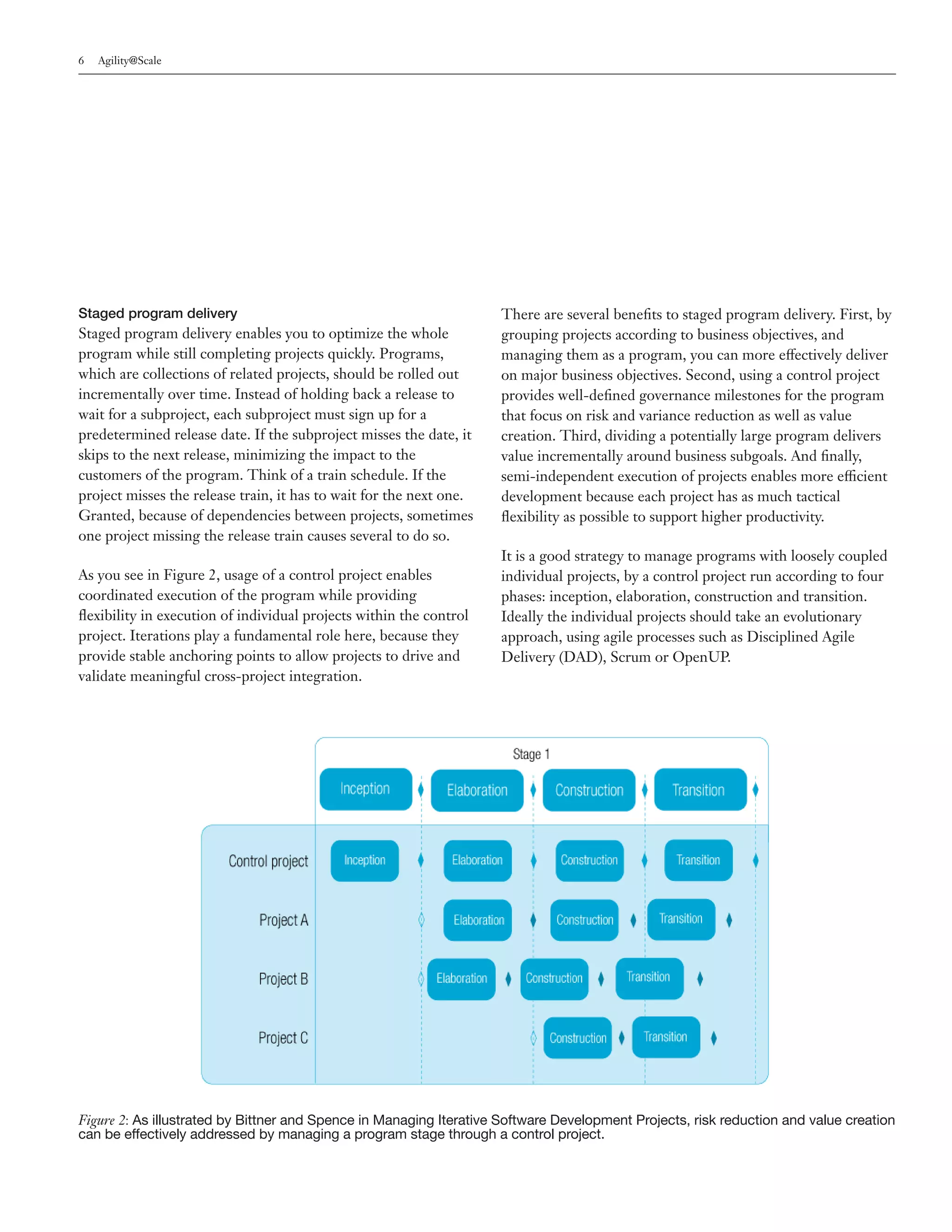
As you see in Figure 2, usage of a control project enables           individual projects, by a control project run according to four
coordinated execution of the program while providing                 phases: inception, elaboration, construction and transition.
flexibility in execution of individual projects within the control   Ideally the individual projects should take an evolutionary
project. Iterations play a fundamental role here, because they       approach, using agile processes such as Disciplined Agile
provide stable anchoring points to allow projects to drive and       Delivery (DAD), Scrum or OpenUP.
validate meaningful cross-project integration.


Figure 2: As illustrated by Bittner and Spence in Managing Iterative Software Development Projects, risk reduction and value creation
can be effectively addressed by managing a program stage through a control project.
IBM Software 7


Business-driven project pipeline                                    are not interested in managing large teams of people. You will
The demand for IT projects always exceeds available resources.      lose qualified people if the only senior roles in your IT
A business-driven project pipeline maximizes the business           organization are management positions. Effective human
value of development investments by enabling organizations to       resources (HR) policies can help you increase your pool of
prioritize and optimize projects in alignment with business         resources and retain skilled staff.
goals and objectives. This alignment can be accomplished with
scorecards and other portfolio management strategies that help      Align stakeholder policies with IT values
you assess each project against a set of parameters you define      You can easily derail software development projects with
to measure business value. Lean thinking encourages                 ill-fitting business practices. For example, many organizations
organizations to focus on no more than five parameters and use      will insist on an “accurate” cost estimate at the beginning of a
scoring as an aid in a business discussion about prioritization     software development project. This proves unrealistic in
rather than as a strict measure.                                    practice because requirements evolve over the life of a project10
                                                                    and because there are so many uncertainties in a project, which
Scenario-driven development                                         leads to a variance in your estimate.
Scenario-driven development provides the business context in
which to drive effective software development projects. The         Besides being unrealistic, stakeholder demand for an accurate
whole cannot be defined without understanding the parts, and        estimate up front motivates development teams to adopt risky
the parts cannot be defined in detail without understanding the     practices such as detailed requirements definitions early in the
whole. If you don’t know how the parts impact the overall           project.11 Although it is expected that the business will put cost
solution, you can get bogged down in building components            and schedule constraints on software development teams, the
that don’t fit together. To understand the big picture of the       way in which it does so must reflect the realities of the
business, you can identify usage scenarios at both the              develop-ment lifecycle and must be flexible enough to allow
enterprise and project levels using approaches such as use-case     development teams to remain effective.12
flow down7 or green threads.8 These techniques help each
project team see how its part fits into the whole. They also        In short, your business stakeholders must have realistic policies
improve collaboration among and between teams and serve as          for engaging IT, including how projects are funded, how
consistent control mechanisms by focusing developer attention       requirements are documented, and the level and kind of
on system integrations.                                             involvement stakeholders will have with software development
                                                                    project teams.
Practices for organization
Two lean practices guide definition of the appropriate              Lean thinking encourages business stakeholders to be active
organizational climate to support agile development.9 Applying      participants on development teams. IT professionals should be
these practices can help you better leverage people as a critical   responsible for educating stakeholders in the fundamentals of
resource.                                                           modern software development so they understand the options
                                                                    available to them and the implications of their decisions.
Align HR policies with IT values                                    Conversely, IT professionals should learn the fundamentals of
Hiring, retaining and promoting technical staff requires            business value management so they can provide the earliest
different strategies than those for non-IT staff. To reward         possible warning when project costs are in danger of exceeding
desired behaviors, you need to ensure that incentives are           the expected business value. The benefits of these practices
appropriate for the mind-set of your technical staff. For           include increased probability of project success and improved
example, many IT professionals want to expand their technical       software economics due to improved decision making.
skills so they can work on more challenging projects. Yet most
8   Agility@Scale


Business stakeholders must play an active                           scope. If the estimation of effort is off due to unforeseen events
                                                                    or difficulties, it is the scope that must give and be reassessed in
role on development project teams.                                  the next iteration. Second, the definitions of “final product”
                                                                    and “complete” may evolve significantly from their original
Practices for development processes                                 conceptions during project execution when the business
Five lean practices promote strategies for running a project        stakeholders and implementers agree that doing so better
efficiently and effectively.13                                      satisfies business objectives. Each iteration of the project will
                                                                    increase the shared understanding of requirements. Third,
Iterative development
                                                                    time boxing forces fast decision making and a crisp focus on
Using an iterative development approach, a project is               what matters most—the regular delivery of working software.
organized into a sequence of short iterations (referred to as       Note that delivery isn’t always into production. Sometimes it’s
“sprints” in Scrum14). Each iteration is time boxed and has a       just into a test environment. The regular delivery of working
well-defined set of objectives. The aim of each iteration is        software increases the number of feedback opportunities
com-plete, defect-free, working code.                               because stakeholders can easily see whether IT understands
                                                                    what they’ve asked for. It also enables fact-based governance
During each iteration, you build on the work of previous
                                                                    because working software is a concrete representation of what
iterations to evolve the requirements, analysis, design,
                                                                    a team has accomplished; whereas secondary artifacts such as
implementation and test assets until the final product is
                                                                    plans or specifications are merely promises that the team may
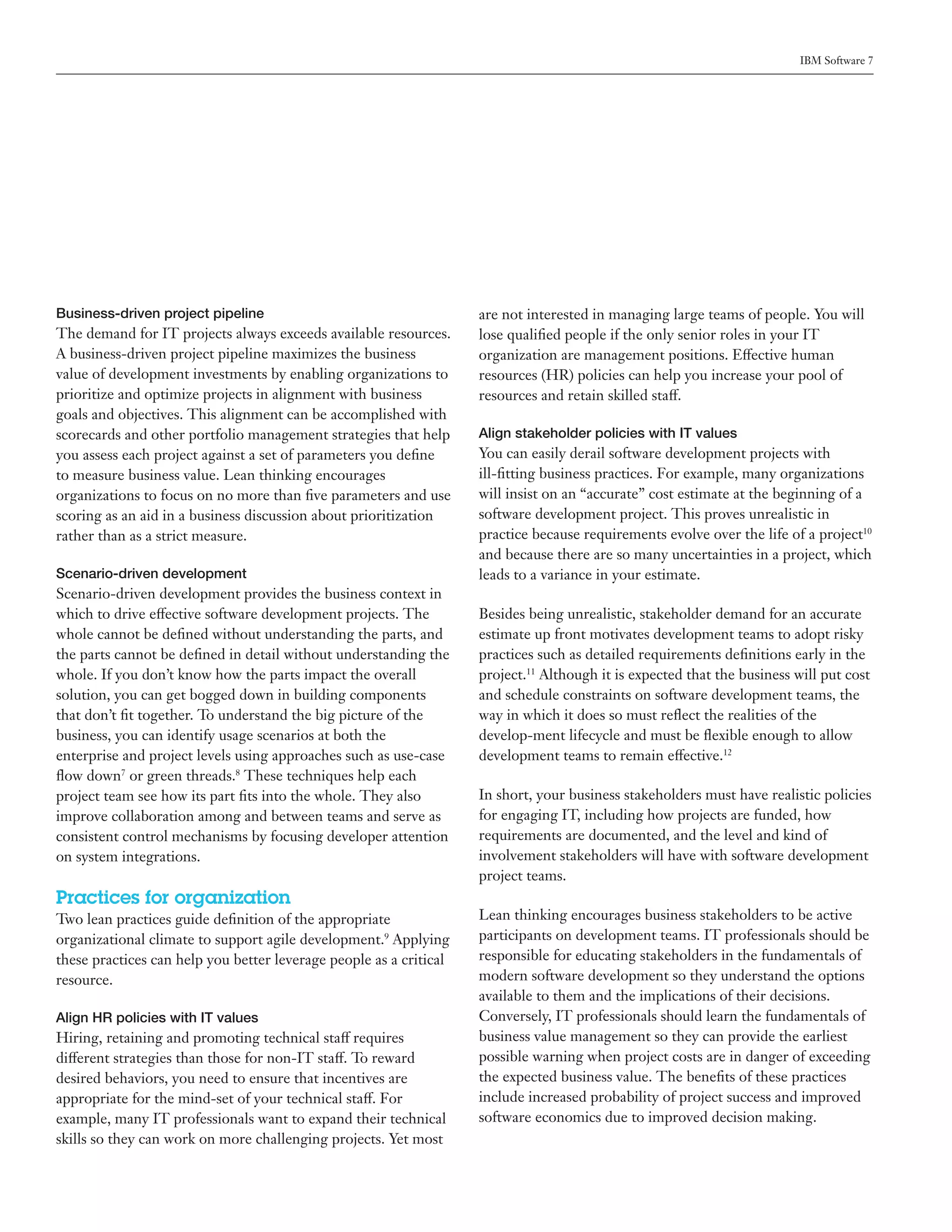
complete (see Figure 3). There are several key benefits to this
                                                                    deliver at some point.
approach. First, the length of each iteration is fixed, not the


Figure 3: Based on frequent demonstrations and stakeholder feedback, the small course corrections early in the lifecycle of an
iterative (“modern”) project lead to more rapid success, compared to a “waterfall” project.
IBM Software 9


Most important, an iterative approach increases your ability to        Risk-based milestones
build systems that meet the changing needs of your                     Iterative development is most effective when you combine it
stakeholders. IBM recommends four-week-long iterations by              with a deliberate balance of early risk reduction and early value
default.15 As you recognize that some other length for                 creation through risk-based milestones. This means that, as
iterations is more appropriate for the context of a project,           you prioritize the work for each iteration, you choose to
change the iteration length to reflect that context. You should        develop those features that represent the biggest business,
strive for the shortest iteration length possible for your             organizational, programmatic and technical risks while
environment because the longer the iteration length the                delivering the most value. Because these two objectives—
greater the risk of allowing needless bureaucracy to creep into        greatest risk and greatest value—are not usually aligned, the
your software delivery processes. There should be no time              risk-based milestones approach of Disciplined Agile Delivery
between iterations: all activities—from evaluating progress            (DAD) or Unified Process (UP) forces a deliberate choice
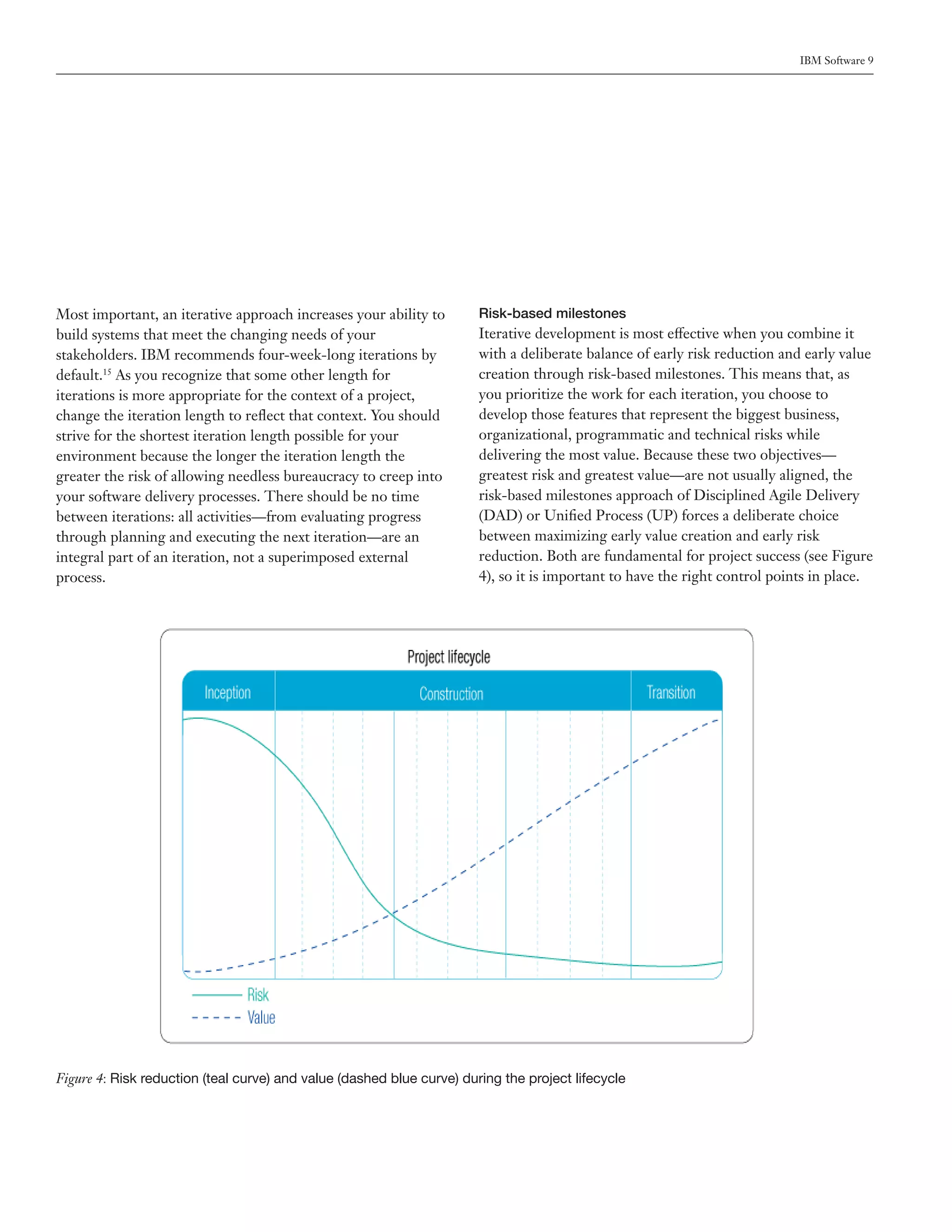
through planning and executing the next iteration—are an               between maximizing early value creation and early risk
integral part of an iteration, not a superimposed external             reduction. Both are fundamental for project success (see Figure
process.                                                               4), so it is important to have the right control points in place.


Figure 4: Risk reduction (teal curve) and value (dashed blue curve) during the project lifecycle
10   Agility@Scale


Throughout a Disciplined Agile Delivery (DAD) project there           calling out eight scaling factors: geographic distribution, team
are light-weight management milestones requiring project              size, regulatory compliance, domain complexity, technical
deliverables to be assessed for risk reduction and value              complexity, organizational complexity, organization
creation. For example, at the end of the Inception phase you          distribution, and enterprise discipline.
should verify that a shared stakeholder consensus around vision
and plan for the current release has been reached. Early in the       We have two critical observations about tailoring your process
Construction phase the team needs to demonstrate that it has          to meet your needs. First, a flexible, practices-based process
an executable architecture, with a few selected scenarios that        framework allows you to maximize reuse across lines of
can be executed, and with a risk list that reflects the mitigation    business (LOB) and projects while enabling flexibility so they
of many key technical and other risks. This risk reduction            can adapt the process to their needs. For example, a given
needs to be balanced with the value of the running code to            project cares about eight specific practices right now because
show concrete evidence that the team has made actual                  they address the challenges faced by that team. Another team
progress. Note that Rational Unified Process (RUP) takes a            may focus on six practices, with four in common with the other
slightly different approach with an explicit phase called             project team, because they face a different situation. The IBM
Elaboration which focuses on proving the architecture with            practices library is a good resource [27]. Second, a project
working code – DAD adopted the strategy of proving the                team should also adapt process ceremony to lifecycle phase.
architecture with working code from RUP but combined its              The beginning of a project is typically accompanied by
Elaboration and Construction phases into one. IBM                     considerable uncertainty, and you want to encourage a lot of
recommends adopting a risk-value lifecycle which includes             creativity to develop an application that addresses the business
explicit milestones.16 You can adopt similar strategies even if       needs. More process typically reduces creativity, so you should
you are following other agile processes such as Scrum or              use less process at the beginning of a project when uncertainty
Extreme Programming (XP).                                             is an everyday factor. On the other hand, late in the project you
                                                                      often want to introduce more control, such as feature freeze or
Risk-based milestones provide greater stakeholder insight and         change-control boards, to remove unpredictability and risks
control and promote early value creation. They also help              associated with the late introduction of defects.
reduce the chance of project failure and can improve
productivity by driving out technical risks early, helping to         Continuous improvement
thereby reduce overall project risk.                                  Lean-thinking organizations strive to continually improve
                                                                      processes. IBM recommends performing an assessment, such
Process adaptation                                                    as a retrospective,17 at the end of each iteration and at project
Because all projects are not created equal, it is critical to adapt   end to capture lessons learned, and leverage that knowledge to
the development process to the needs of the project. A team           improve the process.
developing a Web site will work differently than a team
developing a data warehouse. A team of 5 people will work             The fundamental concept behind continuous improvement is
differently than a team of 50. A team developing a life-critical      simple: improve the way you work whenever the opportunity
system will work differently than a team building a business          presents itself. The old recommendation “You should learn
application. It is not a question of more process being better or     something new every day” is a good one. Furthermore, this
less process being better. Rather, the amount of ceremony,            practice goes one step further and recommends that you act on
precision and control present in a project must be tailored to a      what you learn and increase your overall effectiveness.
variety of factors. The Agile Scaling Model (ASM) [26] defines
a contextual framework for understanding the range of                 There are several ways that you can identify potential
situations which IT delivery teams face, agile or otherwise,          improvements to your software process during the execution of
IBM Software 11


a software project. For example, you could include informal           Simple and relevant metrics
improvement sessions or staff suggestion boxes or Web sites.          Simple and relevant metrics provide the information necessary
Or you could encourage personal reflection and provide teams          to understand how you are doing so you can take corrective
with an editable process (perhaps via a wiki). An effective           actions as needed. Sadly, most organizations either use no
strategy is to schedule two hours at the end of each iteration        metrics at all—meaning they’re effectively flying blind—or
for an informal retrospective. The practice of continuous             they overdo it. They collect so many measurements that they
improvement enables you to learn as you go and gives the team         drown in data.
clear control over its destiny.
                                                                      Effective metrics are relevant because they are commonly used
Embedded compliance                                                   throughout your organization, and they provide the
The easier compliance is to achieve, the greater the chance IT        information managers and executives need to take timely,
professionals will actually comply. Therefore, compliance to          appropriate action. When done right, simple and relevant
regulations, corporate policies and guidance should be                metrics enable fact-based governance. When such metrics are
automated wherever possible. When automation isn’t an                 automated, they enable painless governance. And when they
option, compliance-related tasks should be part of your culture       are used to explore critical trends, they enable proactive
and daily activities, rather than a set of tasks done as a separate   governance.
and late-in-the-game effort. Compliance becomes part of your
culture when people understand why it’s important and what            It’s best to start with metrics that explore the value being
the underlying principles are behind it. If compliance requires       delivered by teams, the quality being delivered by the project
significant amounts of extra work, particularly when that work        and the cost being expended. Not only are these metrics useful
is perceived to be onerous or arbitrary by the people doing it,       for determining the current status of your projects, but they’re
then chances are greater that your compliance effort will be          also useful for determining how far a team has deviated from
subverted by development teams.                                       initial expectations. Expectations are set at the business case
                                                                      level for time, spending and use of resources, and may be
The benefits of embedding compliance include reducing your            updated periodically throughout the project. Bear in mind that
overall compliance costs, reducing pushback from development          the fundamental rule of all business metrics—measure the
teams, and achieving higher levels of compliance than with            thing that you actually want to control—applies equally to
traditional approaches. IBM recommends that you define a              development project metrics. For example, if you want to
minimal solution that can be integrated into your process and         improve code quality, don’t measure the number of bugs fixed.
tools based on the intent of the appropriate regulations. A key       Measure the number of bugs remaining. When the true goal is
consideration is assigning the right people to interpret the          hard to measure, it is often tempting to substitute a more easily
regulations and create guidelines for development teams to            quantified proxy that you believe tracks the true goal. For
follow. If you assign bureaucrats to this effort, you will end up     example, your true goal might be to improve overall ROI, but
with a bureaucratic solution.                                         you choose to measure costs instead. Hard experience has
                                                                      shown that inevitably people will focus on the thing that is
Practices for measurement                                             actually measured. Over time the proxy will become
Within the measures category of development governance,               increasingly decoupled from and thus unreliable as a measure
IBM recommends two lean practices that foster informed                of the true goal. Worse yet, the greater the rewards or
decision making with supporting targets and incentives.18             punishments associated with the proxy measure, the faster this
                                                                      divergence will happen. It is better to roughly measure the true
                                                                      goal than to precisely measure a proxy.
12   Agility@Scale


Continuous project monitoring                                      structure in which it operates. The team assumes the
You can regularly monitor the health of the IT projects within     responsibility of doing the work the way it chooses. Team
your organization through automated metrics collection,            members select their own activities, everyone commits to the
project milestone reviews, postmortem reviews and even word        work and the team coordinates regularly. This is a participatory
of mouth. Continuous project monitoring, combined with             approach to decision making in which everyone has the
iterative development, enables fact based governance by            opportunity to provide input and listen to the decision-making
providing up-to-date and accurate metrics based on delivered       process.
code versus assessments of specifications. This monitoring
enables earlier problem detection, allowing you to take            Self-organization works well when combined with iterative
corrective actions sooner and enabling effective governance        development because the iterative approach allows the team
when you monitor the right metrics. IBM suggests that you          and its stakeholders to agree on what should be delivered in
begin by automatically capturing and displaying your metrics       the next iteration. At the end of the iteration, the team and all
via dashboard software. At http://jazz.net you can see             stakeholders assess what was done, and corrective actions are
examples of live project dashboards for the various Jazz           taken. Although the team takes collective responsibility, the
product teams, dashboards which display information                ultimate responsibility and associated decision rights lie with
generated by the development tools being used by the project       the manager. Iterations provide a control mechanism to keep
teams themselves. Furthermore, it’s possible to roll up            self-organized teams from going off in undesirable direc¬tions.
project-focused metrics to the portfolio level, and drill down     Benefits from self-organization include:
into the details as needed [28]. But, don’t try to manage by the
numbers alone. When a project seems to be deviating from its       •	   Higher motivation that can lead to increased productivity
expected course, you should talk with the project team to          •	   Decisions being made at the right place within the
determine what is actually happening and whether team                   organizational structure because teams are empowered with
members need help from you.                                             both the responsibility and the authority to get the job done
                                                                   •	   Fewer opportunities for errors because of better
Practices for roles and responsibilities                                communication and fewer transitions of work products
The two lean practices in the roles and responsibilities                between individuals.
governance category focus on enabling development by               •	   Greater opportunities for people to increase their skills.
making it clear who is responsible, who has authority and to
whom these people are accountable.19
                                                                   In short, project teams must have the authority to organize
Promote self-organizing teams                                      themselves, their work environment and their overall approach
The first value of agile software development is to foster         as they see fit to effectively achieve project results. Any
individuals and interactions over processes and tools.20 When it   constraints placed on the team, such as organizational guidance
comes to lean development governance, the focus should be on       (eg. coding standards, data guidelines, security guidelines, and
enabling IT professionals to build high-quality working            usability guidelines), must be described to and negotiated with
software and promoting effective collaboration among team          the team throughout the project. Our experience is that
members, instead of trying to control or directly manage them.     effective agile teams balance self-organization with appropriate
                                                                   governance, something which is built into IBM’s Disciplined
A self-organizing team has the authority to allocate the work      Agile Delivery (DAD) process framework.
that it will perform within the scope of the governance
IBM Software 13


Align team structure with context                                    appropriately. Within IBM Software Group we’ve applied this
It is important to align team structure with the context of the      strategy for several common components which needed to
situation in which the team finds itelf. Conway’s law, defined       evolve quickly to support the needs of several disparate teams
by Melvin Conway in the late 1960s,21 tells us that any piece of     who wanted to reuse the components. We found that in such
software reflects the organizational structure of the group that     situations a component team became overwhelmed with
produced it (or succinctly, “You ship your organization”).           change requests and couldn’t easily support the required rate of
People will work in a manner that reflects the way they are          change. This strategy work well in organizations with an
organized. In other words, a decentralized group is likely to        existing and strong open source culture.
produce a system with a decentralized architecture. Any
strengths or weaknesses in a project team’s organizational           4. Specialist teams - A specialist team focuses on the work
structure will inevitably be reflected in the resulting solution     required for a single development discipline, such as
that it produces.                                                    programming, testing, or architecture. Each subteam does
                                                                     their portion of the overall work to implement the required
For large delivery teams there are four fundamental strategies,      functionality and then hands off to the next subteam(s) down
which can and often are combined, for organizing their               the line. This strategy works well for organizations which still
structure:                                                           have IT departments comprised mostly of specialists. The
                                                                     authors do not recommend this strategy for anything but a last
1. Component teams - With this strategy a subteam is                 resort due to the significant bureaucratic burden of organizing
responsible for one or more components of the technical              such teams, of validating the work when it is handed-off
architecture. A component may be a large scale domain                between teams, the increase traceability burden, and other
component, such as payment processing within a                       similar problems.
manufacturing company, a collection of web services, a
technical framework (i.e. a security framework), or a                Practices for policies and standards
subsystem. This strategy works well when the architecture of         The three lean practices underlying governance policies and
the overall system is highly cohesive and loosely coupled and        standards describe specific guidelines to support consistent
when the requirements are easily assigned to a single                operation among the various parties involved with
component (large requirements which span components would            development.22
need to be divided into small requirements which do not).
                                                                     The first value of agile software development is to prefer
2. Feature teams - A feature team is responsible for fully           individuals and interactions over processes and tools. This
implementing a given requirement, the feature, regardless of         doesn’t imply that you won’t have any processes and tools at
the number of components the change affects. This strategy           all, it simply states that they should be secondary to people,
works well in environments with developers with a                    and the tools and processes should reflect the way that people
comprehensive knowledge about the system the are working             work, not the other way around. With a lean approach to
on, a sophisticated change and control process, and a                governance your organization will adopt policies and standards
continuous integration approach.’                                    that enable developers to collaborate effectively, that motivate
                                                                     them to develop and reuse existing infrastructure and assets,
3. Internal open source - The basic idea is that the artifacts for   and that enable them to do high-quality work. If there is a
a component are made available internally within your                conflict between effective individual behaviors and tool
organization in an open source manner and people from                behaviors, the tool should concede.
various development teams will evolve the artifacts
14   Agility@Scale


Integrated lifecycle environment                                    There are significant organizational benefits to supporting
Software development relies on intense collaboration among          valued IT assets, including increased consistency and efficiency,
team members at separate sites who frequently work different        improved time to market, improved communication and
hours or in different time zones. The sheer size of many            decreased governance costs. IT departments should maintain
development efforts also makes collaboration difficult because      coding standards for their primary development languages, a
you need to support large-scale interactions. Added to the          library of common patterns that they wish to promote within
challenge is the need for management oversight and the              their systems, reference architectures for critical aspects of
necessary bookkeeping to ensure regulatory compliance.              their technical infrastructure, and a description of the vision
Integrated lifecycle environments are built to enable               for their enterprise architecture. There should also be people
collaboration at the lowest possible cost enabling infrastructure   in place to support, evolve, and purchase or harvest these
for most if not all the other governance practices.                 valued IT assets. An asset repository, such as IBM Rational
                                                                    Asset Manager (RAM), is critical to enable IT professionals to
Key components of an integrated lifecycle environment               find and manage the reusable assets available to them, and to
include tools for software configuration management, analysis,      capture and enforce policies related to asset creation and reuse.
design, construction, test, quality assurance, process              And, it’s important to have metrics in place that can identify
management and project management. Lean integrated                  and reduce barriers to reuse, as well as measure the value of
lifecycle environments such as the IBM Rational Application         different elements of the reuse effort.
Lifecycle Management (ALM) solution, facilitate
implementation of all or almost all of the identified governance    Wherever possible you should buy rather than build an IT
practices. They help you lower your total cost of ownership         asset, particularly if you can easily acquire something that
(TCO) for tool environments, and enable collaboration. And,         meets your needs, and thereby put the maintenance burden on
the best tool environments will automatically capture as much       someone else.
audit and metric data as possible with as little drag on
developers’ work as possible.                                       Flexible architectures
                                                                    One of the aims of lean software development governance is to
Valued corporate assets                                             enable flexibility and responsiveness in your business, which in
An IT asset is any software component, service, template,           turn requires flexibility and responsiveness in how you
enterprise model, reference architecture, example, pattern,         organize and evolve your IT systems. Lean governance is
guideline or standard that the organization expects IT              enabled by flexible architectures because they enable
professionals to apply in their everyday work. A valued IT asset    development teams to react effectively to the changing needs
is one that IT professionals actually want to apply, typically      of the business. Currently the most flexible approaches to
because they are viewed as both relevant to the task at hand        architecture are through open computing and service
and of sufficiently high quality. In other words, IT                orientation and through the adoption of lean development
professionals take advantage of the IT assets available to them     techniques such as Agile Model Driven Development,23 Test
because the assets actually enable them to increase their           Driven Development (TDD),24 and continuous integration.25
productivity.                                                       Flexible architectures can support evolving business needs,
                                                                    reduce time to market, increase ROI, lower TCO and reduce
Developers follow the enterprise architecture and appropriate       technical risk. By default, IBM recommends service-oriented
reference architectures because those assets save them time.        architectures (SOAs), open source technologies such as
Their systems invoke existing services, so they can take            Eclipse, and standards such as Java™ Platform, Enterprise
advantage of existing technical infrastructure. The key is to       Edition (Java EE) and Unified Modeling Language (UML)..
make it easier to reuse assets than to build them again.
IBM Software 15


Conclusion                                                         Authors
Every IT organization has a development governance program
                                                                   Scott W. Ambler, Chief Methodologist for Agile and Lean, Rational
in place, but this program may not be explicit and it may not      Software, IBM Software Group
be effective. Traditional development governance frameworks
have had limited success because developers are intellectual       Per Kroll, Chief Solution Architect, Measured Improvements, Rational
workers who don’t work well under command-and-control              Software, IBM Software Group
approaches. To be effective, a governance program must reflect
the actual environment in which it is being applied, and take      Endnotes
into consideration the people involved.
                                                                   We’d like to thank Cheri Bergeron, Lynn Brennan, Murray Cantor, Bernie
                                                                   Coyne, Clay M. Nelson, Bob Noble, Ted Rivera and Carl Zetie for the
Successful development governance focuses on enabling the          feedback and insights they provided for this paper.
right behaviors and the best practices through collaborative
and supportive techniques. It proves to be far more effective to   1
                                                                    Kroll, Per; “Making Agile Mainstream: Crossing the Chasm”; IBM
motivate people to do the right thing instead of forcing them      Rational Edge; http://www.ibm.com/developerworks/rational/library/mar07/
                                                                   kroll; 2007
to do so. The 18 practices IBM has identified for lean
development governance reflect the realities of software
                                                                   2
                                                                    Cantor, Murray and Sanders, John D.; “Operational IT Governance”; IBM
                                                                   Rational Edge; http://www-128.ibm.com/developerworks/rational/library/
development today. These practices can enable you to embed         may07/cantor_sanders/index.html; May 2007
governance in your tools, processes and development guidance.      3
                                                                    Poppendieck, Mary and Poppendieck, Tom; Implementing Lean Software
They support such modern approaches to development as              Development: From Concept to Cash; Addison-Wesley Professional; Boston;
Lean Software Development, Scrum, XP, Rational Unified             2006
Process (RUP), Disciplined Agile Delivery (DAD), and Eclipse       4
                                                                    Ambler, S. W. and Kroll, Per; “Best practices for lean development
Way.                                                               governance—Part 1: Principles and Organizations”; IBM Rational Edge;
                                                                   http://www.ibm.com/developerworks/rational/library/jun07/kroll; 2007
Development governance is only part of the overall IT and          5
                                                                    Kroll, P. and MacIsaac, B.; Agility and Discipline Made Easy—Practices from
systems engineering governance picture, but it’s an important      OpenUP and RUP; Addison-Wesley Professional; Pearson Education, Inc.;
one. By streamlining the flow of work performed by the team,       Boston; 2006

a lean approach to governance can help you improve the value       6
                                                                    Bittner, K. and Spence, I.; Managing Iterative Software Development Projects;
provided by development projects.                                  Addison-Wesley Professional; Boston; 2006
                                                                   7
                                                                    Cantor, M.; “Requirements Analysis and Design Part 3”; IBM Rational
For more information                                               Edge; http://www.ibm.com/developerworks/rational/library/content/
                                                                   RationalEdge/oct03/m_rupse_mc.pdf; 2003
To learn more about the Rational tools that can help you
implement lean development governance practices, contact
                                                                   8
                                                                    Nightingale, J. ; “Green Threads: Improving Cross-Product Integration”;
                                                                   Dr. Dobb’s Journal; http://www.ddj.com/architect/196603524; 2006
your IBM representative or visit:
ibm.com/rational/agile
                                                                   9
                                                                    Ambler, S. W. and Kroll, P.; “Best practices for lean development
                                                                   governance—Part 1: Principles and Organizations”; IBM Rational Edge;
                                                                   http://www.ibm.com/developerworks/rational/library/jun07/kroll/; 2007
For an all-in-one lean development solution, learn more about
IBM Rational Team Concert at:
                                                                   10
                                                                     Kroll, P. and Royce, W.; “Key Principles for Business-Driven
                                                                   Development”; IBM Rational Edge; http://www.ibm.com/developerworks/
ibm.com/rational/rtc                                               rational/library/oct05/kroll; 2005

                                                                    Ambler, Scott W.; “Examining the “Big Requirements Up Front (BRUF)”
                                                                   11

                                                                   Approach”; http://www.agilemodeling.com/essays/examiningBRUF.htm;
                                                                   2005
Ambler, Scott W.; “Agile on a Fixed Budget”; Dr. Dobb’s Journal; http://
12

www.ddj.com/architect/196603524; 2006
                                                                                © Copyright IBM Corporation 2011
 Ambler, S. W. and Kroll, Per; “Best practices for lean development
13

governance—Part 2: Processes and Measures”; IBM Rational Edge; http://          IBM Corporation
www.ibm.com/developerworks/rational/library/jul07/kroll_ambler; 2007            Software Group
                                                                                Route 100
14
     Agile Alliance; The Agile Manifesto; http://www.agilemanifesto.org; 2001   Somers, NY 10589
                                                                                U.S.A.
 Cantor, Murray and Kruchten. P.; Rational Unified Process Made Easy—A
15

Practitioner’s Guide to the RUP; Addison-Wesley Professional; Pearson           Produced in the United States of America
Education, Inc.; Boston; 2003                                                   January 2011
                                                                                All Rights Reserved
 Kroll, P. and MacIsaac, B; Agility and Discipline Made Easy—Practices from
16

OpenUP and RUP; Addison-Wesley Professional; Pearson Education, Inc.;           IBM, the IBM logo, Rational and ibm.com are trademarks or registered
Boston; 2006                                                                    trademarks of International Business Machines Corporation in the United
                                                                                States, other countries, or both. If these and other IBM trademarked terms
 Kerth, Norman L; Project Retrospectives: A Handbook for Team Reviews;
17
                                                                                are marked on their first occurrence in this information with a trademark
Dorset House; New York; 2001                                                    symbol (® or ™), these symbols indicate U.S. registered or common law
 Ambler, S. W. and Kroll, Per; “Best practices for lean development
18                                                                              trademarks owned by IBM at the time this information was published. Such
governance—Part 2: Processes and Measures”; IBM Rational Edge; http://          trademarks may also be registered or common law trademarks in other
www.ibm.com/developerworks/rational/library/jul07/kroll_ambler; 2007            countries. A current list of IBM trademarks is available on the Web at
                                                                                “Copyright and trademark information” at ibm.com/legal/copytrade.shtml
19
  Ambler, S. W. and Kroll, Per; “Best practices for lean development
governance—Part 3: Roles and Policies”; IBM Rational Edge; http://www.          Other company, product and service names may be trademarks or service
ibm.com/developerworks/rational/library/aug07/ambler_kroll/; 2007               marks of others.

20
     Agile Alliance; The Agile Manifesto; http://www.agilemanifesto.org; 2001   References in this publication to IBM products and services do not
                                                                                imply that IBM intends to make them available in all countries in which
21
  Conway, M. E.; “How Do Committees Invent?”; Datamation Magazine;              IBM operates.
http://www.melconway.com/research/committees.html; 1968
                                                                                The information contained in this documentation is provided for
22
  Ambler, S. W. and Kroll, Per; “Best practices for lean development            informational purposes only. While efforts were made to verify the
governance—Part 3: Roles and Policies”; IBM Rational Edge; http://www.          completeness and accuracy of the information contained in this
ibm.com/developerworks/rational/library/aug07/ambler_kroll/; 2007               documentation, it is provided “as is” without warranty of any kind, express
                                                                                or implied.
 Ambler, S. W.; The Object Primer 3rd Edition: Agile Model Driven
23

Development with UML 2; Cambridge University Press; New York; 2005                       Please Recycle
 Astels, D.; Test-Driven Development: A Practical Guide; Addison Wesley;
24

Upper Saddle River, New Jersey; 2003

 IBM; Rational Build Forge; http://www-306.ibm.com/software/awdtools/
25

buildforge; 2007
26
  Ambler, S.W.; “The Agile Scaling Model (ASM): Adapting Agile Methods for
Complex Environments”; ftp://ftp.software.ibm.com/common/ssi/sa/wh/n/
raw14204usen/RAW14204USEN.PDF; 2009
27
  IBM; IBM Practices Plugins for Rational Method Composer; http://www.
ibm.com/support/docview.wss?rs=2360&uid=swg24024567; 2010
28
  IBM; Rational Executive Dashboard; http://jazz.net/projects/rational-
insight/exec-dashboard/; 2010

 IBM; IBM Rational Asset Manager; http://www.ibm.com/
29

developerworks/rational/products/ram/; 2010


                                                                                                                                     RAW14000-USEN-01

Applying agile and lean principles to the governance of software and systems development

  • 1.
    IBM Software Agility@Scale™ Rational Applying agile and lean principles to the governance of software and systems development
  • 2.
    2 Agility@Scale Applying lean thinking to the governance It’s possible to loosen the reins on of software development development teams without losing control. As more and more project teams adopt agile software development methods, issues arise with traditional approaches The good news is that you’re likely following some of these to IT governance. Such approaches—which include Control practices already. The bad news is that it’ll likely take your Objectives for Information and Related Technology (COBIT) organization several years to adopt every practice, and there’s and the Project Management Institute (PMI) Organizational no set order in which to implement them. However, the Project Management Maturity Model (OPM-3)—are often too practices are synergistic and can be adopted incrementally. heavy in practice for development shops seeking to be more Each added practice helps strengthen your ability to effectively agile or lean. implement subsequent practices. Effective governance for lean development isn’t about Defining governance command and control. Instead, the focus is on enabling the IT and systems engineering governance establishes chains of right behaviors and practices through collaborative and responsibility, authority and communication in support of the supportive techniques. It is far more effective to motivate overall enterprise’s goals and strategy. It also establishes people to do the right thing than it is to force them to do so. measurements, policies, standards and control mechanisms to enable people to carry out their roles and responsibilities A lean approach to development governance weaves the effectively.1 You do this by balancing risk versus return on philosophies of lean and agile software development into investment (ROI), setting in place effective processes and traditional IT governance to form a lightweight, collaboration- practices, defining the direction and goals for the department, based framework that reflects the realities of modern IT and defining the roles that people play with and within the organizations. department. This paper begins with an overview of the principles of Governance and management are two different things: effective IT governance, discussing how they pertain to the Governance looks at an organization from the outside, treating more specific subset of development governance. It follows it as a system that needs to have the appropriate structure and with an overview of the principles of lean software processes in place to provide a stream of value. Management, development. The heart of the paper is a description of on the other hand, is inside the organization and ensures that eighteen practices that define a lean approach to governing the structure and processes are implemented effectively. software development projects within your IT organization. These practices show how to embed governance into tools, Development governance is an important subset of IT and processes and development guidance to make it as easy as system engineering governance, the scope of which covers the possible for people to keep their software and systems delivery steering of software and system development projects. Based projects on track. They bring the lean thinking that has on considerable experience with agile development teams, IBM revolutionized supply chain management into the governance believes organizations that have adopted COBIT or OPM-3 of software and systems development. (or similar traditional frameworks) can benefit by loosening the reins on their approach to governing development projects— without sacrificing essential controls and audit trails. To help you improve your governance framework, IBM has developed a palette of practices that support lean development.
  • 3.
    IBM Software 3 Althoughmany of these practices also apply to IT and systems organization performing in such a way that business goals are engineering governance in general, the focus of this paper is on met. In many ways the maxims “You ship the organization” and governing agile and lean development projects. “You get what you measure” are primary motivators for organizations to build an effective development governance Principles of effective IT governance program. In The IBM Rational Edge2, Murray Cantor and John D. Sanders describe seven principles to guide IT governance Deployment efforts. Because development governance is a subset of IT The governance solution must be implemented incrementally. governance, these principles are directly applicable to a You cannot implement all of the practices described in this discussion of lean development governance. They address paper at once. You must first pick and choose the ones that process, artifact lifecycle, risk, suitability, behavior, deployment address your immediate pains before adopting others. and automation. Automation Process Technology makes the governance solution empowering and Governance is a process that is applied to the processes that unobtrusive. The more you embed, or automate, your need to be governed. Policies and standards are applied to development governance practices through automation and development processes; decision rights are enforced within the culture, the more likely they are to be followed. processes; and the processes are measured and controlled. Principles of lean software development Artifact lifecycle In Implementing Lean Software Development 3, Mary and The lifecycles of artifacts produced by the governed processes Tom Poppendieck show how the seven principles of lean guide the governance solution. Part of governing software manufacturing can be applied to optimize the whole IT value development is understanding the artifacts (such as executable stream. These principles offer practical, measurable ways to tests and working software) produced by project teams, and transform software delivery processes. then monitoring how these artifacts evolve throughout the develop¬ment effort. Eliminate waste Lean thinking advocates regard any activity that does not Risk directly add value to the finished product as waste. The three Measures and controls must be adjusted according to the level biggest sources of waste in software development are the of risk. When risk is low you can focus on measuring the addition of extra features, churn and crossing organizational activities of the team. When risk is high you need to focus on boundaries. Crossing organizational boundaries can increase helping the team mitigate the risk(s) it faces. costs by 25 percent or more by creating buffers that slow response time and interfere with communication. It is critical Suitability that development teams be allowed to organize and operate in The needs of the organization determine how the level and a manner that reflects the work they’re trying to accomplish— style of governance are tailored. For example, development rather than the functional roles of team members. teams building life critical software need a tighter governance approach than teams building an informational Web site. Build in quality The Poppendiecks make a simple observation: if you routinely Behavior find problems with your verification process, then your process The governance solution drives the organizational behavior. must be defective. When you regularly find that your From a development governance point of view, the challenge is developers are doing things that you don’t want them to to create an environment that results in the development
  • 4.
    4 Agility@Scale do—or are not doing what they should be doing—then your Optimize the whole approach to governance must be at fault. It’s important not to If you want to govern your development efforts effectively, you make governance yet another set of activities layered on top of must look at the bigger picture. You need to understand the your software process. Instead the strategy should be to embed high-level business processes that individual projects support— governance into your processes, making it as easy as possible processes that often cross multiple systems. You need to for developers to do the right thing. manage programs of interrelated systems so you can deliver a complete product to your stakeholders. Measurements should Create knowledge address how well you’re delivering business value, because that Planning is useful, but learning is essential. You want to is the raison d’être of your IT department. promote strategies, such as iterative development, that help teams discover what stakeholders really want and act on that Categories of development governance knowledge. It’s also important to have a body of reusable Traditional governance often uses command-and-control standards and guidelines that people can easily modify to meet strategies. These strategies focus on managing and directing specific project needs. In addition, consistent and timely development project teams explicitly, using gateways and feedback is important, both within the team and at the triggers that attempt to enforce rules and catch violations. program level, through continuous monitoring of simple and Although valid and effective in some situations, this approach relevant metrics. can be like herding cats for many organizations. Much work is put into establishing the governance framework and managing Defer commitment the governance effort, but very little is achieved in practice. It’s not necessary to start software development by defining a complete specification. You can support the business effectively In contrast, lean governance focuses on collaborative strategies through flexible architectures that are change tolerant and by that strive to enable and motivate team members implicitly. scheduling irreversible decisions to the last possible moment. For example, the traditional approach to coding guidelines Frequently, deferring commitment requires the ability to would be to create them and then enforce their usage through closely couple end-to-end business scenarios to capabilities formal inspections and post hoc correction of errant code. The developed in multiple applications by multiple projects. lean approach would be to write the guidelines collaboratively with your programmers, explain why it’s important for Deliver quickly everyone to adopt the guidelines, and then provide tooling and It is possible to deliver high-quality systems quickly. By support to make it as easy as possible for developers to limiting the work of a team to its capacity, you can establish a continuously code within those guidelines. reliable and repeatable flow of work. An effective governance strategy doesn’t demand teams do more than they are capable Figure 1 categorizes and illustrates the relationships of the of, but instead asks them to self-organize and determine what practices for lean governance. It shows how they align to the they can accomplish. At an organizational level, it’s important six major categories of IT governance: mission and principles, to enable programs to deliver business value at a pace defined organization, processes, measures, roles and responsibilities, by the fastest-moving projects, rather than at the speed of the and policies and standards. slowest project. Respect people The Poppendiecks also observe that sustainable advantage is gained from engaged, thinking people. The implication is that you need a human resources strategy that focuses on enabling IT teams—not on controlling them.
  • 5.
    IBM Software 5 Figure1: The eighteen practices of lean software development governance are aligned to six categories of governance. Practices for mission and principles Under the guidance of a pragmatic governance body, IT teams IBM identifies four lean practices to guide the mission and 4 will be much more likely to conform to the governance principles category of governance. program because it’s easy for them to do so. People will actually step up and make processes and polices come alive to Pragmatic governance body help the organization reach its goals. The alternative is an A governance program does not run itself; a group of people environment where teams will do whatever is necessary to called a governance body runs it. The manner in which the comply with the command-and-control governance structure. governance body organizes and conducts itself is a key After any review, they’ll simply return to managing the project determinant of the overall effectiveness of the governance the way they see fit, resulting in two sets of books—the real program. one and the one presented outside of the team. To support lean development, a pragmatic governance body An effective approach for lean development is to create a small respects people by focusing on enabling IT professionals first, central team, often referred to as a governance competency and on controlling and managing them second. It does this by center, which is extended with part-time members from the creating an environment where people can be effective in governed IT organizations and the appropriate business units. practice and not just in management theory. Such an Making key representatives of the governed organizations part environment promotes situation-specific strategies, procedures of the governance body avoids a “us versus them” mentality and practices; provides teams with access to the resources they and helps ensure that governance guidance is relevant and need, including ready access to business stakeholders; and actionable. Picking the right people for the governance body is provides guidance, support and mentoring to teams that have absolutely crucial. Very often the people who jump at the deviated from expected norms. chance to volunteer for a governance body are the people you least want governing.
  • 6.
    6 Agility@Scale Staged program delivery There are several benefits to staged program delivery. First, by Staged program delivery enables you to optimize the whole grouping projects according to business objectives, and program while still completing projects quickly. Programs, managing them as a program, you can more effectively deliver which are collections of related projects, should be rolled out on major business objectives. Second, using a control project incrementally over time. Instead of holding back a release to provides well-defined governance milestones for the program wait for a subproject, each subproject must sign up for a that focus on risk and variance reduction as well as value predetermined release date. If the subproject misses the date, it creation. Third, dividing a potentially large program delivers skips to the next release, minimizing the impact to the value incrementally around business subgoals. And finally, customers of the program. Think of a train schedule. If the semi-independent execution of projects enables more efficient project misses the release train, it has to wait for the next one. development because each project has as much tactical Granted, because of dependencies between projects, sometimes flexibility as possible to support higher productivity. one project missing the release train causes several to do so. It is a good strategy to manage programs with loosely coupled As you see in Figure 2, usage of a control project enables individual projects, by a control project run according to four coordinated execution of the program while providing phases: inception, elaboration, construction and transition. flexibility in execution of individual projects within the control Ideally the individual projects should take an evolutionary project. Iterations play a fundamental role here, because they approach, using agile processes such as Disciplined Agile provide stable anchoring points to allow projects to drive and Delivery (DAD), Scrum or OpenUP. validate meaningful cross-project integration. Figure 2: As illustrated by Bittner and Spence in Managing Iterative Software Development Projects, risk reduction and value creation can be effectively addressed by managing a program stage through a control project.
  • 7.
    IBM Software 7 Business-drivenproject pipeline are not interested in managing large teams of people. You will The demand for IT projects always exceeds available resources. lose qualified people if the only senior roles in your IT A business-driven project pipeline maximizes the business organization are management positions. Effective human value of development investments by enabling organizations to resources (HR) policies can help you increase your pool of prioritize and optimize projects in alignment with business resources and retain skilled staff. goals and objectives. This alignment can be accomplished with scorecards and other portfolio management strategies that help Align stakeholder policies with IT values you assess each project against a set of parameters you define You can easily derail software development projects with to measure business value. Lean thinking encourages ill-fitting business practices. For example, many organizations organizations to focus on no more than five parameters and use will insist on an “accurate” cost estimate at the beginning of a scoring as an aid in a business discussion about prioritization software development project. This proves unrealistic in rather than as a strict measure. practice because requirements evolve over the life of a project10 and because there are so many uncertainties in a project, which Scenario-driven development leads to a variance in your estimate. Scenario-driven development provides the business context in which to drive effective software development projects. The Besides being unrealistic, stakeholder demand for an accurate whole cannot be defined without understanding the parts, and estimate up front motivates development teams to adopt risky the parts cannot be defined in detail without understanding the practices such as detailed requirements definitions early in the whole. If you don’t know how the parts impact the overall project.11 Although it is expected that the business will put cost solution, you can get bogged down in building components and schedule constraints on software development teams, the that don’t fit together. To understand the big picture of the way in which it does so must reflect the realities of the business, you can identify usage scenarios at both the develop-ment lifecycle and must be flexible enough to allow enterprise and project levels using approaches such as use-case development teams to remain effective.12 flow down7 or green threads.8 These techniques help each project team see how its part fits into the whole. They also In short, your business stakeholders must have realistic policies improve collaboration among and between teams and serve as for engaging IT, including how projects are funded, how consistent control mechanisms by focusing developer attention requirements are documented, and the level and kind of on system integrations. involvement stakeholders will have with software development project teams. Practices for organization Two lean practices guide definition of the appropriate Lean thinking encourages business stakeholders to be active organizational climate to support agile development.9 Applying participants on development teams. IT professionals should be these practices can help you better leverage people as a critical responsible for educating stakeholders in the fundamentals of resource. modern software development so they understand the options available to them and the implications of their decisions. Align HR policies with IT values Conversely, IT professionals should learn the fundamentals of Hiring, retaining and promoting technical staff requires business value management so they can provide the earliest different strategies than those for non-IT staff. To reward possible warning when project costs are in danger of exceeding desired behaviors, you need to ensure that incentives are the expected business value. The benefits of these practices appropriate for the mind-set of your technical staff. For include increased probability of project success and improved example, many IT professionals want to expand their technical software economics due to improved decision making. skills so they can work on more challenging projects. Yet most
  • 8.
    8 Agility@Scale Business stakeholders must play an active scope. If the estimation of effort is off due to unforeseen events or difficulties, it is the scope that must give and be reassessed in role on development project teams. the next iteration. Second, the definitions of “final product” and “complete” may evolve significantly from their original Practices for development processes conceptions during project execution when the business Five lean practices promote strategies for running a project stakeholders and implementers agree that doing so better efficiently and effectively.13 satisfies business objectives. Each iteration of the project will increase the shared understanding of requirements. Third, Iterative development time boxing forces fast decision making and a crisp focus on Using an iterative development approach, a project is what matters most—the regular delivery of working software. organized into a sequence of short iterations (referred to as Note that delivery isn’t always into production. Sometimes it’s “sprints” in Scrum14). Each iteration is time boxed and has a just into a test environment. The regular delivery of working well-defined set of objectives. The aim of each iteration is software increases the number of feedback opportunities com-plete, defect-free, working code. because stakeholders can easily see whether IT understands what they’ve asked for. It also enables fact-based governance During each iteration, you build on the work of previous because working software is a concrete representation of what iterations to evolve the requirements, analysis, design, a team has accomplished; whereas secondary artifacts such as implementation and test assets until the final product is plans or specifications are merely promises that the team may complete (see Figure 3). There are several key benefits to this deliver at some point. approach. First, the length of each iteration is fixed, not the Figure 3: Based on frequent demonstrations and stakeholder feedback, the small course corrections early in the lifecycle of an iterative (“modern”) project lead to more rapid success, compared to a “waterfall” project.
  • 9.
    IBM Software 9 Mostimportant, an iterative approach increases your ability to Risk-based milestones build systems that meet the changing needs of your Iterative development is most effective when you combine it stakeholders. IBM recommends four-week-long iterations by with a deliberate balance of early risk reduction and early value default.15 As you recognize that some other length for creation through risk-based milestones. This means that, as iterations is more appropriate for the context of a project, you prioritize the work for each iteration, you choose to change the iteration length to reflect that context. You should develop those features that represent the biggest business, strive for the shortest iteration length possible for your organizational, programmatic and technical risks while environment because the longer the iteration length the delivering the most value. Because these two objectives— greater the risk of allowing needless bureaucracy to creep into greatest risk and greatest value—are not usually aligned, the your software delivery processes. There should be no time risk-based milestones approach of Disciplined Agile Delivery between iterations: all activities—from evaluating progress (DAD) or Unified Process (UP) forces a deliberate choice through planning and executing the next iteration—are an between maximizing early value creation and early risk integral part of an iteration, not a superimposed external reduction. Both are fundamental for project success (see Figure process. 4), so it is important to have the right control points in place. Figure 4: Risk reduction (teal curve) and value (dashed blue curve) during the project lifecycle
  • 10.
    10 Agility@Scale Throughout a Disciplined Agile Delivery (DAD) project there calling out eight scaling factors: geographic distribution, team are light-weight management milestones requiring project size, regulatory compliance, domain complexity, technical deliverables to be assessed for risk reduction and value complexity, organizational complexity, organization creation. For example, at the end of the Inception phase you distribution, and enterprise discipline. should verify that a shared stakeholder consensus around vision and plan for the current release has been reached. Early in the We have two critical observations about tailoring your process Construction phase the team needs to demonstrate that it has to meet your needs. First, a flexible, practices-based process an executable architecture, with a few selected scenarios that framework allows you to maximize reuse across lines of can be executed, and with a risk list that reflects the mitigation business (LOB) and projects while enabling flexibility so they of many key technical and other risks. This risk reduction can adapt the process to their needs. For example, a given needs to be balanced with the value of the running code to project cares about eight specific practices right now because show concrete evidence that the team has made actual they address the challenges faced by that team. Another team progress. Note that Rational Unified Process (RUP) takes a may focus on six practices, with four in common with the other slightly different approach with an explicit phase called project team, because they face a different situation. The IBM Elaboration which focuses on proving the architecture with practices library is a good resource [27]. Second, a project working code – DAD adopted the strategy of proving the team should also adapt process ceremony to lifecycle phase. architecture with working code from RUP but combined its The beginning of a project is typically accompanied by Elaboration and Construction phases into one. IBM considerable uncertainty, and you want to encourage a lot of recommends adopting a risk-value lifecycle which includes creativity to develop an application that addresses the business explicit milestones.16 You can adopt similar strategies even if needs. More process typically reduces creativity, so you should you are following other agile processes such as Scrum or use less process at the beginning of a project when uncertainty Extreme Programming (XP). is an everyday factor. On the other hand, late in the project you often want to introduce more control, such as feature freeze or Risk-based milestones provide greater stakeholder insight and change-control boards, to remove unpredictability and risks control and promote early value creation. They also help associated with the late introduction of defects. reduce the chance of project failure and can improve productivity by driving out technical risks early, helping to Continuous improvement thereby reduce overall project risk. Lean-thinking organizations strive to continually improve processes. IBM recommends performing an assessment, such Process adaptation as a retrospective,17 at the end of each iteration and at project Because all projects are not created equal, it is critical to adapt end to capture lessons learned, and leverage that knowledge to the development process to the needs of the project. A team improve the process. developing a Web site will work differently than a team developing a data warehouse. A team of 5 people will work The fundamental concept behind continuous improvement is differently than a team of 50. A team developing a life-critical simple: improve the way you work whenever the opportunity system will work differently than a team building a business presents itself. The old recommendation “You should learn application. It is not a question of more process being better or something new every day” is a good one. Furthermore, this less process being better. Rather, the amount of ceremony, practice goes one step further and recommends that you act on precision and control present in a project must be tailored to a what you learn and increase your overall effectiveness. variety of factors. The Agile Scaling Model (ASM) [26] defines a contextual framework for understanding the range of There are several ways that you can identify potential situations which IT delivery teams face, agile or otherwise, improvements to your software process during the execution of
  • 11.
    IBM Software 11 asoftware project. For example, you could include informal Simple and relevant metrics improvement sessions or staff suggestion boxes or Web sites. Simple and relevant metrics provide the information necessary Or you could encourage personal reflection and provide teams to understand how you are doing so you can take corrective with an editable process (perhaps via a wiki). An effective actions as needed. Sadly, most organizations either use no strategy is to schedule two hours at the end of each iteration metrics at all—meaning they’re effectively flying blind—or for an informal retrospective. The practice of continuous they overdo it. They collect so many measurements that they improvement enables you to learn as you go and gives the team drown in data. clear control over its destiny. Effective metrics are relevant because they are commonly used Embedded compliance throughout your organization, and they provide the The easier compliance is to achieve, the greater the chance IT information managers and executives need to take timely, professionals will actually comply. Therefore, compliance to appropriate action. When done right, simple and relevant regulations, corporate policies and guidance should be metrics enable fact-based governance. When such metrics are automated wherever possible. When automation isn’t an automated, they enable painless governance. And when they option, compliance-related tasks should be part of your culture are used to explore critical trends, they enable proactive and daily activities, rather than a set of tasks done as a separate governance. and late-in-the-game effort. Compliance becomes part of your culture when people understand why it’s important and what It’s best to start with metrics that explore the value being the underlying principles are behind it. If compliance requires delivered by teams, the quality being delivered by the project significant amounts of extra work, particularly when that work and the cost being expended. Not only are these metrics useful is perceived to be onerous or arbitrary by the people doing it, for determining the current status of your projects, but they’re then chances are greater that your compliance effort will be also useful for determining how far a team has deviated from subverted by development teams. initial expectations. Expectations are set at the business case level for time, spending and use of resources, and may be The benefits of embedding compliance include reducing your updated periodically throughout the project. Bear in mind that overall compliance costs, reducing pushback from development the fundamental rule of all business metrics—measure the teams, and achieving higher levels of compliance than with thing that you actually want to control—applies equally to traditional approaches. IBM recommends that you define a development project metrics. For example, if you want to minimal solution that can be integrated into your process and improve code quality, don’t measure the number of bugs fixed. tools based on the intent of the appropriate regulations. A key Measure the number of bugs remaining. When the true goal is consideration is assigning the right people to interpret the hard to measure, it is often tempting to substitute a more easily regulations and create guidelines for development teams to quantified proxy that you believe tracks the true goal. For follow. If you assign bureaucrats to this effort, you will end up example, your true goal might be to improve overall ROI, but with a bureaucratic solution. you choose to measure costs instead. Hard experience has shown that inevitably people will focus on the thing that is Practices for measurement actually measured. Over time the proxy will become Within the measures category of development governance, increasingly decoupled from and thus unreliable as a measure IBM recommends two lean practices that foster informed of the true goal. Worse yet, the greater the rewards or decision making with supporting targets and incentives.18 punishments associated with the proxy measure, the faster this divergence will happen. It is better to roughly measure the true goal than to precisely measure a proxy.
  • 12.
    12 Agility@Scale Continuous project monitoring structure in which it operates. The team assumes the You can regularly monitor the health of the IT projects within responsibility of doing the work the way it chooses. Team your organization through automated metrics collection, members select their own activities, everyone commits to the project milestone reviews, postmortem reviews and even word work and the team coordinates regularly. This is a participatory of mouth. Continuous project monitoring, combined with approach to decision making in which everyone has the iterative development, enables fact based governance by opportunity to provide input and listen to the decision-making providing up-to-date and accurate metrics based on delivered process. code versus assessments of specifications. This monitoring enables earlier problem detection, allowing you to take Self-organization works well when combined with iterative corrective actions sooner and enabling effective governance development because the iterative approach allows the team when you monitor the right metrics. IBM suggests that you and its stakeholders to agree on what should be delivered in begin by automatically capturing and displaying your metrics the next iteration. At the end of the iteration, the team and all via dashboard software. At http://jazz.net you can see stakeholders assess what was done, and corrective actions are examples of live project dashboards for the various Jazz taken. Although the team takes collective responsibility, the product teams, dashboards which display information ultimate responsibility and associated decision rights lie with generated by the development tools being used by the project the manager. Iterations provide a control mechanism to keep teams themselves. Furthermore, it’s possible to roll up self-organized teams from going off in undesirable direc¬tions. project-focused metrics to the portfolio level, and drill down Benefits from self-organization include: into the details as needed [28]. But, don’t try to manage by the numbers alone. When a project seems to be deviating from its • Higher motivation that can lead to increased productivity expected course, you should talk with the project team to • Decisions being made at the right place within the determine what is actually happening and whether team organizational structure because teams are empowered with members need help from you. both the responsibility and the authority to get the job done • Fewer opportunities for errors because of better Practices for roles and responsibilities communication and fewer transitions of work products The two lean practices in the roles and responsibilities between individuals. governance category focus on enabling development by • Greater opportunities for people to increase their skills. making it clear who is responsible, who has authority and to whom these people are accountable.19 In short, project teams must have the authority to organize Promote self-organizing teams themselves, their work environment and their overall approach The first value of agile software development is to foster as they see fit to effectively achieve project results. Any individuals and interactions over processes and tools.20 When it constraints placed on the team, such as organizational guidance comes to lean development governance, the focus should be on (eg. coding standards, data guidelines, security guidelines, and enabling IT professionals to build high-quality working usability guidelines), must be described to and negotiated with software and promoting effective collaboration among team the team throughout the project. Our experience is that members, instead of trying to control or directly manage them. effective agile teams balance self-organization with appropriate governance, something which is built into IBM’s Disciplined A self-organizing team has the authority to allocate the work Agile Delivery (DAD) process framework. that it will perform within the scope of the governance
  • 13.
    IBM Software 13 Alignteam structure with context appropriately. Within IBM Software Group we’ve applied this It is important to align team structure with the context of the strategy for several common components which needed to situation in which the team finds itelf. Conway’s law, defined evolve quickly to support the needs of several disparate teams by Melvin Conway in the late 1960s,21 tells us that any piece of who wanted to reuse the components. We found that in such software reflects the organizational structure of the group that situations a component team became overwhelmed with produced it (or succinctly, “You ship your organization”). change requests and couldn’t easily support the required rate of People will work in a manner that reflects the way they are change. This strategy work well in organizations with an organized. In other words, a decentralized group is likely to existing and strong open source culture. produce a system with a decentralized architecture. Any strengths or weaknesses in a project team’s organizational 4. Specialist teams - A specialist team focuses on the work structure will inevitably be reflected in the resulting solution required for a single development discipline, such as that it produces. programming, testing, or architecture. Each subteam does their portion of the overall work to implement the required For large delivery teams there are four fundamental strategies, functionality and then hands off to the next subteam(s) down which can and often are combined, for organizing their the line. This strategy works well for organizations which still structure: have IT departments comprised mostly of specialists. The authors do not recommend this strategy for anything but a last 1. Component teams - With this strategy a subteam is resort due to the significant bureaucratic burden of organizing responsible for one or more components of the technical such teams, of validating the work when it is handed-off architecture. A component may be a large scale domain between teams, the increase traceability burden, and other component, such as payment processing within a similar problems. manufacturing company, a collection of web services, a technical framework (i.e. a security framework), or a Practices for policies and standards subsystem. This strategy works well when the architecture of The three lean practices underlying governance policies and the overall system is highly cohesive and loosely coupled and standards describe specific guidelines to support consistent when the requirements are easily assigned to a single operation among the various parties involved with component (large requirements which span components would development.22 need to be divided into small requirements which do not). The first value of agile software development is to prefer 2. Feature teams - A feature team is responsible for fully individuals and interactions over processes and tools. This implementing a given requirement, the feature, regardless of doesn’t imply that you won’t have any processes and tools at the number of components the change affects. This strategy all, it simply states that they should be secondary to people, works well in environments with developers with a and the tools and processes should reflect the way that people comprehensive knowledge about the system the are working work, not the other way around. With a lean approach to on, a sophisticated change and control process, and a governance your organization will adopt policies and standards continuous integration approach.’ that enable developers to collaborate effectively, that motivate them to develop and reuse existing infrastructure and assets, 3. Internal open source - The basic idea is that the artifacts for and that enable them to do high-quality work. If there is a a component are made available internally within your conflict between effective individual behaviors and tool organization in an open source manner and people from behaviors, the tool should concede. various development teams will evolve the artifacts
  • 14.
    14 Agility@Scale Integrated lifecycle environment There are significant organizational benefits to supporting Software development relies on intense collaboration among valued IT assets, including increased consistency and efficiency, team members at separate sites who frequently work different improved time to market, improved communication and hours or in different time zones. The sheer size of many decreased governance costs. IT departments should maintain development efforts also makes collaboration difficult because coding standards for their primary development languages, a you need to support large-scale interactions. Added to the library of common patterns that they wish to promote within challenge is the need for management oversight and the their systems, reference architectures for critical aspects of necessary bookkeeping to ensure regulatory compliance. their technical infrastructure, and a description of the vision Integrated lifecycle environments are built to enable for their enterprise architecture. There should also be people collaboration at the lowest possible cost enabling infrastructure in place to support, evolve, and purchase or harvest these for most if not all the other governance practices. valued IT assets. An asset repository, such as IBM Rational Asset Manager (RAM), is critical to enable IT professionals to Key components of an integrated lifecycle environment find and manage the reusable assets available to them, and to include tools for software configuration management, analysis, capture and enforce policies related to asset creation and reuse. design, construction, test, quality assurance, process And, it’s important to have metrics in place that can identify management and project management. Lean integrated and reduce barriers to reuse, as well as measure the value of lifecycle environments such as the IBM Rational Application different elements of the reuse effort. Lifecycle Management (ALM) solution, facilitate implementation of all or almost all of the identified governance Wherever possible you should buy rather than build an IT practices. They help you lower your total cost of ownership asset, particularly if you can easily acquire something that (TCO) for tool environments, and enable collaboration. And, meets your needs, and thereby put the maintenance burden on the best tool environments will automatically capture as much someone else. audit and metric data as possible with as little drag on developers’ work as possible. Flexible architectures One of the aims of lean software development governance is to Valued corporate assets enable flexibility and responsiveness in your business, which in An IT asset is any software component, service, template, turn requires flexibility and responsiveness in how you enterprise model, reference architecture, example, pattern, organize and evolve your IT systems. Lean governance is guideline or standard that the organization expects IT enabled by flexible architectures because they enable professionals to apply in their everyday work. A valued IT asset development teams to react effectively to the changing needs is one that IT professionals actually want to apply, typically of the business. Currently the most flexible approaches to because they are viewed as both relevant to the task at hand architecture are through open computing and service and of sufficiently high quality. In other words, IT orientation and through the adoption of lean development professionals take advantage of the IT assets available to them techniques such as Agile Model Driven Development,23 Test because the assets actually enable them to increase their Driven Development (TDD),24 and continuous integration.25 productivity. Flexible architectures can support evolving business needs, reduce time to market, increase ROI, lower TCO and reduce Developers follow the enterprise architecture and appropriate technical risk. By default, IBM recommends service-oriented reference architectures because those assets save them time. architectures (SOAs), open source technologies such as Their systems invoke existing services, so they can take Eclipse, and standards such as Java™ Platform, Enterprise advantage of existing technical infrastructure. The key is to Edition (Java EE) and Unified Modeling Language (UML).. make it easier to reuse assets than to build them again.
  • 15.
    IBM Software 15 Conclusion Authors Every IT organization has a development governance program Scott W. Ambler, Chief Methodologist for Agile and Lean, Rational in place, but this program may not be explicit and it may not Software, IBM Software Group be effective. Traditional development governance frameworks have had limited success because developers are intellectual Per Kroll, Chief Solution Architect, Measured Improvements, Rational workers who don’t work well under command-and-control Software, IBM Software Group approaches. To be effective, a governance program must reflect the actual environment in which it is being applied, and take Endnotes into consideration the people involved. We’d like to thank Cheri Bergeron, Lynn Brennan, Murray Cantor, Bernie Coyne, Clay M. Nelson, Bob Noble, Ted Rivera and Carl Zetie for the Successful development governance focuses on enabling the feedback and insights they provided for this paper. right behaviors and the best practices through collaborative and supportive techniques. It proves to be far more effective to 1 Kroll, Per; “Making Agile Mainstream: Crossing the Chasm”; IBM motivate people to do the right thing instead of forcing them Rational Edge; http://www.ibm.com/developerworks/rational/library/mar07/ kroll; 2007 to do so. The 18 practices IBM has identified for lean development governance reflect the realities of software 2 Cantor, Murray and Sanders, John D.; “Operational IT Governance”; IBM Rational Edge; http://www-128.ibm.com/developerworks/rational/library/ development today. These practices can enable you to embed may07/cantor_sanders/index.html; May 2007 governance in your tools, processes and development guidance. 3 Poppendieck, Mary and Poppendieck, Tom; Implementing Lean Software They support such modern approaches to development as Development: From Concept to Cash; Addison-Wesley Professional; Boston; Lean Software Development, Scrum, XP, Rational Unified 2006 Process (RUP), Disciplined Agile Delivery (DAD), and Eclipse 4 Ambler, S. W. and Kroll, Per; “Best practices for lean development Way. governance—Part 1: Principles and Organizations”; IBM Rational Edge; http://www.ibm.com/developerworks/rational/library/jun07/kroll; 2007 Development governance is only part of the overall IT and 5 Kroll, P. and MacIsaac, B.; Agility and Discipline Made Easy—Practices from systems engineering governance picture, but it’s an important OpenUP and RUP; Addison-Wesley Professional; Pearson Education, Inc.; one. By streamlining the flow of work performed by the team, Boston; 2006 a lean approach to governance can help you improve the value 6 Bittner, K. and Spence, I.; Managing Iterative Software Development Projects; provided by development projects. Addison-Wesley Professional; Boston; 2006 7 Cantor, M.; “Requirements Analysis and Design Part 3”; IBM Rational For more information Edge; http://www.ibm.com/developerworks/rational/library/content/ RationalEdge/oct03/m_rupse_mc.pdf; 2003 To learn more about the Rational tools that can help you implement lean development governance practices, contact 8 Nightingale, J. ; “Green Threads: Improving Cross-Product Integration”; Dr. Dobb’s Journal; http://www.ddj.com/architect/196603524; 2006 your IBM representative or visit: ibm.com/rational/agile 9 Ambler, S. W. and Kroll, P.; “Best practices for lean development governance—Part 1: Principles and Organizations”; IBM Rational Edge; http://www.ibm.com/developerworks/rational/library/jun07/kroll/; 2007 For an all-in-one lean development solution, learn more about IBM Rational Team Concert at: 10 Kroll, P. and Royce, W.; “Key Principles for Business-Driven Development”; IBM Rational Edge; http://www.ibm.com/developerworks/ ibm.com/rational/rtc rational/library/oct05/kroll; 2005 Ambler, Scott W.; “Examining the “Big Requirements Up Front (BRUF)” 11 Approach”; http://www.agilemodeling.com/essays/examiningBRUF.htm; 2005
  • 16.
    Ambler, Scott W.;“Agile on a Fixed Budget”; Dr. Dobb’s Journal; http:// 12 www.ddj.com/architect/196603524; 2006 © Copyright IBM Corporation 2011 Ambler, S. W. and Kroll, Per; “Best practices for lean development 13 governance—Part 2: Processes and Measures”; IBM Rational Edge; http:// IBM Corporation www.ibm.com/developerworks/rational/library/jul07/kroll_ambler; 2007 Software Group Route 100 14 Agile Alliance; The Agile Manifesto; http://www.agilemanifesto.org; 2001 Somers, NY 10589 U.S.A. Cantor, Murray and Kruchten. P.; Rational Unified Process Made Easy—A 15 Practitioner’s Guide to the RUP; Addison-Wesley Professional; Pearson Produced in the United States of America Education, Inc.; Boston; 2003 January 2011 All Rights Reserved Kroll, P. and MacIsaac, B; Agility and Discipline Made Easy—Practices from 16 OpenUP and RUP; Addison-Wesley Professional; Pearson Education, Inc.; IBM, the IBM logo, Rational and ibm.com are trademarks or registered Boston; 2006 trademarks of International Business Machines Corporation in the United States, other countries, or both. If these and other IBM trademarked terms Kerth, Norman L; Project Retrospectives: A Handbook for Team Reviews; 17 are marked on their first occurrence in this information with a trademark Dorset House; New York; 2001 symbol (® or ™), these symbols indicate U.S. registered or common law Ambler, S. W. and Kroll, Per; “Best practices for lean development 18 trademarks owned by IBM at the time this information was published. Such governance—Part 2: Processes and Measures”; IBM Rational Edge; http:// trademarks may also be registered or common law trademarks in other www.ibm.com/developerworks/rational/library/jul07/kroll_ambler; 2007 countries. A current list of IBM trademarks is available on the Web at “Copyright and trademark information” at ibm.com/legal/copytrade.shtml 19 Ambler, S. W. and Kroll, Per; “Best practices for lean development governance—Part 3: Roles and Policies”; IBM Rational Edge; http://www. Other company, product and service names may be trademarks or service ibm.com/developerworks/rational/library/aug07/ambler_kroll/; 2007 marks of others. 20 Agile Alliance; The Agile Manifesto; http://www.agilemanifesto.org; 2001 References in this publication to IBM products and services do not imply that IBM intends to make them available in all countries in which 21 Conway, M. E.; “How Do Committees Invent?”; Datamation Magazine; IBM operates. http://www.melconway.com/research/committees.html; 1968 The information contained in this documentation is provided for 22 Ambler, S. W. and Kroll, Per; “Best practices for lean development informational purposes only. While efforts were made to verify the governance—Part 3: Roles and Policies”; IBM Rational Edge; http://www. completeness and accuracy of the information contained in this ibm.com/developerworks/rational/library/aug07/ambler_kroll/; 2007 documentation, it is provided “as is” without warranty of any kind, express or implied. Ambler, S. W.; The Object Primer 3rd Edition: Agile Model Driven 23 Development with UML 2; Cambridge University Press; New York; 2005 Please Recycle Astels, D.; Test-Driven Development: A Practical Guide; Addison Wesley; 24 Upper Saddle River, New Jersey; 2003 IBM; Rational Build Forge; http://www-306.ibm.com/software/awdtools/ 25 buildforge; 2007 26 Ambler, S.W.; “The Agile Scaling Model (ASM): Adapting Agile Methods for Complex Environments”; ftp://ftp.software.ibm.com/common/ssi/sa/wh/n/ raw14204usen/RAW14204USEN.PDF; 2009 27 IBM; IBM Practices Plugins for Rational Method Composer; http://www. ibm.com/support/docview.wss?rs=2360&uid=swg24024567; 2010 28 IBM; Rational Executive Dashboard; http://jazz.net/projects/rational- insight/exec-dashboard/; 2010 IBM; IBM Rational Asset Manager; http://www.ibm.com/ 29 developerworks/rational/products/ram/; 2010 RAW14000-USEN-01