








Leadership without Authority
             UTS MBITM - 5 April 2012
What is Leadership?
•
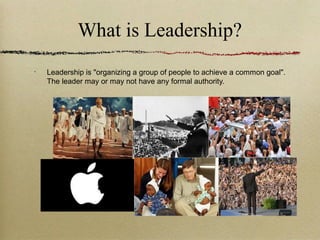
    Leadership is "organizing a group of people to achieve a common goal".
    The leader may or may not have any formal authority.
Scenarios of leadership without authority in today’s
              corporate environment


  Suppliers, vendors, outsourced partners
  Collaborative cross-functional teams
  Leading upwards
  Leading business partners
  Thought leadership
  Change management
  Self-leadership
Motivation
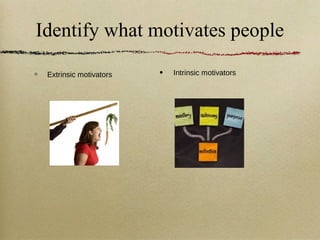
Identify what motivates people

 Extrinsic motivators   •   Intrinsic motivators
The Candle problem!
The solution
New Candle problem
Exercise #1:


•
    Discussion: Think of people in your organisation who:
    a) Are motivated extrinsically
    b) Are motivated intrinsically
•
    If you were to get ‘something done’ by each of these
    people, how will you phrase your approach?
Power
Sources of power: What’s your own?


•
    Expert Power: When a leader has significant domain knowledge/skills. E.g. an expert
    accountant influences how junior accountants go about their tasks


•
    Positional Power: Comes when a leader has a legitimately held position of authority. E.g.
    typically, the CEO of an organisation has the highest positional power


•
    Reward Power: Is evident when a leader can give, or take away, a reward. E.g. a leader
    can influence a follower’s behaviour by awarding a bonus, or taking away perks


•
    Coercive Power: This is felt when a leader creates the perception of a threat. E.g. a
    leader has coercive power if her followers believe that she will initiate disciplinary action


•
    Personal Power: Influence gained by persuasion. E.g. a manager may have to rely on
    nothing more than a friendly please and thank you for an employee to perform a task
Networking
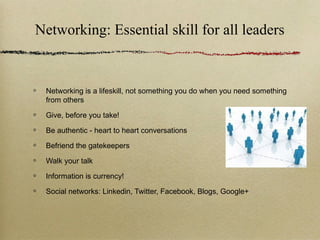
Networking: Essential skill for all leaders


 Networking is a lifeskill, not something you do when you need something
 from others

 Give, before you take!

 Be authentic - heart to heart conversations

 Befriend the gatekeepers

 Walk your talk

 Information is currency!

 Social networks: Linkedin, Twitter, Facebook, Blogs, Google+
Exercise #2: Master Networkers


•
    Talk to someone in this class who you don’t
    know.
Collaboration
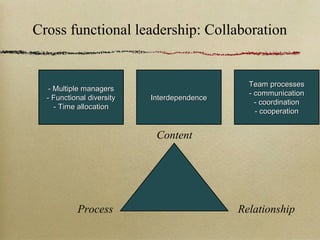
Cross functional leadership: Collaboration


                                               Team processes
   - Multiple managers
                                               - communication
  - Functional diversity   Interdependence
                                                 - coordination
     - Time allocation
                                                 - cooperation


                            Content


           Process                           Relationship
Cultural Sensitivity
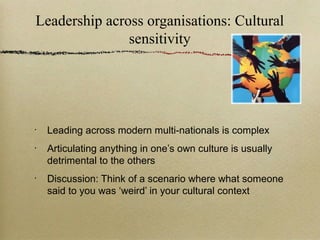
Leadership across organisations: Cultural
               sensitivity


•
    Leading across modern multi-nationals is complex
•
    Articulating anything in one’s own culture is usually
    detrimental to the others
•
    Discussion: Think of a scenario where what someone
    said to you was ‘weird’ in your cultural context
Manage Change
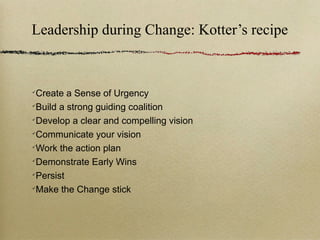
Leadership during Change: Kotter’s recipe



 Create a Sense of Urgency

 Build a strong guiding coalition

 Develop a clear and compelling vision

 Communicate your vision

 Work the action plan

 Demonstrate Early Wins

 Persist

 Make the Change stick
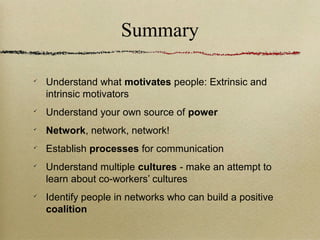
Summary


    Understand what motivates people: Extrinsic and
    intrinsic motivators

    Understand your own source of power

    Network, network, network!

    Establish processes for communication

    Understand multiple cultures - make an attempt to
    learn about co-workers’ cultures

    Identify people in networks who can build a positive
    coalition

Leading without authority

  • 1.
    Leadership without Authority UTS MBITM - 5 April 2012
  • 2.
    What is Leadership? • Leadership is "organizing a group of people to achieve a common goal". The leader may or may not have any formal authority.
  • 3.
    Scenarios of leadershipwithout authority in today’s corporate environment Suppliers, vendors, outsourced partners Collaborative cross-functional teams Leading upwards Leading business partners Thought leadership Change management Self-leadership
  • 4.
  • 5.
    Identify what motivatespeople Extrinsic motivators • Intrinsic motivators
  • 6.
  • 7.
  • 8.
  • 9.
    Exercise #1: • Discussion: Think of people in your organisation who: a) Are motivated extrinsically b) Are motivated intrinsically • If you were to get ‘something done’ by each of these people, how will you phrase your approach?
  • 10.
  • 11.
    Sources of power:What’s your own? • Expert Power: When a leader has significant domain knowledge/skills. E.g. an expert accountant influences how junior accountants go about their tasks • Positional Power: Comes when a leader has a legitimately held position of authority. E.g. typically, the CEO of an organisation has the highest positional power • Reward Power: Is evident when a leader can give, or take away, a reward. E.g. a leader can influence a follower’s behaviour by awarding a bonus, or taking away perks • Coercive Power: This is felt when a leader creates the perception of a threat. E.g. a leader has coercive power if her followers believe that she will initiate disciplinary action • Personal Power: Influence gained by persuasion. E.g. a manager may have to rely on nothing more than a friendly please and thank you for an employee to perform a task
  • 12.
  • 13.
    Networking: Essential skillfor all leaders Networking is a lifeskill, not something you do when you need something from others Give, before you take! Be authentic - heart to heart conversations Befriend the gatekeepers Walk your talk Information is currency! Social networks: Linkedin, Twitter, Facebook, Blogs, Google+
  • 14.
    Exercise #2: MasterNetworkers • Talk to someone in this class who you don’t know.
  • 15.
  • 16.
    Cross functional leadership:Collaboration Team processes - Multiple managers - communication - Functional diversity Interdependence - coordination - Time allocation - cooperation Content Process Relationship
  • 17.
  • 18.
    Leadership across organisations:Cultural sensitivity • Leading across modern multi-nationals is complex • Articulating anything in one’s own culture is usually detrimental to the others • Discussion: Think of a scenario where what someone said to you was ‘weird’ in your cultural context
  • 19.
  • 20.
    Leadership during Change:Kotter’s recipe  Create a Sense of Urgency  Build a strong guiding coalition  Develop a clear and compelling vision  Communicate your vision  Work the action plan  Demonstrate Early Wins  Persist  Make the Change stick
  • 21.
    Summary  Understand what motivates people: Extrinsic and intrinsic motivators  Understand your own source of power  Network, network, network!  Establish processes for communication  Understand multiple cultures - make an attempt to learn about co-workers’ cultures  Identify people in networks who can build a positive coalition

Editor's Notes

  • #6 - There is a mismatch between what science knows and what business does - Atlassian: Fedex days - Encarta vs Wikipedia
  • #7 - 2 groups: 1 were asked to establish norm averages on how long such a problem would take - 2nd group: incentivized $5 ... avg 3.5 seconds longer! Functional fixedness :-).. Gluxberg
  • #9 - Since the solution is more visible, it is easy to come to the conclusion -