
LEADERSHIP
COACHING
CONTENT
Leadership
Interpersonal Communications
Conflict Management
Problem solving
Leadership coaching
LEADERSHIP
Leadership is the ability to influence others,
with or without authority.
All successful endeavors are the result of human
effort; thus, the ability to influence others is a
derivation of
Interpersonal Communications
Conflict Management
Problem solving
INTERPERSONAL
COMMUNICATIONS
Interpersonal effectiveness is the capability of an
individual to do this, influence others, competently.
Leadership is a direct function of three elements of
interpersonal effectiveness
Awareness
Ability
Commitment
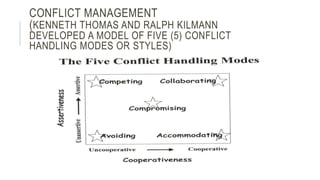
CONFLICT MANAGEMENT
(KENNETH THOMAS AND RALPH KILMANN
DEVELOPED A MODEL OF FIVE (5) CONFLICT
HANDLING MODES OR STYLES)
•Avoiding (Uncooperative and unassertive) Neglects own
concerns as well as those of other parties: does not raise or
address conflict issues.
•Accommodating (Cooperative and unassertive) Seeks to satisfy
other person's concerns at the expense of own.
•Competing (Uncooperative and assertive) Opposite of
accommodating. Uses whatever seems appropriate to win.
•Collaborating (Cooperative and assertive) Opposite of avoiding.
Works with other party to find a solution that satisfies both own
and other party's concerns.
•Compromising (Middle ground) Seeks to find a middle ground
to partially satisfy both parties.
CONFLICT CONTROL
•Use avoidance to ignore the issue.
•Use accommodating style to allow the other person to
resolve the issue.
•Structure the interaction so that a triggering event is
unlikely to occur.
•Strengthen the barriers that inhibit the expression of
conflict.
•Avoid dealing with the person with whom you are in
conflict.
PROBLEM SOLVING
A number of formal, structural problem solving
and decision making techniques are taught in
organizational management courses.
BRAINSTORMING PROCESS
•Everyone must be involved.
•Call out ideas to scribe.
•Build on ideas.
•No idea is too trivial or silly.
•There is no criticism nor judgment on any idea.
•Get as many ideas as possible in the time.
•Objective: solve problems and enjoy doing it.
LEADERSHIP COACHING
Leadership Coaching, however, is a
collaborative, individualised relationship
between a leader and the coach — the
leader could well be an executive,
manager, supervisor, team leader or
business owner.
Leadership Coaching.

Leadership Coaching.

  • 1.
  • 2.
  • 3.
    LEADERSHIP Leadership is theability to influence others, with or without authority. All successful endeavors are the result of human effort; thus, the ability to influence others is a derivation of Interpersonal Communications Conflict Management Problem solving
  • 4.
    INTERPERSONAL COMMUNICATIONS Interpersonal effectiveness isthe capability of an individual to do this, influence others, competently. Leadership is a direct function of three elements of interpersonal effectiveness Awareness Ability Commitment
  • 5.
    CONFLICT MANAGEMENT (KENNETH THOMASAND RALPH KILMANN DEVELOPED A MODEL OF FIVE (5) CONFLICT HANDLING MODES OR STYLES)
  • 6.
    •Avoiding (Uncooperative andunassertive) Neglects own concerns as well as those of other parties: does not raise or address conflict issues. •Accommodating (Cooperative and unassertive) Seeks to satisfy other person's concerns at the expense of own. •Competing (Uncooperative and assertive) Opposite of accommodating. Uses whatever seems appropriate to win. •Collaborating (Cooperative and assertive) Opposite of avoiding. Works with other party to find a solution that satisfies both own and other party's concerns. •Compromising (Middle ground) Seeks to find a middle ground to partially satisfy both parties.
  • 7.
    CONFLICT CONTROL •Use avoidanceto ignore the issue. •Use accommodating style to allow the other person to resolve the issue. •Structure the interaction so that a triggering event is unlikely to occur. •Strengthen the barriers that inhibit the expression of conflict. •Avoid dealing with the person with whom you are in conflict.
  • 8.
    PROBLEM SOLVING A numberof formal, structural problem solving and decision making techniques are taught in organizational management courses.
  • 9.
    BRAINSTORMING PROCESS •Everyone mustbe involved. •Call out ideas to scribe. •Build on ideas. •No idea is too trivial or silly. •There is no criticism nor judgment on any idea. •Get as many ideas as possible in the time. •Objective: solve problems and enjoy doing it.
  • 10.
    LEADERSHIP COACHING Leadership Coaching,however, is a collaborative, individualised relationship between a leader and the coach — the leader could well be an executive, manager, supervisor, team leader or business owner.