Adaptive Leadership Review – technical & adaptive problems Leading from authority Leading without authority Surviving The questions of adaptive leadership
Technical & Adaptive Problems Technical: modes of action required to deal with routine problems Adaptive: a demand for innovation and learning Adaptive work consists of the learning required to address conflicts in the values people hold, or to diminish the gap between the values people stand for and the reality they face.  Adaptive work requires a change in values, beliefs, or behaviour. (p. 22)
Authority as a Resource for Leadership Providing a  holding environment  for containing the stresses of adaptive work Can command and direct attention Access to information/reality testing Control over the flow of information Power to frame the issues Means to orchestrate conflict and contain disorder Power to choose the decision-making process
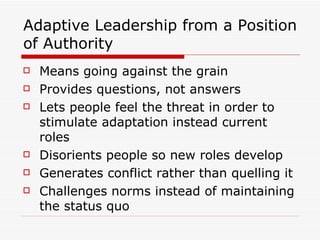
Adaptive Leadership from a Position of Authority Means going against the grain Provides questions, not answers Lets people feel the threat in order to stimulate adaptation instead current roles Disorients people so new roles develop Generates conflict rather than quelling it Challenges norms instead of maintaining the status quo
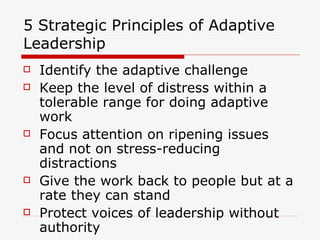
5 Strategic Principles of Adaptive Leadership Identify the adaptive challenge Keep the level of distress within a tolerable range for doing adaptive work Focus attention on ripening issues and not on stress-reducing distractions Give the work back to people but at a rate they can stand Protect voices of leadership without authority
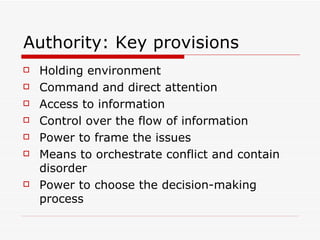
Authority: Key provisions Holding environment Command and direct attention Access to information Control over the flow of information Power to frame the issues Means to orchestrate conflict and contain disorder Power to choose the decision-making process
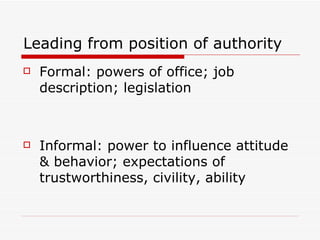
Leading from position of authority Formal: powers of office; job description; legislation Informal: power to influence attitude & behavior; expectations of trustworthiness, civility, ability
Leading without authority The non-dominant viewpoint Some advantages Don’t have to follow the norms Focus on a single issue Closer to the stakeholders
Examples:  DEVIANTS Ghandi Margaret Sanger Martin Luther King Other historical examples Examples in school systems
Considerations & Limitations Little control over holding environment Lack of “big picture” Need to read the authority figure Vulnerability of becoming the lightening rod Assuming that only authority figures can make change
Staying Alive Leadership is dangerous Can be silenced Can be killed Leaders always fail someone Leadership is lonely Myth of the lone warrior
To Survive Manage yourself Manage the social environment
Getting on the Balcony Identify the adaptive challenge Key questions p.258 Regulate Distress Key questions p.259-260 Direct disciplined attention Key questions p.261-262 Give work back to the people Key questions p.263
7 Practical Suggestions Leading without losing effectiveness or collapsing Get on the balcony Role/self distinction Externalize conflict Find partners Listen – use oneself as data Find sanctuary Preserve sense of purpose
Adaptive Leadership: Leadership requires a learning strategy The adaptive demands of our societies require leadership that takes responsibility without waiting for revelation or request. One may lead perhaps with no more than a question in mind. p.276
Final Thoughts What adaptive challenge do you currently face in your work environment? Where will you find sanctuary this winter break?

Adadptiveldrsp2

  • 1.
    Adaptive Leadership Review– technical & adaptive problems Leading from authority Leading without authority Surviving The questions of adaptive leadership
  • 2.
    Technical & AdaptiveProblems Technical: modes of action required to deal with routine problems Adaptive: a demand for innovation and learning Adaptive work consists of the learning required to address conflicts in the values people hold, or to diminish the gap between the values people stand for and the reality they face. Adaptive work requires a change in values, beliefs, or behaviour. (p. 22)
  • 3.
    Authority as aResource for Leadership Providing a holding environment for containing the stresses of adaptive work Can command and direct attention Access to information/reality testing Control over the flow of information Power to frame the issues Means to orchestrate conflict and contain disorder Power to choose the decision-making process
  • 4.
    Adaptive Leadership froma Position of Authority Means going against the grain Provides questions, not answers Lets people feel the threat in order to stimulate adaptation instead current roles Disorients people so new roles develop Generates conflict rather than quelling it Challenges norms instead of maintaining the status quo
  • 5.
    5 Strategic Principlesof Adaptive Leadership Identify the adaptive challenge Keep the level of distress within a tolerable range for doing adaptive work Focus attention on ripening issues and not on stress-reducing distractions Give the work back to people but at a rate they can stand Protect voices of leadership without authority
  • 6.
    Authority: Key provisionsHolding environment Command and direct attention Access to information Control over the flow of information Power to frame the issues Means to orchestrate conflict and contain disorder Power to choose the decision-making process
  • 7.
    Leading from positionof authority Formal: powers of office; job description; legislation Informal: power to influence attitude & behavior; expectations of trustworthiness, civility, ability
  • 8.
    Leading without authorityThe non-dominant viewpoint Some advantages Don’t have to follow the norms Focus on a single issue Closer to the stakeholders
  • 9.
    Examples: DEVIANTSGhandi Margaret Sanger Martin Luther King Other historical examples Examples in school systems
  • 10.
    Considerations & LimitationsLittle control over holding environment Lack of “big picture” Need to read the authority figure Vulnerability of becoming the lightening rod Assuming that only authority figures can make change
  • 11.
    Staying Alive Leadershipis dangerous Can be silenced Can be killed Leaders always fail someone Leadership is lonely Myth of the lone warrior
  • 12.
    To Survive Manageyourself Manage the social environment
  • 13.
    Getting on theBalcony Identify the adaptive challenge Key questions p.258 Regulate Distress Key questions p.259-260 Direct disciplined attention Key questions p.261-262 Give work back to the people Key questions p.263
  • 14.
    7 Practical SuggestionsLeading without losing effectiveness or collapsing Get on the balcony Role/self distinction Externalize conflict Find partners Listen – use oneself as data Find sanctuary Preserve sense of purpose
  • 15.
    Adaptive Leadership: Leadershiprequires a learning strategy The adaptive demands of our societies require leadership that takes responsibility without waiting for revelation or request. One may lead perhaps with no more than a question in mind. p.276
  • 16.
    Final Thoughts Whatadaptive challenge do you currently face in your work environment? Where will you find sanctuary this winter break?