Leadership
Training
Module 4
The Proactive Focus / Leading the Way
Your life doesn't just "happen." Whether you know
it or not, it is carefully designed by you. The
choices, after all, are yours. You choose happiness.
You choose sadness. You choose decisiveness. You
choose ambivalence. You choose success. You
choose failure. You choose courage. You choose
fear. Just remember that every moment, every
situation, provides a new choice. And in doing so,
it gives you a perfect opportunity to do things
differently to produce more positive results.


Your choice…
90 / 10 PRINCIPLE
•   Somebody says negative things about you
•   Someone tries to compete with you
•   You are being scolded because you are late
•   One of your group members has been consistently late
•   You were kicked out of the production / project
•   Jeepney driver na ang tagal lumarga


Application
Absolutely everything we
give, say, or even think is
like a boomerang. It will
come back to us.

Remember!
Proactive Focus
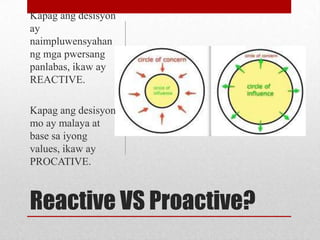
Kapag ang desisyon
ay
naimpluwensyahan
ng mga pwersang
panlabas, ikaw ay
REACTIVE.

Kapag ang desisyon
mo ay malaya at
base sa iyong
values, ikaw ay
PROCATIVE.


Reactive VS Proactive?
Being Proactive is about taking
responsibility for your life. You can't keep
blaming everything on your parents or
grandparents. Proactive people recognize
that they are "response-able." They don't
blame genetics, circumstances, conditions,
or conditioning for their behavior. They
know they choose their behavior.


Be Proactive
• I can
• I will
• I want to
• Next time
• Let me handle it
• Let me help


Usual Expressions
Reactive people, on the other hand, are often
affected by their physical environment. They find
external sources to blame for their behavior. If the
weather is good, they feel good. If it isn't, it affects
their attitude and performance, and they blame the
weather. All of these external forces act as stimuli
that we respond to. Between the stimulus and the
response is your greatest power--you have the
freedom to choose your response. One of the most
important things you choose is what you say. Your
language is a good indicator of how you see
yourself.
Reactive
• I can’t
• I’ll try
• I have to
• I could have
• It’s not my fault
• It’s not my job


Usual Expressions
•   Broad-minded
•   Intelligent
•   Competent
•   Imaginative
•   Insightful
•   Honest
•   Proactive
•   Motivating

Success Habits of
Effective Leaders
7 Habits of Highly
Effective People
Leading the Way
Followers follow if their leaders are
viewed to be capable of satisfying
their needs.

Followers expect their needs to be
satisfied.


Why do followers follow?
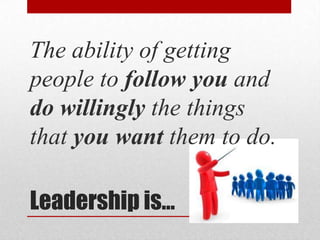
The ability of getting
people to follow you and
do willingly the things
that you want them to do.

Leadership is…
• Ability to sell ideas and win
  support
• Ability to exert power over others
• Art of creating among others
  willingness to cooperate through
  interpersonal skills


Personal skills required:
• Envision an exciting future
• Enlist others in a common
  vision
• Appeal to their
  values, interests, hopes and
  dreams
Encouraging
Followership
• Set the example for others
• Be consistent with CAST
  values
• Achieve small wins that
  promote consistent progress
Encouraging
Followership
• Recognize contribution
• Celebrate accomplishment
• Be generous with praise but be
  sincere
• Maintain or enhance self-esteem
Encouraging
Followership
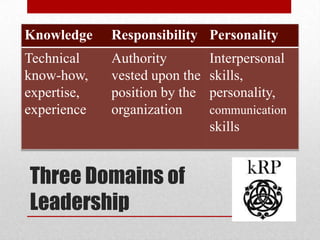
Knowledge    Responsibility Personality
Technical    Authority         Interpersonal
know-how,    vested upon the   skills,
expertise,   position by the   personality,
experience   organization      communication
                               skills


Three Domains of
Leadership
Assess yourself.
Make your own
KRP chart

Exercise
The Communication
Process
• Can be simple
• Body language
• Silence is a form of communication
• Know the person you are talking to
• People tend to believe those whom they
  trust
• Timing is essential
• Feedback is vital

Points to remember
• Filtering
• Selective perception
• Defensiveness
• Language

Barriers to effective
communication
Gumawa ng 10 alituntunin
kung paano mas
mapapahusay ang
komikasyon sa grupo.

Exercise
• Huwag pangunahan ang kausap.
• Huwag puputulin ang sinasabi ng kausap.
• Intindihin ang nararamdaman at banggitin
  ito
• Huwag mag-react kaagad.
• Ulitin ang detalye ng sinabi ng kausap.
• Sabihin muli ng buod (summarize)
Paano mapapahusay ang
Komunikasyon?
Effective Listening          Active Listening
Listening to the words and   Listener takes
their meaning.               responsibility to
                             understand the content and
                             feeling of what is being
                             said and then checks if
                             he/she heard correctly.


What is listening?
Intentional               Unintentional
• Physical environment    • Fatigue
• Poor message            • Stress
• Source                  • Lack of time
• Tuning-out
• Letting emotions take
  over
• Criticizing
• Preparing to argue
• Allowing distractions

Reasons for poor
listening:
Positive                     Negative
Reflecting                   Not ignoring
Encouraging                  Not discouraging
Checking for Understanding   Not assuming
• Summarizing
• Clarifying
• Validating
Validating                   Not ignoring

Methods of Active
Listening
•   Talking too much or talking too little
•   Tactless & Offensive
•   Divulging confidential information
•   Talking about matters that are not yet final
•   Inconsistencies among leaders’ statements


Dangers in
communicating with
members
• Matters members are interested in
• Level of detail they need to know
• Matters that are not classified
• Matter that is official and final.

What to communicate to
members?
• Feeling good about oneself = feeling good
  about the world
• What & Why statements are sincere and
  specific
• No reason to enhance esteem? Just
  maintain it.
• Develop your style
• Make it your second nature.


Managing Self-Esteem
Effective Positive          Ineffective Positive
Feedback                    Feedback
Very good! Marami ang       Ok ang ginawa niyo. Keep
nakiisa sa project natin.   it up.
Dati mga 50% lang ang
participation, ngayon 90%
na. Dahil yan sa
improvement ng team mo.
Salamat sa tulong and
keep up the good work!


Examples
INNOCENT                           PASAWAY
Ignorant of rules. Commits         Commits deviations of rules and
Unintentional mistakes.            standards intentionally just for the
                                   heck of it.


AVENGER                            DISTURBED
Believes he/she is being treated   Seldom commits mistakes that are
unfairly. Trying to get even.      unintentional. Usually due to
                                   emotional stress.


Common Problems of
Members
Coach and remind. Avoid      Coach and warn. Prepare
destroying his/ her          for possible assessment
motivation.                  session. Keep records and
                             build the case.


Coach and warn. Find out     Coach and Remind. Listen
what’s his/her sentiments.   actively. Show sincerity and
Resolve ASAP.                concern.


How to deal with them?
1.   Prepare an agenda
2.   Arrange the venue
3.   Decide on the schedule
4.   Send announcement
5.   Get information on attendance
6.   Assign recorder and timekeeper
7.   Assign topics
8.   Prepare logistics

Managing Meetings
1. Start on time       7. Introduce              13. Determine
2. Assign a recorder       participants and          resources / budget
3. Assign a time           explain their roles       needed
   keeper              8. Tackle each item in    14. Agree on timetable
4. Review previous         the agenda            15. Review agreement
   meeting             9. Resolve or park            & get commitment
5. Announce an             issues when needed    16. Agree on the next
   agenda              10. Identify action           meeting schedule
6. Explain meeting         problems              17. End on time
   rules and get       11. Manage difficult
   commitment to           personalities
   follow              12. Assign
                           responsibilities


Making Meetings Work
1. Review minutes of the last meeting
2. Send copy of the minutes of
   attendees
3. Follow-up on assigned tasks
4. Put copy of minutes to your archive
   for future reference


After the Meeting

Leadership training module 4

  • 1.
  • 2.
    Your life doesn'tjust "happen." Whether you know it or not, it is carefully designed by you. The choices, after all, are yours. You choose happiness. You choose sadness. You choose decisiveness. You choose ambivalence. You choose success. You choose failure. You choose courage. You choose fear. Just remember that every moment, every situation, provides a new choice. And in doing so, it gives you a perfect opportunity to do things differently to produce more positive results. Your choice…
  • 3.
    90 / 10PRINCIPLE
  • 4.
    Somebody says negative things about you • Someone tries to compete with you • You are being scolded because you are late • One of your group members has been consistently late • You were kicked out of the production / project • Jeepney driver na ang tagal lumarga Application
  • 5.
    Absolutely everything we give,say, or even think is like a boomerang. It will come back to us. Remember!
  • 6.
  • 7.
    Kapag ang desisyon ay naimpluwensyahan ngmga pwersang panlabas, ikaw ay REACTIVE. Kapag ang desisyon mo ay malaya at base sa iyong values, ikaw ay PROCATIVE. Reactive VS Proactive?
  • 8.
    Being Proactive isabout taking responsibility for your life. You can't keep blaming everything on your parents or grandparents. Proactive people recognize that they are "response-able." They don't blame genetics, circumstances, conditions, or conditioning for their behavior. They know they choose their behavior. Be Proactive
  • 9.
    • I can •I will • I want to • Next time • Let me handle it • Let me help Usual Expressions
  • 10.
    Reactive people, onthe other hand, are often affected by their physical environment. They find external sources to blame for their behavior. If the weather is good, they feel good. If it isn't, it affects their attitude and performance, and they blame the weather. All of these external forces act as stimuli that we respond to. Between the stimulus and the response is your greatest power--you have the freedom to choose your response. One of the most important things you choose is what you say. Your language is a good indicator of how you see yourself. Reactive
  • 11.
    • I can’t •I’ll try • I have to • I could have • It’s not my fault • It’s not my job Usual Expressions
  • 12.
    Broad-minded • Intelligent • Competent • Imaginative • Insightful • Honest • Proactive • Motivating Success Habits of Effective Leaders
  • 13.
    7 Habits ofHighly Effective People
  • 14.
  • 15.
    Followers follow iftheir leaders are viewed to be capable of satisfying their needs. Followers expect their needs to be satisfied. Why do followers follow?
  • 16.
    The ability ofgetting people to follow you and do willingly the things that you want them to do. Leadership is…
  • 17.
    • Ability tosell ideas and win support • Ability to exert power over others • Art of creating among others willingness to cooperate through interpersonal skills Personal skills required:
  • 18.
    • Envision anexciting future • Enlist others in a common vision • Appeal to their values, interests, hopes and dreams Encouraging Followership
  • 19.
    • Set theexample for others • Be consistent with CAST values • Achieve small wins that promote consistent progress Encouraging Followership
  • 20.
    • Recognize contribution •Celebrate accomplishment • Be generous with praise but be sincere • Maintain or enhance self-esteem Encouraging Followership
  • 21.
    Knowledge Responsibility Personality Technical Authority Interpersonal know-how, vested upon the skills, expertise, position by the personality, experience organization communication skills Three Domains of Leadership
  • 22.
    Assess yourself. Make yourown KRP chart Exercise
  • 23.
  • 24.
    • Can besimple • Body language • Silence is a form of communication • Know the person you are talking to • People tend to believe those whom they trust • Timing is essential • Feedback is vital Points to remember
  • 25.
    • Filtering • Selectiveperception • Defensiveness • Language Barriers to effective communication
  • 26.
    Gumawa ng 10alituntunin kung paano mas mapapahusay ang komikasyon sa grupo. Exercise
  • 27.
    • Huwag pangunahanang kausap. • Huwag puputulin ang sinasabi ng kausap. • Intindihin ang nararamdaman at banggitin ito • Huwag mag-react kaagad. • Ulitin ang detalye ng sinabi ng kausap. • Sabihin muli ng buod (summarize) Paano mapapahusay ang Komunikasyon?
  • 28.
    Effective Listening Active Listening Listening to the words and Listener takes their meaning. responsibility to understand the content and feeling of what is being said and then checks if he/she heard correctly. What is listening?
  • 29.
    Intentional Unintentional • Physical environment • Fatigue • Poor message • Stress • Source • Lack of time • Tuning-out • Letting emotions take over • Criticizing • Preparing to argue • Allowing distractions Reasons for poor listening:
  • 30.
    Positive Negative Reflecting Not ignoring Encouraging Not discouraging Checking for Understanding Not assuming • Summarizing • Clarifying • Validating Validating Not ignoring Methods of Active Listening
  • 31.
    Talking too much or talking too little • Tactless & Offensive • Divulging confidential information • Talking about matters that are not yet final • Inconsistencies among leaders’ statements Dangers in communicating with members
  • 32.
    • Matters membersare interested in • Level of detail they need to know • Matters that are not classified • Matter that is official and final. What to communicate to members?
  • 33.
    • Feeling goodabout oneself = feeling good about the world • What & Why statements are sincere and specific • No reason to enhance esteem? Just maintain it. • Develop your style • Make it your second nature. Managing Self-Esteem
  • 34.
    Effective Positive Ineffective Positive Feedback Feedback Very good! Marami ang Ok ang ginawa niyo. Keep nakiisa sa project natin. it up. Dati mga 50% lang ang participation, ngayon 90% na. Dahil yan sa improvement ng team mo. Salamat sa tulong and keep up the good work! Examples
  • 35.
    INNOCENT PASAWAY Ignorant of rules. Commits Commits deviations of rules and Unintentional mistakes. standards intentionally just for the heck of it. AVENGER DISTURBED Believes he/she is being treated Seldom commits mistakes that are unfairly. Trying to get even. unintentional. Usually due to emotional stress. Common Problems of Members
  • 36.
    Coach and remind.Avoid Coach and warn. Prepare destroying his/ her for possible assessment motivation. session. Keep records and build the case. Coach and warn. Find out Coach and Remind. Listen what’s his/her sentiments. actively. Show sincerity and Resolve ASAP. concern. How to deal with them?
  • 37.
    1. Prepare an agenda 2. Arrange the venue 3. Decide on the schedule 4. Send announcement 5. Get information on attendance 6. Assign recorder and timekeeper 7. Assign topics 8. Prepare logistics Managing Meetings
  • 38.
    1. Start ontime 7. Introduce 13. Determine 2. Assign a recorder participants and resources / budget 3. Assign a time explain their roles needed keeper 8. Tackle each item in 14. Agree on timetable 4. Review previous the agenda 15. Review agreement meeting 9. Resolve or park & get commitment 5. Announce an issues when needed 16. Agree on the next agenda 10. Identify action meeting schedule 6. Explain meeting problems 17. End on time rules and get 11. Manage difficult commitment to personalities follow 12. Assign responsibilities Making Meetings Work
  • 39.
    1. Review minutesof the last meeting 2. Send copy of the minutes of attendees 3. Follow-up on assigned tasks 4. Put copy of minutes to your archive for future reference After the Meeting