Leadership Formula for Change
Objectives Identify and understand your organization’s tools and goals Define instinctive leadership Discuss factors affecting performance Review a formula for change
Identify Your Organization’s Tools Do you understand the goals?
How do you define Safety? Provide an answer to this question in a: Word Statement Philosophy Organizational expectation
Typical words provided for safety P lanning (5 – P’s) R ight thing - tool – material – procedure A wareness – patience, don’t rush, focus on work C ommunication - work smarter not harder! T eamwork I nspect C ulture - get home every night E nvironment – housekeeping, site layout, preparation
Leadership in Safety Hazard Identification & Control Plan for project or work safety in bid Provide the right equipment and tools Conduct routine inspections and correct issues ASAP Deliver relevant training regularly Encourage and acknowledge the “right behaviors” Hold each other accountable at all levels
Defining Instinctive Leadership  What did you like about the best leader you ever had?
Best leader qualities company 1 Integrity – “talk the talk walk the walk” Good teacher Expectations were clear and reasonable Positive attitude with confidence in own abilities Patience and understood individuals needs and wants Understood people as an individual and knew the right approach for communicating the necessary information
Best leader qualities company 2 Prepared – physically and mentally Accountability – with opportunity to succeed Passion in leadership through example Experience – been there done that Respect – Complimentary - Considerate Trust Willing and Caring Humility and Consistency Learn from your past so you can improve on future
So what is leadership? Ability to mobilize people to learn and adapt Overcoming the challenges of the moment to inspire and enable change in others Do you notice similarities with the definition of safety?
Leaders doing the right thing When they effectively balance production: Costs Efficiency, Quality and Safety
Leadership E mployee Participation Understand and follow workplace rules Be part of the solution, not part of the problem Comply with basic expectations Know your role and meet your responsibilities If you are successful so is the organization
Individual Behavior A person’s behavior is driven by what gives them satisfaction or comfort Opportunities for behavioral change are found in an individual’s: Knowledge Skills Abilities Responsibilities Experiences Bad habits becoming good actions instinctively.
Attitudes The longer I live, the more I realize the impact of  attitude on life. Attitude to me is more important than the past, than education, than money, than circumstances, than failures, than successes, than what other people think, say, or do. The remarkable thing is we have a choice every day regarding the attitude we will embrace for that day. We cannot change our past.  We can, however, look to the future, starting with today.  Our attitude influences how others will act. I am convinced that life is 10% what happens to me and 90% how I react to it.  And so it is with you.  We are in charge of our attitudes. -  Charles Swindoll
“ A leader is a dealer in hope.” Winston Churchill Vision Communicate Perseverance Empathy Flexible - creative Banked Trust TEAM Manage by Walking Around Homework – increases fortune Character – be who you are
Leaders Set Expectations Plan your work and work your plan. “ Think it, write it, act on it.”
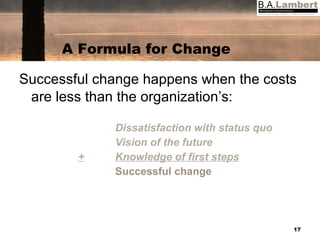
A Formula for Change Successful change happens when the costs are less than the organization’s:  Dissatisfaction with status quo Vision of the future   + Knowledge of first steps Successful change

Leadership Formula For Change

  • 1.
  • 2.
    Objectives Identify andunderstand your organization’s tools and goals Define instinctive leadership Discuss factors affecting performance Review a formula for change
  • 3.
    Identify Your Organization’sTools Do you understand the goals?
  • 4.
    How do youdefine Safety? Provide an answer to this question in a: Word Statement Philosophy Organizational expectation
  • 5.
    Typical words providedfor safety P lanning (5 – P’s) R ight thing - tool – material – procedure A wareness – patience, don’t rush, focus on work C ommunication - work smarter not harder! T eamwork I nspect C ulture - get home every night E nvironment – housekeeping, site layout, preparation
  • 6.
    Leadership in SafetyHazard Identification & Control Plan for project or work safety in bid Provide the right equipment and tools Conduct routine inspections and correct issues ASAP Deliver relevant training regularly Encourage and acknowledge the “right behaviors” Hold each other accountable at all levels
  • 7.
    Defining Instinctive Leadership What did you like about the best leader you ever had?
  • 8.
    Best leader qualitiescompany 1 Integrity – “talk the talk walk the walk” Good teacher Expectations were clear and reasonable Positive attitude with confidence in own abilities Patience and understood individuals needs and wants Understood people as an individual and knew the right approach for communicating the necessary information
  • 9.
    Best leader qualitiescompany 2 Prepared – physically and mentally Accountability – with opportunity to succeed Passion in leadership through example Experience – been there done that Respect – Complimentary - Considerate Trust Willing and Caring Humility and Consistency Learn from your past so you can improve on future
  • 10.
    So what isleadership? Ability to mobilize people to learn and adapt Overcoming the challenges of the moment to inspire and enable change in others Do you notice similarities with the definition of safety?
  • 11.
    Leaders doing theright thing When they effectively balance production: Costs Efficiency, Quality and Safety
  • 12.
    Leadership E mployeeParticipation Understand and follow workplace rules Be part of the solution, not part of the problem Comply with basic expectations Know your role and meet your responsibilities If you are successful so is the organization
  • 13.
    Individual Behavior Aperson’s behavior is driven by what gives them satisfaction or comfort Opportunities for behavioral change are found in an individual’s: Knowledge Skills Abilities Responsibilities Experiences Bad habits becoming good actions instinctively.
  • 14.
    Attitudes The longerI live, the more I realize the impact of attitude on life. Attitude to me is more important than the past, than education, than money, than circumstances, than failures, than successes, than what other people think, say, or do. The remarkable thing is we have a choice every day regarding the attitude we will embrace for that day. We cannot change our past. We can, however, look to the future, starting with today. Our attitude influences how others will act. I am convinced that life is 10% what happens to me and 90% how I react to it. And so it is with you. We are in charge of our attitudes. - Charles Swindoll
  • 15.
    “ A leaderis a dealer in hope.” Winston Churchill Vision Communicate Perseverance Empathy Flexible - creative Banked Trust TEAM Manage by Walking Around Homework – increases fortune Character – be who you are
  • 16.
    Leaders Set ExpectationsPlan your work and work your plan. “ Think it, write it, act on it.”
  • 17.
    A Formula forChange Successful change happens when the costs are less than the organization’s: Dissatisfaction with status quo Vision of the future + Knowledge of first steps Successful change

Editor's Notes

  • #2 Discussion: This program will review the importance of effective knowledge, skills abilities, attitudes, responsibilities and recognition developed and practiced throughout work experiences and life. What is your instinct for doing the right thing? Roget's II: The New Thesaurus Instinct:    noun The power to discern the true nature of a person or situation. Synonyms:    insight , intuition , intuitiveness , penetration , sixth sense Bruce Lambert brings over 20 years of professional experience and expertise in strategic planning of environmental, health and safety (EHS) and loss control management processes. We offer 'value-added' services to a wide variety of industries throughout the Northeast. Our commitment is to assist organizations at affecting change to be the best. Lambert's mission is to provide clients with a "best in class" service which partners with key decision-makers to create an organizational culture where a conscious concern for EHS issues, that eliminates, controls or reduces losses over time, is automatic.