


Motivation
Sample
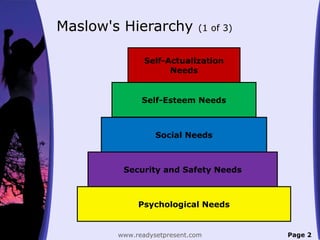
Maslow's Hierarchy (1 of 3)
Page 2www.readysetpresent.com
Psychological Needs
Security and Safety Needs
Social Needs
Self-Esteem Needs
Self-Actualization
Needs
Definition of Motivation
Motivation:
 The act or process of
stimulating to action or
providing an incentive or
motive, especially for an act.
Page 3www.readysetpresent.com
McGregor's Theory X
 People inherently dislike work
and will avoid it if they can.
 People must be coerced,
controlled, directed, and
threatened in order to make
them work.
 The average human being
prefers to be directed, wishes
to avoid responsibility, and has
relatively little ambition.
Page 4www.readysetpresent.com
Achievement Motivation Theory
 Mcclelland, et al. stated that
achievement motivation, or the
need for achievement comes
from internal and external
factors.
 Highly motivated people have
three different needs:
achievement, affiliation, and
power.
 Most people have a mix of
these needs.
Page 5www.readysetpresent.com
Hackman and Oldham (2 of 3)
 Hackman and Oldham also
identify five core job
dimensions:
1. Skill variety – different job
activities that require a variety
of skills and talents
2. Task identity – the completion of
an identifiable project
3. Task significance – the
responsibility for a task that
significantly and positively
affects other people
Page 6www.readysetpresent.com
Praise Or
Recognition
www.readysetpresent.com Page 7
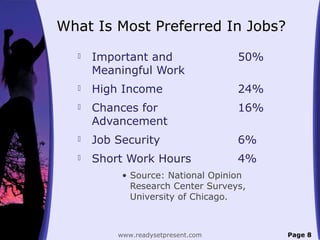
What Is Most Preferred In Jobs?
 Important and 50%
Meaningful Work
 High Income 24%
 Chances for 16%
Advancement
 Job Security 6%
 Short Work Hours 4%
• Source: National Opinion
Research Center Surveys,
University of Chicago.
Page 8www.readysetpresent.com
Five Types of Rewards
 Monetary rewards
 Indirect financial rewards
(benefits)
 Satisfying work content
 Affiliation with an admirable
organization
 Long-term career opportunities
Page 9www.readysetpresent.com
Two Types of Motivation (3 of 3)
Extrinsic Motivation
 Motivation from the outside,
often from rewards
 If the employee perceives the
possibility of achieving other
goals through accomplishing
the task, you can expect the
quality of their performance to
be inferior.
Page 10www.readysetpresent.com
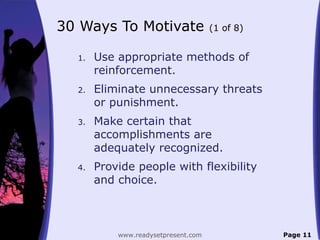
30 Ways To Motivate (1 of 8)
1. Use appropriate methods of
reinforcement.
2. Eliminate unnecessary threats
or punishment.
3. Make certain that
accomplishments are
adequately recognized.
4. Provide people with flexibility
and choice.
Page 11www.readysetpresent.com
Download “Motivation”
PowerPoint presentation
at ReadySetPresent.com
Slides include: 6 points on MacGregor’s theories, 3 slides on Maslow’s
hierarchy, 7 points on Alderfer's ERG theory, 13 points on the motivator-
hygiene, 3 points on the achievement motivation, 10 points on Hackman
and Oldham‘s, 5 points on the expectancy, 2 points on the equity, 2
points on the goal setting, 15 points on what employees want, 10
motivating factors, 10 employee rewards, 6 points on a supportive
environment, 8 points on positive feedback, 4 steps for giving praise, 7
points on performance problems, 6 points on coaching steps, 7 principles
of planning, 4 characteristics of a good plan, 5 points on S.M.A.R.T., 5
management functions, 4 points on power, 5 points on what is preferred
in jobs, 4 reasons employees don’t do what you want, 5 types of
rewards, 9 points on incentives, 5 points on 2 types of motivation, 22
points on principles for enriching jobs, 13 points on a pay plan to
motivate, 9 points on the structure of human motivation, 24 points on
the 5 categories for all human behavior, 4 steps to solve motivational
problems, 6 points on informal recognition, 5 points on the M.A.G.I.C.
formula, 11 ways to motivate today, 9 cautions for incentive programs, 9
motivation program ironies, 9 action motivators, 9 points on employees
who love work, 5 motivation factors, 4 maintenance factors, 30 ways to
motivate, 10 ways to boost efficiency, 16 action steps and much more.
Royalty Free - Use Them Over and Over Again.
Now: more content, graphics, and diagrams
www.readysetpresent.com Page 12

Motivation

  • 1.
  • 2.
    Maslow's Hierarchy (1of 3) Page 2www.readysetpresent.com Psychological Needs Security and Safety Needs Social Needs Self-Esteem Needs Self-Actualization Needs
  • 3.
    Definition of Motivation Motivation: The act or process of stimulating to action or providing an incentive or motive, especially for an act. Page 3www.readysetpresent.com
  • 4.
    McGregor's Theory X People inherently dislike work and will avoid it if they can.  People must be coerced, controlled, directed, and threatened in order to make them work.  The average human being prefers to be directed, wishes to avoid responsibility, and has relatively little ambition. Page 4www.readysetpresent.com
  • 5.
    Achievement Motivation Theory Mcclelland, et al. stated that achievement motivation, or the need for achievement comes from internal and external factors.  Highly motivated people have three different needs: achievement, affiliation, and power.  Most people have a mix of these needs. Page 5www.readysetpresent.com
  • 6.
    Hackman and Oldham(2 of 3)  Hackman and Oldham also identify five core job dimensions: 1. Skill variety – different job activities that require a variety of skills and talents 2. Task identity – the completion of an identifiable project 3. Task significance – the responsibility for a task that significantly and positively affects other people Page 6www.readysetpresent.com
  • 7.
  • 8.
    What Is MostPreferred In Jobs?  Important and 50% Meaningful Work  High Income 24%  Chances for 16% Advancement  Job Security 6%  Short Work Hours 4% • Source: National Opinion Research Center Surveys, University of Chicago. Page 8www.readysetpresent.com
  • 9.
    Five Types ofRewards  Monetary rewards  Indirect financial rewards (benefits)  Satisfying work content  Affiliation with an admirable organization  Long-term career opportunities Page 9www.readysetpresent.com
  • 10.
    Two Types ofMotivation (3 of 3) Extrinsic Motivation  Motivation from the outside, often from rewards  If the employee perceives the possibility of achieving other goals through accomplishing the task, you can expect the quality of their performance to be inferior. Page 10www.readysetpresent.com
  • 11.
    30 Ways ToMotivate (1 of 8) 1. Use appropriate methods of reinforcement. 2. Eliminate unnecessary threats or punishment. 3. Make certain that accomplishments are adequately recognized. 4. Provide people with flexibility and choice. Page 11www.readysetpresent.com
  • 12.
    Download “Motivation” PowerPoint presentation atReadySetPresent.com Slides include: 6 points on MacGregor’s theories, 3 slides on Maslow’s hierarchy, 7 points on Alderfer's ERG theory, 13 points on the motivator- hygiene, 3 points on the achievement motivation, 10 points on Hackman and Oldham‘s, 5 points on the expectancy, 2 points on the equity, 2 points on the goal setting, 15 points on what employees want, 10 motivating factors, 10 employee rewards, 6 points on a supportive environment, 8 points on positive feedback, 4 steps for giving praise, 7 points on performance problems, 6 points on coaching steps, 7 principles of planning, 4 characteristics of a good plan, 5 points on S.M.A.R.T., 5 management functions, 4 points on power, 5 points on what is preferred in jobs, 4 reasons employees don’t do what you want, 5 types of rewards, 9 points on incentives, 5 points on 2 types of motivation, 22 points on principles for enriching jobs, 13 points on a pay plan to motivate, 9 points on the structure of human motivation, 24 points on the 5 categories for all human behavior, 4 steps to solve motivational problems, 6 points on informal recognition, 5 points on the M.A.G.I.C. formula, 11 ways to motivate today, 9 cautions for incentive programs, 9 motivation program ironies, 9 action motivators, 9 points on employees who love work, 5 motivation factors, 4 maintenance factors, 30 ways to motivate, 10 ways to boost efficiency, 16 action steps and much more. Royalty Free - Use Them Over and Over Again. Now: more content, graphics, and diagrams www.readysetpresent.com Page 12