LEADERSHIP AND
HUMAN BEHAVIOUR
LEVEL -05-
Dr.S.L.Riyas BA,MA,MBA,PhD, Management
Consultant/Trainer
Improving your PR and HR skills
LEADERSHIP AND HUMAN
BEHAVIOUR
 As a leader, you need to interact with your
followers, peers, seniors, and others, whose
support you need in orders to accomplish your
objective.
 To gain their support, you must be able to
understand and motivate them.
 To understand and motivate people, you must
know the human nature.
 Human nature is the common quality of all human
being.
 People behave according to certain principles of
human nature.
HIERARCHY OF NEEDS
 Human needs are important part of human
nature.
 Values, beliefs, and customs differ from
country to country and group to group, but all
people have similar needs.
 As a leader you must understand these needs
because they are powerful.
HIERARCHY OF NEEDS
 There are two major groups of human needs:
 01. Basic Needs – Psychological AND
Physiological
 02. Beta Needs – Being needs.
BASIC NEEDS
 Physiological Needs : Food, Water and Sleep
 Psychological Needs : affection, security, and
self esteem.
 These needs are called deficiency needs.
META NEEDS
 The higher needs are called meta needs or
being needs.
 These include Justice, goodness, beauty,
order and Unity.
 Ex: a person who lacks food or water will not
normally attend to justice or beauty needs.
MASLOW’S HIERARCHY
NEEDS…
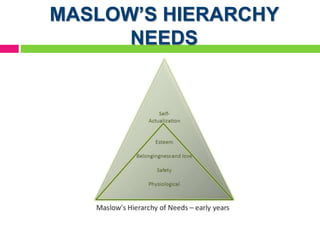
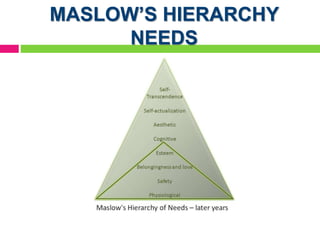
 1. Physiological : food , water, shelter sex
 2. Safety: feel free from immediate danger
 3. Belongingness and Love : being to a
group, close friends to confidence with.
 4. Esteem : feeling of moving up in world,
recognition, few doubts about self.
MASLOW’S HIERARCHY
NEEDS
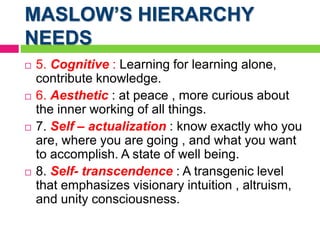
 5. Cognitive : Learning for learning alone,
contribute knowledge.
 6. Aesthetic : at peace , more curious about
the inner working of all things.
 7. Self – actualization : know exactly who you
are, where you are going , and what you want
to accomplish. A state of well being.
 8. Self- transcendence : A transgenic level
that emphasizes visionary intuition , altruism,
and unity consciousness.
MASLOW’S HIERARCHY
NEEDS
MASLOW’S HIERARCHY
NEEDS
CHARACTERISTICS OF
SELF-ACTUALISING PEOPLE…
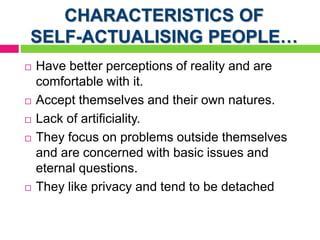
 Have better perceptions of reality and are
comfortable with it.
 Accept themselves and their own natures.
 Lack of artificiality.
 They focus on problems outside themselves
and are concerned with basic issues and
eternal questions.
 They like privacy and tend to be detached
CHARACTERISTICS OF
SELF-ACTUALISING PEOPLE
 Rely on their own development and continued
growth.
 Appreciate the basic pleasure of life.
 Have a deep feelings of kinship with others.
 Are deeply democratic and are not really
aware of differences.
 Have strong , ethical and moral standards.
 Are original , initiatives, less constricted and
fresher than others
Hygiene and Motivational
factors
 Herzberg developed a list of factors that are
based on Maslow’s hierarchy of needs, except
his version is more closely related to the
working environment .
 01. Hygiene or Dissatisfiers
 02. Motivators or Satisfiers.
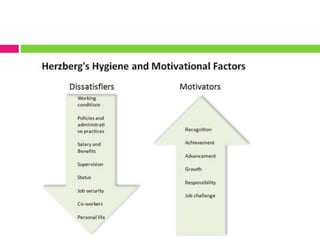
HYGIENE OR
DISSATISFIERS:
 - Working conditions
 - Policies and administrative practices
 - salaries and benefits
 - Supervision
 - Status
 - Job security
 - Co- workers
 - Personal life.
MOTIVATOR OR SATISFIERS:
 - Recognition
 - Achievement
 - Advancement
 - Growth
 - Responsibility
 - Job challenge
THEORY “X” AND THEORY
“Y”
 Douglas McGregor developed a philosophical
view of humankind with his theory X and
Theory Y, which are two opposing perceptions
about how people view human behavior at
work and organizational life. McGregor felt that
companies followed either one or other
approach
THEORY “X”
 -People have an inherent dislike for work and
will avoid whenever possible.
 - People must be coerced, controlled, directed,
or threatened with punishment on order to get
them to achieve the organizational objectives.
 People prefer to be directed, do not want
responsibility, and have little or no ambition.
 - People seeks security above all else.
THEORY “X”
 Work is as natural as play and rest.
 People will exercise self – direction if they are
committed to the objectives ( they are NOT lazy)
 Commitment to objectives is a function of the
rewards associated with their achievement.
 People learn to accept and seek responsibility
 Creativity, ingenuity, and imagination are widely
distributed among the population. People are
capable of using these abilities to solve an
organizational problem.
 People have potential.
THEORY “X” AND THEORY
“Y”
 Theory X is the view that traditional
management has taken towards the workforce.
 Many organizations are now taking theory Y
approach.
 A boss can be viewed a staking the theory X
approach.
 A leader takes the theory Y approach.
THEORIES ARE TIE
TOGETHER
 Maslow, Herzberg and McGregor’s theories all tie
together.
 -Herzberg’s theory is a micro version of Maslow’s
theory.
 -McGregor’s Theory X is based on workers caught
in the lower levels of Maslow’s theory, while his
Theory Y is for workers who have gone above level
3.
 - McGregor’s Theory X is based on workers caught
in Herzberg’s Hygiene Dissatisfiers, while Theory Y
is based on workers who are in the Motivators or
Satisfiers section.
EXISTENCE/RELATEDNESS/ GROWTH
(ERG)….
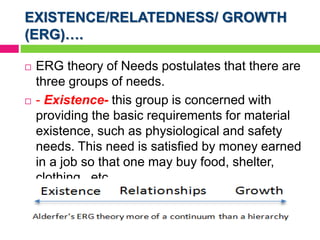
 ERG theory of Needs postulates that there are
three groups of needs.
 - Existence- this group is concerned with
providing the basic requirements for material
existence, such as physiological and safety
needs. This need is satisfied by money earned
in a job so that one may buy food, shelter,
clothing , etc..
EXISTENCE/RELATEDNESS/ GROWTH
(ERG)
 - Relationship- This group of needs centers
upon the desire to establish and maintain
interpersonal relationships. Since a people
normally satisfied to some degree by their
coworkers.
 - Growth- These needs are met by personal
development. A person’s job, career, or
profession provides significant satisfaction of
growth needs.
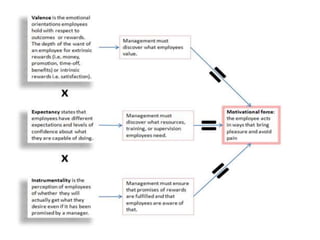
Vroom's Expectancy Theory
 Vroom's Expectancy Theory (1964)states that
an individual will act in a certain way based on
the expectation (belief) that the act will be
followed by a given outcome and on the
attractiveness of that outcome to the
individual. This motivational model has been
modified by several people, to include Porter
and Lawler (1968). Vroom's Expectancy
Theory is written as a formula:
 Valence x Expectancy x Instrumentality =
Motivation
EXPECTANCY THEORY
 Valence X Expectancy X Instrumentality =
Motivation
 Valence (Reward) = the amount of desire for a
goal ( What is the reward?)
 Expectancy (Performance)= the strength of
belief that work related effort will result in the
completion of the task.
 Instrumentality (Belief) = the belief that the
reward will be received once the task is
completed.
References
 Alderfer, C. (1969). An Empirical Test of a New Theory of Human Needs. Organizational Behavior
and Human Performance, vol. 4, pp. 142 - 175.
 Bootzin, R., Loftus, E., Zajonc, R., Hall, E. (1983). Psychology Today: An Introduction. New York:
Random House. Fifth Edition.
 Herzberg, F. (1966). Work and the Nature of Man. Cleveland: World Publishing Co.
 Maslow, A. (1971). The Farther Reaches of Human Nature. New York: McGraw-Hill.
 Maslow, A. (1954). Motivation and Personality. New York: Harper and Row
 Maslow, A. (1970). Motivation and personality (2nd ed.). New York: Harper & Row.
 Maslow, A. (1968). Toward a Psychology of Being. (2nd ed.). New York: Van Nostrand Reinhold.
 McGregor, D. (1957). Proceedings of the Fifth Anniversary Convocation of the School of Industrial
Management, The Human Side of Enterprise. Massachusetts Institute of Technology (April 9,
1957).
 Porter, L. & Lawler, E. (1968). Managerial Attitudes and Performance. Homewood, Ill.: Dorsey
Press.
 Tay, L., Diener, E. (2011). Needs and subjective well-being around the world.. Journal of
Personality and Social Psychology, Vol 101(2), Aug 2011, 354-365. doi: 10.1037/a0023779.
 Vroom, V. (1964). Work and Motivation. New York: Jon Wiley & Sons.
Thank you
 For more details or Seminars contact
 Dr.S.L.Riyas
 077 40567 41
 cpslanka@gmail.com

Leadership and Human Behaviour - level 5

  • 1.
    LEADERSHIP AND HUMAN BEHAVIOUR LEVEL-05- Dr.S.L.Riyas BA,MA,MBA,PhD, Management Consultant/Trainer
  • 2.
    Improving your PRand HR skills
  • 3.
    LEADERSHIP AND HUMAN BEHAVIOUR As a leader, you need to interact with your followers, peers, seniors, and others, whose support you need in orders to accomplish your objective.  To gain their support, you must be able to understand and motivate them.  To understand and motivate people, you must know the human nature.  Human nature is the common quality of all human being.  People behave according to certain principles of human nature.
  • 4.
    HIERARCHY OF NEEDS Human needs are important part of human nature.  Values, beliefs, and customs differ from country to country and group to group, but all people have similar needs.  As a leader you must understand these needs because they are powerful.
  • 5.
    HIERARCHY OF NEEDS There are two major groups of human needs:  01. Basic Needs – Psychological AND Physiological  02. Beta Needs – Being needs.
  • 6.
    BASIC NEEDS  PhysiologicalNeeds : Food, Water and Sleep  Psychological Needs : affection, security, and self esteem.  These needs are called deficiency needs.
  • 7.
    META NEEDS  Thehigher needs are called meta needs or being needs.  These include Justice, goodness, beauty, order and Unity.  Ex: a person who lacks food or water will not normally attend to justice or beauty needs.
  • 8.
    MASLOW’S HIERARCHY NEEDS…  1.Physiological : food , water, shelter sex  2. Safety: feel free from immediate danger  3. Belongingness and Love : being to a group, close friends to confidence with.  4. Esteem : feeling of moving up in world, recognition, few doubts about self.
  • 9.
    MASLOW’S HIERARCHY NEEDS  5.Cognitive : Learning for learning alone, contribute knowledge.  6. Aesthetic : at peace , more curious about the inner working of all things.  7. Self – actualization : know exactly who you are, where you are going , and what you want to accomplish. A state of well being.  8. Self- transcendence : A transgenic level that emphasizes visionary intuition , altruism, and unity consciousness.
  • 10.
  • 11.
  • 12.
    CHARACTERISTICS OF SELF-ACTUALISING PEOPLE… Have better perceptions of reality and are comfortable with it.  Accept themselves and their own natures.  Lack of artificiality.  They focus on problems outside themselves and are concerned with basic issues and eternal questions.  They like privacy and tend to be detached
  • 13.
    CHARACTERISTICS OF SELF-ACTUALISING PEOPLE Rely on their own development and continued growth.  Appreciate the basic pleasure of life.  Have a deep feelings of kinship with others.  Are deeply democratic and are not really aware of differences.  Have strong , ethical and moral standards.  Are original , initiatives, less constricted and fresher than others
  • 14.
    Hygiene and Motivational factors Herzberg developed a list of factors that are based on Maslow’s hierarchy of needs, except his version is more closely related to the working environment .  01. Hygiene or Dissatisfiers  02. Motivators or Satisfiers.
  • 15.
    HYGIENE OR DISSATISFIERS:  -Working conditions  - Policies and administrative practices  - salaries and benefits  - Supervision  - Status  - Job security  - Co- workers  - Personal life.
  • 16.
    MOTIVATOR OR SATISFIERS: - Recognition  - Achievement  - Advancement  - Growth  - Responsibility  - Job challenge
  • 18.
    THEORY “X” ANDTHEORY “Y”  Douglas McGregor developed a philosophical view of humankind with his theory X and Theory Y, which are two opposing perceptions about how people view human behavior at work and organizational life. McGregor felt that companies followed either one or other approach
  • 19.
    THEORY “X”  -Peoplehave an inherent dislike for work and will avoid whenever possible.  - People must be coerced, controlled, directed, or threatened with punishment on order to get them to achieve the organizational objectives.  People prefer to be directed, do not want responsibility, and have little or no ambition.  - People seeks security above all else.
  • 20.
    THEORY “X”  Workis as natural as play and rest.  People will exercise self – direction if they are committed to the objectives ( they are NOT lazy)  Commitment to objectives is a function of the rewards associated with their achievement.  People learn to accept and seek responsibility  Creativity, ingenuity, and imagination are widely distributed among the population. People are capable of using these abilities to solve an organizational problem.  People have potential.
  • 21.
    THEORY “X” ANDTHEORY “Y”  Theory X is the view that traditional management has taken towards the workforce.  Many organizations are now taking theory Y approach.  A boss can be viewed a staking the theory X approach.  A leader takes the theory Y approach.
  • 23.
    THEORIES ARE TIE TOGETHER Maslow, Herzberg and McGregor’s theories all tie together.  -Herzberg’s theory is a micro version of Maslow’s theory.  -McGregor’s Theory X is based on workers caught in the lower levels of Maslow’s theory, while his Theory Y is for workers who have gone above level 3.  - McGregor’s Theory X is based on workers caught in Herzberg’s Hygiene Dissatisfiers, while Theory Y is based on workers who are in the Motivators or Satisfiers section.
  • 24.
    EXISTENCE/RELATEDNESS/ GROWTH (ERG)….  ERGtheory of Needs postulates that there are three groups of needs.  - Existence- this group is concerned with providing the basic requirements for material existence, such as physiological and safety needs. This need is satisfied by money earned in a job so that one may buy food, shelter, clothing , etc..
  • 25.
    EXISTENCE/RELATEDNESS/ GROWTH (ERG)  -Relationship- This group of needs centers upon the desire to establish and maintain interpersonal relationships. Since a people normally satisfied to some degree by their coworkers.  - Growth- These needs are met by personal development. A person’s job, career, or profession provides significant satisfaction of growth needs.
  • 26.
    Vroom's Expectancy Theory Vroom's Expectancy Theory (1964)states that an individual will act in a certain way based on the expectation (belief) that the act will be followed by a given outcome and on the attractiveness of that outcome to the individual. This motivational model has been modified by several people, to include Porter and Lawler (1968). Vroom's Expectancy Theory is written as a formula:  Valence x Expectancy x Instrumentality = Motivation
  • 27.
    EXPECTANCY THEORY  ValenceX Expectancy X Instrumentality = Motivation  Valence (Reward) = the amount of desire for a goal ( What is the reward?)  Expectancy (Performance)= the strength of belief that work related effort will result in the completion of the task.  Instrumentality (Belief) = the belief that the reward will be received once the task is completed.
  • 29.
    References  Alderfer, C.(1969). An Empirical Test of a New Theory of Human Needs. Organizational Behavior and Human Performance, vol. 4, pp. 142 - 175.  Bootzin, R., Loftus, E., Zajonc, R., Hall, E. (1983). Psychology Today: An Introduction. New York: Random House. Fifth Edition.  Herzberg, F. (1966). Work and the Nature of Man. Cleveland: World Publishing Co.  Maslow, A. (1971). The Farther Reaches of Human Nature. New York: McGraw-Hill.  Maslow, A. (1954). Motivation and Personality. New York: Harper and Row  Maslow, A. (1970). Motivation and personality (2nd ed.). New York: Harper & Row.  Maslow, A. (1968). Toward a Psychology of Being. (2nd ed.). New York: Van Nostrand Reinhold.  McGregor, D. (1957). Proceedings of the Fifth Anniversary Convocation of the School of Industrial Management, The Human Side of Enterprise. Massachusetts Institute of Technology (April 9, 1957).  Porter, L. & Lawler, E. (1968). Managerial Attitudes and Performance. Homewood, Ill.: Dorsey Press.  Tay, L., Diener, E. (2011). Needs and subjective well-being around the world.. Journal of Personality and Social Psychology, Vol 101(2), Aug 2011, 354-365. doi: 10.1037/a0023779.  Vroom, V. (1964). Work and Motivation. New York: Jon Wiley & Sons.
  • 30.
    Thank you  Formore details or Seminars contact  Dr.S.L.Riyas  077 40567 41  cpslanka@gmail.com