MANAGERIAL DEVELOPMENT PROGRAM
“Don’t hope, just decide”
WHAT MAKES A LEADER TRULY
GREAT?
Humans are the most ill-equipped species in
the whole world
Humans are most ill-equipped
⚫can’t fly like birds.
⚫swim like a fish.
⚫climb tree like a monkey.
⚫don’t have the eye of eagle.
⚫can’t run like tiger.
⚫don’t have skin like rhino
⚫don’t have a claws & teeth like a wildcat.
Physically humans are helpless & defenseless
But nature is responsible and kind
Human kind have ability to think
Can create his own environment
Sadly, very few people use the greatest gift- the
ability to think its full potential.
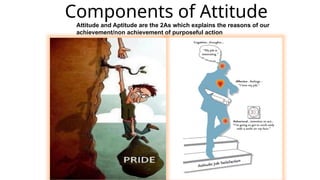
Components of Attitude
Attitude and Aptitude are the 2As which explains the reasons of our
achievement/non achievement of purposeful action
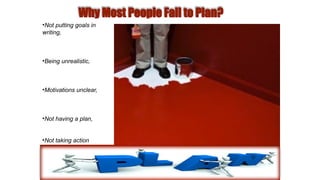
Why Most People Fail to Plan?
•Not putting goals in
writing,
•Being unrealistic,
•Motivations unclear,
•Not having a plan,
•Not taking action
FROM GOALS TO ACTION!!!
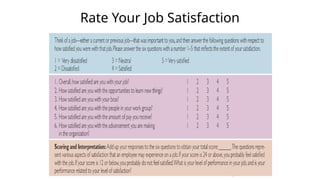
Rate Your Job Satisfaction
16
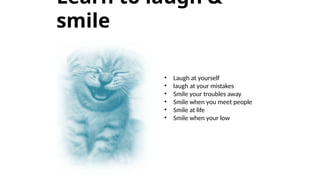
• Laugh at yourself
• laugh at your mistakes
• Smile your troubles away
• Smile when you meet people
• Smile at life
• Smile when your low
Learn to laugh &
smile
Qualities that make a person Successful
⚫Give More Than You Get
⚫Hard Working People
⚫Power Of Persistence
⚫Pride Of Performance
⚫Be Willing To Be A Student - Get A Mentor
⚫Never compromise your integrity
⚫Plan to win and not to lose
⚫Learn from other people’s mistakes
⚫Nobody wants to be a loser. Everybody wants to win.
⚫‘Positive Attitude’ is the key to a successful life.
⚫We don’t have to be 10 times smarter than our competitor.
All we need is the edge.
WINNERS MAKE THE DAYS COUNT. LOSERS COUNT
THE DAYS THEY have.
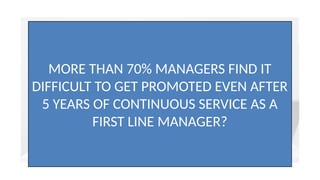
MORE THAN 70% MANAGERS FIND IT
DIFFICULT TO GET PROMOTED EVEN AFTER
5 YEARS OF CONTINUOUS SERVICE AS A
FIRST LINE MANAGER?
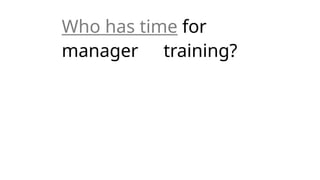
Who has time for
manager training?
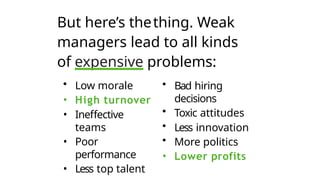
But here’s thething. Weak
managers lead to all kinds
of expensive problems:
• Low morale
• High turnover
• Ineffective
teams
• Poor
performance
• Less top talent
• Bad hiring
decisions
• Toxic attitudes
• Less innovation
• More politics
• Lower profits
The bottom line: if you’re growing fast
and scaling faster, weak managers can
literally Break The Company.
But don’t be too hard on your managers. It’s not
entirely their fault...
Good managers aren’t
born. It’s a learned skill,
and it’s really hard.
New managers rarely get the training and
support they need to be effective.
Now the good news: The
solution to this problem is
simple.
1.Research indicates “great” managers listen well,
motivate others, and consistently make good decisions.
2.Research indicates “great” managers are passionate
about their work and compassionate toward others.
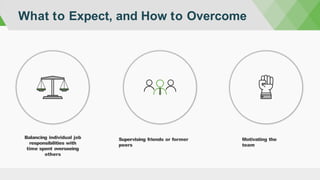
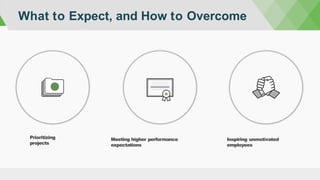
Top Challenges of New Managers
Balancing individual job responsibilities
with time spent overseeing others
Supervising friends or former
peers
Motivating the
team
Prioritizing
projects
Meeting higher
performance expectations
Inspiring unmotivated
employees
What to Expect, and How to Overcome
Balancing individual job
responsibilities with
time spent overseeing
others
Supervising friends or former
peers
Motivating the
team
What to Expect, and How to Overcome
Prioritizing
projects
Meeting higher performance
expectations
Inspiring unmotivated
employees
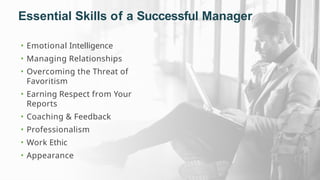
Essential Skills of a Successful Manager
• Emotional Intelligence
• Managing Relationships
• Overcoming the Threat of
Favoritism
• Earning Respect from Your
Reports
• Coaching & Feedback
• Professionalism
• Work Ethic
• Appearance
Emotional Intelligence
• Delegation
• Performance
• Listening
• Coaching
• Leadership
• Strategic
Thinking
Managing
Relationships
Co-
managers
Employees Bos
s
Three
Relationships
Common Myths About Management
Let’s explore each of these myths…..
In order to be successful as a manager,
it’s important to consider these common
myths about management:
• “I’ll use the same skills as before.”
• “I’ll have power.”
• “I’ll have a lot more freedom.”
• “I’ll always have control.”
• I’ll learn the job primarily through
training.”
Myth #1: “I’ll use the same skills as before.”
TRUTH: The skills of a manager are vastly different than
that of an individual contributor.
• Many managers promoted based
on their skill in the Individual
Contributor role
• As a manager, you still need the
skills and knowledge you’ve
acquired, but…
• Now you will also need to
work through others to
achieve your objectives
Remember…
“What got you HERE won’t get you
THERE.”
Myth #2: “I’ll have power.”
TRUTH: Many managers do have more formal
authority than individual contributors, but
authority does not guarantee the manager will
have influence.
Use the management tools you have to influence
others:
• Your position in the organization – are you visible?
• Your personal characteristics – what are you “known”
for?
To influence others to help you get things done, provide
them with valued resources and services in exchange for
resources and services you need.
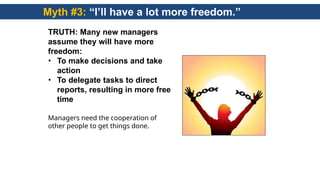
Myth #3: “I’ll have a lot more freedom.”
TRUTH: Many new managers
assume they will have more
freedom:
• To make decisions and take
action
• To delegate tasks to direct
reports, resulting in more free
time
Managers need the cooperation of
other people to get things done.
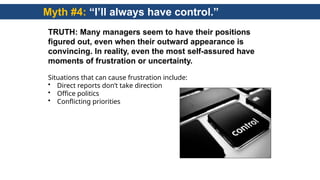
Myth #4: “I’ll always have control.”
TRUTH: Many managers seem to have their positions
figured out, even when their outward appearance is
convincing. In reality, even the most self-assured have
moments of frustration or uncertainty.
Situations that can cause frustration include:
• Direct reports don’t take direction
• Office politics
• Conflicting priorities
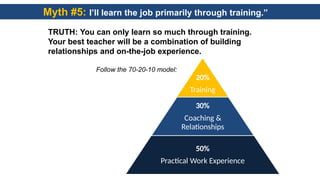
Myth #5: I’ll learn the job primarily through training.”
TRUTH: You can only learn so much through training.
Your best teacher will be a combination of building
relationships and on-the-job experience.
Follow the 70-20-10 model:
20%
Training
30%
Coaching &
Relationships
50%
Practical Work Experience
DEFINING YOUR Role
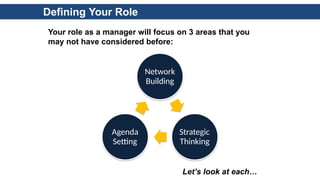
Defining Your Role
Let’s look at each…
Your role as a manager will focus on 3 areas that you
may not have considered before:
Network
Building
Strategic
Thinking
Agenda
Setting
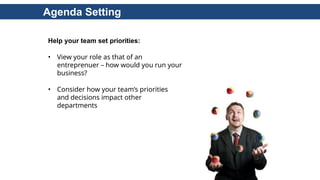
Agenda Setting
Help your team set priorities:
• View your role as that of an
entreprenuer – how would you run your
business?
• Consider how your team’s priorities
and decisions impact other
departments
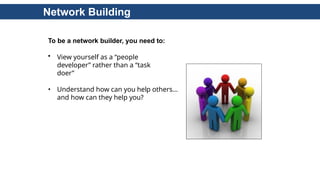
Network Building
To be a network builder, you need to:
• View yourself as a “people
developer” rather than a “task
doer”
• Understand how can you help others…
and how can they help you?
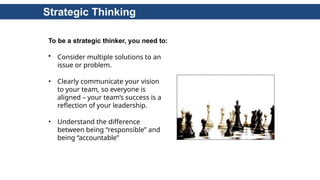
Strategic Thinking
To be a strategic thinker, you need to:
• Consider multiple solutions to an
issue or problem.
• Clearly communicate your vision
to your team, so everyone is
aligned – your team’s success is a
reflection of your leadership.
• Understand the difference
between being “responsible” and
being “accountable”
Coping With Your Feelings
You can expect to experience one or
more of the following emotions as you
transition to management:
• Frustration
• Performance
Anxiety
• Loss
• Humility
• Conflict
Coping With Your Feelings: Solutions
A few ideas:
• Always be developing yourself
• Get enough leisure time to relax – use your personal/vacation
time!
• Talk about your concerns with supportive friends or a mentor
• Take care of your health
• Keep your job in perspective – remember what’s most
REAPING THE Rewards OF BEING A
MANAGER
Key Messages
• Having authority does
not guarantee one will
have influence
• Transitions take time – even
the most self-assured
managers have moments of
frustration or uncertainty
• The most effective
learning for new (&
seasoned) managers often
comes from building
relationships and on-the-job
experience
Overcoming the
Threat of Favoritism
Earning Respect from Your Reportees
“Respect is something that must be earned.
Managers earn respect when they are respectful to
others, as well as when they demonstrate
trustworthiness, credibility, and a healthy dose of
humanity.”
– Lisa Parker, author of Managing the Moment: A Leader’s Guide to Building Executive Presence One Interaction at a
Time
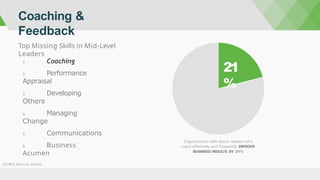
Coaching &
Feedback
Organizations with senior leaders who
coach effectively and frequently IMPROVE
BUSINESS RESUL
TS BY 21%
21
%
Top Missing Skills in Mid-Level
Leaders
1. Coaching
2. Performance
Appraisal
3. Developing
Others
4. Managing
Change
5. Communications
6. Business
Acumen
SOURCE: Bersin by Deloitte
“Employees who
receive daily feedback
from their managers are
3x more likely to be
engaged than those who
give feedback once a
week or less”
“When managers
provide meaningful
feedback to employees,
those employees are
3.5x more likely to be
engaged”
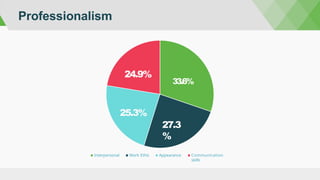
Professionalism
Interpersonal Work Ethic Appearance Communication
skills
25.3%
27.3
%
24.9%
33.6%
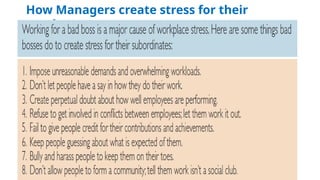
How Managers create stress for their
employees
59
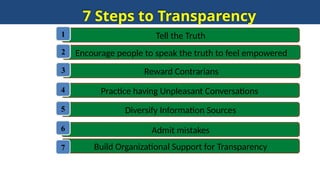
7 Steps to Transparency
Tell the Truth
1
Encourage people to speak the truth to feel empowered
2
Reward Contrarians
3
Practice having Unpleasant Conversations
4
Diversify Information Sources
5
Admit mistakes
6
Build Organizational Support for Transparency
7
With great
power comes
great
responsibility
And though we don’t
have super powers,
as leaders, we do
have the power to
influence others and
the responsibility to
do it well.
There are several
traits associated
with being a
successful leader.
Let’s take a look at
them together.
What qualities make a manager different
and a super hero of their team??
Plz write down in your diaries and share
with us
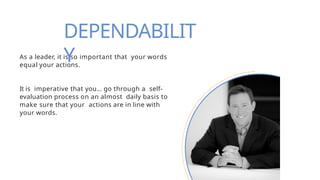
As a leader, it is so important that your words
equal your actions.
It is imperative that you… go through a self-
evaluation process on an almost daily basis to
make sure that your actions are in line with
your words.
DEPENDABILIT
Y
[A good leader has] an understanding of the
goals and how to get there, as well as an
understanding of how to make goals personal for
each staffer.
AWARENESS
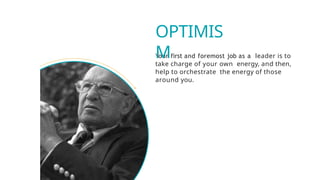
Your first and foremost job as a leader is to
take charge of your own energy, and then,
help to orchestrate the energy of those
around you.
OPTIMIS
M
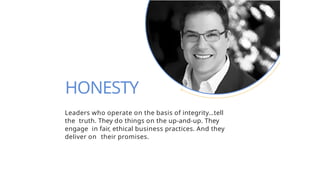
Leaders who operate on the basis of integrity…tell
the truth. They do things on the up-and-up. They
engage in fair, ethical business practices. And they
deliver on their promises.
HONESTY
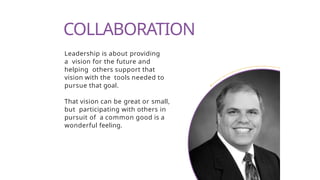
Leadership is about providing
a vision for the future and
helping others support that
vision with the tools needed to
pursue that goal.
That vision can be great or small,
but participating with others in
pursuit of a common good is a
wonderful feeling.
COLLABORATION
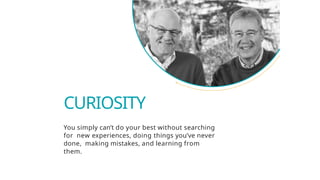
You simply can’t do your best without searching
for new experiences, doing things you’ve never
done, making mistakes, and learning from
them.
CURIOSITY
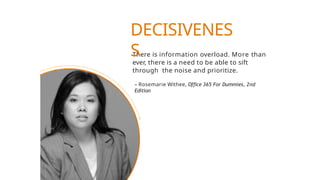
There is information overload. More than
ever, there is a need to be able to sift
through the noise and prioritize.
– Rosemarie Withee, Office 365 For Dummies, 2nd
Edition
DECISIVENES
S
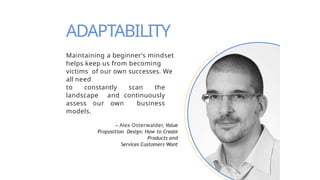
Maintaining a beginner’s mindset
helps keep us from becoming
victims of our own successes. We
all need
to constantly scan the
landscape and continuously
assess our own business
models.
– Alex Osterwalder, Value
Proposition Design: How to Create
Products and
Services Customers Want
ADAPTABILITY
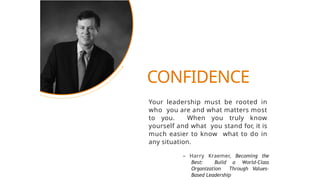
Your leadership must be rooted in
who you are and what matters most
to you. When you truly know
yourself and what you stand for, it is
much easier to know what to do in
any situation.
– Harry Kraemer, Becoming the
Best: Build a World-Class
Organization Through Values-
Based Leadership
CONFIDENCE
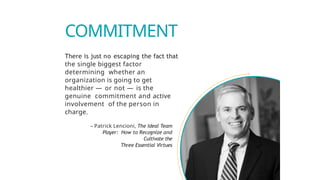
COMMITMENT
There is just no escaping the fact that
the single biggest factor
determining whether an
organization is going to get
healthier — or not — is the
genuine commitment and active
involvement of the person in
charge.
– Patrick Lencioni, The Ideal Team
Player: How to Recognize and
Cultivate the
Three Essential Virtues
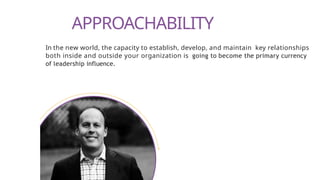
APPROACHABILITY
In the new world, the capacity to establish, develop, and maintain key relationships
both inside and outside your organization is going to become the primary currency
of leadership influence.
INSPIRATIO
N
Leaders must recognize that leadership is not
about them and their ability to attract followers.
Leadership is about serving others to bring out
the best in them.
As leaders, we must inspire,
encourage, and empower those
around us. By fostering these skills,
you’re on your way to becoming a
truly great leader.
Employee Retention
And Leadership
“You can’t expect people to be committed, to be
loyal to an organization, to be engaged in an
organization, OR to stay in an organization if the
company doesn’t care about them.”
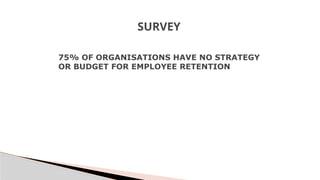
SURVEY
75% OF ORGANISATIONS HAVE NO STRATEGY
OR BUDGET FOR EMPLOYEE RETENTION
Why do employees leave?
Plz tell??
 Fail to connect with their bosses as leaders and
people
 Work environment is not particularly friendly
 Do not feel appreciated
 Managers will not listen to employees
Top Reasons Employees Leave
CONT…
Employees usually don’t leave the
company, they leave their BOSSES
 Limited career growth or opportunity
 Lack of respect for supervisor
 Higher compensation
 Felt their job duties were unchallenging
 Felt their supervisor lacked leadership skills
 For better work hours
Other reasons employees leave
 There is no incentive for employees to explain why they are
actually leaving their job.
 Employees want to leave their job and have that boss as a good
reference.
 Few exit surveys have been done.
What is the Real Reason?-Limitations
Put it into perspective…
 Employees who have worked with an organization for six or
fewer months are the ones most likely to leave the company.
 Those with one to two years’ experience are the next most likely
to leave.
 “On average, the cost of losing an employee is about 150 percent. It’s
one-and-a-half times the person’s compensation”.
New Employees
Why is employee retention
important?
 Employees are the heart and soul of an organization
 Employee turnover is costly for an organization
 Finding suitable replacements for key employees is difficult
 Low employee turnover leads to outstanding performance of an
organization
Employee Retention
Why do employees stay?
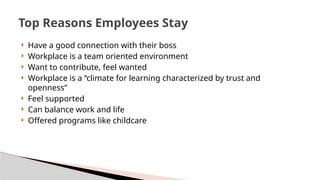
 Have a good connection with their boss
 Workplace is a team oriented environment
 Want to contribute, feel wanted
 Workplace is a “climate for learning characterized by trust and
openness”
 Feel supported
 Can balance work and life
 Offered programs like childcare
Top Reasons Employees Stay
“Shoe Size”
Team Challenge
What do employees want?
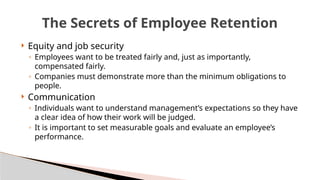
 Equity and job security
◦ Employees want to be treated fairly and, just as importantly,
compensated fairly.
◦ Companies must demonstrate more than the minimum obligations to
people.
 Communication
◦ Individuals want to understand management’s expectations so they have
a clear idea of how their work will be judged.
◦ It is important to set measurable goals and evaluate an employee’s
performance.
The Secrets of Employee Retention
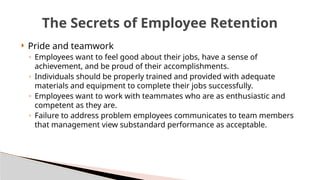
 Pride and teamwork
◦ Employees want to feel good about their jobs, have a sense of
achievement, and be proud of their accomplishments.
◦ Individuals should be properly trained and provided with adequate
materials and equipment to complete their jobs successfully.
◦ Employees want to work with teammates who are as enthusiastic and
competent as they are.
◦ Failure to address problem employees communicates to team members
that management view substandard performance as acceptable.
The Secrets of Employee Retention
 Fun
◦ While it’s important that attempts at creating a fun work environment
don’t disrupt the overall productivity of employees, making the job
enjoyable is beneficial.
◦ By never taking time to celebrate, employees are more likely to
experience elevated stress and burn-out.
The Secrets of Employee Retention
 Recognition
◦ “People want to do good work and they want to be recognized for it,”
◦ Johnson recommends that recognition be significant, specific and sincere.
 For example, telling an employee “you’re great” isn’t nearly as meaningful as
saying that his/her innovative ideas and work to satisfy a particular tenant or to
keep a specific project on budget was terrific.
The Secrets of Employee Retention
How do you find out if your employees are
happy?
 Assure subordinates that they are free to express their opinions
without fear of negative repercussions.
 Consider seeking the services of a third party to survey staff.
 Be prepared to share the survey findings and a plan of action
with the team.
 If you can determine why employees are not happy, it’s likely you
can prevent them from leaving by changing practices, culture, and
sometimes even your management style.
Ask!
 (1)They have open channels of communication
that lead to collaboration and inclusion
◦ These leaders are open with information, interested
in learning what employees think, and incorporate
their ideas into doing business.
◦ These leaders not only inform people about issues
affecting them but involve them in decisions.
Four Characteristics of
Leaders
 (2)They move beyond the status quo.
◦ These leader take bold action in support of their
people, raising the benchmark.
For Characteristics of Leaders
 (3)They are very selective about what to
measure and why.
◦ Great leaders know what makes their unique culture
tick and measure accordingly.
◦ A clear and accurate understanding of their culture
allows them to choose and reward measures
selectively.
For Characteristics of Leaders
 (4)They are passionate about values and
culture.
◦ Values are tied to success and measures, and the
leaders are very familiar with the values. Their vigor
for values and culture is contagious.
For Characteristics of Leaders
7 STEPS TO BETTER EMPLOYEE RETENTION
1. Track retention
2. Hire right in the first place
3. Offer employees a path to greater pay and responsibility
4. Train first-level supervisors
5. Look for stressors and train leaders on how to help employees in stressful
positions
6. Be more flexible on work conditions
7. Re-evaluate benefits package
IDEAS FOR EMPLOYEE RETENTION PROGRAMS
 Workplace culture
 Involvement
 Orientation
 Learning
 Reward
KEEPING IS CHEAPER THAN REPLACING
 Direct Costs of Replacement
 Paperwork/Time Exit Interview
 Recruiting Replacement
 Interview/Select New Employee
 On boarding New Employee
 Training New Employee
 Depending on the complexity of the job, this process can take at least 3-6
months in most cases.
KEEPING IS CHEAPER THAN REPLACING
 Indirect Costs of Replacement
 Losses in productivity.
 Slips in schedule.
 Loss of corporate knowledge.
 Lost opportunity costs etc.
KEYS TO RETENTION
 The keys to retention simply put are based on a name
we called SAM;
 Satisfaction - There are a number of elements to
satisfaction. They include, salary, health plan, work
environment, and more.
 Appreciation - Appreciation is just what it says it is, being
recognized and appreciated for your work. Both publicly
and privately.
 Motivation - Once an employee is satisfied and
appreciated, that employee can be motivated. Ways to
motivate include bonuses, promotions, conferences and
training and more.
 That's it! Employee retention is as simple as SAM
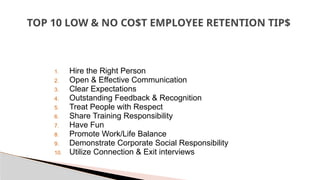
TOP 10 LOW & NO CO$T EMPLOYEE RETENTION TIP$
1. Hire the Right Person
2. Open & Effective Communication
3. Clear Expectations
4. Outstanding Feedback & Recognition
5. Treat People with Respect
6. Share Training Responsibility
7. Have Fun
8. Promote Work/Life Balance
9. Demonstrate Corporate Social Responsibility
10. Utilize Connection & Exit interviews
Liability employees are growth
hinders
 DON’T BE EMOTIONAL
 Always give people a third chance, never a
fourth chance.
 Never let people go in anger, under
pressure, or in a crisis.
 If termination is a surprise, you have done
something wrong.
 Have a check ready and all the facts
about money, benefits, vacation, etc.
 Be general, not specific about the
reasons for dismissal.
 Do not argue or be defensive.
 Do not make promises you can’t keep.
 Get keys, passes, IDs, etc.
 Do it Saturday afternoon.
 Tell people about insurance continuation options (a
legal requirement).
 Handling the garbage work, such a firing people,
well gains you great credibility and value to your
bosses.
 Keep terminated employees away from the office if
possible.
 Do not give other employees any specifics about a
termination.
 Statistics show that most people are better off
after being fired and usually say good things about
the person who fired them if the person does it
gently and preserves the dignity of the person
being let go.
 Most medium-sized and large companies
require someone else be present at
termination meeting, usually an HR person.
 Fine, but you do all the talking and take
responsibility for the termination.
 Your most difficult job. Not everyone can do
it.
Winners Don’t Do Different Things .
They Do Things Differently……........
1. Importance of Attitude
2. Success
3. Motivation
4. Self Esteem
5. Interpersonal skills
6. Subconscious Mind & Habits
7. Goal setting
8. Value & Visions
Winners Don’t Do Different Things .
They Do Things Differently……........
“ If there was one thing that
you would like to see
change, that would make
your organization more
productive , what would it
be? ”
All said that…..
Attitud
e
THERE ARE 3 KINDS OF PEOPLE IN THIS
WORLD
⚫Those who make things happen.
⚫Those who watch things
happen.
⚫Those who wonder what
happened.
Whatcategory are YOU
in?
Winners Vs Losers
• Winner sees an answer for every problem; Loser sees
a problem for every answer.
• Winners see possibilities; Loser see
problems.
• Winners see the gain;
Loser see the PAIN.
• Winners say, “I must do something.” Losers say’
“Something must be done.”
• Winners have dreams;
Losers have schemes.
“ Success Is The Progressive
Realization
Of A Worthy Goal ”
⚫Success and Happiness go hand in hand.
Success is getting what you want &
happiness is wanting what you get!
STRUGGLE
[Nothing worthwhile in life comes without a
struggle.]
 Story of caterpillar turning into butterfly.
Law of Nature:-
- struggle to come out of cocoon helps develop
and strengthen its wings.
⚫Failure are of two kinds:- those who did and
never thought And those who thought and
never did.
LIFE IS CAFETERIA
⚫Life is like a cafeteria: Take your tray, Select your
food, and pay at other end. You can get anything
you want as long as you are willing to pay the
PRICE.
⚫In a cafeteria, if you wait for people to serve
for you, you will wait forever.

⚫Make the choices and pay the prices.
TOP 7 MANAGEMENT
SKILLS! How to be a
GREAT MANAGER!
we
“The Secret of Leadership”
Climbing your
mountain
●Edmund Hillary’s to Mount Everest
●Some year before when he failed
he screamed to mountain “I will
come again and conquer you!
Because as a mountain, you can’t
grow. But as a human ,I can!
Climbing your
mountain
●That message was not for mountain it
was for world only that we can keep
trying better ,we can keep growing and
we can all overcome life’s challenges
and climb all those mountains we set
our sights on
Climbing your
mountain
●So if two people want to climb the
mountain, what's the most important
things they need? Teamwork? Or
training? Favorable weather conditions?
Luck?
Are you PHD???
“PHD”
●Passion ,Hunger And Discipline
●Passion: Do you Enjoy what you are
doing? Do you love your work?
●Hunger: How badly do you want to
win? Are you really hungry for success?
“PhD
”
●Discipline : Once you have the passion
and the hunger , you will probably see a
road emerge in front of you ,leading you
to your goal. And then you all need is
discipline...
●
●You will get obstacles ,roadblocks and
many things which can stop you to get
your goal
“Run with YOUR mind , Not Just
Your Legs!”
●Success in life is not defined by talent
and physical ability
●When you run with your legs, you allow
the pressures to weigh you down. You
find yourself saying , “I can’t!”
“Run with YOUR mind , Not Just
Your Legs!”
●But when you run with your mind, YOU
must mind your mind and say “I CAN!”.
“One 500-Rupee Note.
And Two lessons!”
● Most of us just wait for good things to
happen. That’s of no use. You’ve got to make
things happen
● And there will be times when we feel crushed,
stamped on, beaten. But never let that
diminish your worth.
● Remember you are still the terrific person
you were. Just because someone chooses to
crush you –that doesn’t change your worth
one bit!
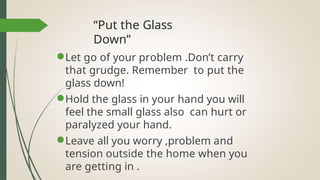
“Put the Glass
Down”
●Let go of your problem .Don’t carry
that grudge. Remember to put the
glass down!
●Hold the glass in your hand you will
feel the small glass also can hurt or
paralyzed your hand.
●Leave all you worry ,problem and
tension outside the home when you
are getting in .
“The Secret of Sachin Tendulkar”
●Tendulkar studies always practiced
before the match. Do you?
●I will play!, he said . I will fight
●The opportunity comes to us all the
question is how prepared are we
when opportunity comes knocking ?
“The Secret of Sachin Tendulkar”
●We may not all have Tendulkar talents
or his mental strength, but we can all
have his work ethic.
What to Be a Good Leader? Just Do It!
●Make a beginning –right away- Whenever
you have goal take the first step,
however small
●Break up the grand plan into smaller
tasks-Something is better than nothings
What to Be a Good Leader? Just Do It!
●Visualize your success-Think the pleasure
not the pain
●Create a support team-surrounded
yourself with people who share your
objective
What to Be a Good Leader? Just Do It!
Every morning write down a list
of the things that need to be
done that day
- Do Them
“The Truck with No Tail
Lights”
●Good leader make sure they have
great headlights and excellent tail
lamps too
●They recognize that there are folks
behind them who need to see those tail
lamps as they drive forth on their
journey
●Not giving tail lamp can cause an
accident and interrupt the journey
THE
LEADER
WHO
HAD NO
TITLE
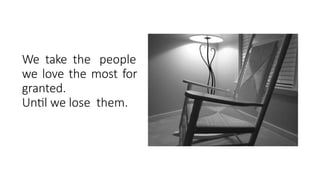
We take the people
we love the most for
granted.
Until we lose them.
LEADERSHIP
Strengthen the capacities of employees at
every level to lead in everything they do.
Long forgotten secret :
“you don’t have to have a title
to be a leader.”
Money is really only the by product of standing for the
finest within you and doing some SEW.
Seriously Exceptional Work
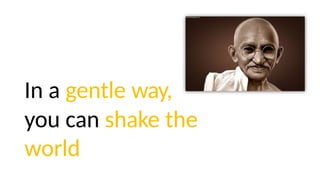
In a gentle way,
you can shake the
world
“Nobody succeeds beyond his or her wildest
expectations unless he or she begin with some
wild expectations.”
“The sight of an achievement is the greatest gift a
human being could offer others.”
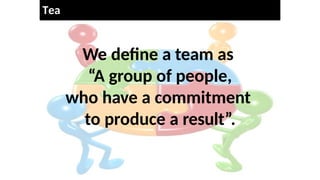
Tea
m
We define a team as
“A group of people,
who have a commitment
to produce a result”.
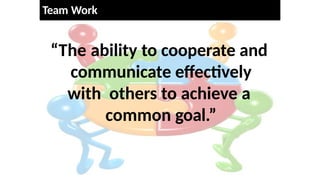
“The ability to cooperate and
communicate effectively
with others to achieve a
common goal.”
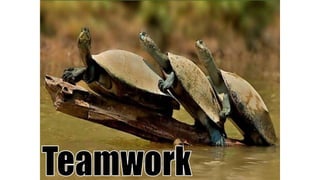
Team Work
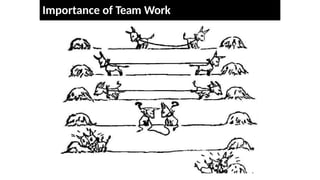
Importance of Team Work
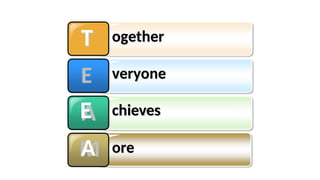
ogether
veryone
chieves
ore
T
E
A
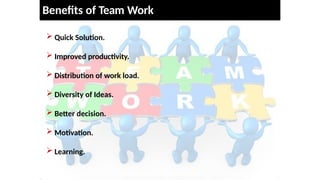
 Quick Solution.
 Improved productivity.
 Distribution of work load.
 Diversity of Ideas.
 Better decision.
 Motivation.
 Learning.
Benefits of Team Work
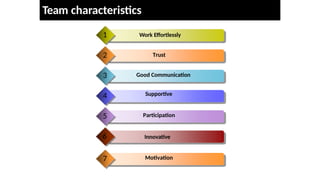
Team characteristics
Participation
5
Work Effortlessly
1
Trust
2
Good Communication
3
Supportive
4
Motivation
7
Innovative
6
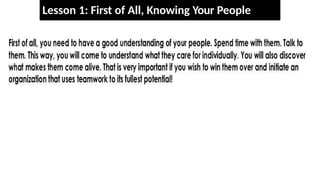
Lesson 1: First of All, Knowing Your People
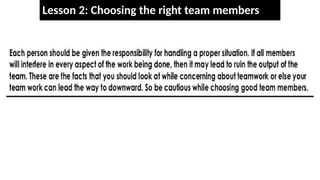
Lesson 2: Choosing the right team members
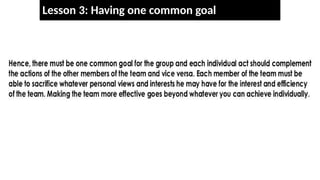
Lesson 3: Having one common goal
Lesson 4: Developing teamwork requires commitment
Lesson 5: Sharing Information
Lesson 6: Empowering the team
Lesson 7: Facilitating open communication
Lesson 8: Creating problem solving environment
Lesson 9: Measuring teamwork performance continually
Lesson 10: Sharing the outcomes together
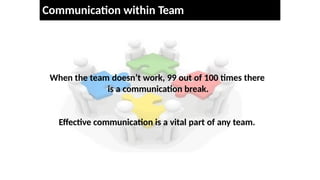
Communication within Team
When the team doesn’t work, 99 out of 100 times there
is a communication break.
Effective communication is a vital part of any team.
Communication – Do’s
 Support Group Member's Ideas.
 If there is a problem, talk.
 Listen actively.
 Get involved.
 Be proactive, than reactive.
 Give and take feedback.
 Be open.
 Have fun.
Communication – Don’ts
 Do not blame others.
 No Bragging.
 Do not take credit for what others are doing.
 Being unprepared.
 Do not speak poorly of those in authority.
 Do not make others look bad.
 Don’t cheat.
 Don’t lie.
 Don’t steal.
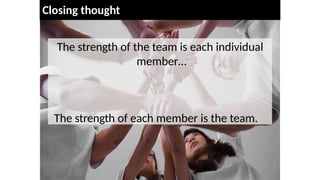
Closing thought
The strength of the team is each individual
member…
The strength of each member is the team.
THE TEAM IS AS FAST AS THE
SLOWEST MEMBER IN THE TEAM
Leadership Is Action, Not Position
LEADERSHIP COMPETENCIES
What is Competence and Competency?
'Competence' means a skill and the standard of performance reached
while 'Competency' refers to the behavior by which it is achieved.
LEADERSHIP COMPETENCIES
What is Competence and Competency?
Competence describes what people can do and Competency focuses on
how they do it.
Competence is skill based and Competency is behavior based.
Let us understand the
Nine Leadership Competencies
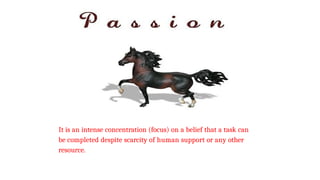
It is an intense concentration (focus) on a belief that a task can
be completed despite scarcity of human support or any other
resource.
How to raise your passion competency
●
Lead a team in your organization.
●
Ensure from team the organization's mission
statement or vision.
●
Mentor an employee.
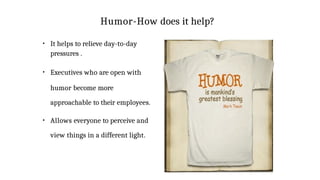
Humor-How does it help?
●
It helps to relieve day-to-day
pressures .
●
Executives who are open with
humor become more
approachable to their employees.
●
Allows everyone to perceive and
view things in a different light.
COURAGE
It is the ability to
confront fear, pain,
danger, uncertainty or
intimidation.
This is what Osho says about courage:
●
"You cannot be truthful if you are not courageous - You
cannot be loving if you are not courageous - You cannot be
trusting if you are not courageous- You cannot inquire into
reality if you are not courageous - Hence courage comes first
and everything else follows."
INTEGRITY AND TRUST
Integrity:
Firm adherence to a code of moral or artistic values.
Trust:
Firm reliance on the integrity, ability, or character of a
person or thing.
BL U E PR INT
for
S U C C E S S
Winners do things, in spite of
problems.
Losers permanently rationalize.
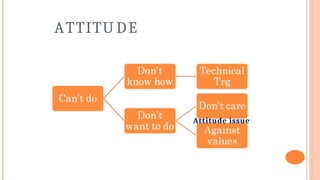
ATTITU DE
Attitude issue
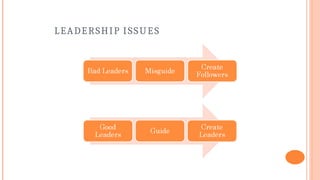
LEADERSHIP ISSUES
STEPS FOR BUILDING POSITIVE
ATTITUDE-8
Step1: Change focus – look for
the positive in people
STEPS FOR BUILDING POSITIVE
ATTITUDE-8
Step 2: Make a habit of doing it
now
STEPS FOR BUILDING POSITIVE
ATTITUDE-8
Step 3: Develop an attitude of
gratitude.
STEPS FOR BUILDING POSITIVE ATTITUDE
Step 4:Get into a continuous
education and development
program
STEPS FOR BUILDING POSITIVE ATTITUDE
Step 5: Build a positive self-esteem
STEPS FOR BUILDING POSITIVE ATTITUDE
Step 6: Stay away from negative
influences
STEPS FOR BUILDING POSITIVE ATTITUDE
Step 7:Learn to like the things
that need to be done
STEPS FOR BUILDING POSITIVE ATTITUDE
Step 8: Start your day with a
positive thoughts
Positive attitude
World famous personalities
THIS WAS A MAN WHO:
 failed in business at the age of 21 ;
 was defeated in a legislative race at age 22;
 failed again in business at age 24;
 overcame the death of his sweetheart at age 26;
 had a nervous breakdown at age 27;
 lost a congressional race at age 34;
 lost a senatorial race at age 45;
 failed in an effort to become vice-president at age 47;
 lost a senatorial race at age 49; and
 was elected president of the United States at age 52.
This man was Abraham Lincoln
EVERY SUCCESS STORY IS A STORY
OF GREAT FAILURE
 Henry Ford was broke at the age of 40.
 Lee Iacocca was fired by Henry Ford II at the age
of 54.
 Young Beethoven was told that he had no talent
for music, but he gave some of the best music to
the world.
 In 1913, Lee De Forest, inventor of the triodes tube,
was charged by the district attorney for using
fraudulent means to mislead the public into
buying stocks of his company by claiming that he
could transmit the human voice across the
Atlantic. He was publicly humiliated.
EVERY SUCCESS STORY IS A STORY
OF GREAT FAILURE
 As a young cartoonist, Walt Disney faced many
rejections from newspaper editors, who said he
had no talent.
 One day a minister at a church hired him to
draw some cartoons. Disney was working out of a
small mouse- infested shed near the church.
 After seeing a small mouse, he was inspired. That
was the start of Mickey Mouse.
EVERY SUCCESS STORY IS A STORY
OF GREAT FAILURE
 A New York Times editorial on 10 December 1903,
questioned the wisdom of the Wright Brothers
who were trying to invent a machine, heavier
than air, that would fly.
 One week later, at Kitty Hawk, the Wright
Brothers took their famous flight.
EVERY SUCCESS STORY IS A STORY
OF GREAT FAILURE
 In 1914, Thomas Edison, at age 67, lost his factory,
which was worth a few million dollars, to fire. It
had very little insurance.
 No longer a young man, Edison watched his
lifetime effort go up in smoke and said, “There is
great value in disaster.

 All our mistakes are burnt up. Thank God we can
start anew.” In spite of disaster, three weeks later,
he invented the phonograph.
What an attitude!
IF YOU THINK
If you think you are beaten, you are. If
you think you dare not, you don’t!
QUALITIES THAT MAKE A PERSON SUCCESSFUL
o Desire
o Commitment
o Responsibility
o Hard work
o Character
o Positive belief
o Give more than you get
o Persistence
LU C K SHINES ON THE DESERVING
Alexander Graham Bell was desperately trying to invent a
hearing aid for his partially deaf wife.
 He failed at inventing a hearing aid but in the process
discovered the principles of the telephone.
LU C K SHINES ON THE DESERVING
You wouldn’t call someone like that lucky, would you?
Good luck is when opportunity meets preparation.
Without effort and preparation, lucky coincidences don’t
happen.
MOTIVATION
 Motivation is like fire unless you keep adding fuel to it, it dies. Just like
exercise and food don’t last long, neither does motivation. However, if the
source of motivation is belief in inner values, it becomes long-lasting.
MOTIVATION
 Experience has shown that people will do a lot for money, more for a good
leader, and do most for a belief. We see this happening every day all over
the world. People will die for a belief.
STEPS FOR BUILDING POSITIVE
SELF-ESTEEM
 Turn Scars into Stars - Some of the best music was composed by Beethoven.
 What was his handicap?
 He was deaf.
 Some of the best poetry written on nature was written by Milton.
 What was his handicap?
 He was blind.
 One of the greatest world leaders was U S President Franklin D. Roosevelt. What
was his handicap?
 He served from a wheelchair.
STEPS FOR BUILDING POSITIVE
SELF-ESTEEM
Learn Intelligent Ignorance
I'm looking for a lot of men with an infinite capacity for not
knowing what cannot be done. - Henry Ford
Henry Ford gave this world the V8 engine. He did not have
much formal education. In fact, he did not go to school
beyond the age of 14. He was intelligent enough to know there
had to be a V8 engine but he was ignorant and didn’t know
how to build it. So he asked all his highly qualified,
educated people to build one. But they told him what could
be done and what couldn’t. According to them, a V8 was an
impossibility. But Henry Ford insisted on having his V8. A
few months later he asked his people if they had the V8 and
they replied, “We know what can be done and we also know
what cannot be done and V8 is an impossibility.” This went
on for many months and still Henry Ford said, “I want my
V8.” And shortly thereafter the same people produced his V8
engine.
STEPS FOR BUILDING POSITIVE
SELF-ESTEEM
Learn to Give and Receive Compliments
Don’t miss out on any opportunity to give sincere
compliments. Remember, the key word is
sincerity. When others give you a compliment,
accept it graciously and gracefully with two
words, “Thank you.” That is a sign of humility.
STEPS FOR BUILDING POSITIVE
SELF-ESTEEM
Accept responsibility
If the average life expectancy of a person is 75
years and if you are 40 years old, you have 365
days x 35 years, to live. Ask yourself this
question: What are you going to do with this
time? When we accept or add responsibility, we
make ourselves more valuable.
STEPS FOR BUILDING POSITIVE
SELF-ESTEEM
Set Goals
Well-defined goals give a person a sense of
direction, a feeling of accomplishment when he
reaches his goals. More important than goals is a
sense of purpose and vision. It gives meaning and
fulfillment to life.
STEPS FOR BUILDING POSITIVE
SELF-ESTEEM
Associate with People of High Moral
Character
Associate yourself with people of good quality if
you esteem your reputation, for it is better to be
alone than to be in bad company.
- George
Washington
STEPS FOR BUILDING POSITIVE
SELF-ESTEEM
Become Internally Driven, Not Externally Driven
No one can make you feel inferior without your
permission.
- Eleanor
Roosevelt
There is a story about an ancient Indian sage who was
called ugly names by a passerby. The sage listened
unperturbed till the man ran out of words. He asked the
man, “If an offering is not accepted, who does it belong to?”
The man replied, “It belongs to the person who offered it.”
The sage said, “I refuse to accept your offering,” and walked
away, leaving the man dazed. The sage was internally
driven.
STEPS FOR BUILDING POSITIVE
SELF-ESTEEM
Develop a Mindset That Brings Happiness






Look for the positive in every person and in every situation.
Resolve to be happy.
Set your own standards judiciously. Develop
an immunity to negative criticism. Learn to
find pleasure in every little thing.
Remember all times are not the same. Ups and downs are part of
life.
Make the best of every situation.
Keep yourself constructively occupied.
Help others less fortunate than yourself.
Learn to get over things. Don’t brood.
Forgive yourself and others. Don’t hold
guilt or bear grudges.





STEPS FOR BUILDING POSITIVE
SELF-ESTEEM
Have patience
In China there is a bamboo tree which is planted,
watered and fertilized for the first four years and
nothing happens. There is no visible sign of growth.
But sometime during the fifth year, the bamboo
tree grows about 90 feet in six weeks. The question
is: Did the bamboo tree grow in six weeks or did it
take five years to grow even though there was no
visible sign it was taking root in the ground?
LIFE IS AN ECHO
 Benjamin Franklin said, “When you are good to
others, you are best to yourself.”
 Our life is like an echo: We get back what we give.
 It is one of the most beautiful compensations of life
that no man can sincerely try to help another without
helping himself. - Ralph Waldo Emerson
 Goodness has a way of coming back; that is the nature
of the beast. One doesn’t have to do good with a desire
to get back. It just happens automatically.
LIFE IS AN ECHO
Many years ago two boys were working their way through
Stanford University. Their funds got desperately low, and the
idea came to them to engage Ignacy Paderewski for a piano
recital. They would use the funds to help pay their board and
tuition. The great pianist’s manager asked for a guarantee of
$2,000.The guarantee was a lot of money in those days, but the
boys agreed and proceeded to promote the concert. They
worked hard, only to find that they had grossed only $1,600.
After the concert the two boys told the great artist the bad news.
They gave him the entire $1,600, along with a promissory note
for $400, explaining that they would earn the amount at the
earliest possible moment and send the money to him. It looked
like the end of their college careers.
“No, boys,” replied Paderewski, “that won’t do.” Then, tearing the
note in two, he returned the money to them as well. “Now,” he
told them, “take out of this $1,600 all of your expenses and keep
for each of you 10 percent of the balance for your work.
Let me have the rest.” C ont’d…
LIFE IS AN ECHO
The years rolled by. World War-I came and went.
Paderewski, now premier of Poland, was striving to feed
thousands of starving people in his native land. The only
person in the world who could help him was Herbert
Hoover, who was in charge of the U S Food and Relief
Bureau. Hoover responded and soon thousands of tons of
food were sent to Poland.
After the starving people were fed, Paderewski journeyed
to Paris to thank Hoover for the relief sent him.
“That's all right, Mr. Paderewski ,” was Hoover's reply.
“Besides, you don’t remember it, but you helped me once
when I was a student at college, and I was in trouble.”
WE S E E T H I N G S N OT T H E WAY
TH EY A R E BUT T H E WAY WE A R E
There is a legend about a wise man who was sitting
outside his village. A traveler came up and asked
him, “What kind of people live in this village, because
I am looking to move from my present one?” The wise
man asked, “What kind of people live where you want
to move from?” The man said, “They are mean, cruel,
rude.” The wise man replied, “The same kind of people
live in this village too.” After some time another
traveler came by and asked the same question and the
wise man asked him, “What kind of people live where
you want to move from?” And the traveler replied,
“The people are very kind, courteous, polite and good.”
The wise man said, “You will find the same kind of
people here too.”
STEPS FOR BUILDING A POSITIVE PERSONALITY
Step 1: Accept Responsibility
“Responsibilities gravitate to the person who can
shoulder them.” - Elbert Hubbard
People who don’t accept responsibility shift the
blame to their parents, teachers, genes, God, fate,
luck or the stars.
For evil to flourish, good people have to do nothing
and evil shall flourish. - Edmund Burke
STEPS FOR BUILDING A POSITIVE PERSONALITY
Step 2: Consideration
One day, a ten-year-old boy went to an ice-cream shop, sat
at a table and asked the waitress, “How much is an ice-
cream cone?” She said, “seventy-five cents.” The boy started
counting the coins he had in his hand. Then he asked how
much a small cup of ice-cream was. The waitress
impatiently replied, “sixty- five cents.” The boy said, “I will
have the small ice-cream cup.” He had his ice-cream, paid
the bill and left. When the waitress came to pick up the
empty plate, she was touched. Underneath were ten one-
cent coins as tip.
The little boy had consideration for the waitress before he
ordered his ice-cream. He showed sensitivity and caring.
He thought of others before himself.
STEPS FOR BUILDING A POSITIVE PERSONALITY
Step 3: Think win-win
When we serve our customers, our families, our
employers and employees, we automatically win.
Step 4: Choose Your Words Carefully
A person who says what he likes usually ends up
hearing what he doesn't like. Be tactful.
Excessive talking does not mean communication. Talk
less; say more.
STEPS FOR BUILDING A POSITIVE PERSONALITY
Step 5: Don’t criticize & complain
A critic is like a back-seat driver who drives the
driver mad.
Receiving criticism
1. Take it graciously.
2. Evaluate. If it makes sense, accept and
implement.
3. Accept it immediately and empathetically
4. Always thank the other person for criticizing in
constructive manner.
STEPS FOR BUILDING A POSITIVE PERSONALITY
Step 6: Smile & Be Kind
In the course of the day, some of your acquaintances may
be too tired to give you a smile. Give them one of yours.
Nobody needs a smile so much as those who have none
left to give.
Step 7: Put Positive Interpretation on Other
People's Behavior
In the absence of sufficient facts, people instinctively
put a negative interpretation on others’ actions or
inactions. Some people suffer from “paranoia”; they
think the world is out to get them. That is not true.
STEPS FOR BUILDING A POSITIVE PERSONALITY
Step 8: Be a good listener
Listening shows caring. When you show a caring attitude
toward another person, that person feels impor-tant. When
he feels important, he is more motivated and more receptive
to your ideas.
An open ear is the only believable sign of an open heart.
- David Augsburger
Step 9: Be Enthusiastic
Nothing great is ever achieved without enthusiasm.
- Ralph Waldo Emerson
STEPS FOR BUILDING A POSITIVE PERSONALITY
Step 10: Give Honest and Sincere Appreciation
The psychologist William James said, “One of the deepest
desires of human beings is the desire to be appreciated. The
feeling of being unwanted is hurtful.”
The biggest disease today is not leprosy or tuberculosis but
rather the feeling of being unwanted.
- Mother Teresa
Step 11: When We Make a Mistake, We Should Accept
It immediately and Willingly
GIVING APPRECIATION
1. Be specific
2. Be sincere
3. Time bound – should be immediate
STEPS FOR BUILDING A POSITIVE PERSONALITY
Step 12: When the Other Person Realizes and Admits
That He Has Made a Mistake, Congratulate Him and
Give Him a Way Out to Save Face
Step 13: Discuss But Don't Argue
Arguing is like fighting a losing battle. Even if one wins, the
cost may be more than the victory is worth. Emotional battles
leave a residual ill will even if you win.
I learned a long time ago never to wrestle with a pig. You get
dirty and besides, the pig likes it. - Cyrus Ching
STEPS FOR BUILDING A POSITIVE PERSONALITY
Step 14: Don't Gossip
“Small people talk about other people, mediocre people talk
about things, great people talk about ideas.”
Step 15: Turn Your Promises into Commitments
Commitment says, “I am predictable in the unpredictable
future.”
The most important commitment we ever make is to our
values.
Commitment leads to enduring relationships through thick
and thin. It shows in a person’s personality and
relationships.
STEPS FOR BUILDING A POSITIVE PERSONALITY
Step 16: Be Grateful But Do Not Expect Gratitude
Gratitude would rank among the top qualities that
form the character and personality of an individual
with integrity. Ego stands in the way of showing
gratitude. A gracious attitude changes our outlook in
life. With gratitude and humility, right actions come
naturally.
Step 17: Be Dependable and Practice Loyalty
The old adage, “an ounce of loyalty is worth more than
a pound of cleverness,” is universal and eternal.
STEPS FOR BUILDING A POSITIVE PERSONALITY
Step 18: Avoid Bearing Grudges. Forgive and
Forget
John Kennedy once said, “Forgive the other person but
don't forget their name.”
“You cheat me once, shame on you; you cheat me twice,
shame on me.”
Step 19: Practice Honesty, Integrity, and Sincerity
STEPS FOR BUILDING A POSITIVE PERSONALITY
Step 20: Practice humility
Many years ago, a rider came across some soldiers who were
trying to move a heavy log without success. The corporal was
standing by as the men struggled. The rider asked the
corporal why he wasn’t helping. The corporal replied, “I am
the corporal; I give orders.” The rider dismounted, went up
and stood by the soldiers and as they were lifting the log, he
helped them. With his help, the log got moved. The rider
quietly mounted his horse and went to the corporal and said,
“The next time your men need help, send for the Commander-
in-Chief.” After he left, the corporal and his men found out
that the rider was George Washington
Step 21: Be understanding & caring
STEPS FOR BUILDING A POSITIVE PERSONALITY
Step 22: Practice courtesy on daily basis
Rudeness is the weak man’s imitation of strength.
- Eric Hoffer
Step 23: Develop a Sense of Humor
Dr. Norman Cousins, author of Anatomy of An Illness, is a
prime example of how a person can cure himself of a terminal
illness. He had a 1-in-500 chance of recovery, but Cousin
wanted to prove that if there was anything like mind over
matter, he'd make it a reality. He figured if negative emotions
caused negative chemicals in our body, then the reverse must
be true too. Positive emotions, like happiness and laughter,
would bring positive chemicals into our system. He moved from
the hospital to a hotel and rented humorous movies and
literally cured himself by laughing.
STEPS FOR BUILDING A POSITIVE
PERSONALITY
Step 24: Don’t Be Sarcastic and Put Others
Down
When someone blushes with embarrassment, when
someone carries away an ache, when something sacred
is made to appear common, when someone’s weakness
provides the laughter, when profanity is required to
make it funny, when a child is brought to tears or when
everyone can't join in the laughter, it's a poor
joke. - Cliff Thomas
Step 25: To Have a Friend, Be a Friend
STEPS FOR BUILDING A POSITIVE PERSONALITY
Step 26: Show Empathy
Resolve to be tender with the young, compassionate
with the aged, sympathetic with the striving and
tolerant of the weak and wrong. Because some time in
our lives we would have been all of these ourselves.
- Lloyd Shearer, 1986
PROBLEM SOLVING
1. Is it a problem or is it an inconvenience?
2. If it’s a problem, please write down the problem.
3. Please write down what are the possible causes
of the problem.
4. Write down the possible solutions.
5. What solutions do you recommend.
6. Why do you recommend this one.
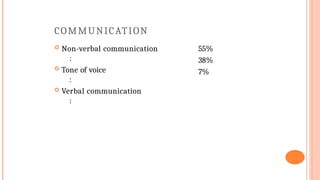
COMMUNICATION
 Non-verbal communication
:
 Tone of voice
:
 Verbal communication
:
55%
38%
7%
SERENITY PRAYER
God grant me the serenity to accept
the things that I cannot change and
courage to change the things I can
and wisdom to know the difference.
275
First Time Managers
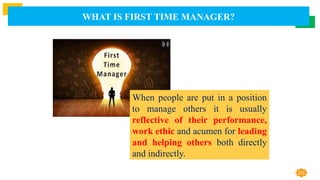
WHAT IS FIRST TIME MANAGER?
276
When people are put in a position
to manage others it is usually
reflective of their performance,
work ethic and acumen for leading
and helping others both directly
and indirectly.
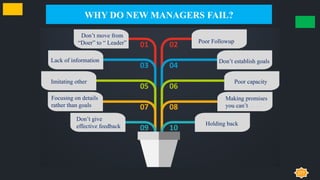
WHY DO NEW MANAGERS FAIL?
Don’t move from
“Doer” to “ Leader” Poor Followup
Lack of information Don’t establish goals
Imitating other Poor capacity
Focusing on details
rather than goals
Making promises
you can’t
Don’t give
effective feedback Holding back
277
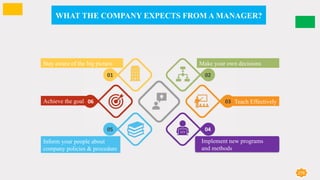
WHAT THE COMPANY EXPECTS FROM A MANAGER?
278
Achieve the goal
Implement new programs
and methods
Stay aware of the big picture
Teach Effectively
Inform your people about
company policies & procedure
Make your own decisions
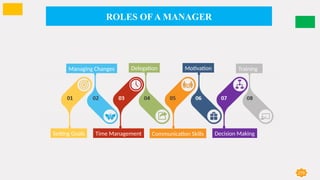
ROLES OF A MANAGER
279
Setting Goals
Managing Changes
Communication Skills
Delegation
Decision Making
Time Management
Motivation Training
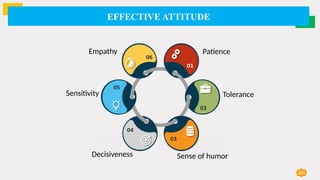
EFFECTIVE ATTITUDE
280
Patience
Tolerance
Sensitivity
Empathy
Sense of humor
Decisiveness
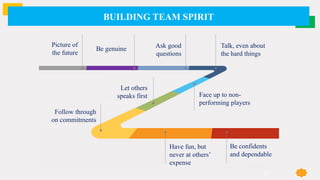
BUILDING TEAM SPIRIT
281
Be genuine Ask good
questions
Talk, even about
the hard things
Follow through
on commitments
Let others
speaks first Face up to non-
performing players
Have fun, but
never at others’
expense
Be confidents
and dependable
Picture of
the future
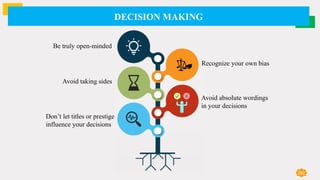
DECISION MAKING
282
Be truly open-minded
Avoid taking sides
Recognize your own bias
Don’t let titles or prestige
influence your decisions
Avoid absolute wordings
in your decisions
DECISION MAKING
283
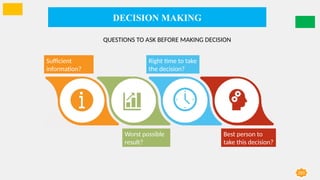
QUESTIONS TO ASK BEFORE MAKING DECISION
Sufficient
information?
Worst possible
result?
Right time to take
the decision?
Best person to
take this decision?
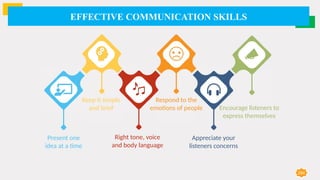
EFFECTIVE COMMUNICATION SKILLS
284
Present one
idea at a time
Keep it simple
and brief
Right tone, voice
and body language
Respond to the
emotions of people
Appreciate your
listeners concerns
Encourage listeners to
express themselves
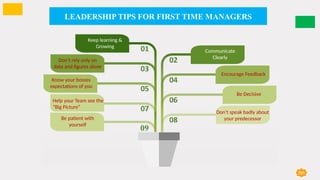
LEADERSHIP TIPS FOR FIRST TIME MANAGERS
285
Keep learning &
Growing
Communicate
Clearly
Don’t rely only on
data and figures alone
Encourage Feedback
Know your bosses
expectations of you
Be Decisive
Help your Team see the
”Big Picture”
Don’t speak badly about
your predecessor
Be patient with
yourself
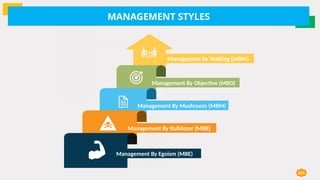
MANAGEMENT STYLES
286
Management By Objective (MBO)
Management By Mushroom (MBM)
Management By Bulldozer (MBB)
Management By Walking (MBW)
Management By Egoism (MBE)
ABM DEVELOPMENT PROGRAM FOR STUPUP IN MANAGEMENT

ABM DEVELOPMENT PROGRAM FOR STUPUP IN MANAGEMENT

  • 3.
  • 5.
    WHAT MAKES ALEADER TRULY GREAT?
  • 7.
    Humans are themost ill-equipped species in the whole world
  • 8.
    Humans are mostill-equipped ⚫can’t fly like birds. ⚫swim like a fish. ⚫climb tree like a monkey. ⚫don’t have the eye of eagle. ⚫can’t run like tiger. ⚫don’t have skin like rhino ⚫don’t have a claws & teeth like a wildcat.
  • 9.
    Physically humans arehelpless & defenseless
  • 10.
    But nature isresponsible and kind Human kind have ability to think Can create his own environment Sadly, very few people use the greatest gift- the ability to think its full potential.
  • 12.
    Components of Attitude Attitudeand Aptitude are the 2As which explains the reasons of our achievement/non achievement of purposeful action
  • 14.
    Why Most PeopleFail to Plan? •Not putting goals in writing, •Being unrealistic, •Motivations unclear, •Not having a plan, •Not taking action
  • 15.
    FROM GOALS TOACTION!!!
  • 16.
    Rate Your JobSatisfaction 16
  • 17.
    • Laugh atyourself • laugh at your mistakes • Smile your troubles away • Smile when you meet people • Smile at life • Smile when your low Learn to laugh & smile
  • 19.
    Qualities that makea person Successful ⚫Give More Than You Get ⚫Hard Working People ⚫Power Of Persistence ⚫Pride Of Performance ⚫Be Willing To Be A Student - Get A Mentor ⚫Never compromise your integrity ⚫Plan to win and not to lose ⚫Learn from other people’s mistakes
  • 20.
    ⚫Nobody wants tobe a loser. Everybody wants to win. ⚫‘Positive Attitude’ is the key to a successful life. ⚫We don’t have to be 10 times smarter than our competitor. All we need is the edge. WINNERS MAKE THE DAYS COUNT. LOSERS COUNT THE DAYS THEY have.
  • 22.
    MORE THAN 70%MANAGERS FIND IT DIFFICULT TO GET PROMOTED EVEN AFTER 5 YEARS OF CONTINUOUS SERVICE AS A FIRST LINE MANAGER?
  • 23.
    Who has timefor manager training?
  • 24.
    But here’s thething.Weak managers lead to all kinds of expensive problems: • Low morale • High turnover • Ineffective teams • Poor performance • Less top talent • Bad hiring decisions • Toxic attitudes • Less innovation • More politics • Lower profits
  • 25.
    The bottom line:if you’re growing fast and scaling faster, weak managers can literally Break The Company. But don’t be too hard on your managers. It’s not entirely their fault...
  • 26.
    Good managers aren’t born.It’s a learned skill, and it’s really hard. New managers rarely get the training and support they need to be effective.
  • 27.
    Now the goodnews: The solution to this problem is simple.
  • 29.
    1.Research indicates “great”managers listen well, motivate others, and consistently make good decisions. 2.Research indicates “great” managers are passionate about their work and compassionate toward others.
  • 30.
    Top Challenges ofNew Managers Balancing individual job responsibilities with time spent overseeing others Supervising friends or former peers Motivating the team Prioritizing projects Meeting higher performance expectations Inspiring unmotivated employees
  • 31.
    What to Expect,and How to Overcome Balancing individual job responsibilities with time spent overseeing others Supervising friends or former peers Motivating the team
  • 32.
    What to Expect,and How to Overcome Prioritizing projects Meeting higher performance expectations Inspiring unmotivated employees
  • 33.
    Essential Skills ofa Successful Manager • Emotional Intelligence • Managing Relationships • Overcoming the Threat of Favoritism • Earning Respect from Your Reports • Coaching & Feedback • Professionalism • Work Ethic • Appearance
  • 35.
    Emotional Intelligence • Delegation •Performance • Listening • Coaching • Leadership • Strategic Thinking
  • 36.
  • 37.
    Common Myths AboutManagement Let’s explore each of these myths….. In order to be successful as a manager, it’s important to consider these common myths about management: • “I’ll use the same skills as before.” • “I’ll have power.” • “I’ll have a lot more freedom.” • “I’ll always have control.” • I’ll learn the job primarily through training.”
  • 38.
    Myth #1: “I’lluse the same skills as before.” TRUTH: The skills of a manager are vastly different than that of an individual contributor. • Many managers promoted based on their skill in the Individual Contributor role • As a manager, you still need the skills and knowledge you’ve acquired, but… • Now you will also need to work through others to achieve your objectives Remember… “What got you HERE won’t get you THERE.”
  • 39.
    Myth #2: “I’llhave power.” TRUTH: Many managers do have more formal authority than individual contributors, but authority does not guarantee the manager will have influence. Use the management tools you have to influence others: • Your position in the organization – are you visible? • Your personal characteristics – what are you “known” for? To influence others to help you get things done, provide them with valued resources and services in exchange for resources and services you need.
  • 40.
    Myth #3: “I’llhave a lot more freedom.” TRUTH: Many new managers assume they will have more freedom: • To make decisions and take action • To delegate tasks to direct reports, resulting in more free time Managers need the cooperation of other people to get things done.
  • 41.
    Myth #4: “I’llalways have control.” TRUTH: Many managers seem to have their positions figured out, even when their outward appearance is convincing. In reality, even the most self-assured have moments of frustration or uncertainty. Situations that can cause frustration include: • Direct reports don’t take direction • Office politics • Conflicting priorities
  • 42.
    Myth #5: I’lllearn the job primarily through training.” TRUTH: You can only learn so much through training. Your best teacher will be a combination of building relationships and on-the-job experience. Follow the 70-20-10 model: 20% Training 30% Coaching & Relationships 50% Practical Work Experience
  • 44.
  • 45.
    Defining Your Role Let’slook at each… Your role as a manager will focus on 3 areas that you may not have considered before: Network Building Strategic Thinking Agenda Setting
  • 46.
    Agenda Setting Help yourteam set priorities: • View your role as that of an entreprenuer – how would you run your business? • Consider how your team’s priorities and decisions impact other departments
  • 47.
    Network Building To bea network builder, you need to: • View yourself as a “people developer” rather than a “task doer” • Understand how can you help others… and how can they help you?
  • 48.
    Strategic Thinking To bea strategic thinker, you need to: • Consider multiple solutions to an issue or problem. • Clearly communicate your vision to your team, so everyone is aligned – your team’s success is a reflection of your leadership. • Understand the difference between being “responsible” and being “accountable”
  • 49.
    Coping With YourFeelings You can expect to experience one or more of the following emotions as you transition to management: • Frustration • Performance Anxiety • Loss • Humility • Conflict
  • 50.
    Coping With YourFeelings: Solutions A few ideas: • Always be developing yourself • Get enough leisure time to relax – use your personal/vacation time! • Talk about your concerns with supportive friends or a mentor • Take care of your health • Keep your job in perspective – remember what’s most
  • 51.
    REAPING THE RewardsOF BEING A MANAGER
  • 53.
    Key Messages • Havingauthority does not guarantee one will have influence • Transitions take time – even the most self-assured managers have moments of frustration or uncertainty • The most effective learning for new (& seasoned) managers often comes from building relationships and on-the-job experience
  • 54.
  • 55.
    Earning Respect fromYour Reportees “Respect is something that must be earned. Managers earn respect when they are respectful to others, as well as when they demonstrate trustworthiness, credibility, and a healthy dose of humanity.” – Lisa Parker, author of Managing the Moment: A Leader’s Guide to Building Executive Presence One Interaction at a Time
  • 56.
    Coaching & Feedback Organizations withsenior leaders who coach effectively and frequently IMPROVE BUSINESS RESUL TS BY 21% 21 % Top Missing Skills in Mid-Level Leaders 1. Coaching 2. Performance Appraisal 3. Developing Others 4. Managing Change 5. Communications 6. Business Acumen SOURCE: Bersin by Deloitte
  • 57.
    “Employees who receive dailyfeedback from their managers are 3x more likely to be engaged than those who give feedback once a week or less” “When managers provide meaningful feedback to employees, those employees are 3.5x more likely to be engaged”
  • 58.
    Professionalism Interpersonal Work EthicAppearance Communication skills 25.3% 27.3 % 24.9% 33.6%
  • 59.
    How Managers createstress for their employees 59
  • 60.
    7 Steps toTransparency Tell the Truth 1 Encourage people to speak the truth to feel empowered 2 Reward Contrarians 3 Practice having Unpleasant Conversations 4 Diversify Information Sources 5 Admit mistakes 6 Build Organizational Support for Transparency 7
  • 61.
  • 62.
    And though wedon’t have super powers, as leaders, we do have the power to influence others and the responsibility to do it well.
  • 63.
    There are several traitsassociated with being a successful leader. Let’s take a look at them together.
  • 64.
    What qualities makea manager different and a super hero of their team?? Plz write down in your diaries and share with us
  • 65.
    As a leader,it is so important that your words equal your actions. It is imperative that you… go through a self- evaluation process on an almost daily basis to make sure that your actions are in line with your words. DEPENDABILIT Y
  • 66.
    [A good leaderhas] an understanding of the goals and how to get there, as well as an understanding of how to make goals personal for each staffer. AWARENESS
  • 67.
    Your first andforemost job as a leader is to take charge of your own energy, and then, help to orchestrate the energy of those around you. OPTIMIS M
  • 68.
    Leaders who operateon the basis of integrity…tell the truth. They do things on the up-and-up. They engage in fair, ethical business practices. And they deliver on their promises. HONESTY
  • 69.
    Leadership is aboutproviding a vision for the future and helping others support that vision with the tools needed to pursue that goal. That vision can be great or small, but participating with others in pursuit of a common good is a wonderful feeling. COLLABORATION
  • 70.
    You simply can’tdo your best without searching for new experiences, doing things you’ve never done, making mistakes, and learning from them. CURIOSITY
  • 71.
    There is informationoverload. More than ever, there is a need to be able to sift through the noise and prioritize. – Rosemarie Withee, Office 365 For Dummies, 2nd Edition DECISIVENES S
  • 72.
    Maintaining a beginner’smindset helps keep us from becoming victims of our own successes. We all need to constantly scan the landscape and continuously assess our own business models. – Alex Osterwalder, Value Proposition Design: How to Create Products and Services Customers Want ADAPTABILITY
  • 73.
    Your leadership mustbe rooted in who you are and what matters most to you. When you truly know yourself and what you stand for, it is much easier to know what to do in any situation. – Harry Kraemer, Becoming the Best: Build a World-Class Organization Through Values- Based Leadership CONFIDENCE
  • 74.
    COMMITMENT There is justno escaping the fact that the single biggest factor determining whether an organization is going to get healthier — or not — is the genuine commitment and active involvement of the person in charge. – Patrick Lencioni, The Ideal Team Player: How to Recognize and Cultivate the Three Essential Virtues
  • 75.
    APPROACHABILITY In the newworld, the capacity to establish, develop, and maintain key relationships both inside and outside your organization is going to become the primary currency of leadership influence.
  • 76.
    INSPIRATIO N Leaders must recognizethat leadership is not about them and their ability to attract followers. Leadership is about serving others to bring out the best in them.
  • 77.
    As leaders, wemust inspire, encourage, and empower those around us. By fostering these skills, you’re on your way to becoming a truly great leader.
  • 78.
  • 79.
    “You can’t expectpeople to be committed, to be loyal to an organization, to be engaged in an organization, OR to stay in an organization if the company doesn’t care about them.”
  • 80.
    SURVEY 75% OF ORGANISATIONSHAVE NO STRATEGY OR BUDGET FOR EMPLOYEE RETENTION
  • 82.
  • 83.
  • 84.
     Fail toconnect with their bosses as leaders and people  Work environment is not particularly friendly  Do not feel appreciated  Managers will not listen to employees Top Reasons Employees Leave CONT… Employees usually don’t leave the company, they leave their BOSSES
  • 85.
     Limited careergrowth or opportunity  Lack of respect for supervisor  Higher compensation  Felt their job duties were unchallenging  Felt their supervisor lacked leadership skills  For better work hours Other reasons employees leave
  • 86.
     There isno incentive for employees to explain why they are actually leaving their job.  Employees want to leave their job and have that boss as a good reference.  Few exit surveys have been done. What is the Real Reason?-Limitations
  • 87.
    Put it intoperspective…
  • 88.
     Employees whohave worked with an organization for six or fewer months are the ones most likely to leave the company.  Those with one to two years’ experience are the next most likely to leave.  “On average, the cost of losing an employee is about 150 percent. It’s one-and-a-half times the person’s compensation”. New Employees
  • 89.
    Why is employeeretention important?
  • 90.
     Employees arethe heart and soul of an organization  Employee turnover is costly for an organization  Finding suitable replacements for key employees is difficult  Low employee turnover leads to outstanding performance of an organization Employee Retention
  • 91.
  • 92.
     Have agood connection with their boss  Workplace is a team oriented environment  Want to contribute, feel wanted  Workplace is a “climate for learning characterized by trust and openness”  Feel supported  Can balance work and life  Offered programs like childcare Top Reasons Employees Stay
  • 93.
  • 94.
  • 95.
     Equity andjob security ◦ Employees want to be treated fairly and, just as importantly, compensated fairly. ◦ Companies must demonstrate more than the minimum obligations to people.  Communication ◦ Individuals want to understand management’s expectations so they have a clear idea of how their work will be judged. ◦ It is important to set measurable goals and evaluate an employee’s performance. The Secrets of Employee Retention
  • 96.
     Pride andteamwork ◦ Employees want to feel good about their jobs, have a sense of achievement, and be proud of their accomplishments. ◦ Individuals should be properly trained and provided with adequate materials and equipment to complete their jobs successfully. ◦ Employees want to work with teammates who are as enthusiastic and competent as they are. ◦ Failure to address problem employees communicates to team members that management view substandard performance as acceptable. The Secrets of Employee Retention
  • 97.
     Fun ◦ Whileit’s important that attempts at creating a fun work environment don’t disrupt the overall productivity of employees, making the job enjoyable is beneficial. ◦ By never taking time to celebrate, employees are more likely to experience elevated stress and burn-out. The Secrets of Employee Retention
  • 98.
     Recognition ◦ “Peoplewant to do good work and they want to be recognized for it,” ◦ Johnson recommends that recognition be significant, specific and sincere.  For example, telling an employee “you’re great” isn’t nearly as meaningful as saying that his/her innovative ideas and work to satisfy a particular tenant or to keep a specific project on budget was terrific. The Secrets of Employee Retention
  • 99.
    How do youfind out if your employees are happy?
  • 100.
     Assure subordinatesthat they are free to express their opinions without fear of negative repercussions.  Consider seeking the services of a third party to survey staff.  Be prepared to share the survey findings and a plan of action with the team.  If you can determine why employees are not happy, it’s likely you can prevent them from leaving by changing practices, culture, and sometimes even your management style. Ask!
  • 101.
     (1)They haveopen channels of communication that lead to collaboration and inclusion ◦ These leaders are open with information, interested in learning what employees think, and incorporate their ideas into doing business. ◦ These leaders not only inform people about issues affecting them but involve them in decisions. Four Characteristics of Leaders
  • 102.
     (2)They movebeyond the status quo. ◦ These leader take bold action in support of their people, raising the benchmark. For Characteristics of Leaders
  • 103.
     (3)They arevery selective about what to measure and why. ◦ Great leaders know what makes their unique culture tick and measure accordingly. ◦ A clear and accurate understanding of their culture allows them to choose and reward measures selectively. For Characteristics of Leaders
  • 104.
     (4)They arepassionate about values and culture. ◦ Values are tied to success and measures, and the leaders are very familiar with the values. Their vigor for values and culture is contagious. For Characteristics of Leaders
  • 105.
    7 STEPS TOBETTER EMPLOYEE RETENTION 1. Track retention 2. Hire right in the first place 3. Offer employees a path to greater pay and responsibility 4. Train first-level supervisors 5. Look for stressors and train leaders on how to help employees in stressful positions 6. Be more flexible on work conditions 7. Re-evaluate benefits package
  • 106.
    IDEAS FOR EMPLOYEERETENTION PROGRAMS  Workplace culture  Involvement  Orientation  Learning  Reward
  • 107.
    KEEPING IS CHEAPERTHAN REPLACING  Direct Costs of Replacement  Paperwork/Time Exit Interview  Recruiting Replacement  Interview/Select New Employee  On boarding New Employee  Training New Employee  Depending on the complexity of the job, this process can take at least 3-6 months in most cases.
  • 108.
    KEEPING IS CHEAPERTHAN REPLACING  Indirect Costs of Replacement  Losses in productivity.  Slips in schedule.  Loss of corporate knowledge.  Lost opportunity costs etc.
  • 109.
    KEYS TO RETENTION The keys to retention simply put are based on a name we called SAM;  Satisfaction - There are a number of elements to satisfaction. They include, salary, health plan, work environment, and more.  Appreciation - Appreciation is just what it says it is, being recognized and appreciated for your work. Both publicly and privately.  Motivation - Once an employee is satisfied and appreciated, that employee can be motivated. Ways to motivate include bonuses, promotions, conferences and training and more.  That's it! Employee retention is as simple as SAM
  • 110.
    TOP 10 LOW& NO CO$T EMPLOYEE RETENTION TIP$ 1. Hire the Right Person 2. Open & Effective Communication 3. Clear Expectations 4. Outstanding Feedback & Recognition 5. Treat People with Respect 6. Share Training Responsibility 7. Have Fun 8. Promote Work/Life Balance 9. Demonstrate Corporate Social Responsibility 10. Utilize Connection & Exit interviews
  • 112.
    Liability employees aregrowth hinders  DON’T BE EMOTIONAL  Always give people a third chance, never a fourth chance.  Never let people go in anger, under pressure, or in a crisis.  If termination is a surprise, you have done something wrong.
  • 113.
     Have acheck ready and all the facts about money, benefits, vacation, etc.  Be general, not specific about the reasons for dismissal.
  • 114.
     Do notargue or be defensive.  Do not make promises you can’t keep.  Get keys, passes, IDs, etc.  Do it Saturday afternoon.  Tell people about insurance continuation options (a legal requirement).  Handling the garbage work, such a firing people, well gains you great credibility and value to your bosses.
  • 115.
     Keep terminatedemployees away from the office if possible.  Do not give other employees any specifics about a termination.  Statistics show that most people are better off after being fired and usually say good things about the person who fired them if the person does it gently and preserves the dignity of the person being let go.
  • 116.
     Most medium-sizedand large companies require someone else be present at termination meeting, usually an HR person.  Fine, but you do all the talking and take responsibility for the termination.  Your most difficult job. Not everyone can do it.
  • 117.
    Winners Don’t DoDifferent Things . They Do Things Differently……........
  • 118.
    1. Importance ofAttitude 2. Success 3. Motivation 4. Self Esteem 5. Interpersonal skills 6. Subconscious Mind & Habits 7. Goal setting 8. Value & Visions Winners Don’t Do Different Things . They Do Things Differently……........
  • 119.
    “ If therewas one thing that you would like to see change, that would make your organization more productive , what would it be? ” All said that….. Attitud e
  • 120.
    THERE ARE 3KINDS OF PEOPLE IN THIS WORLD ⚫Those who make things happen. ⚫Those who watch things happen. ⚫Those who wonder what happened. Whatcategory are YOU in?
  • 121.
    Winners Vs Losers •Winner sees an answer for every problem; Loser sees a problem for every answer. • Winners see possibilities; Loser see problems. • Winners see the gain; Loser see the PAIN. • Winners say, “I must do something.” Losers say’ “Something must be done.” • Winners have dreams; Losers have schemes.
  • 122.
    “ Success IsThe Progressive Realization Of A Worthy Goal ” ⚫Success and Happiness go hand in hand. Success is getting what you want & happiness is wanting what you get!
  • 123.
    STRUGGLE [Nothing worthwhile inlife comes without a struggle.]  Story of caterpillar turning into butterfly. Law of Nature:- - struggle to come out of cocoon helps develop and strengthen its wings.
  • 124.
    ⚫Failure are oftwo kinds:- those who did and never thought And those who thought and never did.
  • 125.
    LIFE IS CAFETERIA ⚫Lifeis like a cafeteria: Take your tray, Select your food, and pay at other end. You can get anything you want as long as you are willing to pay the PRICE. ⚫In a cafeteria, if you wait for people to serve for you, you will wait forever. ⚫Make the choices and pay the prices.
  • 126.
    TOP 7 MANAGEMENT SKILLS!How to be a GREAT MANAGER!
  • 138.
  • 160.
    “The Secret ofLeadership”
  • 161.
    Climbing your mountain ●Edmund Hillary’sto Mount Everest ●Some year before when he failed he screamed to mountain “I will come again and conquer you! Because as a mountain, you can’t grow. But as a human ,I can!
  • 162.
    Climbing your mountain ●That messagewas not for mountain it was for world only that we can keep trying better ,we can keep growing and we can all overcome life’s challenges and climb all those mountains we set our sights on
  • 163.
    Climbing your mountain ●So iftwo people want to climb the mountain, what's the most important things they need? Teamwork? Or training? Favorable weather conditions? Luck?
  • 164.
  • 165.
    “PHD” ●Passion ,Hunger AndDiscipline ●Passion: Do you Enjoy what you are doing? Do you love your work? ●Hunger: How badly do you want to win? Are you really hungry for success?
  • 166.
    “PhD ” ●Discipline : Onceyou have the passion and the hunger , you will probably see a road emerge in front of you ,leading you to your goal. And then you all need is discipline... ● ●You will get obstacles ,roadblocks and many things which can stop you to get your goal
  • 167.
    “Run with YOURmind , Not Just Your Legs!” ●Success in life is not defined by talent and physical ability ●When you run with your legs, you allow the pressures to weigh you down. You find yourself saying , “I can’t!”
  • 168.
    “Run with YOURmind , Not Just Your Legs!” ●But when you run with your mind, YOU must mind your mind and say “I CAN!”.
  • 169.
    “One 500-Rupee Note. AndTwo lessons!” ● Most of us just wait for good things to happen. That’s of no use. You’ve got to make things happen ● And there will be times when we feel crushed, stamped on, beaten. But never let that diminish your worth. ● Remember you are still the terrific person you were. Just because someone chooses to crush you –that doesn’t change your worth one bit!
  • 170.
    “Put the Glass Down” ●Letgo of your problem .Don’t carry that grudge. Remember to put the glass down! ●Hold the glass in your hand you will feel the small glass also can hurt or paralyzed your hand. ●Leave all you worry ,problem and tension outside the home when you are getting in .
  • 171.
    “The Secret ofSachin Tendulkar” ●Tendulkar studies always practiced before the match. Do you? ●I will play!, he said . I will fight ●The opportunity comes to us all the question is how prepared are we when opportunity comes knocking ?
  • 172.
    “The Secret ofSachin Tendulkar” ●We may not all have Tendulkar talents or his mental strength, but we can all have his work ethic.
  • 173.
    What to Bea Good Leader? Just Do It! ●Make a beginning –right away- Whenever you have goal take the first step, however small ●Break up the grand plan into smaller tasks-Something is better than nothings
  • 174.
    What to Bea Good Leader? Just Do It! ●Visualize your success-Think the pleasure not the pain ●Create a support team-surrounded yourself with people who share your objective
  • 175.
    What to Bea Good Leader? Just Do It! Every morning write down a list of the things that need to be done that day - Do Them
  • 176.
    “The Truck withNo Tail Lights” ●Good leader make sure they have great headlights and excellent tail lamps too ●They recognize that there are folks behind them who need to see those tail lamps as they drive forth on their journey ●Not giving tail lamp can cause an accident and interrupt the journey
  • 177.
  • 178.
    We take thepeople we love the most for granted. Until we lose them.
  • 179.
    LEADERSHIP Strengthen the capacitiesof employees at every level to lead in everything they do.
  • 181.
    Long forgotten secret: “you don’t have to have a title to be a leader.”
  • 182.
    Money is reallyonly the by product of standing for the finest within you and doing some SEW. Seriously Exceptional Work
  • 183.
    In a gentleway, you can shake the world
  • 184.
    “Nobody succeeds beyondhis or her wildest expectations unless he or she begin with some wild expectations.” “The sight of an achievement is the greatest gift a human being could offer others.”
  • 186.
    Tea m We define ateam as “A group of people, who have a commitment to produce a result”.
  • 187.
    “The ability tocooperate and communicate effectively with others to achieve a common goal.” Team Work
  • 188.
  • 189.
  • 190.
     Quick Solution. Improved productivity.  Distribution of work load.  Diversity of Ideas.  Better decision.  Motivation.  Learning. Benefits of Team Work
  • 191.
    Team characteristics Participation 5 Work Effortlessly 1 Trust 2 GoodCommunication 3 Supportive 4 Motivation 7 Innovative 6
  • 192.
    Lesson 1: Firstof All, Knowing Your People
  • 193.
    Lesson 2: Choosingthe right team members
  • 194.
    Lesson 3: Havingone common goal
  • 195.
    Lesson 4: Developingteamwork requires commitment
  • 196.
    Lesson 5: SharingInformation
  • 197.
  • 198.
    Lesson 7: Facilitatingopen communication
  • 199.
    Lesson 8: Creatingproblem solving environment
  • 200.
    Lesson 9: Measuringteamwork performance continually
  • 201.
    Lesson 10: Sharingthe outcomes together
  • 202.
    Communication within Team Whenthe team doesn’t work, 99 out of 100 times there is a communication break. Effective communication is a vital part of any team.
  • 203.
    Communication – Do’s Support Group Member's Ideas.  If there is a problem, talk.  Listen actively.  Get involved.  Be proactive, than reactive.  Give and take feedback.  Be open.  Have fun.
  • 204.
    Communication – Don’ts Do not blame others.  No Bragging.  Do not take credit for what others are doing.  Being unprepared.  Do not speak poorly of those in authority.  Do not make others look bad.  Don’t cheat.  Don’t lie.  Don’t steal.
  • 205.
    Closing thought The strengthof the team is each individual member… The strength of each member is the team.
  • 206.
    THE TEAM ISAS FAST AS THE SLOWEST MEMBER IN THE TEAM
  • 207.
  • 208.
    LEADERSHIP COMPETENCIES What isCompetence and Competency? 'Competence' means a skill and the standard of performance reached while 'Competency' refers to the behavior by which it is achieved.
  • 209.
    LEADERSHIP COMPETENCIES What isCompetence and Competency? Competence describes what people can do and Competency focuses on how they do it. Competence is skill based and Competency is behavior based.
  • 210.
    Let us understandthe Nine Leadership Competencies
  • 211.
    It is anintense concentration (focus) on a belief that a task can be completed despite scarcity of human support or any other resource.
  • 212.
    How to raiseyour passion competency ● Lead a team in your organization. ● Ensure from team the organization's mission statement or vision. ● Mentor an employee.
  • 213.
    Humor-How does ithelp? ● It helps to relieve day-to-day pressures . ● Executives who are open with humor become more approachable to their employees. ● Allows everyone to perceive and view things in a different light.
  • 214.
    COURAGE It is theability to confront fear, pain, danger, uncertainty or intimidation.
  • 215.
    This is whatOsho says about courage: ● "You cannot be truthful if you are not courageous - You cannot be loving if you are not courageous - You cannot be trusting if you are not courageous- You cannot inquire into reality if you are not courageous - Hence courage comes first and everything else follows."
  • 216.
    INTEGRITY AND TRUST Integrity: Firmadherence to a code of moral or artistic values. Trust: Firm reliance on the integrity, ability, or character of a person or thing.
  • 217.
    BL U EPR INT for S U C C E S S
  • 218.
    Winners do things,in spite of problems. Losers permanently rationalize.
  • 219.
  • 220.
  • 221.
    STEPS FOR BUILDINGPOSITIVE ATTITUDE-8 Step1: Change focus – look for the positive in people
  • 222.
    STEPS FOR BUILDINGPOSITIVE ATTITUDE-8 Step 2: Make a habit of doing it now
  • 223.
    STEPS FOR BUILDINGPOSITIVE ATTITUDE-8 Step 3: Develop an attitude of gratitude.
  • 224.
    STEPS FOR BUILDINGPOSITIVE ATTITUDE Step 4:Get into a continuous education and development program
  • 225.
    STEPS FOR BUILDINGPOSITIVE ATTITUDE Step 5: Build a positive self-esteem
  • 226.
    STEPS FOR BUILDINGPOSITIVE ATTITUDE Step 6: Stay away from negative influences
  • 227.
    STEPS FOR BUILDINGPOSITIVE ATTITUDE Step 7:Learn to like the things that need to be done
  • 228.
    STEPS FOR BUILDINGPOSITIVE ATTITUDE Step 8: Start your day with a positive thoughts
  • 229.
  • 230.
    THIS WAS AMAN WHO:  failed in business at the age of 21 ;  was defeated in a legislative race at age 22;  failed again in business at age 24;  overcame the death of his sweetheart at age 26;  had a nervous breakdown at age 27;  lost a congressional race at age 34;  lost a senatorial race at age 45;  failed in an effort to become vice-president at age 47;  lost a senatorial race at age 49; and  was elected president of the United States at age 52. This man was Abraham Lincoln
  • 231.
    EVERY SUCCESS STORYIS A STORY OF GREAT FAILURE  Henry Ford was broke at the age of 40.  Lee Iacocca was fired by Henry Ford II at the age of 54.  Young Beethoven was told that he had no talent for music, but he gave some of the best music to the world.  In 1913, Lee De Forest, inventor of the triodes tube, was charged by the district attorney for using fraudulent means to mislead the public into buying stocks of his company by claiming that he could transmit the human voice across the Atlantic. He was publicly humiliated.
  • 232.
    EVERY SUCCESS STORYIS A STORY OF GREAT FAILURE  As a young cartoonist, Walt Disney faced many rejections from newspaper editors, who said he had no talent.  One day a minister at a church hired him to draw some cartoons. Disney was working out of a small mouse- infested shed near the church.  After seeing a small mouse, he was inspired. That was the start of Mickey Mouse.
  • 233.
    EVERY SUCCESS STORYIS A STORY OF GREAT FAILURE  A New York Times editorial on 10 December 1903, questioned the wisdom of the Wright Brothers who were trying to invent a machine, heavier than air, that would fly.  One week later, at Kitty Hawk, the Wright Brothers took their famous flight.
  • 234.
    EVERY SUCCESS STORYIS A STORY OF GREAT FAILURE  In 1914, Thomas Edison, at age 67, lost his factory, which was worth a few million dollars, to fire. It had very little insurance.  No longer a young man, Edison watched his lifetime effort go up in smoke and said, “There is great value in disaster.  All our mistakes are burnt up. Thank God we can start anew.” In spite of disaster, three weeks later, he invented the phonograph. What an attitude!
  • 235.
    IF YOU THINK Ifyou think you are beaten, you are. If you think you dare not, you don’t!
  • 236.
    QUALITIES THAT MAKEA PERSON SUCCESSFUL o Desire o Commitment o Responsibility o Hard work o Character o Positive belief o Give more than you get o Persistence
  • 237.
    LU C KSHINES ON THE DESERVING Alexander Graham Bell was desperately trying to invent a hearing aid for his partially deaf wife.  He failed at inventing a hearing aid but in the process discovered the principles of the telephone.
  • 238.
    LU C KSHINES ON THE DESERVING You wouldn’t call someone like that lucky, would you? Good luck is when opportunity meets preparation. Without effort and preparation, lucky coincidences don’t happen.
  • 239.
    MOTIVATION  Motivation islike fire unless you keep adding fuel to it, it dies. Just like exercise and food don’t last long, neither does motivation. However, if the source of motivation is belief in inner values, it becomes long-lasting.
  • 240.
    MOTIVATION  Experience hasshown that people will do a lot for money, more for a good leader, and do most for a belief. We see this happening every day all over the world. People will die for a belief.
  • 241.
    STEPS FOR BUILDINGPOSITIVE SELF-ESTEEM  Turn Scars into Stars - Some of the best music was composed by Beethoven.  What was his handicap?  He was deaf.  Some of the best poetry written on nature was written by Milton.  What was his handicap?  He was blind.  One of the greatest world leaders was U S President Franklin D. Roosevelt. What was his handicap?  He served from a wheelchair.
  • 242.
    STEPS FOR BUILDINGPOSITIVE SELF-ESTEEM Learn Intelligent Ignorance I'm looking for a lot of men with an infinite capacity for not knowing what cannot be done. - Henry Ford Henry Ford gave this world the V8 engine. He did not have much formal education. In fact, he did not go to school beyond the age of 14. He was intelligent enough to know there had to be a V8 engine but he was ignorant and didn’t know how to build it. So he asked all his highly qualified, educated people to build one. But they told him what could be done and what couldn’t. According to them, a V8 was an impossibility. But Henry Ford insisted on having his V8. A few months later he asked his people if they had the V8 and they replied, “We know what can be done and we also know what cannot be done and V8 is an impossibility.” This went on for many months and still Henry Ford said, “I want my V8.” And shortly thereafter the same people produced his V8 engine.
  • 243.
    STEPS FOR BUILDINGPOSITIVE SELF-ESTEEM Learn to Give and Receive Compliments Don’t miss out on any opportunity to give sincere compliments. Remember, the key word is sincerity. When others give you a compliment, accept it graciously and gracefully with two words, “Thank you.” That is a sign of humility.
  • 244.
    STEPS FOR BUILDINGPOSITIVE SELF-ESTEEM Accept responsibility If the average life expectancy of a person is 75 years and if you are 40 years old, you have 365 days x 35 years, to live. Ask yourself this question: What are you going to do with this time? When we accept or add responsibility, we make ourselves more valuable.
  • 245.
    STEPS FOR BUILDINGPOSITIVE SELF-ESTEEM Set Goals Well-defined goals give a person a sense of direction, a feeling of accomplishment when he reaches his goals. More important than goals is a sense of purpose and vision. It gives meaning and fulfillment to life.
  • 246.
    STEPS FOR BUILDINGPOSITIVE SELF-ESTEEM Associate with People of High Moral Character Associate yourself with people of good quality if you esteem your reputation, for it is better to be alone than to be in bad company. - George Washington
  • 247.
    STEPS FOR BUILDINGPOSITIVE SELF-ESTEEM Become Internally Driven, Not Externally Driven No one can make you feel inferior without your permission. - Eleanor Roosevelt There is a story about an ancient Indian sage who was called ugly names by a passerby. The sage listened unperturbed till the man ran out of words. He asked the man, “If an offering is not accepted, who does it belong to?” The man replied, “It belongs to the person who offered it.” The sage said, “I refuse to accept your offering,” and walked away, leaving the man dazed. The sage was internally driven.
  • 248.
    STEPS FOR BUILDINGPOSITIVE SELF-ESTEEM Develop a Mindset That Brings Happiness       Look for the positive in every person and in every situation. Resolve to be happy. Set your own standards judiciously. Develop an immunity to negative criticism. Learn to find pleasure in every little thing. Remember all times are not the same. Ups and downs are part of life. Make the best of every situation. Keep yourself constructively occupied. Help others less fortunate than yourself. Learn to get over things. Don’t brood. Forgive yourself and others. Don’t hold guilt or bear grudges.     
  • 249.
    STEPS FOR BUILDINGPOSITIVE SELF-ESTEEM Have patience In China there is a bamboo tree which is planted, watered and fertilized for the first four years and nothing happens. There is no visible sign of growth. But sometime during the fifth year, the bamboo tree grows about 90 feet in six weeks. The question is: Did the bamboo tree grow in six weeks or did it take five years to grow even though there was no visible sign it was taking root in the ground?
  • 250.
    LIFE IS ANECHO  Benjamin Franklin said, “When you are good to others, you are best to yourself.”  Our life is like an echo: We get back what we give.  It is one of the most beautiful compensations of life that no man can sincerely try to help another without helping himself. - Ralph Waldo Emerson  Goodness has a way of coming back; that is the nature of the beast. One doesn’t have to do good with a desire to get back. It just happens automatically.
  • 251.
    LIFE IS ANECHO Many years ago two boys were working their way through Stanford University. Their funds got desperately low, and the idea came to them to engage Ignacy Paderewski for a piano recital. They would use the funds to help pay their board and tuition. The great pianist’s manager asked for a guarantee of $2,000.The guarantee was a lot of money in those days, but the boys agreed and proceeded to promote the concert. They worked hard, only to find that they had grossed only $1,600. After the concert the two boys told the great artist the bad news. They gave him the entire $1,600, along with a promissory note for $400, explaining that they would earn the amount at the earliest possible moment and send the money to him. It looked like the end of their college careers. “No, boys,” replied Paderewski, “that won’t do.” Then, tearing the note in two, he returned the money to them as well. “Now,” he told them, “take out of this $1,600 all of your expenses and keep for each of you 10 percent of the balance for your work. Let me have the rest.” C ont’d…
  • 252.
    LIFE IS ANECHO The years rolled by. World War-I came and went. Paderewski, now premier of Poland, was striving to feed thousands of starving people in his native land. The only person in the world who could help him was Herbert Hoover, who was in charge of the U S Food and Relief Bureau. Hoover responded and soon thousands of tons of food were sent to Poland. After the starving people were fed, Paderewski journeyed to Paris to thank Hoover for the relief sent him. “That's all right, Mr. Paderewski ,” was Hoover's reply. “Besides, you don’t remember it, but you helped me once when I was a student at college, and I was in trouble.”
  • 253.
    WE S EE T H I N G S N OT T H E WAY TH EY A R E BUT T H E WAY WE A R E There is a legend about a wise man who was sitting outside his village. A traveler came up and asked him, “What kind of people live in this village, because I am looking to move from my present one?” The wise man asked, “What kind of people live where you want to move from?” The man said, “They are mean, cruel, rude.” The wise man replied, “The same kind of people live in this village too.” After some time another traveler came by and asked the same question and the wise man asked him, “What kind of people live where you want to move from?” And the traveler replied, “The people are very kind, courteous, polite and good.” The wise man said, “You will find the same kind of people here too.”
  • 254.
    STEPS FOR BUILDINGA POSITIVE PERSONALITY Step 1: Accept Responsibility “Responsibilities gravitate to the person who can shoulder them.” - Elbert Hubbard People who don’t accept responsibility shift the blame to their parents, teachers, genes, God, fate, luck or the stars. For evil to flourish, good people have to do nothing and evil shall flourish. - Edmund Burke
  • 255.
    STEPS FOR BUILDINGA POSITIVE PERSONALITY Step 2: Consideration One day, a ten-year-old boy went to an ice-cream shop, sat at a table and asked the waitress, “How much is an ice- cream cone?” She said, “seventy-five cents.” The boy started counting the coins he had in his hand. Then he asked how much a small cup of ice-cream was. The waitress impatiently replied, “sixty- five cents.” The boy said, “I will have the small ice-cream cup.” He had his ice-cream, paid the bill and left. When the waitress came to pick up the empty plate, she was touched. Underneath were ten one- cent coins as tip. The little boy had consideration for the waitress before he ordered his ice-cream. He showed sensitivity and caring. He thought of others before himself.
  • 256.
    STEPS FOR BUILDINGA POSITIVE PERSONALITY Step 3: Think win-win When we serve our customers, our families, our employers and employees, we automatically win. Step 4: Choose Your Words Carefully A person who says what he likes usually ends up hearing what he doesn't like. Be tactful. Excessive talking does not mean communication. Talk less; say more.
  • 257.
    STEPS FOR BUILDINGA POSITIVE PERSONALITY Step 5: Don’t criticize & complain A critic is like a back-seat driver who drives the driver mad. Receiving criticism 1. Take it graciously. 2. Evaluate. If it makes sense, accept and implement. 3. Accept it immediately and empathetically 4. Always thank the other person for criticizing in constructive manner.
  • 258.
    STEPS FOR BUILDINGA POSITIVE PERSONALITY Step 6: Smile & Be Kind In the course of the day, some of your acquaintances may be too tired to give you a smile. Give them one of yours. Nobody needs a smile so much as those who have none left to give. Step 7: Put Positive Interpretation on Other People's Behavior In the absence of sufficient facts, people instinctively put a negative interpretation on others’ actions or inactions. Some people suffer from “paranoia”; they think the world is out to get them. That is not true.
  • 259.
    STEPS FOR BUILDINGA POSITIVE PERSONALITY Step 8: Be a good listener Listening shows caring. When you show a caring attitude toward another person, that person feels impor-tant. When he feels important, he is more motivated and more receptive to your ideas. An open ear is the only believable sign of an open heart. - David Augsburger Step 9: Be Enthusiastic Nothing great is ever achieved without enthusiasm. - Ralph Waldo Emerson
  • 260.
    STEPS FOR BUILDINGA POSITIVE PERSONALITY Step 10: Give Honest and Sincere Appreciation The psychologist William James said, “One of the deepest desires of human beings is the desire to be appreciated. The feeling of being unwanted is hurtful.” The biggest disease today is not leprosy or tuberculosis but rather the feeling of being unwanted. - Mother Teresa Step 11: When We Make a Mistake, We Should Accept It immediately and Willingly
  • 261.
    GIVING APPRECIATION 1. Bespecific 2. Be sincere 3. Time bound – should be immediate
  • 262.
    STEPS FOR BUILDINGA POSITIVE PERSONALITY Step 12: When the Other Person Realizes and Admits That He Has Made a Mistake, Congratulate Him and Give Him a Way Out to Save Face Step 13: Discuss But Don't Argue Arguing is like fighting a losing battle. Even if one wins, the cost may be more than the victory is worth. Emotional battles leave a residual ill will even if you win. I learned a long time ago never to wrestle with a pig. You get dirty and besides, the pig likes it. - Cyrus Ching
  • 263.
    STEPS FOR BUILDINGA POSITIVE PERSONALITY Step 14: Don't Gossip “Small people talk about other people, mediocre people talk about things, great people talk about ideas.” Step 15: Turn Your Promises into Commitments Commitment says, “I am predictable in the unpredictable future.” The most important commitment we ever make is to our values. Commitment leads to enduring relationships through thick and thin. It shows in a person’s personality and relationships.
  • 264.
    STEPS FOR BUILDINGA POSITIVE PERSONALITY Step 16: Be Grateful But Do Not Expect Gratitude Gratitude would rank among the top qualities that form the character and personality of an individual with integrity. Ego stands in the way of showing gratitude. A gracious attitude changes our outlook in life. With gratitude and humility, right actions come naturally. Step 17: Be Dependable and Practice Loyalty The old adage, “an ounce of loyalty is worth more than a pound of cleverness,” is universal and eternal.
  • 265.
    STEPS FOR BUILDINGA POSITIVE PERSONALITY Step 18: Avoid Bearing Grudges. Forgive and Forget John Kennedy once said, “Forgive the other person but don't forget their name.” “You cheat me once, shame on you; you cheat me twice, shame on me.” Step 19: Practice Honesty, Integrity, and Sincerity
  • 266.
    STEPS FOR BUILDINGA POSITIVE PERSONALITY Step 20: Practice humility Many years ago, a rider came across some soldiers who were trying to move a heavy log without success. The corporal was standing by as the men struggled. The rider asked the corporal why he wasn’t helping. The corporal replied, “I am the corporal; I give orders.” The rider dismounted, went up and stood by the soldiers and as they were lifting the log, he helped them. With his help, the log got moved. The rider quietly mounted his horse and went to the corporal and said, “The next time your men need help, send for the Commander- in-Chief.” After he left, the corporal and his men found out that the rider was George Washington Step 21: Be understanding & caring
  • 267.
    STEPS FOR BUILDINGA POSITIVE PERSONALITY Step 22: Practice courtesy on daily basis Rudeness is the weak man’s imitation of strength. - Eric Hoffer Step 23: Develop a Sense of Humor Dr. Norman Cousins, author of Anatomy of An Illness, is a prime example of how a person can cure himself of a terminal illness. He had a 1-in-500 chance of recovery, but Cousin wanted to prove that if there was anything like mind over matter, he'd make it a reality. He figured if negative emotions caused negative chemicals in our body, then the reverse must be true too. Positive emotions, like happiness and laughter, would bring positive chemicals into our system. He moved from the hospital to a hotel and rented humorous movies and literally cured himself by laughing.
  • 268.
    STEPS FOR BUILDINGA POSITIVE PERSONALITY Step 24: Don’t Be Sarcastic and Put Others Down When someone blushes with embarrassment, when someone carries away an ache, when something sacred is made to appear common, when someone’s weakness provides the laughter, when profanity is required to make it funny, when a child is brought to tears or when everyone can't join in the laughter, it's a poor joke. - Cliff Thomas Step 25: To Have a Friend, Be a Friend
  • 269.
    STEPS FOR BUILDINGA POSITIVE PERSONALITY Step 26: Show Empathy Resolve to be tender with the young, compassionate with the aged, sympathetic with the striving and tolerant of the weak and wrong. Because some time in our lives we would have been all of these ourselves. - Lloyd Shearer, 1986
  • 270.
    PROBLEM SOLVING 1. Isit a problem or is it an inconvenience? 2. If it’s a problem, please write down the problem. 3. Please write down what are the possible causes of the problem. 4. Write down the possible solutions. 5. What solutions do you recommend. 6. Why do you recommend this one.
  • 271.
    COMMUNICATION  Non-verbal communication : Tone of voice :  Verbal communication : 55% 38% 7%
  • 272.
    SERENITY PRAYER God grantme the serenity to accept the things that I cannot change and courage to change the things I can and wisdom to know the difference.
  • 273.
  • 274.
    WHAT IS FIRSTTIME MANAGER? 276 When people are put in a position to manage others it is usually reflective of their performance, work ethic and acumen for leading and helping others both directly and indirectly.
  • 275.
    WHY DO NEWMANAGERS FAIL? Don’t move from “Doer” to “ Leader” Poor Followup Lack of information Don’t establish goals Imitating other Poor capacity Focusing on details rather than goals Making promises you can’t Don’t give effective feedback Holding back 277
  • 276.
    WHAT THE COMPANYEXPECTS FROM A MANAGER? 278 Achieve the goal Implement new programs and methods Stay aware of the big picture Teach Effectively Inform your people about company policies & procedure Make your own decisions
  • 277.
    ROLES OF AMANAGER 279 Setting Goals Managing Changes Communication Skills Delegation Decision Making Time Management Motivation Training
  • 278.
  • 279.
    BUILDING TEAM SPIRIT 281 Begenuine Ask good questions Talk, even about the hard things Follow through on commitments Let others speaks first Face up to non- performing players Have fun, but never at others’ expense Be confidents and dependable Picture of the future
  • 280.
    DECISION MAKING 282 Be trulyopen-minded Avoid taking sides Recognize your own bias Don’t let titles or prestige influence your decisions Avoid absolute wordings in your decisions
  • 281.
    DECISION MAKING 283 QUESTIONS TOASK BEFORE MAKING DECISION Sufficient information? Worst possible result? Right time to take the decision? Best person to take this decision?
  • 282.
    EFFECTIVE COMMUNICATION SKILLS 284 Presentone idea at a time Keep it simple and brief Right tone, voice and body language Respond to the emotions of people Appreciate your listeners concerns Encourage listeners to express themselves
  • 283.
    LEADERSHIP TIPS FORFIRST TIME MANAGERS 285 Keep learning & Growing Communicate Clearly Don’t rely only on data and figures alone Encourage Feedback Know your bosses expectations of you Be Decisive Help your Team see the ”Big Picture” Don’t speak badly about your predecessor Be patient with yourself
  • 284.
    MANAGEMENT STYLES 286 Management ByObjective (MBO) Management By Mushroom (MBM) Management By Bulldozer (MBB) Management By Walking (MBW) Management By Egoism (MBE)

Editor's Notes

  • #14 Not putting goals in writing, Being unrealistic, motivations unclear, not having a plan, not taking action
  • #78 Welcome listensers Introduce yourself *Today we are going to talk about an important topic, one that affects every business in some way-Employee Retention *Employee retention means holding on to key employees and learning how to lower employee turnover *The higher a businesses employee turnover, the higher the cost of daily operation of that business
  • #79 *David Sirota: Coauthor of The Enthusiastic Employee: How Companies Profit by Giving Workers What They Want
  • #82 *In a minute we are going to see the top reasons employees leave their jobs. *This information was taken from a compilation of published journal articles. *Before we continue, give me some reasons you think employees leave their jobs *What do you think the number one reason is?
  • #84 Go through reasons Compare previous answers *How do you think this connects to your role in your county office? -How can you develop good working relationships with your co-workers to overcome the “connection” issue? -Have any of you had complaints by co-workers about your office setting? In the study by Bhasin, he refers to the workplace as sometimes being hostile. What are some ways you could help the office setting become more friendly? Extension Risk Management -Have you ever had a boss that made you feel appreciated or not appreciated? In what ways did he/she make you feel appreciated In what ways did he/she make you feel appreciated Give me some ideas about how you could make your co-workers feel appreciated Congratulate, compliments, end of the week lunch, thank you cards What about asking their input on certain decisions? Sometimes, that is a big compliment to people. -It is always a good idea to take into considerations what your co-workers/employees are saying. This could help your organization, work environment, and employee retention
  • #85 Briefly touch on other reasons. *Any comments/suggestions?
  • #86 *As in any study or experiment, there are limitations to the results. *It is important to take these limitations into consideration to get a better idea of the “big picture” *In this case, the limitations are (read above) *This is an issue in Extension. *If we better understood why people leave their jobs, there may be a way to fix them and increase employee retention. *For now, we must focus on decreasing the happenings of why they leave and increase the happenings of why they stay. *Is there a good way that Extension could measure why employees leave? *Would you be honest about why you left a job in an exit interview with your boss(s)? What about with a third party that is outside of your office?
  • #87 *To help you understand why this is a topic we are covering, we need to put it into perspective.
  • #88 Read above facts *Does this sound accurate to you? *Why do you think the critical time is six months or less and those with two plus years of experience? *What could employers do during those “critical times” to reduce losing employees? *Is there a way to do this through Extension? *The last bullet describes the issue well. This is why employee retention is so important to study. The cost of losing an employee is detrimental to a small business. *Any comments/suggestions?
  • #89 *We covered this in the previous slide so answer this question for me… *In Extension, why is it important to keep employees long term?
  • #90 *These studies suggest that it is important to keep employees long term because (read above) *How do businesses expand? Grow in size, right? How are they able to grow in size? By hiring more employees? Higher employee retention means more success for the business.
  • #91 *We have talked about why employees leave, now we are going to talk about why they stay. *We can benefit from learning about items they do not like, but it is even more beneficial to learn why they stay. If we know what we can do to keep them happy, we can focus on those areas and succeed.
  • #92 Read Title *Do you remember what the number one reason was that employees left their job? *It was that they fail to connect with their bosses a leaders and as people. *So these studies run side by side with their results. *The number one reason employees stay is that they have a good connection with their boss. -Why do you think that is so important? Maybe it gives them a buy-in within their company? Maybe they feel like they are contributing to a cause they like? *They also like to have a team oriented environment. -How can employers create a team oriented environment? Team challenges (short games) Setting goals and steps to accomplish as a team rather than individual Less competition and more reward for working together Read other bullets *What do you think about the other reasons? -How can we re-create this in Extension offices?
  • #94 *Just as understanding why employees stay with a company, understanding what they want is also important. *Why should we pay attention to what employees want from their job/bosses/co-workers?
  • #95 Read first reason *Job security-employees do not want to keep one foot out the door. -How do you all feel when something important in your life is unstable? -They want to feel secure they will not only get reimbursed fairly, but that their job will be there as long as they need it. Read second reason *If they want to connect with their bosses as leaders and as people, they will need to be able to communicate with them.
  • #96 *Here is teamwork again. -They would rather work as a team to accomplish goals rather than compete against one another. -Wasn’t it always more fun to work on homework with a buddy rather than doing it yourself? *They want to be trained properly so they feel they are qualified to do they work you ask them. -Extension provides in-services and other trainings *Here it expresses employees want to know they are valued by their boss and want him/her to address problem employees rather than ignore it. -How would you all handle a problem employee? -Besides this reason, why is it important to deal with these issues rather than letting them continue?
  • #97 *How can you create “fun” in your office?
  • #98 Read Slide *Can you give me some examples in Extension office settings?
  • #99 Read slide *Tell me how you determine if your employees are happy?
  • #100 *The same way you connect with your employees, find out if something is wrong, learn about their schedule for the day, or communicate in general-just ask. *Third party surveys are not mistake proof but they can offer a lot of insight about what your employees are thinking without them having to tell you in person. *Sharing the findings can be a good experience for the whole office as long as the right attitude is used. Remember-they want to feel comfortable talking/discussing with their bosses. Yelling or being short with them will not entice them to be open about their concerns.
  • #101 *The first characteristic of a leader is…(Read slide) *We have talked about how communication is important, have you ever had to work with someone who would not communicate at all or had poor communication skills? *How did you handle that situations? *What were the main problems that arose because of the lack of communication? *How did you solve those issues?
  • #102 Read Slide *How does this work in Extension Offices? -Stand by co-workers and secretary? -Listen to problems outside of the office and then discuss them without blaming any one person? *Is there a way to “move beyond the status quo” with Extension co-workers? -Always have regard for their actions in situations. -Stand by their decisions, making them feel superior. -If a mistake is made by them, help them understand what they should have done differently in private instead of around a group of peers.
  • #103 Read Slide *Why is culture important to consider when handling a mistake or measuring a co-worker? -What is acceptable for one culture may be rude/innapropriate in another?
  • #104 Read Slide *Here again, cultural knowledge is shown to be important when dealing with co-workers. *Would it be difficult for you if someone from a different cultural background only recognized their traditions, interests, and values? *It is important to express interest in individuals, showing them that their values are important to their leader.
  • #276 Acumen=Wise
  • #277 Imitating ធ្វើតាមគេ អត់មានស្អីថ្មី Holding backស្ទាក់ស្ទើរ មិនលះ
  • #280 Tolerance ត្រាប្រណី អត់អោន
  • #281 Be genuine: caring the people