© 2015 www.businessevolution.co All rights reserved Helping organizations improve performance Slide: 1
18 November 2015
Sarah Coleman
Director, Business Evolution Ltd
Fellow Association for Project Management & former NED
Fellow Chartered Management Institute
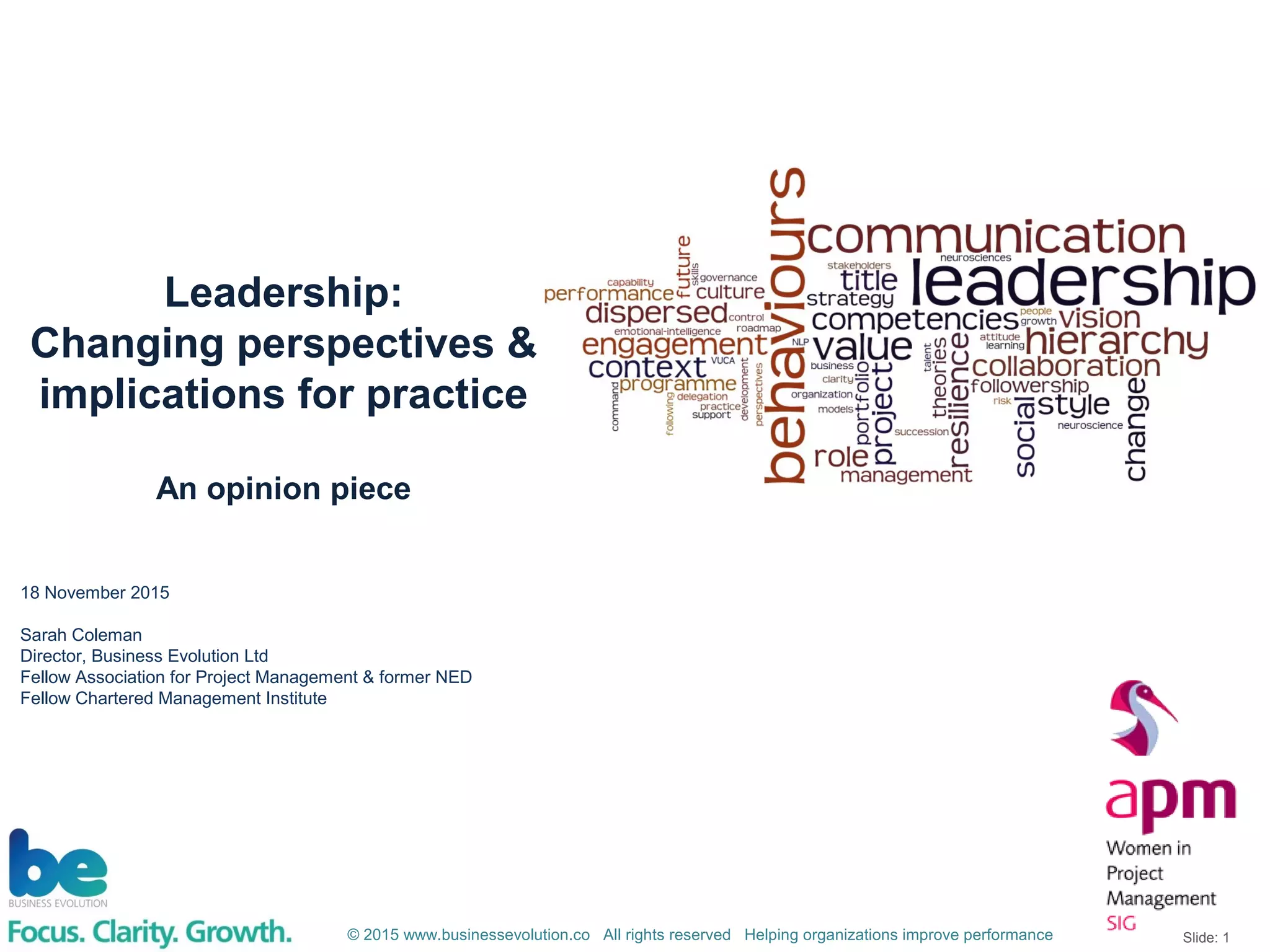
Leadership:
Changing perspectives &
implications for practice
An opinion piece
© 2015 www.businessevolution.co All rights reserved Helping organizations improve performance Slide: 2
Career start-up:
 software developer & business analyst
 working across industry sectors
Current:
 Consultant, educator, author, facilitator,
coach, mentor
 Shaping, designing, planning and
delivering business critical initiatives and
change
 Across industry sectors in the UK and
abroad
 Design and deliver learning and
development programmes
 Fellow of the Chartered Management
Institute, the Institute of Leadership &
Management, the Institute of Consulting,
the Association for Project Management
 Guest speaker at conferences, seminars &
business schools.
© 2015 www.businessevolution.co All rights reserved Helping organizations improve performance Slide: 3
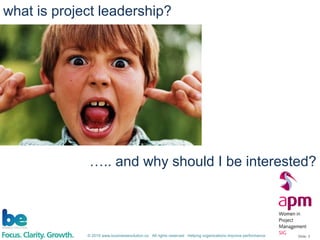
….. and why should I be interested?
what is project leadership?
© 2015 www.businessevolution.co All rights reserved Helping organizations improve performance Slide: 4
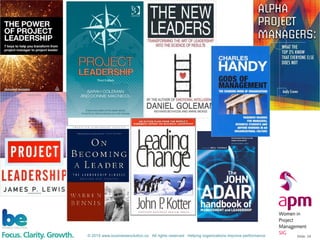
© 2015 www.businessevolution.co All rights reserved Helping organizations improve performance Slide: 5
discuss:
 Where do you find
leadership within your
organization?
 What’s the difference
between “leader” and
“leadership”?
 Which 3 words would
you use to describe
your own leadership
style?
© 2015 www.businessevolution.co All rights reserved Helping organizations improve performance Slide: 6
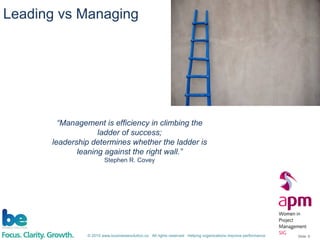
Leading vs Managing
“Management is efficiency in climbing the
ladder of success;
leadership determines whether the ladder is
leaning against the right wall.”
Stephen R. Covey
© 2015 www.businessevolution.co All rights reserved Helping organizations improve performance Slide: 7
getting to leadership ……
“ ….. to make the transition successfully, executives must navigate a
tricky set of changes in their leadership focus and skills
….. seven seismic shifts. “
Specialist Generalist
Analyst Integrator
Tactician Strategist
Bricklayer Architect
Problem solver Agenda setter
Warrior Diplomat
Supporting cast member Lead role.
“How Managers Become Leaders”
Michael D. Watkins, Harvard Business Review, June 2012
© 2015 www.businessevolution.co All rights reserved Helping organizations improve performance Slide: 8
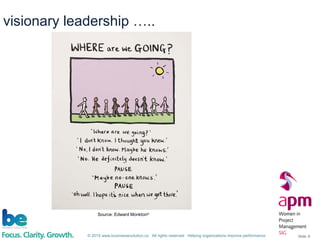
visionary leadership …..
Source: Edward Monkton©
© 2015 www.businessevolution.co All rights reserved Helping organizations improve performance Slide: 9
© 2015 www.businessevolution.co All rights reserved Helping organizations improve performance Slide: 10
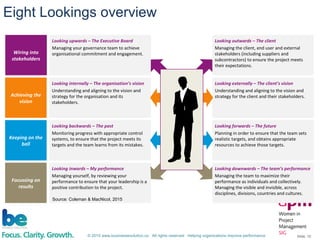
Eight Lookings overview
Looking outwards – The client
Managing the client, end user and external
stakeholders (including suppliers and
subcontractors) to ensure the project meets
their expectations.
Looking upwards – The Executive Board
Managing your governance team to achieve
organisational commitment and engagement.Wiring into
stakeholders
Looking externally – The client’s vision
Understanding and aligning to the vision and
strategy for the client and their stakeholders.
Looking internally – The organisation’s vision
Understanding and aligning to the vision and
strategy for the organisation and its
stakeholders.
Achieving the
vision
Looking forwards – The future
Planning in order to ensure that the team sets
realistic targets, and obtains appropriate
resources to achieve those targets.
Looking backwards – The past
Monitoring progress with appropriate control
systems, to ensure that the project meets its
targets and the team learns from its mistakes.
Keeping on the
ball
Looking downwards – The team’s performance
Managing the team to maximize their
performance as individuals and collectively.
Managing the visible and invisible, across
disciplines, divisions, countries and cultures.
Looking inwards – My performance
Managing yourself, by reviewing your
performance to ensure that your leadership is a
positive contribution to the project.
Focussing on
results
Source: Coleman & MacNicol, 2015
© 2015 www.businessevolution.co All rights reserved Helping organizations improve performance Slide: 11
www.youtube.com/watch?v=fW8amMCVAJQ
© 2015 www.businessevolution.co All rights reserved Helping organizations improve performance Slide: 12
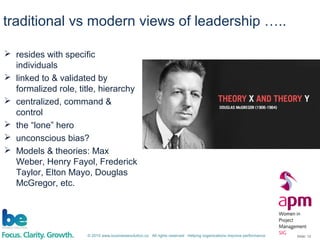
 resides with specific
individuals
 linked to & validated by
formalized role, title, hierarchy
 centralized, command &
control
 the “lone” hero
 unconscious bias?
 Models & theories: Max
Weber, Henry Fayol, Frederick
Taylor, Elton Mayo, Douglas
McGregor, etc.
traditional vs modern views of leadership …..
© 2015 www.businessevolution.co All rights reserved Helping organizations improve performance Slide: 13
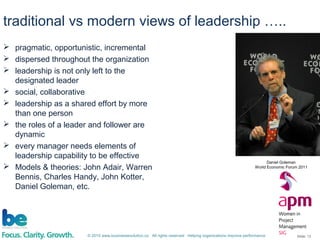
 pragmatic, opportunistic, incremental
 dispersed throughout the organization
 leadership is not only left to the
designated leader
 social, collaborative
 leadership as a shared effort by more
than one person
 the roles of a leader and follower are
dynamic
 every manager needs elements of
leadership capability to be effective
 Models & theories: John Adair, Warren
Bennis, Charles Handy, John Kotter,
Daniel Goleman, etc.
traditional vs modern views of leadership …..
Daniel Goleman
World Economic Forum 2011
© 2015 www.businessevolution.co All rights reserved Helping organizations improve performance Slide: 14
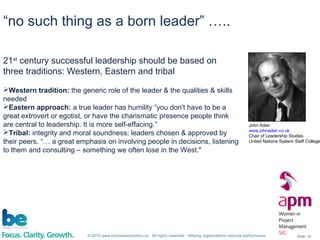
“no such thing as a born leader” …..
21st
century successful leadership should be based on
three traditions: Western, Eastern and tribal
Western tradition: the generic role of the leader & the qualities & skills
needed
Eastern approach: a true leader has humility “you don't have to be a
great extrovert or egotist, or have the charismatic presence people think
are central to leadership. It is more self-effacing.”
Tribal: integrity and moral soundness; leaders chosen & approved by
their peers. “… a great emphasis on involving people in decisions, listening
to them and consulting – something we often lose in the West."
John Adair
www.johnadair.co.uk
Chair of Leadership Studies
United Nations System Staff College
© 2015 www.businessevolution.co All rights reserved Helping organizations improve performance Slide: 15
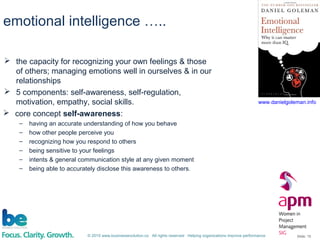
emotional intelligence …..
 the capacity for recognizing your own feelings & those
of others; managing emotions well in ourselves & in our
relationships
 5 components: self-awareness, self-regulation,
motivation, empathy, social skills. www.danielgoleman.info
 core concept self-awareness:
– having an accurate understanding of how you behave
– how other people perceive you
– recognizing how you respond to others
– being sensitive to your feelings
– intents & general communication style at any given moment
– being able to accurately disclose this awareness to others.
© 2015 www.businessevolution.co All rights reserved Helping organizations improve performance Slide: 16
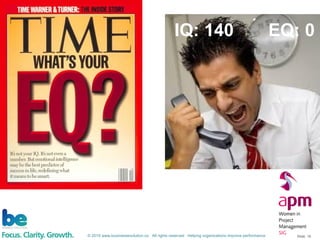
IQ: 140 EQ: 0
© 2015 www.businessevolution.co All rights reserved Helping organizations improve performance Slide: 17
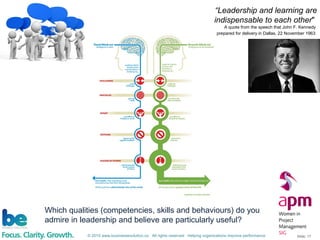
“Leadership and learning are
indispensable to each other"
A quote from the speech that John F. Kennedy
prepared for delivery in Dallas, 22 November 1963
Which qualities (competencies, skills and behaviours) do you
admire in leadership and believe are particularly useful?
© 2015 www.businessevolution.co All rights reserved Helping organizations improve performance Slide: 18
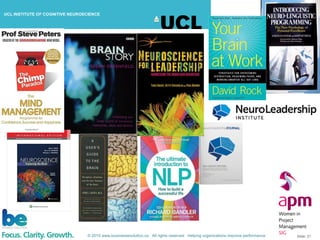
 Emphasizes the biological basis of behaviour, as well as
that gained through life experience
 Has identified:
o how the human brain develops from in utero, through adolescence
to ageing
o the relation between changes in the brain and behaviour, plasticity,
and cognitive development
o the diagnosis and treatment of disorders related to development.
 Developmental neuroscience brings together a range of
different approaches, including behavioural studies,
genetics, neural circuits, computational modelling, imaging,
cell biology and psychology.
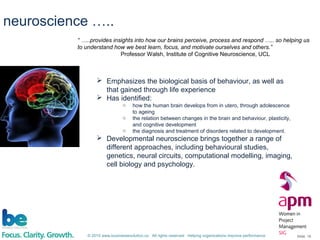
“ …..provides insights into how our brains perceive, process and respond ….. so helping us
to understand how we best learn, focus, and motivate ourselves and others.”
Professor Walsh, Institute of Cognitive Neuroscience, UCL
neuroscience …..
© 2015 www.businessevolution.co All rights reserved Helping organizations improve performance Slide: 19
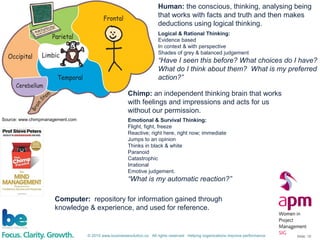
Source: www.chimpmanagement.com
Human: the conscious, thinking, analysing being
that works with facts and truth and then makes
deductions using logical thinking.
Chimp: an independent thinking brain that works
with feelings and impressions and acts for us
without our permission.
Computer: repository for information gained through
knowledge & experience, and used for reference.
Emotional & Survival Thinking:
Flight, fight, freeze
Reactive; right here, right now; immediate
Jumps to an opinion
Thinks in black & white
Paranoid
Catastrophic
Irrational
Emotive judgement.
“What is my automatic reaction?”
Logical & Rational Thinking:
Evidence based
In context & with perspective
Shades of grey & balanced judgement
“Have I seen this before? What choices do I have?
What do I think about them? What is my preferred
action?”
© 2015 www.businessevolution.co All rights reserved Helping organizations improve performance Slide: 20
www.youtube.com/watch?v=StNCvT2-Z8o
© 2015 www.businessevolution.co All rights reserved Helping organizations improve performance Slide: 21
© 2015 www.businessevolution.co All rights reserved Helping organizations improve performance Slide: 22
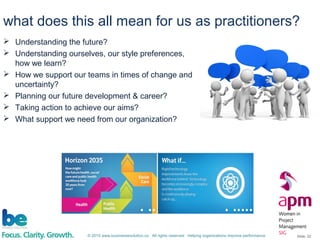
what does this all mean for us as practitioners?
 Understanding the future?
 Understanding ourselves, our style preferences,
how we learn?
 How we support our teams in times of change and
uncertainty?
 Planning our future development & career?
 Taking action to achieve our aims?
 What support we need from our organization?
© 2015 www.businessevolution.co All rights reserved Helping organizations improve performance Slide: 23
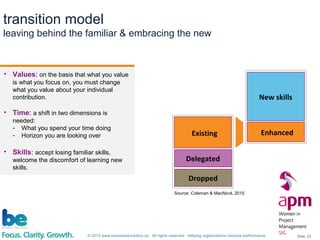
transition model
leaving behind the familiar & embracing the new
• Values: on the basis that what you value
is what you focus on, you must change
what you value about your individual
contribution.
• Time: a shift in two dimensions is
needed:
- What you spend your time doing
- Horizon you are looking over
• Skills: accept losing familiar skills,
welcome the discomfort of learning new
skills.
New skills
Enhanced
Delegated
Dropped
Existing
Source: Coleman & MacNicol, 2015
© 2015 www.businessevolution.co All rights reserved Helping organizations improve performance Slide: 24
© 2015 www.businessevolution.co All rights reserved Helping organizations improve performance Slide: 25
thank you …..
e: sarah.coleman@businessevolution.co
w: www.businessevolution.co
m: +44 (0)7999 879870
t: +44 (0)1636 893716
http://uk.linkedin.com/in/sjcoleman
@business_evolve

Leadership - changing perspectives & implications for practice - 18November2015

  • 1.
    © 2015 www.businessevolution.coAll rights reserved Helping organizations improve performance Slide: 1 18 November 2015 Sarah Coleman Director, Business Evolution Ltd Fellow Association for Project Management & former NED Fellow Chartered Management Institute Leadership: Changing perspectives & implications for practice An opinion piece
  • 2.
    © 2015 www.businessevolution.coAll rights reserved Helping organizations improve performance Slide: 2 Career start-up:  software developer & business analyst  working across industry sectors Current:  Consultant, educator, author, facilitator, coach, mentor  Shaping, designing, planning and delivering business critical initiatives and change  Across industry sectors in the UK and abroad  Design and deliver learning and development programmes  Fellow of the Chartered Management Institute, the Institute of Leadership & Management, the Institute of Consulting, the Association for Project Management  Guest speaker at conferences, seminars & business schools.
  • 3.
    © 2015 www.businessevolution.coAll rights reserved Helping organizations improve performance Slide: 3 ….. and why should I be interested? what is project leadership?
  • 4.
    © 2015 www.businessevolution.coAll rights reserved Helping organizations improve performance Slide: 4
  • 5.
    © 2015 www.businessevolution.coAll rights reserved Helping organizations improve performance Slide: 5 discuss:  Where do you find leadership within your organization?  What’s the difference between “leader” and “leadership”?  Which 3 words would you use to describe your own leadership style?
  • 6.
    © 2015 www.businessevolution.coAll rights reserved Helping organizations improve performance Slide: 6 Leading vs Managing “Management is efficiency in climbing the ladder of success; leadership determines whether the ladder is leaning against the right wall.” Stephen R. Covey
  • 7.
    © 2015 www.businessevolution.coAll rights reserved Helping organizations improve performance Slide: 7 getting to leadership …… “ ….. to make the transition successfully, executives must navigate a tricky set of changes in their leadership focus and skills ….. seven seismic shifts. “ Specialist Generalist Analyst Integrator Tactician Strategist Bricklayer Architect Problem solver Agenda setter Warrior Diplomat Supporting cast member Lead role. “How Managers Become Leaders” Michael D. Watkins, Harvard Business Review, June 2012
  • 8.
    © 2015 www.businessevolution.coAll rights reserved Helping organizations improve performance Slide: 8 visionary leadership ….. Source: Edward Monkton©
  • 9.
    © 2015 www.businessevolution.coAll rights reserved Helping organizations improve performance Slide: 9
  • 10.
    © 2015 www.businessevolution.coAll rights reserved Helping organizations improve performance Slide: 10 Eight Lookings overview Looking outwards – The client Managing the client, end user and external stakeholders (including suppliers and subcontractors) to ensure the project meets their expectations. Looking upwards – The Executive Board Managing your governance team to achieve organisational commitment and engagement.Wiring into stakeholders Looking externally – The client’s vision Understanding and aligning to the vision and strategy for the client and their stakeholders. Looking internally – The organisation’s vision Understanding and aligning to the vision and strategy for the organisation and its stakeholders. Achieving the vision Looking forwards – The future Planning in order to ensure that the team sets realistic targets, and obtains appropriate resources to achieve those targets. Looking backwards – The past Monitoring progress with appropriate control systems, to ensure that the project meets its targets and the team learns from its mistakes. Keeping on the ball Looking downwards – The team’s performance Managing the team to maximize their performance as individuals and collectively. Managing the visible and invisible, across disciplines, divisions, countries and cultures. Looking inwards – My performance Managing yourself, by reviewing your performance to ensure that your leadership is a positive contribution to the project. Focussing on results Source: Coleman & MacNicol, 2015
  • 11.
    © 2015 www.businessevolution.coAll rights reserved Helping organizations improve performance Slide: 11 www.youtube.com/watch?v=fW8amMCVAJQ
  • 12.
    © 2015 www.businessevolution.coAll rights reserved Helping organizations improve performance Slide: 12  resides with specific individuals  linked to & validated by formalized role, title, hierarchy  centralized, command & control  the “lone” hero  unconscious bias?  Models & theories: Max Weber, Henry Fayol, Frederick Taylor, Elton Mayo, Douglas McGregor, etc. traditional vs modern views of leadership …..
  • 13.
    © 2015 www.businessevolution.coAll rights reserved Helping organizations improve performance Slide: 13  pragmatic, opportunistic, incremental  dispersed throughout the organization  leadership is not only left to the designated leader  social, collaborative  leadership as a shared effort by more than one person  the roles of a leader and follower are dynamic  every manager needs elements of leadership capability to be effective  Models & theories: John Adair, Warren Bennis, Charles Handy, John Kotter, Daniel Goleman, etc. traditional vs modern views of leadership ….. Daniel Goleman World Economic Forum 2011
  • 14.
    © 2015 www.businessevolution.coAll rights reserved Helping organizations improve performance Slide: 14 “no such thing as a born leader” ….. 21st century successful leadership should be based on three traditions: Western, Eastern and tribal Western tradition: the generic role of the leader & the qualities & skills needed Eastern approach: a true leader has humility “you don't have to be a great extrovert or egotist, or have the charismatic presence people think are central to leadership. It is more self-effacing.” Tribal: integrity and moral soundness; leaders chosen & approved by their peers. “… a great emphasis on involving people in decisions, listening to them and consulting – something we often lose in the West." John Adair www.johnadair.co.uk Chair of Leadership Studies United Nations System Staff College
  • 15.
    © 2015 www.businessevolution.coAll rights reserved Helping organizations improve performance Slide: 15 emotional intelligence …..  the capacity for recognizing your own feelings & those of others; managing emotions well in ourselves & in our relationships  5 components: self-awareness, self-regulation, motivation, empathy, social skills. www.danielgoleman.info  core concept self-awareness: – having an accurate understanding of how you behave – how other people perceive you – recognizing how you respond to others – being sensitive to your feelings – intents & general communication style at any given moment – being able to accurately disclose this awareness to others.
  • 16.
    © 2015 www.businessevolution.coAll rights reserved Helping organizations improve performance Slide: 16 IQ: 140 EQ: 0
  • 17.
    © 2015 www.businessevolution.coAll rights reserved Helping organizations improve performance Slide: 17 “Leadership and learning are indispensable to each other" A quote from the speech that John F. Kennedy prepared for delivery in Dallas, 22 November 1963 Which qualities (competencies, skills and behaviours) do you admire in leadership and believe are particularly useful?
  • 18.
    © 2015 www.businessevolution.coAll rights reserved Helping organizations improve performance Slide: 18  Emphasizes the biological basis of behaviour, as well as that gained through life experience  Has identified: o how the human brain develops from in utero, through adolescence to ageing o the relation between changes in the brain and behaviour, plasticity, and cognitive development o the diagnosis and treatment of disorders related to development.  Developmental neuroscience brings together a range of different approaches, including behavioural studies, genetics, neural circuits, computational modelling, imaging, cell biology and psychology. “ …..provides insights into how our brains perceive, process and respond ….. so helping us to understand how we best learn, focus, and motivate ourselves and others.” Professor Walsh, Institute of Cognitive Neuroscience, UCL neuroscience …..
  • 19.
    © 2015 www.businessevolution.coAll rights reserved Helping organizations improve performance Slide: 19 Source: www.chimpmanagement.com Human: the conscious, thinking, analysing being that works with facts and truth and then makes deductions using logical thinking. Chimp: an independent thinking brain that works with feelings and impressions and acts for us without our permission. Computer: repository for information gained through knowledge & experience, and used for reference. Emotional & Survival Thinking: Flight, fight, freeze Reactive; right here, right now; immediate Jumps to an opinion Thinks in black & white Paranoid Catastrophic Irrational Emotive judgement. “What is my automatic reaction?” Logical & Rational Thinking: Evidence based In context & with perspective Shades of grey & balanced judgement “Have I seen this before? What choices do I have? What do I think about them? What is my preferred action?”
  • 20.
    © 2015 www.businessevolution.coAll rights reserved Helping organizations improve performance Slide: 20 www.youtube.com/watch?v=StNCvT2-Z8o
  • 21.
    © 2015 www.businessevolution.coAll rights reserved Helping organizations improve performance Slide: 21
  • 22.
    © 2015 www.businessevolution.coAll rights reserved Helping organizations improve performance Slide: 22 what does this all mean for us as practitioners?  Understanding the future?  Understanding ourselves, our style preferences, how we learn?  How we support our teams in times of change and uncertainty?  Planning our future development & career?  Taking action to achieve our aims?  What support we need from our organization?
  • 23.
    © 2015 www.businessevolution.coAll rights reserved Helping organizations improve performance Slide: 23 transition model leaving behind the familiar & embracing the new • Values: on the basis that what you value is what you focus on, you must change what you value about your individual contribution. • Time: a shift in two dimensions is needed: - What you spend your time doing - Horizon you are looking over • Skills: accept losing familiar skills, welcome the discomfort of learning new skills. New skills Enhanced Delegated Dropped Existing Source: Coleman & MacNicol, 2015
  • 24.
    © 2015 www.businessevolution.coAll rights reserved Helping organizations improve performance Slide: 24
  • 25.
    © 2015 www.businessevolution.coAll rights reserved Helping organizations improve performance Slide: 25 thank you ….. e: sarah.coleman@businessevolution.co w: www.businessevolution.co m: +44 (0)7999 879870 t: +44 (0)1636 893716 http://uk.linkedin.com/in/sjcoleman @business_evolve