Intensive leadership
development for 16 to 25
year-olds
A Social Enterprise Organisation
2
“We understand that leadership development is
not an overnight fix but a journey and one which
requires the organisation, participants and
Extraordinary Leadership to work in partnership
to deliver the right environment and input for
learning.   Extraordinary Leadership share this
philosophy and have been a “true” partner
investing in the development of our current and
future leaders.   The feedback from participants
has been overwhelmingly positive with people
often citing these programmes as the best they
have ever attended”
EVP HR, Telecommunication
¨Extraordinary Leadership has been an enormous
help to our business ... has helped transform our
senior management team within one of our
largest divisions, from a group of
underperforming individuals into the highest
performing leadership team within our
organisation. Without this help we would not be
where we are today as a business¨
VP, International Recruitment
Some Principles of Extraordinary
Leadership & LeadNow!
3
We are all unique individuals – the way you and I lead most effectively will be
different!
Knowledge and skills are not enough – leadership must be addressed experientially
at the level of values, beliefs, and purpose
All leadership begins with leadership of self
True leadership integrates the physical, mental, emotional and spiritual dimensions
The quality of Leadership determined by quality of Awareness, Connection and
yourself Transformation (the ACT of leadership)
Leading others is about enabling, not doing
Leaders at all levels need to be empowered to respond to events in a “VUCA” world
Leadership development is about human value as well as organisational value
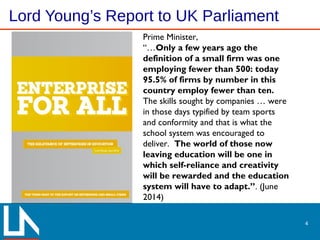
Lord Young’s Report to UK Parliament
4
Prime Minister,
“…Only a few years ago the
definition of a small firm was one
employing fewer than 500: today
95.5% of firms by number in this
country employ fewer than ten.
The skills sought by companies … were
in those days typified by team sports
and conformity and that is what the
school system was encouraged to
deliver. The world of those now
leaving education will be one in
which self-reliance and creativity
will be rewarded and the education
system will have to adapt.”. (June
2014)
Intensive leadership
development for 16 to 25
year-olds
www.leadnow.net
A Social Enterprise Organisation
• “I’ve rarely seen our students so animated and enthused!”
(Jenny Blakesley, Director, LSE Careers)
“Wow! I can see my way forward” “Everyone should do it”
“Inspirational” “I learnt more in 3 days than in years”
“Exceeded expectations, haven’t been to such a workshop in
many years”
“This workshop was amazing. I learnt a lot about my strengths-
weaknesses and how to assess and lead a team”
A Social Enterprise Organisation
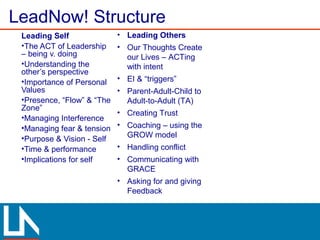
LeadNow! Structure
Leading Self
•The ACT of Leadership
– being v. doing
•Understanding the
other’s perspective
•Importance of Personal
Values
•Presence, “Flow” & “The
Zone”
•Managing Interference
•Managing fear & tension
•Purpose & Vision - Self
•Time & performance
•Implications for self
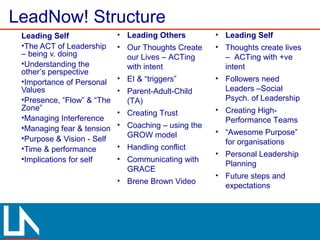
LeadNow! Structure
Leading Self
•The ACT of Leadership
– being v. doing
•Understanding the
other’s perspective
•Importance of Personal
Values
•Presence, “Flow” & “The
Zone”
•Managing Interference
•Managing fear & tension
•Purpose & Vision - Self
•Time & performance
•Implications for self
• Leading Others
• Our Thoughts Create
our Lives – ACTing
with intent
• EI & “triggers”
• Parent-Adult-Child to
Adult-to-Adult (TA)
• Creating Trust
• Coaching – using the
GROW model
• Handling conflict
• Communicating with
GRACE
• Asking for and giving
Feedback
LeadNow! Structure
Leading Self
•The ACT of Leadership
– being v. doing
•Understanding the
other’s perspective
•Importance of Personal
Values
•Presence, “Flow” & “The
Zone”
•Managing Interference
•Managing fear & tension
•Purpose & Vision - Self
•Time & performance
•Implications for self
• Leading Others
• Our Thoughts Create
our Lives – ACTing
with intent
• EI & “triggers”
• Parent-Adult-Child
(TA)
• Creating Trust
• Coaching – using the
GROW model
• Handling conflict
• Communicating with
GRACE
• Brene Brown Video
• Leading Self
• Thoughts create lives
– ACTing with +ve
intent
• Followers need
Leaders –Social
Psych. of Leadership
• Creating High-
Performance Teams
• “Awesome Purpose”
for organisations
• Personal Leadership
Planning
• Future steps and
expectations
Examples: Leading Self
(Day 1)
A Social Enterprise Organisation
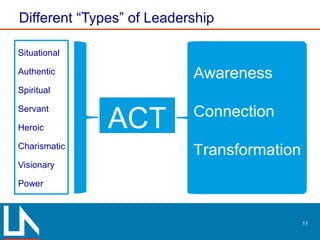
Different “Types” of Leadership
Situational
Authentic
Spiritual
Servant
Heroic
Charismatic
Visionary
Power
11
ACT
Awareness
Connection
Transformation
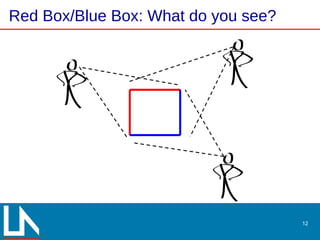
Red Box/Blue Box: What do you see?
12
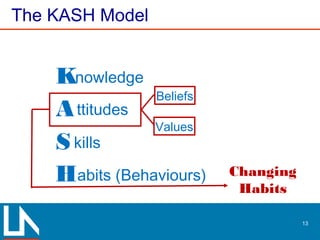
The KASH Model
13
K
A
S
H
nowledge
ttitudes
kills
abits (Behaviours)
Beliefs
Values
Changing
Habits
Choose your 5 most important
Values/Qualities – for example:
Accountability
Achievement
Balance (home/work)
Commitment
Compassion
Competence
Continuous learning
Cooperation
Courage
Craftsmanship
Creativity
Customer
Enthusiasm
Efficiency
Empathy
Ethics
Excellence
Fairness
Family
Financial gain
Friendships
Future generations
Health
Honesty
Humour/fun
Independence
Integrity
Initiative
Intuition
Leadership
Love
Making a difference
Open communication
Openness
Ownership
Personal fulfilment
Personal growth
Power
Respect
Responsibility
Risk-taking
Self-discipline
Success
Trust
Teamwork
Wisdom
14
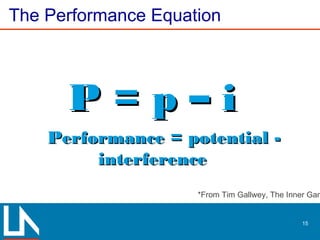
The Performance Equation
15
P = p – iP = p – i
Performance = potential -Performance = potential -
interferenceinterference
*From Tim Gallwey, The Inner Gam
Managing Stress and Tension:
Breathing and Neurophysiology
and Presence/Mindfulness
16
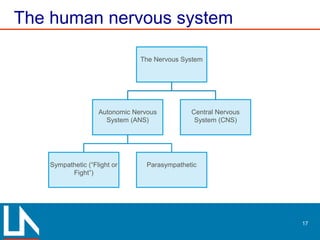
The human nervous system
17
The Nervous System
Autonomic Nervous
System (ANS)
Sympathetic (“Flight or
Fight”)
Parasympathetic
Central Nervous
System (CNS)
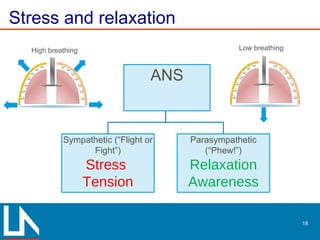
Stress and relaxation
18
ANS
Sympathetic (“Flight or
Fight”)
Stress
Tension
Parasympathetic
(“Phew!”)
Relaxation
Awareness
High breathing Low breathing
Purpose
19
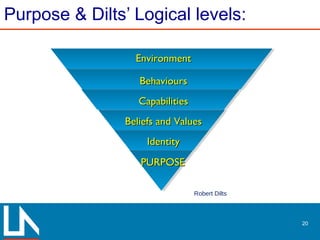
Purpose & Dilts’ Logical levels:
20
Robert Dilts
PURPOSEPURPOSE
EnvironmentEnvironment
BehavioursBehaviours
CapabilitiesCapabilities
Beliefs and ValuesBeliefs and Values
IdentityIdentity
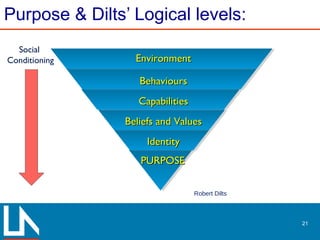
Purpose & Dilts’ Logical levels:
21
Robert Dilts
PURPOSEPURPOSE
EnvironmentEnvironment
BehavioursBehaviours
CapabilitiesCapabilities
Beliefs and ValuesBeliefs and Values
IdentityIdentity
Social
Conditioning
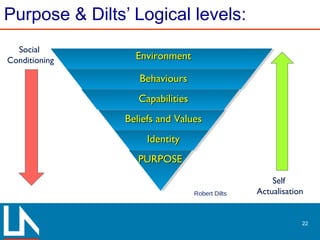
Purpose & Dilts’ Logical levels:
22
Robert Dilts
PURPOSEPURPOSE
EnvironmentEnvironment
BehavioursBehaviours
CapabilitiesCapabilities
Beliefs and ValuesBeliefs and Values
IdentityIdentity
Social
Conditioning
Self
Actualisation

Lead Now!

  • 1.
    Intensive leadership development for16 to 25 year-olds A Social Enterprise Organisation
  • 2.
    2 “We understand thatleadership development is not an overnight fix but a journey and one which requires the organisation, participants and Extraordinary Leadership to work in partnership to deliver the right environment and input for learning.   Extraordinary Leadership share this philosophy and have been a “true” partner investing in the development of our current and future leaders.   The feedback from participants has been overwhelmingly positive with people often citing these programmes as the best they have ever attended” EVP HR, Telecommunication ¨Extraordinary Leadership has been an enormous help to our business ... has helped transform our senior management team within one of our largest divisions, from a group of underperforming individuals into the highest performing leadership team within our organisation. Without this help we would not be where we are today as a business¨ VP, International Recruitment
  • 3.
    Some Principles ofExtraordinary Leadership & LeadNow! 3 We are all unique individuals – the way you and I lead most effectively will be different! Knowledge and skills are not enough – leadership must be addressed experientially at the level of values, beliefs, and purpose All leadership begins with leadership of self True leadership integrates the physical, mental, emotional and spiritual dimensions The quality of Leadership determined by quality of Awareness, Connection and yourself Transformation (the ACT of leadership) Leading others is about enabling, not doing Leaders at all levels need to be empowered to respond to events in a “VUCA” world Leadership development is about human value as well as organisational value
  • 4.
    Lord Young’s Reportto UK Parliament 4 Prime Minister, “…Only a few years ago the definition of a small firm was one employing fewer than 500: today 95.5% of firms by number in this country employ fewer than ten. The skills sought by companies … were in those days typified by team sports and conformity and that is what the school system was encouraged to deliver. The world of those now leaving education will be one in which self-reliance and creativity will be rewarded and the education system will have to adapt.”. (June 2014)
  • 5.
    Intensive leadership development for16 to 25 year-olds www.leadnow.net A Social Enterprise Organisation
  • 6.
    • “I’ve rarelyseen our students so animated and enthused!” (Jenny Blakesley, Director, LSE Careers) “Wow! I can see my way forward” “Everyone should do it” “Inspirational” “I learnt more in 3 days than in years” “Exceeded expectations, haven’t been to such a workshop in many years” “This workshop was amazing. I learnt a lot about my strengths- weaknesses and how to assess and lead a team” A Social Enterprise Organisation
  • 7.
    LeadNow! Structure Leading Self •TheACT of Leadership – being v. doing •Understanding the other’s perspective •Importance of Personal Values •Presence, “Flow” & “The Zone” •Managing Interference •Managing fear & tension •Purpose & Vision - Self •Time & performance •Implications for self
  • 8.
    LeadNow! Structure Leading Self •TheACT of Leadership – being v. doing •Understanding the other’s perspective •Importance of Personal Values •Presence, “Flow” & “The Zone” •Managing Interference •Managing fear & tension •Purpose & Vision - Self •Time & performance •Implications for self • Leading Others • Our Thoughts Create our Lives – ACTing with intent • EI & “triggers” • Parent-Adult-Child to Adult-to-Adult (TA) • Creating Trust • Coaching – using the GROW model • Handling conflict • Communicating with GRACE • Asking for and giving Feedback
  • 9.
    LeadNow! Structure Leading Self •TheACT of Leadership – being v. doing •Understanding the other’s perspective •Importance of Personal Values •Presence, “Flow” & “The Zone” •Managing Interference •Managing fear & tension •Purpose & Vision - Self •Time & performance •Implications for self • Leading Others • Our Thoughts Create our Lives – ACTing with intent • EI & “triggers” • Parent-Adult-Child (TA) • Creating Trust • Coaching – using the GROW model • Handling conflict • Communicating with GRACE • Brene Brown Video • Leading Self • Thoughts create lives – ACTing with +ve intent • Followers need Leaders –Social Psych. of Leadership • Creating High- Performance Teams • “Awesome Purpose” for organisations • Personal Leadership Planning • Future steps and expectations
  • 10.
    Examples: Leading Self (Day1) A Social Enterprise Organisation
  • 11.
    Different “Types” ofLeadership Situational Authentic Spiritual Servant Heroic Charismatic Visionary Power 11 ACT Awareness Connection Transformation
  • 12.
    Red Box/Blue Box:What do you see? 12
  • 13.
    The KASH Model 13 K A S H nowledge ttitudes kills abits(Behaviours) Beliefs Values Changing Habits
  • 14.
    Choose your 5most important Values/Qualities – for example: Accountability Achievement Balance (home/work) Commitment Compassion Competence Continuous learning Cooperation Courage Craftsmanship Creativity Customer Enthusiasm Efficiency Empathy Ethics Excellence Fairness Family Financial gain Friendships Future generations Health Honesty Humour/fun Independence Integrity Initiative Intuition Leadership Love Making a difference Open communication Openness Ownership Personal fulfilment Personal growth Power Respect Responsibility Risk-taking Self-discipline Success Trust Teamwork Wisdom 14
  • 15.
    The Performance Equation 15 P= p – iP = p – i Performance = potential -Performance = potential - interferenceinterference *From Tim Gallwey, The Inner Gam
  • 16.
    Managing Stress andTension: Breathing and Neurophysiology and Presence/Mindfulness 16
  • 17.
    The human nervoussystem 17 The Nervous System Autonomic Nervous System (ANS) Sympathetic (“Flight or Fight”) Parasympathetic Central Nervous System (CNS)
  • 18.
    Stress and relaxation 18 ANS Sympathetic(“Flight or Fight”) Stress Tension Parasympathetic (“Phew!”) Relaxation Awareness High breathing Low breathing
  • 19.
  • 20.
    Purpose & Dilts’Logical levels: 20 Robert Dilts PURPOSEPURPOSE EnvironmentEnvironment BehavioursBehaviours CapabilitiesCapabilities Beliefs and ValuesBeliefs and Values IdentityIdentity
  • 21.
    Purpose & Dilts’Logical levels: 21 Robert Dilts PURPOSEPURPOSE EnvironmentEnvironment BehavioursBehaviours CapabilitiesCapabilities Beliefs and ValuesBeliefs and Values IdentityIdentity Social Conditioning
  • 22.
    Purpose & Dilts’Logical levels: 22 Robert Dilts PURPOSEPURPOSE EnvironmentEnvironment BehavioursBehaviours CapabilitiesCapabilities Beliefs and ValuesBeliefs and Values IdentityIdentity Social Conditioning Self Actualisation