The Reference Interview Spring 2008
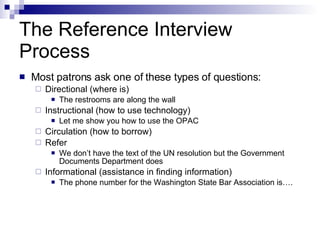
The Reference Interview Process Most patrons ask one of these types of questions: Directional (where is) The restrooms are along the wall Instructional (how to use technology) Let me show you how to use the OPAC Circulation (how to borrow) Refer We don’t have the text of the UN resolution but the Government Documents Department does Informational (assistance in finding information) The phone number for the Washington State Bar Association is….
Definition of the Reference Interview A creative problem solving process that is collaborative
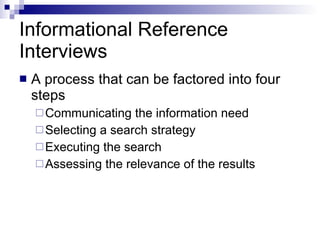
Informational Reference Interviews A process that can be factored into four steps Communicating the information need Selecting a search strategy Executing the search Assessing the relevance of the results
Specific Strategies We need to first clarify and elicit the patron’s information needs We need to decide which information sources to consult based on an assessment of the patron’s need We must be able to evaluate potential sources during the formulation of the search process and during retrieval
The 6 Pieces of Evidence Purpose  Deadline Type and Amount (how much, picture, text) Who (how knowledgeable is the patron) Where (Where did the patron hear about the information) The Basic Question (what does the patron really want to know)
Why can’t they ask for what they want? They don’t know the extent of your information resources They don’t know how to ask for what they want They feel the information is too confidential to disclose fully They aren’t really sure yet what they want They aren’t sure you have the information They don’t think you understand the subject
Nonverbal Skills Make eye contact Have a relaxed, open posture Watch your facial expression and tone of voice “Be here now”
Verbal Skills Project a professional image over the telephone Be quiet and let the patron talk Listen to each item of the request Use encouragers Ask open-ended questions Establish a sense of expertise Avoid premature diagnosis Get to the heart of the matter Paraphrase the request in different words Negotiate boundaries How to say “no” without saying NO Think through your search – any additional questions?
Approachability, Interest, Listening/Inquiring, Searching, Follow-up In all forms of reference services, the success of the transaction is measured not just by the information conveyed, but also by the positive or negative impact of the patron/librarian interaction.
Human Conversation Failure Human conversation failure seems to be more of the rule rather than the exception Pet Sematary = Animal Graveyard Socrates=soccer tees UNIX=eunuchs Supervision=super vision Wales=whales
Communications Accidents Oranges and Peaches An undergraduate student approaches the librarian.  “I just can’t find this book and I have to read it by Monday.  I tried to find it on my own and I can’t!  The librarian replies in a soothing voice, “Do you have the title?” “It’s called Oranges and Peaches”.  Of course there is no book with this title in the library.  The librarian asks gently, “Do you have the author”.  Charles somebody.
Can you guess the real title of the book?
The real book The student states that the book is legendary.  The Bible on evolution. On the Origin of Species  by Charles Darwin
Virtual Reference Are we artificially inflating the expectation that virtual reference must be a quick interchange? Impatient patrons (face-to-face) – they have to get back to work, or go to class, or time is money, or my paper is due now. They tap their fingers, they look at the clock, etc. Patrons may use virtual reference because it is more convenient Negative closures and bad interview practices happen at the desk and they also happen online
Librarians’ Perceptions of the Reference Interview Many factors enter into a successful reference interview including the librarian’s communication style, the patron’s emotions and literacy skills, and the resources available.
Strategies for Children Problems can be: Being more inarticulate in voicing information needs Either caring a lot or not caring at all because of the requests being a school assignment Being more unfamiliar with the classification system Needing to get the same information as the rest of the class

The Reference Interview

  • 1.
  • 2.
    The Reference InterviewProcess Most patrons ask one of these types of questions: Directional (where is) The restrooms are along the wall Instructional (how to use technology) Let me show you how to use the OPAC Circulation (how to borrow) Refer We don’t have the text of the UN resolution but the Government Documents Department does Informational (assistance in finding information) The phone number for the Washington State Bar Association is….
  • 3.
    Definition of theReference Interview A creative problem solving process that is collaborative
  • 4.
    Informational Reference InterviewsA process that can be factored into four steps Communicating the information need Selecting a search strategy Executing the search Assessing the relevance of the results
  • 5.
    Specific Strategies Weneed to first clarify and elicit the patron’s information needs We need to decide which information sources to consult based on an assessment of the patron’s need We must be able to evaluate potential sources during the formulation of the search process and during retrieval
  • 6.
    The 6 Piecesof Evidence Purpose Deadline Type and Amount (how much, picture, text) Who (how knowledgeable is the patron) Where (Where did the patron hear about the information) The Basic Question (what does the patron really want to know)
  • 7.
    Why can’t theyask for what they want? They don’t know the extent of your information resources They don’t know how to ask for what they want They feel the information is too confidential to disclose fully They aren’t really sure yet what they want They aren’t sure you have the information They don’t think you understand the subject
  • 8.
    Nonverbal Skills Makeeye contact Have a relaxed, open posture Watch your facial expression and tone of voice “Be here now”
  • 9.
    Verbal Skills Projecta professional image over the telephone Be quiet and let the patron talk Listen to each item of the request Use encouragers Ask open-ended questions Establish a sense of expertise Avoid premature diagnosis Get to the heart of the matter Paraphrase the request in different words Negotiate boundaries How to say “no” without saying NO Think through your search – any additional questions?
  • 10.
    Approachability, Interest, Listening/Inquiring,Searching, Follow-up In all forms of reference services, the success of the transaction is measured not just by the information conveyed, but also by the positive or negative impact of the patron/librarian interaction.
  • 11.
    Human Conversation FailureHuman conversation failure seems to be more of the rule rather than the exception Pet Sematary = Animal Graveyard Socrates=soccer tees UNIX=eunuchs Supervision=super vision Wales=whales
  • 12.
    Communications Accidents Orangesand Peaches An undergraduate student approaches the librarian. “I just can’t find this book and I have to read it by Monday. I tried to find it on my own and I can’t! The librarian replies in a soothing voice, “Do you have the title?” “It’s called Oranges and Peaches”. Of course there is no book with this title in the library. The librarian asks gently, “Do you have the author”. Charles somebody.
  • 13.
    Can you guessthe real title of the book?
  • 14.
    The real bookThe student states that the book is legendary. The Bible on evolution. On the Origin of Species by Charles Darwin
  • 15.
    Virtual Reference Arewe artificially inflating the expectation that virtual reference must be a quick interchange? Impatient patrons (face-to-face) – they have to get back to work, or go to class, or time is money, or my paper is due now. They tap their fingers, they look at the clock, etc. Patrons may use virtual reference because it is more convenient Negative closures and bad interview practices happen at the desk and they also happen online
  • 16.
    Librarians’ Perceptions ofthe Reference Interview Many factors enter into a successful reference interview including the librarian’s communication style, the patron’s emotions and literacy skills, and the resources available.
  • 17.
    Strategies for ChildrenProblems can be: Being more inarticulate in voicing information needs Either caring a lot or not caring at all because of the requests being a school assignment Being more unfamiliar with the classification system Needing to get the same information as the rest of the class