Application Development Using
Spring LDAP
Balaji Varanasi
About Me


Development Manager



Author



LDAPUnit Creator
Agenda
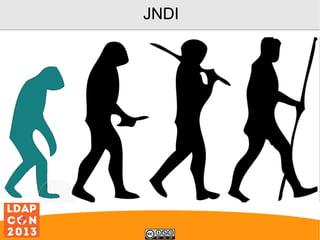
JNDI
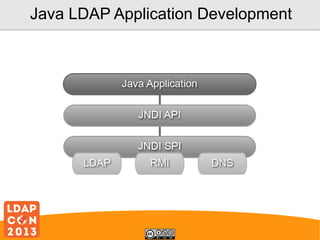
Java LDAP Application Development
Java LDAP Development
• JNDI Way Of Development
• Connect to LDAP Server
• Perform LDAP Operations
• Close resources
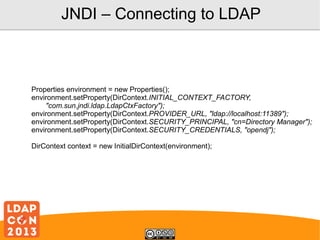
JNDI – Connecting to LDAP

Properties environment = new Properties();
environment.setProperty(DirContext.INITIAL_CONTEXT_FACTORY,
"com.sun.jndi.ldap.LdapCtxFactory");
environment.setProperty(DirContext.PROVIDER_URL, "ldap://localhost:11389");
environment.setProperty(DirContext.SECURITY_PRINCIPAL, "cn=Directory Manager");
environment.setProperty(DirContext.SECURITY_CREDENTIALS, "opendj");
DirContext context = new InitialDirContext(environment);
JNDI – Performing LDAP Operation
SearchControls searchControls = new SearchControls();
searchControls.setSearchScope(SearchControls.SUBTREE_SCOPE);
searchControls.setReturningAttributes(new String[]{"givenName", "sn",
"telephoneNumber"});
searchResults = context.search(BASE_PATH, "(objectClass=inetOrgPerson)",
searchControls);
while (searchResults.hasMore()) {
SearchResult result = searchResults.next();
Attributes attributes = result.getAttributes();
// Read single valued attributes
String firstName = (String)attributes.get("givenName").get();
String lastName = (String)attributes.get("sn").get();
// Read the multi-valued attribute
Attribute phoneAttribute = attributes.get("telephoneNumber");
String[] phone = new String[phoneAttribute.size()];
NamingEnumeration phoneValues = phoneAttribute.getAll();
for(int i = 0; phoneValues.hasMore(); i++) {
phone[i] = (String)phoneValues.next();
}
}
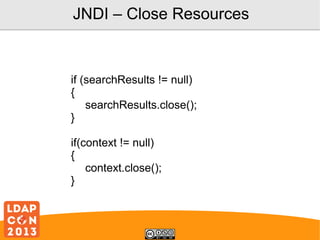
JNDI – Close Resources

if (searchResults != null)
{
searchResults.close();
}
if(context != null)
{
context.close();
}
JNDI LDAP Operations Demo
What’s wrong with JNDI?
• JNDI Drawbacks
• Plumbing Code
• Explicit Resource Management
• Checked Exceptions
Spring LDAP
Spring LDAP

“Makes it easier to build Spring-based
applications that use the Lightweight Directory
Access Protocol”
Spring LDAP

“Makes it easier to build Spring-based
applications that use the Lightweight Directory
Access Protocol”
Spring LDAP
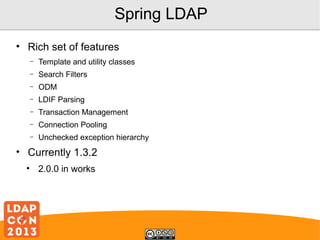
• Rich set of features
–

Template and utility classes

–

Search Filters

–

ODM

–

LDIF Parsing

–

Transaction Management

–

Connection Pooling

–

Unchecked exception hierarchy

• Currently 1.3.2
• 2.0.0 in works
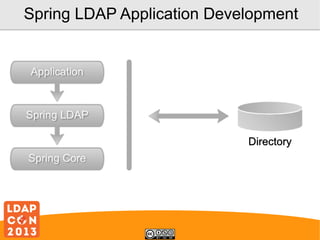
Spring LDAP Application Development
Spring LDAP Development
• Core Concepts
• Context Source
• LdapTemplate
Spring LDAP Development
• Context Source
• Abstracts LDAP Connection
• LdapContextSource implementation
LdapTemplate
• Provides Overloaded
• Search
• Lookup
• Bind/Unbind
• Authenticate methods

• Thread safe
Spring LDAP Template Demo
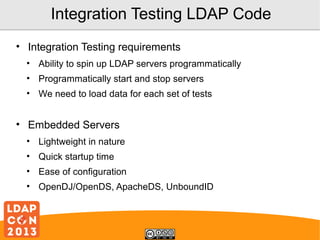
Integration Testing LDAP Code
• Integration Testing requirements
• Ability to spin up LDAP servers programmatically
• Programmatically start and stop servers
• We need to load data for each set of tests

• Embedded Servers
• Lightweight in nature
• Quick startup time
• Ease of configuration
• OpenDJ/OpenDS, ApacheDS, UnboundID
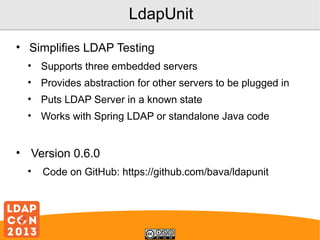
LdapUnit
• Simplifies LDAP Testing
• Supports three embedded servers
• Provides abstraction for other servers to be plugged in
• Puts LDAP Server in a known state
• Works with Spring LDAP or standalone Java code

• Version 0.6.0
•

Code on GitHub: https://github.com/bava/ldapunit
LdapUnit Demo
Spring LDAP ODM
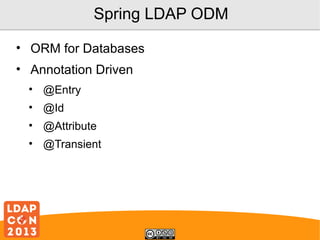
Spring LDAP ODM
• ORM for Databases
• Annotation Driven
• @Entry
• @Id
• @Attribute
• @Transient
ODM Demo
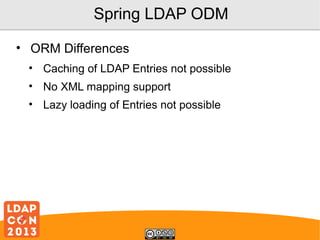
Spring LDAP ODM
• ORM Differences
• Caching of LDAP Entries not possible
• No XML mapping support
• Lazy loading of Entries not possible
What else can we improve?
Spring LDAP Authentication
public boolean authenticate(String userid, String password) {
DistinguishedName dn = new DistinguishedName(BASE_DN);
dn.add("uid", userid);
DirContext authenticatedContext = null;
try {
authenticatedContext = contextSource.getContext(dn.toString(), password);
return true;
}
catch(NamingException e) {
e.printStackTrace();
return false;
}
finally {
LdapUtils.closeContext(authenticatedContext);
}
}
Spring LDAP Authentication

@Override
public boolean authenticate(String userid, String password) {
return ldapTemplate.authenticate("","(uid=" + userid + ")", password);
}
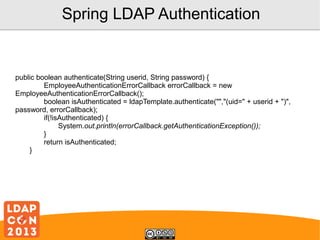
Spring LDAP Authentication

public boolean authenticate(String userid, String password) {
EmployeeAuthenticationErrorCallback errorCallback = new
EmployeeAuthenticationErrorCallback();
boolean isAuthenticated = ldapTemplate.authenticate("","(uid=" + userid + ")",
password, errorCallback);
if(!isAuthenticated) {
System.out.println(errorCallback.getAuthenticationException());
}
return isAuthenticated;
}
Questions
Thanks!

LDAP Development Using Spring LDAP

  • 1.
  • 2.
  • 3.
  • 4.
  • 5.
  • 6.
    Java LDAP Development •JNDI Way Of Development • Connect to LDAP Server • Perform LDAP Operations • Close resources
  • 7.
    JNDI – Connectingto LDAP Properties environment = new Properties(); environment.setProperty(DirContext.INITIAL_CONTEXT_FACTORY, "com.sun.jndi.ldap.LdapCtxFactory"); environment.setProperty(DirContext.PROVIDER_URL, "ldap://localhost:11389"); environment.setProperty(DirContext.SECURITY_PRINCIPAL, "cn=Directory Manager"); environment.setProperty(DirContext.SECURITY_CREDENTIALS, "opendj"); DirContext context = new InitialDirContext(environment);
  • 8.
    JNDI – PerformingLDAP Operation SearchControls searchControls = new SearchControls(); searchControls.setSearchScope(SearchControls.SUBTREE_SCOPE); searchControls.setReturningAttributes(new String[]{"givenName", "sn", "telephoneNumber"}); searchResults = context.search(BASE_PATH, "(objectClass=inetOrgPerson)", searchControls); while (searchResults.hasMore()) { SearchResult result = searchResults.next(); Attributes attributes = result.getAttributes(); // Read single valued attributes String firstName = (String)attributes.get("givenName").get(); String lastName = (String)attributes.get("sn").get(); // Read the multi-valued attribute Attribute phoneAttribute = attributes.get("telephoneNumber"); String[] phone = new String[phoneAttribute.size()]; NamingEnumeration phoneValues = phoneAttribute.getAll(); for(int i = 0; phoneValues.hasMore(); i++) { phone[i] = (String)phoneValues.next(); } }
  • 9.
    JNDI – CloseResources if (searchResults != null) { searchResults.close(); } if(context != null) { context.close(); }
  • 10.
  • 11.
    What’s wrong withJNDI? • JNDI Drawbacks • Plumbing Code • Explicit Resource Management • Checked Exceptions
  • 12.
  • 13.
    Spring LDAP “Makes iteasier to build Spring-based applications that use the Lightweight Directory Access Protocol”
  • 14.
    Spring LDAP “Makes iteasier to build Spring-based applications that use the Lightweight Directory Access Protocol”
  • 15.
    Spring LDAP • Richset of features – Template and utility classes – Search Filters – ODM – LDIF Parsing – Transaction Management – Connection Pooling – Unchecked exception hierarchy • Currently 1.3.2 • 2.0.0 in works
  • 16.
  • 17.
    Spring LDAP Development •Core Concepts • Context Source • LdapTemplate
  • 18.
    Spring LDAP Development •Context Source • Abstracts LDAP Connection • LdapContextSource implementation
  • 19.
    LdapTemplate • Provides Overloaded •Search • Lookup • Bind/Unbind • Authenticate methods • Thread safe
  • 20.
  • 21.
    Integration Testing LDAPCode • Integration Testing requirements • Ability to spin up LDAP servers programmatically • Programmatically start and stop servers • We need to load data for each set of tests • Embedded Servers • Lightweight in nature • Quick startup time • Ease of configuration • OpenDJ/OpenDS, ApacheDS, UnboundID
  • 22.
    LdapUnit • Simplifies LDAPTesting • Supports three embedded servers • Provides abstraction for other servers to be plugged in • Puts LDAP Server in a known state • Works with Spring LDAP or standalone Java code • Version 0.6.0 • Code on GitHub: https://github.com/bava/ldapunit
  • 23.
  • 24.
  • 25.
    Spring LDAP ODM •ORM for Databases • Annotation Driven • @Entry • @Id • @Attribute • @Transient
  • 26.
  • 27.
    Spring LDAP ODM •ORM Differences • Caching of LDAP Entries not possible • No XML mapping support • Lazy loading of Entries not possible
  • 28.
    What else canwe improve?
  • 29.
    Spring LDAP Authentication publicboolean authenticate(String userid, String password) { DistinguishedName dn = new DistinguishedName(BASE_DN); dn.add("uid", userid); DirContext authenticatedContext = null; try { authenticatedContext = contextSource.getContext(dn.toString(), password); return true; } catch(NamingException e) { e.printStackTrace(); return false; } finally { LdapUtils.closeContext(authenticatedContext); } }
  • 30.
    Spring LDAP Authentication @Override publicboolean authenticate(String userid, String password) { return ldapTemplate.authenticate("","(uid=" + userid + ")", password); }
  • 31.
    Spring LDAP Authentication publicboolean authenticate(String userid, String password) { EmployeeAuthenticationErrorCallback errorCallback = new EmployeeAuthenticationErrorCallback(); boolean isAuthenticated = ldapTemplate.authenticate("","(uid=" + userid + ")", password, errorCallback); if(!isAuthenticated) { System.out.println(errorCallback.getAuthenticationException()); } return isAuthenticated; }
  • 32.
  • 33.