LCU14-101: Coresight Overview 
Mathieu Poirier, LCU14 
LCU14 BURLINGAME
About this Presentation 
● What is CoreSight 
● Why Use CoreSight? 
● Coresight Components and HW tracing 
● Presentation of the Coresight Framework 
● Minimal steps to enable tracing 
● Upstreaming Strategy and Current Status 
● What is Coming Next 
● Question and Comments
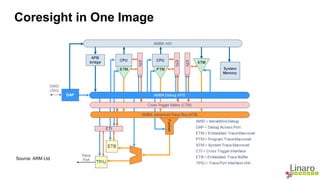
Coresight in One Image 
Source: ARM Ltd.
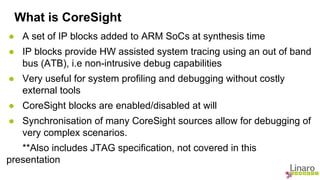
What is CoreSight 
● A set of IP blocks added to ARM SoCs at synthesis time 
● IP blocks provide HW assisted system tracing using an out of band 
bus (ATB), i.e non-intrusive debug capabilities 
● Very useful for system profiling and debugging without costly 
external tools 
● CoreSight blocks are enabled/disabled at will 
● Synchronisation of many CoreSight sources allow for debugging of 
very complex scenarios. 
**Also includes JTAG specification, not covered in this 
presentation
Why Using CoreSight? 
● Enhanced tracing capabilities over common solutions: 
● Decoupling of CPU power state and tracing engine 
● Tuning and configuration of scenarios simply impossible to achieve with a JTAG 
● Synchronisation of traces from different source → multi-dimensional debugging 
● Two different trace format for enhance granularity (STM vs ETM) 
● Some debugging scenarios can’t afford to stop the target for 
debugging when a condition occurs: 
● Assembly chain in production 
● A vehicle in motion 
● Some Systems don’t have a JTAG port or the port is not 
accessible 
● Server with 256 processors 
● A probe in an oil well, somewhere in the field
Enhanced Tracing Capabilities 
● JTAGs require to have a connection with a core, making it difficult 
to trace power management intensive scenarios. 
● Enhance tuning and capabilities: 
● Address range comparators 
● Single address comparator 
● Context ID and Virtual ID tracing 
● Start and Stop address matching 
● Security states ex, secure, non-secure or both 
● External input for global system awareness 
● Three-state sequencer and counters 
● Tunables can be mixed to make very complex cases: 
● Start tracing only if in “secure mode”, between addresses 0xABC and 0xDEX, when 
the ID of the running process is 456.
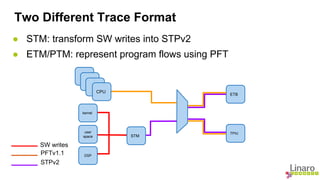
Two Different Trace Format 
● STM: transform SW writes into STPv2 
● ETM/PTM: represent program flows using PFT 
CPU 
kernel 
user 
space 
DSP 
ETB 
TPIU 
STM 
SW writes 
PFTv1.1 
STPv2
Coresight Components 
● Coresight IP blocks are divided in 4 categories: 
● Source, link, sink and “global” (not official term) 
● Source: 
● Generate trace data (PFTv1.x and STPv2) 
● ETM (Embedded Trace Macrocell), PTM (Program Trace Macrocell) 
● STM (System Trace Macrocell) 
● Links: 
● Replicators - duplicate trace data, usually in 2 streams 
● Funnel - aggregate trace data, usually 8 to 1 
● Global: 
● CTI - Cross Trigger Interface, for communication between entities 
** The above list is not exclusive, there are other components **
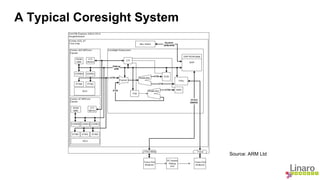
A Typical Coresight System 
Source: ARM Ltd
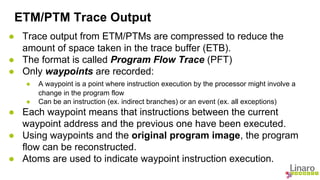
ETM/PTM Trace Output 
● Trace output from ETM/PTMs are compressed to reduce the 
amount of space taken in the trace buffer (ETB). 
● The format is called Program Flow Trace (PFT) 
● Only waypoints are recorded: 
● A waypoint is a point where instruction execution by the processor might involve a 
change in the program flow 
● Can be an instruction (ex. indirect branches) or an event (ex. all exceptions) 
● Each waypoint means that instructions between the current 
waypoint address and the previous one have been executed. 
● Using waypoints and the original program image, the program 
flow can be reconstructed. 
● Atoms are used to indicate waypoint instruction execution.
ETM/PTM Trace Output Decoding 
● Decoding trace output is not to be taken lightly. 
● Program Linaro has experimented with: 
● ptm2human [1]: 
● Not bad for an experimental exercise 
● List received packet, i.e, sync, atoms, timestamps 
● Does not interpret the content of the packet, so no waypoint decoding 
● completely free, thumbs up to “hwangcc23” 
● ARM DS-5: 
● Yields very detailed traces 
● Program execution can be reconstructed perfectly - see [2] for more information 
● Other trace decoding programs: 
● Texas Instrument’s Code Composer Studio 
● Lauderbach Trace32 
● Trace decoding is currently a big problem. 
● Linaro is weighing options on how to proceed in this area.
STM Trace Decoding 
● STM produces a trace stream conformant to the MIPI’s STPv2. 
● For more information see: 
● http://mipi.org/specifications/debug 
● Tools to decode STM traces: 
● ARM’s DS-5 
● ST-Microelectronic’s STM-Probe 
● Liewenthal Electronic’s Fido box
Linaro CoreSight Framework 
● Linaro Started working on CoreSight in March after LCA2014 
● Started from the initial framework submitted by Pratik Patel [3] 
● The framework provides support for: 
● source: ETMv3.3 to ETMv3.5 along with PTMv1.0 and PTMv1.1 
● link: 8 port funnel and non-configurable replicator 
● sink: ETBv1.0, TPIU and TMC (Trace Memory Controller) 
● Support for STM and CTI will be submitted when the base 
framework is accepted upstream. 
● With the framework it is possible to aggregate, configure and 
collect trace data seamlessly on a platform.
Where to get the code 
● Coresight branch on git.linaro.og: 
● https://git.linaro.org/kernel/coresight.git/ 
● Always look at the “master” branch for the latest code 
● The code is rebased on the latest release 
● The Coresight framework and drivers are under drivers/coresight/ 
● Menuconfig options can be found under “Kernel Hacking/Coresight Tracing Support” 
● Earlier submission and initial RFC are also present. 
● Upstream submission if you want to see what we’ve done: 
● V1: http://thread.gmane.org/gmane.linux.kernel/1714785 
● V2: http://thread.gmane.org/gmane.linux.kernel/1734361 
● V3: https://lkml.org/lkml/2014/8/7/439 
● V4: https://lkml.org/lkml/2014/8/20/618
CoreSight Framework Highlights 
● Provides an easy integration via DT for any platforms with generic 
coreSight components 
● Plenty of flexibility for addition of, new non-generic devices 
● A front-end/back-end configuration for common and architecture specific parts are very 
likely to happen. 
● Device specific method to access DT configuration can also be done easily 
● Access via debugfs of all ETM/PTM configuration registers 
● Processor state (hibernation) not coupled with ETM/PTM 
configuration 
● Multiple configuration of source and sink is supported. 
● Provides interface for reporting the status of various components 
and the gathering of meta data.
CoreSight Framework 
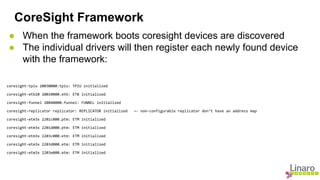
● When the framework boots coresight devices are discovered 
● The individual drivers will then register each newly found device 
with the framework: 
coresight-tpiu 20030000.tpiu: TPIU initialized 
coresight-etb10 20010000.etb: ETB initialized 
coresight-funnel 20040000.funnel: FUNNEL initialized 
coresight-replicator replicator: REPLICATOR initialized ← non-configurable replicator don’t have an address map 
coresight-etm3x 2201c000.ptm: ETM initialized 
coresight-etm3x 2201d000.ptm: ETM initialized 
coresight-etm3x 2203c000.etm: ETM initialized 
coresight-etm3x 2203d000.etm: ETM initialized 
coresight-etm3x 2203e000.etm: ETM initialized
CoreSight Framework 
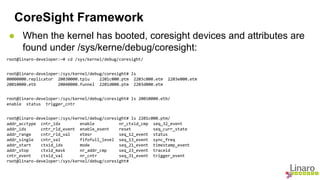
● When the kernel has booted, coresight devices and attributes are 
found under /sys/kerne/debug/coresight: 
root@linaro-developer:~# cd /sys/kernel/debug/coresight/ 
root@linaro-developer:/sys/kernel/debug/coresight# ls 
00000000.replicator 20030000.tpiu 2201c000.ptm 2203c000.etm 2203e000.etm 
20010000.etb 20040000.funnel 2201d000.ptm 2203d000.etm 
root@linaro-developer:/sys/kernel/debug/coresight# ls 20010000.etb/ 
enable status trigger_cntr 
root@linaro-developer:/sys/kernel/debug/coresight# ls 2201c000.ptm/ 
addr_acctype cntr_idx enable nr_ctxid_cmp seq_32_event 
addr_idx cntr_rld_event enable_event reset seq_curr_state 
addr_range cntr_rld_val etmsr seq_12_event status 
addr_single cntr_val fifofull_level seq_13_event sync_freq 
addr_start ctxid_idx mode seq_21_event timestamp_event 
addr_stop ctxid_mask nr_addr_cmp seq_23_event traceid 
cntr_event ctxid_val nr_cntr seq_31_event trigger_event 
root@linaro-developer:/sys/kernel/debug/coresight#
CoreSight Framework 
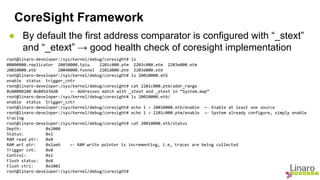
● By default the first address comparator is configured with “_stext” 
and “_etext” → good health check of coresight implementation 
root@linaro-developer:/sys/kernel/debug/coresight# ls 
00000000.replicator 20030000.tpiu 2201c000.ptm 2203c000.etm 2203e000.etm 
20010000.etb 20040000.funnel 2201d000.ptm 2203d000.etm 
root@linaro-developer:/sys/kernel/debug/coresight# ls 20010000.etb 
enable status trigger_cntr 
root@linaro-developer:/sys/kernel/debug/coresight# cat 2201c000.ptm/addr_range 
0x80008280 0x805d34d8 ← Addresses match with _stext and _etext in “System.map” 
root@linaro-developer:/sys/kernel/debug/coresight# ls 20010000.etb/ 
enable status trigger_cntr 
root@linaro-developer:/sys/kernel/debug/coresight# echo 1 > 20010000.etb/enable ← Enable at least one source 
root@linaro-developer:/sys/kernel/debug/coresight# echo 1 > 2201c000.ptm/enable ← System already configure, simply enable 
tracing 
root@linaro-developer:/sys/kernel/debug/coresight# cat 20010000.etb/status 
Depth: 0x2000 
Status: 0x1 
RAM read ptr: 0x0 
RAM wrt ptr: 0x1aeb ← RAM write pointer is incrementing, i.e, traces are being collected 
Trigger cnt: 0x0 
Control: 0x1 
Flush status: 0x0 
Flush ctrl: 0x2001 
root@linaro-developer:/sys/kernel/debug/coresight#
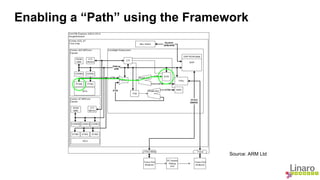
Enabling a “Path” using the Framework 
Source: ARM Ltd
CoreSight Framework 
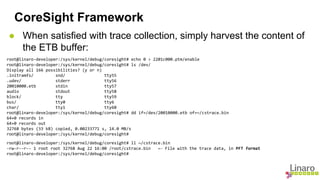
● When satisfied with trace collection, simply harvest the content of 
the ETB buffer: 
root@linaro-developer:/sys/kernel/debug/coresight# echo 0 > 2201c000.ptm/enable 
root@linaro-developer:/sys/kernel/debug/coresight# ls /dev/ 
Display all 166 possibilities? (y or n) 
.initramfs/ snd/ tty55 
.udev/ stderr tty56 
20010000.etb stdin tty57 
audio stdout tty58 
block/ tty tty59 
bus/ tty0 tty6 
char/ tty1 tty60 
root@linaro-developer:/sys/kernel/debug/coresight# dd if=/dev/20010000.etb of=~/cstrace.bin 
64+0 records in 
64+0 records out 
32768 bytes (33 kB) copied, 0.00233771 s, 14.0 MB/s 
root@linaro-developer:/sys/kernel/debug/coresight# 
root@linaro-developer:/sys/kernel/debug/coresight# ll ~/cstrace.bin 
-rw-r--r-- 1 root root 32768 Aug 22 16:00 /root/cstrace.bin ← File with the trace data, in PFT format 
root@linaro-developer:/sys/kernel/debug/coresight#
Upstreaming Stargegy and Status 
● CodeAurora’s submission created a lot of talk on STM and CTI 
implementation 
● Linaro’s goal was to establish a foundation without being impaired 
by STM and CTI debates 
● Concentrating on basic tracing would concentrate efforts and 
discussions on the framework implementation 
● STM and CTI will be coming as soon as the framework gets 
accepted upstream. 
● At this time we have been through 4 submission, each round 
yielding very fruitful comments and ideas
What is next 
● Currently supported platforms: 
● ARM Vexpress-TC2 
● TI beagle/beagleXM 
● Huawei’s D01 board (upstreaming currently under way) 
● New platforms we are currently working on: 
● Qualcomm APQ8074 
● TI UEVM5432 (OMAP5) 
● Support for STM/STM500 
● Need to find a way to manage channel allocation between user and kernel space 
● How to model external input in a flexible and generic way? 
● Userspace tool and libraries… 
● CTI (Cross Trigger Interface) 
● John Hunter (formely?) at TI published a good driver on github 
● codeAurora also has one, need to look at both
What is Next (Cont’d) 
● Support for ARMv8 
● The framework has been developed on ARMv7, need to see how it will work on V8 
● Devices, like STM500 ant ETMv4, are tailored for V8 
● STM500 may turn out to be like STM 
● ETMv4 is a very different implementation than ETMv3.x 
● How to support the tracing of application code? 
● Integration with other kernel subsystem, i.e Perf and Ftrace 
● Follow what other architectures are doing and not re-invent the 
wheel: 
● Intel’s PT architecture [6][7] 
● MIPS ?
Challenges (Preview of the Next Session) 
● How data is represented in the trace stream depends on how the 
trace source has been configure (cycle accurate, timestamp) 
● Unlike ftrace, trace streams can’t simply be exported off platform and decoded 
● There has to be knowledge about the configuration and the image in memory 
● Commonly called the “metadata” problem 
● Identification of trace stream decoder that is open and free 
● ptm2human is a very good start. 
● etm-objdump[4]]5] also did a very promising decoder 
● Both need to be improved (and maintained) 
● How do we control traces from the kernel? 
● ftrace has the capability to start and stop traces using a kernel API 
● Do we need the same mechanism for coresight? 
● STM channel allocation and management
Question and Comment 
[1]. https://github.com/hwangcc23/ptm2human 
[2]. https://wiki.linaro.org/WorklingGroups/Kernel/Coresight/traceDecodingWithDS5 
[3]. http://lists.infradead.org/pipermail/linux-arm-kernel/2012-December/138646.html 
[4]. http://lists.linaro.org/pipermail/linaro-dev/2012-November/014439.html 
[5]. http://lists.linaro.org/pipermail/linaro-dev/2012-November/014476.html 
[6]. http://thread.gmane.org/gmane.linux.kernel/1771197 
[7]. https://software.intel.com/en-us/blogs/2013/09/18/processor-tracing
More about Linaro Connect: connect.linaro.org 
Linaro members: www.linaro.org/members 
More about Linaro: www.linaro.org/about/

Lcu14 101- coresight overview

  • 1.
    LCU14-101: Coresight Overview Mathieu Poirier, LCU14 LCU14 BURLINGAME
  • 2.
    About this Presentation ● What is CoreSight ● Why Use CoreSight? ● Coresight Components and HW tracing ● Presentation of the Coresight Framework ● Minimal steps to enable tracing ● Upstreaming Strategy and Current Status ● What is Coming Next ● Question and Comments
  • 3.
    Coresight in OneImage Source: ARM Ltd.
  • 4.
    What is CoreSight ● A set of IP blocks added to ARM SoCs at synthesis time ● IP blocks provide HW assisted system tracing using an out of band bus (ATB), i.e non-intrusive debug capabilities ● Very useful for system profiling and debugging without costly external tools ● CoreSight blocks are enabled/disabled at will ● Synchronisation of many CoreSight sources allow for debugging of very complex scenarios. **Also includes JTAG specification, not covered in this presentation
  • 5.
    Why Using CoreSight? ● Enhanced tracing capabilities over common solutions: ● Decoupling of CPU power state and tracing engine ● Tuning and configuration of scenarios simply impossible to achieve with a JTAG ● Synchronisation of traces from different source → multi-dimensional debugging ● Two different trace format for enhance granularity (STM vs ETM) ● Some debugging scenarios can’t afford to stop the target for debugging when a condition occurs: ● Assembly chain in production ● A vehicle in motion ● Some Systems don’t have a JTAG port or the port is not accessible ● Server with 256 processors ● A probe in an oil well, somewhere in the field
  • 6.
    Enhanced Tracing Capabilities ● JTAGs require to have a connection with a core, making it difficult to trace power management intensive scenarios. ● Enhance tuning and capabilities: ● Address range comparators ● Single address comparator ● Context ID and Virtual ID tracing ● Start and Stop address matching ● Security states ex, secure, non-secure or both ● External input for global system awareness ● Three-state sequencer and counters ● Tunables can be mixed to make very complex cases: ● Start tracing only if in “secure mode”, between addresses 0xABC and 0xDEX, when the ID of the running process is 456.
  • 7.
    Two Different TraceFormat ● STM: transform SW writes into STPv2 ● ETM/PTM: represent program flows using PFT CPU kernel user space DSP ETB TPIU STM SW writes PFTv1.1 STPv2
  • 8.
    Coresight Components ●Coresight IP blocks are divided in 4 categories: ● Source, link, sink and “global” (not official term) ● Source: ● Generate trace data (PFTv1.x and STPv2) ● ETM (Embedded Trace Macrocell), PTM (Program Trace Macrocell) ● STM (System Trace Macrocell) ● Links: ● Replicators - duplicate trace data, usually in 2 streams ● Funnel - aggregate trace data, usually 8 to 1 ● Global: ● CTI - Cross Trigger Interface, for communication between entities ** The above list is not exclusive, there are other components **
  • 9.
    A Typical CoresightSystem Source: ARM Ltd
  • 10.
    ETM/PTM Trace Output ● Trace output from ETM/PTMs are compressed to reduce the amount of space taken in the trace buffer (ETB). ● The format is called Program Flow Trace (PFT) ● Only waypoints are recorded: ● A waypoint is a point where instruction execution by the processor might involve a change in the program flow ● Can be an instruction (ex. indirect branches) or an event (ex. all exceptions) ● Each waypoint means that instructions between the current waypoint address and the previous one have been executed. ● Using waypoints and the original program image, the program flow can be reconstructed. ● Atoms are used to indicate waypoint instruction execution.
  • 11.
    ETM/PTM Trace OutputDecoding ● Decoding trace output is not to be taken lightly. ● Program Linaro has experimented with: ● ptm2human [1]: ● Not bad for an experimental exercise ● List received packet, i.e, sync, atoms, timestamps ● Does not interpret the content of the packet, so no waypoint decoding ● completely free, thumbs up to “hwangcc23” ● ARM DS-5: ● Yields very detailed traces ● Program execution can be reconstructed perfectly - see [2] for more information ● Other trace decoding programs: ● Texas Instrument’s Code Composer Studio ● Lauderbach Trace32 ● Trace decoding is currently a big problem. ● Linaro is weighing options on how to proceed in this area.
  • 12.
    STM Trace Decoding ● STM produces a trace stream conformant to the MIPI’s STPv2. ● For more information see: ● http://mipi.org/specifications/debug ● Tools to decode STM traces: ● ARM’s DS-5 ● ST-Microelectronic’s STM-Probe ● Liewenthal Electronic’s Fido box
  • 13.
    Linaro CoreSight Framework ● Linaro Started working on CoreSight in March after LCA2014 ● Started from the initial framework submitted by Pratik Patel [3] ● The framework provides support for: ● source: ETMv3.3 to ETMv3.5 along with PTMv1.0 and PTMv1.1 ● link: 8 port funnel and non-configurable replicator ● sink: ETBv1.0, TPIU and TMC (Trace Memory Controller) ● Support for STM and CTI will be submitted when the base framework is accepted upstream. ● With the framework it is possible to aggregate, configure and collect trace data seamlessly on a platform.
  • 14.
    Where to getthe code ● Coresight branch on git.linaro.og: ● https://git.linaro.org/kernel/coresight.git/ ● Always look at the “master” branch for the latest code ● The code is rebased on the latest release ● The Coresight framework and drivers are under drivers/coresight/ ● Menuconfig options can be found under “Kernel Hacking/Coresight Tracing Support” ● Earlier submission and initial RFC are also present. ● Upstream submission if you want to see what we’ve done: ● V1: http://thread.gmane.org/gmane.linux.kernel/1714785 ● V2: http://thread.gmane.org/gmane.linux.kernel/1734361 ● V3: https://lkml.org/lkml/2014/8/7/439 ● V4: https://lkml.org/lkml/2014/8/20/618
  • 15.
    CoreSight Framework Highlights ● Provides an easy integration via DT for any platforms with generic coreSight components ● Plenty of flexibility for addition of, new non-generic devices ● A front-end/back-end configuration for common and architecture specific parts are very likely to happen. ● Device specific method to access DT configuration can also be done easily ● Access via debugfs of all ETM/PTM configuration registers ● Processor state (hibernation) not coupled with ETM/PTM configuration ● Multiple configuration of source and sink is supported. ● Provides interface for reporting the status of various components and the gathering of meta data.
  • 16.
    CoreSight Framework ●When the framework boots coresight devices are discovered ● The individual drivers will then register each newly found device with the framework: coresight-tpiu 20030000.tpiu: TPIU initialized coresight-etb10 20010000.etb: ETB initialized coresight-funnel 20040000.funnel: FUNNEL initialized coresight-replicator replicator: REPLICATOR initialized ← non-configurable replicator don’t have an address map coresight-etm3x 2201c000.ptm: ETM initialized coresight-etm3x 2201d000.ptm: ETM initialized coresight-etm3x 2203c000.etm: ETM initialized coresight-etm3x 2203d000.etm: ETM initialized coresight-etm3x 2203e000.etm: ETM initialized
  • 17.
    CoreSight Framework ●When the kernel has booted, coresight devices and attributes are found under /sys/kerne/debug/coresight: root@linaro-developer:~# cd /sys/kernel/debug/coresight/ root@linaro-developer:/sys/kernel/debug/coresight# ls 00000000.replicator 20030000.tpiu 2201c000.ptm 2203c000.etm 2203e000.etm 20010000.etb 20040000.funnel 2201d000.ptm 2203d000.etm root@linaro-developer:/sys/kernel/debug/coresight# ls 20010000.etb/ enable status trigger_cntr root@linaro-developer:/sys/kernel/debug/coresight# ls 2201c000.ptm/ addr_acctype cntr_idx enable nr_ctxid_cmp seq_32_event addr_idx cntr_rld_event enable_event reset seq_curr_state addr_range cntr_rld_val etmsr seq_12_event status addr_single cntr_val fifofull_level seq_13_event sync_freq addr_start ctxid_idx mode seq_21_event timestamp_event addr_stop ctxid_mask nr_addr_cmp seq_23_event traceid cntr_event ctxid_val nr_cntr seq_31_event trigger_event root@linaro-developer:/sys/kernel/debug/coresight#
  • 18.
    CoreSight Framework ●By default the first address comparator is configured with “_stext” and “_etext” → good health check of coresight implementation root@linaro-developer:/sys/kernel/debug/coresight# ls 00000000.replicator 20030000.tpiu 2201c000.ptm 2203c000.etm 2203e000.etm 20010000.etb 20040000.funnel 2201d000.ptm 2203d000.etm root@linaro-developer:/sys/kernel/debug/coresight# ls 20010000.etb enable status trigger_cntr root@linaro-developer:/sys/kernel/debug/coresight# cat 2201c000.ptm/addr_range 0x80008280 0x805d34d8 ← Addresses match with _stext and _etext in “System.map” root@linaro-developer:/sys/kernel/debug/coresight# ls 20010000.etb/ enable status trigger_cntr root@linaro-developer:/sys/kernel/debug/coresight# echo 1 > 20010000.etb/enable ← Enable at least one source root@linaro-developer:/sys/kernel/debug/coresight# echo 1 > 2201c000.ptm/enable ← System already configure, simply enable tracing root@linaro-developer:/sys/kernel/debug/coresight# cat 20010000.etb/status Depth: 0x2000 Status: 0x1 RAM read ptr: 0x0 RAM wrt ptr: 0x1aeb ← RAM write pointer is incrementing, i.e, traces are being collected Trigger cnt: 0x0 Control: 0x1 Flush status: 0x0 Flush ctrl: 0x2001 root@linaro-developer:/sys/kernel/debug/coresight#
  • 19.
    Enabling a “Path”using the Framework Source: ARM Ltd
  • 20.
    CoreSight Framework ●When satisfied with trace collection, simply harvest the content of the ETB buffer: root@linaro-developer:/sys/kernel/debug/coresight# echo 0 > 2201c000.ptm/enable root@linaro-developer:/sys/kernel/debug/coresight# ls /dev/ Display all 166 possibilities? (y or n) .initramfs/ snd/ tty55 .udev/ stderr tty56 20010000.etb stdin tty57 audio stdout tty58 block/ tty tty59 bus/ tty0 tty6 char/ tty1 tty60 root@linaro-developer:/sys/kernel/debug/coresight# dd if=/dev/20010000.etb of=~/cstrace.bin 64+0 records in 64+0 records out 32768 bytes (33 kB) copied, 0.00233771 s, 14.0 MB/s root@linaro-developer:/sys/kernel/debug/coresight# root@linaro-developer:/sys/kernel/debug/coresight# ll ~/cstrace.bin -rw-r--r-- 1 root root 32768 Aug 22 16:00 /root/cstrace.bin ← File with the trace data, in PFT format root@linaro-developer:/sys/kernel/debug/coresight#
  • 21.
    Upstreaming Stargegy andStatus ● CodeAurora’s submission created a lot of talk on STM and CTI implementation ● Linaro’s goal was to establish a foundation without being impaired by STM and CTI debates ● Concentrating on basic tracing would concentrate efforts and discussions on the framework implementation ● STM and CTI will be coming as soon as the framework gets accepted upstream. ● At this time we have been through 4 submission, each round yielding very fruitful comments and ideas
  • 22.
    What is next ● Currently supported platforms: ● ARM Vexpress-TC2 ● TI beagle/beagleXM ● Huawei’s D01 board (upstreaming currently under way) ● New platforms we are currently working on: ● Qualcomm APQ8074 ● TI UEVM5432 (OMAP5) ● Support for STM/STM500 ● Need to find a way to manage channel allocation between user and kernel space ● How to model external input in a flexible and generic way? ● Userspace tool and libraries… ● CTI (Cross Trigger Interface) ● John Hunter (formely?) at TI published a good driver on github ● codeAurora also has one, need to look at both
  • 23.
    What is Next(Cont’d) ● Support for ARMv8 ● The framework has been developed on ARMv7, need to see how it will work on V8 ● Devices, like STM500 ant ETMv4, are tailored for V8 ● STM500 may turn out to be like STM ● ETMv4 is a very different implementation than ETMv3.x ● How to support the tracing of application code? ● Integration with other kernel subsystem, i.e Perf and Ftrace ● Follow what other architectures are doing and not re-invent the wheel: ● Intel’s PT architecture [6][7] ● MIPS ?
  • 24.
    Challenges (Preview ofthe Next Session) ● How data is represented in the trace stream depends on how the trace source has been configure (cycle accurate, timestamp) ● Unlike ftrace, trace streams can’t simply be exported off platform and decoded ● There has to be knowledge about the configuration and the image in memory ● Commonly called the “metadata” problem ● Identification of trace stream decoder that is open and free ● ptm2human is a very good start. ● etm-objdump[4]]5] also did a very promising decoder ● Both need to be improved (and maintained) ● How do we control traces from the kernel? ● ftrace has the capability to start and stop traces using a kernel API ● Do we need the same mechanism for coresight? ● STM channel allocation and management
  • 25.
    Question and Comment [1]. https://github.com/hwangcc23/ptm2human [2]. https://wiki.linaro.org/WorklingGroups/Kernel/Coresight/traceDecodingWithDS5 [3]. http://lists.infradead.org/pipermail/linux-arm-kernel/2012-December/138646.html [4]. http://lists.linaro.org/pipermail/linaro-dev/2012-November/014439.html [5]. http://lists.linaro.org/pipermail/linaro-dev/2012-November/014476.html [6]. http://thread.gmane.org/gmane.linux.kernel/1771197 [7]. https://software.intel.com/en-us/blogs/2013/09/18/processor-tracing
  • 26.
    More about LinaroConnect: connect.linaro.org Linaro members: www.linaro.org/members More about Linaro: www.linaro.org/about/