
WORKPLACE
COMMUNICATION
Applied Linguistics
By Shara G. Pineda
Definition of Terms:
Workplace communication :
is the process of exchanging information,
both verbal and non-verbal, within an
organization. An organization may consist
of employees from different parts of the
society. In order to unite the activities of all
employees, communication is crucial.

Importance of Workplace Communication
 Communication problems can make the
work environment uncomfortable and
unproductive for everyone, and not just
the individuals directly involved in the
issue.
 Good communication is a key part of
success in the workplace.
Importance of Workplace Communication
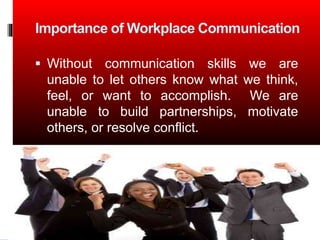
 Without communication skills we are
unable to let others know what we think,
feel, or want to accomplish. We are
unable to build partnerships, motivate
others, or resolve conflict.
MOST EFFECTIVE COMMUNICATION IN
THE WORKPLACE
 Listening
 Empathy
 Patience
 Clarity
 Positivity
 Self-improvement
Barriers of Workplace Communication
 Physical Barriers
 Walls, doors and dividers do their jobs--
they divide.
 Language Barriers
 In many cases people whose first
language is not English are part of the
working environment.
Barriers of Workplace Communication
 Cultural Barriers
 People who speak English perfectly well
may have different attitudes and
approaches that come from their places
of origin or the way they were raised.
 Emotional Barriers
 Some people are just shy. Others are
conflict avoidant.
Barriers of Workplace Communication
 Personality
 People come with all kinds of angles,
quirks, attitudes, approaches and world
views.
Applied Linguistics: Workplace Communication

Applied Linguistics: Workplace Communication

  • 1.
  • 2.
    Definition of Terms: Workplacecommunication : is the process of exchanging information, both verbal and non-verbal, within an organization. An organization may consist of employees from different parts of the society. In order to unite the activities of all employees, communication is crucial. 
  • 3.
    Importance of WorkplaceCommunication  Communication problems can make the work environment uncomfortable and unproductive for everyone, and not just the individuals directly involved in the issue.  Good communication is a key part of success in the workplace.
  • 4.
    Importance of WorkplaceCommunication  Without communication skills we are unable to let others know what we think, feel, or want to accomplish. We are unable to build partnerships, motivate others, or resolve conflict.
  • 5.
    MOST EFFECTIVE COMMUNICATIONIN THE WORKPLACE  Listening  Empathy  Patience  Clarity  Positivity  Self-improvement
  • 6.
    Barriers of WorkplaceCommunication  Physical Barriers  Walls, doors and dividers do their jobs-- they divide.  Language Barriers  In many cases people whose first language is not English are part of the working environment.
  • 7.
    Barriers of WorkplaceCommunication  Cultural Barriers  People who speak English perfectly well may have different attitudes and approaches that come from their places of origin or the way they were raised.  Emotional Barriers  Some people are just shy. Others are conflict avoidant.
  • 8.
    Barriers of WorkplaceCommunication  Personality  People come with all kinds of angles, quirks, attitudes, approaches and world views.