An Introduction to Clinical Trials
DANIEL KAUFER, MD
Associate Professor, Neurology and Psychiatry
Division Chief, Cognitive & Behavioral Neurology
Director, Memory Disorders Program
University of North Carolina at Chapel Hill
Overview
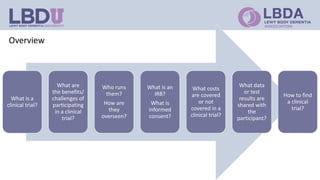
What is a
clinical trial?
What are
the benefits/
challenges of
participating
in a clinical
trial?
Who runs
them?
How are
they
overseen?
What is an
IRB?
What is
informed
consent?
What costs
are covered
or not
covered in a
clinical trial?
What data
or test
results are
shared with
the
participant?
How to find
a clinical
trial?
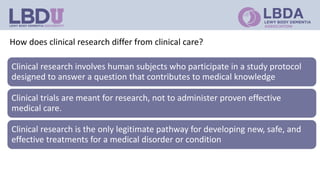
How does clinical research differ from clinical care?
Clinical research involves human subjects who participate in a study protocol
designed to answer a question that contributes to medical knowledge
Clinical trials are meant for research, not to administer proven effective
medical care.
Clinical research is the only legitimate pathway for developing new, safe, and
effective treatments for a medical disorder or condition
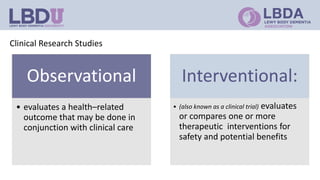
Clinical Research Studies
Observational
• evaluates a health–related
outcome that may be done in
conjunction with clinical care
Interventional:
• (also known as a clinical trial) evaluates
or compares one or more
therapeutic interventions for
safety and potential benefits
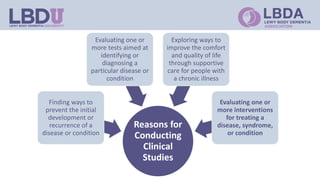
Reasons for
Conducting
Clinical
Studies
Finding ways to
prevent the initial
development or
recurrence of a
disease or condition
Evaluating one or
more tests aimed at
identifying or
diagnosing a
particular disease or
condition
Exploring ways to
improve the comfort
and quality of life
through supportive
care for people with
a chronic illness
Evaluating one or
more interventions
for treating a
disease, syndrome,
or condition
Drug Development Process for Human Disease
Potential treatment identified based on laboratory
studies (in vitro)
Proof of concept studies in laboratory animal
model (in vivo)
Human Testing - Clinical
Preclinical Clinical
(Average time/$: 12 years / $1.2 billion)
Drug Development Process for Human Disease: Clinical Phases
Phase 3:
(100s – 1000s), a.k.a. “pivotal” trial;
Typically involves testing 1 or more doses of the
experimental therapy in a randomized, placebo-
controlled, double-blind study to determine if the
therapy is safe and effective; data from these studies
are reviewed by the FDA for regulatory approval
Subjects are assigned by chance (randomized) to
receive either active treatment or placebo
(placebo-controlled), which is not known by
either the subject or investigator (double-blind)
Phase 2:
(100-1000 subjects)
Assess the safety and potential effectiveness of an experimental
therapy for a specific medical condition i.e. what dose or delivery
method provides the highest benefit and the least amount of risk?
Phase 1:
(< 100 subjects)
Is the therapy safe to use in people?
(usually tested in normal human subjects)
Drug Development Process for Human Disease: Registration
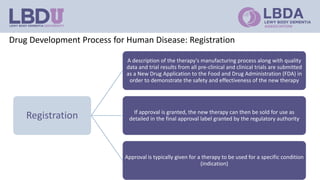
Registration
A description of the therapy's manufacturing process along with quality
data and trial results from all pre-clinical and clinical trials are submitted
as a New Drug Application to the Food and Drug Administration (FDA) in
order to demonstrate the safety and effectiveness of the new therapy
If approval is granted, the new therapy can then be sold for use as
detailed in the final approval label granted by the regulatory authority
Approval is typically given for a therapy to be used for a specific condition
(indication)
Therapeutic Interventions: Regulatory Tiers
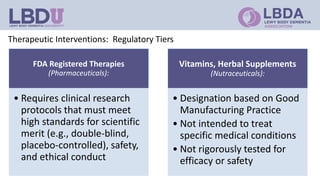
FDA Registered Therapies
(Pharmaceuticals):
• Requires clinical research
protocols that must meet
high standards for scientific
merit (e.g., double-blind,
placebo-controlled), safety,
and ethical conduct
Vitamins, Herbal Supplements
(Nutraceuticals):
• Designation based on Good
Manufacturing Practice
• Not intended to treat
specific medical conditions
• Not rigorously tested for
efficacy or safety
Therapeutic Interventions for Neurodegenerative Disorders
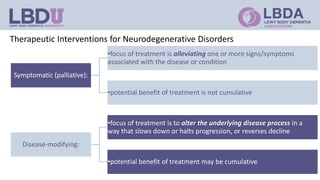
Symptomatic (palliative):
•focus of treatment is alleviating one or more signs/symptoms
associated with the disease or condition
•potential benefit of treatment is not cumulative
Disease-modifying:
•focus of treatment is to alter the underlying disease process in a
way that slows down or halts progression, or reverses decline
•potential benefit of treatment may be cumulative
Who Conducts Clinical Studies?
Every clinical study is led by a
principal investigator, typically a
medical doctor, and includes a
research team that may include
doctors, nurses, social workers, and
other health care professionals
Clinical studies can be sponsored by
pharmaceutical companies, academic
medical centers, Federal agencies
such as the National Institutes of
Health and the U.S. Department of
Veterans Affairs
Where Are Clinical Studies Conducted?
Academic research centers,
which typically conduct a
variety of different research
studies, in addition to
performing clinical trials and
providing clinical care
Community-based clinical
trial centers that primarily
focus on performing clinical
trials with little or no
provision for clinical care
Private practices that focus
primarily on clinical care but
also conduct clinical trials.
Institutional Review Board (IRB)
An IRB is made up of doctors, researchers, and members of the
community who review the study protocol.
• Ensure that research risks are minimized and are reasonable in relation to any
potential benefits
• Review, approve, and monitor all clinical research studies
• Review the informed consent document to make sure it is understandable and
clearly describes the risks and benefits of the study
INFORMED CONSENT
Provides potential and enrolled
participants information about a
clinical study
Intended to help a person make an
informed decision about the risks of,
potential benefits of, and alternatives
to the study
A person must sign an informed
consent document before
participating in a research study
Signing the document and providing
consent is not a contract
Participants may withdraw from a
study at any time
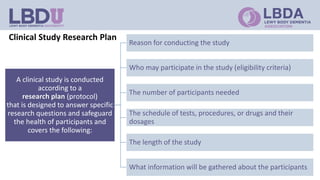
Clinical Study Research Plan
A clinical study is conducted
according to a
research plan (protocol)
that is designed to answer specific
research questions and safeguard
the health of participants and
covers the following:
Reason for conducting the study
Who may participate in the study (eligibility criteria)
The number of participants needed
The schedule of tests, procedures, or drugs and their
dosages
The length of the study
What information will be gathered about the participants
WHAT DO YOU NEED TO KNOW?
What is being
studied?
What is the
therapeutic
rationale for this
treatment?
What do we know
about possible
treatment effects?
BASICS
WHAT DO YOU NEED TO KNOW?
What is the target
population?
Inclusion criteria: age,
diagnosis, severity, etc.
Exclusion criteria: age,
severity, prohibited
medications, other
medical conditions, etc.
ELIGIBILITY
Many studies have fairly strict criteria
WHAT DO YOU NEED TO KNOW?
What are the possible
interventions (e.g.,
treatment vs. placebo)
that I might receive
during the trial?
How will it be
determined which
intervention I receive
(for example, by
chance)?
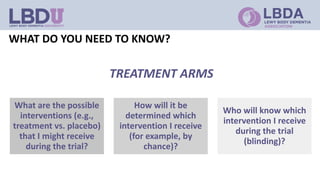
Who will know which
intervention I receive
during the trial
(blinding)?
TREATMENT ARMS
WHAT DO YOU NEED TO KNOW?
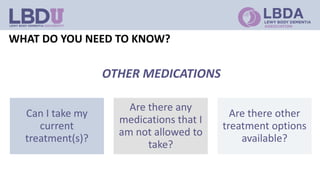
Can I take my
current
treatment(s)?
Are there any
medications that I
am not allowed to
take?
Are there other
treatment options
available?
OTHER MEDICATIONS
WHAT DO YOU NEED TO KNOW?
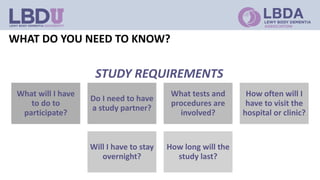
What will I have
to do to
participate?
Do I need to have
a study partner?
What tests and
procedures are
involved?
How often will I
have to visit the
hospital or clinic?
Will I have to stay
overnight?
How long will the
study last?
STUDY REQUIREMENTS
WHAT DO YOU NEED TO KNOW?
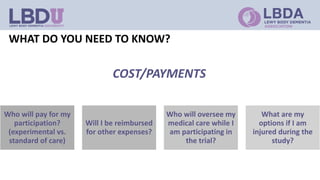
Who will pay for my
participation?
(experimental vs.
standard of care)
Will I be reimbursed
for other expenses?
Who will oversee my
medical care while I
am participating in
the trial?
What are my
options if I am
injured during the
study?
COST/PAYMENTS
WHAT DO YOU NEED TO KNOW?
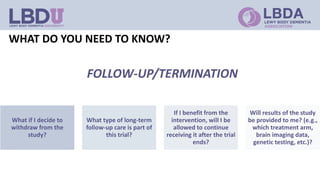
What if I decide to
withdraw from the
study?
What type of long-term
follow-up care is part of
this trial?
If I benefit from the
intervention, will I be
allowed to continue
receiving it after the trial
ends?
Will results of the study
be provided to me? (e.g.,
which treatment arm,
brain imaging data,
genetic testing, etc.)?
FOLLOW-UP/TERMINATION
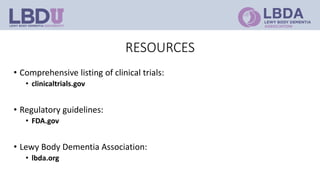
RESOURCES
• Comprehensive listing of clinical trials:
• clinicaltrials.gov
• Regulatory guidelines:
• FDA.gov
• Lewy Body Dementia Association:
• lbda.org

LBDA: Ask the Expert - Daniel Kaufer Live Webinar June 2016

  • 1.
    An Introduction toClinical Trials DANIEL KAUFER, MD Associate Professor, Neurology and Psychiatry Division Chief, Cognitive & Behavioral Neurology Director, Memory Disorders Program University of North Carolina at Chapel Hill
  • 2.
    Overview What is a clinicaltrial? What are the benefits/ challenges of participating in a clinical trial? Who runs them? How are they overseen? What is an IRB? What is informed consent? What costs are covered or not covered in a clinical trial? What data or test results are shared with the participant? How to find a clinical trial?
  • 3.
    How does clinicalresearch differ from clinical care? Clinical research involves human subjects who participate in a study protocol designed to answer a question that contributes to medical knowledge Clinical trials are meant for research, not to administer proven effective medical care. Clinical research is the only legitimate pathway for developing new, safe, and effective treatments for a medical disorder or condition
  • 4.
    Clinical Research Studies Observational •evaluates a health–related outcome that may be done in conjunction with clinical care Interventional: • (also known as a clinical trial) evaluates or compares one or more therapeutic interventions for safety and potential benefits
  • 5.
    Reasons for Conducting Clinical Studies Finding waysto prevent the initial development or recurrence of a disease or condition Evaluating one or more tests aimed at identifying or diagnosing a particular disease or condition Exploring ways to improve the comfort and quality of life through supportive care for people with a chronic illness Evaluating one or more interventions for treating a disease, syndrome, or condition
  • 6.
    Drug Development Processfor Human Disease Potential treatment identified based on laboratory studies (in vitro) Proof of concept studies in laboratory animal model (in vivo) Human Testing - Clinical Preclinical Clinical (Average time/$: 12 years / $1.2 billion)
  • 7.
    Drug Development Processfor Human Disease: Clinical Phases Phase 3: (100s – 1000s), a.k.a. “pivotal” trial; Typically involves testing 1 or more doses of the experimental therapy in a randomized, placebo- controlled, double-blind study to determine if the therapy is safe and effective; data from these studies are reviewed by the FDA for regulatory approval Subjects are assigned by chance (randomized) to receive either active treatment or placebo (placebo-controlled), which is not known by either the subject or investigator (double-blind) Phase 2: (100-1000 subjects) Assess the safety and potential effectiveness of an experimental therapy for a specific medical condition i.e. what dose or delivery method provides the highest benefit and the least amount of risk? Phase 1: (< 100 subjects) Is the therapy safe to use in people? (usually tested in normal human subjects)
  • 8.
    Drug Development Processfor Human Disease: Registration Registration A description of the therapy's manufacturing process along with quality data and trial results from all pre-clinical and clinical trials are submitted as a New Drug Application to the Food and Drug Administration (FDA) in order to demonstrate the safety and effectiveness of the new therapy If approval is granted, the new therapy can then be sold for use as detailed in the final approval label granted by the regulatory authority Approval is typically given for a therapy to be used for a specific condition (indication)
  • 9.
    Therapeutic Interventions: RegulatoryTiers FDA Registered Therapies (Pharmaceuticals): • Requires clinical research protocols that must meet high standards for scientific merit (e.g., double-blind, placebo-controlled), safety, and ethical conduct Vitamins, Herbal Supplements (Nutraceuticals): • Designation based on Good Manufacturing Practice • Not intended to treat specific medical conditions • Not rigorously tested for efficacy or safety
  • 10.
    Therapeutic Interventions forNeurodegenerative Disorders Symptomatic (palliative): •focus of treatment is alleviating one or more signs/symptoms associated with the disease or condition •potential benefit of treatment is not cumulative Disease-modifying: •focus of treatment is to alter the underlying disease process in a way that slows down or halts progression, or reverses decline •potential benefit of treatment may be cumulative
  • 11.
    Who Conducts ClinicalStudies? Every clinical study is led by a principal investigator, typically a medical doctor, and includes a research team that may include doctors, nurses, social workers, and other health care professionals Clinical studies can be sponsored by pharmaceutical companies, academic medical centers, Federal agencies such as the National Institutes of Health and the U.S. Department of Veterans Affairs
  • 12.
    Where Are ClinicalStudies Conducted? Academic research centers, which typically conduct a variety of different research studies, in addition to performing clinical trials and providing clinical care Community-based clinical trial centers that primarily focus on performing clinical trials with little or no provision for clinical care Private practices that focus primarily on clinical care but also conduct clinical trials.
  • 13.
    Institutional Review Board(IRB) An IRB is made up of doctors, researchers, and members of the community who review the study protocol. • Ensure that research risks are minimized and are reasonable in relation to any potential benefits • Review, approve, and monitor all clinical research studies • Review the informed consent document to make sure it is understandable and clearly describes the risks and benefits of the study
  • 14.
    INFORMED CONSENT Provides potentialand enrolled participants information about a clinical study Intended to help a person make an informed decision about the risks of, potential benefits of, and alternatives to the study A person must sign an informed consent document before participating in a research study Signing the document and providing consent is not a contract Participants may withdraw from a study at any time
  • 15.
    Clinical Study ResearchPlan A clinical study is conducted according to a research plan (protocol) that is designed to answer specific research questions and safeguard the health of participants and covers the following: Reason for conducting the study Who may participate in the study (eligibility criteria) The number of participants needed The schedule of tests, procedures, or drugs and their dosages The length of the study What information will be gathered about the participants
  • 16.
    WHAT DO YOUNEED TO KNOW? What is being studied? What is the therapeutic rationale for this treatment? What do we know about possible treatment effects? BASICS
  • 17.
    WHAT DO YOUNEED TO KNOW? What is the target population? Inclusion criteria: age, diagnosis, severity, etc. Exclusion criteria: age, severity, prohibited medications, other medical conditions, etc. ELIGIBILITY Many studies have fairly strict criteria
  • 18.
    WHAT DO YOUNEED TO KNOW? What are the possible interventions (e.g., treatment vs. placebo) that I might receive during the trial? How will it be determined which intervention I receive (for example, by chance)? Who will know which intervention I receive during the trial (blinding)? TREATMENT ARMS
  • 19.
    WHAT DO YOUNEED TO KNOW? Can I take my current treatment(s)? Are there any medications that I am not allowed to take? Are there other treatment options available? OTHER MEDICATIONS
  • 20.
    WHAT DO YOUNEED TO KNOW? What will I have to do to participate? Do I need to have a study partner? What tests and procedures are involved? How often will I have to visit the hospital or clinic? Will I have to stay overnight? How long will the study last? STUDY REQUIREMENTS
  • 21.
    WHAT DO YOUNEED TO KNOW? Who will pay for my participation? (experimental vs. standard of care) Will I be reimbursed for other expenses? Who will oversee my medical care while I am participating in the trial? What are my options if I am injured during the study? COST/PAYMENTS
  • 22.
    WHAT DO YOUNEED TO KNOW? What if I decide to withdraw from the study? What type of long-term follow-up care is part of this trial? If I benefit from the intervention, will I be allowed to continue receiving it after the trial ends? Will results of the study be provided to me? (e.g., which treatment arm, brain imaging data, genetic testing, etc.)? FOLLOW-UP/TERMINATION
  • 23.
    RESOURCES • Comprehensive listingof clinical trials: • clinicaltrials.gov • Regulatory guidelines: • FDA.gov • Lewy Body Dementia Association: • lbda.org