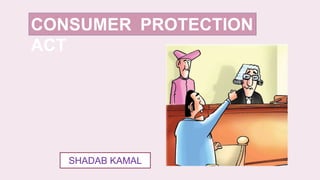

CONSUMER PROTECTION
ACT
SHADAB KAMAL
INTRODUCTION
 Consumer Protection Act is an Act of the Parliament
of India enacted in 24th December, 1986 .
 protects interests of consumers in India.
 earlier amended three times in the years 1991, 1993 &
2002 to make the act more purposeful in order to widen
the scope and to strengthen the functioning of Consumer
Fora further amendment is under process.
Consumer Protection Council
 Consumer Protection Councils are established at the
national, state and district level to increase consumer
awareness.
i. Central Consumer Protection Council
ii. State Consumer Protection Council
iii. Consumer Disputes Redressal Agencies or
Consumer Court
Central Consumer Protection
Council
 It is established by the Central Government which consists
of the following members:
i. The Minister of Consumer Affairs, – Chairman
ii. Such number of other official or non-official members
representing such interests as may be prescribed.
State Consumer Protection
Council
 It is established by the State Government which consists of the
following members:
i. The Minister in charge of consumer affairs in the State
Government – Chairman.
ii. Such number of other official or non-official members
representing such interests as may be prescribed by the State
Government.
iii. Such number of other official or non-official members, not
exceeding ten, as may be nominated by the Central
Government.
 The State Council is required to meet as and when necessary
Consumer Disputes Redressal Agencies or
Consumer Court
District Consumer Disputes Redressal Forum (DCDRF):
 Also known as the "District Forum" established by the
State Government in each district of the State. Currently
there are 644 DCDRFs.
 The State Government may establish more than one
District Forum in a district.
 It is a district level court that deals with cases valuing up to
Rs. 2 million.
State Consumer Disputes Redressal Commission
(SCDRC):
 Also known as the "State Commission" established by
the State Government in the State. Currently there are
35 SCDRCs.
 It is a state level court that takes up cases valuing less
than Rs. 10 million.
National Consumer Disputes Redressal Commission
(NCDRC):
 Established by the Central Government. It is a national
level court that works for the whole country and deals
with amount more than Rs. 10 million
Objectives of Central and state
Council
 The objectives of the Central Council is to promote and
protect the rights of the consumers such as:-
1. protected against the marketing of goods and services
which are hazardous to life and property.
2. informed about the quality, quantity, potency, purity,
standard and price of goods or services, as the case may
be so as to protect the consumer against unfair trade
practices.
3. assured, wherever possible, access to a variety of goods
and services at competitive prices.
4. heard and to be assured that consumer's interests will receive
due consideration at appropriate forums.
5. the right to seek redressal against unfair trade practices or
restrictive trade practices or unscrupulous exploitation of
consumers; and
6. consumer education.
7. against consumer exploitation.
 The objects of every State Council shall be to promote and
protect within the State the rights of the consumers laid down in
clauses 1 to 7 in central council objectives.
Jurisdiction of District Forum
 District Forum shall have jurisdiction to entertain
complaints where the value of the goods or services and
the compensation, if any, claimed does not exceed rupees
twenty lakhs.
 A complaint shall be instituted in a District Forum by the
opposite party , at the time of the institution of the
complaint, actually and voluntarily resides or carries on
business or has a branch office or personally works for
gain.
 Within 30 days from the date of decision, appeal can be
Jurisdiction of state commission
 State Commission shall have jurisdiction to entertain:-
 i) complaints where the value of the goods or services and
compensation, if any, claimed exceeds rupees twenty
lakhs but does not exceed rupees one crore (Rs. 10
million); and
 ii) appeals against the orders of any District Forum within
the State;
 Within 30 days from the date of decision, appeal can be
filed in the higher commision
Jurisdiction of National
Commission
 The National Commission shall have jurisdiction—
 i) complaints where the value of the goods or services and
compensation, if any, claimed exceeds rupees ten million;
and
 ii) appeals against the orders of any State Commission
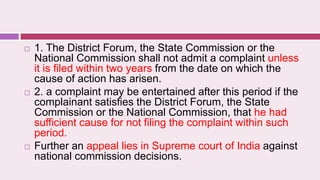
 1. The District Forum, the State Commission or the
National Commission shall not admit a complaint unless
it is filed within two years from the date on which the
cause of action has arisen.
 2. a complaint may be entertained after this period if the
complainant satisfies the District Forum, the State
Commission or the National Commission, that he had
sufficient cause for not filing the complaint within such
period.
 Further an appeal lies in Supreme court of India against
national commission decisions.
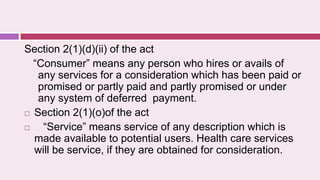
Section 2(1)(d)(ii) of the act
“Consumer” means any person who hires or avails of
any services for a consideration which has been paid or
promised or partly paid and partly promised or under
any system of deferred payment.
 Section 2(1)(o)of the act
 “Service” means service of any description which is
made available to potential users. Health care services
will be service, if they are obtained for consideration.
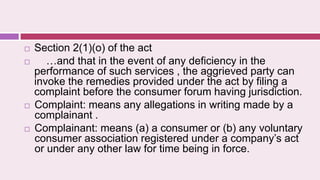
 Section 2(1)(o) of the act
 …and that in the event of any deficiency in the
performance of such services , the aggrieved party can
invoke the remedies provided under the act by filing a
complaint before the consumer forum having jurisdiction.
 Complaint: means any allegations in writing made by a
complainant .
 Complainant: means (a) a consumer or (b) any voluntary
consumer association registered under a company’s act
or under any other law for time being in force.
ANAESTHESIOLOGISTS
CONSIDERARATION
 Anaesthesiology is a high risk specialty. However the public at large
are not aware of the risks involved in anaesthesia.
 Moreover, in the present system of anaesthesia practice in India,
there is not much scope for interaction between the patient and the
anaesthesiologist and hence there is no rapport between them.
 Under such circumstances, when something goes wrong, the
patient or his relatives react in a hostile manner towards the
anaesthesiologist and many a times they land up in a police station
or court to seek redressal.
 Types of cases: criminal or a civil case.
 In a criminal case, the aggrieved party files a complaint against the
anaesthesiologist in a police station which then investigates the
case and the Government prosecutes the concerned
anaesthesiologist.
 This happens only when the offense is of a serious nature.
 The idea of judicial proceedings in criminal cases is to punish the
anaesthesiologist concerned for the lapse on his part.
 Complainant does not get any compensation in criminal cases.
 In a civil case the aggrieved party itself approaches the court to seek
compensation for the harm caused by the action of the
anaesthesiologist.
 These cases can go to the common courts or to one of the consumer
courts.
 After introduction of Consumer ProtectionAct (CPA), most of the
cases relating to Medical Negligence go to the consumer courts.
 The reasons for this are the inexpensive and simple procedure and
speedy disposal of the cases in these courts(period of 3 months).
Grounds for action:
 Almost always the patient or his relative blames the
Anaesthesiologist on grounds of negligence.
 In a criminal case, it is criminal negligence and in a civil suit it is
negligence in torts (any wrongdoing for which an action for
damages may be brought).
Ingredients of negligence
 To be successful in a suit for medical negligence, the patient
(plaintiff) has to prove four things:
1. Duty: that the anaesthesiologist owed him or her a duty.
2. Breach of Duty: That the anaesthesiologist failed to fulfill his or her
duty.
3. Damages: resulted because of the acts of the anaesthesiologist.
4. Causation: causal relationship exists between the
anaesthesiologist’s acts and the resultant injury.
Duty
 When the patient is seen preoperatively and the Anaesthesiologist
agrees to provide anaesthesia care for the patient, a duty to the
patient has been established.
 Abreach of any of these duties gives a right of action for
negligence to the patient.
 Anaesthesiologists are also responsible for those they supervise.
 a duty of care arises, where anAnaesthesiologist undertakes any
professional service for a patient whether he is paid for that service
or not.
Standard of care
 Since it is imposible to delineate specific standards for all aspects of
medical practice and all eventualities, the courts have created the
“reasonable and prudent” physician.
 The practitioner must bring to his task a reasonable degree of skill
and knowledge and must exercise a reasonable degree of care.
 Neither highest nor a very low degree of care and competence
judged in the light of particular circumstances of each case is what
the law requires.
 The standard has to be applied with reference to those facts and
circumstances under which theAnaesthesiologist was practicing at
the time in question.
 Just as the various cardiac, respiratory, haematological and other
aspects of a patient’s condition, the nature of the procedure, the
availability of the equipment etc. must be taken into consideration in
applying the standard of care and evaluating the potential legal
liability of an anaesthesiologist.
Inexperience
 Inexperience is no defense.
 The patient is entitled to receive all the care and skill, which fully
qualified and well experiencedAnaesthesiologist would possess
and use.
 Delegation of responsibility to a junior with knowledge that the
junior was incapable of performing his duties properly will
amount to negligence.
 Failure to intubate a patient is not negligence where the
hospital authority had weighed up the risks and disadvantages,
which might occur as a result.
Keeping up to date
 The obligation is to make a reasonable effort to keep up to date.
 A doctor can not realistically be expected to read every article in
every learned medical journal.
 But where a particular risk has been highlighted on a number of
occasions the practitioner will ignore it at his peril.
 Professional practices may change over time so that what was
accepted as the correct procedure is no longer considered
respectable or responsible.
 When a practice becomes outdated so much so as to be
considered negligence is difficult to say.
 However, once the risk associated with an old procedure
becomes generally known, so that it can be said that an ordinary
and reasonably competent practitioner would have changed his
practice, it will be negligent to continue with that procedure.
Error of judgment
 An error of judgment is not negligence.
 Wrong diagnosis is not deficiency in service.
 In the medical profession, as in others, there is room for
differences of opinion and practice; and a court’s preference of one
body of opinion over another is no basis for a conclusion of
negligence.
 A doctor cannot be found negligent merely because in a matter of
opinion he made an error of judgment.
Mistake
 Very often, in a claim for compensation arising out of medical
negligence, a plea is taken that it is a case of bonafide mistake
which under certain circumstances may be excusable, but a mistake
which is tantamount to negligence cannot be pardoned.
 Gross medical mistake will always result in finding of negligence.
 Use of a wrong drug or a wrong gas during anaesthesia will
frequently lead to the imposition of liability and in some situations
even the principle of res ipsa loquitur may be applied.
Informed consent
 There are certain general duties which, all physicians have to their
patients, and breaching these duties may also serve as the basis for
a lawsuit.
 One of these general duties is that of obtaining an informed consent.
 Consent may be written, verbal or implied. Oral consent is just as
valid, albeit harder to prove years after the fact, then written
consent.
 Informed consent is a doctrine of some complexity. It means shared
decision-making. It means patients right to self-determination and
autonomy.
 Professional standard of disclosure: “The duty of the physician to
disclose is limited to those disclosures which a reasonable
practitioner would make under same or similar circumstances.
 Duty to disclose risk is not limitless, but it does extend to those
risks that are reasonably likely to occur in any patient under the
circumstances, and to those that are reasonably likely to occur in
particular patients because of their condition.
 There is no obligation to inform the patient about the risk of death
from general anaesthesia.
 The duty of a doctor is to explain to the patient what he intends to
do and the implications of that action in a way, which a careful and
responsible doctor would do, so that the consent given by the
patient was, indeed, a real consent.
Express and limited warrantees
 Medicine is an inexact science.
 Presumption is that doctor would not give any warranty.
 But in the case of cosmetic surgeries the warranties are taken by
courts more seriously.
 an anaesthesiologist being paid by a patient for his services may
find himself in difficulties if he gives an express warrantee.
 Such a situation may arise where a patient, fearful of being awake
or waking during surgery, seeks reassurance.
 TheAnaesthesiologist may even be tempted to allay his patient’s
anxiety by saying words to the effect “I can guarantee that you
won’t know anything about it”.
 The Anaesthesiologist may find him paying the damages for breach
of the express contract if the patient is aware during the course of
the surgery, through no fault of his.
Records
 Under the Indian laws a case based on medical negligence can be
filed within three years of the occurrence of an incident.
 Under CPAthis limitation is two years.
 Thus there is a time gap between the occurrence of an incident and
the hearing of a case in the court. Court cannot rely on the memory
of the parties to evaluate the evidence.
 More over court has no way to ascertain as to what happened
within the four walls of the OT.
 It has therefore to depend upon the records of the case
maintained by the anaesthesiologist and the hospital.
 ...although there is no legal requirement to maintain record, there is
no defense in court when asked how one can justify being unable
to write on a single sheet of paper what one has done.
 Anaesthesia record itself should be as accurate, complete and
neat as possible.
 The record was not considered proper when previous history of the
patient was not recorded.
 Not supplying copy of Hospital Record to the patient does not
amount to negligence.
 It is sufficient if a discharge card and a summary of investigations,
diagnosis and treatment are given.
 There is no law that states that the case sheets should be
furnished to a person like the complainant on requirement, nor there
is any undertaking by the opposite parties under an agreement or
otherwise to so furnish.
Burden of proof
 burden of proving that the anaesthesiologist was negligent falls on
the complainant.
 Court allows both parties to prove their case by means of
producing evidence. This may include records, books, journals or
expert witnesses.
Expert Witness
 As a matter of right both the parties to a case can produce expert
witness to support their claim.
 Although any licensed physician may be an expert, information will
be sought regarding the witness’s education, training, nature and
scope of practice, memberships and affiliations, and publications.
 Purpose of collecting this information is to determine, how much
weight can be given to that testimony.
 In many cases, the success of a suit depends primarily on the
stature and believability of the expert witness.
 Anationally recognized expert in the area in question, who is not a
personal friend, but agrees with the defense position, may be very
valuable.
 There have been a number of cases where courts have dismissed
the complaints when complainant has not produced expert witness
to substantiate his claim.
Res ipsa loquitur
 means “Things speak for themselves”.
 It applies when the event which is complained of would not ordinarily
happen in the absence of negligence.
 In such cases the burden of proof shifts from the complainant to the
defendant. He has to prove that he was not negligent.
 Use of a wrong drug or a wrong gas during anaesthesia will
frequently lead to the imposition of liability and in some situations
even the principle of res ipsa loquitur may be applied.
 Applying this doctrine requires proving that:
1. The injury is of a kind that typically would not occur in the absence of
negligence.
2. The injury must be caused by something under the exclusive control of
the an anaesthesiologist.
3. The injury must not be due to any contribution on the part of the
patient.
 Where a patient developed massive tissue emphysema due to wrong
placement of needle for jet ventilation of lungs, The Anaesthesiologist
was held liable because if the needle had been placed correctly into the
trachea, tissue emphysema would not have occurred.
where dictorine of res ipsa loquitor is
applicable.
 Where an explosion occurred during the course of administering
anaesthetic to the patient when the technique had been frequently
been used without any mishap.
 Preanaesthetic evaluation not done.
 Following an operation under general anaesthesia, patient
sustained hypoxic brain damage in recovery ward.
 Unexplained cardiac arrest during anaesthesia leading to death is
negligence.
Doctrine of res ipsa loquitur was not
applied
 where a patient suffered permanent partial paralysis of legs following
spinalanaesthesia, the court said, “...Medical science has not yet
reached a stage where the law ought to presume that a patient must
come out of an operation as well or better than he went into it.”
 Patient developed meningitis after spinal anaesthetia. Court found that
anaesthetic was not contaminated and the staff had taken the usual
precautions to disinfect themselves before the operation, it held the
hospital was responsible for some fault in sterilisation procedure.
 in a case where globe was perforated in the course of giving a local
block prior to cataract surgery.
Damages
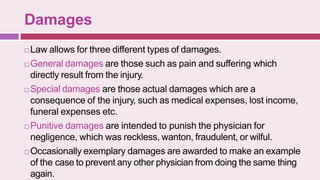
 Law allows for three different types of damages.
 General damages are those such as pain and suffering which
directly result from the injury.
 Special damages are those actual damages which are a
consequence of the injury, such as medical expenses, lost income,
funeral expenses etc.
 Punitive damages are intended to punish the physician for
negligence, which was reckless, wanton, fraudulent, or wilful.
 Occasionally exemplary damages are awarded to make an example
of the case to prevent any other physician from doing the same thing
again.
Defenses
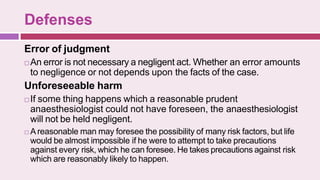
Error of judgment
 An error is not necessary a negligent act. Whether an error amounts
to negligence or not depends upon the facts of the case.
Unforeseeable harm
 If some thing happens which a reasonable prudent
anaesthesiologist could not have foreseen, the anaesthesiologist
will not be held negligent.
 Areasonable man may foresee the possibility of many risk factors, but life
would be almost impossible if he were to attempt to take precautions
against every risk, which he can foresee. He takes precautions against risk
which are reasonably likely to happen.
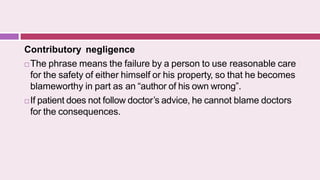
Contributory negligence
 The phrase means the failure by a person to use reasonable care
for the safety of either himself or his property, so that he becomes
blameworthy in part as an “author of his own wrong”.
 If patient does not follow doctor’s advice, he cannot blame doctors
for the consequences.
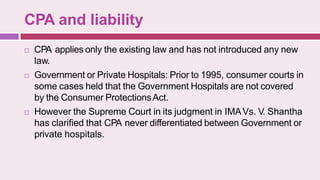
CPA and liability
 CPA applies only the existing law and has not introduced any new
law.
 Government or Private Hospitals: Prior to 1995, consumer courts in
some cases held that the Government Hospitals are not covered
by the Consumer ProtectionsAct.
 However the Supreme Court in its judgment in IMAVs. V. Shantha
has clarified that CPA never differentiated between Government or
private hospitals.
1. All medical/dental practitioners doing independent
medical/dental practice unless rendering only free service.
2. Private hospitals charging all patients.
3. All hospitals having free as well as paying patients and all the
paying and free category patients receiving treatment in such
hospitals.
4. Medical/dental practitioners and hospitals paid by an insurance
firm for the treatment of a client or an employment for that of an
employee.
 Since most of the Government hospitals provide services free of
charge, they are not covered by the CPA.
 However, any hospital whether Government or private who
collects charges from all or some of its patient is covered by the
CPAafter the Supreme Court Judgment.
 In these hospitals even the patients treated free of charge are
entitled to move the Consumer Courts for compensation for any
deficiency in service.
Fee
 Question whether the fees charged by the doctor is excessive or
reasonable does not constitute a consumer dispute.
 Patient cannot complain about the doctor’s fee being excessive.
Vexatious complaints
 Since the approach to the Consumer Courts does not cost anything
to the complainant, there is a possibility of this being misused or
used as a tool for harassment. Even the courts have accepted this
possibility.
 Though courts have awarded compensation to the respondents in
cases of vexatious complaints, the amount (which may be up to
Rs 10000) is not sufficient to act as deterrent against lodging of
frivolous or vexatious complaints and harassment of suppliers of
goods and providers of services.
Prevention
 Codes of practice improve standards and it is for the benefit of the
medical profession and the patients who place themselves in its
hands that further steps are taken expeditiously to achieve this
objective.
 it is necessary for individual Anaesthesiologist to know and to follow
the minimum standards expected of them by the public, their
profession and the law.
 The key factors in the prevention of patient injury are vigilance, up-
to-date knowledge, and adequate monitoring.
 The introduction of theASA“Standards for Basic Intra-Operative
Monitoring” was accompanied by a decrease in the number of
anaesthesia related liability claims.
 Improved monitoring, especially the greater use of pulse oxymetry
and capnography, has undoubtedly contributed to the decrease in
severe complications and the associated large awards.
 The practice of “defensive medicine” includes making of pre- and
postoperative rounds, developing good patient relationships, and
maintaining up-to-date habits.
 In India, slowly people are realizing that it is not easy to get
compensation through court unless there is a strong evidence of
negligence.
 However, Indian Society of Anaesthesiologists must come out with
protocols to be followed by its members in different clinical
situations. Once this is done the courts will decide the issues of
medical negligence by the fact whether the protocol was followed or
not.
 Thus the anaesthesiologists following the protocols will not be held
guilty of negligence.
 This will also improve the patient care and the outcome.
Summary
 Cases of medical negligence are now being filed in consumer
courts instead of the regular courts.
 CPA protect interests of consumers and it makes provisions for
establishment of consumer councils and other authorities for the
settlement of consumers dispute and for matters connected
therewith.
 Thank you...

Consumer protection act

  • 1.
  • 2.
    INTRODUCTION  Consumer ProtectionAct is an Act of the Parliament of India enacted in 24th December, 1986 .  protects interests of consumers in India.  earlier amended three times in the years 1991, 1993 & 2002 to make the act more purposeful in order to widen the scope and to strengthen the functioning of Consumer Fora further amendment is under process.
  • 3.
    Consumer Protection Council Consumer Protection Councils are established at the national, state and district level to increase consumer awareness. i. Central Consumer Protection Council ii. State Consumer Protection Council iii. Consumer Disputes Redressal Agencies or Consumer Court
  • 4.
    Central Consumer Protection Council It is established by the Central Government which consists of the following members: i. The Minister of Consumer Affairs, – Chairman ii. Such number of other official or non-official members representing such interests as may be prescribed.
  • 5.
    State Consumer Protection Council It is established by the State Government which consists of the following members: i. The Minister in charge of consumer affairs in the State Government – Chairman. ii. Such number of other official or non-official members representing such interests as may be prescribed by the State Government. iii. Such number of other official or non-official members, not exceeding ten, as may be nominated by the Central Government.  The State Council is required to meet as and when necessary
  • 6.
    Consumer Disputes RedressalAgencies or Consumer Court District Consumer Disputes Redressal Forum (DCDRF):  Also known as the "District Forum" established by the State Government in each district of the State. Currently there are 644 DCDRFs.  The State Government may establish more than one District Forum in a district.  It is a district level court that deals with cases valuing up to Rs. 2 million.
  • 7.
    State Consumer DisputesRedressal Commission (SCDRC):  Also known as the "State Commission" established by the State Government in the State. Currently there are 35 SCDRCs.  It is a state level court that takes up cases valuing less than Rs. 10 million. National Consumer Disputes Redressal Commission (NCDRC):  Established by the Central Government. It is a national level court that works for the whole country and deals with amount more than Rs. 10 million
  • 8.
    Objectives of Centraland state Council  The objectives of the Central Council is to promote and protect the rights of the consumers such as:- 1. protected against the marketing of goods and services which are hazardous to life and property. 2. informed about the quality, quantity, potency, purity, standard and price of goods or services, as the case may be so as to protect the consumer against unfair trade practices. 3. assured, wherever possible, access to a variety of goods and services at competitive prices.
  • 9.
    4. heard andto be assured that consumer's interests will receive due consideration at appropriate forums. 5. the right to seek redressal against unfair trade practices or restrictive trade practices or unscrupulous exploitation of consumers; and 6. consumer education. 7. against consumer exploitation.  The objects of every State Council shall be to promote and protect within the State the rights of the consumers laid down in clauses 1 to 7 in central council objectives.
  • 10.
    Jurisdiction of DistrictForum  District Forum shall have jurisdiction to entertain complaints where the value of the goods or services and the compensation, if any, claimed does not exceed rupees twenty lakhs.  A complaint shall be instituted in a District Forum by the opposite party , at the time of the institution of the complaint, actually and voluntarily resides or carries on business or has a branch office or personally works for gain.  Within 30 days from the date of decision, appeal can be
  • 11.
    Jurisdiction of statecommission  State Commission shall have jurisdiction to entertain:-  i) complaints where the value of the goods or services and compensation, if any, claimed exceeds rupees twenty lakhs but does not exceed rupees one crore (Rs. 10 million); and  ii) appeals against the orders of any District Forum within the State;  Within 30 days from the date of decision, appeal can be filed in the higher commision
  • 12.
    Jurisdiction of National Commission The National Commission shall have jurisdiction—  i) complaints where the value of the goods or services and compensation, if any, claimed exceeds rupees ten million; and  ii) appeals against the orders of any State Commission
  • 13.
     1. TheDistrict Forum, the State Commission or the National Commission shall not admit a complaint unless it is filed within two years from the date on which the cause of action has arisen.  2. a complaint may be entertained after this period if the complainant satisfies the District Forum, the State Commission or the National Commission, that he had sufficient cause for not filing the complaint within such period.  Further an appeal lies in Supreme court of India against national commission decisions.
  • 14.
    Section 2(1)(d)(ii) ofthe act “Consumer” means any person who hires or avails of any services for a consideration which has been paid or promised or partly paid and partly promised or under any system of deferred payment.  Section 2(1)(o)of the act  “Service” means service of any description which is made available to potential users. Health care services will be service, if they are obtained for consideration.
  • 15.
     Section 2(1)(o)of the act  …and that in the event of any deficiency in the performance of such services , the aggrieved party can invoke the remedies provided under the act by filing a complaint before the consumer forum having jurisdiction.  Complaint: means any allegations in writing made by a complainant .  Complainant: means (a) a consumer or (b) any voluntary consumer association registered under a company’s act or under any other law for time being in force.
  • 16.
  • 17.
     Anaesthesiology isa high risk specialty. However the public at large are not aware of the risks involved in anaesthesia.  Moreover, in the present system of anaesthesia practice in India, there is not much scope for interaction between the patient and the anaesthesiologist and hence there is no rapport between them.  Under such circumstances, when something goes wrong, the patient or his relatives react in a hostile manner towards the anaesthesiologist and many a times they land up in a police station or court to seek redressal.
  • 18.
     Types ofcases: criminal or a civil case.  In a criminal case, the aggrieved party files a complaint against the anaesthesiologist in a police station which then investigates the case and the Government prosecutes the concerned anaesthesiologist.  This happens only when the offense is of a serious nature.  The idea of judicial proceedings in criminal cases is to punish the anaesthesiologist concerned for the lapse on his part.  Complainant does not get any compensation in criminal cases.
  • 19.
     In acivil case the aggrieved party itself approaches the court to seek compensation for the harm caused by the action of the anaesthesiologist.  These cases can go to the common courts or to one of the consumer courts.  After introduction of Consumer ProtectionAct (CPA), most of the cases relating to Medical Negligence go to the consumer courts.  The reasons for this are the inexpensive and simple procedure and speedy disposal of the cases in these courts(period of 3 months).
  • 20.
    Grounds for action: Almost always the patient or his relative blames the Anaesthesiologist on grounds of negligence.  In a criminal case, it is criminal negligence and in a civil suit it is negligence in torts (any wrongdoing for which an action for damages may be brought).
  • 21.
    Ingredients of negligence To be successful in a suit for medical negligence, the patient (plaintiff) has to prove four things: 1. Duty: that the anaesthesiologist owed him or her a duty. 2. Breach of Duty: That the anaesthesiologist failed to fulfill his or her duty. 3. Damages: resulted because of the acts of the anaesthesiologist. 4. Causation: causal relationship exists between the anaesthesiologist’s acts and the resultant injury.
  • 22.
    Duty  When thepatient is seen preoperatively and the Anaesthesiologist agrees to provide anaesthesia care for the patient, a duty to the patient has been established.  Abreach of any of these duties gives a right of action for negligence to the patient.  Anaesthesiologists are also responsible for those they supervise.  a duty of care arises, where anAnaesthesiologist undertakes any professional service for a patient whether he is paid for that service or not.
  • 23.
    Standard of care Since it is imposible to delineate specific standards for all aspects of medical practice and all eventualities, the courts have created the “reasonable and prudent” physician.  The practitioner must bring to his task a reasonable degree of skill and knowledge and must exercise a reasonable degree of care.  Neither highest nor a very low degree of care and competence judged in the light of particular circumstances of each case is what the law requires.
  • 24.
     The standardhas to be applied with reference to those facts and circumstances under which theAnaesthesiologist was practicing at the time in question.  Just as the various cardiac, respiratory, haematological and other aspects of a patient’s condition, the nature of the procedure, the availability of the equipment etc. must be taken into consideration in applying the standard of care and evaluating the potential legal liability of an anaesthesiologist.
  • 25.
    Inexperience  Inexperience isno defense.  The patient is entitled to receive all the care and skill, which fully qualified and well experiencedAnaesthesiologist would possess and use.  Delegation of responsibility to a junior with knowledge that the junior was incapable of performing his duties properly will amount to negligence.  Failure to intubate a patient is not negligence where the hospital authority had weighed up the risks and disadvantages, which might occur as a result.
  • 26.
    Keeping up todate  The obligation is to make a reasonable effort to keep up to date.  A doctor can not realistically be expected to read every article in every learned medical journal.  But where a particular risk has been highlighted on a number of occasions the practitioner will ignore it at his peril.
  • 27.
     Professional practicesmay change over time so that what was accepted as the correct procedure is no longer considered respectable or responsible.  When a practice becomes outdated so much so as to be considered negligence is difficult to say.  However, once the risk associated with an old procedure becomes generally known, so that it can be said that an ordinary and reasonably competent practitioner would have changed his practice, it will be negligent to continue with that procedure.
  • 28.
    Error of judgment An error of judgment is not negligence.  Wrong diagnosis is not deficiency in service.  In the medical profession, as in others, there is room for differences of opinion and practice; and a court’s preference of one body of opinion over another is no basis for a conclusion of negligence.  A doctor cannot be found negligent merely because in a matter of opinion he made an error of judgment.
  • 29.
    Mistake  Very often,in a claim for compensation arising out of medical negligence, a plea is taken that it is a case of bonafide mistake which under certain circumstances may be excusable, but a mistake which is tantamount to negligence cannot be pardoned.  Gross medical mistake will always result in finding of negligence.  Use of a wrong drug or a wrong gas during anaesthesia will frequently lead to the imposition of liability and in some situations even the principle of res ipsa loquitur may be applied.
  • 30.
    Informed consent  Thereare certain general duties which, all physicians have to their patients, and breaching these duties may also serve as the basis for a lawsuit.  One of these general duties is that of obtaining an informed consent.  Consent may be written, verbal or implied. Oral consent is just as valid, albeit harder to prove years after the fact, then written consent.  Informed consent is a doctrine of some complexity. It means shared decision-making. It means patients right to self-determination and autonomy.
  • 31.
     Professional standardof disclosure: “The duty of the physician to disclose is limited to those disclosures which a reasonable practitioner would make under same or similar circumstances.  Duty to disclose risk is not limitless, but it does extend to those risks that are reasonably likely to occur in any patient under the circumstances, and to those that are reasonably likely to occur in particular patients because of their condition.  There is no obligation to inform the patient about the risk of death from general anaesthesia.
  • 32.
     The dutyof a doctor is to explain to the patient what he intends to do and the implications of that action in a way, which a careful and responsible doctor would do, so that the consent given by the patient was, indeed, a real consent.
  • 33.
    Express and limitedwarrantees  Medicine is an inexact science.  Presumption is that doctor would not give any warranty.  But in the case of cosmetic surgeries the warranties are taken by courts more seriously.  an anaesthesiologist being paid by a patient for his services may find himself in difficulties if he gives an express warrantee.
  • 34.
     Such asituation may arise where a patient, fearful of being awake or waking during surgery, seeks reassurance.  TheAnaesthesiologist may even be tempted to allay his patient’s anxiety by saying words to the effect “I can guarantee that you won’t know anything about it”.  The Anaesthesiologist may find him paying the damages for breach of the express contract if the patient is aware during the course of the surgery, through no fault of his.
  • 35.
    Records  Under theIndian laws a case based on medical negligence can be filed within three years of the occurrence of an incident.  Under CPAthis limitation is two years.  Thus there is a time gap between the occurrence of an incident and the hearing of a case in the court. Court cannot rely on the memory of the parties to evaluate the evidence.  More over court has no way to ascertain as to what happened within the four walls of the OT.  It has therefore to depend upon the records of the case maintained by the anaesthesiologist and the hospital.
  • 36.
     ...although thereis no legal requirement to maintain record, there is no defense in court when asked how one can justify being unable to write on a single sheet of paper what one has done.  Anaesthesia record itself should be as accurate, complete and neat as possible.  The record was not considered proper when previous history of the patient was not recorded.
  • 37.
     Not supplyingcopy of Hospital Record to the patient does not amount to negligence.  It is sufficient if a discharge card and a summary of investigations, diagnosis and treatment are given.  There is no law that states that the case sheets should be furnished to a person like the complainant on requirement, nor there is any undertaking by the opposite parties under an agreement or otherwise to so furnish.
  • 38.
    Burden of proof burden of proving that the anaesthesiologist was negligent falls on the complainant.  Court allows both parties to prove their case by means of producing evidence. This may include records, books, journals or expert witnesses.
  • 39.
    Expert Witness  Asa matter of right both the parties to a case can produce expert witness to support their claim.  Although any licensed physician may be an expert, information will be sought regarding the witness’s education, training, nature and scope of practice, memberships and affiliations, and publications.  Purpose of collecting this information is to determine, how much weight can be given to that testimony.  In many cases, the success of a suit depends primarily on the stature and believability of the expert witness.
  • 40.
     Anationally recognizedexpert in the area in question, who is not a personal friend, but agrees with the defense position, may be very valuable.  There have been a number of cases where courts have dismissed the complaints when complainant has not produced expert witness to substantiate his claim.
  • 41.
    Res ipsa loquitur means “Things speak for themselves”.  It applies when the event which is complained of would not ordinarily happen in the absence of negligence.  In such cases the burden of proof shifts from the complainant to the defendant. He has to prove that he was not negligent.  Use of a wrong drug or a wrong gas during anaesthesia will frequently lead to the imposition of liability and in some situations even the principle of res ipsa loquitur may be applied.
  • 42.
     Applying thisdoctrine requires proving that: 1. The injury is of a kind that typically would not occur in the absence of negligence. 2. The injury must be caused by something under the exclusive control of the an anaesthesiologist. 3. The injury must not be due to any contribution on the part of the patient.  Where a patient developed massive tissue emphysema due to wrong placement of needle for jet ventilation of lungs, The Anaesthesiologist was held liable because if the needle had been placed correctly into the trachea, tissue emphysema would not have occurred.
  • 43.
    where dictorine ofres ipsa loquitor is applicable.  Where an explosion occurred during the course of administering anaesthetic to the patient when the technique had been frequently been used without any mishap.  Preanaesthetic evaluation not done.  Following an operation under general anaesthesia, patient sustained hypoxic brain damage in recovery ward.  Unexplained cardiac arrest during anaesthesia leading to death is negligence.
  • 44.
    Doctrine of resipsa loquitur was not applied  where a patient suffered permanent partial paralysis of legs following spinalanaesthesia, the court said, “...Medical science has not yet reached a stage where the law ought to presume that a patient must come out of an operation as well or better than he went into it.”  Patient developed meningitis after spinal anaesthetia. Court found that anaesthetic was not contaminated and the staff had taken the usual precautions to disinfect themselves before the operation, it held the hospital was responsible for some fault in sterilisation procedure.  in a case where globe was perforated in the course of giving a local block prior to cataract surgery.
  • 45.
    Damages  Law allowsfor three different types of damages.  General damages are those such as pain and suffering which directly result from the injury.  Special damages are those actual damages which are a consequence of the injury, such as medical expenses, lost income, funeral expenses etc.  Punitive damages are intended to punish the physician for negligence, which was reckless, wanton, fraudulent, or wilful.  Occasionally exemplary damages are awarded to make an example of the case to prevent any other physician from doing the same thing again.
  • 46.
    Defenses Error of judgment An error is not necessary a negligent act. Whether an error amounts to negligence or not depends upon the facts of the case. Unforeseeable harm  If some thing happens which a reasonable prudent anaesthesiologist could not have foreseen, the anaesthesiologist will not be held negligent.  Areasonable man may foresee the possibility of many risk factors, but life would be almost impossible if he were to attempt to take precautions against every risk, which he can foresee. He takes precautions against risk which are reasonably likely to happen.
  • 47.
    Contributory negligence  Thephrase means the failure by a person to use reasonable care for the safety of either himself or his property, so that he becomes blameworthy in part as an “author of his own wrong”.  If patient does not follow doctor’s advice, he cannot blame doctors for the consequences.
  • 48.
    CPA and liability CPA applies only the existing law and has not introduced any new law.  Government or Private Hospitals: Prior to 1995, consumer courts in some cases held that the Government Hospitals are not covered by the Consumer ProtectionsAct.  However the Supreme Court in its judgment in IMAVs. V. Shantha has clarified that CPA never differentiated between Government or private hospitals.
  • 49.
    1. All medical/dentalpractitioners doing independent medical/dental practice unless rendering only free service. 2. Private hospitals charging all patients. 3. All hospitals having free as well as paying patients and all the paying and free category patients receiving treatment in such hospitals. 4. Medical/dental practitioners and hospitals paid by an insurance firm for the treatment of a client or an employment for that of an employee.
  • 50.
     Since mostof the Government hospitals provide services free of charge, they are not covered by the CPA.  However, any hospital whether Government or private who collects charges from all or some of its patient is covered by the CPAafter the Supreme Court Judgment.  In these hospitals even the patients treated free of charge are entitled to move the Consumer Courts for compensation for any deficiency in service.
  • 51.
    Fee  Question whetherthe fees charged by the doctor is excessive or reasonable does not constitute a consumer dispute.  Patient cannot complain about the doctor’s fee being excessive.
  • 52.
    Vexatious complaints  Sincethe approach to the Consumer Courts does not cost anything to the complainant, there is a possibility of this being misused or used as a tool for harassment. Even the courts have accepted this possibility.  Though courts have awarded compensation to the respondents in cases of vexatious complaints, the amount (which may be up to Rs 10000) is not sufficient to act as deterrent against lodging of frivolous or vexatious complaints and harassment of suppliers of goods and providers of services.
  • 53.
    Prevention  Codes ofpractice improve standards and it is for the benefit of the medical profession and the patients who place themselves in its hands that further steps are taken expeditiously to achieve this objective.  it is necessary for individual Anaesthesiologist to know and to follow the minimum standards expected of them by the public, their profession and the law.  The key factors in the prevention of patient injury are vigilance, up- to-date knowledge, and adequate monitoring.
  • 54.
     The introductionof theASA“Standards for Basic Intra-Operative Monitoring” was accompanied by a decrease in the number of anaesthesia related liability claims.  Improved monitoring, especially the greater use of pulse oxymetry and capnography, has undoubtedly contributed to the decrease in severe complications and the associated large awards.  The practice of “defensive medicine” includes making of pre- and postoperative rounds, developing good patient relationships, and maintaining up-to-date habits.
  • 55.
     In India,slowly people are realizing that it is not easy to get compensation through court unless there is a strong evidence of negligence.  However, Indian Society of Anaesthesiologists must come out with protocols to be followed by its members in different clinical situations. Once this is done the courts will decide the issues of medical negligence by the fact whether the protocol was followed or not.  Thus the anaesthesiologists following the protocols will not be held guilty of negligence.  This will also improve the patient care and the outcome.
  • 56.
    Summary  Cases ofmedical negligence are now being filed in consumer courts instead of the regular courts.  CPA protect interests of consumers and it makes provisions for establishment of consumer councils and other authorities for the settlement of consumers dispute and for matters connected therewith.
  • 57.