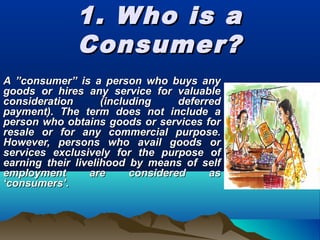
A ”consumer” is a person who buys anyA ”consumer” is a person who buys any
goods or hires any service for valuablegoods or hires any service for valuable
consideration (including deferredconsideration (including deferred
payment). The term does not include apayment). The term does not include a
person who obtains goods or services forperson who obtains goods or services for
resale or for any commercial purpose.resale or for any commercial purpose.
However, persons who avail goods orHowever, persons who avail goods or
services exclusively for the purpose ofservices exclusively for the purpose of
earning their livelihood by means of selfearning their livelihood by means of self
employment are considered asemployment are considered as
‘consumers’.‘consumers’.
1. Who is a1. Who is a
Consumer?Consumer?
2. Consumer Rights2. Consumer Rights
There are 8 (eight) Consumer Rights.There are 8 (eight) Consumer Rights.
1.Right To Safety1.Right To Safety
2.Right To Information2.Right To Information
3.Right To Choose3.Right To Choose
4.Right To Heard4.Right To Heard
5.Right To Redressal5.Right To Redressal
6.Right To Consumer Education6.Right To Consumer Education
7.Right To Healthy Environment7.Right To Healthy Environment
8.Right To Basic Needs8.Right To Basic Needs
Rights 1 to 6 are directly guaranteed under the ConsumerRights 1 to 6 are directly guaranteed under the Consumer
Protection Act 1986 while Rights 7&8 are implied under theProtection Act 1986 while Rights 7&8 are implied under the
Constitution of India.Constitution of India.
1.Right to Safety1.Right to Safety
Right to be protected against marketing of
goods or services which are hazardous to
life and property.
2.Right to Information2.Right to Information
Right to be informed about the quality,
quantity, potency, purity, standard and price
of goods or services as the case may be, so
as to protect the consumer against unfair
trade practices.
3.Right to Choose3.Right to Choose
Right to be assured, wherever possible,
access to a variety of goods and services at
competitive prices.
4.Right to be Heard4.Right to be Heard
Right to be heard and to be assured that
consumer’s interest will receive due
consideration at appropriate for.
5.Right to Redressal5.Right to Redressal
Right to seek redressal against Unfair Trade
Practices or Restrictive Trade Practices or
unscrupulous exploitation of consumers.
6.Right to consumer6.Right to consumer
EducationEducation
Right to acquire knowledge and skills needed
for taking action to influence factors which
affect consumer decisions.
7. Right to healthy7. Right to healthy
EnvironmentEnvironment
The right to physical environment that will
enhance the quality of life. It includes
protection against environmental dangers
over which the individual has no control. It
acknowledges the need to protect and
improve the environment for present and
future generations.
8.Right to basic needs8.Right to basic needs
Right to basic needs ensures basic goods
and services which guarantee survival. It
includes adequate food, clothing, shelter,
health care, education and sanitation to lead
a decent life.
RESPONSIBILITIES OFRESPONSIBILITIES OF
CONSUMERSCONSUMERS
1. BEFORE BUYING
• Planning in advance.
• Enquiring past performance of product /
service.
• Enquiring about reputation and past
performance of producer / seller / service
provider.
2. WHILE BUYING
• Asking for demonstration regarding how to
operate / use the product/service.
• Enquiring about after-sales service and
ensuring availability, phone number,
address and e-mail of service center.
• Reading and knowing the contents of
guarantee / warranty card.
• Insisting for approved sale bill with serial
number, address, phone number, etc.
• Obtaining guarantee / warranty card and
getting it signed/sealed by dealer.
3. AFTER BUYING
• Use products as per instruction given in
user manual.
• Keeping bills and guarantee/warranty card
safely.
• In case of fault inform dealer and service
center. Do not meddle or repair yourself.
• Keeping record for all correspondences.
• Seek immediate redressal of deficiency in
product.
CONSUMER PROTECTIONCONSUMER PROTECTION
ACT, 1986ACT, 1986
The Act envisages a three tier quasi judicial
system. They are known as:-
(i) District Consumer Disputes Redressal
Forum
(ii) State Consumer Disputes Redressal
Commission and
(iii) National Consumer Disputes Redressal
Commission
Features of ConsumerFeatures of Consumer
Protection Act, 1986 andProtection Act, 1986 and
filing of complaintsfiling of complaints
1.Simple formalities.
2.Advocates not compulsory.
3.Consumers themselves can conduct cases.
4.Complaints may be sent even through Registered
Post.
5.Registered Consumer Organizations or
Government can also file complaint on behalf of
consumer's.
6.Less expensive.
7.Compensation can be claimed for the loss suffered
including mental agony.
Protection offered byProtection offered by
Consumer Protection Act,Consumer Protection Act,
1986 against:-1986 against:-
a. Deficiency in product or service.
b. Poor after sales service.
c. Damage/Loss to health, life and property due to
product.
d. Hazards arising out of product/service.
e. Unjust enrichment through unfair means.
f. Misleading advertisements.
g. Unfair Trade Practices.
h. Restrictive Trade Practices (like tie-up sales)
i. Violations of any other applicable laws or
regulations.
Grievance RedressalGrievance Redressal
• Consumer should send a detailed petition to
the dealer / service provider through registered
post pointing out the defect / deficiency and
details regarding relief sought for Copy of the
petition with postal acknowledgement card to
be preserved.
If the dealer / service provider not responded in
time consumer may approach to District
Consumer Protection Council headed by
District Collector or Commissioner of Civil
Supplies and Consumer Protection or Reputed
Consumer Organisation who will be sending
notices to the dealer / service provider on
behalf of consumer.
If no remedy available through all above
agencies, then relevant Consumer Disputes
Redressal Commission / Forum as the case
may be approached to file a complaint against
dealer / service provider.
POINTS FOR CONSUMERPOINTS FOR CONSUMER
ATTENTIONATTENTION
i) PURCHASING UNDER PUBLIC DISTRIBUTION SYSTEM
• Public Distribution System Outlets (ration shops) are
distributing commodities against family cards at
subsidized rates. Consumer should ensure that
Commodities are provided in correct weight without denial
Display board is placed in front of every shop indicating
available commodities and their quantity with selling price
of each product Samples of commodities are placed for
notice of card holders.
• In the absence of any of above complaint can be made to
Civil Supplies and Consumer Protection Department.
PURCHASE OFPURCHASE OF
COSMETICSCOSMETICS
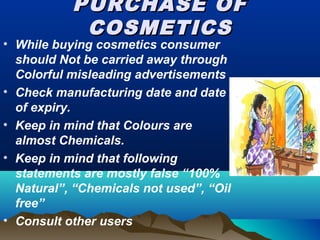
• While buying cosmetics consumer
should Not be carried away through
Colorful misleading advertisements
• Check manufacturing date and date
of expiry.
• Keep in mind that Colours are
almost Chemicals.
• Keep in mind that following
statements are mostly false “100%
Natural”, “Chemicals not used”, “Oil
free”
• Consult other users
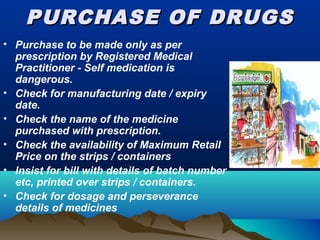
PURCHASE OF DRUGSPURCHASE OF DRUGS
• Purchase to be made only as per
prescription by Registered Medical
Practitioner - Self medication is
dangerous.
• Check for manufacturing date / expiry
date.
• Check the name of the medicine
purchased with prescription.
• Check the availability of Maximum Retail
Price on the strips / containers
• Insist for bill with details of batch number
etc, printed over strips / containers.
• Check for dosage and perseverance
details of medicines
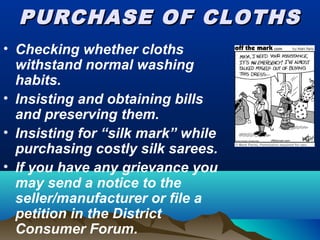
PURCHASE OF CLOTHSPURCHASE OF CLOTHS
• Checking whether cloths
withstand normal washing
habits.
• Insisting and obtaining bills
and preserving them.
• Insisting for “silk mark” while
purchasing costly silk sarees.
• If you have any grievance you
may send a notice to the
seller/manufacturer or file a
petition in the District
Consumer Forum.
PURCHASE OF GOLDPURCHASE OF GOLD
• Check for “Hall Mark”.
• Weight of stones to be
separately noted down in bills
while purchasing ornaments with
precious stones.
• Obtain purchase bills and keep it
safely.
• In case of grievances you may
issue a notice to the seller or file
a complaint with Bureau of
Indian Standards at
www.bis.org.in .
MISLEADINGMISLEADING
ADVERTISEMENTSADVERTISEMENTS
Consumer should always:-
• be alert about the advertisements while going for purchase
of goods afresh or in exchange of old product not be
carried away by statements like free offers / discounts etc.
since they are not the deciding factors for the requirement
of consumers.
• not be misled through colourful glamorous
advertisements.
• In case of grievances, please issue a notice to the
newspaper or complain to Advertisement Standards
Council of India (ASCI) at 219, Bombay Market, Tardeo
Road, Mumbai 400 034, ph 23521066 / 23516863, Web:
www.ascionline.org and Email: ascia@vsnl.com .
PURCHASE OF FOODPURCHASE OF FOOD
PRODUCTSPRODUCTS
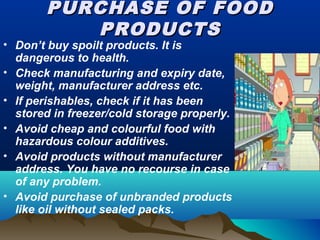
• Don’t buy spoilt products. It is
dangerous to health.
• Check manufacturing and expiry date,
weight, manufacturer address etc.
• If perishables, check if it has been
stored in freezer/cold storage properly.
• Avoid cheap and colourful food with
hazardous colour additives.
• Avoid products without manufacturer
address. You have no recourse in case
of any problem.
• Avoid purchase of unbranded products
like oil without sealed packs.
PACKAGEDPACKAGED
COMMODITIESCOMMODITIES
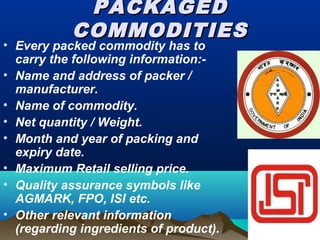
• Every packed commodity has to
carry the following information:-
• Name and address of packer /
manufacturer.
• Name of commodity.
• Net quantity / Weight.
• Month and year of packing and
expiry date.
• Maximum Retail selling price.
• Quality assurance symbols like
AGMARK, FPO, ISI etc.
• Other relevant information
(regarding ingredients of product).
SUSTAINABLESUSTAINABLE
CONSUMPTIONCONSUMPTION
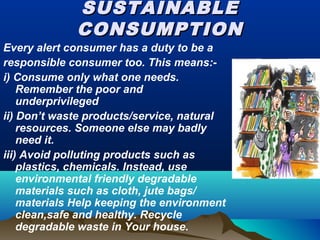
Every alert consumer has a duty to be a
responsible consumer too. This means:-
i) Consume only what one needs.
Remember the poor and
underprivileged
ii) Don’t waste products/service, natural
resources. Someone else may badly
need it.
iii) Avoid polluting products such as
plastics, chemicals. Instead, use
environmental friendly degradable
materials such as cloth, jute bags/
materials Help keeping the environment
clean,safe and healthy. Recycle
degradable waste in Your house.
Remember the 3 R’s of aRemember the 3 R’s of a
dutiful consumerdutiful consumer
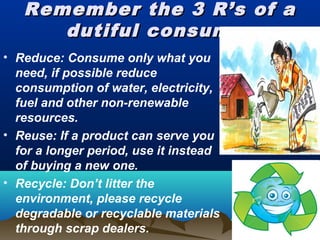
• Reduce: Consume only what you
need, if possible reduce
consumption of water, electricity,
fuel and other non-renewable
resources.
• Reuse: If a product can serve you
for a longer period, use it instead
of buying a new one.
• Recycle: Don’t litter the
environment, please recycle
degradable or recyclable materials
through scrap dealers.
What is Cash memo?What is Cash memo?
Cash memo is a written document that seller
gives it to the buyer at the time of the
respective purchase. Cash memo contains
all details about that physical substance like
its date of manufacture, date of purchase,
quantity, price the dealer and the address of
the dealer. Cash memo also fill statutory
requirements.
What is the Theme of JagoWhat is the Theme of Jago
Grahk Jago?Grahk Jago?
To mark National Consumer Day in the capital, the
government announced that it would intensify the
consumer awareness campaign ‘Jago Grahak Jago’.
Commemorating the occasion, Yashwant Bhave, secretary,
Department of Consumer Affairs, said that enactment of
Consumer Protection Act in 1986 has proved to be a
milestone in consumer movement and on this day, all
stakeholders should take a pledge to protect the interests
of consumers.
Bhave said that an aware and enlightened consumer can play
a crucial role in enabling the transition to a knowledge-
based society. He added that a three-tier structure
comprising legal framework, standards and consumer
redress is paramount for protecting the interests of
consumers.
Giving the example of gold purchase, Bhave observed that
about 18 to 39 per cent samples of gold were found to be
of lower carat than claimed, leading to an estimated annual
loss of Rs 7,500 crore. In view of this, the government will
expand the hallmarking scheme in the coming months, he
said.
Other issues concerning the interests of the consumers
such as MRP, labelling and standardisation, are being
highlighted by the department through its consumer
awareness publicity campaign.
Appreciating the efficacy of consumer forums, Bhave
pointed out that out of 28 lakh complaints received, over 25
lakh cases have been disposed off.
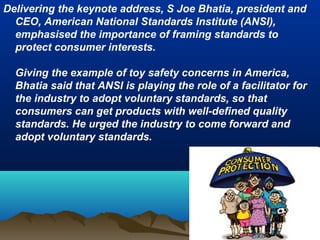
Delivering the keynote address, S Joe Bhatia, president and
CEO, American National Standards Institute (ANSI),
emphasised the importance of framing standards to
protect consumer interests.
Giving the example of toy safety concerns in America,
Bhatia said that ANSI is playing the role of a facilitator for
the industry to adopt voluntary standards, so that
consumers can get products with well-defined quality
standards. He urged the industry to come forward and
adopt voluntary standards.
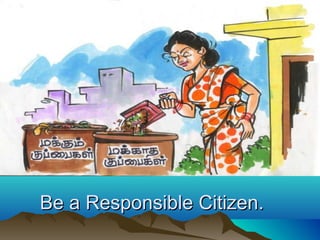
Be a Responsible Citizen.Be a Responsible Citizen.
THANK YOUTHANK YOU
A. SHERPAA. SHERPA
TGT SOCIAL SCIENCETGT SOCIAL SCIENCE
KV SEVOKE ROADKV SEVOKE ROAD

Consumer awerness

  • 2.
    A ”consumer” isa person who buys anyA ”consumer” is a person who buys any goods or hires any service for valuablegoods or hires any service for valuable consideration (including deferredconsideration (including deferred payment). The term does not include apayment). The term does not include a person who obtains goods or services forperson who obtains goods or services for resale or for any commercial purpose.resale or for any commercial purpose. However, persons who avail goods orHowever, persons who avail goods or services exclusively for the purpose ofservices exclusively for the purpose of earning their livelihood by means of selfearning their livelihood by means of self employment are considered asemployment are considered as ‘consumers’.‘consumers’. 1. Who is a1. Who is a Consumer?Consumer?
  • 3.
    2. Consumer Rights2.Consumer Rights There are 8 (eight) Consumer Rights.There are 8 (eight) Consumer Rights. 1.Right To Safety1.Right To Safety 2.Right To Information2.Right To Information 3.Right To Choose3.Right To Choose 4.Right To Heard4.Right To Heard 5.Right To Redressal5.Right To Redressal 6.Right To Consumer Education6.Right To Consumer Education 7.Right To Healthy Environment7.Right To Healthy Environment 8.Right To Basic Needs8.Right To Basic Needs Rights 1 to 6 are directly guaranteed under the ConsumerRights 1 to 6 are directly guaranteed under the Consumer Protection Act 1986 while Rights 7&8 are implied under theProtection Act 1986 while Rights 7&8 are implied under the Constitution of India.Constitution of India.
  • 4.
    1.Right to Safety1.Rightto Safety Right to be protected against marketing of goods or services which are hazardous to life and property.
  • 5.
    2.Right to Information2.Rightto Information Right to be informed about the quality, quantity, potency, purity, standard and price of goods or services as the case may be, so as to protect the consumer against unfair trade practices.
  • 6.
    3.Right to Choose3.Rightto Choose Right to be assured, wherever possible, access to a variety of goods and services at competitive prices.
  • 7.
    4.Right to beHeard4.Right to be Heard Right to be heard and to be assured that consumer’s interest will receive due consideration at appropriate for.
  • 8.
    5.Right to Redressal5.Rightto Redressal Right to seek redressal against Unfair Trade Practices or Restrictive Trade Practices or unscrupulous exploitation of consumers.
  • 9.
    6.Right to consumer6.Rightto consumer EducationEducation Right to acquire knowledge and skills needed for taking action to influence factors which affect consumer decisions.
  • 10.
    7. Right tohealthy7. Right to healthy EnvironmentEnvironment The right to physical environment that will enhance the quality of life. It includes protection against environmental dangers over which the individual has no control. It acknowledges the need to protect and improve the environment for present and future generations.
  • 11.
    8.Right to basicneeds8.Right to basic needs Right to basic needs ensures basic goods and services which guarantee survival. It includes adequate food, clothing, shelter, health care, education and sanitation to lead a decent life.
  • 12.
    RESPONSIBILITIES OFRESPONSIBILITIES OF CONSUMERSCONSUMERS 1.BEFORE BUYING • Planning in advance. • Enquiring past performance of product / service. • Enquiring about reputation and past performance of producer / seller / service provider.
  • 13.
    2. WHILE BUYING •Asking for demonstration regarding how to operate / use the product/service. • Enquiring about after-sales service and ensuring availability, phone number, address and e-mail of service center. • Reading and knowing the contents of guarantee / warranty card. • Insisting for approved sale bill with serial number, address, phone number, etc. • Obtaining guarantee / warranty card and getting it signed/sealed by dealer.
  • 14.
    3. AFTER BUYING •Use products as per instruction given in user manual. • Keeping bills and guarantee/warranty card safely. • In case of fault inform dealer and service center. Do not meddle or repair yourself. • Keeping record for all correspondences. • Seek immediate redressal of deficiency in product.
  • 15.
    CONSUMER PROTECTIONCONSUMER PROTECTION ACT,1986ACT, 1986 The Act envisages a three tier quasi judicial system. They are known as:- (i) District Consumer Disputes Redressal Forum (ii) State Consumer Disputes Redressal Commission and (iii) National Consumer Disputes Redressal Commission
  • 16.
    Features of ConsumerFeaturesof Consumer Protection Act, 1986 andProtection Act, 1986 and filing of complaintsfiling of complaints 1.Simple formalities. 2.Advocates not compulsory. 3.Consumers themselves can conduct cases. 4.Complaints may be sent even through Registered Post. 5.Registered Consumer Organizations or Government can also file complaint on behalf of consumer's. 6.Less expensive. 7.Compensation can be claimed for the loss suffered including mental agony.
  • 17.
    Protection offered byProtectionoffered by Consumer Protection Act,Consumer Protection Act, 1986 against:-1986 against:- a. Deficiency in product or service. b. Poor after sales service. c. Damage/Loss to health, life and property due to product. d. Hazards arising out of product/service. e. Unjust enrichment through unfair means. f. Misleading advertisements. g. Unfair Trade Practices. h. Restrictive Trade Practices (like tie-up sales) i. Violations of any other applicable laws or regulations.
  • 18.
    Grievance RedressalGrievance Redressal •Consumer should send a detailed petition to the dealer / service provider through registered post pointing out the defect / deficiency and details regarding relief sought for Copy of the petition with postal acknowledgement card to be preserved. If the dealer / service provider not responded in time consumer may approach to District Consumer Protection Council headed by District Collector or Commissioner of Civil Supplies and Consumer Protection or Reputed Consumer Organisation who will be sending notices to the dealer / service provider on behalf of consumer.
  • 19.
    If no remedyavailable through all above agencies, then relevant Consumer Disputes Redressal Commission / Forum as the case may be approached to file a complaint against dealer / service provider.
  • 20.
    POINTS FOR CONSUMERPOINTSFOR CONSUMER ATTENTIONATTENTION i) PURCHASING UNDER PUBLIC DISTRIBUTION SYSTEM • Public Distribution System Outlets (ration shops) are distributing commodities against family cards at subsidized rates. Consumer should ensure that Commodities are provided in correct weight without denial Display board is placed in front of every shop indicating available commodities and their quantity with selling price of each product Samples of commodities are placed for notice of card holders. • In the absence of any of above complaint can be made to Civil Supplies and Consumer Protection Department.
  • 21.
    PURCHASE OFPURCHASE OF COSMETICSCOSMETICS •While buying cosmetics consumer should Not be carried away through Colorful misleading advertisements • Check manufacturing date and date of expiry. • Keep in mind that Colours are almost Chemicals. • Keep in mind that following statements are mostly false “100% Natural”, “Chemicals not used”, “Oil free” • Consult other users
  • 22.
    PURCHASE OF DRUGSPURCHASEOF DRUGS • Purchase to be made only as per prescription by Registered Medical Practitioner - Self medication is dangerous. • Check for manufacturing date / expiry date. • Check the name of the medicine purchased with prescription. • Check the availability of Maximum Retail Price on the strips / containers • Insist for bill with details of batch number etc, printed over strips / containers. • Check for dosage and perseverance details of medicines
  • 23.
    PURCHASE OF CLOTHSPURCHASEOF CLOTHS • Checking whether cloths withstand normal washing habits. • Insisting and obtaining bills and preserving them. • Insisting for “silk mark” while purchasing costly silk sarees. • If you have any grievance you may send a notice to the seller/manufacturer or file a petition in the District Consumer Forum.
  • 24.
    PURCHASE OF GOLDPURCHASEOF GOLD • Check for “Hall Mark”. • Weight of stones to be separately noted down in bills while purchasing ornaments with precious stones. • Obtain purchase bills and keep it safely. • In case of grievances you may issue a notice to the seller or file a complaint with Bureau of Indian Standards at www.bis.org.in .
  • 25.
    MISLEADINGMISLEADING ADVERTISEMENTSADVERTISEMENTS Consumer should always:- •be alert about the advertisements while going for purchase of goods afresh or in exchange of old product not be carried away by statements like free offers / discounts etc. since they are not the deciding factors for the requirement of consumers. • not be misled through colourful glamorous advertisements. • In case of grievances, please issue a notice to the newspaper or complain to Advertisement Standards Council of India (ASCI) at 219, Bombay Market, Tardeo Road, Mumbai 400 034, ph 23521066 / 23516863, Web: www.ascionline.org and Email: ascia@vsnl.com .
  • 26.
    PURCHASE OF FOODPURCHASEOF FOOD PRODUCTSPRODUCTS • Don’t buy spoilt products. It is dangerous to health. • Check manufacturing and expiry date, weight, manufacturer address etc. • If perishables, check if it has been stored in freezer/cold storage properly. • Avoid cheap and colourful food with hazardous colour additives. • Avoid products without manufacturer address. You have no recourse in case of any problem. • Avoid purchase of unbranded products like oil without sealed packs.
  • 27.
    PACKAGEDPACKAGED COMMODITIESCOMMODITIES • Every packedcommodity has to carry the following information:- • Name and address of packer / manufacturer. • Name of commodity. • Net quantity / Weight. • Month and year of packing and expiry date. • Maximum Retail selling price. • Quality assurance symbols like AGMARK, FPO, ISI etc. • Other relevant information (regarding ingredients of product).
  • 28.
    SUSTAINABLESUSTAINABLE CONSUMPTIONCONSUMPTION Every alert consumerhas a duty to be a responsible consumer too. This means:- i) Consume only what one needs. Remember the poor and underprivileged ii) Don’t waste products/service, natural resources. Someone else may badly need it. iii) Avoid polluting products such as plastics, chemicals. Instead, use environmental friendly degradable materials such as cloth, jute bags/ materials Help keeping the environment clean,safe and healthy. Recycle degradable waste in Your house.
  • 29.
    Remember the 3R’s of aRemember the 3 R’s of a dutiful consumerdutiful consumer • Reduce: Consume only what you need, if possible reduce consumption of water, electricity, fuel and other non-renewable resources. • Reuse: If a product can serve you for a longer period, use it instead of buying a new one. • Recycle: Don’t litter the environment, please recycle degradable or recyclable materials through scrap dealers.
  • 30.
    What is Cashmemo?What is Cash memo? Cash memo is a written document that seller gives it to the buyer at the time of the respective purchase. Cash memo contains all details about that physical substance like its date of manufacture, date of purchase, quantity, price the dealer and the address of the dealer. Cash memo also fill statutory requirements.
  • 31.
    What is theTheme of JagoWhat is the Theme of Jago Grahk Jago?Grahk Jago? To mark National Consumer Day in the capital, the government announced that it would intensify the consumer awareness campaign ‘Jago Grahak Jago’. Commemorating the occasion, Yashwant Bhave, secretary, Department of Consumer Affairs, said that enactment of Consumer Protection Act in 1986 has proved to be a milestone in consumer movement and on this day, all stakeholders should take a pledge to protect the interests of consumers. Bhave said that an aware and enlightened consumer can play a crucial role in enabling the transition to a knowledge- based society. He added that a three-tier structure comprising legal framework, standards and consumer redress is paramount for protecting the interests of consumers.
  • 32.
    Giving the exampleof gold purchase, Bhave observed that about 18 to 39 per cent samples of gold were found to be of lower carat than claimed, leading to an estimated annual loss of Rs 7,500 crore. In view of this, the government will expand the hallmarking scheme in the coming months, he said. Other issues concerning the interests of the consumers such as MRP, labelling and standardisation, are being highlighted by the department through its consumer awareness publicity campaign. Appreciating the efficacy of consumer forums, Bhave pointed out that out of 28 lakh complaints received, over 25 lakh cases have been disposed off.
  • 33.
    Delivering the keynoteaddress, S Joe Bhatia, president and CEO, American National Standards Institute (ANSI), emphasised the importance of framing standards to protect consumer interests. Giving the example of toy safety concerns in America, Bhatia said that ANSI is playing the role of a facilitator for the industry to adopt voluntary standards, so that consumers can get products with well-defined quality standards. He urged the industry to come forward and adopt voluntary standards.
  • 34.
    Be a ResponsibleCitizen.Be a Responsible Citizen.
  • 35.
    THANK YOUTHANK YOU A.SHERPAA. SHERPA TGT SOCIAL SCIENCETGT SOCIAL SCIENCE KV SEVOKE ROADKV SEVOKE ROAD