





















BEST PRACTICES FOR TEACHING ONLINE
Steve
Sosa
Dean of eLearning &
Instructional Support
Dr. Stephanie
Scroggins
Executive Dean of
Social Sciences
Jennifer
McGuire
Instructional
Technologist
Rebecca
McDowell
Director of Professional
Development
STATE OF FACULTY PROFESSIONAL
DEVELOPMENT IN ONLINE LEARNING
STATE OF FACULTY PROFESSIONAL DEVELOPMENT
Related to Online Learning:
• Acknowledge Importance of Continuous
Training/Development
• Evolution of Technology
• Teaching Practices Evolve
• Student Expectations and Preferences Evolve
• Range of Skills Necessary
STATE OF FACULTY PROFESSIONAL DEVELOPMENT
Reality of Higher Education:
• Limited Funding
• Limited Staff
• Formal Programs can be Expensive
• Licensing/Participation
• Instructional Design Team/Infrastructure
• Not Seen as Mission Critical
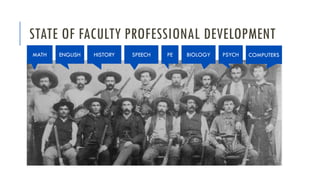
STATE OF FACULTY PROFESSIONAL DEVELOPMENT
MATH ENGLISH HISTORY SPEECH PE BIOLOGY PSYCH COMPUTERS
INTENTIONAL EFFORTS AT MVC
• Sought to improve performance
• Focus on quality and consistency in online
programs and course offerings
• Provide faculty with opportunities for personal
growth and professional development
• Investment in one of our most valuable
resources, our faculty
INTENTIONAL EFFORTS AT MVC
• Focused on desired student experience
• DCCCD Strategic Priorities
• Streamline navigation to and through our system
• Consistency in information and process
• MVC Core Value
• Accommodate 21st century learners by adopting
innovations that promote greater student success
“How might we involve others, seek
external recognition, and create a program
faculty would be proud to be a part of?”
INTENTIONAL EFFORTS AT MVC
Formation of eLearning Work Group
Goal:
• Improve quality, scale, and breadth of online program
and offerings
Deliverables:
1. Summary of Best Practices for Teaching Online
2. Faculty Checklist for Developing Online Courses
3. Professional Development Plan to Support Online
Faculty
INTENTIONAL EFFORTS AT MVC
• Comprised of 26 dedicated faculty and
support staff
• Met several times over the span of multiple
semesters
• Presented findings and recommendations
• Vice President of Instruction
• Faculty forums
• All faculty email
Ismael Aleman
Jean Baker
Doris Barnard
Jean Crissien
Taunya Dixon-Collins
Farzin Farzad
Yasmin Gulzar
Rodney Jackson
Samar Kolailat
Joe Martinez
Rebecca McDowell
Jennifer McGuire
Dana Nachawati
Richard Parra
John Payne
Ulises Rodriguez
Kumars Ranjbaran
Stephanie Scroggins
Rochelle Self-Drake
Denise Shipley
Shahnaz Sokhansanj
Ron Stein
Luke Story
Steve Sosa
Debby Sutton
Tai Tran
ELEARNING WORK GROUP PARTICIPANTS
EXPLORATION OF BEST PRACTICES
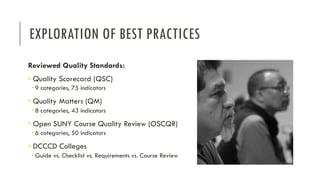
Reviewed Quality Standards:
• Quality Scorecard (QSC)
• 9 categories, 75 indicators
• Quality Matters (QM)
• 8 categories, 43 indicators
• Open SUNY Course Quality Review (OSCQR)
• 6 categories, 50 indicators
• DCCCD Colleges
• Guide vs. Checklist vs. Requirements vs. Course Review
EXPLORATION OF BEST PRACTICES
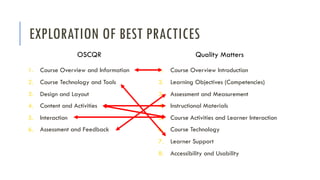
OSCQR
1. Course Overview and Information
2. Course Technology and Tools
3. Design and Layout
4. Content and Activities
5. Interaction
6. Assessment and Feedback
Quality Matters
1. Course Overview Introduction
2. Learning Objectives (Competencies)
3. Assessment and Measurement
4. Instructional Materials
5. Course Activities and Learner Interaction
6. Course Technology
7. Learner Support
8. Accessibility and Usability
EXPLORATION OF BEST PRACTICES
• Compared categories as a whole, across
programs, institutions, and field of higher ed
• Discussed each indicators in depth
• Consolidated and streamlined where possible
EXPLORATION OF BEST PRACTICES
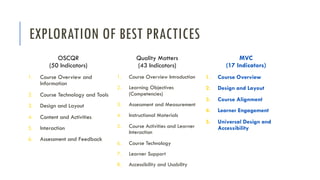
OSCQR
(50 Indicators)
1. Course Overview and
Information
2. Course Technology and Tools
3. Design and Layout
4. Content and Activities
5. Interaction
6. Assessment and Feedback
Quality Matters
(43 Indicators)
1. Course Overview Introduction
2. Learning Objectives
(Competencies)
3. Assessment and Measurement
4. Instructional Materials
5. Course Activities and Learner
Interaction
6. Course Technology
7. Learner Support
8. Accessibility and Usability
MVC
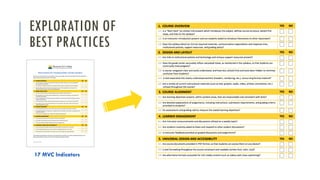
(17 Indicators)
1. Course Overview
2. Design and Layout
3. Course Alignment
4. Learner Engagement
5. Universal Design and
Accessibility
EXPLORATION OF
BEST PRACTICES
17 MVC Indicators
ELEARNING WORK
GROUP CONCLUDED
JUST THE BEGINNING…
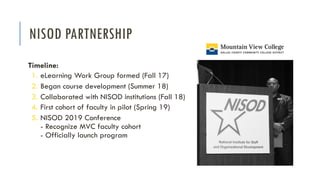
NISOD PARTNERSHIP
NISOD PARTNERSHIP
National Institute for Staff and Organizational
Development (NISOD)
• Based in Austin, Texas
• 40 years of history
• Named, “The country’s leading provider of
professional development for community
college faculty, staff, and administrators” by
the American Association of Community
Colleges
NISOD PARTNERSHIP
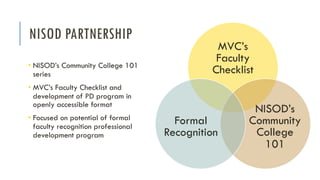
MVC’s
Faculty
Checklist
NISOD’s
Community
College
101
Formal
Recognition
• NISOD’s Community College 101
series
• MVC’s Faculty Checklist and
development of PD program in
openly accessible format
• Focused on potential of formal
faculty recognition professional
development program
NISOD PARTNERSHIP
Partnership Attributes:
­ Openly accessible
­ Competency-based course
­ Digital badging platform to recognize progress
and completion
­ Faculty interviews that shared knowledge,
experience, and teaching philosophies
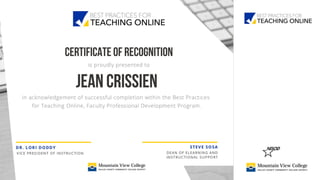
­ National recognition via Faculty Certificate in
“Best Practices for Teaching Online”
NISOD PARTNERSHIP
Timeline:
1. eLearning Work Group formed (Fall 17)
2. Began course development (Summer 18)
3. Collaborated with NISOD institutions (Fall 18)
4. First cohort of faculty in pilot (Spring 19)
5. NISOD 2019 Conference
- Recognize MVC faculty cohort
- Officially launch program
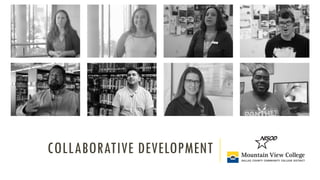
COLLABORATIVE DEVELOPMENT
PROMOTIONAL WEBSITE
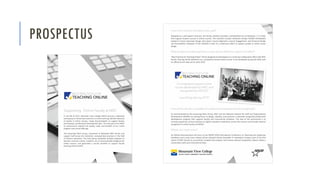
PROSPECTUS
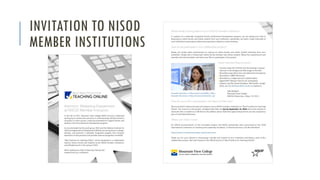
INVITATION TO NISOD
MEMBER INSTITUTIONS
COLLABORATIVE DEVELOPMENT (INTERVIEWS)
• Rio Salado College, AZ
• Palm Beach State College, FL
• Elgin Community College, IL
• Harper College, IL
• Hill College, TX
• Palo Alto College, TX
• Tyler Junior College, TX
https://youtu.be/RQULA8AHyuk
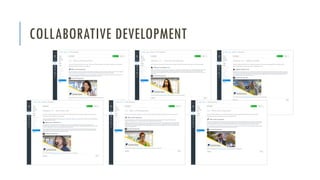
COLLABORATIVE DEVELOPMENT (CONTENT)
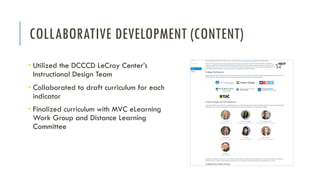
• Utilized the DCCCD LeCroy Center’s
Instructional Design Team
• Collaborated to draft curriculum for each
indicator
• Finalized curriculum with MVC eLearning
Work Group and Distance Learning
Committee
COLLABORATIVE DEVELOPMENT (CONTENT)
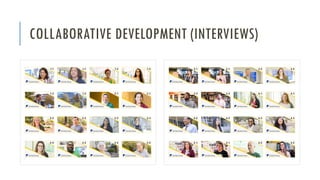
COLLABORATIVE DEVELOPMENT (INTERVIEWS)
https://youtu.be/U7p6rVVmmRA
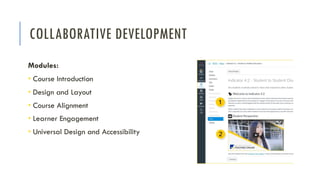
COLLABORATIVE DEVELOPMENT
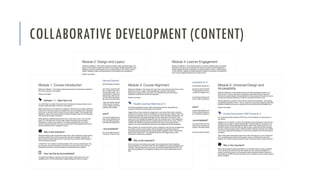
Modules:
• Course Introduction
• Design and Layout
• Course Alignment
• Learner Engagement
• Universal Design and Accessibility
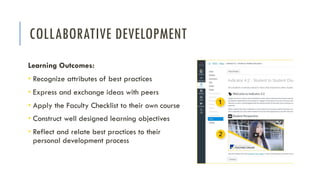
COLLABORATIVE DEVELOPMENT
Learning Outcomes:
• Recognize attributes of best practices
• Express and exchange ideas with peers
• Apply the Faculty Checklist to their own course
• Construct well designed learning objectives
• Reflect and relate best practices to their
personal development process
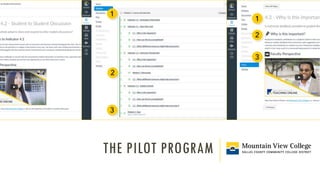
THE PILOT PROGRAM
THE PILOT PROGRAM
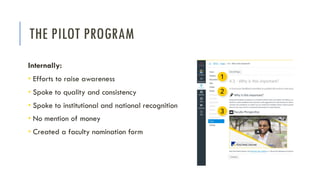
Internally:
• Efforts to raise awareness
• Spoke to quality and consistency
• Spoke to institutional and national recognition
• No mention of money
• Created a faculty nomination form
THE PILOT PROGRAM
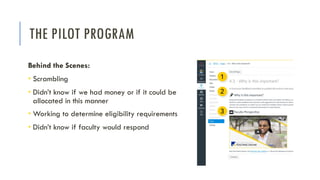
Behind the Scenes:
• Scrambling
• Didn’t know if we had money or if it could be
allocated in this manner
• Working to determine eligibility requirements
• Didn’t know if faculty would respond
THE PILOT PROGRAM
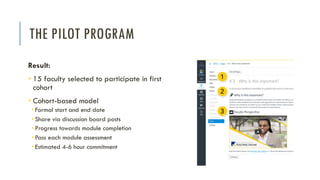
Result:
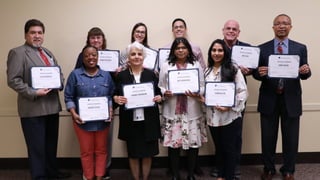
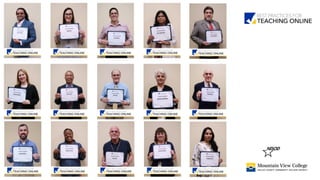
• 15 faculty selected to participate in first
cohort
• Cohort-based model
• Formal start and end date
• Share via discussion board posts
• Progress towards module completion
• Pass each module assessment
• Estimated 4-6 hour commitment
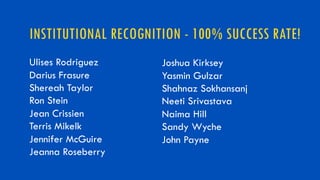
INSTITUTIONAL RECOGNITION
Ulises Rodriguez
Darius Frasure
Shereah Taylor
Ron Stein
Jean Crissien
Terris Mikelk
Jennifer McGuire
Jeanna Roseberry
Joshua Kirksey
Yasmin Gulzar
Shahnaz Sokhansanj
Neeti Srivastava
Naima Hill
Sandy Wyche
John Payne
INSTITUTIONAL RECOGNITION - 100% SUCCESS RATE!
“In my case, I think I can revise and
review every aspect of best practices easily.
The only area I need to start spending
more time in is editing the auto captions
of my videos.”
“If asked by others about my experience, I
would describe it as the best online
professional development training I have
ever taken.”
“Excellent! This course has opened my eyes
to several best practices. It is now time to
revisit my online course and try to
comply with all I learned.”
CONSIDERATIONS FOR ADOPTING
BEST PRACTICES FOR TEACHING ONLINE
CONSIDERATIONS FOR ADOPTING
BEST PRACTICES FOR TEACHING ONLINE
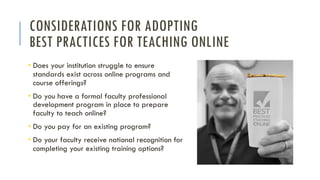
• Does your institution struggle to ensure
standards exist across online programs and
course offerings?
• Do you have a formal faculty professional
development program in place to prepare
faculty to teach online?
• Do you pay for an existing program?
• Do your faculty receive national recognition for
completing your existing training options?
CONSIDERATIONS FOR ADOPTING
BEST PRACTICES FOR TEACHING ONLINE
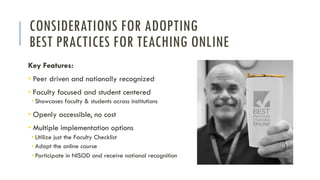
Key Features:
• Peer driven and nationally recognized
• Faculty focused and student centered
• Showcases faculty & students across institutions
• Openly accessible, no cost
• Multiple implementation options
• Utilize just the Faculty Checklist
• Adopt the online course
• Participate in NISOD and receive national recognition
CONSIDERATIONS FOR ADOPTING
BEST PRACTICES FOR TEACHING ONLINE
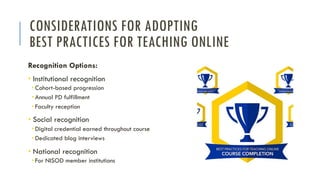
Recognition Options:
• Institutional recognition
• Cohort-based progression
• Annual PD fulfillment
• Faculty reception
• Social recognition
• Digital credential earned throughout course
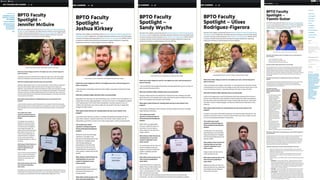
• Dedicated blog interviews
• National recognition
• For NISOD member institutions
QUESTIONS?
THANK YOU!

Launching Best Practices for Teaching Online

  • 2.
    BEST PRACTICES FORTEACHING ONLINE Steve Sosa Dean of eLearning & Instructional Support Dr. Stephanie Scroggins Executive Dean of Social Sciences Jennifer McGuire Instructional Technologist Rebecca McDowell Director of Professional Development
  • 3.
    STATE OF FACULTYPROFESSIONAL DEVELOPMENT IN ONLINE LEARNING
  • 4.
    STATE OF FACULTYPROFESSIONAL DEVELOPMENT Related to Online Learning: • Acknowledge Importance of Continuous Training/Development • Evolution of Technology • Teaching Practices Evolve • Student Expectations and Preferences Evolve • Range of Skills Necessary
  • 5.
    STATE OF FACULTYPROFESSIONAL DEVELOPMENT Reality of Higher Education: • Limited Funding • Limited Staff • Formal Programs can be Expensive • Licensing/Participation • Instructional Design Team/Infrastructure • Not Seen as Mission Critical
  • 6.
    STATE OF FACULTYPROFESSIONAL DEVELOPMENT MATH ENGLISH HISTORY SPEECH PE BIOLOGY PSYCH COMPUTERS
  • 7.
  • 8.
    INTENTIONAL EFFORTS ATMVC • Sought to improve performance • Focus on quality and consistency in online programs and course offerings • Provide faculty with opportunities for personal growth and professional development • Investment in one of our most valuable resources, our faculty
  • 9.
    INTENTIONAL EFFORTS ATMVC • Focused on desired student experience • DCCCD Strategic Priorities • Streamline navigation to and through our system • Consistency in information and process • MVC Core Value • Accommodate 21st century learners by adopting innovations that promote greater student success
  • 10.
    “How might weinvolve others, seek external recognition, and create a program faculty would be proud to be a part of?”
  • 11.
    INTENTIONAL EFFORTS ATMVC Formation of eLearning Work Group Goal: • Improve quality, scale, and breadth of online program and offerings Deliverables: 1. Summary of Best Practices for Teaching Online 2. Faculty Checklist for Developing Online Courses 3. Professional Development Plan to Support Online Faculty
  • 12.
    INTENTIONAL EFFORTS ATMVC • Comprised of 26 dedicated faculty and support staff • Met several times over the span of multiple semesters • Presented findings and recommendations • Vice President of Instruction • Faculty forums • All faculty email
  • 13.
    Ismael Aleman Jean Baker DorisBarnard Jean Crissien Taunya Dixon-Collins Farzin Farzad Yasmin Gulzar Rodney Jackson Samar Kolailat Joe Martinez Rebecca McDowell Jennifer McGuire Dana Nachawati Richard Parra John Payne Ulises Rodriguez Kumars Ranjbaran Stephanie Scroggins Rochelle Self-Drake Denise Shipley Shahnaz Sokhansanj Ron Stein Luke Story Steve Sosa Debby Sutton Tai Tran ELEARNING WORK GROUP PARTICIPANTS
  • 14.
  • 15.
    EXPLORATION OF BESTPRACTICES Reviewed Quality Standards: • Quality Scorecard (QSC) • 9 categories, 75 indicators • Quality Matters (QM) • 8 categories, 43 indicators • Open SUNY Course Quality Review (OSCQR) • 6 categories, 50 indicators • DCCCD Colleges • Guide vs. Checklist vs. Requirements vs. Course Review
  • 16.
    EXPLORATION OF BESTPRACTICES OSCQR 1. Course Overview and Information 2. Course Technology and Tools 3. Design and Layout 4. Content and Activities 5. Interaction 6. Assessment and Feedback Quality Matters 1. Course Overview Introduction 2. Learning Objectives (Competencies) 3. Assessment and Measurement 4. Instructional Materials 5. Course Activities and Learner Interaction 6. Course Technology 7. Learner Support 8. Accessibility and Usability
  • 17.
    EXPLORATION OF BESTPRACTICES • Compared categories as a whole, across programs, institutions, and field of higher ed • Discussed each indicators in depth • Consolidated and streamlined where possible
  • 18.
    EXPLORATION OF BESTPRACTICES OSCQR (50 Indicators) 1. Course Overview and Information 2. Course Technology and Tools 3. Design and Layout 4. Content and Activities 5. Interaction 6. Assessment and Feedback Quality Matters (43 Indicators) 1. Course Overview Introduction 2. Learning Objectives (Competencies) 3. Assessment and Measurement 4. Instructional Materials 5. Course Activities and Learner Interaction 6. Course Technology 7. Learner Support 8. Accessibility and Usability MVC (17 Indicators) 1. Course Overview 2. Design and Layout 3. Course Alignment 4. Learner Engagement 5. Universal Design and Accessibility
  • 19.
  • 21.
  • 22.
  • 23.
    NISOD PARTNERSHIP National Institutefor Staff and Organizational Development (NISOD) • Based in Austin, Texas • 40 years of history • Named, “The country’s leading provider of professional development for community college faculty, staff, and administrators” by the American Association of Community Colleges
  • 24.
    NISOD PARTNERSHIP MVC’s Faculty Checklist NISOD’s Community College 101 Formal Recognition • NISOD’sCommunity College 101 series • MVC’s Faculty Checklist and development of PD program in openly accessible format • Focused on potential of formal faculty recognition professional development program
  • 25.
    NISOD PARTNERSHIP Partnership Attributes: ­Openly accessible ­ Competency-based course ­ Digital badging platform to recognize progress and completion ­ Faculty interviews that shared knowledge, experience, and teaching philosophies ­ National recognition via Faculty Certificate in “Best Practices for Teaching Online”
  • 26.
    NISOD PARTNERSHIP Timeline: 1. eLearningWork Group formed (Fall 17) 2. Began course development (Summer 18) 3. Collaborated with NISOD institutions (Fall 18) 4. First cohort of faculty in pilot (Spring 19) 5. NISOD 2019 Conference - Recognize MVC faculty cohort - Officially launch program
  • 27.
  • 28.
  • 29.
  • 30.
  • 31.
    COLLABORATIVE DEVELOPMENT (INTERVIEWS) •Rio Salado College, AZ • Palm Beach State College, FL • Elgin Community College, IL • Harper College, IL • Hill College, TX • Palo Alto College, TX • Tyler Junior College, TX
  • 33.
  • 34.
    COLLABORATIVE DEVELOPMENT (CONTENT) •Utilized the DCCCD LeCroy Center’s Instructional Design Team • Collaborated to draft curriculum for each indicator • Finalized curriculum with MVC eLearning Work Group and Distance Learning Committee
  • 35.
  • 36.
  • 37.
  • 38.
  • 39.
    COLLABORATIVE DEVELOPMENT Modules: • CourseIntroduction • Design and Layout • Course Alignment • Learner Engagement • Universal Design and Accessibility
  • 40.
    COLLABORATIVE DEVELOPMENT Learning Outcomes: •Recognize attributes of best practices • Express and exchange ideas with peers • Apply the Faculty Checklist to their own course • Construct well designed learning objectives • Reflect and relate best practices to their personal development process
  • 42.
  • 43.
    THE PILOT PROGRAM Internally: •Efforts to raise awareness • Spoke to quality and consistency • Spoke to institutional and national recognition • No mention of money • Created a faculty nomination form
  • 44.
    THE PILOT PROGRAM Behindthe Scenes: • Scrambling • Didn’t know if we had money or if it could be allocated in this manner • Working to determine eligibility requirements • Didn’t know if faculty would respond
  • 45.
    THE PILOT PROGRAM Result: •15 faculty selected to participate in first cohort • Cohort-based model • Formal start and end date • Share via discussion board posts • Progress towards module completion • Pass each module assessment • Estimated 4-6 hour commitment
  • 46.
  • 47.
    Ulises Rodriguez Darius Frasure ShereahTaylor Ron Stein Jean Crissien Terris Mikelk Jennifer McGuire Jeanna Roseberry Joshua Kirksey Yasmin Gulzar Shahnaz Sokhansanj Neeti Srivastava Naima Hill Sandy Wyche John Payne INSTITUTIONAL RECOGNITION - 100% SUCCESS RATE!
  • 50.
    “In my case,I think I can revise and review every aspect of best practices easily. The only area I need to start spending more time in is editing the auto captions of my videos.”
  • 51.
    “If asked byothers about my experience, I would describe it as the best online professional development training I have ever taken.”
  • 52.
    “Excellent! This coursehas opened my eyes to several best practices. It is now time to revisit my online course and try to comply with all I learned.”
  • 56.
    CONSIDERATIONS FOR ADOPTING BESTPRACTICES FOR TEACHING ONLINE
  • 57.
    CONSIDERATIONS FOR ADOPTING BESTPRACTICES FOR TEACHING ONLINE • Does your institution struggle to ensure standards exist across online programs and course offerings? • Do you have a formal faculty professional development program in place to prepare faculty to teach online? • Do you pay for an existing program? • Do your faculty receive national recognition for completing your existing training options?
  • 58.
    CONSIDERATIONS FOR ADOPTING BESTPRACTICES FOR TEACHING ONLINE Key Features: • Peer driven and nationally recognized • Faculty focused and student centered • Showcases faculty & students across institutions • Openly accessible, no cost • Multiple implementation options • Utilize just the Faculty Checklist • Adopt the online course • Participate in NISOD and receive national recognition
  • 59.
    CONSIDERATIONS FOR ADOPTING BESTPRACTICES FOR TEACHING ONLINE Recognition Options: • Institutional recognition • Cohort-based progression • Annual PD fulfillment • Faculty reception • Social recognition • Digital credential earned throughout course • Dedicated blog interviews • National recognition • For NISOD member institutions
  • 61.
  • 62.