

APPLYING GAMIFICATION PRINCIPLES
TO ONLINE FACULTY PROFESSIONAL DEVELOPMENT
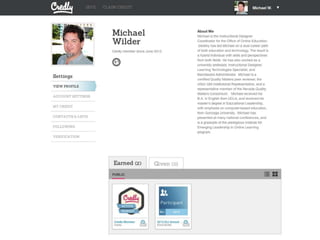
Michael Wilder
October 29, 2014
S E S S I O N E VA L U AT I O N S
As a part of our “green”
initiatives, OLC is no longer
using paper forms for
session evaluations. Please
use the OLC Conference
mobile app to evaluate this
session. Navigate to this
session listing, then click
on “Rate this Session”.
Applying
Gamification
Principles to
Online Faculty
Professional
Development
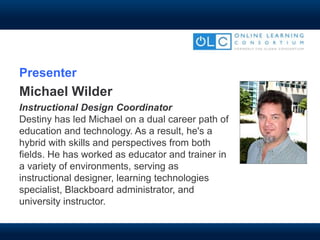
Presenter
Michael Wilder
Instructional Design Coordinator
Destiny has led Michael on a dual career path of
education and technology. As a result, he's a
hybrid with skills and perspectives from both
fields. He has worked as educator and trainer in
a variety of environments, serving as
instructional designer, learning technologies
specialist, Blackboard administrator, and
university instructor.
Learning Objectives
By attending this presentation, participants will be able to:
• Discuss the challenges of online professional
development (PD)
• Identify potential solutions for providing PD to higher
education faculty
• Define essential gamification principles
• Develop a basic badge issuing system
• Analyze a case study applying these methods
Questions
• How many ever taught an online course?
• How many have ever received formal training
on online teaching and learning pedagogy and
tool use?
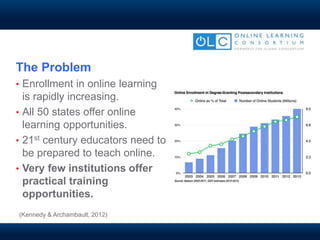
The Problem
• Enrollment in online learning
is rapidly increasing.
• All 50 states offer online
learning opportunities.
• 21st century educators need to
be prepared to teach online.
• Very few institutions offer
practical training
opportunities.
(Kennedy & Archambault, 2012)
UNLV Online Education
• 300 – 400 online or hybrid
sections per semester
• Similar # of instructors
• Many courses taught by
part-time instructors
• Many new instructors every
semester (with little or no
prior online teaching
experience)
Our Mission
Provide online professional
development for online instructors.
• Online teaching and learning pedagogy
• Course planning and development
• Best-practice models for faculty to see
what the environment looks like
• Opportunity for faculty to experience an
online course as a student
• Experience with technology and tool use
• Identify helpful resources
The Art & Science of Teaching Online
Version 1.0
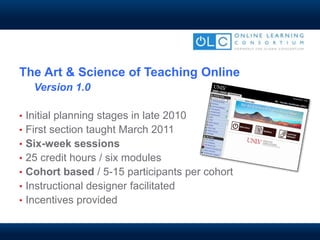
• Initial planning stages in late 2010
• First section taught March 2011
• Six-week sessions
• 25 credit hours / six modules
• Cohort based / 5-15 participants per cohort
• Instructional designer facilitated
• Incentives provided
The Art & Science of Teaching Online
Version 1.0
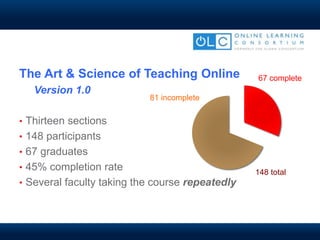
• Thirteen sections
• 148 participants
• 67 graduates
• 45% completion rate
• Several faculty taking the course repeatedly
67 complete
81 incomplete
148 total
Questions
Imagine yourself in a position to provide professional
development to online educators.
• What are some ways you could encourage higher
completion rates?
• How could you build flexibility so that educators
keep coming back for additional training?
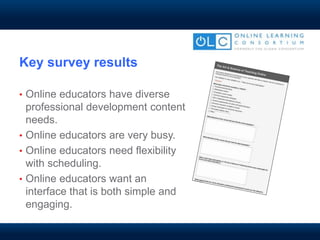
Key survey results
• Online educators have diverse
professional development content
needs.
• Online educators are very busy.
• Online educators need flexibility
with scheduling.
• Online educators want an
interface that is both simple and
engaging.
Open ended
• No start or end date
• Complete on your own schedule
• Certificate of completion after all
six modules
Solution
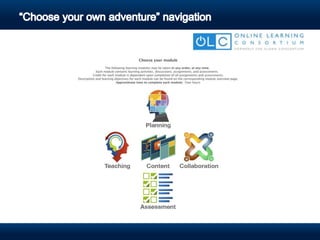
Non-linear
• “Choose your own adventure”
• Modules can be taken in any
order
Solution
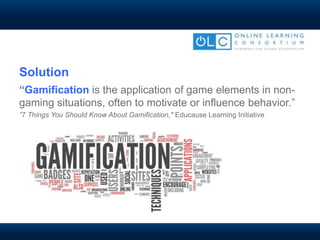
“Gamification is the application of game elements in non-
gaming situations, often to motivate or influence behavior.”
”7 Things You Should Know About Gamification," Educause Learning Initiative
Solution
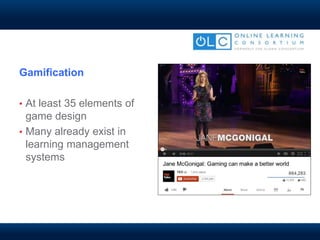
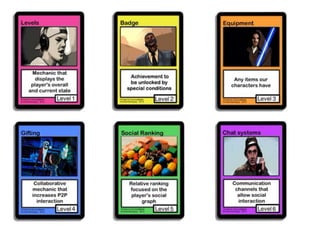
Gamification
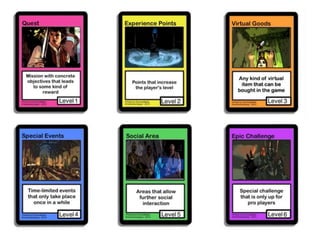
• At least 35 elements of
game design
• Many already exist in
learning management
systems
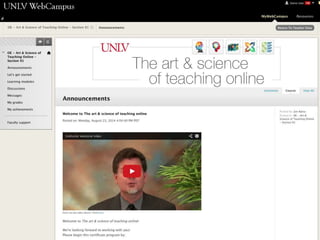
Case Study
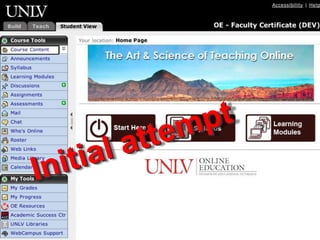
The Art &
Science of
Teaching Online
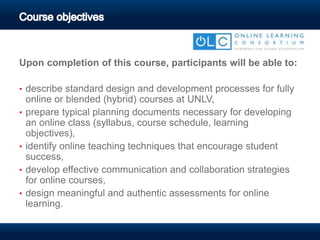
Upon completion of this course, participants will be able to:
• describe standard design and development processes for fully
online or blended (hybrid) courses at UNLV,
• prepare typical planning documents necessary for developing
an online class (syllabus, course schedule, learning
objectives),
• identify online teaching techniques that encourage student
success,
• develop effective communication and collaboration strategies
for online courses,
• design meaningful and authentic assessments for online
learning.
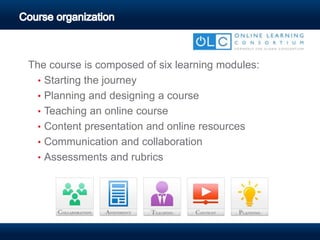
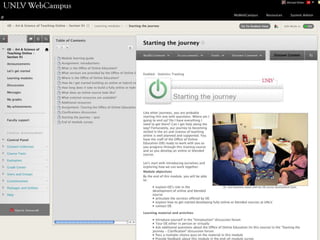
The course is composed of six learning modules:
• Starting the journey
• Planning and designing a course
• Teaching an online course
• Content presentation and online resources
• Communication and collaboration
• Assessments and rubrics
Faculty are encouraged to share
challenges and successes,
resources, ideas, and thoughts
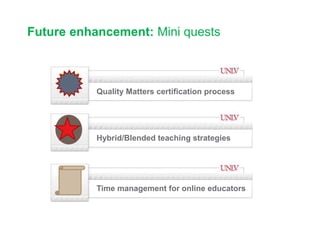
Future enhancement: Mini quests
Learning Theory?
-
Learning Theory?
Learning Theory?
Quality Matters certification process
Hybrid/Blended teaching strategies
Time management for online educators
Questions
• What additional topics could be added for
online faculty professional development?
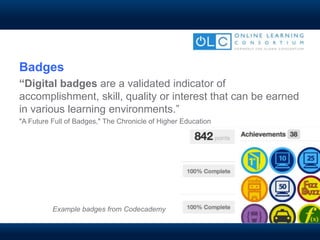
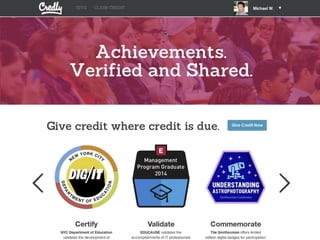
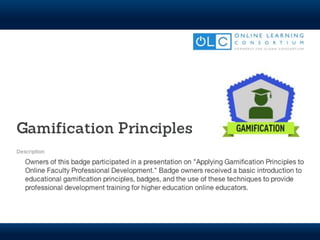
Badges
“Digital badges are a validated indicator of
accomplishment, skill, quality or interest that can be earned
in various learning environments.”
"A Future Full of Badges," The Chronicle of Higher Education
Example badges from Codecademy
Badges
• Bullet point #1
• Bullet point #2
• Bullet point #3
• Bullet point #4
• Bullet point #5
Badges
• Bullet point #1
• Bullet point #2
• Bullet point #3
• Bullet point #4
• Bullet point #5
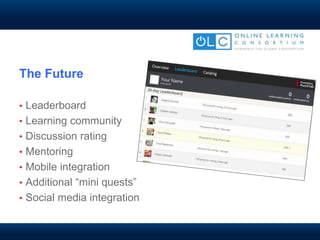
The Future
• Leaderboard
• Learning community
• Discussion rating
• Mentoring
• Mobile integration
• Additional “mini quests”
• Social media integration
Questions – Tie Breakers
“Over 5 million people play an average of _____
hours a week of games.”
Questions – Tie Breakers
“As a planet, we spend ______ hours a week
playing video and computer games.”
Questions?
Michael Wilder
E-mail: michael.wilder@unlv.edu
Phone: 702-879-8454
Web: http://online.unlv.edu

Applying Gamification Principles to Online Faculty Professional Development

  • 1.
    APPLYING GAMIFICATION PRINCIPLES TOONLINE FACULTY PROFESSIONAL DEVELOPMENT Michael Wilder October 29, 2014
  • 2.
    S E SS I O N E VA L U AT I O N S As a part of our “green” initiatives, OLC is no longer using paper forms for session evaluations. Please use the OLC Conference mobile app to evaluate this session. Navigate to this session listing, then click on “Rate this Session”.
  • 3.
  • 4.
    Presenter Michael Wilder Instructional DesignCoordinator Destiny has led Michael on a dual career path of education and technology. As a result, he's a hybrid with skills and perspectives from both fields. He has worked as educator and trainer in a variety of environments, serving as instructional designer, learning technologies specialist, Blackboard administrator, and university instructor.
  • 5.
    Learning Objectives By attendingthis presentation, participants will be able to: • Discuss the challenges of online professional development (PD) • Identify potential solutions for providing PD to higher education faculty • Define essential gamification principles • Develop a basic badge issuing system • Analyze a case study applying these methods
  • 6.
    Questions • How manyever taught an online course? • How many have ever received formal training on online teaching and learning pedagogy and tool use?
  • 7.
    The Problem • Enrollmentin online learning is rapidly increasing. • All 50 states offer online learning opportunities. • 21st century educators need to be prepared to teach online. • Very few institutions offer practical training opportunities. (Kennedy & Archambault, 2012)
  • 8.
    UNLV Online Education •300 – 400 online or hybrid sections per semester • Similar # of instructors • Many courses taught by part-time instructors • Many new instructors every semester (with little or no prior online teaching experience)
  • 9.
    Our Mission Provide onlineprofessional development for online instructors. • Online teaching and learning pedagogy • Course planning and development • Best-practice models for faculty to see what the environment looks like • Opportunity for faculty to experience an online course as a student • Experience with technology and tool use • Identify helpful resources
  • 10.
    The Art &Science of Teaching Online Version 1.0 • Initial planning stages in late 2010 • First section taught March 2011 • Six-week sessions • 25 credit hours / six modules • Cohort based / 5-15 participants per cohort • Instructional designer facilitated • Incentives provided
  • 12.
    The Art &Science of Teaching Online Version 1.0 • Thirteen sections • 148 participants • 67 graduates • 45% completion rate • Several faculty taking the course repeatedly 67 complete 81 incomplete 148 total
  • 13.
    Questions Imagine yourself ina position to provide professional development to online educators. • What are some ways you could encourage higher completion rates? • How could you build flexibility so that educators keep coming back for additional training?
  • 14.
    Key survey results •Online educators have diverse professional development content needs. • Online educators are very busy. • Online educators need flexibility with scheduling. • Online educators want an interface that is both simple and engaging.
  • 15.
    Open ended • Nostart or end date • Complete on your own schedule • Certificate of completion after all six modules Solution
  • 16.
    Non-linear • “Choose yourown adventure” • Modules can be taken in any order Solution
  • 17.
    “Gamification is theapplication of game elements in non- gaming situations, often to motivate or influence behavior.” ”7 Things You Should Know About Gamification," Educause Learning Initiative Solution
  • 18.
    Gamification • At least35 elements of game design • Many already exist in learning management systems
  • 21.
    Case Study The Art& Science of Teaching Online
  • 23.
    Upon completion ofthis course, participants will be able to: • describe standard design and development processes for fully online or blended (hybrid) courses at UNLV, • prepare typical planning documents necessary for developing an online class (syllabus, course schedule, learning objectives), • identify online teaching techniques that encourage student success, • develop effective communication and collaboration strategies for online courses, • design meaningful and authentic assessments for online learning.
  • 24.
    The course iscomposed of six learning modules: • Starting the journey • Planning and designing a course • Teaching an online course • Content presentation and online resources • Communication and collaboration • Assessments and rubrics
  • 28.
    Faculty are encouragedto share challenges and successes, resources, ideas, and thoughts
  • 29.
    Future enhancement: Miniquests Learning Theory? - Learning Theory? Learning Theory? Quality Matters certification process Hybrid/Blended teaching strategies Time management for online educators
  • 30.
    Questions • What additionaltopics could be added for online faculty professional development?
  • 31.
    Badges “Digital badges area validated indicator of accomplishment, skill, quality or interest that can be earned in various learning environments.” "A Future Full of Badges," The Chronicle of Higher Education Example badges from Codecademy
  • 32.
    Badges • Bullet point#1 • Bullet point #2 • Bullet point #3 • Bullet point #4 • Bullet point #5
  • 33.
    Badges • Bullet point#1 • Bullet point #2 • Bullet point #3 • Bullet point #4 • Bullet point #5
  • 35.
    The Future • Leaderboard •Learning community • Discussion rating • Mentoring • Mobile integration • Additional “mini quests” • Social media integration
  • 36.
    Questions – TieBreakers “Over 5 million people play an average of _____ hours a week of games.”
  • 37.
    Questions – TieBreakers “As a planet, we spend ______ hours a week playing video and computer games.”
  • 38.
  • 39.
    Michael Wilder E-mail: michael.wilder@unlv.edu Phone:702-879-8454 Web: http://online.unlv.edu

Editor's Notes

  • #4 Title screen
  • #5 Introduction
  • #6 Learning objectives
  • #7 Engagement of prior learning
  • #13 Our problem
  • #14 Engagement of prior learning
  • #15 Learning theory vs. tool use
  • #16 Still moderated Asynchronous discussions Rating system for discussions
  • #17 Still moderated Asynchronous discussions Rating system for discussions
  • #22 Title screen
  • #23 Welcome to a Course Tour Open entry Self paced Course never ends
  • #28 Project based and collaborative learning activities
  • #29 Faculty lounge – a place for collaboration
  • #30 Learning Quests – After 5 main quests completed, could unlock additional “mini quests”. What topics might be good for additional quests? -
  • #31 Question – Additional Learning quest – topics for faculty PD
  • #37 Answer: 45
  • #38 Answer: 3 billion
  • #40 Please copy the address above http://tinyurl.com/86vahp5 into the chat window.