A
A
Latest technology trends
Pega Hrnjak
pega@illinois.edu
Director ACRC,
Will Stoecker Res. Professor,
University of Illinois, Urbana-Champaign, USA
President, CTS, Creative Thermal Solutions
A
P. Hrnjak 3/29
Light commercial refrigeration
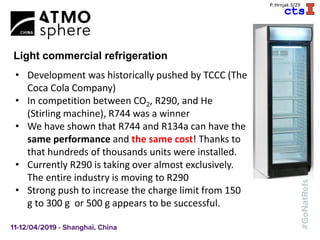
• Development was historically pushed by TCCC (The
Coca Cola Company)
• In competition between CO2, R290, and He
(Stirling machine), R744 was a winner
• We have shown that R744 and R134a can have the
same performance and the same cost! Thanks to
that hundreds of thousands units were installed.
• Currently R290 is taking over almost exclusively.
The entire industry is moving to R290
• Strong push to increase the charge limit from 150
g to 300 g or 500 g appears to be successful.
A
P. Hrnjak 4/29
Commercial refrigeration with CO2, HC and NH3
• CO2
• Self contained display cases: not as well spread as
centralized
• Centralized (racks) systems extremely successful in Europe
and Japan, USA and Canada behind, China just started
• HC (R290)
• Self contained, low charged only. Very successful
• Water loops are increasingly attractive
• NH3 only as a chiller or high stage in cascades with R744. At
this point just trials.
A
P. Hrnjak 5/29
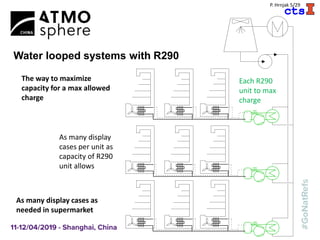
Water looped systems with R290
Each R290
unit to max
charge
As many display
cases per unit as
capacity of R290
unit allows
As many display cases as
needed in supermarket
The way to maximize
capacity for a max allowed
charge
A
P. Hrnjak 6/29
Industrial refrigeration
90-95% of industrial refrigeration in USA is with NH3!
Major trends:
• Low charge NH3 systems vs. NH3 and NH3/CO2 systems
• Numerous starts with CO2 transcritical in large projects.
A
P. Hrnjak 7/29
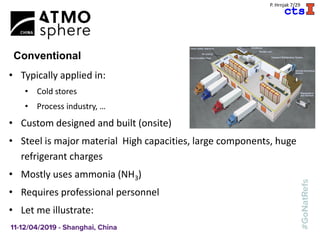
Conventional
• Typically applied in:
• Cold stores
• Process industry, …
• Custom designed and built (onsite)
• Steel is major material High capacities, large components, huge
refrigerant charges
• Mostly uses ammonia (NH3)
• Requires professional personnel
• Let me illustrate:
A
P. Hrnjak 8/29
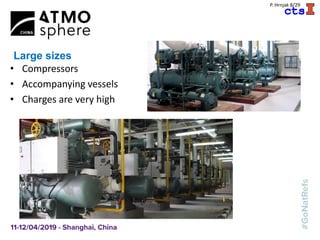
Large sizes
• Compressors
• Accompanying vessels
• Charges are very high
A
P. Hrnjak 9/29
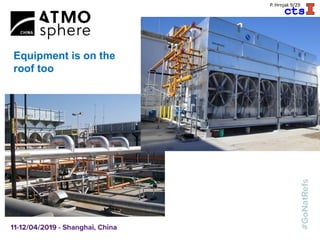
Equipment is on the
roof too
A
P. Hrnjak 10/29
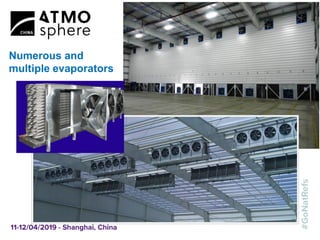
Numerous and
multiple evaporators
A
P. Hrnjak 11/29
Ammonia in China
• After several lethal incidents in NH3 plants this excellent
refrigerant, used in 90-95% or cold stores in USA is
questioned
• These incidents were the cases of serious negligence, not of
ammonia
• New approach with low, and ultra low charges is perfect way
to mitigate even that problem:
• Much lower charge
• Factory made systems have much higher quality and
better safety
A
P. Hrnjak 12/29
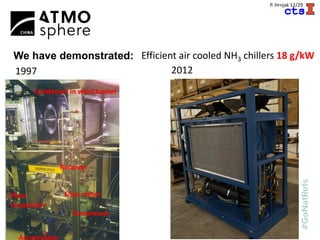
Condenser in wind tunnel
Compressor
Accumulator
Plate
evaporator
Receiver
Flow meter
We have demonstrated: Efficient air cooled NH3 chillers 18 g/kW
1997 2012
A
P. Hrnjak 13/29
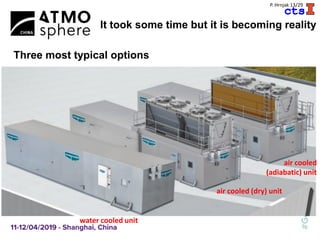
Three most typical options
water cooled unit
air cooled (dry) unit
air cooled
(adiabatic) unit
It took some time but it is becoming reality
A
P. Hrnjak 14/29
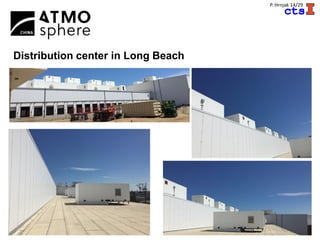
Distribution center in Long Beach
A
P. Hrnjak 15/29
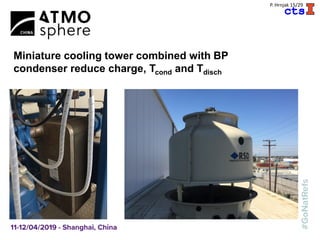
Miniature cooling tower combined with BP
condenser reduce charge, Tcond and Tdisch
A
P. Hrnjak 16/29
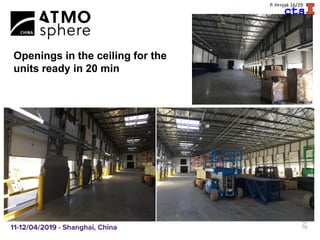
Openings in the ceiling for the
units ready in 20 min
A
P. Hrnjak 17/29
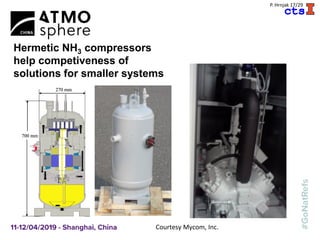
Hermetic NH3 compressors
help competiveness of
solutions for smaller systems
700 mm
270 mm
700 mm
270 mm
700 mm
270 mm
Courtesy Mycom, Inc.
A
P. Hrnjak 18/29
Why these trends in NH3
• SAFETY!!!
• Fluid like NH3 is the best for charge reduction: thermophysical
properties are good but more importantly mildly toxic and
mildly flammable is the best to be handled by low charge
• It is not a question if there will be disasters like in Fukushima
– that is just a matter of time
• Users want to be proactive
• “Mass” production = lower costs
• Empty market for grab: no OEMs
• Active companies see the opportunity
A
P. Hrnjak 19/29
Transport and mobile application
• 20 years ago we developed excellent R744 systems that were
equally efficient as R134a but R1234yf was selected
• Today, heat pumps for electric cars are pushing
• I will leave this topics to prof. Chen
• We have developed the first R744 system for the fastest
Chinese train that is 5% more efficient and 10% smaller than
the baseline HFC
• I will leave that topic to Mr. Bai from CRRC
A
P. Hrnjak 20/29
AC & HPs - what is the future?
• The most uncertain predictions
• USA OEMs bets on blends (mixtures): R452, R454,…
• Japanese lean towards R32 or R1224yd/1123 in some mixture
• China seem to be influenced by all above, but strongest push
comes from Europeans towards R290
• I believe eventually R744 will win but after going through one
or two interim solutions.
• Why I think so?
A
P. Hrnjak 21/29
Why I think so? Interim solutions
• L2Ls or A3s are very attractive as easier solutions for
businesses
• Flammability will most likely cause some problems
• Experts in industry are aware of that, but are not ready to talk
• Some like R1123 for being A1
A
P. Hrnjak 22/29
Why I think so? CO2
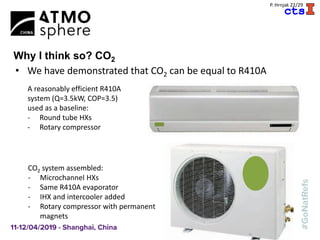
A reasonably efficient R410A
system (Q=3.5kW, COP=3.5)
used as a baseline:
- Round tube HXs
- Rotary compressor
CO2 system assembled:
- Microchannel HXs
- Same R410A evaporator
- IHX and intercooler added
- Rotary compressor with permanent
magnets
• We have demonstrated that CO2 can be equal to R410A
A
P. Hrnjak 23/29
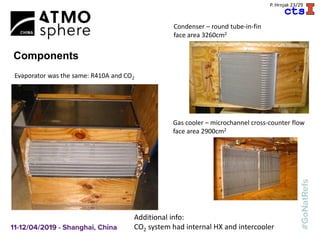
Components
Gas cooler – microchannel cross-counter flow
face area 2900cm2
Evaporator was the same: R410A and CO2
Condenser – round tube-in-fin
face area 3260cm2
Additional info:
CO2 system had internal HX and intercooler
A
P. Hrnjak 24/29
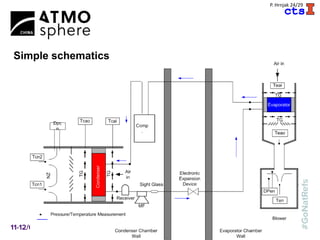
Simple schematics
A
P. Hrnjak 25/29
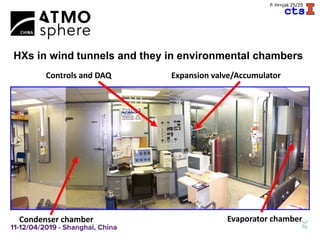
HXs in wind tunnels and they in environmental chambers
Condenser chamber Evaporator chamber
Expansion valve/AccumulatorControls and DAQ
A
P. Hrnjak 26/29
0.00
1.00
2.00
3.00
4.00
ARI A ARI B ARI C
Coolingcapacity[kW]
0.00
1.00
2.00
3.00
4.00
ARI A ARI B ARI C
COP[-]
R744 serpentine microchannel
R410A round tube-in-fin
Extremely close performance
A
P. Hrnjak 27/29
Efficiency will be less important than today
• Once all or most of electricity will be produced w/o CO2
emission, efficiency is a matter of cost only
• At this point NONFLAMMABLE and NONTOXIC, low GWP is
the most logical choice. There is only one fluid like that
• The knowledge gap will be closed.
• Mechanical engineers will be better educated and have
stronger support.
• Public support will be even stronger
A
P. Hrnjak 28/29
Conclusions
• R290 in light commercial
• CO2 in commercial refrigeration, R290 in secondary looped
systems
• Industrial: LOW CHARGE, PREFABRICATED systems (some are
looking in transcitical CO2)
• Transport AC and refrigeration: great steps forward for CO2
• Mobile AC: rejuvenated heat pumps with CO2
• Reversible AC/HP eventually CO2 after interim solutions with
blends
A

Latest technology trends by Prof. Hrnjak

  • 1.
  • 2.
    A Latest technology trends PegaHrnjak pega@illinois.edu Director ACRC, Will Stoecker Res. Professor, University of Illinois, Urbana-Champaign, USA President, CTS, Creative Thermal Solutions
  • 3.
    A P. Hrnjak 3/29 Lightcommercial refrigeration • Development was historically pushed by TCCC (The Coca Cola Company) • In competition between CO2, R290, and He (Stirling machine), R744 was a winner • We have shown that R744 and R134a can have the same performance and the same cost! Thanks to that hundreds of thousands units were installed. • Currently R290 is taking over almost exclusively. The entire industry is moving to R290 • Strong push to increase the charge limit from 150 g to 300 g or 500 g appears to be successful.
  • 4.
    A P. Hrnjak 4/29 Commercialrefrigeration with CO2, HC and NH3 • CO2 • Self contained display cases: not as well spread as centralized • Centralized (racks) systems extremely successful in Europe and Japan, USA and Canada behind, China just started • HC (R290) • Self contained, low charged only. Very successful • Water loops are increasingly attractive • NH3 only as a chiller or high stage in cascades with R744. At this point just trials.
  • 5.
    A P. Hrnjak 5/29 Waterlooped systems with R290 Each R290 unit to max charge As many display cases per unit as capacity of R290 unit allows As many display cases as needed in supermarket The way to maximize capacity for a max allowed charge
  • 6.
    A P. Hrnjak 6/29 Industrialrefrigeration 90-95% of industrial refrigeration in USA is with NH3! Major trends: • Low charge NH3 systems vs. NH3 and NH3/CO2 systems • Numerous starts with CO2 transcritical in large projects.
  • 7.
    A P. Hrnjak 7/29 Conventional •Typically applied in: • Cold stores • Process industry, … • Custom designed and built (onsite) • Steel is major material High capacities, large components, huge refrigerant charges • Mostly uses ammonia (NH3) • Requires professional personnel • Let me illustrate:
  • 8.
    A P. Hrnjak 8/29 Largesizes • Compressors • Accompanying vessels • Charges are very high
  • 9.
    A P. Hrnjak 9/29 Equipmentis on the roof too
  • 10.
    A P. Hrnjak 10/29 Numerousand multiple evaporators
  • 11.
    A P. Hrnjak 11/29 Ammoniain China • After several lethal incidents in NH3 plants this excellent refrigerant, used in 90-95% or cold stores in USA is questioned • These incidents were the cases of serious negligence, not of ammonia • New approach with low, and ultra low charges is perfect way to mitigate even that problem: • Much lower charge • Factory made systems have much higher quality and better safety
  • 12.
    A P. Hrnjak 12/29 Condenserin wind tunnel Compressor Accumulator Plate evaporator Receiver Flow meter We have demonstrated: Efficient air cooled NH3 chillers 18 g/kW 1997 2012
  • 13.
    A P. Hrnjak 13/29 Threemost typical options water cooled unit air cooled (dry) unit air cooled (adiabatic) unit It took some time but it is becoming reality
  • 14.
    A P. Hrnjak 14/29 Distributioncenter in Long Beach
  • 15.
    A P. Hrnjak 15/29 Miniaturecooling tower combined with BP condenser reduce charge, Tcond and Tdisch
  • 16.
    A P. Hrnjak 16/29 Openingsin the ceiling for the units ready in 20 min
  • 17.
    A P. Hrnjak 17/29 HermeticNH3 compressors help competiveness of solutions for smaller systems 700 mm 270 mm 700 mm 270 mm 700 mm 270 mm Courtesy Mycom, Inc.
  • 18.
    A P. Hrnjak 18/29 Whythese trends in NH3 • SAFETY!!! • Fluid like NH3 is the best for charge reduction: thermophysical properties are good but more importantly mildly toxic and mildly flammable is the best to be handled by low charge • It is not a question if there will be disasters like in Fukushima – that is just a matter of time • Users want to be proactive • “Mass” production = lower costs • Empty market for grab: no OEMs • Active companies see the opportunity
  • 19.
    A P. Hrnjak 19/29 Transportand mobile application • 20 years ago we developed excellent R744 systems that were equally efficient as R134a but R1234yf was selected • Today, heat pumps for electric cars are pushing • I will leave this topics to prof. Chen • We have developed the first R744 system for the fastest Chinese train that is 5% more efficient and 10% smaller than the baseline HFC • I will leave that topic to Mr. Bai from CRRC
  • 20.
    A P. Hrnjak 20/29 AC& HPs - what is the future? • The most uncertain predictions • USA OEMs bets on blends (mixtures): R452, R454,… • Japanese lean towards R32 or R1224yd/1123 in some mixture • China seem to be influenced by all above, but strongest push comes from Europeans towards R290 • I believe eventually R744 will win but after going through one or two interim solutions. • Why I think so?
  • 21.
    A P. Hrnjak 21/29 WhyI think so? Interim solutions • L2Ls or A3s are very attractive as easier solutions for businesses • Flammability will most likely cause some problems • Experts in industry are aware of that, but are not ready to talk • Some like R1123 for being A1
  • 22.
    A P. Hrnjak 22/29 WhyI think so? CO2 A reasonably efficient R410A system (Q=3.5kW, COP=3.5) used as a baseline: - Round tube HXs - Rotary compressor CO2 system assembled: - Microchannel HXs - Same R410A evaporator - IHX and intercooler added - Rotary compressor with permanent magnets • We have demonstrated that CO2 can be equal to R410A
  • 23.
    A P. Hrnjak 23/29 Components Gascooler – microchannel cross-counter flow face area 2900cm2 Evaporator was the same: R410A and CO2 Condenser – round tube-in-fin face area 3260cm2 Additional info: CO2 system had internal HX and intercooler
  • 24.
  • 25.
    A P. Hrnjak 25/29 HXsin wind tunnels and they in environmental chambers Condenser chamber Evaporator chamber Expansion valve/AccumulatorControls and DAQ
  • 26.
    A P. Hrnjak 26/29 0.00 1.00 2.00 3.00 4.00 ARIA ARI B ARI C Coolingcapacity[kW] 0.00 1.00 2.00 3.00 4.00 ARI A ARI B ARI C COP[-] R744 serpentine microchannel R410A round tube-in-fin Extremely close performance
  • 27.
    A P. Hrnjak 27/29 Efficiencywill be less important than today • Once all or most of electricity will be produced w/o CO2 emission, efficiency is a matter of cost only • At this point NONFLAMMABLE and NONTOXIC, low GWP is the most logical choice. There is only one fluid like that • The knowledge gap will be closed. • Mechanical engineers will be better educated and have stronger support. • Public support will be even stronger
  • 28.
    A P. Hrnjak 28/29 Conclusions •R290 in light commercial • CO2 in commercial refrigeration, R290 in secondary looped systems • Industrial: LOW CHARGE, PREFABRICATED systems (some are looking in transcitical CO2) • Transport AC and refrigeration: great steps forward for CO2 • Mobile AC: rejuvenated heat pumps with CO2 • Reversible AC/HP eventually CO2 after interim solutions with blends
  • 29.