Lateral Ankle Sprains:
Review of Current Evidence
By Mick Hughes
(B. Physio, Grad. Cert. Sports Physio., B. Ex. Sci.)
Lateral Ankle Sprains: Overview
• Mechanism of Injury
• Epidemiology
• Chronic Ankle Instability
• Evidence-Based Treatment
• Return to Sport Considerations
• Taping Technique
Lateral Ankle Sprains
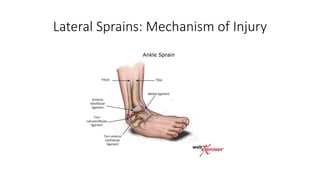
Lateral Sprains: Mechanism of Injury
Lateral Ankle Sprains: Economic Burden
• During the late 90’s and early 2000’s in the USA; estimated to be $US2
billion dollars per year (Dallinga et al., 2012).
• Amateur Dutch Volleyball population; Predicted cost per injury was 360
euro. Based on number of participants and predicted injuries, the authors
concluded that LAS can cost 200million euro per annum (Verhagen et al.,
2005).
• Here in Australia (specifically the state of Victoria), lower limb sporting
injuries rose 26% between 2004 and 2010, equating to an accumulated
economic burden $110million during this time (Finch et al., 2015).
Lateral Ankle Sprains: Epidemiology
• Ankle most commonly injured body part in 24 of 70 sports
reviewed (Fong et al., 2007).
• Indoor/Outdoor Court Sports most common sporting activity
(Doherty et al., 2014).
• Peak incidence:
• 15-19 yrs of age.
• Males 1.5x more likely to sustain LAS in 15-24yrs.
• Females 2x more likely to sustain >30yrs (Waterman et al.,
2010).
Lateral Ankle Sprains: Epidemiology
• Most common injury diagnosis in NCAA athletes between 2009-15
(4.95/10,000 athlete exposures) – Roos et al., 2017.
• Men’s and Women’s Basketball have the highest rates of LAS injuries with
11.96/10,000 AEs and 9.50/10,000 occurring respectively.
• 12% recurrence rate
• Recurrence rates:
• Highest recurrence rates of all lower limb musculoskeletal injuries
• 2x increased risk of reinjuring within 12 months following primary LAS
(Hootman et al., 2007, Swensom et al., 2009).
• 40% of first LAS develop chronic ankle instability within 1 year
(Doherty et al, 2016).
Lateral Ankle Sprains: Chronic Ankle Instability
• “Feeling of instability and giving away for a minimum of 1 year post
initial sprain” (Hertel et al 2002 & Delahunt et al 2010).
• Prevalence of 25%-50% in sporting populations (basketball, soccer,
volleyball, handball, ballet) - Attenborough et al., 2015 & Tanen et al.,
2014.
• ?high prevalence due to:
• Rapid return to sport without addressing underlying deficits
(strength/ROM/proprioception)
• Only 50% of people seek formal medical care
• Initial treatment too passive or too aggressive
Lateral Ankle Sprains: Chronic Ankle Instability
• Persistent instability leads to ongoing disability & seniromotor control
issues with subsequent decrease in physical activity & quality of life
and early OA changes.
• Early work on CAI by Gerber et al (1998)
• 78% of grade 1 sprains and 48% of grade 2-3 sprains returning to full military
duties by 6 weeks – 28% overall still reported pain.
• At 6 months follow up; 25% of all ankle sprains still reported pain
• Konradsen et al (2002) found at 7 year follow-up following primary
LAS:
• 30% still had pain, swelling or recurrent injury (>3 sprains per year)
• 70% felt functionally impaired
Lateral Ankle Sprains: Chronic Ankle Instability
• 3 predictors have been found (Doherty et al., 2016):
1) Inability to perform single leg land from 45cm height at 2
weeks post injury
2) <89% on FAAMadl ankle outcome at 6 months
3) <86% leg length distance on PL component of Y-Balance Test
at 6 months
FAAM Outcome Measure: Link -
http://www.aaos.org/uploadedFiles/PreProduction/Quality/Measures/
Foot%20and%20Ankle%20Ability%20Measure.pdf
Lateral Ankle Sprains: Treatment
Primary outcome goals: Improved function and recurrence rates (Gribble et
al., 2016)
Acute LAS:
- Exercise therapy: Unanimous for function
- External supports: Unanimous for function and recurrence rates
Chronic ankle instability:
- Exercise: Unanimous for function and recurrence rates
- External supports: Unanimous for recurrence rates
- Manual therapy: Unanimous for initial increases in DF ROM (function)
Lateral Ankle Sprains: Treatment
Exercise interventions significantly decreased the risk of sustaining
recurrent LAS by 41%
• Provided that the exercise therapy is given in a high dose (>900mins)
• 5x30mins per week = 150mins p/wk
• 150mins x 6 weeks = 900mins
External supports significantly decreased risk of recurrent ankle sprains
by 62%.
• Recommended: minimum for 6 months after acute LAS to prevent
recurrence. Benefit lasts up to 1 year following the most recent LAS.
Lateral Ankle Sprains: Treatment
• Bracing considerations:
• Ankle braces are successful in reducing ankle inversion moments, but
also restrict ankle DF  altered knee mechanics.
• A study by Klem et al (2016) on semi-elite female basketball players
showed that hinged braces were able to restrict peak ankle inversion
compared to controls; whereas a lace-up ASO brace lace-up could
not.
• BUT!!!! Both hinged and lace-up ASO both increased peak knee
internal rotation and knee abduction angles (knee valgus) compared
to controls
Why we should encourage early mobilisation
following ankle sprains:
A) healthy control B) early mobilisation C) immobilised (Photo credit: Twitter: @RodWhiteley)
Lateral Ankle Sprains: Return To Sport
Return to sport testing following LAS (Clanton et al., 2012)
• Knee to wall test
• SEBT or YBT
• Agility T-Test
• Vertical Jump
Others to consider:
• Hop test battery (within 10% of uninjured side on all 4 tests)
• Single leg heel raises (>25 reps on each leg)
Lateral Ankle Sprains: Return To Sport
• Knee to wall test
• <9cm considered restricted
• Aim to have no >2cm difference between limbs
• SEBT/YBT
• Vertical Jump
• Compare to previous known measures or age matched “norms”
Lateral Ankle Sprains: Return to Sport
Lateral Ankle Sprains: Return To Sport
Lateral Ankle Sprains: Prevention > Cure
• SEBT or YBT
Lateral Ankle Sprains: Prevention > Cure
• 94 amateur female Netball players were screened in the pre-season.
• 4x greater risk of sustaining a future LAS if <77% leg length or less in PM
direction on SEBT (Attenborough et al., 2017)
• 606 American Football athletes (high school and college) were
screened in the pre-season.
• 3x more likely to sustain LAS if SEBT-ANT 67% or less leg length (Gribble et al.,
2016)
• 125 healthy recreational college athletes performed a series of
screening tests
• 48% increased risk of sustaining a LAS <80% leg length in the PL direction (de
Noronha et al., 2013)
Lateral Ankle Sprains: Taping
• Skin preparation / Underwrap / Fixomul
• Anchor on
• Stirrups
• Figure 6’s
• Heel locks
• Anchor off
Thank You!!

Lateral Ankle Sprain Presentation

  • 1.
    Lateral Ankle Sprains: Reviewof Current Evidence By Mick Hughes (B. Physio, Grad. Cert. Sports Physio., B. Ex. Sci.)
  • 2.
    Lateral Ankle Sprains:Overview • Mechanism of Injury • Epidemiology • Chronic Ankle Instability • Evidence-Based Treatment • Return to Sport Considerations • Taping Technique
  • 3.
  • 4.
  • 5.
    Lateral Ankle Sprains:Economic Burden • During the late 90’s and early 2000’s in the USA; estimated to be $US2 billion dollars per year (Dallinga et al., 2012). • Amateur Dutch Volleyball population; Predicted cost per injury was 360 euro. Based on number of participants and predicted injuries, the authors concluded that LAS can cost 200million euro per annum (Verhagen et al., 2005). • Here in Australia (specifically the state of Victoria), lower limb sporting injuries rose 26% between 2004 and 2010, equating to an accumulated economic burden $110million during this time (Finch et al., 2015).
  • 6.
    Lateral Ankle Sprains:Epidemiology • Ankle most commonly injured body part in 24 of 70 sports reviewed (Fong et al., 2007). • Indoor/Outdoor Court Sports most common sporting activity (Doherty et al., 2014). • Peak incidence: • 15-19 yrs of age. • Males 1.5x more likely to sustain LAS in 15-24yrs. • Females 2x more likely to sustain >30yrs (Waterman et al., 2010).
  • 7.
    Lateral Ankle Sprains:Epidemiology • Most common injury diagnosis in NCAA athletes between 2009-15 (4.95/10,000 athlete exposures) – Roos et al., 2017. • Men’s and Women’s Basketball have the highest rates of LAS injuries with 11.96/10,000 AEs and 9.50/10,000 occurring respectively. • 12% recurrence rate • Recurrence rates: • Highest recurrence rates of all lower limb musculoskeletal injuries • 2x increased risk of reinjuring within 12 months following primary LAS (Hootman et al., 2007, Swensom et al., 2009). • 40% of first LAS develop chronic ankle instability within 1 year (Doherty et al, 2016).
  • 8.
    Lateral Ankle Sprains:Chronic Ankle Instability • “Feeling of instability and giving away for a minimum of 1 year post initial sprain” (Hertel et al 2002 & Delahunt et al 2010). • Prevalence of 25%-50% in sporting populations (basketball, soccer, volleyball, handball, ballet) - Attenborough et al., 2015 & Tanen et al., 2014. • ?high prevalence due to: • Rapid return to sport without addressing underlying deficits (strength/ROM/proprioception) • Only 50% of people seek formal medical care • Initial treatment too passive or too aggressive
  • 9.
    Lateral Ankle Sprains:Chronic Ankle Instability • Persistent instability leads to ongoing disability & seniromotor control issues with subsequent decrease in physical activity & quality of life and early OA changes. • Early work on CAI by Gerber et al (1998) • 78% of grade 1 sprains and 48% of grade 2-3 sprains returning to full military duties by 6 weeks – 28% overall still reported pain. • At 6 months follow up; 25% of all ankle sprains still reported pain • Konradsen et al (2002) found at 7 year follow-up following primary LAS: • 30% still had pain, swelling or recurrent injury (>3 sprains per year) • 70% felt functionally impaired
  • 10.
    Lateral Ankle Sprains:Chronic Ankle Instability • 3 predictors have been found (Doherty et al., 2016): 1) Inability to perform single leg land from 45cm height at 2 weeks post injury 2) <89% on FAAMadl ankle outcome at 6 months 3) <86% leg length distance on PL component of Y-Balance Test at 6 months FAAM Outcome Measure: Link - http://www.aaos.org/uploadedFiles/PreProduction/Quality/Measures/ Foot%20and%20Ankle%20Ability%20Measure.pdf
  • 11.
    Lateral Ankle Sprains:Treatment Primary outcome goals: Improved function and recurrence rates (Gribble et al., 2016) Acute LAS: - Exercise therapy: Unanimous for function - External supports: Unanimous for function and recurrence rates Chronic ankle instability: - Exercise: Unanimous for function and recurrence rates - External supports: Unanimous for recurrence rates - Manual therapy: Unanimous for initial increases in DF ROM (function)
  • 12.
    Lateral Ankle Sprains:Treatment Exercise interventions significantly decreased the risk of sustaining recurrent LAS by 41% • Provided that the exercise therapy is given in a high dose (>900mins) • 5x30mins per week = 150mins p/wk • 150mins x 6 weeks = 900mins External supports significantly decreased risk of recurrent ankle sprains by 62%. • Recommended: minimum for 6 months after acute LAS to prevent recurrence. Benefit lasts up to 1 year following the most recent LAS.
  • 13.
    Lateral Ankle Sprains:Treatment • Bracing considerations: • Ankle braces are successful in reducing ankle inversion moments, but also restrict ankle DF  altered knee mechanics. • A study by Klem et al (2016) on semi-elite female basketball players showed that hinged braces were able to restrict peak ankle inversion compared to controls; whereas a lace-up ASO brace lace-up could not. • BUT!!!! Both hinged and lace-up ASO both increased peak knee internal rotation and knee abduction angles (knee valgus) compared to controls
  • 14.
    Why we shouldencourage early mobilisation following ankle sprains: A) healthy control B) early mobilisation C) immobilised (Photo credit: Twitter: @RodWhiteley)
  • 15.
    Lateral Ankle Sprains:Return To Sport Return to sport testing following LAS (Clanton et al., 2012) • Knee to wall test • SEBT or YBT • Agility T-Test • Vertical Jump Others to consider: • Hop test battery (within 10% of uninjured side on all 4 tests) • Single leg heel raises (>25 reps on each leg)
  • 16.
    Lateral Ankle Sprains:Return To Sport • Knee to wall test • <9cm considered restricted • Aim to have no >2cm difference between limbs • SEBT/YBT • Vertical Jump • Compare to previous known measures or age matched “norms”
  • 17.
    Lateral Ankle Sprains:Return to Sport
  • 18.
    Lateral Ankle Sprains:Return To Sport
  • 19.
    Lateral Ankle Sprains:Prevention > Cure • SEBT or YBT
  • 20.
    Lateral Ankle Sprains:Prevention > Cure • 94 amateur female Netball players were screened in the pre-season. • 4x greater risk of sustaining a future LAS if <77% leg length or less in PM direction on SEBT (Attenborough et al., 2017) • 606 American Football athletes (high school and college) were screened in the pre-season. • 3x more likely to sustain LAS if SEBT-ANT 67% or less leg length (Gribble et al., 2016) • 125 healthy recreational college athletes performed a series of screening tests • 48% increased risk of sustaining a LAS <80% leg length in the PL direction (de Noronha et al., 2013)
  • 21.
    Lateral Ankle Sprains:Taping • Skin preparation / Underwrap / Fixomul • Anchor on • Stirrups • Figure 6’s • Heel locks • Anchor off
  • 22.