DR. GIRISH MOTWANI
Consultant Foot & Ankle
surgeon (Paediatric & Adult)
1)Sushrut Hospital, Research
Centre & PostGraduate
Institute of Orthopaedics,
Nagpur west
2)Aman hospital,Nagpur east
3)South point clinic, Nagpur
south
Qualifications
o MS orthopaedics (Gold
medalist)
o Fellowship in Foot & Ankle
ortho
(university of Alabama at
Birmingham ,USA)
o Fellowship in paediatric ortho
(B.J.wadia hospital for childrens
,Mumbai)
o Certification in Ankle sports
medicine
(Northwestern university
ANKLE SPRAINANKLE SPRAIN
Athletic Injuries of the Foot and AnkleAthletic Injuries of the Foot and Ankle
Acute Lateral Ankle SprainsAcute Lateral Ankle Sprains

23,000 injuries a day in the U.S.23,000 injuries a day in the U.S.

7-10% of E.R. visits7-10% of E.R. visits

Most common athletic injuryMost common athletic injury
Athletic Injuries of the Foot and AnkleAthletic Injuries of the Foot and Ankle
Acute Lateral Ankle SprainsAcute Lateral Ankle Sprains

Ligaments- passive stabilityLigaments- passive stability

Muscles- active stabilityMuscles- active stability

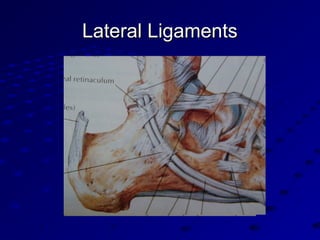
Lateral ligamentsLateral ligaments
ATFL- anterior talo-fibular ligamentATFL- anterior talo-fibular ligament
CFL- calcaneo-fibular ligamentCFL- calcaneo-fibular ligament
PTFL- posterior talo-fibular ligamentPTFL- posterior talo-fibular ligament
Lateral LigamentsLateral Ligaments
Athletic Injuries of the Foot and AnkleAthletic Injuries of the Foot and Ankle
Acute Lateral Ankle SprainsAcute Lateral Ankle Sprains

Injury depends on direction and magnitudeInjury depends on direction and magnitude

Deformities contribute to injuriesDeformities contribute to injuries

More common in previously injured anklesMore common in previously injured ankles

Occur indirectly from plantar flexion andOccur indirectly from plantar flexion and
inversioninversion
DiagnosisDiagnosis
Careful History TakingCareful History Taking
Physical ExamPhysical Exam
Useful additional diagnostic testingUseful additional diagnostic testing
ArthroscopyArthroscopy
History TakingHistory Taking
Determine if the pain is mechanical-Determine if the pain is mechanical-
brought on by activity, relieved by restbrought on by activity, relieved by rest
Where is the pain located?Where is the pain located?
Is there swelling, catching, pain onlyIs there swelling, catching, pain only
with certain motions or activitieswith certain motions or activities??
History TakingHistory Taking
Can you bear weight?Can you bear weight?
Feel like it is going to give out?Feel like it is going to give out?
Has it done this before?Has it done this before?
Athletic Injuries of the Foot and AnkleAthletic Injuries of the Foot and Ankle
Acute Lateral AnkleAcute Lateral Ankle
SprainsSprains

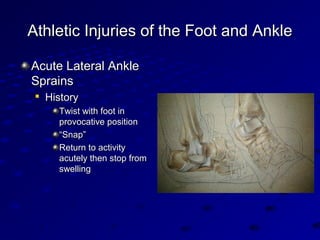
HistoryHistory
Twist with foot inTwist with foot in
provocative positionprovocative position
““Snap”Snap”
Return to activityReturn to activity
acutely then stop fromacutely then stop from
swellingswelling
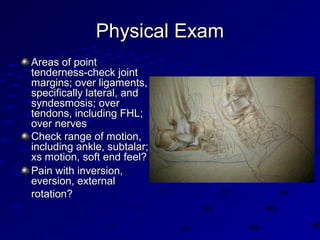
Physical ExamPhysical Exam
Areas of pointAreas of point
tenderness-check jointtenderness-check joint
margins; over ligaments,margins; over ligaments,
specifically lateral, andspecifically lateral, and
syndesmosis; oversyndesmosis; over
tendons, including FHL;tendons, including FHL;
over nervesover nerves
Check range of motion,Check range of motion,
including ankle, subtalar;including ankle, subtalar;
xs motion, soft end feel?xs motion, soft end feel?
Pain with inversion,Pain with inversion,
eversion, externaleversion, external
rotation?rotation?
Athletic Injuries of the Foot and AnkleAthletic Injuries of the Foot and Ankle
Acute Lateral Ankle SprainsAcute Lateral Ankle Sprains

PhysicalPhysical
ROM indicative of return timeROM indicative of return time
Swelling localized at firstSwelling localized at first
TendernessTenderness
StabilityStability
RadiographsRadiographs
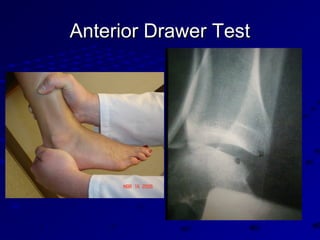
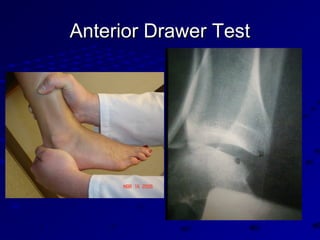
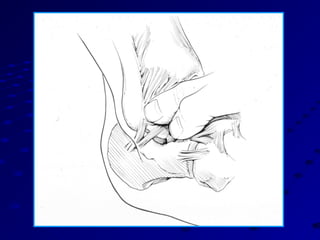
Anterior Drawer TestAnterior Drawer Test
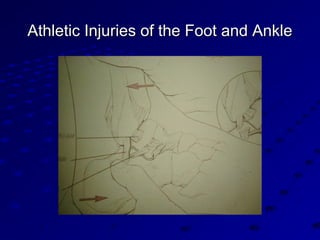
Athletic Injuries of the Foot and AnkleAthletic Injuries of the Foot and Ankle
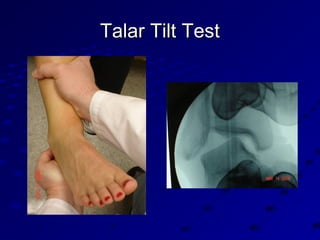
Talar Tilt TestTalar Tilt Test
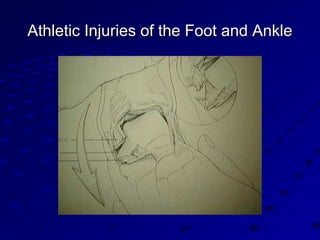
Athletic Injuries of the Foot and AnkleAthletic Injuries of the Foot and Ankle
Acute Lateral Ankle SprainsAcute Lateral Ankle Sprains

Differential DiagnosisDifferential Diagnosis
FracturesFractures
OLTOLT
Stress fracturesStress fractures
Midfoot injuriesMidfoot injuries
Peroneal tendonsPeroneal tendons
Basic Helpful TestsBasic Helpful Tests
Plain x-rays: get good ankle and footPlain x-rays: get good ankle and foot
films; stress testing of ligamentsfilms; stress testing of ligaments
CT scans (for subtle fractures, OCDs)CT scans (for subtle fractures, OCDs)
MRIs (for soft tissue, intraosseous)MRIs (for soft tissue, intraosseous)
For the most part, I find ultrasound hard toFor the most part, I find ultrasound hard to
interpret, and bone scans too nonspecificinterpret, and bone scans too nonspecific
(unless metal is present, rendering MRI(unless metal is present, rendering MRI
difficult to interpret.)difficult to interpret.)
Athletic Injuries of the Foot and AnkleAthletic Injuries of the Foot and Ankle
Acute Lateral Ankle SprainsAcute Lateral Ankle Sprains

GradesGrades
I - Stretch w/o macroscopic tearingI - Stretch w/o macroscopic tearing
II - Torn ATFL, intact CFLII - Torn ATFL, intact CFL
III - Entire complexIII - Entire complex
Athletic Injuries of the Foot and AnkleAthletic Injuries of the Foot and Ankle
Acute Lateral Ankle SprainsAcute Lateral Ankle Sprains

TreatmentTreatment
I and III and II

RICERICE

BracesBraces

Early ROM, stretching, strengthening, proprioceptionEarly ROM, stretching, strengthening, proprioception
IIIIII

ControversialControversial

Cast for one week then progressCast for one week then progress
Athletic Injuries of the Foot and AnkleAthletic Injuries of the Foot and Ankle
Acute Lateral Ankle SprainsAcute Lateral Ankle Sprains

Return to Play?Return to Play?
Painless smooth ROMPainless smooth ROM
80% strength to uninjured side80% strength to uninjured side
Ability to hop on one footAbility to hop on one foot
Sprint and cut drills without hesitationSprint and cut drills without hesitation
Position simulated activitiesPosition simulated activities
Athletic Injuries of the Foot and AnkleAthletic Injuries of the Foot and Ankle
Acute Lateral Ankle SprainsAcute Lateral Ankle Sprains

Surgery indicated for chronic problems orSurgery indicated for chronic problems or
instabilityinstability
ArthroscopyArthroscopy
MRI is extremely important to R/OMRI is extremely important to R/O
tendinous, extraarticular and intraosseoustendinous, extraarticular and intraosseous
lesions.lesions.
Stress testing under anesthesia with fluoroStress testing under anesthesia with fluoro
is accurate and helpfulis accurate and helpful
Arthroscopy best evaluates cartilageArthroscopy best evaluates cartilage
status, OCDs, loose bodies, anteriorstatus, OCDs, loose bodies, anterior
impingement lesionsimpingement lesions
ANKLEANKLE
INSTABILITYINSTABILITY
LATERAL ANKLE ANDLATERAL ANKLE AND
SUBTALARSUBTALAR
CHRONIC INSTABILITYCHRONIC INSTABILITY
DYNAMIC VS STATICDYNAMIC VS STATIC
FEELING OF “GIVING WAY”FEELING OF “GIVING WAY”
SORENESS AND RECURRENTSORENESS AND RECURRENT
EFFUSIONSEFFUSIONS
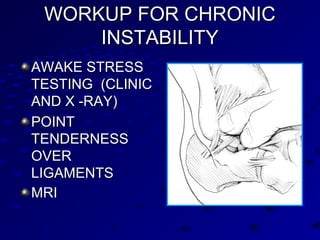
WORKUP FOR CHRONICWORKUP FOR CHRONIC
INSTABILITYINSTABILITY
AWAKE STRESSAWAKE STRESS
TESTING (CLINICTESTING (CLINIC
AND X -RAY)AND X -RAY)
POINTPOINT
TENDERNESSTENDERNESS
OVEROVER
LIGAMENTSLIGAMENTS
MRIMRI
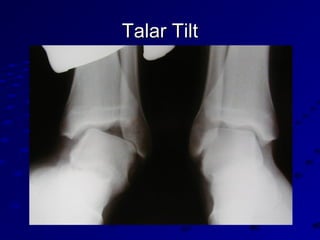
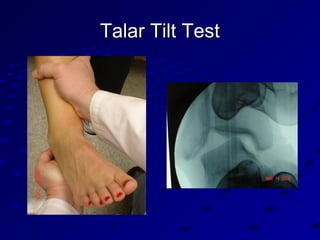
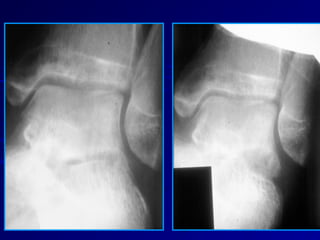
TALAR TILT TESTINGTALAR TILT TESTING
ANKLE NEUTRAL OR SLIGHTLYANKLE NEUTRAL OR SLIGHTLY
PLANTAR FLEXEDPLANTAR FLEXED
VARUS STRESS APPLIED AT CCVARUS STRESS APPLIED AT CC
JOINTJOINT
9-10 DEGREES = + STRESS TEST9-10 DEGREES = + STRESS TEST
3-5 DEGREES SIDE VS SIDE = +3-5 DEGREES SIDE VS SIDE = +
Talar TiltTalar Tilt
Talar Tilt TestTalar Tilt Test
ANTERIOR DRAWER TESTANTERIOR DRAWER TEST
ANKLE IN SLIGHT PLANTARANKLE IN SLIGHT PLANTAR
FLEXIONFLEXION
AVOID FALSE NEGATIVE FROMAVOID FALSE NEGATIVE FROM
DELTOIDDELTOID
9-10 MM = + TEST9-10 MM = + TEST
3-5 MM SIDE VS SIDE = + TEST3-5 MM SIDE VS SIDE = + TEST
Anterior Drawer TestAnterior Drawer Test
SUBTALAR INSTABILITYSUBTALAR INSTABILITY
10% OF ANKLE SPRAINS10% OF ANKLE SPRAINS
POSITIVE BRODENS VIEWPOSITIVE BRODENS VIEW
STRESS SIDE VS SIDESTRESS SIDE VS SIDE
(DEGREES NOT DEFINED)(DEGREES NOT DEFINED)
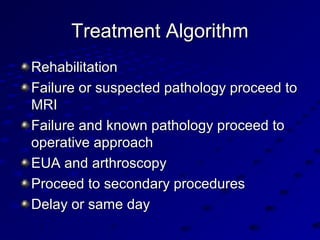
Treatment AlgorithmTreatment Algorithm
RehabilitationRehabilitation
Failure or suspected pathology proceed toFailure or suspected pathology proceed to
MRIMRI
Failure and known pathology proceed toFailure and known pathology proceed to
operative approachoperative approach
EUA and arthroscopyEUA and arthroscopy
Proceed to secondary proceduresProceed to secondary procedures
Delay or same dayDelay or same day
EVALUATION UNDEREVALUATION UNDER
ANESTHESIA (EUA)ANESTHESIA (EUA)
STRESS TESTING (LATERALSTRESS TESTING (LATERAL
TILT, STRESS BRODENS,TILT, STRESS BRODENS,
ANTERIOR DRAWER)ANTERIOR DRAWER)
ANKLE TESTING COMPUTERANKLE TESTING COMPUTER
ASSISTED (HOLLIS)ASSISTED (HOLLIS)
Treatment OptionsTreatment Options
ForFor subtle,subtle, dynamicdynamic instability:instability:
peroneal strengthening, lateral heelperoneal strengthening, lateral heel
flare and supportive deviceflare and supportive device
ForFor failures of conservative treatmentfailures of conservative treatment
andand staticstatic instability:instability:

Non-Anatomic Repairs with PeroneusNon-Anatomic Repairs with Peroneus
brevusbrevus

Anatomic Repairs of lateral ligamentsAnatomic Repairs of lateral ligaments
OPTIONS OF REPAIROPTIONS OF REPAIR
METHODMETHOD
ANATOMIC ( MODIFIEDANATOMIC ( MODIFIED
BROSTROMBROSTROM, USUALLY WITH N., USUALLY WITH N.
GOULDGOULD EXTENSOREXTENSOR
RETINACULUM REINFORCEMENT)RETINACULUM REINFORCEMENT)
NON ANATOMIC (NON ANATOMIC (CHRISMAN-CHRISMAN-
SNOOKSNOOK))
TIMING OF REPAIRTIMING OF REPAIR
Often delay 10-14 days to allowOften delay 10-14 days to allow
for the tissue to dry outfor the tissue to dry out
Immediate repairImmediate repair
Depends on the time ofDepends on the time of
arthroscopyarthroscopy
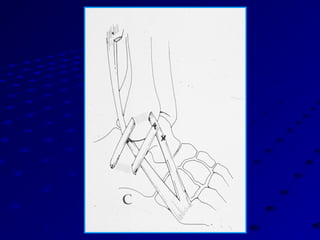
CHRISMAN-SNOOKCHRISMAN-SNOOK
1/2 PERONEUS BREVUS THRU1/2 PERONEUS BREVUS THRU
TALUS, FIBULA AND CALCANEUSTALUS, FIBULA AND CALCANEUS
20% LOSS OF INVERSION20% LOSS OF INVERSION
(SUBTALAR AND ANKLE)(SUBTALAR AND ANKLE)
BEST REPAIR OF NON ANATOMICBEST REPAIR OF NON ANATOMIC
SPECIAL INDICATIONS FORSPECIAL INDICATIONS FOR
EXTRA ARTICULAR REPAIREXTRA ARTICULAR REPAIR
EXCESSIVE WEIGHT ANDEXCESSIVE WEIGHT AND
STRESSESSTRESSES
FUSED SUBTALAR JOINTFUSED SUBTALAR JOINT
ABSENT OR EXCESSIVELYABSENT OR EXCESSIVELY
SHREDDED TISSUESSHREDDED TISSUES
ANATOMICANATOMIC
RECONSTRUCTIONRECONSTRUCTION
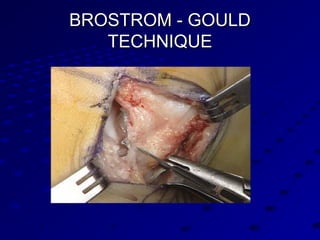
BROSTROM: DIRECT REPAIR OF ATFLBROSTROM: DIRECT REPAIR OF ATFL
AND CFLAND CFL
KARLSSON: SUTURE INTO BONE ANDKARLSSON: SUTURE INTO BONE AND
OVERSEWINGOVERSEWING
GOULD: CFL, LATERALGOULD: CFL, LATERAL
TALOCALCANEAL, ATFL, ANDTALOCALCANEAL, ATFL, AND
REINFORCEMENT W EXTENSORREINFORCEMENT W EXTENSOR
RETINACULUMRETINACULUM
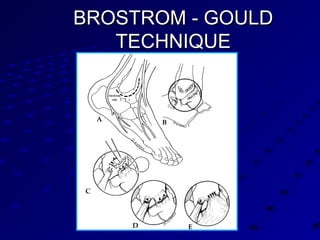
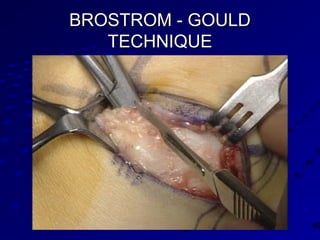
BROSTROM - GOULDBROSTROM - GOULD
TECHNIQUETECHNIQUE
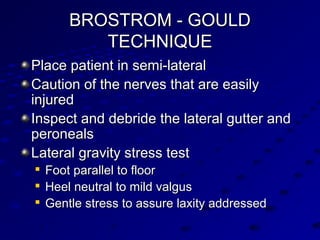
Place patient in semi-lateralPlace patient in semi-lateral
Caution of the nerves that are easilyCaution of the nerves that are easily
injuredinjured
Inspect and debride the lateral gutter andInspect and debride the lateral gutter and
peronealsperoneals
Lateral gravity stress testLateral gravity stress test

Foot parallel to floorFoot parallel to floor

Heel neutral to mild valgusHeel neutral to mild valgus

Gentle stress to assure laxity addressedGentle stress to assure laxity addressed
BROSTROM - GOULDBROSTROM - GOULD
TECHNIQUETECHNIQUE
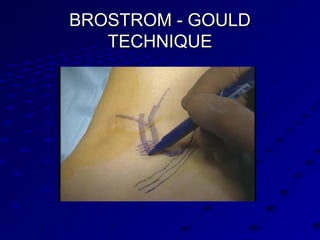
BROSTROM - GOULDBROSTROM - GOULD
TECHNIQUETECHNIQUE
BROSTROM - GOULDBROSTROM - GOULD
TECHNIQUETECHNIQUE
BROSTROM - GOULDBROSTROM - GOULD
TECHNIQUETECHNIQUE
POST OPERATIVE REGIMENPOST OPERATIVE REGIMEN
CAST OR SPLINT 4 WEEKS NWBCAST OR SPLINT 4 WEEKS NWB
BEGIN ACTIVE ROMBEGIN ACTIVE ROM
PREsPREs
PROPRIOCEPTIVE EXERCISESPROPRIOCEPTIVE EXERCISES
RESUME NORMAL ACTIVITIESRESUME NORMAL ACTIVITIES
CHOICE OF REPAIRCHOICE OF REPAIR
BROSTROM-GOULDBROSTROM-GOULD TESTSTESTS
TIGHT INITIALLY, BUT RANGETIGHT INITIALLY, BUT RANGE
OF MOTION IS NOT LIMITED--OF MOTION IS NOT LIMITED--
MAKING ITMAKING IT THE REPAIR OFTHE REPAIR OF
CHOICECHOICE WHEN FLEXIBILITY ISWHEN FLEXIBILITY IS
DESIREDDESIRED
CONCEPT OF THECONCEPT OF THE
ANATOMIC REPAIRANATOMIC REPAIR
REPAIRED INJURED TISSUESREPAIRED INJURED TISSUES
HYPERTROPHY AND REGAINHYPERTROPHY AND REGAIN
STRENGTH AND FLEXIBILITYSTRENGTH AND FLEXIBILITY
WITH STRESS AND MATURITY.WITH STRESS AND MATURITY.
THE REPAIRED TISSUES ARETHE REPAIRED TISSUES ARE
IN THE ANATOMIC AXESIN THE ANATOMIC AXES
WHY REPAIR THEWHY REPAIR THE
LIGAMENTS?LIGAMENTS?
CONTINUAL FLAKING OFF OFCONTINUAL FLAKING OFF OF
OSTEOCHONDRAL FRAGMENTSOSTEOCHONDRAL FRAGMENTS
PAIN, SWELLING, GIVING WAYPAIN, SWELLING, GIVING WAY
DEVELOPMENT OF ARTHRITISDEVELOPMENT OF ARTHRITIS
CONCERNS TO BE AWARE OFCONCERNS TO BE AWARE OF
AT OR BEFORE SURGERYAT OR BEFORE SURGERY
CONCOMITANT EXTRAARTICULARCONCOMITANT EXTRAARTICULAR
(TENDINOUS) OR INTRAARTICULAR(TENDINOUS) OR INTRAARTICULAR
PATHOLOGYPATHOLOGY
VARUS HEEL OR VARUS HEEL STRIKEVARUS HEEL OR VARUS HEEL STRIKE
2° TO TIBIA VARA2° TO TIBIA VARA
HYPERELASTICITYHYPERELASTICITY
DAMAGE TO SUPERFICIAL PERONEALDAMAGE TO SUPERFICIAL PERONEAL
OR SURAL NERVE BRANCHOR SURAL NERVE BRANCH
CONCLUSIONSCONCLUSIONS
OVERALL THE OBJECTIVE RESULTSOVERALL THE OBJECTIVE RESULTS
ARE EXCELLENT WITH GOODARE EXCELLENT WITH GOOD
STABILITY AND FLEXIBILITYSTABILITY AND FLEXIBILITY
ATTENTION TO THE VARUS HEEL,ATTENTION TO THE VARUS HEEL,
PRELIMINARY WORKUP, AND GRAVITYPRELIMINARY WORKUP, AND GRAVITY
TEST HAS AVOIDED PERSISTENTTEST HAS AVOIDED PERSISTENT
UNDETECTED PROBLEMS ORUNDETECTED PROBLEMS OR
RECURRENCES.RECURRENCES.
CONCLUSIONSCONCLUSIONS
THE BROSTROM-GOULD TECHNIQUETHE BROSTROM-GOULD TECHNIQUE
FOR LATERAL LIGAMENTFOR LATERAL LIGAMENT
RECONSTRUCTION REMAINS OURRECONSTRUCTION REMAINS OUR
PROCEDURE OF CHOICE FOR THEPROCEDURE OF CHOICE FOR THE
UNSTABLE LATERAL ANKLE FOR ALLUNSTABLE LATERAL ANKLE FOR ALL
AGES AND ALL SPORTS AT THISAGES AND ALL SPORTS AT THIS
POINT IN TIMEPOINT IN TIME
Subtle Fractures MimickingSubtle Fractures Mimicking
InstabilityInstability
Anterior Process of the calcaneusAnterior Process of the calcaneus
Lateral Process of the talusLateral Process of the talus
Subtle Fractures MimickingSubtle Fractures Mimicking
InstabilityInstability
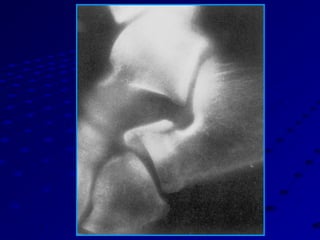
Anterior Process of the calcaneusAnterior Process of the calcaneus

Commonly over-lookedCommonly over-looked

Pain located anterior to ligamentsPain located anterior to ligaments

Small – exciseSmall – excise

Large – ORIFLarge – ORIF
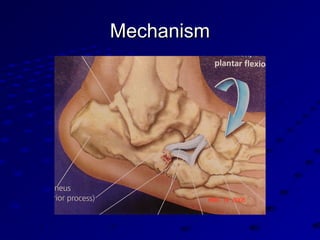
MechanismMechanism
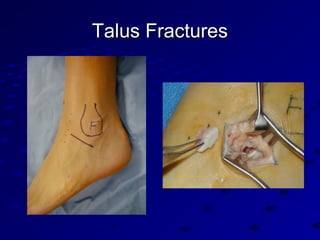
Talus FracturesTalus Fractures
Lateral Process FracturesLateral Process Fractures

24% of talus fractures24% of talus fractures

Snowboarders fractureSnowboarders fracture

Dorsiflexion, compression, and ext. rotationDorsiflexion, compression, and ext. rotation

Serves as insertion point for many ligamentsServes as insertion point for many ligaments

Often overlookedOften overlooked

Involves fibula and calcaneusInvolves fibula and calcaneus
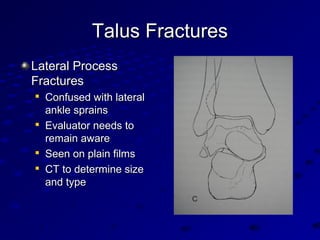
Talus FracturesTalus Fractures
Lateral ProcessLateral Process
FracturesFractures

Confused with lateralConfused with lateral
ankle sprainsankle sprains

Evaluator needs toEvaluator needs to
remain awareremain aware

Seen on plain filmsSeen on plain films

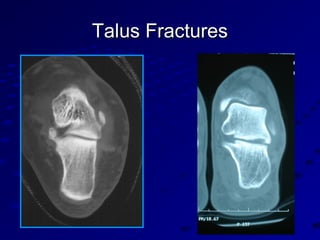
CT to determine sizeCT to determine size
and typeand type
Talus FracturesTalus Fractures
Lateral Process FracturesLateral Process Fractures

TreatmentTreatment
Non-displacedNon-displaced

4 weeks SLC non-weight bearing4 weeks SLC non-weight bearing

2 weeks in SLWC2 weeks in SLWC
DisplacedDisplaced

Depends on sizeDepends on size

Excise if to smallExcise if to small

Fixate in large enoughFixate in large enough
ANKLE ARTHROSCOPYANKLE ARTHROSCOPY
SYNOVITISSYNOVITIS
PLICASPLICAS
CHONDROMALACIACHONDROMALACIA
CHONDRAL ANDCHONDRAL AND
OSTEOCHONDRAL LESIONSOSTEOCHONDRAL LESIONS
LOOSE BODIESLOOSE BODIES
IMPINGMENTIMPINGMENT
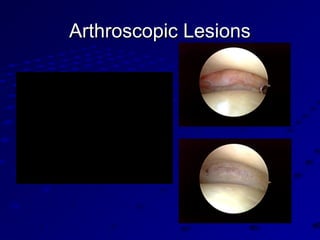
Arthroscopic LesionsArthroscopic Lesions
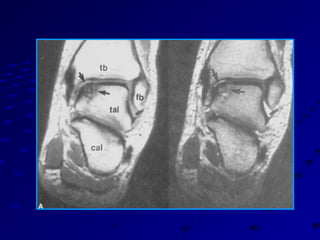
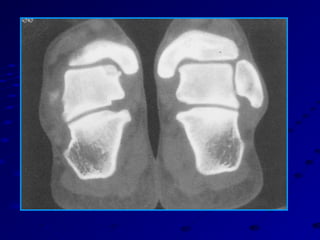
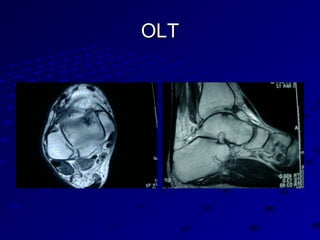
Osteochondritis dissecans of theOsteochondritis dissecans of the
talustalus
Known as OCDs or OLTsKnown as OCDs or OLTs
MRI shows marrow edema, and effect onMRI shows marrow edema, and effect on
the surrounding bonethe surrounding bone
CT gives a more accurate sizing of theCT gives a more accurate sizing of the
lesionlesion
Arthroscopy accurately defines the lesionArthroscopy accurately defines the lesion
and determines therapeutic approachand determines therapeutic approach
Options of Treatment for OLTsOptions of Treatment for OLTs
Microfracture/”picking” of lesions 1.0cm inMicrofracture/”picking” of lesions 1.0cm in
diameter and smallerdiameter and smaller
Retrograde drilling if cartilaginous surface intactRetrograde drilling if cartilaginous surface intact
ORIF if there is adequate bone for appositionORIF if there is adequate bone for apposition
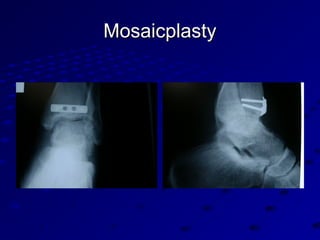
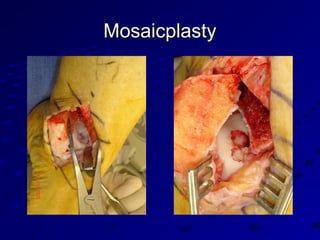
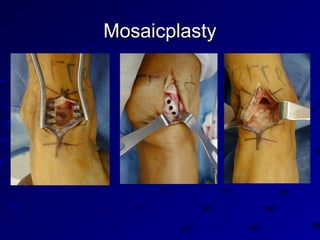
Osteochondral grafting from the knee for largerOsteochondral grafting from the knee for larger
lesions (mosaicplasty)lesions (mosaicplasty)
Possible allografting for defects (rare)Possible allografting for defects (rare)
Possible autogenous chondrocyte graftingPossible autogenous chondrocyte grafting
(difficult access in the ankle)(difficult access in the ankle)
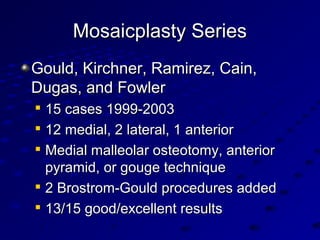
Mosaicplasty SeriesMosaicplasty Series
Gould, Kirchner, Ramirez, Cain,Gould, Kirchner, Ramirez, Cain,
Dugas, and FowlerDugas, and Fowler

15 cases 1999-200315 cases 1999-2003

12 medial, 2 lateral, 1 anterior12 medial, 2 lateral, 1 anterior

Medial malleolar osteotomy, anteriorMedial malleolar osteotomy, anterior
pyramid, or gouge techniquepyramid, or gouge technique

2 Brostrom-Gould procedures added2 Brostrom-Gould procedures added

13/15 good/excellent results13/15 good/excellent results
OLTOLT
MosaicplastyMosaicplasty
Anterior Impingement LesionsAnterior Impingement Lesions
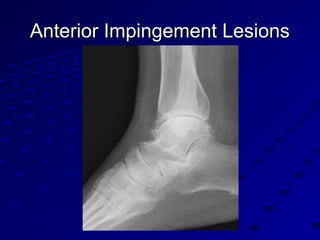
Usually anterolateralUsually anterolateral
Usually soft tissue and may beUsually soft tissue and may be
associated with lateral instabilityassociated with lateral instability
May be bonyMay be bony
All can be treated arthroscopicallyAll can be treated arthroscopically
with ligament reconstruction added ifwith ligament reconstruction added if
neededneeded..
Anterior Impingement LesionsAnterior Impingement Lesions
Thank YouThank You

Ankle sprains

  • 1.
    DR. GIRISH MOTWANI ConsultantFoot & Ankle surgeon (Paediatric & Adult) 1)Sushrut Hospital, Research Centre & PostGraduate Institute of Orthopaedics, Nagpur west 2)Aman hospital,Nagpur east 3)South point clinic, Nagpur south Qualifications o MS orthopaedics (Gold medalist) o Fellowship in Foot & Ankle ortho (university of Alabama at Birmingham ,USA) o Fellowship in paediatric ortho (B.J.wadia hospital for childrens ,Mumbai) o Certification in Ankle sports medicine (Northwestern university ANKLE SPRAINANKLE SPRAIN
  • 3.
    Athletic Injuries ofthe Foot and AnkleAthletic Injuries of the Foot and Ankle Acute Lateral Ankle SprainsAcute Lateral Ankle Sprains  23,000 injuries a day in the U.S.23,000 injuries a day in the U.S.  7-10% of E.R. visits7-10% of E.R. visits  Most common athletic injuryMost common athletic injury
  • 4.
    Athletic Injuries ofthe Foot and AnkleAthletic Injuries of the Foot and Ankle Acute Lateral Ankle SprainsAcute Lateral Ankle Sprains  Ligaments- passive stabilityLigaments- passive stability  Muscles- active stabilityMuscles- active stability  Lateral ligamentsLateral ligaments ATFL- anterior talo-fibular ligamentATFL- anterior talo-fibular ligament CFL- calcaneo-fibular ligamentCFL- calcaneo-fibular ligament PTFL- posterior talo-fibular ligamentPTFL- posterior talo-fibular ligament
  • 5.
  • 6.
    Athletic Injuries ofthe Foot and AnkleAthletic Injuries of the Foot and Ankle Acute Lateral Ankle SprainsAcute Lateral Ankle Sprains  Injury depends on direction and magnitudeInjury depends on direction and magnitude  Deformities contribute to injuriesDeformities contribute to injuries  More common in previously injured anklesMore common in previously injured ankles  Occur indirectly from plantar flexion andOccur indirectly from plantar flexion and inversioninversion
  • 7.
    DiagnosisDiagnosis Careful History TakingCarefulHistory Taking Physical ExamPhysical Exam Useful additional diagnostic testingUseful additional diagnostic testing ArthroscopyArthroscopy
  • 8.
    History TakingHistory Taking Determineif the pain is mechanical-Determine if the pain is mechanical- brought on by activity, relieved by restbrought on by activity, relieved by rest Where is the pain located?Where is the pain located? Is there swelling, catching, pain onlyIs there swelling, catching, pain only with certain motions or activitieswith certain motions or activities??
  • 9.
    History TakingHistory Taking Canyou bear weight?Can you bear weight? Feel like it is going to give out?Feel like it is going to give out? Has it done this before?Has it done this before?
  • 10.
    Athletic Injuries ofthe Foot and AnkleAthletic Injuries of the Foot and Ankle Acute Lateral AnkleAcute Lateral Ankle SprainsSprains  HistoryHistory Twist with foot inTwist with foot in provocative positionprovocative position ““Snap”Snap” Return to activityReturn to activity acutely then stop fromacutely then stop from swellingswelling
  • 11.
    Physical ExamPhysical Exam Areasof pointAreas of point tenderness-check jointtenderness-check joint margins; over ligaments,margins; over ligaments, specifically lateral, andspecifically lateral, and syndesmosis; oversyndesmosis; over tendons, including FHL;tendons, including FHL; over nervesover nerves Check range of motion,Check range of motion, including ankle, subtalar;including ankle, subtalar; xs motion, soft end feel?xs motion, soft end feel? Pain with inversion,Pain with inversion, eversion, externaleversion, external rotation?rotation?
  • 12.
    Athletic Injuries ofthe Foot and AnkleAthletic Injuries of the Foot and Ankle Acute Lateral Ankle SprainsAcute Lateral Ankle Sprains  PhysicalPhysical ROM indicative of return timeROM indicative of return time Swelling localized at firstSwelling localized at first TendernessTenderness StabilityStability RadiographsRadiographs
  • 13.
  • 14.
    Athletic Injuries ofthe Foot and AnkleAthletic Injuries of the Foot and Ankle
  • 15.
  • 16.
    Athletic Injuries ofthe Foot and AnkleAthletic Injuries of the Foot and Ankle
  • 17.
    Athletic Injuries ofthe Foot and AnkleAthletic Injuries of the Foot and Ankle Acute Lateral Ankle SprainsAcute Lateral Ankle Sprains  Differential DiagnosisDifferential Diagnosis FracturesFractures OLTOLT Stress fracturesStress fractures Midfoot injuriesMidfoot injuries Peroneal tendonsPeroneal tendons
  • 18.
    Basic Helpful TestsBasicHelpful Tests Plain x-rays: get good ankle and footPlain x-rays: get good ankle and foot films; stress testing of ligamentsfilms; stress testing of ligaments CT scans (for subtle fractures, OCDs)CT scans (for subtle fractures, OCDs) MRIs (for soft tissue, intraosseous)MRIs (for soft tissue, intraosseous) For the most part, I find ultrasound hard toFor the most part, I find ultrasound hard to interpret, and bone scans too nonspecificinterpret, and bone scans too nonspecific (unless metal is present, rendering MRI(unless metal is present, rendering MRI difficult to interpret.)difficult to interpret.)
  • 19.
    Athletic Injuries ofthe Foot and AnkleAthletic Injuries of the Foot and Ankle Acute Lateral Ankle SprainsAcute Lateral Ankle Sprains  GradesGrades I - Stretch w/o macroscopic tearingI - Stretch w/o macroscopic tearing II - Torn ATFL, intact CFLII - Torn ATFL, intact CFL III - Entire complexIII - Entire complex
  • 20.
    Athletic Injuries ofthe Foot and AnkleAthletic Injuries of the Foot and Ankle Acute Lateral Ankle SprainsAcute Lateral Ankle Sprains  TreatmentTreatment I and III and II  RICERICE  BracesBraces  Early ROM, stretching, strengthening, proprioceptionEarly ROM, stretching, strengthening, proprioception IIIIII  ControversialControversial  Cast for one week then progressCast for one week then progress
  • 21.
    Athletic Injuries ofthe Foot and AnkleAthletic Injuries of the Foot and Ankle Acute Lateral Ankle SprainsAcute Lateral Ankle Sprains  Return to Play?Return to Play? Painless smooth ROMPainless smooth ROM 80% strength to uninjured side80% strength to uninjured side Ability to hop on one footAbility to hop on one foot Sprint and cut drills without hesitationSprint and cut drills without hesitation Position simulated activitiesPosition simulated activities
  • 22.
    Athletic Injuries ofthe Foot and AnkleAthletic Injuries of the Foot and Ankle Acute Lateral Ankle SprainsAcute Lateral Ankle Sprains  Surgery indicated for chronic problems orSurgery indicated for chronic problems or instabilityinstability
  • 23.
    ArthroscopyArthroscopy MRI is extremelyimportant to R/OMRI is extremely important to R/O tendinous, extraarticular and intraosseoustendinous, extraarticular and intraosseous lesions.lesions. Stress testing under anesthesia with fluoroStress testing under anesthesia with fluoro is accurate and helpfulis accurate and helpful Arthroscopy best evaluates cartilageArthroscopy best evaluates cartilage status, OCDs, loose bodies, anteriorstatus, OCDs, loose bodies, anterior impingement lesionsimpingement lesions
  • 24.
  • 25.
    CHRONIC INSTABILITYCHRONIC INSTABILITY DYNAMICVS STATICDYNAMIC VS STATIC FEELING OF “GIVING WAY”FEELING OF “GIVING WAY” SORENESS AND RECURRENTSORENESS AND RECURRENT EFFUSIONSEFFUSIONS
  • 26.
    WORKUP FOR CHRONICWORKUPFOR CHRONIC INSTABILITYINSTABILITY AWAKE STRESSAWAKE STRESS TESTING (CLINICTESTING (CLINIC AND X -RAY)AND X -RAY) POINTPOINT TENDERNESSTENDERNESS OVEROVER LIGAMENTSLIGAMENTS MRIMRI
  • 27.
    TALAR TILT TESTINGTALARTILT TESTING ANKLE NEUTRAL OR SLIGHTLYANKLE NEUTRAL OR SLIGHTLY PLANTAR FLEXEDPLANTAR FLEXED VARUS STRESS APPLIED AT CCVARUS STRESS APPLIED AT CC JOINTJOINT 9-10 DEGREES = + STRESS TEST9-10 DEGREES = + STRESS TEST 3-5 DEGREES SIDE VS SIDE = +3-5 DEGREES SIDE VS SIDE = +
  • 28.
  • 29.
  • 30.
    ANTERIOR DRAWER TESTANTERIORDRAWER TEST ANKLE IN SLIGHT PLANTARANKLE IN SLIGHT PLANTAR FLEXIONFLEXION AVOID FALSE NEGATIVE FROMAVOID FALSE NEGATIVE FROM DELTOIDDELTOID 9-10 MM = + TEST9-10 MM = + TEST 3-5 MM SIDE VS SIDE = + TEST3-5 MM SIDE VS SIDE = + TEST
  • 31.
  • 32.
    SUBTALAR INSTABILITYSUBTALAR INSTABILITY 10%OF ANKLE SPRAINS10% OF ANKLE SPRAINS POSITIVE BRODENS VIEWPOSITIVE BRODENS VIEW STRESS SIDE VS SIDESTRESS SIDE VS SIDE (DEGREES NOT DEFINED)(DEGREES NOT DEFINED)
  • 35.
    Treatment AlgorithmTreatment Algorithm RehabilitationRehabilitation Failureor suspected pathology proceed toFailure or suspected pathology proceed to MRIMRI Failure and known pathology proceed toFailure and known pathology proceed to operative approachoperative approach EUA and arthroscopyEUA and arthroscopy Proceed to secondary proceduresProceed to secondary procedures Delay or same dayDelay or same day
  • 36.
    EVALUATION UNDEREVALUATION UNDER ANESTHESIA(EUA)ANESTHESIA (EUA) STRESS TESTING (LATERALSTRESS TESTING (LATERAL TILT, STRESS BRODENS,TILT, STRESS BRODENS, ANTERIOR DRAWER)ANTERIOR DRAWER) ANKLE TESTING COMPUTERANKLE TESTING COMPUTER ASSISTED (HOLLIS)ASSISTED (HOLLIS)
  • 39.
    Treatment OptionsTreatment Options ForForsubtle,subtle, dynamicdynamic instability:instability: peroneal strengthening, lateral heelperoneal strengthening, lateral heel flare and supportive deviceflare and supportive device ForFor failures of conservative treatmentfailures of conservative treatment andand staticstatic instability:instability:  Non-Anatomic Repairs with PeroneusNon-Anatomic Repairs with Peroneus brevusbrevus  Anatomic Repairs of lateral ligamentsAnatomic Repairs of lateral ligaments
  • 40.
    OPTIONS OF REPAIROPTIONSOF REPAIR METHODMETHOD ANATOMIC ( MODIFIEDANATOMIC ( MODIFIED BROSTROMBROSTROM, USUALLY WITH N., USUALLY WITH N. GOULDGOULD EXTENSOREXTENSOR RETINACULUM REINFORCEMENT)RETINACULUM REINFORCEMENT) NON ANATOMIC (NON ANATOMIC (CHRISMAN-CHRISMAN- SNOOKSNOOK))
  • 41.
    TIMING OF REPAIRTIMINGOF REPAIR Often delay 10-14 days to allowOften delay 10-14 days to allow for the tissue to dry outfor the tissue to dry out Immediate repairImmediate repair Depends on the time ofDepends on the time of arthroscopyarthroscopy
  • 42.
    CHRISMAN-SNOOKCHRISMAN-SNOOK 1/2 PERONEUS BREVUSTHRU1/2 PERONEUS BREVUS THRU TALUS, FIBULA AND CALCANEUSTALUS, FIBULA AND CALCANEUS 20% LOSS OF INVERSION20% LOSS OF INVERSION (SUBTALAR AND ANKLE)(SUBTALAR AND ANKLE) BEST REPAIR OF NON ANATOMICBEST REPAIR OF NON ANATOMIC
  • 44.
    SPECIAL INDICATIONS FORSPECIALINDICATIONS FOR EXTRA ARTICULAR REPAIREXTRA ARTICULAR REPAIR EXCESSIVE WEIGHT ANDEXCESSIVE WEIGHT AND STRESSESSTRESSES FUSED SUBTALAR JOINTFUSED SUBTALAR JOINT ABSENT OR EXCESSIVELYABSENT OR EXCESSIVELY SHREDDED TISSUESSHREDDED TISSUES
  • 45.
    ANATOMICANATOMIC RECONSTRUCTIONRECONSTRUCTION BROSTROM: DIRECT REPAIROF ATFLBROSTROM: DIRECT REPAIR OF ATFL AND CFLAND CFL KARLSSON: SUTURE INTO BONE ANDKARLSSON: SUTURE INTO BONE AND OVERSEWINGOVERSEWING GOULD: CFL, LATERALGOULD: CFL, LATERAL TALOCALCANEAL, ATFL, ANDTALOCALCANEAL, ATFL, AND REINFORCEMENT W EXTENSORREINFORCEMENT W EXTENSOR RETINACULUMRETINACULUM
  • 46.
    BROSTROM - GOULDBROSTROM- GOULD TECHNIQUETECHNIQUE Place patient in semi-lateralPlace patient in semi-lateral Caution of the nerves that are easilyCaution of the nerves that are easily injuredinjured Inspect and debride the lateral gutter andInspect and debride the lateral gutter and peronealsperoneals Lateral gravity stress testLateral gravity stress test  Foot parallel to floorFoot parallel to floor  Heel neutral to mild valgusHeel neutral to mild valgus  Gentle stress to assure laxity addressedGentle stress to assure laxity addressed
  • 47.
    BROSTROM - GOULDBROSTROM- GOULD TECHNIQUETECHNIQUE
  • 48.
    BROSTROM - GOULDBROSTROM- GOULD TECHNIQUETECHNIQUE
  • 49.
    BROSTROM - GOULDBROSTROM- GOULD TECHNIQUETECHNIQUE
  • 50.
    BROSTROM - GOULDBROSTROM- GOULD TECHNIQUETECHNIQUE
  • 51.
    POST OPERATIVE REGIMENPOSTOPERATIVE REGIMEN CAST OR SPLINT 4 WEEKS NWBCAST OR SPLINT 4 WEEKS NWB BEGIN ACTIVE ROMBEGIN ACTIVE ROM PREsPREs PROPRIOCEPTIVE EXERCISESPROPRIOCEPTIVE EXERCISES RESUME NORMAL ACTIVITIESRESUME NORMAL ACTIVITIES
  • 52.
    CHOICE OF REPAIRCHOICEOF REPAIR BROSTROM-GOULDBROSTROM-GOULD TESTSTESTS TIGHT INITIALLY, BUT RANGETIGHT INITIALLY, BUT RANGE OF MOTION IS NOT LIMITED--OF MOTION IS NOT LIMITED-- MAKING ITMAKING IT THE REPAIR OFTHE REPAIR OF CHOICECHOICE WHEN FLEXIBILITY ISWHEN FLEXIBILITY IS DESIREDDESIRED
  • 53.
    CONCEPT OF THECONCEPTOF THE ANATOMIC REPAIRANATOMIC REPAIR REPAIRED INJURED TISSUESREPAIRED INJURED TISSUES HYPERTROPHY AND REGAINHYPERTROPHY AND REGAIN STRENGTH AND FLEXIBILITYSTRENGTH AND FLEXIBILITY WITH STRESS AND MATURITY.WITH STRESS AND MATURITY. THE REPAIRED TISSUES ARETHE REPAIRED TISSUES ARE IN THE ANATOMIC AXESIN THE ANATOMIC AXES
  • 54.
    WHY REPAIR THEWHYREPAIR THE LIGAMENTS?LIGAMENTS? CONTINUAL FLAKING OFF OFCONTINUAL FLAKING OFF OF OSTEOCHONDRAL FRAGMENTSOSTEOCHONDRAL FRAGMENTS PAIN, SWELLING, GIVING WAYPAIN, SWELLING, GIVING WAY DEVELOPMENT OF ARTHRITISDEVELOPMENT OF ARTHRITIS
  • 55.
    CONCERNS TO BEAWARE OFCONCERNS TO BE AWARE OF AT OR BEFORE SURGERYAT OR BEFORE SURGERY CONCOMITANT EXTRAARTICULARCONCOMITANT EXTRAARTICULAR (TENDINOUS) OR INTRAARTICULAR(TENDINOUS) OR INTRAARTICULAR PATHOLOGYPATHOLOGY VARUS HEEL OR VARUS HEEL STRIKEVARUS HEEL OR VARUS HEEL STRIKE 2° TO TIBIA VARA2° TO TIBIA VARA HYPERELASTICITYHYPERELASTICITY DAMAGE TO SUPERFICIAL PERONEALDAMAGE TO SUPERFICIAL PERONEAL OR SURAL NERVE BRANCHOR SURAL NERVE BRANCH
  • 56.
    CONCLUSIONSCONCLUSIONS OVERALL THE OBJECTIVERESULTSOVERALL THE OBJECTIVE RESULTS ARE EXCELLENT WITH GOODARE EXCELLENT WITH GOOD STABILITY AND FLEXIBILITYSTABILITY AND FLEXIBILITY ATTENTION TO THE VARUS HEEL,ATTENTION TO THE VARUS HEEL, PRELIMINARY WORKUP, AND GRAVITYPRELIMINARY WORKUP, AND GRAVITY TEST HAS AVOIDED PERSISTENTTEST HAS AVOIDED PERSISTENT UNDETECTED PROBLEMS ORUNDETECTED PROBLEMS OR RECURRENCES.RECURRENCES.
  • 57.
    CONCLUSIONSCONCLUSIONS THE BROSTROM-GOULD TECHNIQUETHEBROSTROM-GOULD TECHNIQUE FOR LATERAL LIGAMENTFOR LATERAL LIGAMENT RECONSTRUCTION REMAINS OURRECONSTRUCTION REMAINS OUR PROCEDURE OF CHOICE FOR THEPROCEDURE OF CHOICE FOR THE UNSTABLE LATERAL ANKLE FOR ALLUNSTABLE LATERAL ANKLE FOR ALL AGES AND ALL SPORTS AT THISAGES AND ALL SPORTS AT THIS POINT IN TIMEPOINT IN TIME
  • 58.
    Subtle Fractures MimickingSubtleFractures Mimicking InstabilityInstability Anterior Process of the calcaneusAnterior Process of the calcaneus Lateral Process of the talusLateral Process of the talus
  • 59.
    Subtle Fractures MimickingSubtleFractures Mimicking InstabilityInstability Anterior Process of the calcaneusAnterior Process of the calcaneus  Commonly over-lookedCommonly over-looked  Pain located anterior to ligamentsPain located anterior to ligaments  Small – exciseSmall – excise  Large – ORIFLarge – ORIF
  • 61.
  • 62.
    Talus FracturesTalus Fractures LateralProcess FracturesLateral Process Fractures  24% of talus fractures24% of talus fractures  Snowboarders fractureSnowboarders fracture  Dorsiflexion, compression, and ext. rotationDorsiflexion, compression, and ext. rotation  Serves as insertion point for many ligamentsServes as insertion point for many ligaments  Often overlookedOften overlooked  Involves fibula and calcaneusInvolves fibula and calcaneus
  • 63.
    Talus FracturesTalus Fractures LateralProcessLateral Process FracturesFractures  Confused with lateralConfused with lateral ankle sprainsankle sprains  Evaluator needs toEvaluator needs to remain awareremain aware  Seen on plain filmsSeen on plain films  CT to determine sizeCT to determine size and typeand type
  • 64.
  • 65.
  • 66.
    Talus FracturesTalus Fractures LateralProcess FracturesLateral Process Fractures  TreatmentTreatment Non-displacedNon-displaced  4 weeks SLC non-weight bearing4 weeks SLC non-weight bearing  2 weeks in SLWC2 weeks in SLWC DisplacedDisplaced  Depends on sizeDepends on size  Excise if to smallExcise if to small  Fixate in large enoughFixate in large enough
  • 67.
    ANKLE ARTHROSCOPYANKLE ARTHROSCOPY SYNOVITISSYNOVITIS PLICASPLICAS CHONDROMALACIACHONDROMALACIA CHONDRALANDCHONDRAL AND OSTEOCHONDRAL LESIONSOSTEOCHONDRAL LESIONS LOOSE BODIESLOOSE BODIES IMPINGMENTIMPINGMENT
  • 68.
  • 69.
    Osteochondritis dissecans oftheOsteochondritis dissecans of the talustalus Known as OCDs or OLTsKnown as OCDs or OLTs MRI shows marrow edema, and effect onMRI shows marrow edema, and effect on the surrounding bonethe surrounding bone CT gives a more accurate sizing of theCT gives a more accurate sizing of the lesionlesion Arthroscopy accurately defines the lesionArthroscopy accurately defines the lesion and determines therapeutic approachand determines therapeutic approach
  • 72.
    Options of Treatmentfor OLTsOptions of Treatment for OLTs Microfracture/”picking” of lesions 1.0cm inMicrofracture/”picking” of lesions 1.0cm in diameter and smallerdiameter and smaller Retrograde drilling if cartilaginous surface intactRetrograde drilling if cartilaginous surface intact ORIF if there is adequate bone for appositionORIF if there is adequate bone for apposition Osteochondral grafting from the knee for largerOsteochondral grafting from the knee for larger lesions (mosaicplasty)lesions (mosaicplasty) Possible allografting for defects (rare)Possible allografting for defects (rare) Possible autogenous chondrocyte graftingPossible autogenous chondrocyte grafting (difficult access in the ankle)(difficult access in the ankle)
  • 73.
    Mosaicplasty SeriesMosaicplasty Series Gould,Kirchner, Ramirez, Cain,Gould, Kirchner, Ramirez, Cain, Dugas, and FowlerDugas, and Fowler  15 cases 1999-200315 cases 1999-2003  12 medial, 2 lateral, 1 anterior12 medial, 2 lateral, 1 anterior  Medial malleolar osteotomy, anteriorMedial malleolar osteotomy, anterior pyramid, or gouge techniquepyramid, or gouge technique  2 Brostrom-Gould procedures added2 Brostrom-Gould procedures added  13/15 good/excellent results13/15 good/excellent results
  • 74.
  • 75.
  • 76.
  • 77.
  • 78.
    Anterior Impingement LesionsAnteriorImpingement Lesions Usually anterolateralUsually anterolateral Usually soft tissue and may beUsually soft tissue and may be associated with lateral instabilityassociated with lateral instability May be bonyMay be bony All can be treated arthroscopicallyAll can be treated arthroscopically with ligament reconstruction added ifwith ligament reconstruction added if neededneeded..
  • 79.
  • 80.
  • 81.
  • 82.