Social Studies for 9th EBG
Teacher: Mauricio Torres
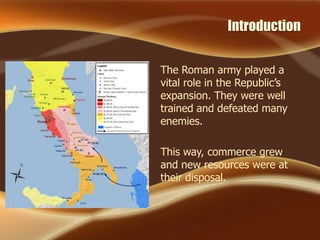
The Roman army played a
vital role in the Republic’s
expansion. They were well
trained and defeated many
enemies.
This way, commerce grew
and new resources were at
their disposal.
Expansion
When the Gauls had to be paid to
leave Rome, others attempted to
invade Rome. Little by little, the
Romans defeated them and took
over their lands.
This way, Romans took over almost
all of the Italian peninsula.
The army, was a highly organized
entity, capable of fighting in large or
small groups.
The Legion
• Groups of 6,000
soldiers
Centuries
• Groups of 100
soldiers, led by a
centurion.
Legionaire
• Roman infantry
soldier.
Before Rome set out to conquer
Italy, most of its inhabitants were
farmers. As the republic grew, most
arrived in the city to work.
Wealthy romans bought the empty
lands and set their own farms, which
were worked by slaves.
Even with these production of
food, it wasn’t enough to feed a
growing population. Therefore
merchants had to trade with other
lands and bring in more resources
such as:
• Slaves
• Metal goods
They were using coins to trade
all over the Mediterranean!
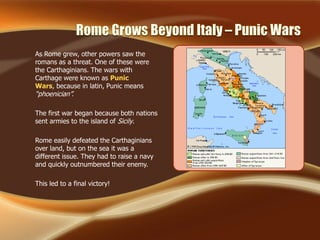
As Rome grew, other powers saw the
romans as a threat. One of these were
the Carthaginians. The wars with
Carthage were known as Punic
Wars, because in latin, Punic means
“phoenician”.
The first war began because both nations
sent armies to the island of Sicily.
Rome easily defeated the Carthaginians
over land, but on the sea it was a
different issue. They had to raise a navy
and quickly outnumbered their enemy.
This led to a final victory!
Carthage was seeking revenge from
Rome.
Hannibal, its most brilliant general
led an army across the Alps and
defeated the Romans many times, in
the Italian peninsula.
The Romans, on the verge of
defeat, made a daring attempt at
destroying Carthage itself! It lured
Hannibal back to Africa and was
finally defeated at the battle of
Zama.
By 140 BC, the Roman senate grew
alarmed because Carthage was
regaining its power.
The consuls declared war and finally
Carthage was destroyed to its
foundations:
• The burned the city
• Killed most of the inhabitants
• Sold the survivors as slaves.
This way, Rome now had control over
the western Mediterranean and
northern Africa.
Later, the roman legion marched on:
They invaded Gaul and Greece.
But it was Greece, that would later change the
Romans forever!
With the Punic wars, Rome took
control of:
Sicily, Corsica, Spain and North Africa.

Late republic

  • 1.
    Social Studies for9th EBG Teacher: Mauricio Torres
  • 2.
    The Roman armyplayed a vital role in the Republic’s expansion. They were well trained and defeated many enemies. This way, commerce grew and new resources were at their disposal.
  • 3.
    Expansion When the Gaulshad to be paid to leave Rome, others attempted to invade Rome. Little by little, the Romans defeated them and took over their lands. This way, Romans took over almost all of the Italian peninsula. The army, was a highly organized entity, capable of fighting in large or small groups.
  • 4.
    The Legion • Groupsof 6,000 soldiers Centuries • Groups of 100 soldiers, led by a centurion. Legionaire • Roman infantry soldier.
  • 5.
    Before Rome setout to conquer Italy, most of its inhabitants were farmers. As the republic grew, most arrived in the city to work. Wealthy romans bought the empty lands and set their own farms, which were worked by slaves. Even with these production of food, it wasn’t enough to feed a growing population. Therefore merchants had to trade with other lands and bring in more resources such as: • Slaves • Metal goods They were using coins to trade all over the Mediterranean!
  • 6.
    As Rome grew,other powers saw the romans as a threat. One of these were the Carthaginians. The wars with Carthage were known as Punic Wars, because in latin, Punic means “phoenician”. The first war began because both nations sent armies to the island of Sicily. Rome easily defeated the Carthaginians over land, but on the sea it was a different issue. They had to raise a navy and quickly outnumbered their enemy. This led to a final victory!
  • 7.
    Carthage was seekingrevenge from Rome. Hannibal, its most brilliant general led an army across the Alps and defeated the Romans many times, in the Italian peninsula. The Romans, on the verge of defeat, made a daring attempt at destroying Carthage itself! It lured Hannibal back to Africa and was finally defeated at the battle of Zama.
  • 8.
    By 140 BC,the Roman senate grew alarmed because Carthage was regaining its power. The consuls declared war and finally Carthage was destroyed to its foundations: • The burned the city • Killed most of the inhabitants • Sold the survivors as slaves. This way, Rome now had control over the western Mediterranean and northern Africa.
  • 10.
    Later, the romanlegion marched on: They invaded Gaul and Greece. But it was Greece, that would later change the Romans forever! With the Punic wars, Rome took control of: Sicily, Corsica, Spain and North Africa.