Laser in dentistry
Presented by/ Hams Hamed
Objectives:
By the end of this lecture you will be able to:
• Identify different types and uses of lasers in dental
field.
• Discover various serious hazards effects which is
caused by lasers.
• Recognize most important control measures of laser
hazards.
Outline:
• Introduction.
• History of lasers in dentistry.
• Uses of laser in dentistry.
• Infection control of laser devices.
• Hazards of laser.
• Control measures for laser hazards.
Introduction:
• The word laser is an acronym standing for
“Light Amplification by Stimulated Emission of Radiation.”
• A device that generates an intense beam of coherent,
monochromatic light (or other electromagnetic radiation)
by stimulated emission of photons from excited atoms or
molecules.
• Lasers are used in drilling and cutting, alignment and
guidance, and in surgery.
What is laser?
History of lasers in Dentistry:
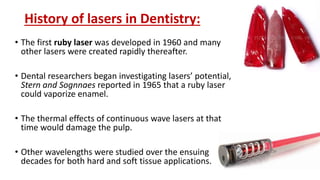
• The first ruby laser was developed in 1960 and many
other lasers were created rapidly thereafter.
• Dental researchers began investigating lasers’ potential,
Stern and Sognnaes reported in 1965 that a ruby laser
could vaporize enamel.
• The thermal effects of continuous wave lasers at that
time would damage the pulp.
• Other wavelengths were studied over the ensuing
decades for both hard and soft tissue applications.
Lasers in Dentistry
Lasers in Dentistry:
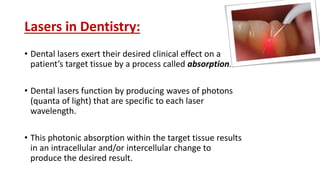
• Dental lasers exert their desired clinical effect on a
patient’s target tissue by a process called absorption.
• Dental lasers function by producing waves of photons
(quanta of light) that are specific to each laser
wavelength.
• This photonic absorption within the target tissue results
in an intracellular and/or intercellular change to
produce the desired result.
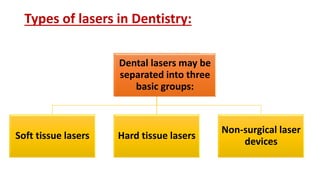
Types of lasers in Dentistry:
Soft tissue lasers Hard tissue lasers
Non-surgical laser
devices
Dental lasers may be
separated into three
basic groups:
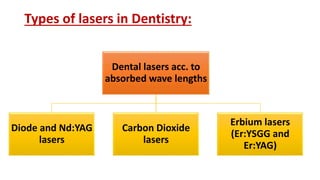
Types of lasers in Dentistry:
Dental lasers acc. to
absorbed wave lengths
Diode and Nd:YAG
lasers
Carbon Dioxide
lasers
Erbium lasers
(Er:YSGG and
Er:YAG)
Uses of laser in Dentistry:
Outline:
• Hard tissue (enamel and dentine).
• Bone surgery.
• Soft tissue surgery.
• Root canal treatment.
• Periodontics.
• Other uses.
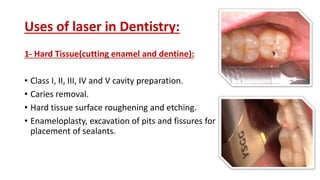
Uses of laser in Dentistry:
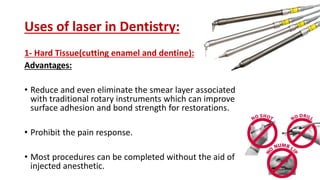
1- Hard Tissue(cutting enamel and dentine):
• Class I, II, III, IV and V cavity preparation.
• Caries removal.
• Hard tissue surface roughening and etching.
• Enameloplasty, excavation of pits and fissures for
placement of sealants.
Uses of laser in Dentistry:
1- Hard Tissue(cutting enamel and dentine):
Advantages:
• Reduce and even eliminate the smear layer associated
with traditional rotary instruments which can improve
surface adhesion and bond strength for restorations.
• Prohibit the pain response.
• Most procedures can be completed without the aid of
injected anesthetic.
Uses of laser in Dentistry:
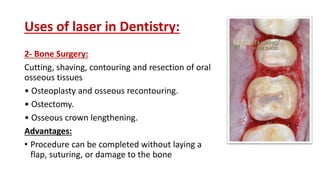
2- Bone Surgery:
Cutting, shaving, contouring and resection of oral
osseous tissues
• Osteoplasty and osseous recontouring.
• Ostectomy.
• Osseous crown lengthening.
Advantages:
• Procedure can be completed without laying a
flap, suturing, or damage to the bone
Uses of laser in Dentistry:
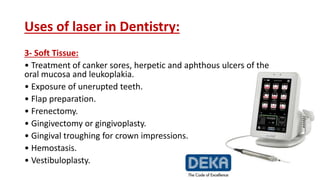
3- Soft Tissue:
• Treatment of canker sores, herpetic and aphthous ulcers of the
oral mucosa and leukoplakia.
• Exposure of unerupted teeth.
• Flap preparation.
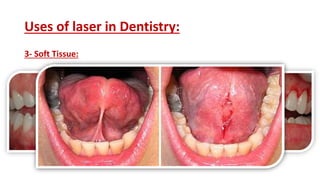
• Frenectomy.
• Gingivectomy or gingivoplasty.
• Gingival troughing for crown impressions.
• Hemostasis.
• Vestibuloplasty.
Uses of laser in Dentistry:
3- Soft Tissue:
Uses of laser in Dentistry:
4- Soft Tissue:
Advantages:
• Capability to atraumatically treat soft
tissue with little to no bleeding, little
edema, and positive post-operative
results.
Uses of laser in Dentistry:
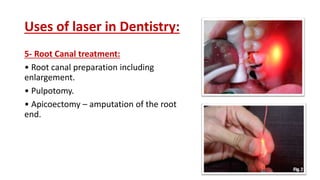
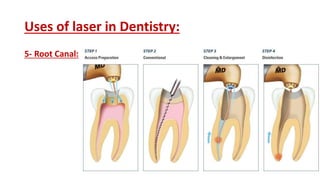
5- Root Canal treatment:
• Root canal preparation including
enlargement.
• Pulpotomy.
• Apicoectomy – amputation of the root
end.
Uses of laser in Dentistry:
5- Root Canal:
Uses of laser in Dentistry:
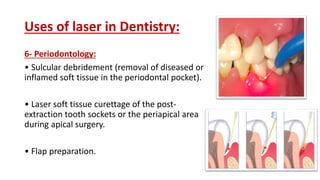
6- Periodontology:
• Sulcular debridement (removal of diseased or
inflamed soft tissue in the periodontal pocket).
• Laser soft tissue curettage of the post-
extraction tooth sockets or the periapical area
during apical surgery.
• Flap preparation.
Uses of laser in Dentistry:
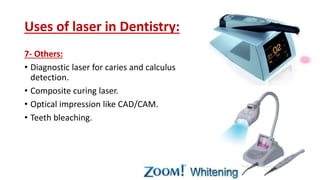
7- Others:
• Diagnostic laser for caries and calculus
detection.
• Composite curing laser.
• Optical impression like CAD/CAM.
• Teeth bleaching.
Infection control
Infection control:
• Specific to lasers, any reusable fibers and tips must be heat sterilized
along with their handpieces, and not wiped with a high-level
disinfectant.
• Any debris on the end of the tip must be removed to ensure effective
sterilization.
• Disposable tips must be put into sharps containers, along with
cleaved pieces of the fiber.
• Care should be shown to the possibility of contamination of all laser
hardware; (e.g., syringe covers, sensor protector sheaths) transparent
universal sticky barrier covers should be utilized where possible.
Hazards of Laser
Hazards of laser:
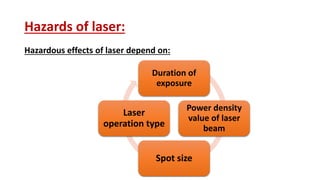
Hazardous effects of laser depend on:
Duration of
exposure
Power density
value of laser
beam
Spot size
Laser
operation type
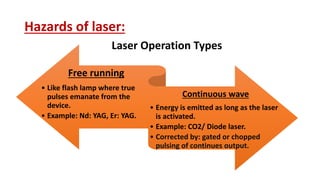
Hazards of laser:
Continuous wave
• Energy is emitted as long as the laser
is activated.
• Example: CO2/ Diode laser.
• Corrected by: gated or chopped
pulsing of continues output.
Free running
• Like flash lamp where true
pulses emanate from the
device.
• Example: Nd: YAG, Er: YAG.
Laser Operation Types
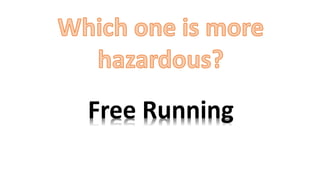
Free Running
Hazards of laser:
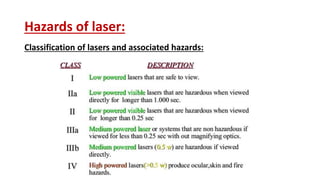
Classification of lasers and associated hazards:
Hazards of laser:
Associated Hazards:
1- Ocular damage:
• Cause: direct exposure of the unprotected eye or diffuse
reflection from mirror like surface.
• Site of injury depend on the absorption of wavelengths by
specific structures of the eye i.e. pigmented epithelium of the
retina and choroids layer.
• 1ry ocular injury result from laser accident is a retinal or
corneal burn.
Hazards of laser:
Associated Hazards:
1- Ocular damage:
• Retinal injury possible with even low intensity because of
focusing effect of the lens and cornea.
• Retinal burn may cause permanent blindness due to
conversion of the radiation to heat.
• Other injury to sclera, aqueous humor and cataract.
Hazards of laser:
Associated Hazards:
2- Tissue damage:
• Laser induced damage to skin and other non-target tissue
(Oral tissue) can result from thermal interaction of radiant
energy with tissue proteins.
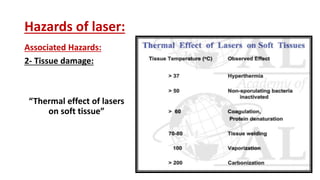
• Elevation of temperature above 37⁰C causes cellular enzymes
and proteins destruction and coagulation necrosis which
affect the metabolic process.
• Final result is Thermal necrosis of the tissues.
Hazards of laser:
Associated Hazards:
2- Tissue damage:
“Thermal effect of lasers
on soft tissue”
Hazards of laser:
Associated Hazards:
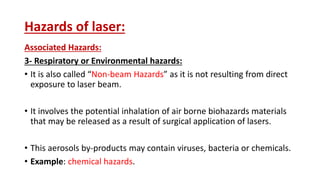
3- Respiratory or Environmental hazards:
• It is also called “Non-beam Hazards” as it is not resulting from direct
exposure to laser beam.
• It involves the potential inhalation of air borne biohazards materials
that may be released as a result of surgical application of lasers.
• This aerosols by-products may contain viruses, bacteria or chemicals.
• Example: chemical hazards.
Hazards of laser:
Associated Hazards:
3- Respiratory or Environmental hazards:
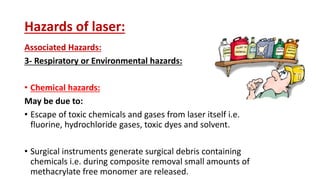
• Chemical hazards:
May be due to:
• Escape of toxic chemicals and gases from laser itself i.e.
fluorine, hydrochloride gases, toxic dyes and solvent.
• Surgical instruments generate surgical debris containing
chemicals i.e. during composite removal small amounts of
methacrylate free monomer are released.
Hazards of laser:
Associated Hazards:
3- Respiratory or Environmental hazards:
Symptoms:
• Eye irritation.
• Nausea and vomiting.
• Breathing difficulties.
• Transfer of infective bacteria and viruses.
Hazards of laser:
Associated Hazards:
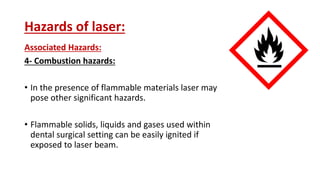
4- Combustion hazards:
• In the presence of flammable materials laser may
pose other significant hazards.
• Flammable solids, liquids and gases used within
dental surgical setting can be easily ignited if
exposed to laser beam.
Hazards of laser:
Associated Hazards:
4- Combustion hazards:
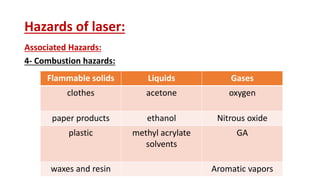
Flammable solids Liquids Gases
clothes acetone oxygen
paper products ethanol Nitrous oxide
plastic methyl acrylate
solvents
GA
waxes and resin Aromatic vapors
Hazards of laser:
Associated Hazards:
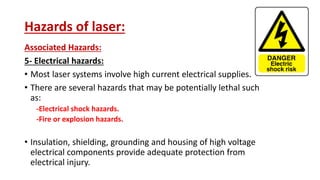
5- Electrical hazards:
• Most laser systems involve high current electrical supplies.
• There are several hazards that may be potentially lethal such
as:
-Electrical shock hazards.
-Fire or explosion hazards.
• Insulation, shielding, grounding and housing of high voltage
electrical components provide adequate protection from
electrical injury.
Laser hazard control measures
Laser hazards control measures:
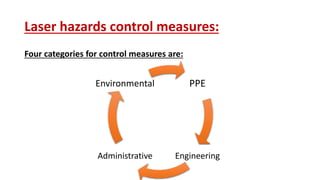
Four categories for control measures are:
PPE
EngineeringAdministrative
Environmental
Laser hazards control measures:
1- Personal Protective Equipment (PPE):
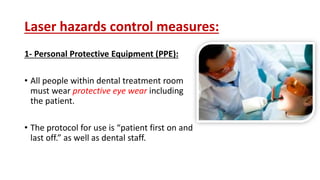
• All people within dental treatment room
must wear protective eye wear including
the patient.
• The protocol for use is “patient first on and
last off.” as well as dental staff.
Laser hazards control measures:
1- Personal Protective Equipment (PPE):
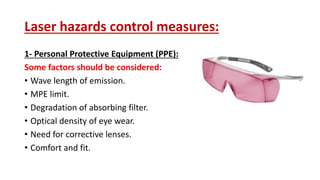
Some factors should be considered:
• Wave length of emission.
• MPE limit.
• Degradation of absorbing filter.
• Optical density of eye wear.
• Need for corrective lenses.
• Comfort and fit.
Laser hazards control measures:
1- Personal Protective Equipment (PPE):
• Care must be taken when cleaning laser eyewear and side shields
so that their protective coating is not destroyed.
• should be washed with antibacterial soap and dried with a soft
cotton cloth in between procedures and patients.
• Disinfecting solutions generally applied to dental surfaces are too
caustic and should be avoided.
• must be inspected frequently to determine whether there is any
breakdown (lifting / cracking / flaking) of the protective material
that would render the eyewear to be useless.
Laser hazards control measures:
2- Engineering control:
• Engineering controls are normally designed and built
into the laser equipment to provide for safety.
• Some of the engineering controls recommended in
the ANSI standard are detailed as follows:
Laser hazards control measures:
2- Engineering control:
• Protective Housing:
Laser should have enclosure around it that limits the access to the
laser beam or radiation at or below the applicable MPE level.
• Master Switch Control:
-The switch can be operated by a key or computer code.
-When disabled (key or code removed), the laser cannot be
operated.
-Also Cover foot switch prevent the accidental operation.
Laser hazards control measures:
2- Engineering control:
• Beam Stop:
Class IV lasers require a permanently attached beam stop which can
reduce the output emission to a level at or below the appropriate
MPE level when the laser system is on "standby.“
• Laser Activation Warning System:
An audible tone or bell and/or visual warning (such as a flashing light)
is recommended as an area control for Class IIIB and IV laser.
Laser hazards control measures:
3- Administrative control:
• Establishing written Standard Operating Procedures (SOPs) for
the dental practice, as required by ANSI and other national
standards as they may apply.
• Supervises the education and training of the dental team.
• Assists with evaluation when a new laser is needed.
• Understands the operational characteristics of the laser(s) in the
practice.
• Ensures the laser is being operated by authorized personnel
only.
Laser hazards control measures:
3- Administrative control:
• Knows the limitations of device output.
• Ensures laser maintenance, beam alignment, and
calibration of the laser device.
• Supervises medical surveillance and incident
reporting.
• Keeps a log of recorded laser use and parameters
employed.
Laser hazards control measures:
4- Environmental control:
• Determines the controlled area and the potential hazard and
non-hazard zones.
• Ensures proper test-firing of the laser prior to admission of
the patient into the operatory.
• Use of carbonized (don’t absorb heat) or non-reflective
instruments during procedure.
Laser hazards control measures:
4- Environmental control:
• Use protective laser curtains to prevent accidental
exposures to passers-by.
• Floor of operating room should be dry to avoid electrical
hazards.
• Keep away all the flammable materials from the laser
source.
Conclusion:
• Laser use in dentistry is proven to be beneficial in treating
a wide range of dental conditions as well as a therapeutic
tool in tissue management.
• The dynamics of laser energy beams pose general risks to
non-oral tissues and the immediate environment.
• Safety measures have been devised to safeguard those
personnel – staff and patients – who may be involved in
dental treatment using lasers.
References:
• https://www.osha.gov/dts/osta/otm/otm_iii/otm_iii_6.html
• http://www.jaypeejournals.com/eJournals/ShowText.aspx?ID=3574&
Type=FREE&TYP=TOP&IN=_eJournals/images/JPLOGO.gif&IID=282&is
PDF=YES
• https://www.laserdentistry.org/uploads/files/education/LaserEdu_Int
roToLasers.pdf
• http://download.mediclaseint.com/Paper_Dental_Lomke.pdf
Laser in dentistry

Laser in dentistry

  • 1.
  • 2.
    Objectives: By the endof this lecture you will be able to: • Identify different types and uses of lasers in dental field. • Discover various serious hazards effects which is caused by lasers. • Recognize most important control measures of laser hazards.
  • 3.
    Outline: • Introduction. • Historyof lasers in dentistry. • Uses of laser in dentistry. • Infection control of laser devices. • Hazards of laser. • Control measures for laser hazards.
  • 4.
    Introduction: • The wordlaser is an acronym standing for “Light Amplification by Stimulated Emission of Radiation.” • A device that generates an intense beam of coherent, monochromatic light (or other electromagnetic radiation) by stimulated emission of photons from excited atoms or molecules. • Lasers are used in drilling and cutting, alignment and guidance, and in surgery. What is laser?
  • 5.
    History of lasersin Dentistry: • The first ruby laser was developed in 1960 and many other lasers were created rapidly thereafter. • Dental researchers began investigating lasers’ potential, Stern and Sognnaes reported in 1965 that a ruby laser could vaporize enamel. • The thermal effects of continuous wave lasers at that time would damage the pulp. • Other wavelengths were studied over the ensuing decades for both hard and soft tissue applications.
  • 6.
  • 7.
    Lasers in Dentistry: •Dental lasers exert their desired clinical effect on a patient’s target tissue by a process called absorption. • Dental lasers function by producing waves of photons (quanta of light) that are specific to each laser wavelength. • This photonic absorption within the target tissue results in an intracellular and/or intercellular change to produce the desired result.
  • 8.
    Types of lasersin Dentistry: Soft tissue lasers Hard tissue lasers Non-surgical laser devices Dental lasers may be separated into three basic groups:
  • 9.
    Types of lasersin Dentistry: Dental lasers acc. to absorbed wave lengths Diode and Nd:YAG lasers Carbon Dioxide lasers Erbium lasers (Er:YSGG and Er:YAG)
  • 10.
    Uses of laserin Dentistry: Outline: • Hard tissue (enamel and dentine). • Bone surgery. • Soft tissue surgery. • Root canal treatment. • Periodontics. • Other uses.
  • 11.
    Uses of laserin Dentistry: 1- Hard Tissue(cutting enamel and dentine): • Class I, II, III, IV and V cavity preparation. • Caries removal. • Hard tissue surface roughening and etching. • Enameloplasty, excavation of pits and fissures for placement of sealants.
  • 12.
    Uses of laserin Dentistry: 1- Hard Tissue(cutting enamel and dentine): Advantages: • Reduce and even eliminate the smear layer associated with traditional rotary instruments which can improve surface adhesion and bond strength for restorations. • Prohibit the pain response. • Most procedures can be completed without the aid of injected anesthetic.
  • 13.
    Uses of laserin Dentistry: 2- Bone Surgery: Cutting, shaving, contouring and resection of oral osseous tissues • Osteoplasty and osseous recontouring. • Ostectomy. • Osseous crown lengthening. Advantages: • Procedure can be completed without laying a flap, suturing, or damage to the bone
  • 14.
    Uses of laserin Dentistry: 3- Soft Tissue: • Treatment of canker sores, herpetic and aphthous ulcers of the oral mucosa and leukoplakia. • Exposure of unerupted teeth. • Flap preparation. • Frenectomy. • Gingivectomy or gingivoplasty. • Gingival troughing for crown impressions. • Hemostasis. • Vestibuloplasty.
  • 15.
    Uses of laserin Dentistry: 3- Soft Tissue:
  • 16.
    Uses of laserin Dentistry: 4- Soft Tissue: Advantages: • Capability to atraumatically treat soft tissue with little to no bleeding, little edema, and positive post-operative results.
  • 17.
    Uses of laserin Dentistry: 5- Root Canal treatment: • Root canal preparation including enlargement. • Pulpotomy. • Apicoectomy – amputation of the root end.
  • 18.
    Uses of laserin Dentistry: 5- Root Canal:
  • 19.
    Uses of laserin Dentistry: 6- Periodontology: • Sulcular debridement (removal of diseased or inflamed soft tissue in the periodontal pocket). • Laser soft tissue curettage of the post- extraction tooth sockets or the periapical area during apical surgery. • Flap preparation.
  • 20.
    Uses of laserin Dentistry: 7- Others: • Diagnostic laser for caries and calculus detection. • Composite curing laser. • Optical impression like CAD/CAM. • Teeth bleaching.
  • 21.
  • 22.
    Infection control: • Specificto lasers, any reusable fibers and tips must be heat sterilized along with their handpieces, and not wiped with a high-level disinfectant. • Any debris on the end of the tip must be removed to ensure effective sterilization. • Disposable tips must be put into sharps containers, along with cleaved pieces of the fiber. • Care should be shown to the possibility of contamination of all laser hardware; (e.g., syringe covers, sensor protector sheaths) transparent universal sticky barrier covers should be utilized where possible.
  • 23.
  • 24.
    Hazards of laser: Hazardouseffects of laser depend on: Duration of exposure Power density value of laser beam Spot size Laser operation type
  • 25.
    Hazards of laser: Continuouswave • Energy is emitted as long as the laser is activated. • Example: CO2/ Diode laser. • Corrected by: gated or chopped pulsing of continues output. Free running • Like flash lamp where true pulses emanate from the device. • Example: Nd: YAG, Er: YAG. Laser Operation Types
  • 26.
  • 27.
    Hazards of laser: Classificationof lasers and associated hazards:
  • 28.
    Hazards of laser: AssociatedHazards: 1- Ocular damage: • Cause: direct exposure of the unprotected eye or diffuse reflection from mirror like surface. • Site of injury depend on the absorption of wavelengths by specific structures of the eye i.e. pigmented epithelium of the retina and choroids layer. • 1ry ocular injury result from laser accident is a retinal or corneal burn.
  • 29.
    Hazards of laser: AssociatedHazards: 1- Ocular damage: • Retinal injury possible with even low intensity because of focusing effect of the lens and cornea. • Retinal burn may cause permanent blindness due to conversion of the radiation to heat. • Other injury to sclera, aqueous humor and cataract.
  • 30.
    Hazards of laser: AssociatedHazards: 2- Tissue damage: • Laser induced damage to skin and other non-target tissue (Oral tissue) can result from thermal interaction of radiant energy with tissue proteins. • Elevation of temperature above 37⁰C causes cellular enzymes and proteins destruction and coagulation necrosis which affect the metabolic process. • Final result is Thermal necrosis of the tissues.
  • 31.
    Hazards of laser: AssociatedHazards: 2- Tissue damage: “Thermal effect of lasers on soft tissue”
  • 32.
    Hazards of laser: AssociatedHazards: 3- Respiratory or Environmental hazards: • It is also called “Non-beam Hazards” as it is not resulting from direct exposure to laser beam. • It involves the potential inhalation of air borne biohazards materials that may be released as a result of surgical application of lasers. • This aerosols by-products may contain viruses, bacteria or chemicals. • Example: chemical hazards.
  • 33.
    Hazards of laser: AssociatedHazards: 3- Respiratory or Environmental hazards: • Chemical hazards: May be due to: • Escape of toxic chemicals and gases from laser itself i.e. fluorine, hydrochloride gases, toxic dyes and solvent. • Surgical instruments generate surgical debris containing chemicals i.e. during composite removal small amounts of methacrylate free monomer are released.
  • 34.
    Hazards of laser: AssociatedHazards: 3- Respiratory or Environmental hazards: Symptoms: • Eye irritation. • Nausea and vomiting. • Breathing difficulties. • Transfer of infective bacteria and viruses.
  • 35.
    Hazards of laser: AssociatedHazards: 4- Combustion hazards: • In the presence of flammable materials laser may pose other significant hazards. • Flammable solids, liquids and gases used within dental surgical setting can be easily ignited if exposed to laser beam.
  • 36.
    Hazards of laser: AssociatedHazards: 4- Combustion hazards: Flammable solids Liquids Gases clothes acetone oxygen paper products ethanol Nitrous oxide plastic methyl acrylate solvents GA waxes and resin Aromatic vapors
  • 37.
    Hazards of laser: AssociatedHazards: 5- Electrical hazards: • Most laser systems involve high current electrical supplies. • There are several hazards that may be potentially lethal such as: -Electrical shock hazards. -Fire or explosion hazards. • Insulation, shielding, grounding and housing of high voltage electrical components provide adequate protection from electrical injury.
  • 38.
  • 39.
    Laser hazards controlmeasures: Four categories for control measures are: PPE EngineeringAdministrative Environmental
  • 40.
    Laser hazards controlmeasures: 1- Personal Protective Equipment (PPE): • All people within dental treatment room must wear protective eye wear including the patient. • The protocol for use is “patient first on and last off.” as well as dental staff.
  • 41.
    Laser hazards controlmeasures: 1- Personal Protective Equipment (PPE): Some factors should be considered: • Wave length of emission. • MPE limit. • Degradation of absorbing filter. • Optical density of eye wear. • Need for corrective lenses. • Comfort and fit.
  • 42.
    Laser hazards controlmeasures: 1- Personal Protective Equipment (PPE): • Care must be taken when cleaning laser eyewear and side shields so that their protective coating is not destroyed. • should be washed with antibacterial soap and dried with a soft cotton cloth in between procedures and patients. • Disinfecting solutions generally applied to dental surfaces are too caustic and should be avoided. • must be inspected frequently to determine whether there is any breakdown (lifting / cracking / flaking) of the protective material that would render the eyewear to be useless.
  • 43.
    Laser hazards controlmeasures: 2- Engineering control: • Engineering controls are normally designed and built into the laser equipment to provide for safety. • Some of the engineering controls recommended in the ANSI standard are detailed as follows:
  • 44.
    Laser hazards controlmeasures: 2- Engineering control: • Protective Housing: Laser should have enclosure around it that limits the access to the laser beam or radiation at or below the applicable MPE level. • Master Switch Control: -The switch can be operated by a key or computer code. -When disabled (key or code removed), the laser cannot be operated. -Also Cover foot switch prevent the accidental operation.
  • 45.
    Laser hazards controlmeasures: 2- Engineering control: • Beam Stop: Class IV lasers require a permanently attached beam stop which can reduce the output emission to a level at or below the appropriate MPE level when the laser system is on "standby.“ • Laser Activation Warning System: An audible tone or bell and/or visual warning (such as a flashing light) is recommended as an area control for Class IIIB and IV laser.
  • 46.
    Laser hazards controlmeasures: 3- Administrative control: • Establishing written Standard Operating Procedures (SOPs) for the dental practice, as required by ANSI and other national standards as they may apply. • Supervises the education and training of the dental team. • Assists with evaluation when a new laser is needed. • Understands the operational characteristics of the laser(s) in the practice. • Ensures the laser is being operated by authorized personnel only.
  • 47.
    Laser hazards controlmeasures: 3- Administrative control: • Knows the limitations of device output. • Ensures laser maintenance, beam alignment, and calibration of the laser device. • Supervises medical surveillance and incident reporting. • Keeps a log of recorded laser use and parameters employed.
  • 48.
    Laser hazards controlmeasures: 4- Environmental control: • Determines the controlled area and the potential hazard and non-hazard zones. • Ensures proper test-firing of the laser prior to admission of the patient into the operatory. • Use of carbonized (don’t absorb heat) or non-reflective instruments during procedure.
  • 49.
    Laser hazards controlmeasures: 4- Environmental control: • Use protective laser curtains to prevent accidental exposures to passers-by. • Floor of operating room should be dry to avoid electrical hazards. • Keep away all the flammable materials from the laser source.
  • 50.
    Conclusion: • Laser usein dentistry is proven to be beneficial in treating a wide range of dental conditions as well as a therapeutic tool in tissue management. • The dynamics of laser energy beams pose general risks to non-oral tissues and the immediate environment. • Safety measures have been devised to safeguard those personnel – staff and patients – who may be involved in dental treatment using lasers.
  • 51.
    References: • https://www.osha.gov/dts/osta/otm/otm_iii/otm_iii_6.html • http://www.jaypeejournals.com/eJournals/ShowText.aspx?ID=3574& Type=FREE&TYP=TOP&IN=_eJournals/images/JPLOGO.gif&IID=282&is PDF=YES •https://www.laserdentistry.org/uploads/files/education/LaserEdu_Int roToLasers.pdf • http://download.mediclaseint.com/Paper_Dental_Lomke.pdf

Editor's Notes

  • #5 Coherent: unidirectional Monochromic: single wave length for each laser beam.
  • #6 Ruby laser: solid state laser uses synthetic ruby crystals as active medium
  • #27 Because it achieve high peak power surges in short pulse followed by long off time durations. The other one take some time till reaching its peak
  • #28 High powered lasers like dental lasers