Light Amplification by
Stimulated Emission of
Radiation
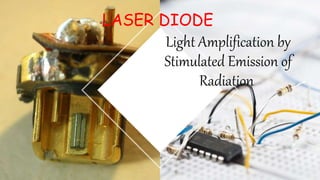
LASER DIODE
LIGHT SOURCES
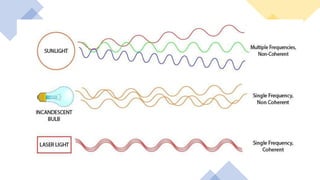
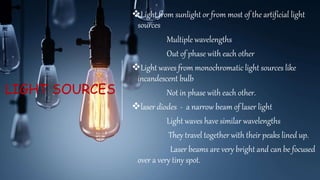
Light from sunlight or from most of the artificial light
sources
Multiple wavelengths
Out of phase with each other
Light waves from monochromatic light sources like
incandescent bulb
Not in phase with each other.
laser diodes - a narrow beam of laser light
Light waves have similar wavelengths
They travel together with their peaks lined up.
Laser beams are very bright and can be focused
over a very tiny spot.
APPLICATIONS
Laser printers
Barcode readers
Security systems
Autonomous vehicles (LIDAR)
Fiber optic communications etc.
It is a semiconductor device. It uses p-n junction to emit coherent
light in which all the waves are at the
same frequency and phase.
p-n junction is used to produce laser
light, this device is named as a laser
diode.
How a Laser Diode
Works?
•Energy Absorption
•Spontaneous Emission
•Stimulated Emission
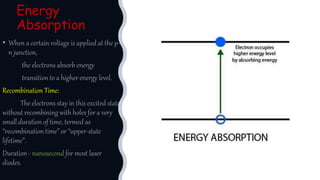
Energy
Absorption
Recombination Time:
nanosecond
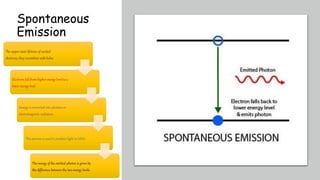
Spontaneous
Emission
The upper-state lifetime of excited
electrons, they recombine with holes.
Electrons fall from higher energy level to a
lower energy level
Energy is converted into photons or
electromagnetic radiation.
This process is used to produce light in LEDs.
The energy of the emitted photon is given by
the difference between the two energy levels.
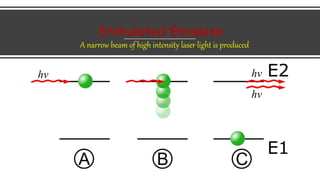
Stimulated Emission
A narrow beam of high intensity laser light is produced
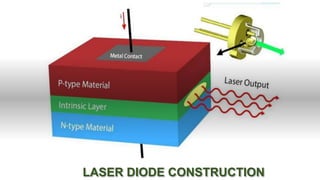
Construction of a Laser Diode
•Metal Contact
•P-type Material
•Active/Intrinsic Region (N-type Material)
•N-type Material
•Metal Contact
LASER DIODE CONSTRUCTION
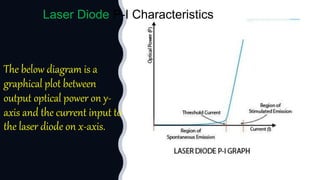
Laser Diode P-I Characteristics
The below diagram is a
graphical plot between
output optical power on y-
axis and the current input to
the laser diode on x-axis.
ADVANTAGES OF
LASER DIODE
•Simple Construction
•Light Weight
•Very cheap
•Small Size
•Longer operating life
•High Efficiency
•Low power Consumption
Disadvantages
of Laser Diode
•Not suitable for the
applications where high
powers are required
•Semiconductor lasers are
highly dependent on
temperature
Applications of a Laser Diode
Consumer Electronics: CD/DVD players, Laser printers, Fiber Optic Communication, Barcode Readers etc.
MedicalMachines: Laser diodes are used in machines used to remove unwanted tissues, eliminating cancer cells, non-invasive
and cataract surgeries etc.
Autonomous Vehicles: Laser diode technology is used in making LIDAR systems implemented for autonomous driving
Scientific Instrumentation: Lasers are used in devices used for remote contactless measurements, spectrometry, range finders etc.
Industrial Applications: Laser Diodes are used as a source of high intensity laser beam for precise cutting of materials. They are
also used in 3D printing to soften the substrate.

LASER DIODE.ppt

  • 1.
    Light Amplification by StimulatedEmission of Radiation LASER DIODE
  • 3.
    LIGHT SOURCES Light fromsunlight or from most of the artificial light sources Multiple wavelengths Out of phase with each other Light waves from monochromatic light sources like incandescent bulb Not in phase with each other. laser diodes - a narrow beam of laser light Light waves have similar wavelengths They travel together with their peaks lined up. Laser beams are very bright and can be focused over a very tiny spot.
  • 4.
    APPLICATIONS Laser printers Barcode readers Securitysystems Autonomous vehicles (LIDAR) Fiber optic communications etc.
  • 5.
    It is asemiconductor device. It uses p-n junction to emit coherent light in which all the waves are at the same frequency and phase. p-n junction is used to produce laser light, this device is named as a laser diode.
  • 6.
    How a LaserDiode Works? •Energy Absorption •Spontaneous Emission •Stimulated Emission
  • 7.
  • 8.
    Spontaneous Emission The upper-state lifetimeof excited electrons, they recombine with holes. Electrons fall from higher energy level to a lower energy level Energy is converted into photons or electromagnetic radiation. This process is used to produce light in LEDs. The energy of the emitted photon is given by the difference between the two energy levels.
  • 9.
    Stimulated Emission A narrowbeam of high intensity laser light is produced
  • 10.
    Construction of aLaser Diode •Metal Contact •P-type Material •Active/Intrinsic Region (N-type Material) •N-type Material •Metal Contact
  • 11.
  • 12.
    Laser Diode P-ICharacteristics The below diagram is a graphical plot between output optical power on y- axis and the current input to the laser diode on x-axis.
  • 13.
    ADVANTAGES OF LASER DIODE •SimpleConstruction •Light Weight •Very cheap •Small Size •Longer operating life •High Efficiency •Low power Consumption
  • 14.
    Disadvantages of Laser Diode •Notsuitable for the applications where high powers are required •Semiconductor lasers are highly dependent on temperature
  • 15.
    Applications of aLaser Diode Consumer Electronics: CD/DVD players, Laser printers, Fiber Optic Communication, Barcode Readers etc. MedicalMachines: Laser diodes are used in machines used to remove unwanted tissues, eliminating cancer cells, non-invasive and cataract surgeries etc. Autonomous Vehicles: Laser diode technology is used in making LIDAR systems implemented for autonomous driving Scientific Instrumentation: Lasers are used in devices used for remote contactless measurements, spectrometry, range finders etc. Industrial Applications: Laser Diodes are used as a source of high intensity laser beam for precise cutting of materials. They are also used in 3D printing to soften the substrate.