Group 1
 Group members:
 Aqsa Batool
 Hasna Batool
 Maryam Kosar
 Izma Ahmad
 Aliza Parveen
 Ayesha Tehreem
 Rubab Ajmal
 Amna Zahid
 Momina Zaka
Non-linear Optics
Non linear optics (Optics of intense light):
 Defination:
• interaction between light and matter
in the presence of high-intensity
• to change its shape in space and time
• allows us to change the color of a light beam
• involves the generation, propagation, and manipulation of light
• basis of many components of optical communications system
• to create the shortest events ever made by humans
Response of optical materials
 Classified into two groups
1. Linear
2. Non-linear
 Linear Response:
 Materials do not depend on the intensity of light
 Follow the laws of classical optics.
 proportional to the intensity of the incident light
Examples
 Stress-strain response of a steel rod under tension up to the yield point
 Elastic deformation of a rubber
Non-linear Response:
 Those that depend on the intensity of light
 Do not obey the laws of classical optics
 Proportional to the square of the incident light intensity
 Example:
 Stress-strain response of a steel rod beyond the yield point
 Elastoplastic deformation of a ceramic plate
Key elements in non linear optics
 Nonlinear Susceptibility:
 Second-Harmonic Generation (SHG)
 Third-Harmonic Generation (THG)
 Four-Wave Mixing (FWM)
 Optical Kerr Effect (OKE)
 Nonlinear Optical Materials
 Nonlinear Susceptibility:
 describes nonlinear effects in materials
 which quantifies the response of a material to the electric field of light
 Second-Harmonic Generation (SHG):
 two photons of the same frequency interact with a material
 generate a new photon with twice the frequency
 Third-Harmonic Generation (THG):
 the interaction of three photons
 generation of a photon with three times the frequency
 Four-Wave Mixing (FWM):
 two or more incident photons interact within a material
 generate new photons with different frequencies
 Optical Kerr Effect (OKE):
 change in refractive index experienced by a material
 due to the presence of an intense light field.
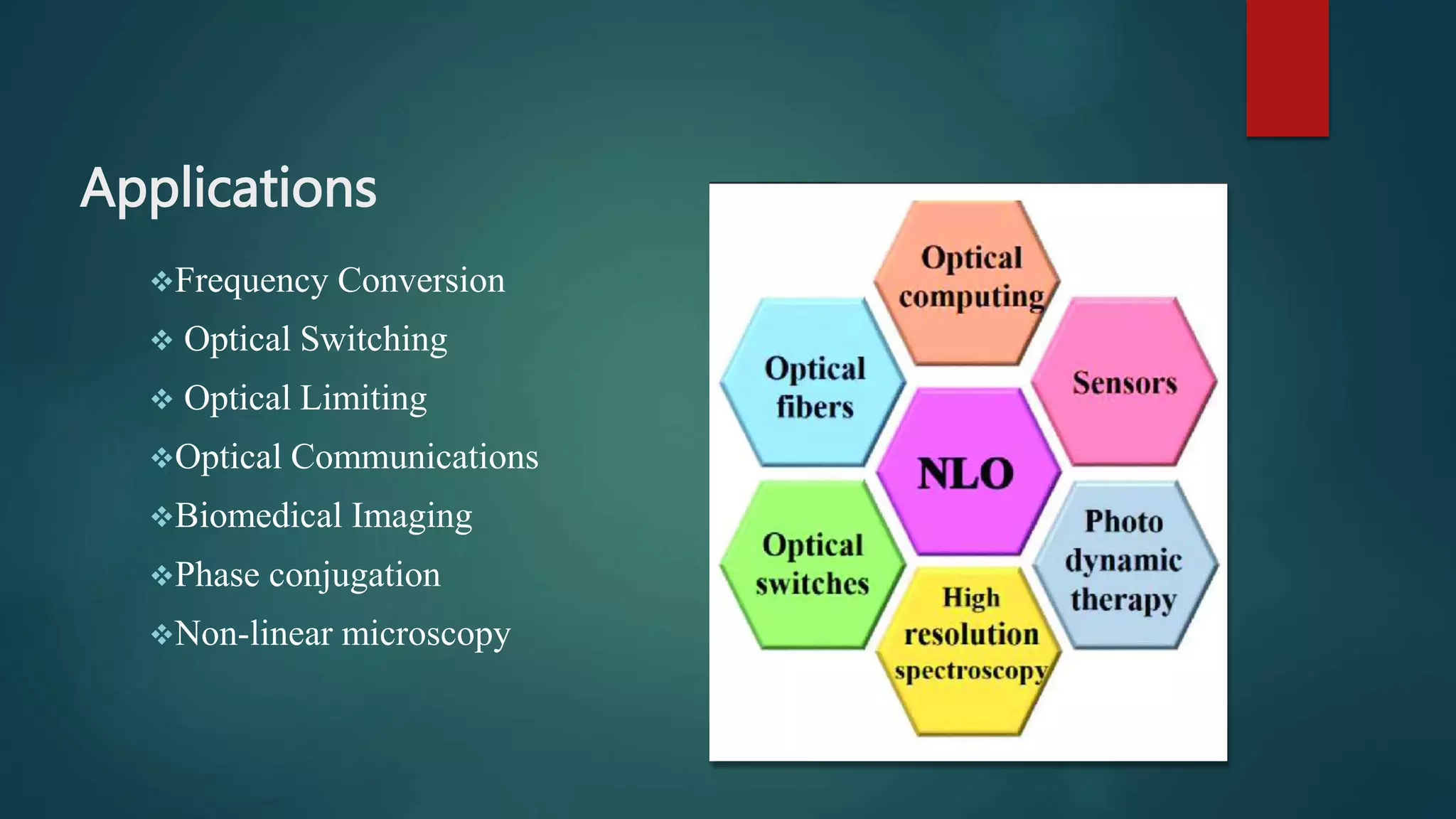
Applications
Frequency Conversion
 Optical Switching
 Optical Limiting
Optical Communications
Biomedical Imaging
Phase conjugation
Non-linear microscopy
 Nonlinear Optical Materials:
 Materials that lack inversion symmetry
 They allow for efficient interaction with light.
Example:
 Crystals (e.g., lithium niobate),
 polymers
Linear optics:
 a sub-field of optics
 includes in most applications of lenses, mirrors, wave plates, diffraction gratings
 Properties:
 If monochromatic light enters an unchanging linear-optical system, the output will be at the same
frequency
 the superposition principle is valid for linear-optical systems.
 Properties are violated in nonlinear optics
 material interactions including absorption and fluorescence
 high-power pulsed lasers
 Examples
 Phase shifters and beam splitters
Non-linear polarization:
 depends nonlinearly on the electric field of the light.
 light propagates in a transparent medium (a dielectric)
 its electric field causes electric polarization in the medium
 at low light intensities
 electric polarization is proportional to the electric field strength
Polarizability: A quantum mechanics point of view
 measure of how polarization occur in atom or molecule
 related to the second derivative of the energy with respect to the electric field
 wave function is perturbed by an electric field, and the change in the energy of the system
 the unperturbed excited-states have different electron distributions than the ground-state,
Non linear optics-1.pptx

Non linear optics-1.pptx

  • 1.
    Group 1  Groupmembers:  Aqsa Batool  Hasna Batool  Maryam Kosar  Izma Ahmad  Aliza Parveen  Ayesha Tehreem  Rubab Ajmal  Amna Zahid  Momina Zaka
  • 2.
  • 3.
    Non linear optics(Optics of intense light):  Defination: • interaction between light and matter in the presence of high-intensity • to change its shape in space and time • allows us to change the color of a light beam • involves the generation, propagation, and manipulation of light • basis of many components of optical communications system • to create the shortest events ever made by humans
  • 4.
    Response of opticalmaterials  Classified into two groups 1. Linear 2. Non-linear  Linear Response:  Materials do not depend on the intensity of light  Follow the laws of classical optics.  proportional to the intensity of the incident light Examples  Stress-strain response of a steel rod under tension up to the yield point  Elastic deformation of a rubber
  • 5.
    Non-linear Response:  Thosethat depend on the intensity of light  Do not obey the laws of classical optics  Proportional to the square of the incident light intensity  Example:  Stress-strain response of a steel rod beyond the yield point  Elastoplastic deformation of a ceramic plate Key elements in non linear optics  Nonlinear Susceptibility:  Second-Harmonic Generation (SHG)  Third-Harmonic Generation (THG)  Four-Wave Mixing (FWM)  Optical Kerr Effect (OKE)  Nonlinear Optical Materials
  • 6.
     Nonlinear Susceptibility: describes nonlinear effects in materials  which quantifies the response of a material to the electric field of light  Second-Harmonic Generation (SHG):  two photons of the same frequency interact with a material  generate a new photon with twice the frequency  Third-Harmonic Generation (THG):  the interaction of three photons  generation of a photon with three times the frequency  Four-Wave Mixing (FWM):  two or more incident photons interact within a material  generate new photons with different frequencies  Optical Kerr Effect (OKE):  change in refractive index experienced by a material  due to the presence of an intense light field.
  • 7.
    Applications Frequency Conversion  OpticalSwitching  Optical Limiting Optical Communications Biomedical Imaging Phase conjugation Non-linear microscopy
  • 8.
     Nonlinear OpticalMaterials:  Materials that lack inversion symmetry  They allow for efficient interaction with light. Example:  Crystals (e.g., lithium niobate),  polymers
  • 9.
    Linear optics:  asub-field of optics  includes in most applications of lenses, mirrors, wave plates, diffraction gratings  Properties:  If monochromatic light enters an unchanging linear-optical system, the output will be at the same frequency  the superposition principle is valid for linear-optical systems.  Properties are violated in nonlinear optics  material interactions including absorption and fluorescence  high-power pulsed lasers  Examples  Phase shifters and beam splitters
  • 10.
    Non-linear polarization:  dependsnonlinearly on the electric field of the light.  light propagates in a transparent medium (a dielectric)  its electric field causes electric polarization in the medium  at low light intensities  electric polarization is proportional to the electric field strength Polarizability: A quantum mechanics point of view  measure of how polarization occur in atom or molecule  related to the second derivative of the energy with respect to the electric field  wave function is perturbed by an electric field, and the change in the energy of the system  the unperturbed excited-states have different electron distributions than the ground-state,